Introduction
Climate change has caused poleward range shifts of species and altered biotic interactions in marine ecosystems, as shown by observational and experimental studies (e.g., Barry et al. Reference Barry, Baxter, Sagarin and Gilman1995; Sanford Reference Sanford1999; Tian et al. Reference Tian, Kidokoro, Watanabe and Iguchi2008; Goddard et al. Reference Goddard, Gosliner and Pearse2011). However, the scarcity of long-term data and difficulty of quantifying biotic interactions in natural ecosystems hamper full characterizations of biotic responses to climate change over long timescales. One potential approach to this problem is to examine the fossil record in relation to past climate change (Hunt et al. Reference Hunt, Wicaksono, Brown and MacLeod2010; Blois et al. Reference Blois, Zarnetske, Fitzpatrick and Finnegan2013). In particular, Quaternary (2.588 million years ago to the present) climate oscillations, in the form of recurring glacial–interglacial cycles, provide a set of natural experiments that can be used to investigate the deep-time context of biotic responses to climate change such as migration patterns (Roy et al. Reference Roy, Jablonski and Valentine1995; Kitamura et al. Reference Kitamura, Omote and Oda2000), life-history traits (Sato Reference Sato1999), morphological evolution (Hellberg et al. Reference Hellberg, Balch and Roy2001), and parasitism (Huntley et al. Reference Huntley, Fürsich, Alberti, Hethke and Liu2014). Nevertheless, how Quaternary climate change affected biotic interactions is poorly understood because quantitative data on biotic interactions are difficult to extract from the fossil record. One exception is predatory drillholes on molluscan shells that are produced by carnivorous gastropods to consume the soft tissues within the prey shells. The predatory drillholes represent an important source of quantifiable information on the nature of past predator–prey interactions, including predator identity (e.g., Kabat Reference Kabat1990; Kowalewski Reference Kowalewski2002), predator size (e.g., Kitchell et al. Reference Kitchell, Boggs, Kitchell and Rice1981; Rodrigues et al. Reference Rodrigues, Nojima and Kikuchi1987; Chiba and Sato Reference Chiba and Sato2012), predatory behavior (e.g., Dietl and Alexander Reference Dietl and Alexander1997; Dietl et al. Reference Dietl, Herbert and Vermeij2004; Dietl and Herbert Reference Dietl and Herbert2005), and predation pressure (e.g., Grey et al. Reference Grey, Boulding and Brookfield2006; Chiba and Sato Reference Chiba and Sato2013, Reference Chiba and Sato2014).
We investigated the effects of Pleistocene (2.588 to 0.012 million years ago) climate change on predator-prey interactions among fossil molluscan assemblages in the Oga Peninsula, northern Japan (Fig. 1A), with particular attention paid to the predatory drillholes on fossil shells of the bivalve Glycymeris yessoensis. This bivalve species is most abundant among the fossil molluscan assemblages and has durable shells, making it relatively easy to examine the predatory drillholes quantitatively. The middle Pleistocene Shibikawa Formation in the Oga Peninsula was deposited on the continental shelf in the Japan Sea during glacial–interglacial climate cycles (Shirai and Tada Reference Shirai and Tada2000; Chiba et al. Reference Chiba, Shirai and Sato2014). The Japan Sea is a marginal sea exchanging seawater with neighboring seas through shallow, narrow passages (Fig. 1A). Therefore, the Quaternary climate cycles and associated eustatic sea-level fluctuations affected ecosystems in the Japan Sea through oceanographic changes such as inflows of warm and cold currents through the passages, surface-water freshening, and deep-water stagnation (Oba et al. Reference Oba, Kato, Kitazato, Koizumi, Omura, Sakai and Takayama1991; Tada et al. Reference Tada, Irino and Koizumi1999; Kido et al. Reference Kido, Minami, Tada, Fujine, Irino, Ikehara and Chun2007). In particular, the Tsushima Warm Current, a combined flow system of a branch of the Kuroshio Warm Current and the Taiwan Warm Current (Gamo et al. Reference Gamo, Nakayama, Takahata, Sano, Zhang, Yamazaki, Taniyasu and Yamashita2014), supplies a large quantity of heat and transports marine organisms, and thus exerts critical influences on ecosystems in the Japan Sea (Fig. 1A). The shallow-marine molluscan assemblages of the Pleistocene Japan Sea are characterized by the appearance of warm-water species in sea-level highstands, which is associated with influx of the Tsushima Warm Current into the Japan Sea through the Tsushima Strait (Fig. 1A) (Kanazawa Reference Kanazawa1990; Nojo and Suzuki Reference Nojo and Suzuki1999; Kitamura et al. Reference Kitamura, Omote and Oda2000). We hypothesize that the abundance of a warm-water shell-drilling predator in the Pleistocene Japan Sea fluctuates with changes in the climate and environment, which in turn alters predator-prey interactions among the fossil molluscan assemblages. We aim to elucidate how the predator-prey interactions changed during the glacial–interglacial climate cycle in the Pleistocene Japan Sea and to highlight the importance of using the fossil record for understanding biotic responses to climate change.
General settings of the study area. A, Map showing simplified present-day geography and surface currents around the Japanese Islands (following Gamo et al. Reference Gamo, Nakayama, Takahata, Sano, Zhang, Yamazaki, Taniyasu and Yamashita2014). TS, Tsushima Strait; TSWC, Tsushima Warm Current; TWWC, Taiwan Warm Current. The Japan Sea is a marginal sea exchanging seawater with its neighboring seas (the Pacific Ocean, the Okhotsk Sea, and the East China Sea) through shallow passages (sill depths of <20, <50, <130, and <130, for the Tatar, Soya, Tsugaru, and Tsushima Straits, respectively). B, A 27-m-thick Wakimoto-2 section located in the Oga Peninsula (Chiba et al. Reference Chiba, Shirai and Sato2014, Reference Chiba, Sato and Yamada2015). W1–W13, sampling horizons. TL, transgressive lag deposit. The Wakimoto-2 section consists of two sedimentary cycles (cycles 5 and 6). The lower sedimentary cycle, including the W4–W9 horizons, is characterized by a shoaling-upward trend from the inner-middle shelf to the foreshore, which is mainly attributed to glacio-eustatic sea-level fluctuations (Chiba et al. Reference Chiba, Shirai and Sato2014).

Geological Settings
The Oga Peninsula is a type locality for Quaternary strata of the Japan Sea side of northern Japan (Fig. 1A) (Kano et al. Reference Kano, Ohguchi, Yanagisawa, Awata, Kobayashi, Sato, Hayashi, Kitazato, Ogasawara and Komazawa2011). The shallow-marine strata have been uplifted above the present sea level as a result of crustal movements (Shirai and Tada Reference Shirai and Tada2002). In particular, the Shibikawa Formation contains well-preserved fossil molluscan shells, and most of the molluscan species (~99%) are still living around the Japanese Islands (Ogasawara et al. Reference Ogasawara, Masuda and Matoba1986; Chiba et al. Reference Chiba, Shirai and Sato2014). The fossil molluscan shells examined here were collected from six stratigraphic horizons (W4–W9) of the Wakimoto-2 section in the Oga Peninsula (Fig. 1B) (Chiba et al. Reference Chiba, Shirai and Sato2014, Reference Chiba, Sato and Yamada2015). The Wakimoto-2 section consists of two sedimentary cycles that mainly reflect glacio-eustatic sea-level fluctuations (Fig. 1B). The lower sedimentary cycle, including the W4–W9 horizons, is interpreted as deposition during a regressive phase of stages 7.4–6.2 of the oxygen isotope curve (Chiba et al. Reference Chiba, Shirai and Sato2014) (ca. 0.23–0.15 million years ago). The W4–W9 horizons are characterized by well-sorted medium-grained to coarse-grained sandstone associated with trough cross-stratification. The pristine and articulated shells of G. yessoensis are abundant at the W4–W9 horizons. Based on these observations, we interpreted that the W4–W9 horizons were formed at a current-swept shoreface (water depth=5–20 m), and the G. yessoensis shells were not subjected to significant post-mortem transportation (Chiba et al. Reference Chiba, Shirai and Sato2014). In addition, a bivalve, Panopea japonica that burrows 40–50 cm into the sea floor (Kondo Reference Kondo1987), is preserved in living orientation at the W4–W9 horizons, suggesting that sediment reworking did not extend 50 cm from the sea floor. Since the vertical spacing between the sampling horizons is greater than 100 cm, temporal changes in the fossil molluscan assemblages can be extracted from the samples (Fig. 1B).
Materials and Methods
Sample Collection
We excavated sediment samples (25×25 cm, 20-cm depth) parallel to the bedding plane from the Wakimoto-2 section in the Oga Peninsula, northern Japan (Fig. 1) (Chiba et al. Reference Chiba, Shirai and Sato2014, Reference Chiba, Sato and Yamada2015). The samples were wet-sieved using a 2-mm mesh in the laboratory, and all unbroken molluscan (bivalve and gastropod) shells were collected (Supplementary Table 1). Because a bivalve individual consists of two valves, we counted a valve as 0.5 individual so as not to overestimate bivalve abundance when comparing with gastropod abundance. To supplement the samples, identifiable specimens of predatory gastropods were collected at the surface of the outcrop.
Molluscan Assemblages
Based on the literature on extant molluscs (Habe Reference Habe1961; Habe and Ito Reference Habe and Ito1965; Okutani Reference Okutani2000), species were categorized into warm-water species, cold-water species, and cosmopolitan species that inhabit, respectively, the area south of 35°N latitude, north of 35°N latitude, and both areas of the Pacific side of the Japanese Islands in general (Fig. 1A). Because the Kuroshio Warm Current, which increases seawater temperatures and transports marine organisms, leaves the Japanese Islands at the Boso Peninsula at 35°N latitude (Fig. 1A), the biogeographic boundary of marine organisms can be recognized in this area (Horikoshi Reference Horikoshi1962).
We performed computer-intensive rarefaction analysis to estimate the numbers of warm-water and cold-water species at each horizon from a standardized sample size (n=200), which is nearly equal to the smallest sample size at the W8 horizon (n=206.5). After molluscan abundance data were rounded, 200 individuals were randomly selected at each horizon with replacement, and the numbers of warm-water and cold-water species were counted. This procedure was repeated 10,000 times to obtain the mean numbers of warm-water and cold-water species and standard deviations around the means.
We performed principal coordinate analysis (PCoA) of the molluscan abundance data to extract primary environmental gradients along which the molluscan assemblages are distributed. All rare species (total abundance <10) were excluded prior to the PCoA because their occurrences depend on chance only. The data matrix of molluscan abundance was then chord-transformed to mitigate any potential effect of the difference in sample sizes. The PCoA with Cailliez correction was performed on a Bray-Curtis dissimilarity matrix of the transformed abundance data. The species scores were projected on the PCoA ordination plot using the weighted average of the transformed abundance data (following Borcard et al. Reference Borcard, Gillet and Legendre2011). In the PCoA ordination plot, horizon points (W4–W9) that are close proximity to one another characterize similar composition of the molluscan assemblages, and species points located near a horizon point represent high abundance in the horizon.
Predatory Drillholes
For unbroken G. yessoensis shells, the following data were recorded: whether the shell was a right or left valve, maximal shell length (measured to the nearest 0.01 mm using a digital caliper), and the presence of a predatory drillhole (Supplementary Tables 2, 3). In our sample, most of the drillholes are countersunk in cross section, with nearly circular outlines. The countersunk drillholes are generally produced by naticid predators often in molluscs inhabiting soft substrata (Kabat Reference Kabat1990; Kelley and Hansen Reference Kelley and Hansen2003). Several drillholes were cylindrical in cross section, characterized by irregularly circular to oval outlines. We did not examine the cylindrical drillholes because various organisms (both predators and parasites) can create them (Kabat Reference Kabat1990; Kowalewski Reference Kowalewski2002), making it difficult to infer the potential producer(s). Therefore, holes were considered to be predatory when they were drilled from the outside to the inside of the shell, passing through the shell perpendicularly rather than oblique, countersunk in cross section, and with nearly circular perforations. For each horizon, drilled and undrilled shells were counted separately, and the following index of drilling intensity (DI) was calculated as DI=d/0.5n, where d is the number of shells at the horizon containing at least one predatory drillhole and n is the total number of shells at the horizon. The equation applies a correction factor of 0.5 to avoid overestimating bivalve abundance (Kowalewski Reference Kowalewski2002). To test the null hypothesis that the prey shells among horizons had an equal probability of being drilled, the χ 2 test with continuity correction was performed on the numbers of undrilled (number of undrilled shells divided by two) and drilled (number of drilled shells) individuals.
The location of the predatory drillhole on each shell was quantified using a landmark approach (Roopnarine and Beussink Reference Roopnarine and Beussink1999; Casey and Chattopadhyay Reference Casey and Chattopadhyay2008). Each drilled shell was photographed, and the digital image was rotated using Adobe Photoshop software to standardize the orientation of each shell image. The anterior and posterior endpoints of each shell were used as a baseline, and Cartesian (Bookstein) coordinates (Bookstein Reference Bookstein1991) were determined for the umbo, ventral endpoint of the shell, and center of the predatory drillhole using ImageJ software (Rasband Reference Rasband2015). The digital images of drilled right valves were mirrored before landmark designation to make them comparable with left valves. The coordinates were then used to plot the location of the predatory drillholes on standardized shell outlines separately for each horizon. The difference in the distribution of predatory drillholes on the prey shells (x and y coordinates of the predatory drillholes) among horizons was tested by permutational multivariate analysis of variance (PERMANOVA) (Anderson Reference Anderson2001), using Euclidian distance, with the p values being estimated by 10,000 permutations.
For drilled G. yessoensis shells, the outer drillhole diameter (ODD) was measured to the nearest 0.001 mm using a microscope (VH-5500, Zoom Lens VH-Z20R, 10–50× magnification) if it was measurable. To estimate the size relationship between the naticid predators and the bivalve prey, ODD (a proxy for predator size) was plotted against the shell length of G. yessoensis (prey size) separately for each horizon, and linear regression analysis was performed on these variables. The difference in the slopes of linear regression lines among horizons was tested using analysis of covariance (ANCOVA, shell length×horizon interaction), with shell length as a continuous variable and horizon as a categorical variable. The method of Holm (Reference Holm1979) was used to adjust the p values in multiple testing. All data manipulation, simulation, and plotting were performed in R (Sarkar Reference Sarkar2008; R Core Team 2014; Oksanen et al. Reference Oksanen, Blanchet, Kindt, Legendre, Minchin, O'Hara, Simpson, Solymos, Stevens and Wagner2015).
Results
Molluscan Assemblages
The fossil molluscan assemblages from the W4–W9 horizons were characterized by dominance of cold-water species in association with warm-water species (Fig. 2A–C). Rarefaction analysis showed that the number of warm-water species tended to decrease from the W4–W5 horizons onwards, whereas cold-water species showed no consistent fluctuation during this interval (Fig. 2A). The PCoA of molluscan abundance data indicated that the warm-water species were relatively abundant at the W4–W5 horizons and declined in abundance from the W4–W5 horizons onwards (Fig. 2B).
Temporal changes in fossil molluscan assemblages and the strength of predator–prey interactions. A, Rarefaction analysis estimating the numbers of warm-water and cold-water species at each horizon. The points represent mean numbers of species calculated based on 10,000 randomized resamples of 200 individuals with replacement. The error bars denote standard deviations around the means. B, Principal coordinate analysis (PCoA) of the molluscan abundance data. W4–W9, data point of each horizon. C, Relative abundance of warm-water (Mammilla sp.) and cosmopolitan/cold-water naticid predators (Cryptonatica janthostomoides/Lunatia pila) at each horizon. The naticid predators collected by supplemental sampling are shown as binary data: (+) presence, (−) absence. D, Drilling intensity (DI, proportion of drilled shells) with binomial 95% confidence intervals.
A total of 53 specimens of predatory gastropods were obtained from the samples, including three naticid (Cryptonatica janthostomoides, Lunatia pila, and Mammilla sp.) and one muricid (Ocenebra inornata) species. The muricid predator was rarer (relative abundance within each horizon <0.31%) than the naticid predators. The cosmopolitan naticid predator C. janthostomoides or the cold-water naticid predator L. pila was present at the W4–W9 horizons, although it was difficult to distinguish between the species for each specimen (Fig. 2C). In contrast, the warm-water naticid predator Mammilla sp. was limited to the W4–W6 horizons (Fig. 2C). Supplemental sampling of these predatory gastropods showed that Mammilla sp., though uncommon, was present at the W7 horizon, but not recorded at the W8–W9 horizons (Fig. 2C).
Predatory Drillholes
A total of 750 completely drilled G. yessoensis shells were obtained from the samples. These drillholes were countersunk in cross section and nearly circular in outline (Fig. 3). For selected drilled shells, rasping traces produced by the predators are present on the side of the drillholes (Fig. 3C, F), as observed in Schiffbauer et al. (Reference Schiffbauer, Yanes, Tyler, Kowalewski and Leighton2008). Several lines of evidence suggest that most of the countersunk drillholes examined here were produced by naticid predators. The naticid predators generally produce countersunk drillholes in infaunal bivalves, whereas the muricid gastropods, including O. inornata, excavate cylindrical drillholes on their prey shells (Kabat Reference Kabat1990; Kelley and Hansen Reference Kelley and Hansen2003; Lützen et al. Reference Lützen, Faasse, Gittenberger, Glenner and Hoffmann2012). Therefore, it is reasonable to postulate that the naticid predators were responsible for most of the countersunk drillholes on G. yessoensis shells. Furthermore, the muricid predator O. inornata is unlikely to have encountered G. yessoensis in the sandy bottoms because extant individuals of O. inornata typically inhabit rocky bottoms (Okutani Reference Okutani2000).
Photographs of predatory drillholes produced by naticid gastropods on fossil shells of Glycymeris yessoensis. Note that the predatory drillholes are countersunk in cross section with nearly circular outlines. A–C, Predatory drillhole located on the central part of the shell. D–F, Predatory drillhole located on the shell edge as a semicircular nick. B, C, E, F, Scanning electron microscopy (SEM) images showing a close-up view of the predatory drillholes. Physical rasping traces produced by naticid predators consist of corrugated lines oriented roughly perpendicular to the drillhole margin. Scale bars: A, D, 5 mm; B, E, 1 mm; C, F, 100 μm. All specimens have been deposited at the Tohoku University Museum (IGPS coll. cat. nos. 111566–111567).
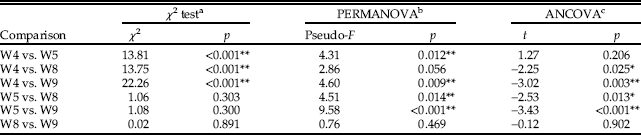
Our expectation is that there are significant differences in the predation patterns between the horizons where Mammilla sp. is common (W4–W5) and where it is not recorded (W8–W9) (Fig. 2C). The DI value was significantly higher at the W4 horizon, where Mammilla sp. was common (χ2 test; Table 1). The DI values ranging from 0.21–0.40 tended to decline from the W4 to W9 horizons, with the exception of the W5 horizon, and were relatively higher at the W4–W7 horizons, where Mammilla sp. was recorded (Fig. 2D). As expected from visual comparisons, PERMANOVA indicated significant differences in the distribution of the predatory drillholes on the prey shells among the horizons (Fig. 4 and Table 1). The predatory drillholes located on the central part of the prey shells were abundant at the W4–W9 horizons (Figs. 3A–C and 4). In contrast, the predatory drillholes located on the commissure of the prey shells as a semicircular nick (edge drilling) were limited to the W4–W7 horizons, where Mammilla sp. was recorded (Figs. 3D–F and 4). Most of the edge drillings (58/59) were observed in shells smaller than 20 mm in length (Fig. 5). The scatter plots of outer drillhole diameter (ODD, a proxy for predator size) versus shell length (SL, prey size) for drilled shells showed that ODD was positively correlated with SL (linear regression analysis, r = 0.794–0.920, p < 0.001; Fig. 5). The slopes of the regression lines were steeper at the W4–W5 horizons, where Mammilla sp. was common (ANCOVA; Fig. 5 and Table 1).
Distribution of predatory drillholes on fossil shells of Glycymeris yessoensis. The location of the predatory drillholes is presented using Cartesian (Bookstein) coordinates on standardized shell outlines separately for each horizon. The x and y coordinates of the umbo and ventral endpoints are mean values at each horizon. Closed and open circles represent predatory drillholes located on the shell edge as a semicircular nick and on the shell wall, respectively. The closed circles may not exactly coincide with the shell edge since the circles represent the center of the predatory drillholes.
Size relationship between naticid predators and the bivalve prey Glycymeris yessoensis. Outer drillhole diameter (ODD, a proxy for predator size) is plotted against the shell length of the bivalve (SL, prey size). Solid lines denote linear regression lines. Closed and open circles represent predatory drillholes located on the shell edge as a semicircular nick and on the shell wall, respectively.
Summary of statistical comparisons.
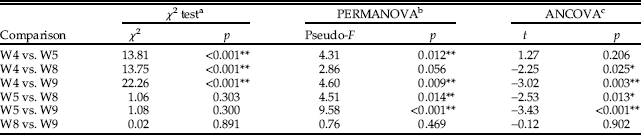
aχ 2 test of drilling intensity (proportion of drilled shells).
bPERMANOVA of drillhole distribution (x and y coordinates of predatory drillholes).
cANCOVA comparing slopes of regression lines between prey size (shell length of Glycymeris yessoensis) and predator size (outer drillhole diameter).
Unadjusted p values are shown. * p<0.05 (unadjusted for multiple tests), ** p<0.05 (adjusted for multiple tests using the Holm [1979] method).
Discussion
Mechanisms of Decline in Warm-Water Molluscs
As the Tsushima Warm Current affects geographic and bathymetric distributions of various organisms in the present-day Japan Sea (Tsuchida and Hayashi Reference Tsuchida and Hayashi1994; Tian et al. Reference Tian, Kidokoro, Watanabe and Iguchi2008), the decline in warm-water molluscs in the Pleistocene Japan Sea could be attributable to the weakening of the Tsushima Warm Current (e.g., Kanazawa Reference Kanazawa1990; Nojo and Suzuki Reference Nojo and Suzuki1999; Kitamura et al. Reference Kitamura, Omote and Oda2000). The volume transport of the Tsushima Warm Current is modulated by the glacial–interglacial climate cycles through eustatic sea-level fluctuations (Tada et al. Reference Tada, Irino and Koizumi1999). Because the W4–W9 horizons were formed during a regressive phase of stages 7.4–6.2 of the oxygen isotope curve (Chiba et al. Reference Chiba, Shirai and Sato2014) (Fig. 1B), the lowering of the eustatic sea level during the deposition of the W4–W9 horizons probably reduced the cross-sectional area of the Tsushima Strait, which weakened the Tsushima Warm Current (Fig. 1A).
Climate-Mediated Changes in Predator-Prey Interactions
The location of predatory drillholes as well as abundance of predatory species suggests that the abundance of the warm-water naticid predator Mammilla sp. declined during the glacial–interglacial climate cycle. The location of the predatory drillholes of extant naticid gastropods is highly consistent within species, which is a reflection of the predatory behavior involved in prey capture, handling, and drilling (Kitchell et al. Reference Kitchell, Boggs, Kitchell and Rice1981; Rodrigues et al. Reference Rodrigues, Nojima and Kikuchi1987; Kabat Reference Kabat1990; Chiba and Sato Reference Chiba and Sato2012). Living individuals of C. janthostomoides and Lunatia spp. produce drillholes on the central part and near the umbo to the central part of their prey bivalves, respectively (Kosuge Reference Kosuge1967; Mondal et al. Reference Mondal, Hutchings and Herbert2014). Based on these observations, most of the drillholes located on the central part of G. yessoensis shells at the W4–W9 horizons were excavated by C. janthostomoides and/or L. pila, which were also obtained from the W4–W9 horizons (Figs. 2C and 4). The edge drilling is quite rare for naticid predators, except for Polinices and Mammilla inhabiting tropical to warm temperate regions (Vermeij Reference Vermeij1980; Ansell and Morton Reference Ansell and Morton1987; Mondal et al. Reference Mondal, Hutchings and Herbert2014). In the present case, the edge drilling was also associated with the occurrence of Mammilla sp. at the W4–W7 horizons (Figs. 2C and 4). Therefore, we interpret that Mammilla sp. was primarily responsible for the edge drilling and declined in abundance from the W4–W5 horizons onwards. Moreover, the restricted occurrence of the edge drilling on small prey shells (SL <20 mm) supports the inference (Fig. 5). Specifically, the small Mammilla sp. (maximum shell height <15 mm) was probably unable to manipulate large G. yessoensis individuals since prey-size limits for the naticid predators are determined by the size of their foot, the organ used to envelop and handle prey (Kitchell et al. Reference Kitchell, Boggs, Kitchell and Rice1981; Rodrigues et al. Reference Rodrigues, Nojima and Kikuchi1987; Kabat Reference Kabat1990; Chiba and Sato Reference Chiba and Sato2012). The edge drilling on G. yessoensis shells was formerly interpreted as an indication of intense competition for prey in the Pleistocene Japan Sea (Amano Reference Amano2006), as observed in the muricid gastropod Chicoreus dilectus, which tends to drill the edge of prey shell(s) when competition for prey becomes severe (Dietl et al. Reference Dietl, Herbert and Vermeij2004; Dietl and Herbert Reference Dietl and Herbert2005). However, experimental studies have not demonstrated such behavioral plasticity of naticid predators in high-competition environment (Chiba and Sato Reference Chiba and Sato2012; Hutchings and Herbert Reference Hutchings and Herbert2013). This implies that naticid predators may be less able to shift drillhole locations depending on the intensity of competition for prey because of their fixed behavioral patterns of prey manipulation (Chiba and Sato Reference Chiba and Sato2012, Reference Chiba and Sato2014). In addition, edge-drilling behavior of Polinices and Mammilla is common even in the absence of potential competitors in experimental observations (Vermeij Reference Vermeij1980; Ansell and Morton Reference Ansell and Morton1987; Mondal et al. Reference Mondal, Hutchings and Herbert2014). Therefore, in the present case, the shifts in the distribution of the predatory drillholes can be explained without invoking a change in the intensity of competition for prey.
The decline in the abundance of the warm-water naticid predator Mammilla sp. altered the strength of the predator-prey interactions. The DI value tended to lessen with decreasing numbers of warm-water molluscs, including Mammilla sp. (Fig. 2). The weakening of the Tsushima Warm Current and resultant drop in seawater temperature could have caused the decline in Mammilla sp. abundance, which is likely to have alleviated predation pressure on the prey bivalve. In addition, unsuitably low seawater temperatures might reduce the consumption rate of Mammilla sp., as observed in several predatory species (Sanford Reference Sanford1999, Reference Sanford2002). Nevertheless, we acknowledge that other factors also influence the consumption rates of naticid predators because the DI value at the W5 horizon is relatively low, despite having the highest abundance of warm-water molluscs, including Mammilla sp. (Fig. 2). It might be that the warmest conditions, at the W5 horizon, were unsuitable for the cold-water predator L. pila, which reduced its abundance and consumption rate. However, as stated earlier, the locations of the predatory drillholes produced by C. janthostomoides and L. pila probably overlap, making it difficult to estimate the contribution of these predators to predation pressure on the prey bivalve. The highly positive size relationship between naticid predators and the prey bivalve showed that larger naticid predators tended to attack larger prey, and vice versa (Fig. 5), which is common in naticid predators (e.g., Dietl and Alexander Reference Dietl and Alexander1997; Chiba and Sato Reference Chiba and Sato2014). The slopes of the regression lines for ODD and SL were steeper at the W4–W5 horizons, where Mammilla sp. was common (Fig. 5 and Table 1). This relationship signifies that the large naticid predators tended to attack smaller prey at the W4–W5 horizons than at the W8–W9 horizons. A laboratory-based theoretical model predicts that naticid predators attack larger prey within their prey-size limits to maximize their net energy intake (Kitchell et al. Reference Kitchell, Boggs, Kitchell and Rice1981; Rodrigues et al. Reference Rodrigues, Nojima and Kikuchi1987). When the relative abundance of larger (more profitable) prey is low in natural settings, naticid predators are expected to attack smaller (less profitable) prey more frequently (Dietl and Alexander Reference Dietl and Alexander1997). Considering these studies, the observed difference in the prey-size selectivity can be accounted for by a change in prey demography during the glacial–interglacial climate cycle. Specifically, the decline in predation pressure from naticid gastropods possibly increased the number of G. yessoensis surviving naticid predation and growing to adulthood, which then allowed naticid predators at the W8–W9 horizons to consume larger prey more frequently.
Effects of Climate Change on Strength of Predator-Prey Interactions
Our results showed that drilling predation and size relationship between the naticid predators and the bivalve prey moderated with declining the warm-water naticid predator during the glacial-interglacial climate cycle, suggesting that predator-prey interactions in shallow-marine ecosystems are likely to weaken/strengthen in association with climate cooling/warming in temperate regions. To some extent, this hypothesis is supported by several studies on latitudinal (partly corresponding to climate) variations in drilling predation. For example, Dudley and Vermeij (Reference Dudley and Vermeij1978) found a sharp increase in drilling predation from the temperate zones to the tropics in the Recent gastropod Turritella, which is paralleled by an equatorward increase in species diversity of shell-drilling predators. Similarly, Alexander and Dietl (Reference Alexander and Dietl2001) reported a southward increase in drilling predation in the modern bivalves (Anadara and Divalinga) from New Jersey (38°N) to the Florida Keys (25°N) and attributed the latitudinal trend to a variety of biotic and abiotic factors such as density of naticid predators, prey availability, and seawater temperature that influences consumption rate of naticid predators. However, Kelley and Hansen (Reference Kelley and Hansen2007) who have explored latitudinal patterns in drilling predation using modern molluscan assemblages from Maine (43°N) to Florida Keys, reinterpreted the results presented in Dudley and Vermeij (Reference Dudley and Vermeij1978) and Alexander and Dietl (Reference Alexander and Dietl2001), showing that drilling predation is most intense in the middle latitude (35°N–28°30'N) and declines to the north and south. In the fossil record, some studies found an increase in drilling predation with increasing latitude at the assemblage level (e.g., Hansen and Kelley Reference Hansen and Kelley1995; Hoffmeister and Kowalewski Reference Hoffmeister and Kowalewski2001). Therefore, drilling predation across species does not show a consistent relationship with latitude, although various biotic interactions tend to become intense from temperate to tropical regions (Schemske et al. Reference Schemske, Mittelbach, Cornell, Sobel and Roy2009). In addition, patterns in drilling predation vary with sedimentary facies (e.g., Hoffmeister and Kowalewski Reference Hoffmeister and Kowalewski2001; Daley et al. Reference Daley, Ostrowski and Geary2007) and prey species (e.g., Kelley and Hansen Reference Kelley and Hansen2007; Sawyer and Zuschin Reference Sawyer and Zuschin2010). These variabilities in drilling predation reinforce the need to examine more samples from multiple regions in the context of changing climate and environment to elucidate the likely results of climate change on strength of predator-prey interactions.
Conclusion and Implication
The current knowledge of climate-mediated biotic interactions depends largely on short-term observations and manipulative experiments (e.g., Sanford Reference Sanford1999; Goddard et al. Reference Goddard, Gosliner and Pearse2011). Consequently, we still know little about how climate change alters biotic interactions in natural ecosystems over long timescales. The Pleistocene molluscan assemblages from the Oga Peninsula provide a unique example of long-term biotic responses to climate change. In particular, climate-mediated fluctuations in the eustatic sea level and the volume transport of the Tsushima Warm Current caused the decline in the warm-water naticid predator, which in turn moderated the predation pressure and the size relationship between the naticid predators and the bivalve prey in the Pleistocene Japan Sea. We tentatively suggest that predator-prey interactions in shallow-marine ecosystems are likely to weaken/strengthen in association with climate cooling/warming in temperate regions.
There is growing evidence that various marine organisms have individually migrated in response to climate-ocean variability over decadal to longer timescales (e.g., Barry et al. Reference Barry, Baxter, Sagarin and Gilman1995; Tian et al. Reference Tian, Kidokoro, Watanabe and Iguchi2008; Goddard et al. Reference Goddard, Gosliner and Pearse2011). In addition, further range shifts of species are expected to be concurrent with anthropogenic global warming (e.g., Tian et al. Reference Tian, Kidokoro, Watanabe, Igeta, Sakaji and Ino2012). Because many Pleistocene species inhabiting shallow-marine environments are present in modern ecosystems, our results raise the possibility that these climate-mediated range shifts of species in present-day and future marine ecosystems likewise increase alternations in predator-prey interactions.
Acknowledgments
The authors thank D. Jones (Associate Editor), J. Huntley (University of Missouri), G. P. Dietl (Cornell University), and an anonymous reviewer for comments that helped to improve the manuscript; M. Shirai (Tokyo Metropolitan University), O. Sasaki (The Tohoku University Museum), and T. Yamada (Tohoku University) for discussion and comments on earlier versions of the manuscript; P. Kelley (University of North Carolina) for providing literature on drilling predation, H. Kano (The Tohoku University Museum), J. Nemoto (Tohoku University) and Kanagawa Academy of Science and Technology (KAST) for technical assistance; owners of the Wakimoto-2 section for permitting our sampling.
Supplementary Material
Supplemental materials deposited at Dryad: doi:10.5061/dryad.6sv75