Introduction
In human populations, inbreeding is influenced by socio-cultural and geographic factors. In the case of historical populations, surnames provide a useful tool to estimate inbreeding and to study their genetic structure.
Since Crow & Mange (Reference Crow and Mange1965) proposed the use of surnames as an alternative tool to estimate relationship and inbreeding coefficients, the isonymic method has been applied to various populations of the world, both contemporary and historical, on a scale ranging from small settlements to whole countries. This procedure, including its assumptions, advantages and restrictions, has been analysed comprehensively by Lasker (Reference Lasker1985), and a world-wide review of studies dealing with the use of surname models from 1985 to 2003 can be found in Colantonio et al. (Reference Colantonio, Lasker, Kaplan and Fuster2003).
The repeated pairs of surnames method is based on the repetition of the same combination of surnames among couples. It was formerly developed by Lasker & Kaplan (Reference Lasker1985). Soon after, Chakraborty (Reference Chakraborty1985) devised a way to determine analytically the expected value of repeated pairs according to the frequency of surnames in populations. The method allows tendencies towards population subdivision to be evaluated, expressed as preferences between lineages to intermarriage, and at the same time are less affected by small sample sizes than marital isonymy (Lasker & Kaplan, Reference Lasker1985; Mascie-Taylor et al., Reference Mascie-Taylor, Lasker and Boyce1987; Gottlieb et al., Reference Gottlieb, Raspe and Lasker1990).
In contemporary Argentina, isonymy has been applied at a national scale by Dipierri et al. (Reference Dipierri, Alfaro, Scapoli, Mamolini, Rodriguez-Larralde and Barrai2005). For Córdoba province, studies of rural populations of the Colonial period indicate a prevalence of randomness in mate selection as well as in the distribution of surnames (Colantonio & López, Reference Colantonio and López1997; Colantonio et al., Reference Colantonio, Fuster and Marcellino2002). For Córdoba city in the early Independent period (following the year 1810), the trends are similar to those of the rural populations (Küffer & Colantonio, Reference Küffer and Colantonio2005). Nevertheless, analyses of population subdivision through repeated pairs have not yet been performed on Argentinean populations.
Historical sources dealing with mating guidelines refer mainly to the city, which had a noticeable class-endogamy among married couples in the late Colonial and early Independent periods, particularly in the Spanish group (Celton, Reference Celton1997). In the same time periods, high levels of illegitimacy and miscegenation were found in the whole population (Endrek, Reference Endrek1966).
The late Colonial period considered here is said to have been very dynamic from a demographic point of view, even though this had different characteristics in a territory as vast as Hispanic America (Fanchin, Reference Fanchin and Fanchin2004). Córdoba province was settled in the middle of the then called Virreinato del Río de la Plata, and was the road hub through which people and goods moved to and from Buenos Aires, Chile and Alto Perú (Ghirardi, Reference Ghirardi2004). Within the framework of intra-provincial movement during the Colonial period, the parishes of north-western Córdoba, a mountainous zone of high population density, showed better consolidated social networks and more limited opportunities for social improvement than their neighbours in the south-east. The north-west, therefore, tended to be areas from which young men emigrated, whereas the provincial centre and the south border, a plain zone, were receiving them (Tell, Reference Tell2008).
Historical censuses of population are useful sources of data for biodemographic studies, mainly because of the way in which information about the inhabitants has been written down (i.e. their full name, ethno-social group, household, and in general, according to their geographic proximity). By having all married couples located in each geographic zone and ethnic group, it is possible to evaluate if the regionalization according to surnames was associated with different behaviour towards mate selection in both geographic populations and ethno-social groups.
The aim of this study was to analyse by means of surnames the prevailing guidelines in spouse election in Spanish and mixed-race groups, at provincial and parish level, as well as assessing the degree of population subdivision within each parish and comparing the behaviour between them. It is worth pointing out that the emphasis was not put on a deep analysis of each particular parish but rather on finding general trends among them, especially when comparing both ethno-social groups.
Methods
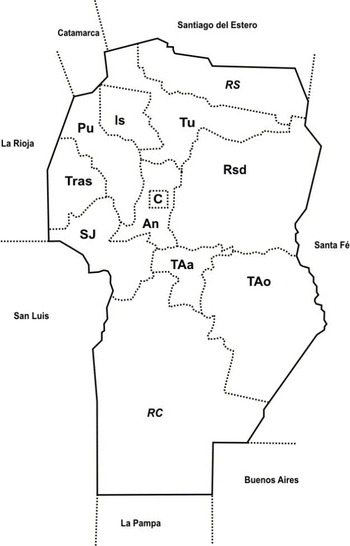
The basic source of data was the ecclesiastical census carried out for Córdoba province in 1795, which is kept in the Archive of the Archbishopric of Córdoba. Although most of the registers used belonged to that particular year (Córdoba city, Anejos, Punilla, San Javier, Tercero Abajo, Traslasierras and Tulumba), the data corresponding to Ischilín in 1793, Tercero Arriba in 1796 and Río Segundo in 1804 were also included. No registers belonging to the years around 1795 were found for the other parishes (Río Cuarto and Río Seco). The total number of people registered added up to 33,028, with the geographic distribution of the units shown in Fig. 1. For each person, the following information was noted: locality within the parish, full name, age, sex, marital status, ‘class’ (ethno-social group), condition (slave or free) and occasionally (where mentioned) profession.
Córdoba province in 1795. Parishes: Córdoba city (C), Anejos (An), Punilla (Pu), Traslasierras (Tras), Tulumba (Tu), Ischilín (Is), San Javier (SJ), Río Segundo (Rsd), Tercero Arriba (TAa), Tercero Abajo (TAo), Río Seco (RS) and Río Cuarto (RC), of which the censuses for the last two mentioned were not found.

The ethno-social groups in the census are specified as ‘Spanish’ (although this also includes a minority of people of European non-Spanish extraction), ‘Black’ and ‘Indian’. In addition to those three groups there is a vast quantity of people of mixed origin, which are an admixture from the three former groups named, according to each enumerator, pardos, naturales, mulatos, mestizos and zambos, and were grouped for the purpose of this study under the category ‘Mixed’. Finally, there are people whose classes were not specified by the enumerator.
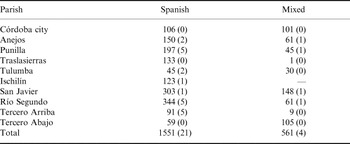
Because the Spanish and Mixed groups are by far the most conspicuous in the census, only the marriages in these groups whose paternal surnames are registered were taken into account. Neither Blacks (since they took generally their masters' surnames) nor Indians (because of its small population size) were included. Due to the scarce number of Mixed couples in the parishes of Ischilín, Traslasierras and Tercero Arriba, these marriages were counted in the global calculations of the provincial but not the parish level. The numbers of married couples in both ethno-social groups are shown in Table 1.
Number of marriages and number of isonymic couples (in parentheses) in the Spanish and Mixed groups

The following estimators of inbreeding by isonymy, as defined by Crow & Mange (Reference Crow and Mange1965) and Crow (Reference Crow1989), were calculated: random (F r), non-random (F n) and total inbreeding (F t) for the whole provincial population and for each single parish. The micro-differentiation at the provincial level (F st) (Wright, Reference Wright1951) according to Kashyap & Tiwari (Reference Kashyap and Tiwari1980) was computed for both ethno-social groups. The degree of population subdivision was measured by the RP (Lasker & Kaplan, Reference Lasker1985) and RPr (Chakraborty, Reference Chakraborty1985) estimators. The indicator (RP–RPr)/RPr was used to compare the observed and expected values (Relethford, Reference Relethford1992). The hypothesis RP=RPr was tested by using the Relethford (Reference Relethford1992) method to calculate the statistical z-value.
As well as calculating these indicators for the Spanish and Mixed groups, estimations for both groups taken as a single one were also carried out in order to know whether the subdivision based on the surnames reflected the stratification in the ethno-social categories.
Results and Discussion
Global inbreeding
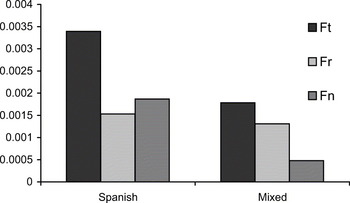
The values of total (F t), random (F r) and non-random (F n) inbreeding at the provincial level are shown in Fig. 2. Both ethno-social groups (Spanish and Mixed) exhibited low values of inbreeding and scarce preference by isonymic spouse, in spite of the selective behaviour traditionally attributed to the Spanish.
Province level: estimations of total (F t), random (F r) and non-random (F n) inbreeding for the Spanish and Mixed groups.

Differences between the two groups were pronounced for F n (the value for Spanish was almost four times greater than for Mixed) whereas F r was only somewhat higher in the Spanish group. The relative loading of each component showed that while in the Spanish group the total inbreeding was primarily due to isonymic marriages, in the Mixed group the random component prevailed.
Inbreeding by parish and micro-differentiation rate
The estimations by parish of F r, F n and F t for the Spanish and Mixed groups can be seen in Table 2 and Table 3, respectively.
Components of inbreeding by parish for the Spanish group

Components of inbreeding by parish for the Mixed group

In the Spanish group, the low values of F r, and F n obtained for Córdoba city suggest that it was a population without a preference for isonymic spouses. This city, during Colonial and early Independent times, has been described as the main receiving centre for intra-provincial migrations, as well as those of neighbouring provinces and Spain, in this latter case consisting mainly of men (Celton, Reference Celton1993; Tell, Reference Tell2008). Nevertheless, the attraction of the city for the feminine labour force of free condition (i.e. of Mixed women), coming from neighbouring regions, has also been mentioned (Celton, Reference Celton1994). Therefore, the addition of new surnames to the city may have played an important role, as reflected in the low F estimators.
In the Spanish group, the parish that showed the greatest preference for isonymic spouses was Tulumba, in the north-west, with a high value of F n indicating a clear preference for spouses having the same surname. The already commented on social organization in this region, which had quite a solid social network, might have included as a preferential strategy marriage between relatives. Relatively high values of F r and F n were found for Tercero Arriba, a zone of more recent settlement, peopled by families from Córdoba city expanding their ranches to the south (Ghirardi et al., Reference Ghirardi, Colantonio and Celton2007). This may have resulted in a population with little variability of surnames, as expressed by the value of F r (which was the highest and at least double the figures obtained for its neighbours). This familial peopling, linked with a high percentage of compound households and a dependent population (Ghirardi et al., Reference Ghirardi, Colantonio and Celton2007), seems to have been related to a dominant class in a good economic position that wished to maintain its status through marriage among relatives, among other strategies. The rest of the parishes, however, did not evidence inbreeding due to mating preference by surname, and even exhibited some degree of rejection of isonymic marriage.
In the Mixed group, none of the parishes revealed any significant inbreeding due to isonymy. The highest F r, found for Tulumba, seemed to be related to its characteristic as an area from which people emigrated.
The parish that displayed the most similar behaviour between Spanish and Mixed groups was Córdoba city. The F t values obtained from the census of 1832 for Córdoba city (Küffer & Colantonio, Reference Küffer and Colantonio2005) were 0.0054 for nobles and 0.0038 for pardos. These figures are of a low magnitude, and similar to those of the present study. This was so, in spite of the fact that 1795 was in the late Colonial period, whereas 1832 corresponds to the Independent period when the recently risen republic was totally free from Spain's monarchy. The results from other parishes showed fluctuating values. Nevertheless, both the Spanish and Mixed groups coincided in having no preference for isonymic marriage, except for the Spanish in the case of Tulumba.
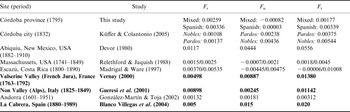
The fact that isonymy tends to overestimate consanguinity, due to the polyphyletic origin of some surnames, gives more credibility that the values found in this work are revealing the scarce inbreeding in the population under study. A comparison with other studies can be seen in Table 4, where it can be observed that the estimations found here are in the range of those obtained for historical communities with similar characteristics. The populations of Córdoba province were more similar to those communities that could be described as ‘open’, that is to say, which displayed dynamism in the entrance and exit of people.
Estimations of consanguinity (F r, F n and F t) found in this study and other studies of historical populations

The values separated by a bar denote the minimum and maximum; those in bold are communities of mountainous zones.
The micro-differentiation rate (F st) among parishes was also relatively low, both in the Spanish (0.0034) and Mixed (0.0026) groups, compared with the values for historical populations of the province. In fact, the F st obtained for smaller settlements, located near to each other in rural populations of Córdoba in the first half of the 19th century (Colantonio & López, Reference Colantonio and López1997), was 0.0042. These results indicate a more important genetic flow occurring among the major geographic units considered in the present study (parish) than among these local populations in the rural curatos of Córdoba.
The values of F st found in this work are similar to those obtained for other historical populations of the same period in Spain, the United States and Finland (see comparative table in Peña et al., Reference Peña, Morales and Calderón1997). The lower value of F st in the Mixed group suggests a greater geographic mobility of this group. It is very plausible that the displacements in search for new labour opportunities in the Mixed group had predominated over the Spanish group, mainly in the case of individuals migrating alone. This can be explained by considering that an easier access to property for the Spanish implied that they had less need to migrate than the Mixed group.
Repeated pairs
The estimates of RP, RPr and (RP−RPr)/RPr by parish for the Spanish group are shown in Table 5. For eight of the ten parishes, RP was higher than RPr, the exceptions being Córdoba city and Ischilín. That is to say, except for these two cases, the parishes exhibited a tendency towards subdivision within the population, as is shown by the (RP−RPr)/RPr indicator. According to the z-test, this tendency was statistically significant in six out of the eight parishes where such a trend was apparent.
Observed (RP) and expected (RPr) repeated pairs, and(RP–RPr)/RPr, z-test and p-values by parish for the Spanish group

* p<0.05.
The estimations for the Mixed group appear in Table 6. For this group, repeated pairs of surnames were only found in two of the seven parishes studied (Tulumba and Río Segundo), and only one – Río Segundo – happened to be statistically significant. Therefore, in contrast to the Spanish group, preferences among family lines were not a prevailing feature.
Observed (RP) and expected (RPr) repeated pairs, and (RP−RPr)/RPr, z-test and p-values by parish for the Mixed group

* p<0.05.
The major cause of these dissimilar trends could be related to the existing economic and social inequalities between the Spanish and Mixed groups. The former had a better standard of living, the majority of the productive land and political power being in their hands. Thus, it may be supposed that a common way to consolidate these privileges was the exchange of spouses between lineages, especially among the richest families.
The parishes that showed the (RP–RPr)/RPr minimum and maximum values, thus repeating the observed pattern in inbreeding for both groups, were Córdoba city and Tulumba, respectively. Córdoba city did not present a population subdivision, whereas in Tulumba the values of (RP–RPr)/RPr were the highest for both ethno-social groups, thereby showing the greatest tendency towards population subdivision. Thus, despite the discrepancies in spouse isonymy observed for the Spanish (preference) and Mixed (non-apparent preference) groups, they displayed a similar behaviour with respect to marriages among certain lineages in this parish. The findings for the city show a non-preferential behaviour of mate selection, at least regarding surnames, revealing a well-stratified society with a strong determination of the dominant class to preserve its privileges, at least if the whole population of the city rather than just some prominent families are considered. In contrast, results obtained for Tulumba suggest a clear selectivity, which could have been convenient, among other reasons, for the preservation of the familial patrimony in the Spanish group. In the Mixed group, however, this explanation is less appropriate because they had few opportunities to become land-owners. Maybe a combination of two factors took place: preserving and increasing the modest and hard-to-acquire properties, and following their employers' mating behaviour (marriages between both spouses' employees). Nevertheless, a third factor might have been even more important: the decrease in potential partners due to migration from Tulumba to other areas, either to Córdoba or other provinces.
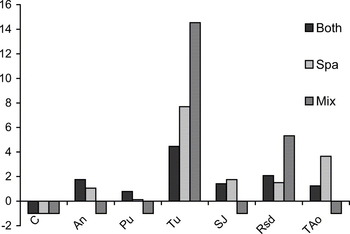
An estimate, by taking the marriages for both the Spanish and Mixed groups together, could show whether the subdivision unveiled by surnames reflected the ethno-social stratification. If this were the case, then the values of (RP–RPr)/RPr obtained for the joined groups would be higher than those considering each one separately. Thus, it would be expected that both groups were sufficiently differentiated so as to be able to characterize them as two different (though not totally isolated) reproductive units. However, the figures of (RP–RPr)/RPr shown in Fig. 3, when compared with those of Tables 5 and 6, suggest that except for two of the seven parishes (Anejos and Punilla), an association between surnames and ethno-social groups was not evident. Even though populations where surnames were strongly associated to an ethnic group or geographic origin have been found (González-Martín et al., Reference González-Martín, García-Moro, Hernández and Moral2006), this was not the case in Córdoba's population. Surnames per se did not make it possible to identify the Spanish and Mixed groups as two different reproductive units, despite the well-documented social segregation (at least in reference to legal unions) that existed at that time in all of Spain's colonies in America. This is in agreement with the very close similarity in the geographical distribution of surnames and in relationships among parishes found for historical rural populations of Córdoba province in different ethno-social groups (Colantonio et al., Reference Colantonio, Fuster, Ferreyra and Lascano2006).
Indicator (RP−RPr)/RPr by parish, taking both groups together.

Summing up, a comprehensive examination of the results obtained by isonymy and repeated pairs at the parish level for the Spanish group shows that, while a preference for spouses of the same surname was not confirmed, there was a tendency towards internal population subdivision. This suggests that although marriage to a relative tended to be avoided, there was an exchange between certain lineages, which may constitute a strategy for maintaining the patrimony while avoiding unions between close relatives. This would also explain why, in most of the parishes, subdivision was verified for Spanish but found in only two for the Mixed group, since among the former were the richest families, who would have had more interest in contracting advisable unions.
Conclusions
The values of inbreeding by isonymy were low for both ethno-social groups, with a slightly higher component of preferential inbreeding found in the Spanish group. The inter-parish population differentiation was moderate both for the Spanish and Mixed groups, although higher in the former case. The isonymic and repeated pairs analysis by parish showed that, in general, Spanish did not show a preference for spousal isonymy, although a tendency towards internal population subdivision was demonstrated, expressed by mating preference between lineages. In the Mixed group, however, none of these preferences was verified. The values obtained from the repeated pairs analysis taking the Spanish and Mixed groups together, indicated that surnames per se do not make it possible to consider both groups as separate reproductive units. The similarity found in all the estimators for both groups in Córdoba city was conspicuous, suggesting a very similar behaviour in both ethno-social groups with respect to mate selection, contrary to the long-lasting depiction of a stratified society with clear differences among ethno-social groups.
Acknowledgment
This research was funded by grants from Consejo Nacional de Investigaciones Científicas y Técnicas (CONICET) PIP 112-200801-00924 and from Secretaría de Ciencia y Técnica (Univ. Nac. de Córdoba) PID 05/I584.