Introduction
Rush skeletonweed is an herbaceous perennial plant in the Compositae family (McVean Reference McVean1966). In the early 1980s, rush skeletonweed infested an estimated 1.4 million ha in southwestern and northern Idaho and 809,000 ha in eastern Washington (Lee Reference Lee1986). Infestations were most common in rangelands and along roadsides, but rush skeletonweed was frequently found in semiarid pastures, cropland, railroad rights-of-way, and residential properties. Rush skeletonweed is currently prevalent in much of the inland Pacific Northwest (Van Vleet and Coombs Reference Van Vleet and Coombs2012) and has become a problematic weed in winter wheat–fallow (WW-F) production regions. Establishment of rush skeletonweed in WW-F cropland in eastern Washington became widespread in areas that had been enrolled in the Conservation Reserve Program (CRP), which started in the mid-1980s. Anecdotal observations by growers are that the standard control strategies practiced in the WW-F systems of the region, rod-weeding in tillage-based systems and herbicides in no-till systems, have failed to control the spread of rush skeletonweed.
Rush skeletonweed rosettes emerge in the fall from established rootstocks or from seed that germinate with fall rains. After overwintering as rosettes, plants produce flower stalks with increasing daylength in spring. By early summer, the broad rosette leaves have withered, and the plant is left with sparse linear or ensiform leaves, giving rise to its common name. Flowering begins in early summer and continues until freezing temperatures in the fall kill the aboveground portions of the plant. Established plants can produce up to 20,000 seeds, which are disseminated by wind and that readily germinate with adequate soil moisture. Rush skeletonweed can also reproduce vegetatively from injured or fragmented taproots (Lee Reference Lee1986). Regeneration happens quickly following tillage and can occur throughout the growing season (Rosenthal et al. Reference Rosenthal, Schirman and Robocker1968).
Annual precipitation in the WW-F cropping region ranges from 300 to 450 mm, and soil water storage during the fallow year is critical for reaching wheat yield targets (Schillinger and Papendick Reference Schillinger and Papendick2008). Rush skeletonweed can deplete soil water in the seedbed zone (McVean Reference McVean1966) resulting in delayed germination, reduced germination, or both. Delaying winter wheat seeding—or germination—beyond the recommended window of late August to early September, can result in as much as a 30% yield loss in the WW-F region of eastern Washington (Schillinger and Papendick Reference Schillinger and Papendick2008). Additionally, wheat seed in this region is often placed up to 15 cm deep into tilled summer fallow to reach moist soil, with dry, loose soil above. Wheat seedlings that fail to emerge prior to fall rains may fail to emerge if a restrictive soil crust layer is formed after rainfall (grower communication; DJL, personal observation). Soil crusting is less of a problem in no-till production systems because the seed is seldom placed deeper than 5 cm (grower communication), and no-till soil is less likely to form a restrictive crust layer (Pareja-Sáncheza Reference Pareja-Sánchez, Plaza-Bonilla, Concepción Ramos, Lampurlanés and Cantero-Martinez2017). However, soil moisture sufficient to germinate wheat seed is often lacking at this depth, so germination is dependent on fall rains, which often do not occur until late September or early October, resulting in reduced yield potential.
Schirman and Robocker (Reference Schirman and Robocker1967) reported that only picloram and dicamba provided acceptable control of rush skeletonweed in a non-crop infestation. Greater consistency of control was obtained with fall rather than spring applications. Leys et al. (Reference Leys, Amor, Barnett and Plater1990) reported that 2,4-D amine plus clopyralid (750 + 60 g ai ha−1) provided the most effective control of rush skeletonweed in summer fallow of the 18 herbicides or herbicide tank mixes evaluated over 3 yr in Australia; picloram was not evaluated in that study. Fischer et al. (Reference Fischer, Thorne and Lyon2020) compared several herbicide treatments applied in the fall with a broadcast or weed-sensing sprayer for rush skeletonweed control in fallow. The following May, rush skeletonweed density was reduced compared with the nontreated check with the use of aminopyralid, glyphosate, clopyralid, and chlorsulfuron + metsulfuron. There was no herbicide by sprayer treatment interaction, and no difference in efficacy between the broadcast and weed-sensing application treatments. Area covered by the weed-sensing sprayer averaged 20% and 52% less than the broadcast application at the two experiment sites. Thorne and Lyon (Reference Thorne and Lyon2021) reported that picloram applied at 280 g ae ha−1 in the fall after wheat harvest provided complete control of rush skeletonweed through June of the fallow year at all three experiment sites. In August, just prior to winter wheat seeding, the greatest reductions in rush skeletonweed density were achieved with fall-applied picloram and clopyralid at two of three sites. No treatments provided effective control into August at the third site.
Although picloram was identified as an effective herbicide for rush skeletonweed control, Schirman and Robocker (Reference Schirman and Robocker1967) cautioned that because eastern Washington has limited rainfall, it would take several years for picloram to degrade to a nonlethal level for broadleaf crops to tolerate it. The average half-life of picloram is 90 d, with a range from 20 d to 300 d (Shaner Reference Shaner2014). Persistence in soil is shorter under warm and humid conditions, in the presence of plant roots, higher soil organic matter content, and at concentrations less than 1.12 kg ae ha−1. Wheat was found to be more sensitive to soil residues of picloram than oat (Avena sativa L.) or barley (Hordeum vulgare L.) (Vanden Born Reference Vanden Born1969). Growers in eastern Washington have been hesitant to use picloram for rush skeletonweed control in fallow out of concern for potential injury to the following winter wheat crop (grower communication).
The objectives of this study were to 1) determine the dose response of rush skeletonweed to picloram applied in the fall or spring of the fallow year with either a broadcast or weed-sensing sprayer, and 2) evaluate injury and grain yield in the subsequent winter wheat crop from these fallow treatments.
Materials and Methods
Field studies were conducted between 2019 and 2022 to evaluate the ability of picloram to control rush skeletonweed in the WW-F cropping region of eastern Washington. Fall treatments were applied at one site in 2019, and one site in 2020. Spring treatments were applied at two sites in 2021. Four picloram herbicide rates (0, 140, 280, and 560 g ae ha−1) were applied with either a weed-sensing precision applicator (WSA; WEED-IT®; Steenderen, The Netherlands) or with a standard broadcast spray applicator (BSA; R&D Sprayers, Opelousas, LA). The experimental design was a randomized complete block with a factorial treatment arrangement of picloram rate and application method. Treatments were replicated four times at each site. Individual plots measured 3.0 by 10.7 m.
The WSA unit had an attached spray boom equipped with 10 0330E nozzles (TeeJet Technologies, Glendale Heights, IL) on 20.3-cm spacing at 50 cm above the ground. The weed-sensing component included two red LED light sources with near-infrared sensors that detect chlorophyll fluorescence and control the operation of each nozzle. The WSA was calibrated in full-broadcast mode to apply 275 L ha−1 at 345 kPa at a ground speed of 8 km h−1; however, the same output rate was applied to individual weeds in spot-spray mode. The applicator was mounted on a four-wheel all-terrain vehicle for the Hay 19 applications and a small utility tractor for applications at the other three sites. The BSA treatments were applied with a hand-held CO2-pressurized spray boom with six XR11002 nozzles (TeeJet® Technologies) on 51-cm spacing held 45 to 50 cm above the ground and calibrated to apply 140 L ha−1 at 172 kPa at a ground speed of 4.7 km h−1.
Rush skeletonweed density was used as the metric to evaluate herbicide control and was assessed by counting all plants in a 2-m by 10-m area through the center of each plot. This measurement area corresponded with the area covered by the WSA but was also the measurement area in the BSA plots. Rush skeletonweed density was measured in each plot and location, except for Hay 2019, at the time of application to determine initial density, and in the wheat crop to assess treatment efficacy.
Hay 2019
The Hay 2019 (Hay 19) fall-applied study was established on October 3, 2019, near Hay, WA (46.6446°N, 117.898°W; 523 m above sea level) on a 15% west-facing slope of Walla Walla silt loam (coarse-silty, mixed, superactive, mesic Typic Haploxeroll) soil, pH 6.1, and with 2.2% soil organic matter in the top 15 cm. The field site had been enrolled in the CRP from 2001 to 2014. In 2014, the field was converted back to wheat production with an initial July application of glyphosate followed by burning and direct seeding of winter wheat in September. The field was subsequently managed in a no-till WW-F rotation.
Treatments were applied on October 3, 2019, to actively growing and flowering rush skeletonweed plants in winter wheat stubble remaining from the 2019 harvest. Weather conditions at the time of application were 10 C air temperature, 8.9 C soil temperature at 5 cm, and 54% relative humidity. The volume of spray solution applied by the WSA was recorded for each treatment to determine the total area sprayed. Rush skeletonweed density in the nontreated checks was measured the following spring (April 15, 2020) as a postapplication estimate of the initial density and averaged 2.0 plants m−2.
Fallow management included a spring application of glyphosate (1,260 g ae ha−1) in April 2020 by the cooperating grower to control volunteer wheat and winter annual weeds. On July 16, 2020, an application of saflufenacil (67 g ai ha−1), modified vegetable oil (1% v/v), and a spray deposition aid (ammonium sulfate, glycerol, phosphoric acid; 1% v/v) was applied with an all-terrain vehicle sprayer (ATV) at 84 L ha−1 at 276 kPa at a ground speed of 8 km h−1 with AIXR110015 nozzles (TeeJet® Technologies) to burn down all living weeds, including rush skeletonweed. On September 10, saflufenacil (2.5 g ai ha−1), modified vegetable oil (1% v/v), and ammonium sulfate (18 g L−1) was applied with the ATV for preplant weed burn down.
The plot area was direct-seeded on September 15, 2020, by the cooperating grower with ‘UI Magic CL+’ soft-white winter wheat at 95 kg ha−1. Fertilizer (90 kg N ha−1, 22 kg S ha−1) was applied with the drill during seeding. On March 27, 2021, MCPA, fluroxypyr, and clopyralid (426, 157, and 123 g ae ha−1, respectively) were applied for weed control in the growing wheat crop. On July 16, 2021, all plots were harvested with a plot combine equipped with a 1.5-m-wide header. Grain samples were bagged from each plot. The grain samples were cleaned with a Clipper® seed cleaner (A.T. Ferrell Company, Inc., Bluffton, IN), tested for moisture, and then weighed for yield. Grain yield for each plot was calculated on a 12% moisture basis at a standard density of 778 g m−3.
Herbicide treatment efficacy was determined by measuring rush skeletonweed density in the winter wheat crop after it was evident that a vigorous and abundant rush skeletonweed population had emerged in the nontreated check plots. Consequently, final rush skeletonweed density was assessed on October 22, 2020.
LaCrosse 2020
The LaCrosse 2020 (Lac 20) fall-applied study was established on October 15, 2020, near LaCrosse, WA (46.804°N, 117.888°W; 461 m above sea level), on a 6% northwest-facing slope of Walla Walla silt loam soil. Soil pH was 5.9 and soil organic matter measured 2.1% in the top 15 cm. The field had been enrolled in the CRP and was transitioned back to winter wheat production in 2015 with a September glyphosate application followed by direct seeding of winter wheat in October 2015. The field was subsequently managed in a WW-F rotation using chemical fallow and direct-seeding farming methods.
Treatments were applied on October 15, 2020, to rush skeletonweed plants in winter wheat stubble remaining from the 2020 harvest. At the time of application, rush skeletonweed plants were showing signs of either drought or frost damage, as flowering was not evident, and stems were dull in color. Rush skeletonweed density was measured at the time of application and averaged 2.1 plants m−2. Weather conditions at the time of application were 8.3 C air temperature, 10.3 C soil temperature at 5 cm, and 50% relative humidity. The WSA spray volume applied to each plot was recorded to determine the total area sprayed for each treatment.
Following treatment applications, chemical fallow management included glyphosate (942 g ae ha−1) plus ammonium sulfate (20.4 g L−1) applied with the ATV on December 8, 2020, to control a flush of volunteer wheat. On March 30, 2021, glyphosate (1,260 g ae ha−1) plus modified seed oil plus surfactants (1% v/v) and a spray deposition aid (ammonium sulfate, glycerol, phosphoric acid; 0.75% v/v) were applied with the ATV to control volunteer wheat and winter annual weeds. On July 15, 2021, a summer burn-down application of glyphosate (2,522 g ae ha−1) plus saflufenacil (50 g ae ha−1) and ammonium sulfate (20.4 g L−1) was applied using the ATV. On September 1, 2021, a preplant glyphosate application (549 g ae ha−1) was applied by the grower.
The plot area was direct-seeded on September 15, 2021, by the cooperating grower, and fertilizer (101 kg N ha−1, 9 kg P ha−1, 17 kg S ha−1) was applied with the drill at seeding. On March 10, 2022, weeds in the wheat crop were sprayed with pyrasulfotole (37 g ai ha−1) + bromoxynil (207 g ai ha−1) and ammonium sulfate (20 g L−1) by the cooperating grower. Wheat plots were harvested on August 5, 2022, and all samples were processed using the same methods as for Hay 19.
Rush skeletonweed final density in the wheat crop was evaluated on April 28, 2022. Rush skeletonweed rosettes had not emerged in the fall following wheat seeding as they did at the Hay 19 site; therefore, density counts were postponed until emergence in the nontreated check plots was determined to be comparable with that of Hay 19.
Hay 2021
The Hay 2021 (Hay 21) spring-applied study was established on May 19, 2021, near Hay, WA (46.645°N, 117.9048°W; 516 m above sea level), on a 4% southwest-facing slope. The soil type was Walla Walla silt loam soil, pH 5.9, and with 2.4% soil organic matter in the top 15 cm. The field site had been enrolled in the CRP from 2001 to 2014. The field site shared the same CRP takeout history as the Hay 19 site.
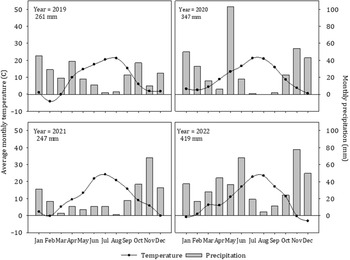
Treatments were applied on May 19, 2021, to rush skeletonweed plants that had emerged following the 2020–21 winter season in winter wheat stubble remaining from the 2020 wheat harvest. Air temperature and relative humidity at the time of application were 10 C and 39%, respectively, while soil temperature at 5 cm was 15.6 C. Spray volume applied with the WSA was recorded for each plot to determine the total area sprayed for each treatment. Rush skeletonweed initial density was measured at the time of application in all plots. Because of cool and dry weather conditions during the 2020–21 winter and spring seasons (Figure 1), rush skeletonweed emergence was delayed until late April. By May 19, emergence averaged only 0.4 plants m−2 at the time of treatment application and some of the plants already had developed reproductive stems (bolting).
Climate diagram for LaCrosse, WA (46.86°N, 117.85°W) for 2019 through 2022 showing average temperature (line with circles) and monthly precipitation (gray bars) (modified from Walter and Lieth (Reference Walter and Lieth1967). Months in which average temperature is above precipitation on the graph indicates a dry or drought period. Data were collected by AgWeatherNet, Washington State University, Pullman, WA. Average annual rainfall (1991–2020) for LaCrosse, WA, is 383 mm (NOAA-NCEI 2023).

Chemical fallow management included glyphosate (942 g ae ha−1) plus ammonium sulfate (20.4 g L−1) applied with the ATV on December 8, 2020, to control a flush of volunteer wheat. On March 30, 2021, glyphosate (1,261 g ae ha−1) plus modified seed oil plus surfactants (1% v/v) and a spray deposition aid (ammonium sulfate, glycerol, phosphoric acid; 0.75% v/v) were applied with the ATV to control volunteer wheat and winter annual weeds. On July 15, 2021, a summer burndown application of glyphosate (2,522 g ae ha−1) plus saflufenacil (50 g ae ha−1) and ammonium sulfate (20.4 g L−1) was applied using the ATV. On September 9, 2021, the ATV was used to apply a preplant burndown amount of paraquat (1,261 g ae ha−1) followed by pyroxasulfone (96 g ai ha−1) + carfentrazone (7.5 g ai ha−1) applied by the grower on September 14.
Crop management included an application of imazamox (52.6 g ae ha−1) plus a nonionic surfactant (0.25% v/v) and ammonium sulfate (18 g L−1) by the cooperating grower on March 18, 2022, in the growing crop for grass and broadleaf weed control. All plots were harvested on July 20, 2022, and all grain samples were processed using the same methods as for Hay 19. Like Lac 20, the emergence of rush skeletonweed through fall and spring 2021–22 had been delayed, therefore, evaluation of rush skeletonweed final density was measured on May 23, 2022. At the time of counting, winter wheat was jointing, and many rush skeletonweed plants were bolting.
LaCrosse 21
The LaCrosse 2021 (Lac 21) spring-applied study was established on May 19, 2021, near LaCrosse, WA (46.6448°N, 117.9052°W; 460 m above sea level), on a 6% northwest-facing slope. The soil type was Walla Walla silt loam soil, pH 5.9, and with 2.1% organic matter in the top 15 cm. The field site was adjacent to the LaCrosse 2020 fall-applied trial and shared the same CRP take-out history.
Treatments were applied on May 19, 2021, to rush skeletonweed plants that had emerged following the 2020–21 winter season in winter wheat stubble remaining from the 2020 wheat harvest. Air temperature and relative humidity at the time of application were 13.3 C and 33%, respectively, while soil temperature at 5 cm was 15.6 C. The spray volume applied with the WSA was recorded for each plot sprayed to determine the total area sprayed for each treatment. Rush skeletonweed initial density was measured at the time of application in each plot. Weather conditions at Lac 21, like Hay 21, delayed rush skeletonweed emergence until April 2021. On May 19, 2021, rush skeletonweed emergence at the time of application averaged only 0.23 plants m−2, and some of the plants had already bolted.
Chemical fallow management, crop management, wheat harvest, and rush skeletonweed control evaluation methods were all identical to those listed for the Lac 20 site.
Statistical Analysis
Rush skeletonweed density was counted in a 2- by 10-m area in each plot; however, for analysis and presentation, all count data were converted to plants per square meter and analyzed using a generalized mixed model analysis (the GLIMMIX procedure) with SAS software (SAS Institute 2019) to determine factor significance and interactions (Stroup Reference Stroup2013). For spring applied treatments, the initial counts were applied as a covariate in the model; however, initial counts were not included for the analysis of the fall-applied treatments because only the Lac 20 site had initial counts in all plots. Block nested within location was used as a random effect for the full model and when data were pooled across locations, but only block was used when data were analyzed by location. Studentized residuals for counts per square meter and for wheat yield were found in compliance with normality assumptions using the Kolmogorov-Smirnov test (P > 0.05) and the UNIVARIATE procedure with SAS software. The LaPlace method was used for maximum likelihood estimation and plants per square meter, and yield data were modeled using a normal distribution.
Interactions that were found to be significant with the GLIMMIX procedure were then analyzed using regression analysis with respect to picloram rate using the REG procedure with SAS software. Model fit was determined if variables were significant (P ≤ 0.05) and if the LACKFIT test in the REG procedure was not significant (P > 0.05; H0: the relationship assumed in the model is reasonable). Regression plots were generated using SigmaPlot software (version 14.0; Inpixon HQ, Palo Alto, CA), and means and standard errors were included in each plot for each variable with respect to rate.
Results and Discussion
Rush Skeletonweed Density
For fall-applied treatments, the initial generalized mixed model analysis found no significant location by picloram rate by application method interaction (P = 0.440), but there was a significant location by picloram rate interaction (P = 0.017), so picloram rate data were analyzed separately by location. There was not a significant interaction between application method and picloram rate (P = 0.528), so for each location, application method data were pooled across rates for statistical analysis. Rush skeletonweed densities in the wheat crop following fall-applied treatments declined with increasing picloram rates at both Hay (P < 0.001) and LaCrosse (P < 0.001; Figure 2). Treatments applied with the weed-sensing sprayer achieved similar efficacy to that of broadcast treatments with an average of 37% and 26% of the broadcast rate applied per hectare at Hay and LaCrosse, respectively (Table 1). Fischer et al. (Reference Fischer, Thorne and Lyon2020), in their studies on control of rush skeletonweed in fallow, suggested that the weed-sensing sprayer had the greatest opportunity to reduce herbicide use and cost compared to broadcast applications when weed cover is <30%.
Rush skeletonweed density in winter wheat at Hay, WA (y = 3.1 – 0.005x; adj. R 2 = 0.33; P < 0.001), and LaCrosse, WA (y = 0.74 – 0.001x; adj. R 2 = 0.41; P < 0.001), following postharvest fall-applied chemical fallow applications of picloram at four rates combined over two application methods. Average densities with associated standard errors for each rate and location are shown for Hay (•) and LaCrosse (▴).

Average picloram rate applied by the weed-sensing sprayer to control rush skeletonweed in the fall following winter wheat harvest at two locations in eastern Washington. a

a Numbers in parentheses represent the percent of broadcast rate.
For spring-applied treatments, initial analysis found no significant interactions between location by picloram rate by application method (P = 0.199), location by picloram rate (P = 0.170), or location by application method (P = 0.130), so data were pooled across locations for statistical analysis. There was a significant picloram rate by application method interaction (P = 0.013), so application methods were analyzed separately. Broadcast applications resulted in reduced rush skeletonweed densities in the fall-planted wheat with increasing picloram rates (Figure 3). Plant densities were reduced to zero at application rates of 280 or 560 g ha−1. Picloram rate had no apparent effect on rush skeletonweed density when applied with a weed-sensing sprayer. The weed-sensing sprayer applied just 16% and 9% of the broadcast rate applied per hectare at Hay and LaCrosse, respectively (Table 1). The very dry conditions in spring 2021 likely reduced or delayed emergence of rush skeletonweed plants prior to the May picloram applications. This lack of emergence resulted in picloram being applied to only a small percentage of the plot area with the weed-sensing sprayer, which may have limited plant uptake from the soil by later emerging plants. Picloram is an ambi-mobile growth regulator herbicide that readily penetrates roots and foliage (Shaner Reference Shaner2014), which likely resulted in greater rush skeletonweed control of later emerging plants with broadcast treatments compared to weed-sensing sprayer treatments.
Rush skeletonweed density in winter wheat following spring broadcast chemical fallow applications of picloram at four rates (y = 0.512 − 0.003x + 0.000004x2; adj R 2 = 0.55; P < 0.001). Weed-sensing application regression was not significant (adj. R 2 = 0.05; P > 0.05). Average densities with associated standard errors are shown for the broadcast (•) and weed-sensing (▴) applications at each rate.

Winter Wheat Grain Yield
Winter wheat grain yields were not reduced by fall picloram applications (data not shown). Grain yields for the fall-applied treatments averaged 4,130 and 6,570 kg ha−1 at Hay in 2021 and LaCrosse in 2022, respectively. For the spring applications, there was a significant interaction between location, picloram rate, and application method (P = 0.005). As with the fall applications, grain yields were not reduced by spring applications of picloram with the weed-sensing sprayer (P = 0.918). The reduced area treated with picloram in spring 2021 with the weed-sensing sprayer (Table 1) reduced the number of wheat plants exposed to potential injury from picloram residues in the soil. Grain yields for the spring-applied weed-sensing sprayer treatments averaged 6,400 and 6,990 kg ha−1 at Hay and Lacrosse, respectively, in 2022. Grain yields were reduced by spring broadcast applications of picloram at both locations, and grain yields declined as picloram rate increased (Figure 4). In this study, spring treatments at both locations were applied in 2021, which was a drought year (Figure 1). The fall treatments, which were applied in 2019 and 2020, experienced a wetter and drier than normal summer fallow period, respectively, so we are more confident that fall treatments of picloram pose a low risk for injury and yield loss in most years. However, because the spring treatments were all applied in 2021, we do not have a good sense of the risk for injury to the following winter wheat crop in years receiving more precipitation than was experienced in 2021. However, it should be noted that summer precipitation in the Pacific Northwest is frequently limited.
Winter wheat yield in response to spring-applied broadcast chemical fallow applications of picloram at four rates at Hay, WA (y= 6,921 – 22.6x + 0.02x2; adj. R 2 = 0.95; P < 0.001), and LaCrosse, WA (y = 7,133 – 7.92x; adj. R 2 = 0.83; P < 0.001). Symbols represent average yield with associated standard errors for each rate and location for Hay (•) and LaCrosse (▴).

Practical Implications
Picloram, applied in fallow, can provide effective control of rush skeletonweed in the winter wheat-fallow cropping systems of Eastern Washington. Control is maximized, and injury to the subsequent winter wheat crop is minimized, when picloram is applied postharvest in fall of the fallow phase rather than in the spring. The application of picloram in the fall with a weed-sensing sprayer can provide similar efficacy to broadcast applications with less herbicide applied. Although we did not observe wheat yield loss following fall broadcast applications of picloram, the use of a weed-sensing sprayer is likely to reduce the risk of yield loss compared to broadcast applications because of the reduced area treated with picloram. Spring applications of picloram for rush skeletonweed control in fallow is not recommended. Although broadcast applications of picloram in the spring provided excellent control of rush skeletonweed, yield loss in the subsequent winter wheat crop was not acceptable. Picloram applied in the spring with a weed-sensing sprayer provided little control of rush skeletonweed in the subsequent winter wheat, and although no yield loss was observed with these treatments, it is difficult to know whether injury would have occurred if the rush skeletonweed density in the spring had been greater, resulting in more area being treated with picloram. Applying picloram in the fall of the fallow phase with a weed-sensing sprayer provides effective and economical control of rush skeletonweed with a low risk for crop injury and yield loss in the following winter wheat crop.
Acknowledgments
This research was partially funded by an endowment from the Washington Grain Commission and by the U.S. Department of Agriculture–National Institute of Food and Agriculture, Hatch project 1017286. The field studies were conducted on land graciously made available to the authors by Terry Miller and Casey Holling. We also acknowledge technical assistance provided by master’s student Jacob Fischer, and Associate in Research Henry Wetzel, for their help with the initial trial establishment. No conflicts of interest have been declared.