

Sex and gender differences in psychological traits have been explained using a variety of theoretical approaches, including sociocultural and evolutionary psychological explanations (Meyers-Levy & Loken, Reference Meyers-Levy and Loken2015). The existence of sex (or gender) differences does not imply invariance within sex—for many traits, male and female distributions largely overlap even in cases of a mean difference (Hyde Reference Hyde2005; Zell, Krizan, & Teeter, Reference Zell, Krizan and Teeter2015). Moreover, as with many areas of psychological study, context matters. Sex differences need not be invariant across cultures, situations, or related domains. For example, work on gender gaps in political knowledge in established democracies suggests that much of the gap can be accounted for by variation in the kind of knowledge that is assessed (e.g., Stolle & Gidengil, Reference Stolle and Gidengil2010), as well as measurement error related to gender differences in survey response style (Mondak & Anderson, Reference Mondak and Anderson2004). In light of these studies, this article revisits the debate about the gender gap in pathogen disgust sensitivity by examining a novel disgust domain (caregiving) and reexamines disgust’s implications for political attitudes.
It has been argued that disgust evolved as a way to avoid pathogen contamination, as well as to regulate mate selection and morality (Tybur et al., Reference Tybur, Lieberman, Kurzban and DiScioli2013; but see Rozin & Haidt, Reference Rozin and Haidt2013, and Rottman, Reference Rottman2014). In light of this, gender differences in disgust sensitivity have also been theorized to arise from an evolutionary process, perhaps related to gender differences in vulnerability to disease, to gender differences in parental investment, or to gender differences in risk taking. These evolutionary psychological explanations can be contrasted with sociocultural explanations that explain gender differences in emotional expressivity (including disgust) as resulting primarily from cultural and socialization processes. These two types of explanations need not be mutually exclusive; human bodies provide the material on which sociocultural forces act, and those forces affect how predispositions express themselves.
Building on research that proposes women may acquire pathogen disgust tolerance through caregiving tasks (Prokop & Jančovičová, Reference Prokop and Fančovičová2016) and research that points to gendered social desirability concerns in emotion expressivity (e.g., Deng et al., Reference Deng, Chang, Yang, Huo and Zhou2016), we posit that feminine gender identity and parenthood suppress self-reported disgust toward caregiving activities compared to conventional measures of pathogen disgust. Further, we revisit the typical relationship between high disgust sensitivity and conservative political attitudes (Inbar et al., Reference Inbar, Pizarro and Bloom2009) and explore whether this relationship is disrupted in the caregiving domain of disgust reaction.
Specifically, we consider four questions:
-
1. Does the gender-disgust link vary across a continuous measure of gender identity (as contrasted with a dichotomous measure of sex)?
-
2. Is the gender-disgust link moderated by parenthood?
-
3. Is the gender-disgust link moderated by the choice of items to measure disgust? Specifically, do disgust items that have a caregiving frame exhibit an attenuated or reversed gender gap when compared with conventional disgust items?
-
4. Is the relationship between pathogen disgust and ideology (i.e., greater pathogen disgust is associated with greater conservatism) altered by these three factors (i.e., a continuous measure of gender identity, parenthood, caregiving-framed disgust measure)?
Gender and disgust sensitivity
Gendered differences in disgust response have been found consistently in many studies, indicating that women tend to report greater disgust than men (e.g., Berger & Anaki, Reference Berger and Anaki2014, Haidt et al., Reference Haidt, McCauley and Rozin1994, Quigley et al., Reference Quigley, Sherman and Sherman1997; see meta-analysis by Sparks et al., Reference Sparks, Fessler, Chan, Ashokkumar and Holbrook2018, and see Tybur et al., Reference Tybur, Inbar, Aarøe, Barclay, Barlow, De Barra and Consedine2016, for a study of disgust across 30 nations). Though women are more disgust sensitive than men across several disgust domains, the sexual disgust gap is much greater than pathogen and moral disgust differences (Tybur et al., Reference Tybur, Lieberman and Griskevicius2009). Gender differences in sexual disgust have been theorized to be the result of selection for different mating strategies in men and women (Tybur et al., Reference Tybur, Lieberman and Griskevicius2009; see also Trivers, Reference Trivers and Campbell1972). Nonetheless, the gender gap in pathogen disgust has also been the subject of much scholarly work.
Evolutionary psychological accounts of gender differences in pathogen disgust have considered several possible mechanisms. Prokop and Jančovičová (Reference Prokop and Fančovičová2016) highlight two possible explanations for greater pathogen disgust among women: vulnerability to disease and parental investment (see also Fleischman, Reference Fleischman, Weekes-Shackelford and Shackelford2014). Women are more vulnerable than heterosexual men to many sexually transmitted diseases, and those diseases may have a negative impact on fetal development (Fleischman, Reference Fleischman, Weekes-Shackelford and Shackelford2014). It is theorized that this acted as a selective pressure for greater pathogen avoidance among women. At the same time, men may have been under selective pressure to express less pathogen disgust as a costly signal of a robust immune system (Fleischman, Reference Fleischman, Weekes-Shackelford and Shackelford2014). The parental investment approach notes the greater investment that females make in offspring relative to males because of differences in mating strategies (Trivers, Reference Trivers and Campbell1972) and suggests that women, particularly mothers, should avoid contamination for protection during pregnancy as well as out of concern for offspring health (Curtis et al., Reference Curtis, Aunger and Rabie2004). Contrary to this expectation, some recent empirical evidence suggests that mothers are, in fact, less disgust sensitive than childless women (Prokop & Jančovičová, Reference Prokop and Fančovičová2016). In addition to these two explanations, recent work suggests that sex differences related to pathogen disgust may be more related to risk tolerance strategies than maternal pathogen avoidance; as men are more risk tolerant than women, this may manifest in differential pathogen avoidance (Sparks et al., Reference Sparks, Fessler, Chan, Ashokkumar and Holbrook2018).
In sum, evolutionary psychological perspectives provide several avenues for explaining greater pathogen disgust among women than men and suggest that these relationships may be moderated by parental status. We do not expect our results to settle this theoretical debate; instead, we hope to add some evidence as to whether or not men and women respond differently to disgusting stimuli specific to caregiving.
Sociocultural explanations of gender differences in pathogen disgust argue that self-presentation concerns may bias responses among men and women on disgust measures, with men showing less willingness to express emotions than women (Isaksen, Reference Isaksen2002). From this perspective, disgust fits into a range of emotions that may or may not be expressed because of gender norm socialization. In many societies, including our target population in the United States, men have historically been expected to be stoic and unemotional, with women being stereotyped as the more expressive group (Fischer, Reference Fischer1993; Grossman & Wood, Reference Grossman and Wood1993; Shields, Reference Shields2002). This emotional suppression in men is thought to demonstrate “powerful control over instable situations” (Rohrmann et al., Reference Rohrmann, Hopp and Quirin2008, p. 73), while emotionally reacting to one’s environment and social situations is more acceptable and even encouraged for women.
However, context matters, too. These gender gaps vary by whether researchers focus on emotional experience (grounded in physiological responses) or emotional expressivity (through self-report and behavior), as well as by emotional domain (Deng et al., Reference Deng, Chang, Yang, Huo and Zhou2016). When considering disgust, physiological reactions may not vary by gender, but women express more negative emotions than men (Deng et al., Reference Deng, Chang, Yang, Huo and Zhou2016; see also Balzer & Jacobs, Reference Balzer and Jacobs2011,Footnote 1 and Rohrmann et al., Reference Rohrmann, Hopp and Quirin2008). On average, then, men and women experience and express emotions differently (e.g., through self-report and facial display), and how they do so is sometimes governed by gendered cultural expectations (Brody, Reference Brody1997; Deng et al., Reference Deng, Chang, Yang, Huo and Zhou2016). In light of this, we may expect disgust expression to vary across different domains and for this variation to be gendered in the case of caregiving disgust, where gendered cultural norms around caregiving and parenthood (i.e., activities in the historically feminine, domestic sphere; see Miller and Borgida, Reference Miller and Borgida2016) may influence emotional expression.
The sociocultural argument suggests that the gender gap in pathogen disgust will be attenuated in a domain like caregiving, where the gendered expectations for expressing disgust are different from those in other areas of life. Women remain expected and more likely to be caregivers to children and loved ones in the United States (Bianchi et al., Reference Bianchi, Sayer, Milkie and Robinson2012) and in other countries (Hook, Reference Hook2006), and therefore they would not have social expectations to be disgusted by changing a dirty diaper or cleaning up after a loved one’s vomit, while men may feel greater freedom to express these types of disgust experiences. Our study cannot speak to whether women have evolved or have been socialized into performing a larger share of caregiving tasks and thus may be less disgusted by these activities.
Genetic factors also may contribute to individual differences in disgust sensitivity. A novel behavioral genetic study using twins found that variation in disgust is explained primarily by genetic and unique environmental factors, and not by the shared environment (Sherlock et al., Reference Sherlock, Zietsch, Tybur and Jern2016; see also discussion in Tybur et al., Reference Tybur, Çınar, Karinen and Perone2018, and work by Tybur et al., Reference Tybur, Wesseldijk and Jern2020). This finding suggests that, at least in some contexts (e.g., among Finnish women in early to mid-adulthood who were the participants in Sherlock et al., Reference Sherlock, Zietsch, Tybur and Jern2016, and among adult Finns in Tybur et al., Reference Tybur, Wesseldijk and Jern2020), familial socialization may play little to no role in disgust sensitivity.
However, this argument does not necessarily mean that socialization into gender norms has no role in disgust sensitivity, for four reasons. First, the absence of male respondents means that the Sherlock et al. (Reference Sherlock, Zietsch, Tybur and Jern2016) study is limited in its ability to explore the role of gender norms in disgust sensitivity (Tybur et al., Reference Tybur, Wesseldijk and Jern2020, find no shared environment effect in disgust proneness or contamination sensitivity and find no gender difference in the variance structure of these traits). Second, as with all twin studies, just because a particular variance component plays a large role (or no role) in one context does not mean that it cannot play a substantively different role in another context (e.g., across countries, social class, or stages of the life course). Variance estimates in any behavioral genetic study are a population characteristic and can vary across populations and over time (e.g., Fazekas & Littvay, Reference Fazekas and Littvay2015; Hatemi et al., Reference Hatemi, Funk, Maes, Silberg, Medland, Martin and Eaves2009). Third, the shared environment component in a behavioral genetic model captures variation in a trait that is driven by differences between households (Medland & Hatemi, Reference Medland and Hatemi2009). It does not directly capture society-wide variables, such as norms and institutions (e.g., gender norms), that are shared across all twin pairs in a sample. Nonetheless, were a common environment component present (which it was not in this case, but it may be in another context), it could imply that differences in gender socialization across households contributed to variation in disgust sensitivity. Fourth, a substantial portion of the variation in disgust is explained by unique environmental factors, which may indicate a role for socialization outside the home (e.g., by peer groups).
In sum, although these findings present valuable insights into the etiology of disgust expression, they remain consistent with the possibility that peer gender socialization matters and leave open the question of whether gender norms and the self-presentational concerns related to them play a role in disgust expression (or, for that matter, whether evolved adaptations do, too).
Ideology and disgust sensitivity
Prominent disgust measures show consistent but modest relationships with political attitudes, such that conservatives are more disgust sensitive than liberals (e.g., Inbar et al., Reference Inbar, Pizarro and Bloom2009) across both self-reported disgust and physiological disgust (Smith et al., Reference Smith, Oxley, Hibbing, Alford and Hibbing2011). The disgust-ideology link, which is related to pathogen and other forms of disgust, has been explained through the behavioral immune system and the fear of risk of contamination from out-group contact (e.g., Aarøe et al., Reference Aarøe, Petersen and Arceneaux2017; Inbar et al., Reference Inbar, Pizarro, Iyer and Haidt2012). Recent research, however, suggests that pathogen avoidance and parasite stress are more predictive of traditional norms within groups than avoidance or dominance orientations toward other groups (Tybur et al., Reference Tybur, Inbar, Aarøe, Barclay, Barlow, De Barra and Consedine2016). There is also evidence that preferences for monogamous sexual strategies, and thereby avoidance of contamination from multiple sex partners, account for the relationship between conservative ideology and pathogen disgust sensitivity (Tybur et al., Reference Tybur, Inbar, Güler and Molho2015).
Nonetheless, because there are theoretical reasons to believe that pathogen disgust remains an important correlate of political ideology, it is worth investigating whether this relationship is moderated by different domains in which pathogen disgust may be experienced. Moreover, it may be advantageous to identify domains of pathogen disgust that are at a greater theoretical distance from sexual disgust. The caregiving domain is a potential candidate as it is theoretically largely independent of sexual strategies (i.e., focusing instead on cleaning bodily waste from loved ones). Furthermore, because caregiving has traditionally occurred in a feminine social sphere (e.g., Miller & Borgida, Reference Miller and Borgida2016), we expect that it may push against the potential self-representation gender bias that some have argued is present in conventional pathogen disgust measures (cf. Stolle & Gidengil, Reference Stolle and Gidengil2010, on the gender gap in political knowledge).Footnote 2 Our expectation is that these factors may lead caregiving disgust to have an attenuated relationship with political ideology when compared to pathogen disgust. We suggest that once disgust stimuli move into the caregiving domain, those with children and feminine gender identification will become more disgust tolerant as sexual strategies will be less relevant to pathogen avoidance when considering kin care situations. Moreover, we think there is a disgust suppressant effect that parents do not find their children’s vomit, poop, or mucus as disgusting as it would be from another human or animal. However, because much less is known about caregiving disgust than pathogen disgust more generally (but see Prokop & Jančovičová, Reference Prokop and Fančovičová2016), we consider the analysis of the relationship between caregiving disgust and political ideology presented here as exploratory, rather than as a confirmatory hypothesis test.
Hypotheses
We present two sets of hypotheses that can jointly shed light on the relationship between self-reported disgust sensitivity and gender, and then we consider the implications of the previous relationships for research on disgust and political ideology.
Using a continuous measure of gender identity
In addition to testing hypotheses about women being more disgusted than men, we include a continuous measure of gender identity in addition to a binary male/female question that conflates gender and sex (Bittner & Goodyear-Grant, Reference Bittner and Goodyear-Grant2017; Gidengil & Stolle, Reference Gidengil and Stolle2020). This continuous measure is not designed to explicitly capture transgender identity, but rather to measure variation in gender identity even among broadly cisgender individuals (i.e., those for whom their gender identity corresponds with their biological sex assigned at birth). For example, Bittner and Goodyear-Grant (Reference Bittner and Goodyear-Grant2017) found that a majority of respondents did not rate themselves at the pole of what would be a conventional gender identity (e.g., a male selecting 100% masculine; see also Gidengil and Stolle, Reference Gidengil and Stolle2020). By measuring gender along masculine and feminine continuums separately, we can allow for the possibility that these identities are to some extent orthogonal, as has been observed with other gender identity measures (e.g., Bem, Reference Bem1974; see also the meta-analysis by Donnelly & Twenge, Reference Donnelly and Twenge2017). We suspect that by using continuous measures of gender identity, we will pick up more variation on disgust differences across both caregiving and typical pathogen domains, with more feminine individuals being more disgusted by regular pathogen items than their less feminine counterparts and more masculine individuals being less disgusted by pathogen items than their less masculine counterparts, regardless of sex. Alternatively, it may be the case that those who most strongly endorse conventional gender identities (i.e., those at the poles that correspond with their biological sex) are more socially conservative and express greater pathogen disgust in general.
H1a: Female respondents, on average, express greater pathogen disgust than male respondents.
H1b: Self-reported femininity is associated with greater pathogen disgust, regardless of sex.
H1c: Self-reported masculinity is associated with less pathogen disgust, regardless of sex.
H1d: Females with high self-reported femininity express greater pathogen disgust than females with low self-reported femininity.
H1e: Males with high self-reported masculinity express greater pathogen disgust than males with low self-reported masculinity.
Caregiving frame for pathogen disgust
The caregiving hypothesis proposes that this gender gap in pathogen disgust may be attenuated or reversed in the caregiving domain—that is, disgusting tasks or actions related to caring for others may be seen as less disgusting by women than by men. At the same time, it is also possible that parenting tasks, which are still performed disproportionately by women (Bianchi et al., Reference Bianchi, Sayer, Milkie and Robinson2012; Hook, Reference Hook2006), decrease overall disgust sensitivity. For example, mothers scored lower on the pathogen disgust scale and rated pathogen insect photos as less disgusting, compared to their childless counterparts, but there were no differences in the other disgust domains (Prokop & Jančovičová, Reference Prokop and Fančovičová2016). The authors suggest their findings point to a possibility that some disgusting items are familiar to parents and thus less disgusting (e.g., head lice) and that pathogen avoidance by way of evolutionary caregiving protection may only apply during pregnancy and not necessarily as a parenting strategy. This study only included women and did not test differences with or between fathers and childless men.
We suspect that there are pathogen disgust differences between parents and nonparents. This disgust desensitization through parenting could be comparable to findings of decreased disgust in medical students once they have dissected a cadaver (Rozin, Reference Rozin2008). Because women are more likely to have experienced our caregiving items (in part because of gender norms surrounding who does caregiving work regardless of whether they are mothers), we expect this habituation to result in lower disgust response in the caregiving domain compared to men.
In sum, we aim to examine whether there are gender and parental differences in pathogen disgust and how those differences are exacerbated or attenuated by moving into the caregiving domain. The exact mechanisms by which these differences occur, if they do, whether through gendered self-presentation, experience with caregiving tasks, or parental status, and whether these are influenced by evolutionary psychological mechanisms will require further study. We hope our results can inform that future work.
To address these questions, we developed a new set of disgust items that reverse the gender norms underlying conventional disgust measures. Specifically, we generated questions that draw on caregiving responsibilities (e.g., child care, elder care, care of a sick relative), which are conventionally viewed as being in the feminine sphere (e.g., Miller & Borgida, Reference Miller and Borgida2016). Our items capture pathogen disgust by reframing items from the Disgust Scale-Revised (DS-R) with a caregiving frame and creating analogous caregiving items. We then compare the effects of these with pathogen disgust as measured by the Three Domain Disgust Scale (TDDS). For example, instead of asking participants to rate the statement “It bothers me to hear someone clear a throat full of mucus,” they could be asked, “It would bother me to hear my romantic partner clear a throat full of mucus while I was caring for them.” We expect that the caregiving framing of disgust will result in a reversal of the gender norms that are activated by these items.
We make several predictions. First, women should express less disgust on caregiving disgust items than on other types of pathogen disgust items. Second, men should express more disgust on caregiving disgust items (e.g., seeing bodily waste in my child’s diaper) than on conventional measures of pathogen disgust. Third, the gender gap in disgust should be attenuated (or perhaps even reversed) on caregiving disgust items. Whether the relationship is attenuated or reversed depends on the effect size of the caregiving frame on different types of disgust and would demonstrate the same theoretical mechanism that women are less disgust sensitive than men for caregiving items. With regard to parenthood, we predict, fourth, that parents should express less pathogen disgust than nonparents. Fifth, parents should express less disgust on caregiving disgust items than on other types of disgust. Finally, the parental gap in disgust (i.e., between parents and nonparents) should be greater on caregiving disgust items than pathogen disgust items.
H2a: Women express less disgust for caregiving items compared to typical pathogen disgust items.
H2b: Men express more disgust for caregiving items compared to typical pathogen disgust items.
H2c: The gender gap in pathogen disgust (i.e., higher disgust among women than men) is attenuated when disgust items are related to caregiving.
H2d: Parents express less pathogen disgust than nonparents.
H2e: Parents express less disgust for caregiving items compared to typical pathogen disgust items.
H2f: The parental gap in pathogen disgust (i.e., higher disgust among nonparents than parents) is exacerbated when disgust items are related to caregiving.
For ease of presentation, interpretation, and in keeping with the literature, H2a, H2b, and H2c are stated in terms of a dichotomous measure of sex. We extend these analyses in two ways in the exploratory analysis. First, in line with the logic underlying H1b and H1c, we examine the relationship between caregiving disgust and a continuous measure of gender identity (i.e., self-reported femininity/masculinity controlling for sex). Second, in line with the logic underlying H1d and H1e, we examine the relationship between caregiving disgust and conventional gender identity (i.e., high femininity and low masculinity for women; high masculinity and low femininity for men).
Revisiting pathogen disgust and political ideology
Our final, exploratory set of analyses address the relationship between different types of disgust measures and political attitudes—namely, that the relationship of social ideology with disgust will be attenuated when we consider disgust in response to caregiving items, which would suggest that the disgust-ideology link (at least with regard to pathogen disgust) is related to gender differences in expressing disgust. We propose doing exploratory analyses on gender, continuous femininity/masculinity, and parental status to examine how each of these variables may contribute to any disruption by interacting differently with pathogen disgust and caregiving disgust. For example, we expect that the disgust-ideology link is stronger among individuals who identify as strongly feminine and strongly masculine, as this identification may be related to traditional gender role preferences, which are often linked to conservative ideology. Individuals who score high on femininity and are parents may be less disgusted by caregiving items but may demonstrate conservative political ideology (reflective of traditional gender role theory), and all women who are parents—regardless of their gender identity ranking—may be less disgusted by caregiving items but may prefer liberal to moderate political preferences. Because of these types of effects, we expect that the relationship between gender, disgust response, and ideology will be disrupted.
Preliminary data
We conducted two pilot studies in the fall of 2018. The goal of these studies was twofold. First, we aimed to develop a caregiving frame for pathogen disgust, which is central to testing H2 and the exploratory ideology models. Second, these studies provide us with a preliminary estimate of effect sizes for our hypothesized relationships to assist with power analysis alongside the broader literature (for limitations of relying on pilot studies alone, see Albers & Läkens, Reference Albers and Läkens2018; Kraemer et al., Reference Kraemer, Mintz, Noda, Tinklenberg and Yesavage2006) and an opportunity to test our analytical strategy in order to uncover any unforeseen challenges.
The first pilot sample was a general adult sample from Amazon Mechanical Turk (MTurk; N = 490). These data were collected in December 2018. In this study, all participants first completed a 39-item caregiving disgust measure and the DS-R scale (van Overveld, de Jong, Peters, & Schouten, Reference van Overveld, Jong, Peters and Schouten2011) in a random order (the two sets of DS-R questions were always presented together, but their order was also randomized). The question order within each scale was randomized for each participant. Finally, participants completed a demographics section with self-reports of political ideology, social ideology, economic ideology, parental status (including age ranges of children), sexual orientation, occupation (including a question specifically about work in the health care industry), age, race and ethnicity, religiosity, gender, and education.
The second pilot sample was collected in the undergraduate subject pool at a midwestern university in the United States (N = 309). In this study, participants first completed an intake survey with background demographic and political measures, including a six-issue Wilson-Patterson inventory for social ideology, in October 2018. In December 2018, participants then completed the caregiving disgust measure and the DS-R using the procedure for the MTurk sample.
To develop a caregiving disgust scale, we generated 39 items modeled on pathogen disgust items from existing disgust scales but reframed them to relate to caregiving responsibilities. Here, we focus on the 34 items that were not modeled on the TDDS, as we plan to use the TDDS in our preregistered analysis. The items had a high reliability (alpha = .94 in the MTurk sample and .91 in the student sample). To reduce the scale to a more practical length, we conducted a factor analysis in each sample, selected the 15 items that most strongly loaded on the first factor in each sample, and selected the 11 items that appeared on both lists (see Table S1 in the online appendix for 34-item factor analysis). These 11 items hang together well in both samples (MTurk alpha = .90, student alpha = .86). Both are highly correlated with the 34-item scale (.92 in the MTurk sample, .90 in the student sample). Caregiving disgust and pathogen disgust are positively correlated in both samples, but each contains substantially unique variance as well (.50 in the MTurk sample, .37 in the student sample).
Methods
Sample
This study relies on a Qualtrics panel sample of the general U.S. adult population, collected between January 8 and January 17, 2020. During recruitment, 53 respondents were removed and replaced because they provided implausible responses on several scales (e.g., choosing the same response option for each question, including reverse coded questions); 5 additional respondents were removed from the replacements following the same criteria. The final N was 669. There was a trivial amount of missingness in the data, so we retained the remaining respondents.
Materials and procedures
We included measures of the following constructs: pathogen disgust, caregiving disgust, social ideology, parental status, sex, gender, masculinity/femininity, work in the healthcare industry, religiosity, education, race, Latin(x) identity, and age. The full text of all questions is available in the online appendix.
In selecting questions to measure our constructs of interest, we opted for multi-item measures when possible to reduce measurement error. In some cases, we used subscales to manage survey length to maximize our sample size within the financial constraints of the study.
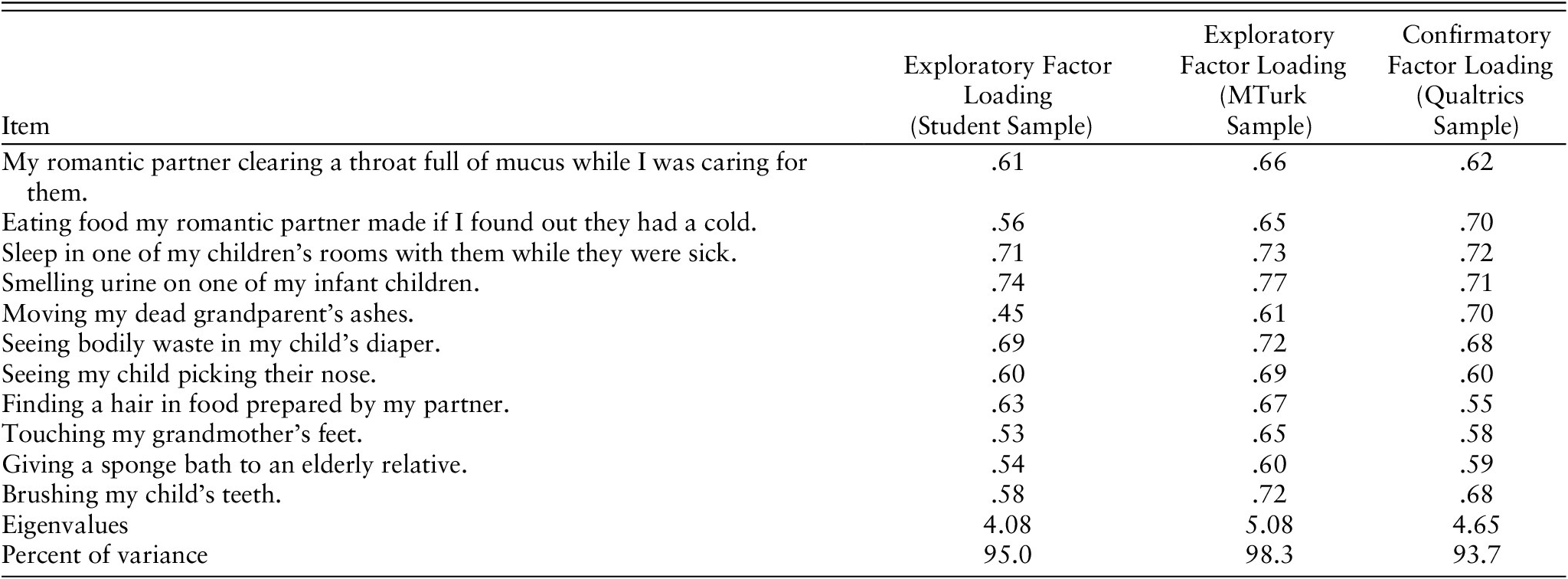
Pathogen disgust was measured using the seven-item pathogen subscale of the TDDS, and caregiving disgust using the 11 items developed in the pilot studies described earlier (see Table 1 for caregiving items and factor analysis across three samples; see appendix Table S2 for a comparison of TDDS pathogen disgust and caregiving disgust).
Caregiving disgust items.

For all models, only the first eigenvalue was greater than 1.
Instructions: “The following items describe a variety of concepts. Please rate how disgusting you find the concepts described in the items, where 0 means that you do not find the concept disgusting at all and 6 means that you find the concept extremely disgusting. 0 (Not at all disgusting) 1 2 3 4 5 6 (Extremely disgusting).”
Note: Question wording in the student and MTurk samples was slightly different for some items compared to the final items (presented here). See online appendix for pilot wording and factor analysis for all 39 items.
We measured social ideology using the six-issue Wilson-Patterson inventory (“protect gun rights,” “support abstinence-only sex education,” and “support prayer in public schools” with “protect abortion rights,” “support transgender people using bathroom of their choice,” and “ban the death penalty” reverse coded; see Wilson & Patterson, Reference Wilson and Patterson1968). This scale had a direction-of-attitude question and a strength-of-attitude question for each issue, resulting in 12 items. The direction-of-attitude question was coded –1, 0, 1 for disagree, uncertain, and agree, respectively, and the strength-of-attitude question was coded 1, 2, 3 for feel not strongly, strongly, and very strongly, respectively. These are multiplied for each issue to arrive at a –3 to 3 rating and then averaged to arrive at a measure of social ideology. Three items were reverse coded so that higher values indicate greater conservatism. We also included a one-item measure of political ideology (from “extremely liberal” to “extremely conservative”) and expected any effects to be weaker on this measure because of measurement error.
Parental status was measured using four questions. The first question asked about parental status in a binary fashion (used in the main analysis). The remaining questions formed a three-item scale of experience with caregiving for young children (up to five years old) with regard to cleaning bodily waste, caregiving during sickness, and preparing food and feeding (used in the exploratory analysis).Footnote 3
We measured sex by asking participants the sex that they were assigned at birth (male or female).
Gender was measured by asking participants whether they identify as a man, a woman, transgender, or gender queer. We did not expect very many individuals to answer transgender or gender queer. Regardless, we intended to examine whether there are different effects for sex versus gender in the exploratory analysis. In the main analysis, we used responses to the sex assigned at birth question.Footnote 4
Gender identity was measured using two continuous scales, one for masculinity and one for femininity, on a scale from 1 to 7 (Gidengil & Stolle, Reference Gidengil and Stolle2020).
Health care industry work was measured with a dichotomous question that asked whether an individual works in the healthcare industry in a position that has direct contact with patients.
Religiosity was measured with a 5-point item about the importance of religion in one’s life.
Education was measured with a standard 6-point item.
Race was measured using a series of checkboxes, which will be converted into dummy variables for analysis.
Latin(x) identity was measured with a dichotomous question.
Age was measured with an open-ended question.
Analysis strategy
We tested our hypotheses with and without statistical controls. We first discuss the models without statistical controls.
To test H1a–H1e, we conducted a series of linear regression models that regress pathogen disgust on sex, either self-reported femininity or masculinity, and their interactions with sex.
To test H1a, we regressed pathogen disgust on dichotomous sex (coded such that male is the reference category); the coefficient for dichotomous sex will indicate the average difference between men and women in pathogen disgust (a test of H1a).
To test H1b and H1d, we conducted a linear regression of pathogen disgust on three predictors: self-reported femininity (centered to ease interpretation), dichotomous sex (coded such that male is the reference category), and their interaction. The interaction term will indicate whether there is a difference in the effect of femininity on pathogen disgust among men and women. If the interaction is significant, we will examine the effect of femininity among men and women separately; if it is not significant, we will focus on the main effect shared across men and women. H1b predicts that femininity is associated with higher pathogen disgust, regardless of sex. If the interaction is significant, this hypothesis predicts both a significant main effect (i.e., the effect among men) and a significant combined effect of the main effect and the interaction (i.e., the effect among women), both indicating greater pathogen disgust. If the interaction is not significant, it predicts a significant positive main effect (i.e., the effect among both women and men). H1d tests the conventional gender identity hypothesis for women. It predicts a significant main effect and interaction such that (1) the combined effect of the main effect and the interaction is positive (i.e., higher femininity, more pathogen disgust among women) and (2) the interaction effect is positive (i.e., the effect of femininity on pathogen disgust is weaker among men than women). Together, these predictions capture the notion that higher femininity among women correspond to conventionalism and that conventionalism is linked to greater disgust sensitivity.
The tests for H1c and H1e were similar, but not identical, to those in the preceding paragraph. We conducted a linear regression of pathogen disgust on three predictors: self-reported masculinity (centered to ease interpretation), dichotomous sex (coded such that male is the reference category), and their interaction. The interaction term will indicate whether there is a difference in the effect of masculinity on pathogen disgust among men and women. If the interaction is significant, we will examine the effect of masculinity among men and women separately; if it is not significant, we will focus on the main effect shared across men and women. H1c predicts that masculinity is associated with lower pathogen disgust, regardless of sex. If the interaction is significant, this hypothesis predicts both a significant main effect (i.e., the effect among men) and a significant combined effect of the main effect and the interaction (i.e., the effect among women), both indicating less pathogen disgust. If the interaction is not significant, it predicts a significant negative main effect (i.e., the effect among both women and men). H1e tests the conventional gender identity hypothesis for men. The predicted result (that masculinity for men is associated with more pathogen disgust) is perhaps counterintuitive because it captures the notion that conventional gender identity as a type of conventionalism is associated with greater pathogen disgust, which acts at cross-pressures to the main effect of masculinity predicted in H1c, which is to reduce pathogen disgust. Together, these predictions capture the notion that higher masculinity among men has a mixed effect, whereby masculine norms decrease pathogen disgust but conventionalism increases pathogen disgust.
It should be noted that the interaction terms may not be significant, which would falsify H1d and H1e while still allowing tests of H1b and H1c, or they may be significant without the directional pattern predicted by H1d and H1e being found. The models proposed here treat femininity and masculinity separately in keeping with research on their orthogonality (Donnelly & Twenge Reference Donnelly and Twenge2017; Gidengil & Stolle, Reference Gidengil and Stolle2020). However, out of concerns for multicollinearity, we leave models that include masculinity and femininity simultaneously for the exploratory analyses.
To test hypotheses H2a–H2f, we conducted a 2 x 2 x 2 ANOVA of disgust (disgust type as a repeated measure by binary sex by binary parental status). We tested for the significance of each set of interactions (in particular, H2c and H2f) and then examined our other hypotheses if those interactions were significant.
To test H2c, we examined the interaction of disgust type and dichotomous sex. If H2c is confirmed, to test H2a, we will conduct a post hoc test of the difference between pathogen disgust and caregiving disgust restricted to women respondents only and, to test H2b, we will conduct a post hoc test of the difference between pathogen disgust and caregiving disgust restricted to men respondents only. If the interaction is not significant, then we will examine the effects pooled across gender (i.e., if H2c is not significant, then H2a and H2b cannot both be true as there is no gender difference)
To test H2f, we examined the interaction of disgust type and parental status. If H2f is confirmed, to test H2d, we will conduct a post hoc test of the effect of parental status on pathogen disgust alone and, to test H2e, we will conduct a post hoc test of the difference between pathogen disgust and caregiving disgust restricted to parents only. If the interaction is not significant, then we will examine the effects pooled across disgust (for H2d) and pooled across parental status (for H2e).
For our exploratory analyses regarding political ideology, we conducted six linear regression models with political ideology as the dependent variable. The first model included only pathogen disgust. The second model included only caregiving disgust. The third model included both types of disgust. The remaining models follow this same pattern, but with controls for sex, masculinity, femininity, child caregiving responsibilities, religiosity, education, and dummy variables for parental status, race (with White as the excluded category), Latin(x) identity, and age. We test for the equality of the disgust coefficients from the first and second models (without controls) and the fourth and fifth models (with controls) using a Chow test to determine whether the effect of disgust is attenuated when considering caregiving disgust. The third and sixth models allow us to determine whether pathogen disgust (or possibly caregiving disgust) account for unique variance in political ideology when controlling for the other type of disgust.
Power analysis
We conducted several a priori power analyses using G*Power software (Faul et al., Reference Faul, Erdfelder, Lang and Buchner2007) to examine the statistical tests proposed in the analysis section. All power analyses assume .80 power with an alpha of .05.
The effect size for sex and pathogen disgust tends to be between the range of a small effect (Cohen’s d = 0.2) and a medium effect (Cohen’s d = 0.5). A recent meta-analysis suggests that sex differences in TDDS pathogen disgust are around 0.39 (Sparks et al., Reference Sparks, Fessler, Chan, Ashokkumar and Holbrook2018). To detect a small effect in multiple regression (Cohen’s f 2 = 0.02), as in H1, which is a more conservative test than in the meta-analysis, a sample size of 395 would be required.
We have less guidance for effects sizes for our other hypotheses, as they concern self-reported femininity/masculinity (which has been less examined in the context of disgust than binary sex) and the new caregiving disgust measure. Thus, we assume small effect sizes by default (i.e., Cohen’s f = 0.10). To detect a small effect size in a 2 x 2 x 2 mixed ANOVA with one repeated measure (i.e., disgust domain), where the repeated measures are correlated at 0.30 (i.e., somewhat less than we observe in the pilot data), we would require 388 participants.
Our target sample size is a minimum of 500 participants, which exceeds the guidelines presented in these power analyses.
Results
We first discuss descriptive statistics and scale reliabilities, followed by the models described earlier. All of the following significance tests are two-tailed.
Descriptive statistics and scale reliabilities
The central concepts in this study are sex, gender identity, parental status, disgust, and political ideology. Our sample is 50.1% female and 49.9% male, based on the sex assigned at birth measure. Among the respondents, 49.5% identify as women, 50.1% as men, 0.5% as gender queer, and 0.0% as other. Among the men, 47.2% rate themselves at the highest point on the 7-point masculinity scale, and 39.0% of women rate themselves at the highest point on the femininity scale. Conversely, 40.7% of men rate themselves at the lowest point on the femininity scale, and 37.0% of women rate themselves at the lowest point on the masculinity scale. Further, 65.8% of respondents are parents. The three-item child caregiving measure has an excellent reliability (Cronbach’s alpha = .90). On the original response scale from 0 to 6, where higher values indicated greater caregiving responsibilities, it has a mean of 4.4 and a standard deviation of 1.3 in the sample as a whole; among women, the average is 5.0, and among men, the average is 3.7. There is a significant gender difference, based on a two-sample t-test, B = –1.26, t(438) = –11.3, p < .001, Cohen’s d = 1.07.
The 7-item TDDS pathogen disgust variable has a good reliability (Cronbach’s alpha = .84). On the original response scale from 0 to 6, where higher values indicated greater disgust, it had a mean of 4.0 and a standard deviation of 1.3. The 11-item caregiving disgust variable also has good reliability (Cronbach’s alpha = .89). It is on the same response scale as TDDS pathogen disgust; it has a mean of 2.3 and a standard deviation of 1.3. Caregiving disgust and pathogen disgust are positively correlated (r = .40).
The six-issue Wilson-Patterson measure of social ideology is less cohesive, with a reliability of Cronbach’s alpha = .63. On the original response scale from –3 to 3, where higher values indicate greater conservatism, it had a mean of 0.3 and a standard deviation of 1.2.
We also report other demographics to assist comparison with other samples. The sample is 74.7% White, 13.3% Black or African American, 2.5% American Indian or Alaska Native, 7.6% Asian, 0.6% Native Hawaiian or other Pacific Islander, and 3.2% other (percentages do not sum to 100% because participants can select multiple categories; 1.8% selected multiple categories). The sample is also 12.1% Latin(x). Participants have an average education in the “some college but no degree” range (2.6 on a 0–6 scale) and average religiosity in the “some guidance in your day-to-day living” category (1.5 on a 0–3 scale). Further, 18.0% of respondents report working in the health care industry.
Hypothesis 1 without controls
For ease of interpretation of the unstandardized coefficients, all variables are rescaled 0 to 1. Femininity and masculinity are centered on 0 to ease interpretation of the interactions.
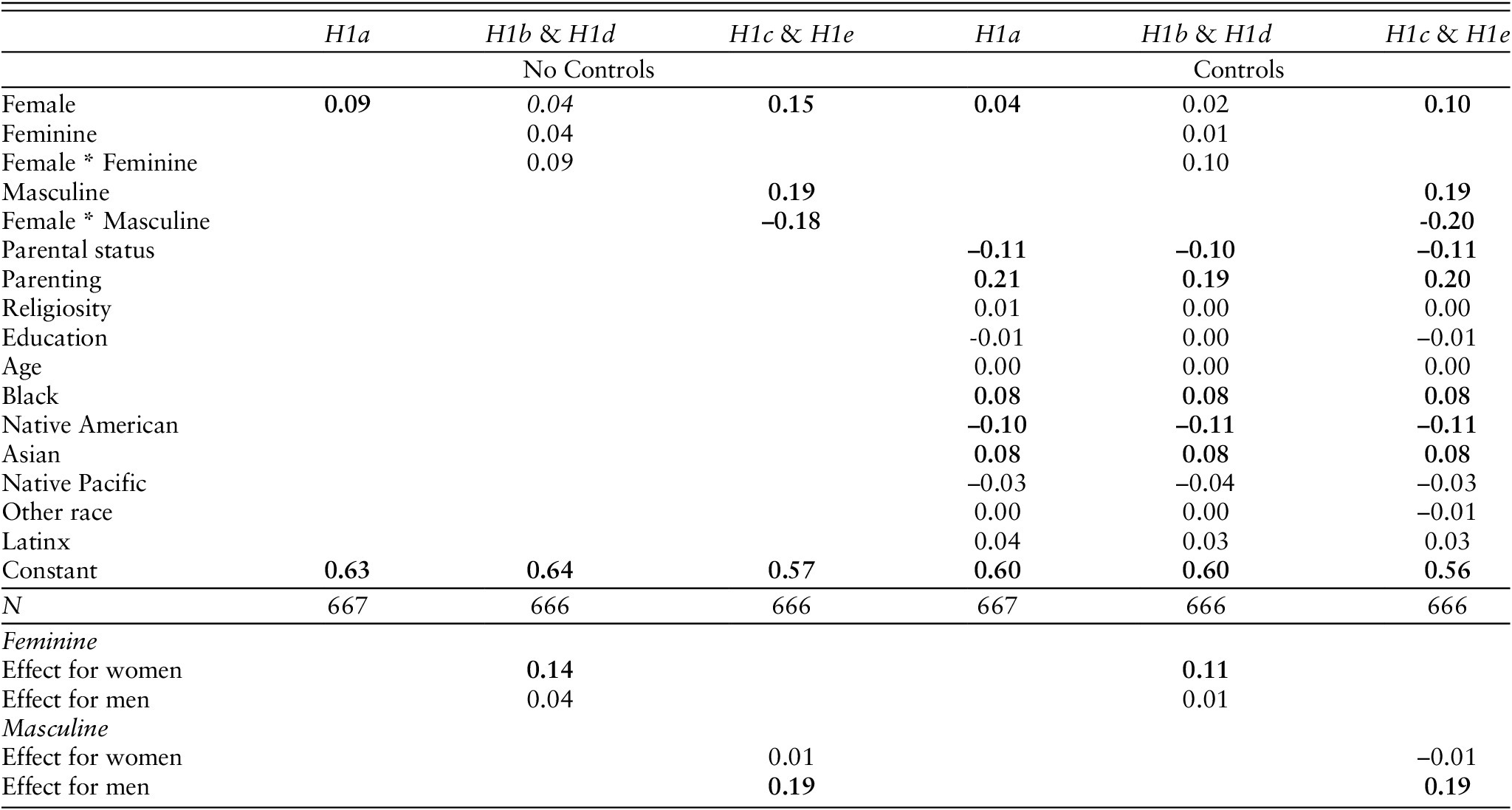
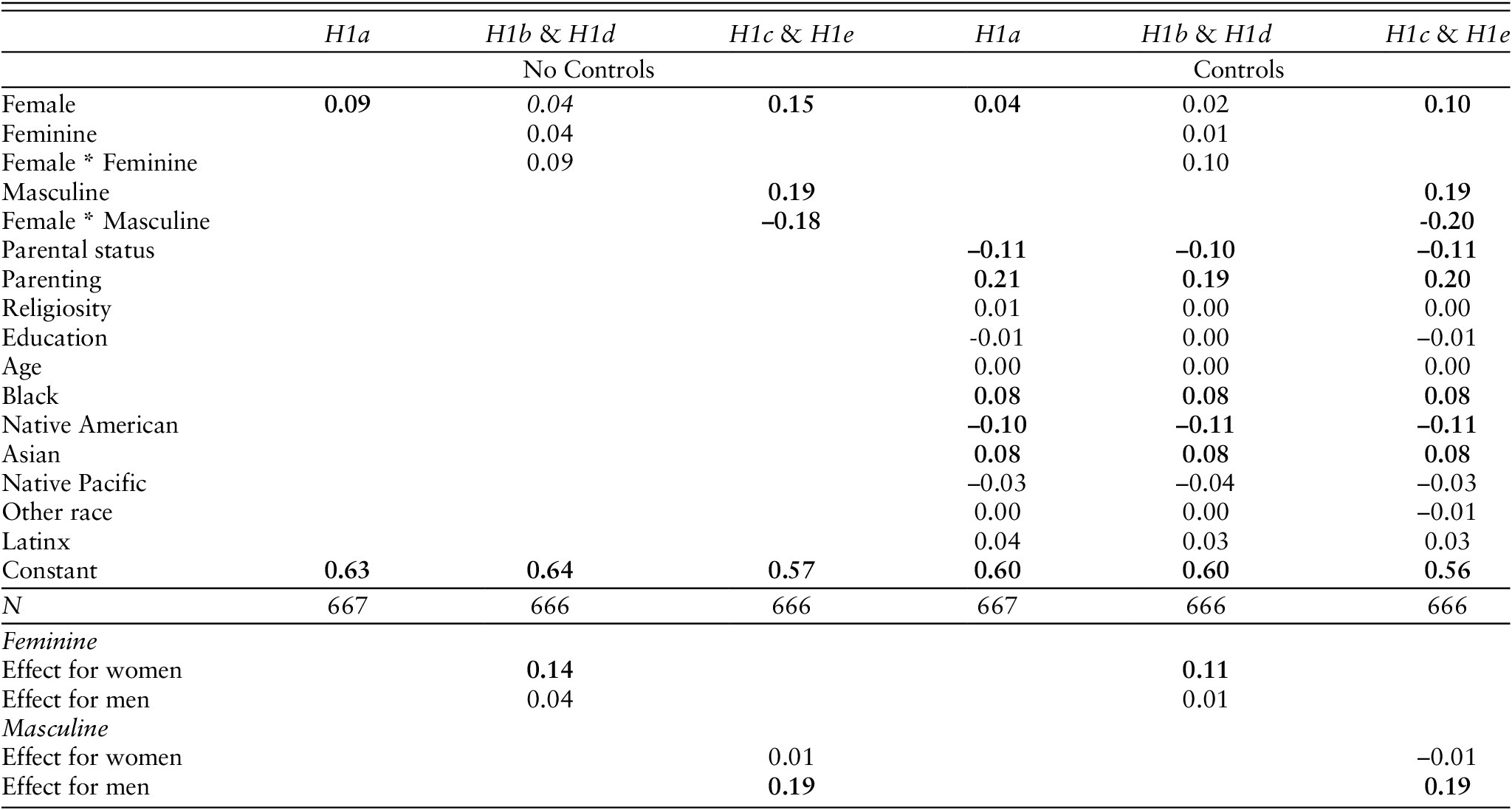
H1a predicts that females will express greater pathogen disgust than males. We first tested this hypothesis by regressing pathogen disgust on dichotomous sex (coded such that male is the reference category), with the results displayed in Table 2. Sex is significantly associated with pathogen disgust, unstandardized B = 0.09, standardized β = 0.21, t(665) = 5.52, p < .001. These results suggest that men express less pathogen disgust than women (i.e., by 9% of the pathogen disgust scale), confirming H1a. This effect is robust when controlling for femininity and masculinity.
Predictors of pathogen disgust.
Notes: Bold values significant at p < .05, italicized at p < .10, standard text p ≥ .10.
Age is in years. Femininity and masculinity were scaled 0 to 1 and then centered on 0. All other variables are scaled 0 to 1.
H1b predicts that individuals with higher levels of self-reported femininity will express greater pathogen disgust, and H1d predicts that females with high self-reported femininity will express greater pathogen disgust than females with low self-reported femininity. We tested these hypotheses by regressing pathogen disgust on sex, femininity, and their interaction. This model explained a significant proportion of variance in pathogen disgust R 2 =.06, Cohen’s f2 = 0.06, F(3, 662) = 13.32, p < .001.
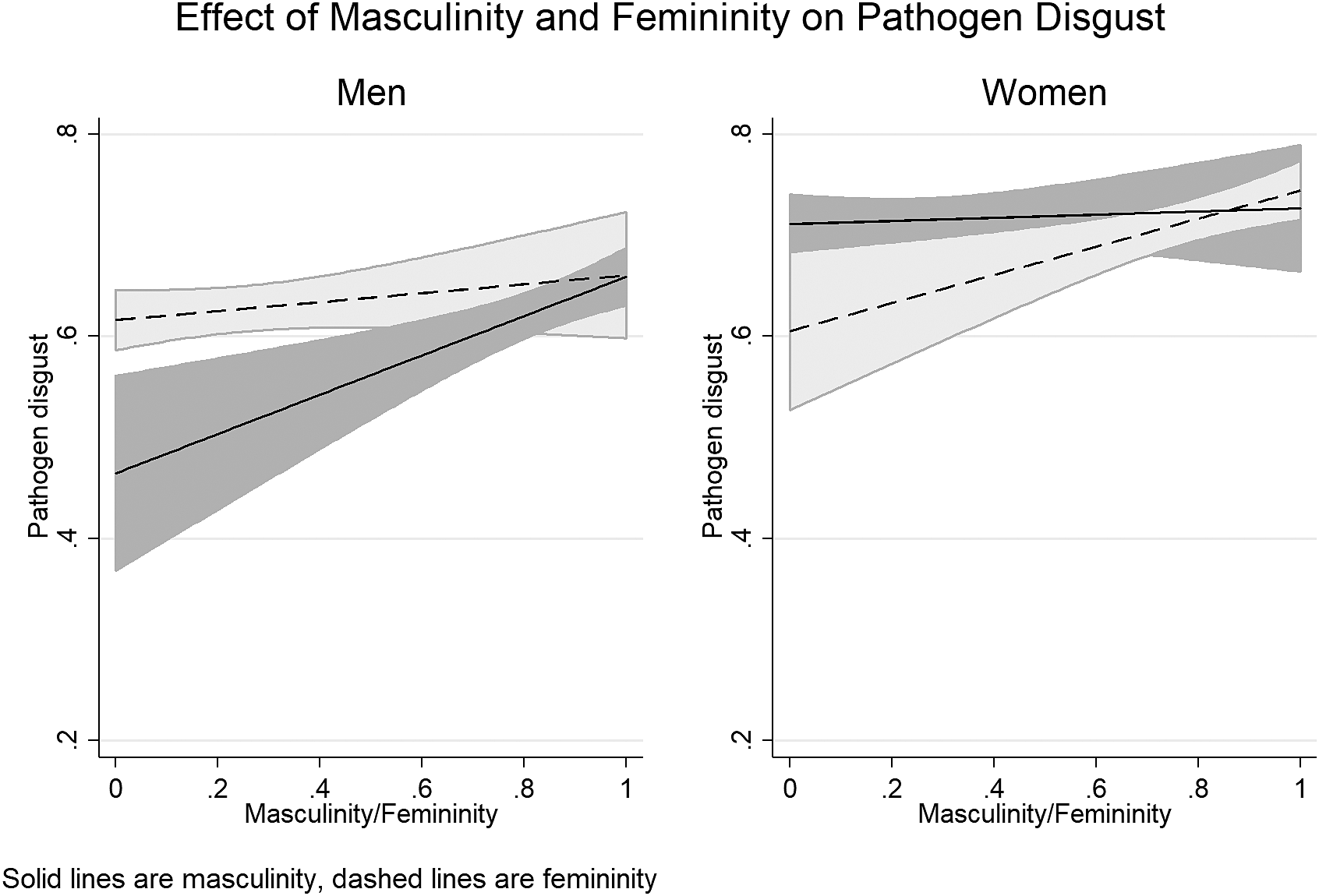
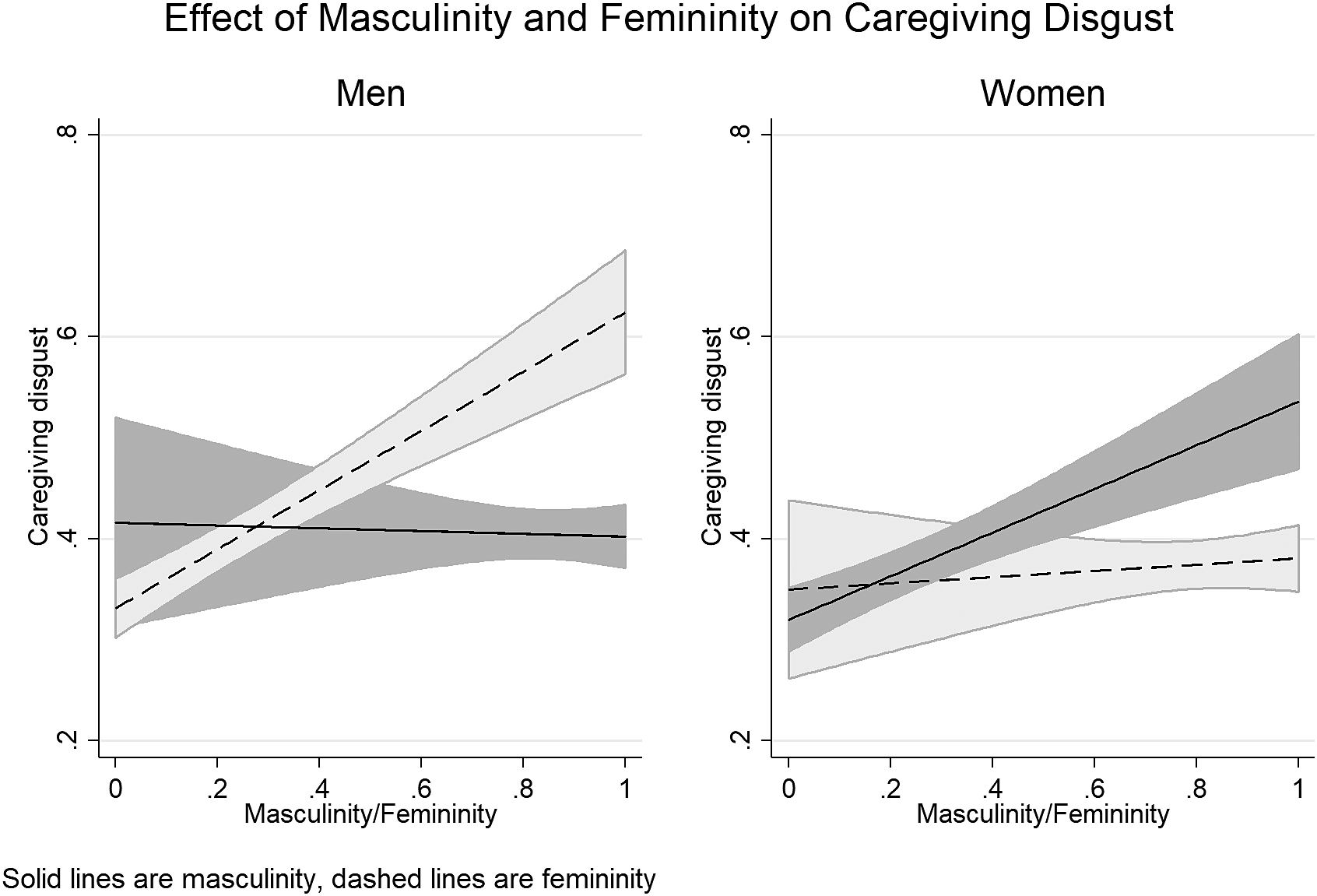
The interaction is not statistically significant, B = 0.09, β = 0.09, t(662) = 1.50, p = .134, indicating that there is no significant difference in the effect of femininity on pathogen disgust between women and men. The main effect is the effect of femininity among men. It is not significant, disconfirming H1b for men, B = 0.04, β = 0.08, t(662) = 1.15, p = .249. For women, the effect is the combination of the main effect and the interaction. This effect is significant, confirming H1b for women and H1d, B = 0.14, β = 0.25, t(662) = 2.97, p = .003. These results suggest that women who perceive themselves as more feminine express greater pathogen disgust (i.e., by 14% of the pathogen disgust scale going from the bottom to the top of the femininity variable), perhaps because they are conforming to feminine gender norms. Men who perceive themselves as more feminine express the same level of disgust as men with lower feminine ratings, despite their self-reported femininity and feminine gender norms surrounding the expression of disgust. Nonetheless, the gender difference is small enough (as indicated by the interaction term) that self-reported femininity plays a similar role in explaining pathogen disgust among women and men. The results for the H1 hypotheses are summarized in Figure 1a. Results for analogous analyses for caregiving disgust are presented in Figure 1b.
Effect of Masculinity and Femininity on Pathogen Disgust

Effect of Masculinity and Femininity on Caregiving Disgust

H1c and H1e provide analogous predictions for masculinity. We tested these hypotheses by regressing pathogen disgust on sex, masculinity, and their interaction. This model explained a significant proportion of variance in pathogen disgust R 2 =.06, Cohen’s f 2 = 0.07, F(3, 662) = 14.38, p < .001. The interaction is statistically significant, B = –0.18, β = –0.21, t(662) = –2.59, p = .010, indicating that there is a significantly smaller effect of masculinity among women than men. We test two additional parameters: the main effect of masculinity (i.e., the effect among men), B = 0.19, β = 0.35, t(662) = 3.47, p = .001 and the joint effect of masculinity and the interaction (i.e., the effect among women), B = 0.02, β = 0.03, t(662) = 0.15, p = .701. H1c predicts a significant and negative main effect, which is disconfirmed, instead indicating that masculinity is associated with greater pathogen disgust among men (i.e., by 19% of the pathogen disgust scale going from the bottom to the top of the masculinity variable); this confirms H1e. H1c also predicts a significant and negative joint effect, which is disconfirmed, instead indicating that masculinity is not associated with pathogen disgust among women.
In sum, the results for masculinity diverge from those of femininity, suggesting that these variables should be considered separately rather than as a unidimensional construct.
Hypothesis 1 with controls
We next tested these hypotheses with a regression model with the variables of interest listed earlier, controlling for continuous child caregiving experience, religiosity, education, age, and dummy variables for parental status, race (with White as the excluded category), and Latin(x) identity. Broadly, the results were substantively unchanged.
Hypothesis 2 without controls
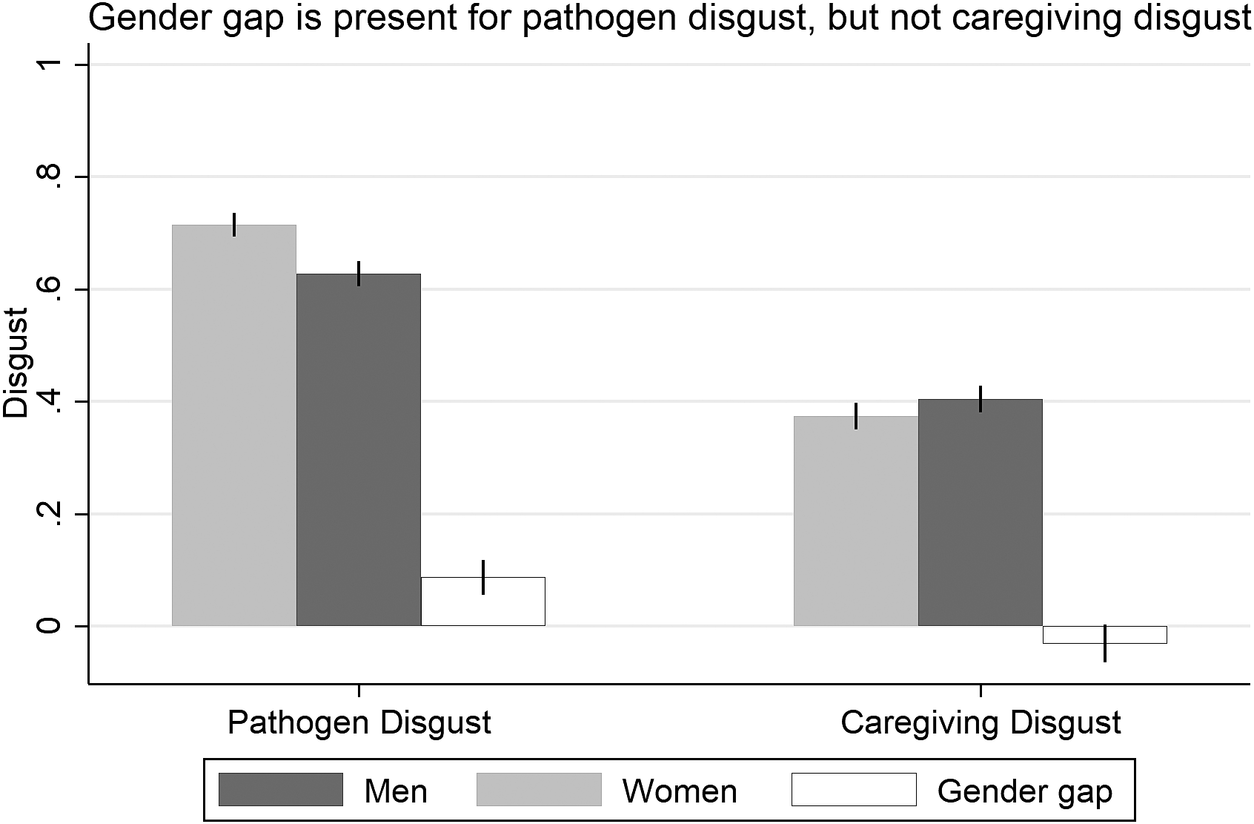
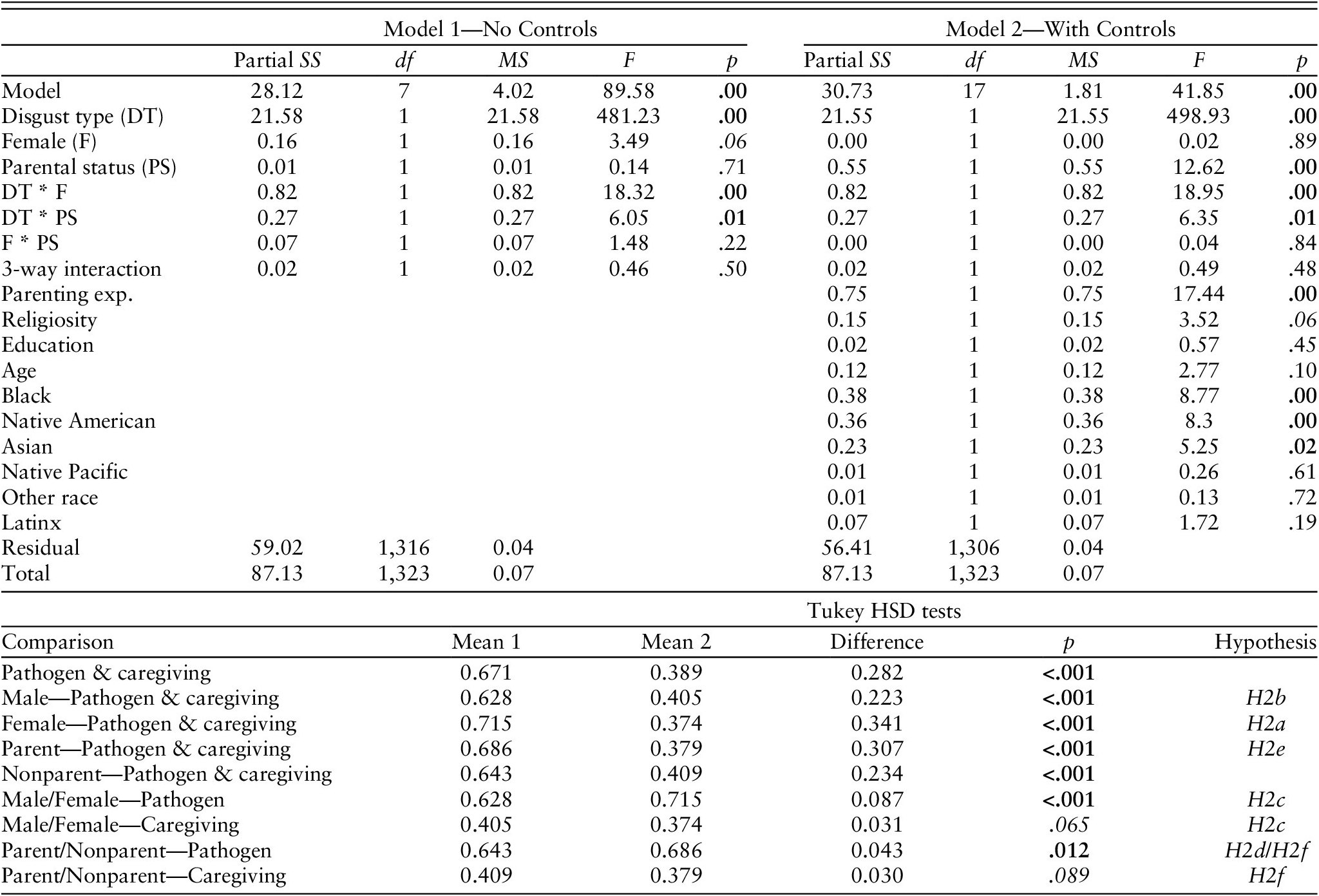
We tested H2a to H2f using a 2 x 2 x 2 ANOVA of disgust response (disgust type as a repeated measure by sex by parental status). The results are summarized in Figure 2. Full model tables are presented in Table 3. The overall model was significant, F(7, 1316) = 89.58, p < .001, indicating that at least one of the pairwise comparisons in the model was significant. Accordingly, we conduct post hoc tests.
Gender gap is present for pathogen disgust, but not caregiving disgust

ANOVA of disgust by type, sex, and parental status.

Notes: Partial SS is partial sum of squares; df is degrees of freedom; MS is mean square; F is the F-statistic; and p is the p-value.
Bold values significant at p < .05, italicized at p < .10, standard text p ≥ .10.
Tukey HSD tests are based on Model 1. The controls in Model 2 do not substantively change these results.
H2c predicts that the size of the gender gap in pathogen disgust (i.e., higher disgust among women than men) is attenuated or reversed for caregiving items compared to the typical pathogen disgust items. A comparison of the two differences (the difference between men’s and women’s caregiving disgust and the difference between men’s and women’s pathogen disgust) is captured by the interaction of disgust type and sex. This interaction was significant, F(1, 1316) = 18.32, p < .001, so we conducted a post hoc Tukey’s HSD test. In the pathogen domain, there was a significant difference between women (M = 0.71, SD = 0.20) and men (M = 0.63, SD = 0.21, p < .001, Cohen’s d = 0.43), such that women expressed more disgust than men. In the caregiving domain, there was no significant difference between women (M = .37, SD = 0.22) and men (M = .40, SD = 0.22, p = .065, Cohen’s d = 0.14). These results confirm H2c, suggesting that the difference in disgust between men and women is attenuated for caregiving items compared to typical pathogen disgust items.
H2a predicts that women express less disgust for caregiving items compared to the typical pathogen disgust items. Using a Tukey’s HSD test, we found a significant difference in the scores among women for caregiving disgust (M = .37, SD = 0.22) and pathogen disgust (M = .71, SD = 0.20, p < .001, Cohen’s d = 1.62), providing support for H2a, that women express less pathogen disgust when items have a caregiving frame.
H2b predicts that men express more disgust for caregiving items compared to the typical pathogen disgust items. Continuing the post hoc analyses, a Tukey’s HSD test revealed a significant difference in the scores among men for caregiving disgust (M = .40, SD = 0.22) and pathogen disgust (M = .63, SD = 0.21, p < .001, Cohen’s d = 1.04), contradicting H2b.
H2d predicts that parents will express less pathogen disgust than nonparents. Because the interaction of parental status and disgust type was significant, F(1, 1316) = 6.05, p = .014, we conducted a Tukey’s HSD post hoc test. In the pathogen domain, there was a significant difference between parents (M = .69, SD = 0.21) and nonparents (M = .64, SD = 0.21, p = .012, Cohen’s d = –0.21), such that parents expressed more disgust than nonparents, contradicting H2d.
H2f predicts that the size of the parental gap in pathogen disgust (i.e., higher disgust among nonparents than parents) is attenuated or reversed for caregiving items compared to the typical pathogen disgust items. Because H2f is premised on the confirmation of H2d, it is necessarily disconfirmed. Nonetheless, we note that in the caregiving domain, there was no significant difference between parents (M = .38, SD = 0.22) and nonparents (M = .41, SD = 0.23, p = .089, Cohen’s d = 0.13), unlike for pathogen disgust. This also runs counter to the logic of H2f, which predicted that the difference between parents and nonparents would be greater in the caregiving domain than in the pathogen domain.
H2e predicts that parents express less disgust for caregiving items compared to the typical pathogen disgust items. Because the interaction of parental status and disgust type was significant, a Tukey’s HSD post hoc test was conducted to compare caregiving disgust and pathogen disgust among parents. There was a significant difference in the scores among parents for caregiving disgust (M = .38, SD = 0.22) and pathogen disgust (M = .69, SD = 0.21, p < .001, Cohen’s d = 1.46). These results suggest that parents express less pathogen disgust when items have a caregiving frame, confirming H2e.
Hypothesis 2 with controls
We next tested these hypotheses with the ANOVAs described earlier, controlling for continuous child caregiving experience, religiosity, education, age, and dummy variables for parental status, race (with White as the excluded category), and Latin(x) identity. Broadly, the results were substantively unchanged across all variables by the addition of control variables; the results of all hypotheses tests remain the same. Full results are presented in Table 3.
Exploratory ideology analysis without controls
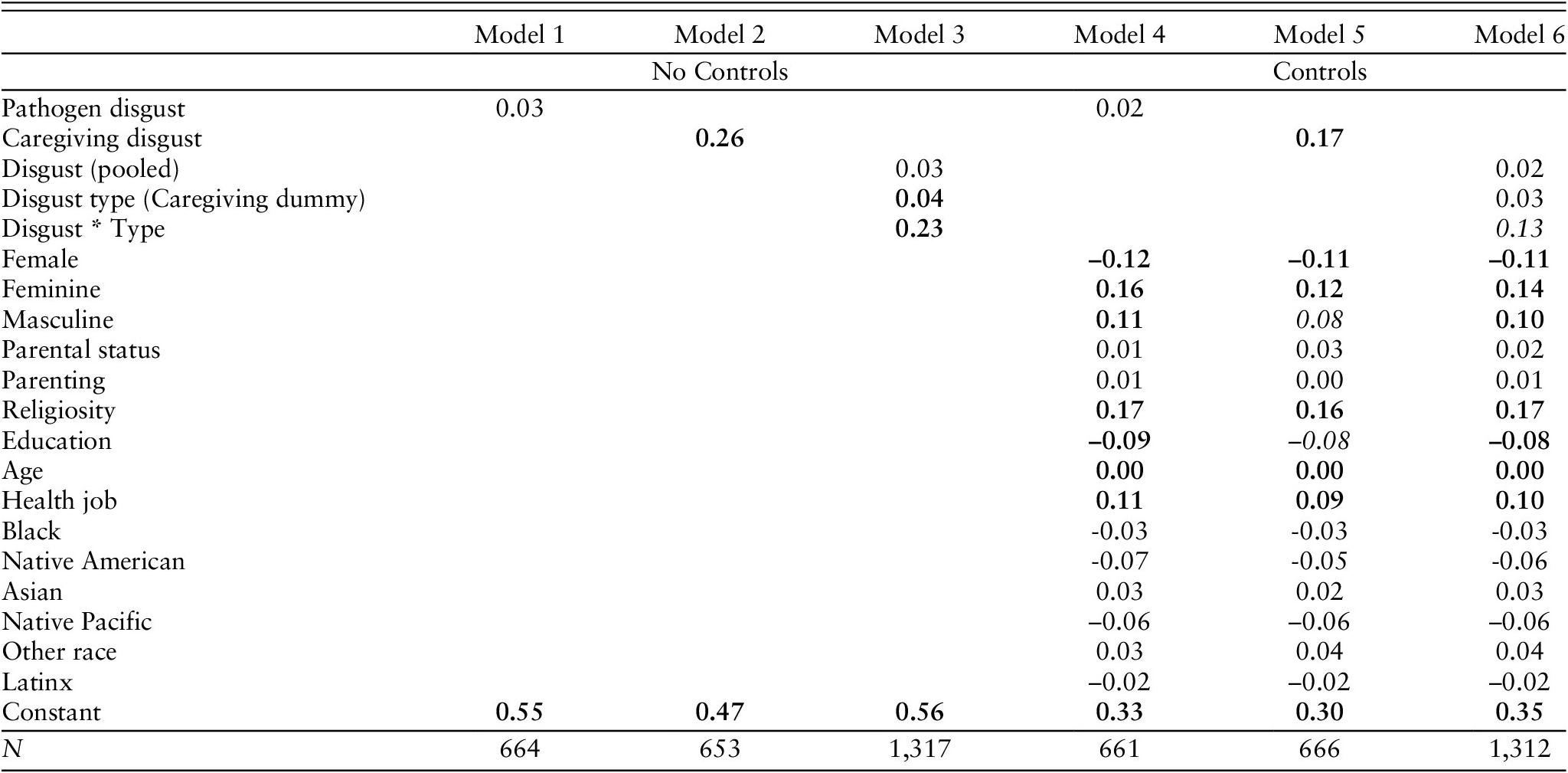
We expect that the relationship between ideology and pathogen disgust will be attenuated in the case of a caregiving frame. To explore this expectation, we conducted six regressions, three without controls and three with controls (see Table 4).
Predictors of political ideology.

Notes: Bold values significant at p < .05, italicized at p < .10, standard text p ≥ .10.
Age is in years. Pooled disgust was scaled 0 to 1 and then centered on 0. All other variables are scaled 0 to 1.
Model 1 regressed political ideology on pathogen disgust. Pathogen disgust did not significantly predict political ideology, B = 0.03, β = 0.02, t(662) = 0.53, p = .596, or the Wilson-Patterson social ideology, B = 0.04, β = 0.04, t(664) = 0.98, p = .328.
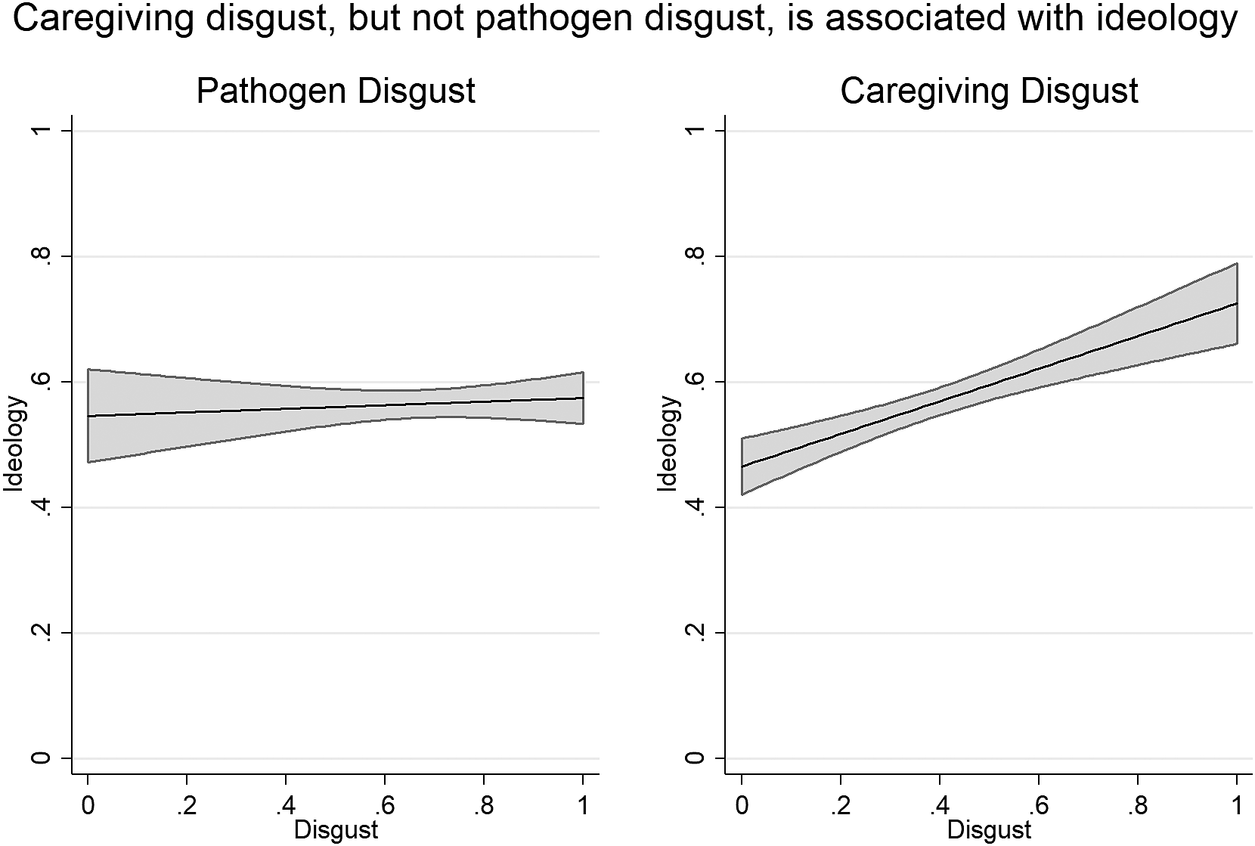
Model 2 regressed political ideology on caregiving disgust. Caregiving disgust significantly predicted political ideology, B = 0.26, β = 0.20, t(651) = 5.15, p < .001. However, for social ideology, it did not, B = 0.02, β = 0.03, t(654) = 0.67, p = .504. This suggests that general conservatism is related to increased self-reported disgust at caregiving tasks (i.e., by 26% of the conservatism scale going from the bottom to the top of the caregiving disgust variable).
Model 3 included both types of disgust simultaneously. This allows us to test whether either type of disgust has an independent effect on political ideology. Pathogen disgust did not significantly predict political ideology, B = 0.03, β = 0.02, t(1313) = 0.53, p = .593, but caregiving disgust significantly predicted political ideology, B = 0.26, β = 0.23, t(1313) = 5.12, p < .001. A Chow’s test revealed that the effect of caregiving disgust was significantly larger than pathogen disgust, contradicting our expectation (p < .001). The results of these models are summarized in Figure 3. For social ideology, neither pathogen nor caregiving disgust had a significant effect, and their effects were not significantly different from each other (p = .829).
Caregiving disgust, but no pathogen disgust, is associated with ideology

Exploratory ideology analysis with controls
Models 4–6 extend the previous models by including controls for dichotomous sex, continuous gender identity, continuous child caregiving experience, religiosity, education, age, and dummy variables for parental status, health care work, race (with White as the excluded category), and Latin(x) identity. We conduct the same tests in these new models. Broadly, the results were substantively unchanged across all variables.
Deviation from preregistration
Because of an oversight in the pre-analysis plan, we neglected to list health care work as a control that we intended to include in the models for H1 and H2. Therefore, it is not included in the results reported here, although it is included in the exploratory ideology models. Its inclusion in the H1 and H2 models does not affect the substance of the results. Nonetheless, although we find little relationship between healthcare work and pathogen disgust (r = .03), there does appear to be a relationship with higher caregiving disgust (r = .20).
In addition, at the request of reviewers, we deviated from the initially approved registered report in several ways. First, in the theory section, we added an explicit statement that this study cannot determine whether sex differences are the result of evolutionary or socialization processes and supplemented our discussion of twin models to include Tybur et al. (Reference Tybur, Wesseldijk and Jern2020). Second, we added Table 1 (and renumbered the subsequent tables) to list the items in the caregiving disgust scale and their factor loadings. Third, we included Table S1, Table S2, and the full text of all of the caregiving items used in the pilot study in the appendix to provide more details on the construction of the caregiving disgust measure and a comparison to TDDS pathogen disgust. Fourth, we clarified the scaling of the unstandardized coefficients near the beginning of the results section, included standardized effects (Cohen’s f 2, Cohen’s d, and β) throughout the results section, and included parenthetical explanations of substantive effects in selected places in the results.
Discussion
In the introduction, we posed four questions regarding how disgust relates to several other variables, including gender, parental status, and political ideology. After an extensive review process of our registered report, we collected data to test our preregistered hypotheses. We find that continuous measures of gender identity reveal new insights about disgust sensitivity, that the effect of parental status varies across types of disgust but not as a function of gender, that reframing disgust in terms of caregiving eliminates the gender gap in disgust, and that the caregiving frame affects the relationship between disgust and political ideology. We address what has been learned regarding caregiving disgust, gender identity, and political ideology before turning to future research directions.
We set out to explore whether responses to disgusting situations would be different if they were framed as common caregiving tasks, particularly as it relates to gender and sex differences and the relationship of disgust to political ideology. We found good scale reliability in the caregiving reframe of disgust items, suggesting this might be a useful measure for testing other research questions. Caregiving disgust correlates positively with an established pathogen disgust inventory, but, as our results show, it differs from pathogen disgust in several meaningful ways. First, for the individuals in our sample, responses to disgusting caregiving situations were lower compared to pathogen items, which we expected for parents and women but not for men. This main effect points to the importance of understanding that pathogen disgust is context dependent and relationship specific, particularly because it eliminates the gender/sex gap reported by other disgust scales.
We also extend the helpful work on testing the explanatory power of sex assigned at birth (i.e., male or female) and gender identity on social attitudes and behavior (Bem, Reference Bem1974; Bittner & Goodyear-Grant, Reference Bittner and Goodyear-Grant2017; Gidengil & Stolle, Reference Gidengil and Stolle2020; Hatemi et al., Reference Hatemi, McDermott, Bailey and Martin2012; McDermott, Reference McDermott2016; Wängnerud, Solevid, & Djerf-Pierre, Reference Wängnerud, Solevid and Djerf-Pierre2019). Indeed, self-described levels of femininity are positively related to caregiving disgust among men, yet it is higher levels of masculinity that are associated with more caregiving disgust in women. This “against type” finding is puzzling and calls for future research. It is possible that men who feel comfortable reporting higher levels of femininity also are more disgusted than less feminine men or are perhaps less influenced by social desirability to appear less disgusted. But then why are women who identify as more masculine expressing greater caregiving disgust? Yet these effects are not in place for pathogen disgust—femininity is unrelated for men, masculinity for women. Conversely, self-reported masculinity is associated with higher pathogen disgust among men, whereas higher femininity is more predictive of pathogen disgust for women. This pattern of findings fits with the notion that individuals who adopt more conventional gender attitudes may be more disgust sensitive. Alternatively, for women, social desirability may drive more feminine women to report higher pathogen disgust and more masculine women (who are pushing against gender expectations) to eschew traditional gender roles like cleaning up after loved ones and therefore express greater caregiving disgust. None of these explanations by itself fully explains the pattern of results for both men and women across both pathogen and caregiving disgust. The present study generated and tested a new disgust measure while simultaneously broadening sex and gender applications; future work should explore and test the mechanisms connecting these differential disgust responses and the interaction with sex and masculinity and femininity.
Turning to politics, in this study, pathogen disgust is unrelated to both unidimensional ideology as well as a battery of social issue attitudes that are similar to those connected to disgust response in past research. Caregiving disgust also appears unrelated to preferences for policies like bathroom choice for transgender individuals, abortion, and prayer in schools. Yet general ideology is connected to the caregiving disgust measure—conservatives are more likely than moderates and liberals to report being disgusted by situations involving their loved ones. We did not set out clear expectations for these exploratory tests. Contrary to our findings, it would be possible that because conservatives in the United States are more likely to endorse traditional gender roles and emphasize the nuclear family, they might say they are less disgusted by things that happen in their homes, with their immediate loved ones (as we depict in our survey items). Conversely, if in our sample, ideology were positively associated with pathogen disgust as well, we could argue that liberals are less likely than conservatives to be disgusted in many types of domains. As the results stand, we do not have a clear explanation, but look forward to future work examining these connections, including examinations of the direction of causation between disgust and ideology. These directions could include replicating whether caregiving disgust has a stronger relationship with political ideology than pathogen disgust, trying to determine what drives the seeming relationship between caregiving disgust and ideology, and examining how caregiving disgust relates to other types of disgust (e.g., sexual disgust and moral disgust on the TDDS).
Furthermore, we were surprised that the unidimensional measure had more explanatory power than the issue attitude items. We looked at the correlations of each individual item, and there were some small effects for men in our sample. For example, higher caregiving disgust is significantly related to conservative positions on supporting abstinence-only sex education (r = .16, p = .003) but with liberal stances on bathroom access for transgender individuals (r = –.15, p = .006). Among women, there were no significant relationships between caregiving disgust and these issue preferences. When we included a transgender bathroom use question, we thought it might capture an updated relationship between disgust sensitivity and a current LGBTQ issue, considering that public opinion, laws, and the U.S. Supreme Court have altered the American perception of the former measure used (Inbar et al., Reference Inbar, Pizarro and Bloom2009)—same-sex marriage. The mixed pattern of results across caregiving and pathogen disgust suggest bathroom policies for transgender Americans may not be related to an underlying disgust orientation. This fits with recent evidence that disgust toward LGBTQ individuals is a direct emotional response—rather than a general disgust sensitivity disposition—to their identities, sexual practices, bodies, and social issues, with higher disgust in reactions to transgender people compared to LGB people (Casey, Reference Casey2016).
Regrettably, because of space constraints, not every exploratory analysis that we discussed in our pre-analysis plan was able to be included in the scope of the final article. We note those analyses here both for transparency and because we believe that they should be explored in future research. These include further work on how continuous gender identity interacts with disgust type and parental status (including when both masculinity and femininity are in the model simultaneously), whether the contrasting gender identity results for pathogen disgust (see Figure 1a) and caregiving disgust (see Figure 1b) can address differences in the effects of pathogen and caregiving disgust on political ideology, the effects of parental responsibilities on disgust rather than dichotomous parental status, and contrasting the effects of adult gender identity and sex assigned at birth (perhaps especially in a sample enriched for transgender respondents).
Future work should also aim to understand the mechanisms and boundary conditions underlying the effects uncovered here. How do individual caregiving experiences (such as, but not limited to, parental responsibilities) and the unequal caregiving experiences among men and women on average affect responding to a caregiving-framed inventory (i.e., as reflecting lived experiences versus hypothetical situations)? What are the mechanisms for the parental effects reported here (e.g., are parental effects about self-selection into parenthood, about parental status as an identity, about parenting experiences, or about other factors)? What role, if any, does sexual orientation and its effects on the expression of masculinity and femininity play in caregiving disgust? To what extent are the effects reported here underpinned by individual or group-level differences in adult hormone levels, exposure to hormones in utero, and other biological influences? How do the relationships discussed here translate across cultures and subcultures?
We have shown that by bringing measures of disgust into specific social contexts, its relationships with social identities, such as gender and with political attitudes, can be substantively affected. We have also shown that a more nuanced approached to gender identity can reveal a complexity to gender dynamics in self-report measures, such as disgust inventories, that are obscured when relying only on a categorical measure of identity. Nonetheless, the specifics of how pathogen disgust, caregiving disgust, masculinity, femininity, and political attitudes fit together remains an open question. While we provide evidence on these points, the results of this study leave the field with many questions to pursue.
Disclosures
Neither author has a conflict of interest or material gain from this study. Human subject approval has been obtained through the IRBs at UIUC (20397) and IUPUI (1911103970).
Supplementary Materials
To view supplementary material for this article, please visit http://dx.doi.org/10.1017/pls.2020.21.