INTRODUCTION
The marine environment of tropical Australia is of global significance. In June 2011 the Ningaloo coast of central Western Australia was listed by UNESCO as a World Heritage Site, the second such marine site in Western Australia after Shark Bay (UNESCO, 2011).
Western Australia is well known for its natural resources, and the areas immediately to the west and north of Ningaloo Reef contain large reserves of oil and gas and therefore are of great interest to the energy industry (Jonasson, Reference Jonasson2011). As such the importance of conserving this region and its biota cannot be understated.
The crustaceans of Ningaloo are poorly known but those of Shark Bay and Dampier Archipelago, over 250 kilometres to the south and north-east respectively, have been better studied (Jones, Reference Jones, Berry, Bradshaw and Wilson1990, Reference Jones2007; Hewitt, Reference Hewitt and Jones2004). Strangely, the off-shore decapods of Ningaloo are arguably better documented than those inhabiting the reef itself. This is a result of the recently published results of the FRV ‘Southern Surveyor' ss10-2005 ‘Voyage of Discovery' in which Poore et al. (Reference Poore, McCallum and Taylor2008) and McEnnulty et al. (Reference McEnnulty, Gowlett-Holmes, Williams, Althaus, Fromont, Poore, O'Hara, Marsh, Kott, Slack-Smith, Alderslade, Kitahara and McEnnulty2011) documented over 300 species of decapods collected between Red Bluff (~24°2′49″S 113°2′17″E) and Barrow Island (~20°59′42″S 114°54′32″E) in depths between 85 and 1295 m. An astonishing 62% of the recorded species were considered to represent either new records for the Western Australian coast or species new to science. Since then, a number of recent biological surveys have been carried out in that region. Research on this wealth of new material will greatly enhance our knowledge about this region's fauna.
MATERIALS AND METHODS
All specimens examined are housed within the Crustacean Collections of the Western Australian Museum, Perth.
Measurements of carapace width by carapace length are given in millimetres.
The following abbreviations are used:
AIMS, Australian Institute of Marine Science; CERF, Commonwealth Environment Research Facilities; DOF, Department of Fisheries, WA; GA, Geosciences Australia; WAM, Western Australian Museum; WAMSI, Western Australia Marine Science Institute.
RESULTS
SYSTEMATICS
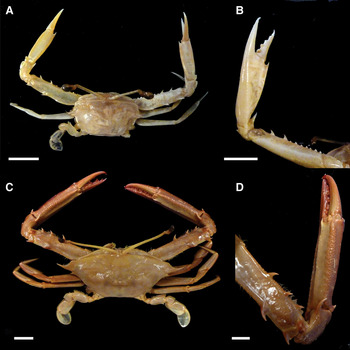
Podophthalmus nacreus Alcock, Reference Alcock1899, male, 24.7 × 13.5 (WAM C42403), from Ningaloo Reef, dorsal view (A) and ventral view of right cheliped (B). Podophthalmus vigil (Fabricius, 1789), male, 127.9 × 52.1 (WAM C11711), from Exmouth Gulf, dorsal view (C) and dorsal view of right cheliped (D). Scale bars: A = 10 mm; B&D = 5 mm; C = 20 mm.

MATERIAL EXAMINED
Western Australia: Ningaloo Marine Park: 2 males, 4 females (1 ovigerous), 12.4 × 7.0–26.4 × 13.3, WAM C38471, West of North-west Cape, 21°48′S 113°56′E, 122.5 m, coll: HMAS ‘Diamantina' Cruise, Station DM 1/24/64 1 February 1964; 1 male, 12.7 × 7.3, WAM C40745, Mandu Sanctuary Zone, 22°08′77″S 113°49′48″E, 72 m, coll: Salotti, M.P., AIMS-WAM RV ‘Cape Ferguson' Ningaloo Survey I April/May 2006, 25 April 2006; 1 juvenile female 14.6 × 8.2, WAM C40895, off Osprey Reef, Station CF4010&11D012, 22°11′53″S 113°47′50″E–22°11′18″S 113°47′57″E, 85.3–81 m, coll: Salotti, M.P., AIMS-WAM RV ‘Cape Ferguson' Ningaloo Survey I April/May 2006, 28 April 2006; 1 male, 24.7 × 13.5 WAM C42403, off Osprey Reef, Stations CF4010 and 11D007, 22°14′55″S 113°45′26″E–22°16′20″S 113°45′11″E, 104–99.7 m, coll: Salotti, M.P., AIMS-WAM RV ‘Cape Ferguson' Ningaloo Survey I April/May 2006, 26 April 2006; 1 female (ovigerous) 19.0 × 10.0, WAM C43228, Mandu Creek, Station SOL4769/2008/1-018SL01, 22°07′09″S 113°47′53″E–22°07′11″S 113°47′53″E, 112.8–113.2 m, coll: Gomez, O.A & Colquhoun, J., AIMS-WAM RV ‘Solander' Ningaloo Survey IV August 2008, 18 August 2008.
Philippines: Mindanao: 1 female (ovigerous) 20.1 × 10.7, WAM C48088, Coronado Bay, 45–126 m, on mud and sand, coll: King, M., RV ‘Pele', 10 February 1964.
COMPARATIVE MATERIAL EXAMINED
Podophthalmus vigil (Fabricius, Reference Fabricius1798): Western Australia: Ningaloo Marine Park: 1 female 108.2 × 46.5, WAM C11602 Muiron Islands, Near Sunday Island, 21°42′S 114°25′E, coll: Liddal, M.A., August 1973. Exmouth Gulf: 3 males, 102.1 × 40.5–127.9 × 52.1, WAM C11711, East of Kailis Fisheries, 22°07′30″S 114°10′00″E, 13 m, coll: Liddal, M.A., 19 May 1974; 1 male, 54.6 × 23.9, WAM C34902, 22°07′38″S 114°13′01″E, coll: Morrison S. & Unsworth, P., DOF-WAM RV ‘Naturaliste' Exmouth Gulf Survey I March 2004, 10 March 2004. Kimberley: 1 female, 102.8 × 46.5, WAM C45977, Cassini Island, 13°57′04″S 125°38′54″E, caught swimming in boat lights at night, coll: Hosie, A.M., WAM-Woodside Kimberley Survey 2010, 14 October 2010.
DIAGNOSIS
Carapace broadly hexagonal, width 1.7–2 times length; regions well defined; fronto-orbital grooves transverse, but lateral portion abruptly angled posteriorly to receive cornea; orbital angle notched. Anterolateral teeth acute, produced laterally; second anterolateral tooth very small. Eye-stalk narrow, cylindrical; distal segment swollen. Cheliped merus anterior margin with row of 5–7 short proximal spines followed by two larger curved, distal spines; posterior margin with two curved spines in distal half; dorsal surface with short distal crista. Propodus with 4 longitudinal carinae; internal surface smooth; inner dorsal carina terminating with acute distal spine. Male gonopod 1 strongly arcuate and evenly tapering, with scattered sharp spinules apically.
DISCUSSION
These specimens are the first records of Podophthalmus nacreus in Australian waters. Podophthalmus nacreus was first described from the Andaman Islands and the Gulf of Martaban by Alcock (Reference Alcock1899) and has since been recorded widely around the Indian Ocean rim (Crosnier & Thomassin, Reference Crosnier and Thomassin1974), and in the Western Pacific (Sakai, Reference Sakai1976; Moosa, Reference Moosa1981) as far east as New Caledonia (Ng & Richer de Forges, Reference Ng, Richer de Forges, Payri and Richer de Forges2007). Based on its known range it is very likely that the distributional range of P. nacreus extends across northern Australia. Podophthalmus nacreus is typically found on soft sediments, and has been recorded in water up to 127 m deep. All of the specimens examined have lost their natural colour but, as denoted by the species epithet, wet specimens still retain their nacreous sheen.
The species of Podophthalmus form a curious group, easily distinguished from other Australian portunids by their unusually long eye-stalks, a feature more commonly associated with the families Ocypodidae and Macrophthalmidae. Podophthalmus vigil is also a wide ranging species in the Indo-West Pacific and has long been known in eastern Australian waters. It was first reported in Western Australia from Exmouth Gulf by Stephenson & Campbell (Reference Stephenson and Campbell1960) and its range extends north into the Kimberley region of Western Australia (Hewitt, Reference Hewitt and Walker1997). The third species of the genus, P. minabensis Sakai, Reference Sakai1961, has been reported only from Japan and Sarawak (Bruce, Reference Bruce1965; Sakai, Reference Sakai1976). More detailed descriptions of both P. nacreus and P. vigil can be found in Sakai (Reference Sakai1939) and Dai & Yang (Reference Dai and Yang1984) and the key published by Sakai (Reference Sakai1976) easily distinguishes all three species in the genus.
Knowledge about the benthic invertebrate fauna of key economic areas of Western Australia is poor, especially when compared with that about areas of similar latitudes in other parts of Australia (Human & McDonald, Reference Human and McDonald2009). Published results of recent surveys, such as those of Poore et al. (Reference Poore, McCallum and Taylor2008) and McEnnulty et al. (Reference McEnnulty, Gowlett-Holmes, Williams, Althaus, Fromont, Poore, O'Hara, Marsh, Kott, Slack-Smith, Alderslade, Kitahara and McEnnulty2011), illustrate this paucity of information while serving to redress this situation.
ACKNOWLEDGEMENTS
I thank Mrs Lee Betterridge and Miss Stacey Osborne (both WAM) for their assistance with specimen processing. Funding for expeditions was provided by WAMSI for Node 3 Project 3.1.1: Deepwater Communities at Ningaloo Marine Park; AIMS, GA, CERF; and Woodside Energy Pty Ltd for Woodside Collection Project (Kimberley) 2008–2011 without whom the specimens might never have been collected.