INTRODUCTION
Delirium is one of the most common psychiatric complications in advanced cancer patients, which occurs in up to 85% of patients with end-of-life stage cancer (Breitbart & Alici, Reference Breitbart and Alici2008). Delirium has been reported to be associated with increased morbidity, mortality, prolonged hospital stays, negative economic impact, and emotional burden not only on patients but also on caregivers (Francis et al., Reference Francis, Martin and Kapoor1990; O'Keeffe & Lavan, Reference O'Keeffe and Lavan1997; Breitbart et al., Reference Breitbart, Gibson and Tremblay2002; Leslie et al., Reference Leslie, Zhang and Holford2005; Leslie et al., Reference Leslie, Marcantonio and Zhang2008). Almost half of delirium cases are reversible if the underlying causes of delirium are recognized and successfully addressed (Lawlor et al., Reference Lawlor, Gagnon and Mancini2000). Thus, the importance of the detection of delirium, identification of its contributing causes, and precise management has been repeatedly emphasized (Breitbart & Alici, Reference Breitbart and Alici2008; Caraceni & Simonetti, Reference Caraceni and Simonetti2009).
Delirium is often under-diagnosed in various medical settings. Previous studies have demonstrated its under-detection and the related risk factors in general medical units, geriatric hospitals, and postoperative populations (Inouye, Reference Inouye2006; Mittal et al., Reference Mittal, Majithia and Kennedy2006; Young & Inouye, Reference Young and Inouye2007; Irwin et al., Reference Irwin, Rao and Bower2008). Several studies on delirium have been conducted among cancer patients, but the information obtained has been limited because of assessment methods without diagnostic criteria, inconsistent object setting, small sample size, or retrospective design (Cobb et al., Reference Cobb, Glantz and Nicholas2000; Braiteh et al., Reference Braiteh, El Osta and Palmer2007; Fang et al., Reference Fang, Chen and Liu2008; Leonard et al., Reference Leonard, Agar and Mason2008). Nevertheless, the difficulty of delirium detection necessitates the education of palliative care practitioners (Meijler et al., Reference Meijler, Van Heest and Otter2005). To date, it has not been reported how the mental condition of delirious patients is assessed by non-psychiatric physicians in an oncological setting. We know of no reports about the final status of misdiagnosed patients or the significance of the recognition of delirium; i.e., whether the identification of delirium by primary medical staff leads directly to appropriate treatment and a favorable outcome.
The comprehensive cancer center of Saitama Medical University International Medical Center is a private institute with 300 beds located near Tokyo in Japan. The Department of Psycho-oncology in Saitama Medical University was established as the first university division of psycho-oncology in Japan in 2005 and it provides a psychiatric service at the cancer center. Three experienced psychiatrists, one psychologist, and research fellows provide medical services and follow-up for cancer inpatients and outpatients. Psychosocial intervention is started whenever a patient is referred by their oncologist.
The purpose of the study was to determine the following aspects of delirium in cancer patients: the detection and the assessment of mental state by the oncologists at the time of consultation; the characteristics of patients who were not accurately diagnosed with delirium; the relationship between the initial recognition by the physician and the outcome in terms of the reversibility of delirium and survival; and the suggestion given by and the intervention of the psychiatrists.
METHOD
Study Population
A retrospective chart review was conducted on all consultations performed by the Department of Psycho-oncology from July 1, 2007 to January 31, 2009. All patients with a histological diagnosis of cancer and a diagnosis of delirium were included. The survey was approved by the Saitama Medical University International Medical Center Institutional Review Board. Delirium was diagnosed based on the Diagnostic and Statistical Manual of Mental Disorders 4th Edition text revision criteria (American Psychiatric Association, 2000) by two experienced psychiatrists separately on the day of the consultation. Its subtype was determined according to motoric form as hyperactive, hypoactive, or mixed delirium through 48-hour observation after the initial referral (Meagher & Trzepacz, Reference Meagher and Trzepacz2000).
Chart Review Procedures
The following information was obtained from electronic medical records by the authors: the patients' demographic background (age, gender); primary cancer diagnosis; the reasons for the consultation and the initial assessment of mental state by the oncologist; the subtype of delirium; the precipitating factors of delirium (shown below); the suggestions or interventions for delirium by psychiatrists (mentioned below); the reversibility of the delirium (fully recovered, partially controlled but deceased later, or deceased without reverse); and the final status of the participants including discharge to home, transfer to other hospitals, and death during hospitalization at the cancer center.
Precipitating Factors
Two psychiatrists considered the possible precipitating factors for delirium separately and then discussed all the cases to determine them finally. As we could not find any appropriate or definite criteria for the precipitating factors of delirium in cancer patients, we defined the common factors in the oncology setting according to previous reports (Francis et al., Reference Francis, Martin and Kapoor1990; Aldemir et al., Reference Aldemir, Ozen and Kara2001; Ljubisavljevic & Kelly, Reference Ljubisavljevic and Kelly2003; Inouye et al., Reference Inouye, Zhang and Jones2007; Pisani et al., Reference Pisani, Murphy and Van Ness2007; Young & Inouye, Reference Young and Inouye2007; Laurila et al., Reference Laurila, Laakkonen and Tilvis2008). They consist of metabolic factors (low albuminemia, glucose instability, electrolyte abnormality, or liver, and renal or respiratory impairment), dehydration diagnosed by clinical features, psychoactive medications known to cause delirium (sleep inducers, anxiolytics, antidepressants, opioids, anticholinergics, or dopaminergics), inflammation/infection/disseminated intravascular coagulation, intracranial factors (metastasis, hydrocephalus, degenerative brain changes, or infarction revealed by radiological examination), recent major surgery (within one week before the onset of delirium), and environmental factors (being in an intensive care unit or annoying physical stimulation like painful urethral catheterization). There was no case with chronic cognitive, visual, or hearing impairment, which are reported as predisposing factors for delirium among geriatric populations (Pisani et al., Reference Pisani, Murphy and Van Ness2007; Laurila et al., Reference Laurila, Laakkonen and Tilvis2008).
Suggestions or Interventions by Psychiatrists
After the diagnosis of delirium, the psychiatrists provided as many proposals as possible for its palliation, including the prescription of antipsychotics, withdrawal of potentially harmful psychotropics, adjustment of opioid dosage, investigation of the underlying precipitating physical abnormalities of delirium, staff education about the clinical features and non-pharmacological care of delirium, the control of annoying environmental factors, reconsidering cancer treatment options, and giving the family members information about the patient's condition and end-of-life issues if necessary. The psychiatrists followed up all the cases daily until their recovery, death, or discharge.
Data Analysis
Statistical analyses were performed using the Statistical Package for the Social Science SPSS (version 16.0; SPSS Inc, Chicago, IL). Patients' backgrounds, subtypes, precipitating factors (dehydration was omitted from the analysis as there was no such case), interventions, and outcome were compared between the two groups of delirium recognition by the oncologist at the time of consultation. Categorical variables were described using the χ2 test; whereas, the mean age, and the mean duration of delirium and survival were compared by the t test. A p value of <0.05 was considered statistically significant.
RESULTS
The Characteristics of the Referred Cancer Patients
Of a total of 334 inpatient consultations during the study period, 60 (18.0%) cancer patients were diagnosed with delirium by the psychiatrists. The mean and median age were 64.7 and 68.0, and 23 patients (38.3%) were female. Their primary cancer diagnoses included gastrointestinal (n = 26), genitourinary (n = 10), breast (n = 9), hematological (n = 5), respiratory (n = 3), brain (n = 2), head and neck (n = 3), and unknown primary location (n = 2). Three patients who were initially assessed by the oncologists as having delirium were diagnosed with other psychiatric conditions (schizophrenia, depression, and dementia).
The Recognition of the Oncologists
Of the 60 delirious patients, 38 (63.3%) were recognized as having delirium by the oncologists at the time of consultation; whereas, 22 (36.7%) were misdiagnosed as to their mental condition before consultation with the psychiatrists. The initial assessment of mental state by the oncologists for the 22 misdiagnosed participants produced diagnoses of anxiety (n = 7), other acute psychosis (n = 6), akathisia (n = 4), annoying character (n = 2), insomnia (n = 2), and dementia (n = 1) (Figure 1).
Oncologists' recognition of delirium before consultation with psychiatrists.

Comparison Between Accurately Recognized and Misdiagnosed Patients
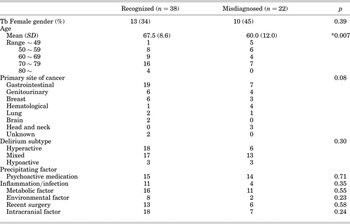
Table 1 represents the characteristics of the patients according to the oncologists' recognition of delirium. The misdiagnosed patients were significantly younger than those who were accurately diagnosed (mean [SD]: 60.0[12.0] vs. 67.5[8.6]; p < 0.01). For example, four participants were in their eighties, and all of them were accurately diagnosed with delirium by the oncologists before the psychiatric consultation; whereas, only one among six patients under 50 years old was accurately diagnosed. The primary cancer site, the subtype of delirium, and the precipitating factors were not significantly related to accurate recognition.
Patient characteristics according to the recognition of delirium by oncologists

*Means statistically significant (p < 0.05).
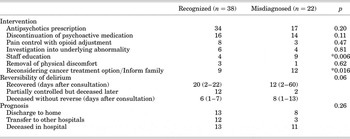
Table 2 shows the interventions by psychiatrists and the outcomes after consultation. The psychiatrists made suggestions to the oncologists for all the referred patients, even when they were accurately diagnosed with delirium before consultation. Among the correctly recognized patients, the main suggestion was pharmacological reevaluation. For the misdiagnosed cases, the psychiatrists suggested a reconsideration of the strategy for cancer treatment and the provision of information to the patient's family members about their condition significantly more often (χ2[1] = 5.83; p = 0.016). For example, if the reversibility of delirium was not expected because of an unexpectedly serious physical condition, the psychiatrists advised withdrawing aggressive anticancer chemotherapy and informing and supporting the family members. Two misdiagnosed cases that had been scheduled to receive chemotherapy but subsequently had it postponed on the psychiatrists' advice declined rapidly and died without identification of the possible causes within a few days of the consultation. In a similar way, staff education in cancer wards was conducted significantly more often for misdiagnosed cases to ensure optimal care of the delirious patients (χ2[1] = 7.58; p < 0.01). The education ranged from information about the clinical features of delirium to non-pharmacological daily care such as how to communicate with delirious patients and how to arrange the environment. Although the result was only marginally significant (p = 0.06), the misdiagnosed patients' life prognosis was poorer. The misdiagnosed patients and accurately recognized cases were not different in terms of final status and duration until recovery, death, or discharge.
Intervention by psychiatrists and outcome

*Means statistically significant (p < 0.05).
DISCUSSION
The findings of our survey imply several important aspects about the clinical significance of delirium in cancer patients.
First of all, more than one third of the patients with delirium were misdiagnosed by the oncologists despite the fact that it was recognized that something was wrong with their mental condition. Previous studies reported under-recognition of delirium, but our result also revealed difficulty in the appropriate assessment of psychiatric abnormalities. The misdiagnosis patterns suggest that there should be more education provided for oncologists. Although careful monitoring and detection of any psychiatric symptom is the first step, it should be underlined that a wide variety of symptoms could represent the clinical signs of delirium.
During the past two years, we have educated staff about the akathisia induced by antiemetics, which has led to earlier detection (Kawanishi et al., Reference Kawanishi, Onishi and Kato2007). This could be the reason why relatively large numbers were misdiagnosed with akathisia by the oncologists. We are considering a more sophisticated educational approach to decrease false diagnoses, although we are optimistic about this type of misdiagnosis because it suggests the efficacy of education for introducing appreciation and careful monitoring of psychiatric disorders and prompt consultation.
Our survey showed no relationship between misrecognition and delirium subtype. This could be because our results were based on the consultation cases only. The actual prevalence of non-hyperactive delirium could be even higher. Fang et al. reported in their prospective study that the detection rate of hypoactive delirium by palliative care teams is only 20.5%; whereas hyperactive delirium was detected in 95.7% (Fang et al., Reference Fang, Chen and Liu2008). Braiteh et al. reported that the palliative care consultation team often revealed delirium that had not been appreciated by the referring physicians (Braiteh et al., Reference Braiteh, El Osta and Palmer2007). Some delirious cases in our hospital might be unrecognized and not have the opportunity to receive appropriate management without psychiatric referral. Effective instruction to detect not only hyperactive delirium but also the mixed and hypoactive forms is important because the hypoactive type is reported to be more prevalent among cancer patients (Fang et al., Reference Fang, Chen and Liu2008) and also because the non-hyperactive subtypes are reported to be related to poorer prognosis (Olofsson et al., Reference Olofsson, Weitzner and Valentine1996; Stagno et al., Reference Stagno, Gibson and Breitbart2004).
Second, the misdiagnosed patients were significantly younger than the accurately recognized participants. One reason may be that the typical image of delirium is that “delirium occurs among older people”. Another possible reason is that all our cases younger than 50 showed symptoms that are difficult to diagnose as delirium, such as anxiety, insomnia, or attention shifting. Again, the importance of education about the clinical features of delirium has been highlighted.
The most noteworthy result is about the intervention by the psychiatrists. Reconsidering the cancer treatment strategy and giving informed consent to the family members were the main suggestions for misdiagnosed cases. These are especially important because without them the physicians could miss the opportunity to detect underlying physical abnormalities, determine the best treatment option, and explain to the patients and their families about the patient's condition and end-of-life issues. Actually, two misdiagnosed cases in this study declined rapidly and died one and three days after being diagnosed with delirium, both of which had been scheduled for aggressive chemotherapy until the consultation.
Staff education seems especially essential in cancer care because without understanding of the underlying psychiatric mechanisms, the nurses were often confused by the patients' unreasonable behavior and sometimes had a negative feeling towards the patients. Especially in cases of patients who were misdiagnosed as having character disorders, the psychological burden on the oncology staff was inevitably high. After our intervention, ward staff members not only gave more appropriate daily care to the patients but also confessed to having counter-transference feeling towards the patients. Non-pharmacological daily care for delirious patients was reported to be valuable but often underutilized among the older population (Inouye, Reference Inouye2000). It is also important for physically fragile cancer patients because non-pharmacological approaches can minimize the necessity of medication.
We proposed various suggestions about the care of delirium even if the oncologists had diagnosed delirium before consulting the psychiatrists; i.e., the management of delirium is not sufficient without a multi-factorial approach in physically complicated patients.
We could not show any statistically positive prognostic effect caused by appropriate diagnosis and intervention by the psychiatrists. Although it is difficult to prove the positive impact on prognostic outcome quantitatively (Kissane, Reference Kissane2009), we believe such intervention brings a better quality of care for cancer patients and families, good mental health, and improved motivation of medical personnel.
There are several methodological limitations to our study, including its retrospective design, rather small sample size, and precise diagnosis based on established criteria but without quantitative delirium assessment instruments. As we showed in this report, the diagnosis of delirium is a difficult task and precise recognition and a multi-dimensional intervention are essential for patient care, so a further survey is warranted to clarify the factors related to improvement of delirium detection and intervention that would lead to better outcomes in the cancer population.
In conclusion, although delirium is a common complication in cancer patients, its diagnosis remains difficult. Delirium is often confused with other psychiatric conditions like anxiety or acute psychosis. Delirium is likely to be misdiagnosed, especially among younger patients. It is of especial necessity for misdiagnosed patients to be precisely diagnosed with delirium and for medical staff to adjust their care and planning of cancer treatment strategies appropriately and to provide information to patients and caregivers. At the same time, multi-dimensional management of delirium needs to be considered not only for misdiagnosed but also for accurately diagnosed delirious patients.
ACKNOWLEDGMENT
This study was presented in part at the 21st annual meeting of the Japanese Psycho-oncology Society in Tokyo, October 10, 2008.