


Introduction
Arguably the most strongly empirically supported clinical intervention for a range of disorders characterized by avoidance is exposure therapy (Vodde & Gilner, Reference Vodde and Gilner1971; Coldwell et al. Reference Coldwell, Getz, Milgrom, Prall, Spadafora and Ramsay1998). This can be defined as ‘deliberately confronting some ordinarily avoided stimulus that provokes an undesired response, in order to reduce the strength of that response’. Such a reduction in responsivity is termed habituation. Despite the weight of empirical studies demonstrating its efficacy (Kendall et al. Reference Kendall, Robin, Hedtke, Suveg, Flannery-Schroeder and Gosch2005) there remains a great deal of resistance in some quarters to its use, sometimes due to misunderstandings about it (Becker et al. Reference Becker, Zayfert and Anderson2004; Feeny et al. Reference Feeny, Hembree and Zoellner2003). Poorly applied exposure may exacerbate the problems experienced by clients, whether by sensitizing them to the phobic stimulus or by convincing them that exposure therapy will not help them. Marks argues that ‘the most important therapeutic task for exposure theory today is to specify those differences between exposure that is sensitizing and exposure that is habituating’ (Marks, Reference Marks1981, p. 230). We believe that this remains true, and hope that our suggestions will contribute to the solving of that problem.
It is often remarked that there is difficulty in excluding exposure from any therapy study. Wolpe & Rachman (Reference Wolpe and Rachman1960) suggested exposure as the active ingredient in at least one famous case of psychoanalysis, Marks (Reference Marks1981) comments on Freud's opinion that exposure is necessary in treating a phobia, while Galovski & Resick (Reference Galovski and Resick2008) describe a cognitive-processing approach to treatment of post-traumatic stress disorder (PTSD) that consists in good measure of imaginal exposure.
Exposure has been successfully applied to disorders as diverse as needle phobia, panic disorder, obsessive–compulsive disorder (OCD), chronic pain, depression, bereavement and PTSD (Cole et al. Reference Cole, Macdonald, Carus and Howden-Leach2005; Richard & Lauterbach, Reference Richard and Lauterbach2006). These are all characterized by avoidance of some stimulus – the needle, the situations where panic attacks are expected, contamination, pain, distressing associations, painful feelings of grief, and triggers for the activation of traumatic memories. What these all have in common is that the phobic subject is attempting to avoid his/her own reaction to the phobic stimulus – whether that be fear, revulsion, horror, panic, or some other negative response. Marks, for example, comments:
The treatment paradigm of guided mourning assumes that morbid grief reactions are maintained by avoidance of painful feelings about a lost loved person or similar unpleasant topics, and aims at exposing the patient to avoided or painful memories, ideas, or situations, both in imagination and in real life, related to the loss of the deceased (Marks Reference Marks1981, p. 139).
Avoidance (and its opposite, exposure) may be seen as methods of controlling the internal experience of arousal or as ‘perceptual control’ (Marken, Reference Marken1999); the percept in question being the internal experience of arousal, rather than the external stimulus itself. For example, a client with a cat phobia is less fearful of the cat than the experience of anxiety evoked by cats (or cat-related stimuli). Hayes et al. (Reference Hayes, Wilson, Gifford, Follette and Strosahl1996) described the phenomenon as ‘experiential avoidance’.
Marken's ‘Perceptual Control Theory’ was developed the 1950s and 1960s and is related to early connectionist theories (Hebb, Reference Hebb1949; Rosenblatt, Reference Rosenblatt1958) proposing that behaviour is the control of perception. In other words, behaviour (e.g. avoidance of cats) is a means, to the end of maintaining some specific perceptual values at a reference or optimal level (in the case of phobias, keeping fear and anxiety levels low).
Descriptions of exposure treatments generally involve the use of a hierarchy – a predetermined list of exposure tasks that the subject works through, moving on to a higher item only when some habituation has occurred on a lower item (Marks, Reference Marks1981). Thus, we find statements such as ‘a patient must identify all the things that are avoided, and order them according to difficulty in a graded hierarchy’ (Hawton et al. Reference Hawton, Salkovskis, Kirk and Clark1989, p. 102). Such a list may be individually negotiated by the therapist and the client or be provided in a standardized form (McGlynn, Reference McGlynn1971). However, whether standardized or individual, it implies a focus on tasks rather than experiences (Zlomke & Davis, Reference Zlomke and Davis2008). The hierarchy specifies which tasks to attempt as the subject works his/her way through. This procedure does not specify or necessarily relate to the level of arousal (fear).
Marken (Reference Marken1997) proposes a model of behaviour that distinguishes between distal and proximal causes. In relation to avoidance, the distal cause might be the presence of the phobic object (cat), while the proximal cause is the consequent rise in arousal (anxiety). The person controls the level of arousal by withdrawing from the phobic object.
Marken identifies the proximal cause as being the controlled variable, i.e. what the subject is trying to maintain at a specified level. In the case of avoidance, the specified level of arousal that the subject is trying to attain is zero (or at least very low), and it is this that maintains the problem, i.e. the responsivity. For exposure, the goal should be to elevate arousal deliberately.
It is not uncommon for therapists to specify exposure in terms of the distal causes, with the therapist maintaining the focus on encouraging the client to face the place/situation rather than face the fear. The natural result of this is that each step on the hierarchy is treated as a separate goal; the distal variable is held steady, while the proximal variable is ignored, or at least allowed to change without being controlled.
However, if avoidance is viewed as a perceptual control method, then exposure should focus on the variable the subject is trying to control, i.e. it should focus on the attempt to control arousal. Dynamic hierarchies are intended to achieve this focus on the controlled variable.
The dynamic hierarchy method
The method of factors
A dynamic hierarchy is not a predetermined list of behavioural tasks. Rather, the subject and therapist collaboratively identify factors that influence the intensity of the phobic experience – such as closeness of approach, size of the stimulus, colour, texture, verbal descriptions, use of imagery, anticipation of feared consequences, touching or not touching, eyes open or closed, induction of symptoms (e.g. hyperventilation) and so on.
A rough set of versions can be distinguished for each of these factors, e.g. degrees of severity of contamination in a case of OCD. (See the Appendix for an example of the clinical application of dynamic hierarchies with a client.)
Arousal set-point
The client should choose the target level of arousal. The therapist should suggest that the appropriate level is one as high as the subject can tolerate for an hour or so, but no higher; but the decision about what that means should be the unforced choice of the client. One important purpose of keeping it so high is to drive the pace of change. That pace is seen in how frequently the subject needs to step up their arousal to prevent it declining. As habituation occurs, one or more of the factors can be intensified in order to keep the discomfort high. Since the rate of habituation is proportional to the intensity of discomfort (Eberle et al. Reference Eberle, Rehm and McBurney1975), this should maximize the rate of improvement.
Moving up the scale
As the arousal measured by subjective units of distress (SUDs) starts to reduce, subjects should ask themselves ‘what could I now do to push it back up to the set-point?’ That question should prompt the subject to review their factors and find some way of raising their arousal, for example by commencing hyperventilation, evoking fearful memories, or by driving faster (if it is safe and legal to do so). It is in order to reduce the strength of one factor so that a different one can be introduced; for example, to step back from the cat, commence hyperventilation, and evoke feared memories; and then move closer to the cat again as habituation occurs.
Escalating the challenge in order to keep arousal high might be thought to prevent within-session habituation, and therefore between-session habituation. In fact, there is evidence that incomplete within-session habituation is preferable, in that it prevents the return of fear (Rachman et al. Reference Rachman, Robinson and Lopatka1987; Rachman & Lopatka, Reference Rachman and Lopatka1988).
It is sometimes suggested that safety behaviours should be discouraged during exposure (Craske & Barlow, Reference Craske and Barlow2007, p. 42), but this results from thinking of the exposure task and the consequent arousal as being separate. Using the dynamic hierarchies model we can treat safety behaviours as just another in the list of factors that modulate arousal.
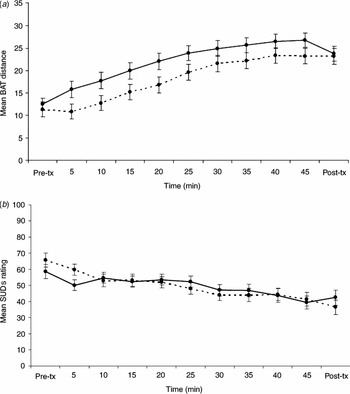
This latter approach is well illustrated in Milosevic & Radomsky (Reference Milosevic and Radomsky2008). They randomized 62 snake-phobic volunteers to two conditions where they approached a snake either with or without gloves and goggles. The subjects with safety equipment achieved closer approach to the snake (Fig. 1a), but SUDs ratings during exposure were identical (Fig. 1b). Post-treatment questionnaires showed significant improvement (p < 0.001) but no significant difference between conditions. This is precisely the pattern we would wish to exploit in using dynamic hierarchies.
(a) Approach to the stimulus and (b) subjective arousal levels during exposure while using (—•—) or not using (- -•- -) safety behaviours. BAT, Behavioral Avoidance Test; SUDs, subjective units of distress. (From Milosevic & Radomsky, Reference Milosevic and Radomsky2008, reproduced with permission from Elsevier Ltd., UK.)

Among the benefits of a dynamic hierarchy approach is that it acknowledges the commonality between different avoidance-based conditions, i.e. that the subject is avoiding the discomfort occasioned by certain triggers. Once clients have learned how to carry out exposure, and experienced the result, they are in a position to apply the same lessons to other areas where they may experience fear, anger, guilt, shame or depression. This might be described as the generalizability of the therapeutic change.
A further benefit is that the therapist does not need to warn against the use of safety behaviours, distraction, self-reassurance and other arousal-prevention behaviours. Using the dynamic hierarchies framework allows the client to examine the function and utility of a range of behaviours in maintaining or resolving their problems. The use of such strategies is discussed with the client and these may be selectively utilized to maintain arousal levels at the agreed ‘set-point’.
A dynamic hierarchy also provides for a smoother escalation in the challenge that subjects present to themselves. Rather than having to simply introduce a new element (such as driving alone rather than accompanied) – which may produce a sharp increase in arousal, possibly beyond what subjects can persuade themselves to accept – a dynamic hierarchy allows the subject to merely ‘top up’ their arousal as it starts to habituate.
Further improvement to the dynamic hierarchy is obtained by paying attention both to the appraisals that we expect to change during exposure, and to the use of cognitive dissonance to maximize such change. We now consider these points in a little more detail.
Appraisals
Appraisal theory attempts to explain emotional experiences by referring both to the evaluative cognitions that accompany (or perhaps cause, underlie or correlate with) them, and to two types of cognitions – knowledge and appraisal (Lazarus & Smith, Reference Lazarus and Smith1988) – in which knowledge is argued to play a distal role and appraisal a proximal role in emotion. Parkinson's (Reference Parkinson1997) review of the evidence is instructive. He questions whether evaluative cognitions have a strictly causal role in emotion. Certainly, from a philosophical perspective (as well as from a three-systems perspective; Lang, Reference Lang and Shlien1968) it makes sense to see appraisals as constitutive of emotions, rather than causal. This does not mean we cannot use behavioural methods to change appraisals, just that we should see ourselves as influencing the whole system of which they are a part. The difference between ‘is’ cognitions and ‘ought’ cognitions is fundamental, and it would be a gross error to confuse them (Hare, Reference Hare and Hudson1969). However, these are deep philosophical waters.
Appraisals may be changed by dissonance-led methods; including disputation (Ellis, Reference Ellis1962), voluntary exposure, and acceptance. An example of the use of disputation to increase dissonance can be found in Festinger (Reference Festinger1957); high-school students were asked to persuade a fellow student of a political position that they themselves disagreed with. The political opinions of the listener changed slightly in the direction opposite to that being argued for, while those of the persuader changed significantly in the direction of their arguments.
If, then, the client's emotional response to a stimulus is to change, we must look to change the client's appraisal (evaluation) of the stimulus. For example, therapeutic change will include a change in attitude to cats, so that they cease to be evaluated as ‘horrible’. Such change can occur if the client engages in behaviour that is dissonant with such an appraisal, and the probability of the desired change can be increased by manipulating the associated cognitive dissonance.
We should also note that descriptive cognitions are susceptible to such cognitive effects as the availability heuristic (Williams et al. Reference Williams, Watson, MacLeod and Mathews1997, ch. 8) – the client's feel for the likelihood of an adverse outcome will be affected by how vividly it is imagined; and this in its turn will be affected by how it is appraised. We predict that reducing a person's emotional responding will cause a reduction in their estimate of the chance of the feared outcome – so changes in descriptive cognition will sometimes be parasitic on changes in appraisal.
Cognitive dissonance
It has been hypothesized that an important mechanism for cognitive change during exposure is cognitive dissonance (Saxby, Reference Saxby1973; Tryon & Misurell, Reference Tryon and Misurell2008), although it must be conceded that the hypothesis still awaits adequate testing.
From the control system perspective, what has been termed ‘cognitive dissonance’ (Festinger, Reference Festinger1957) is better seen as conflict between systems at different levels within the hierarchy – one at a higher (principle or system) level than the other (e.g. programme level). Translating this into a more familiar language, e.g. where there is a conflict between, on the one hand, underlying structures such as schemata, assumptions or value systems and, on the other, the behavioural expressions of those structures, such as self-talk or approach behaviour, the conflict will be resolved by changing either the underlying structure or the behaviour. For the purposes of this paper, however, we shall keep to the language of cognitive dissonance.
Our suggestion is that exposure is therapeutic when it produces a change in attitude (i.e. high-level system), and that such change may be brought about by the mechanism of cognitive dissonance (Festinger, Reference Festinger1957). It is worth noting here that although Festinger's explanation of his theory suggests that the dissonance in question is between two descriptive beliefs (‘I am smoking’ and ‘smoking is bad for me’ being one example he gives), the instances he offers all show discrepancy between a behaviour and a value judgement (witness the above example). This observation suggests that an appraisal (such as ‘this cat is horrible’) is changed by deliberately acting in a manner incompatible with such an opinion, i.e. by exposure.
Thus, the evidence for the effects of cognitive dissonance is primarily around appraisals. Descriptive cognitions or knowledge – statements of putative fact such as ‘everybody hates me’ or ‘I'll never pass my exams’, on which evidence can be brought to bear – are less obviously prone to dissonance-driven change, at least in its direct form. This change of evaluative attitudes (measured by semantic differentials) during exposure is illustrated in Watson et al. (Reference Watson, Gaind and Marks1972, fig. 9) and Marks (Reference Marks1981, fig. 2.2).
One implication of the cognitive dissonance hypothesis for the use of exposure is that the client's choice of level of anxiety should be subjected to as little external influence as possible (Festinger & Carlsmith, Reference Festinger and Carlsmith1959; Zimbardo, Reference Zimbardo1969).
Furthermore, since the pressure to reduce dissonance will be a function of the magnitude of the dissonance, the observed opinion change should be greatest when the pressure used to elicit the overt behavior is just sufficient to do it (Festinger & Carlsmith, Reference Festinger and Carlsmith1959).
The dynamic hierarchy method would conform to this by requiring an ongoing series of decisions-to-continue, each of them (where possible) unforced. The character of these decisions as (relatively) forced or unforced should influence the rate and degree of cognitive change. This is a matter for further research.
If this picture is correct, it suggests that the best way to produce therapeutic change can be specified by looking at how to maximize cognitive dissonance. We know that unforced choices of aversive experience create greater dissonance, and therefore greater drive to change. This means that the ability to escape the exposure at any moment is an important element, provided that the escape is not carried out. Other factors, such as being free to choose the time, duration, frequency and intensity of the exposure will also magnify dissonance (on the model of post-decision dissonance see Festinger, Reference Festinger1957). For this reason, the dynamic hierarchy model is predicted to be more powerful than the static, as it requires the client to make an unforced choice about what to do next.
Discussion
The method of dynamic hierarchies is proposed as a modest theory-driven improvement to the practice of exposure therapy. It is hoped that it will improve the generalizability of therapeutic change, as well as making the processes invoked more transparent. The method of dynamic hierarchies means that we do not create a static hierarchy before starting exposure; instead, we identify which factors conspire to make the stimulus harder or easier, and freely choose to take the harder path.
In addition, the focus on maintaining arousal, rather than on progressing through a list of behaviours, allows for day-to-day variations in the subjects' sensitivity to the phobic stimulus. It also avoids the risk of subjects feeling they have failed if the stimulus is variably arousal provoking across different occasions (‘I managed this yesterday, so I ought to be able to manage it today’).
Thus, whereas static hierarchies focus the subject's attention on the stimulus that evokes arousal, dynamic hierarchies focus attention on the arousal itself. This heuristic should maximize both physiological habituation and change in appraisals by keeping both arousal and cognitive dissonance as high as possible.
It might be in order here to deal with a possible objection; not to the method, but to the idea that it is in any way novel. Hawton et al. (Reference Hawton, Salkovskis, Kirk and Clark1989, pp. 109ff) describe techniques of graded exposure which share some features with dynamic hierarchies. However, we feel that this would be to miss the point slightly. We do not wish to claim that our approach is unprecedented, but rather that it brings together in an organized way a number of techniques that are already in use, and that it provides a reason for those techniques that has previously been absent. The methods proposed by Hawton et al. are offered as ad hoc fixes for the inflexibilities of static hierarchies, while still focusing primarily on the distal variables rather than the proximal ones.
There still remain many points requiring clarification. Does this approach relate at all to the practice of systematic desensitization? Can it be applied to the treatment of the experiential avoidance that causes depression? How does this impact on positive self-talk? Should we consider gradually increasing the arousal set-point? We hope that our proposal will provoke discussion of these and other questions.
Main points
• The present method of generating hierarchies – referred to here as ‘static hierarchies’ – involves specifying exposure in terms of target behaviour.
• An alternative – ‘dynamic hierarchies’ – is suggested, which specifies exposure in terms of the arousal to be achieved by varying the factors which affect it.
• Dynamic hierarchies are generated extempore by clients, guided by a knowledge of the factors that increase or decrease arousal. The aim is to maintain a high level of in-practice arousal.
• The theory of cognitive dissonance suggests that unforced exposure will be more effective in producing change in connotation – and thus affective meaning – than forced. This gives rise to the principle that the client should decide when, where, how, and how intensely to practise; and must be able to terminate the exposure at any point. The repeated sequence of choices-to-continue is (it is argued) required for exposure to be maximally effective.
• The cognitions that we would expect to be changed by this procedure will be primarily evaluative rather than descriptive – absolute value judgements such as ‘this is unbearable’ rather than descriptive cognitions such as ‘I will have a heart attack’. The latter cognitions may be changed, but by disconfirmation rather than by exposure.
Appendix: Example of exposure using dynamic hierarchies
Miss R – avoidance of trauma-related cues
Miss R is a young working-class black woman living in industrial South Yorkshire, who was the victim of an unprovoked attack by three white women outside a nightclub. Her throat was cut in the attack, although she has no clear memory of this aspect. When confronted with reminders, such as images of injury, she re-experiences the attack and can feel and taste blood in her throat. Her ‘hot-spot’ events for this episode include being on her hands and knees on the pavement, being loaded into the ambulance, and in a cubicle at the hospital. She can remember the feeling of her throat being stitched.
Prior to this, she had always had white boyfriends; since the attack she has had only black boyfriends. She will not go to any nightclub alone, and she avoids those clubs where there is a preponderance of white customers.
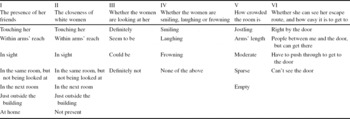
She received instruction in the practice of exposure using dynamic hierarchies. It was emphasized that she should practise frequently and for a good period of time: and that she should try to keep her arousal as high as possible throughout the practice. We discussed what factors would increase or decrease arousal. These arousal-relevant factors included those given in Table 1.
Arousal-relevant factors for Miss R

Clearly some of these factors interact (e.g. II and V, and V and VI). Some are more under her control (I, VI), some less so (II), and others not at all (IV). The control may involve controlling the stimulus (asking a friend to stay close), or the percept (not looking at the women). She was instructed that if someone started staring at her, for example, she might reduce her arousal back to her set-point level by moving closer to her friend, looking away, or moving to a less crowded part of the dance floor. The list of versions of each factor does not need to be in order of severity, although it should ideally represent a good range of different levels of severity. The grading is molar – between whole experiences, each of which has a mix of factors represented, rather than between individual factors. The exercise of grading them is not about producing a static hierarchy, but about teaching the client to construct their hierarchy dynamically and extempore.
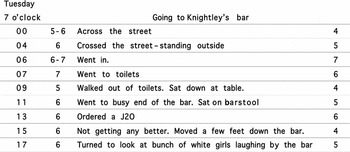
Miss R tried several times to arrange a night out with her friend, but without success. She therefore started working on her hierarchy alone, beginning with bars in the daytime and progressing to nightclubs. She kept a record of her exposure sessions, including arousal levels (see Fig. 2). She used a bluetooth earpiece to record a running commentary on her mobile phone, and transcribed her notes later, but was unwilling to supply a digital copy of her recording.
Excerpt from Miss R's exposure record.

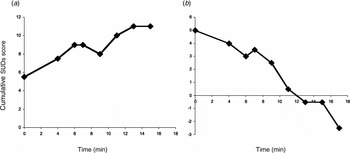
To construct a graphical representation of her progress we associate each rise in SUDs (on stepping up the hierarchy) with the time where it happened, and plot the cumulative rise against minutes into the exposure (Fig. 3a). Notice especially the retrenchment that occurs 9 minutes in: this is entirely compatible with the dynamic hierarchy model, as it was bringing her back to her target arousal level.
Within-session charts showing cumulative subjective units of distress (SUDs) scores for (a) approach and (b) habituation.

Alternatively, we can chart the cumulative habituation by associating falls in SUDs with the times they happened (Fig. 3b)
Declaration of Interest
None.
Learning objectives
• To appreciate the concept of controlled variables, and its application to avoidance and exposure.
• To understand the concept of dynamic hierarchies and be able to apply it in practice.
• To understand the hypothesized relationship between cognitive dissonance and attitude change in exposure, and the implications of this for the organisation of treatment.
• To understand the hypothesized role of evaluative cognitions in emotion, and the relevance of exposure to changing them.



Comments
No Comments have been published for this article.