Palmer amaranth is one of the most troublesome weeds in agronomic row-crop production, due to season-long emergence, rapid growth rate, and prolific seed production (Horak and Loughin Reference Horak and Loughin2000; Keeley et al. Reference Keeley, Carter and Thullen1987). In addition to its innate biological characteristics, the evolution of resistance to several different herbicide sites of action makes Palmer amaranth difficult to control. Currently in the United States, Palmer amaranth populations have evolved resistance to six different herbicide sites of action (Heap Reference Heap2016). In addition to populations that are only resistant to a single site of action, there are several populations that have evolved resistance to multiple herbicide sites of action, which restricts the number of herbicides that farmers can use to manage this weed. In 2013 a population of Palmer amaranth found in Michigan was confirmed to be resistant to three herbicide site-of-action groups: Group 9 (glyphosate), Group 2 (ALS inhibitors), and Group 5 (atrazine) (Kohrt et al. Reference Kohrt, Sprague, Nadakuduti and Douches2017), limiting the number of herbicide options available for Palmer amaranth control in corn.
The 4-hydroxyphenylpyruvate dioxygenase (HPPD)-inhibiting herbicides (Group 27) are potential POST options for control of multiple herbicide–resistant Palmer amaranth in corn. Mesotrione, tembotrione, topramezone, and the new herbicide active ingredient tolpyralate are herbicides that inhibit the HPPD enzyme and may potentially control multiple-resistant Palmer amaranth (Grossmann and Ehrhardt Reference Grossmann and Ehrhardt2007; Mitchell et al. Reference Mitchell, Barlett, Fraser, Hawkes, Holt, Townson and Wichert2001; Witschel 2008). HPPD-inhibiting herbicides control sensitive species by blocking the conversion of 4-hydroxyphenylpyruvate to homogentisate, which leads to the depletion of plastoquinone and α-tocopherol (Grossmann and Ehrhadt 2007; Mitchell et al. Reference Mitchell, Barlett, Fraser, Hawkes, Holt, Townson and Wichert2001; Pallett et al. Reference Pallett, Little, Sheeky and Veerasekaran1998; Schulz 1993). Plastoquinone is a key enzyme cofactor for phytoene desaturase, and its depletion ultimately leads to the inhibition of carotenoid biosynthesis, which results in the bleaching of new tissue (Mitchell et al Reference Mitchell, Barlett, Fraser, Hawkes, Holt, Townson and Wichert2001; Schulz et al. Reference Schulz, Ort, Beyer and Kleinig1993). The inhibition of α-tocopherol results in membrane destruction and degradation of the D1 protein, due to the plant’s inability to quench reactive oxygen species and triplet chlorophyll produced by photosystem II (PSII) (Kruk et al. Reference Kruk, Holländer-Czytko, Oettmeier and Trebst2005; Trebst et al. Reference Trebst, Depka and Holländer-Czytko2002).
Combinations of two or more herbicides can yield either an additive, synergistic, or antagonistic response. These responses are determined by calculating a predicted value and comparing it with an expected value of the herbicide combination (Colby Reference Colby1967; Flint et al. Reference Flint, Cornelius and Barrett1988; Gowing Reference Gowing1960). If the values of the observed and predicted are equal, then the combination is additive. If the observed value is significantly greater than the calculated predicted value, then the herbicide combination is deemed to be synergistic. If the observed value is significantly less than predicted, the combination is antagonistic. Antagonistic responses have been observed with several herbicide tank mixtures (Damalas and Eleftherohorinos Reference Damalas and Eleftherohorinos2001; O’Donovan and O’Sullivan Reference O’Donovan and O’Sullivan1982; Schuster et al. Reference Schuster, Al-Khatib and Dille2008; Selleck and Baird Reference Selleck and Baird1981). For example, previous research has shown that antagonism can occur between the HPPD-inhibiting herbicide mesotrione and sulfonylurea herbicides (Schuster et al. Reference Schuster, Al-Khatib and Dille2008). The addition of mesotrione to nicosulfuron reduced green foxtail [Setaria viridis (L.) Beauv.] control up to 23% compared with nicosulfuron alone. The mechanisms by which antagonism can occur have been attributed reduced absorption, reduced translocation, and physiological interactions at the target site within the plant (Hart and Wax Reference Hart and Wax1996; Green Reference Green1989; Schuster et al. Reference Schuster, Al-Khatib and Dille2007).
A well-documented instance of a synergistic response with combinations of two herbicides has been with the HPPD-inhibiting herbicide mesotrione and the PSII-inhibiting herbicide atrazine (Abendroth et al. Reference Abendroth, Martin and Roeth2006; Armel et al. Reference Armel, Rardon, McComrick and Ferry2007; Hugie et al. Reference Hugie, Bollero and Tranel2008; Woodyard et al. Reference Woodyard, Bollero and Riechers2009a). This synergistic response was observed in giant ragweed (Ambrosia trifida L.), common lambsquarters (Chenopodium album L.), velvetleaf (Abutilon theophrasti Medik.), common waterhemp (Amaranthus rudis Sauer), and redroot pigweed (Amaranthus retroflexus L.) (Abendroth et al. Reference Abendroth, Martin and Roeth2006; Hugie et al. Reference Hugie, Bollero and Tranel2008; Woodyard et al. Reference Woodyard, Bollero and Riechers2009a, Reference Woodyard, Hugie and Riechers2009b), and has also been observed in atrazine-resistant redroot pigweed and velvetleaf (Woodyard et al. Reference Woodyard, Hugie and Riechers2009b). However, the extent of synergistic responses in the atrazine-resistant weed species was dependent on whether the mechanism of resistance was alterede-target site or metabolism based.
The majority of previous research has been focused on the interaction of mesotrione and atrazine. The addition of atrazine to mesotrione and tembotrione has also been observed to increase the level of control in a population of HPPD- and triazine-resistant waterhemp (Hausman et al. Reference Hausman, Singh, Tranel, Riechers, Kaundun, Polge, Thomas and Hager2011, Reference Hausman, Tranel, Riechers and Hager2016). Currently, there is no information available on the potential synergistic effects of atrazine with the newer HPPD-inhibiting herbicides tembotrione, topramezone, and tolpyralate in triazine-resistant Palmer amaranth. While previous research has shown that synergistic responses can occur with mesotrione and atrazine in other atrazine-resistant weed species, it is unknown whether this interaction will exist in the multiple-resistant Palmer amaranth population found in Michigan. Therefore, the objectives of this research were to: (1) evaluate Palmer amaranth control with four HPPD-inhibiting herbicides alone and in combination with atrazine at two different application timings and (2) characterize the response of atrazine-resistant and atrazine-sensitive Palmer amaranth populations to combinations of HPPD-inhibiting herbicides and atrazine.
Materials and Methods
Field Experiments
Field experiments were conducted in 2013 and 2015 in a commercial corn field in Barry County, MI (42.702467°N; 85.524992°W). Previous greenhouse screening has confirmed that the Palmer amaranth population at this location is resistant to glyphosate, ALS-inhibiting herbicides, and atrazine (Kohrt et al. Reference Kohrt, Sprague, Nadakuduti and Douches2017). The soil type was a combination of an Oshtemo sandy loam and a Boyer loamy sand composed of 73% sand, 15% silt, and 12% clay, with a pH of 7.6 and 2.2% organic matter. Field preparation at this location was fall chisel plowing followed by two passes of a soil finisher in the spring. Corn (DKC 48-12, Dekalb, Monsanto, St. Louis, MO) was planted on May 20, 2013, and May 14, 2015, at 67,950 seeds ha−1. The Palmer amaranth population at this location was relatively high, with 484 and 334 plants m−2 in 2013 and 2015, respectively.
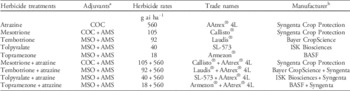
The experiment was conducted as a two-factor randomized complete block design with four replications. Factor A was application timing and Factor B was herbicide treatment. Each plot was 3-m wide by 9-m long. Herbicide treatments were applied when Palmer amaranth was 8 and 15 cm in height. Mesotrione, tembotrione, tolpyralate, and topramezone were applied alone and in combination with atrazine. Table 1 provides a complete listing of product information, application rates, and adjuvants for each herbicide treatment. Herbicide treatments were applied using a CO2-pressurized backpack sprayer calibrated to deliver 187 Lha−1 at a pressure of 207 kPa through 11003 AIXR flat-fan nozzles (TeeJet® Spraying Systems, Wheaton, IL).
Herbicide information for all treatments applied to 8- and 15-cm-tall multiple-resistant Palmer amaranth in Barry County, MI, in 2013 and 2015.

a Abbreviations: COC, crop oil concentrate at 1% v/v (Herbimax®, Loveland Products, Loveland, CO); AMS, ammonium sulfate at 1% w/w (Actamaster®, Loveland Products, Loveland, CO); MSO, methylated seed oil at 1% v/v (Super Spread®, Wilbur-Ellis, San Francisco, CA).
b Manufacturer information: Syngenta Crop Protection, Greensboro, NC; Bayer CropScience, Research Triangle Park, NC; ISK Biosciences, Concord, OH; BASF, Research Triangle Park, NC.
Crop injury and weed control were evaluated 7, 21, and 28 d after treatment (DAT) for the 8-cm application timing and at 7 and 21 DAT for the 15-cm timing. Evaluations were based on a scale from 0% to 100%, with 0% representing no control or crop injury and 100% indicating complete control or total plant death. At the conclusion of the visual evaluations, aboveground Palmer amaranth biomass was harvested from two random 0.25-m2 quadrats in each plot. Biomass was dried for approximately 7 d at 65 C and then weighed to calculate the percent Palmer amaranth biomass reduction compared with the nontreated control plots.
Statistical analysis was conducted using SAS® 9.4 (SAS Institute, Cary, NC). Assumptions of normality of residuals and homogeneity of variances were confirmed using the PROC UNIVARIATE. ANOVA was conducted using PROC MIXED to test for main effects (application timing and herbicide treatment), their interactions, and interactions between years. Since year interactions were not significant, data were combined over both years of the experiment. Multiple comparisons among the means were conducted using t-tests when data were found to be statistically significant at 0.05 levels.
Joint activity between atrazine and each HPPD-inhibiting herbicide was evaluated using the model described by Gowing (Reference Gowing1960) (Equation 1):
 $$E\,{\equals}\,A{\plus}\left( {{{B(100{\minus}A)} \over {100}}} \right)$$
where E is the expected value of the herbicide combination, A is the observed percent control by herbicide atrazine, and B is the observed percent control by the HPPD-inhibiting herbicide. The expected values and observed values for each herbicide combination were compared using t-tests in PROC MIXED. If the observed value was significantly less than the expected value, the combination was antagonistic; if the observed value was significantly greater than the expected value, the combination was synergistic; and if there was no significant difference between the observed and expected values, the combination was additive.
Greenhouse Experiments
Seed heads from the multiple herbicide–resistant Palmer amaranth population from Barry County, MI, were collected in fall 2013 and threshed. We will refer to this population as atrazine resistant (AR) throughout the remainder of the text. Seed from a susceptible Palmer amaranth population was obtained from Larry Steckel, University of Tennessee, and will be referred to as our atrazine-sensitive population (AS). Seeds from both populations were treated with a 50% sulfuric acid and water solution for 4 min, rinsed, and then exposed to gibberellic acid at a concentration of 0.15 gL−1 of water for 6 h to enhance germination. Approximately 15 Palmer amaranth seeds of each of the AR and AS populations were planted 0.75-cm deep in 10 by 10 cm pots filled with potting media (Suremix™ Perlite, Michigan Gower Products, Galesburg, MI). Seedlings were grown in the greenhouse at 25±5 C, and sunlight was supplemented to provide a total midday light intensity of 1,000 µmolm−2s−1 photosynthetic photon flux at plant height in a 16-h day. Plants were watered and fertilized as needed to promote optimum plant growth. After emergence, pots were thinned to 1 Palmer amaranth plant pot−1.
Differential Response of Palmer Amaranth with Four HPPD-inhibiting Herbicides
Mesotrione, tembotrione, tolpyralate, and topramezone were applied at rates ranging from 0.125X to 4X, 0.063X to 2X, 0.031X to 2X, and 0.063X to 2X, respectively, when the AR Palmer amaranth population was 10-cm tall. The 1X rates of mesotrione, tembotrione, tolpyralate, and topramezone were 105, 92, 39, and 18 g ai ha−1, respectively. Tembotrione, tolpyralate, and topramezone treatments were applied with methylated seed oil (MSO) (Super Spread®, Wilbur-Ellis, San Francisco, CA) at 1% v/v and 1% w/w of spray-grade ammonium sulfate (AMS) (Actamaster®, Loveland Products, Loveland, CO). Mesotrione treatments were applied with 1% v/v crop oil concentrate (COC) (Herbimax®, Loveland Products, Loveland, CO) and 1% w/w AMS. Herbicide treatments were applied using a single-nozzle track sprayer equipped with an 8001E TeeJet® flat-fan nozzle (TeeJet® Technologies, Wheaton, IL) calibrated to deliver 187 Lha−1 at 193 kPa of pressure. Weed control was evaluated 14 DAT using a 0% to 100% scale, 0% representing no control and 100% equaling plant death. Aboveground biomass was harvested 14 DAT, dried for 7 d at 60 C, and weighed. Dry weights were converted to the percent of the nontreated control pots. All treatments were replicated five times, and the experiment was repeated in time.
Data were analyzed using nonlinear regression in SigmaPlot v. 11.0 (Systat Software, San Jose, CA). The herbicide dose required to provide 50% control and reduce Palmer amaranth biomass (growth) by 50% (GR50) was calculated for each herbicide using the log-logistic model (Equation 2) (Burgos et al. Reference Burgos, Tranel, Streibig, Davis, Shaner, Norsworthy and Ritz2013):
 $$y\,{\equals}\,c{\plus}{{d{\minus}c} \over {1{\plus}( {{x \over {GR50}}} \right)^{b} }}$$
where d equals the upper limit, c is the lower limit, and b is the relative slope around the GR50. Deviations from the model are indicated by R2 values. Differences in GR50 values between the HPPD inhibitors were detected using the extra sum of squares principle for nonlinear regression (Lindquist et al Reference Lindquist, Mortenson, Clay, Schmenk, Kells, Howatt and Westra1996).
Joint Activity of HPPD-inhibiting Herbicides with Atrazine
Atrazine was applied at rates ranging from 0.031X to 2X (0.04 to 2.24 kg ai ha−1) for the susceptible (AS) population and 0.25X to 32X (0.28 to 35.9 kg ai ha−1) for the resistant (AR) population. These rates were applied alone and in combination with mesotrione at 35 g ai ha−1, tembotrione at 11.5 g ai ha−1, tolpyralate at 2.5 g ai ha−1, and topramezone at 2.25 g ai ha−1. Rates of the HPPD-inhibiting herbicides selected were closely related to the GR50 responses from the previous experiment with the AR population. The 1X atrazine rate was 1.12 kg ai ha−1, regardless of population. COC at 1% v/v plus AMS at 1% w/w were included when atrazine was applied alone or in combination with mesotrione. MSO at 1% v/v plus AMS at 1% w/w were added to the treatments that included tembotrione, tolpyralate, and topramezone. Similar to the previous experiment, all herbicide treatments were applied using a single-nozzle track sprayer equipped with an 8001E TeeJet® flat-fan nozzle calibrated to deliver 187 Lha−1 at 193 kPa of pressure. Weed control evaluations were made 14 DAT on a scale of 0% to 100%. All treatments were replicated six times and the experiment was repeated in time.
Data were analyzed in SAS 9.4 using a method described by Flint et al. (Reference Flint, Cornelius and Barrett1988) to evaluate herbicide interactions. The expected values for the herbicide combinations were derived from the equation developed by Colby in 1967 (Equation 3):
 $$E\,{\equals}\,{{XY} \over {100}}$$
where E represents the expected growth reduction of the herbicide combination, and X and Y are the observed growth reduction with atrazine and HPPD inhibitor applied at specific rates, respectively. Flint et al. (Reference Flint, Cornelius and Barrett1988) developed a statistical test using ANOVA for Colby’s equation to determine whether herbicide interactions were additive, antagonistic, or synergistic. All data were log transformed to account for heterogeneity and allow for slope comparison of the HPPD inhibitors and atrazine applied alone and in combination to determine herbicide interaction (Flint et al. Reference Flint, Cornelius and Barrett1988; Hugie et al. Reference Hugie, Bollero and Tranel2008; Woodyard et al. Reference Woodyard, Hugie and Riechers2009b). Slope estimate comparisons were conducted using PROC MIXED and a series of contrast statements to determine whether the herbicide combinations were additive, antagonistic, or synergistic.
Results and Discussion
Palmer Amaranth Control in the Field with HPPD-inhibiting Herbicides Alone and with Atrazine
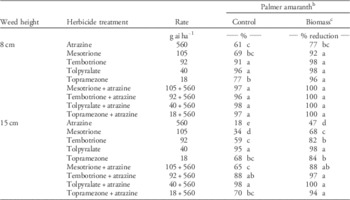
Corn injury was minimal (<3%) with all of the treatments examined (unpublished data). Atrazine applied alone was one of the least effective treatments for Palmer amaranth control, regardless of Palmer amaranth height at the time of application (Table 2). POST applications of atrazine are generally effective for Palmer amaranth control (Norsworthy et al. Reference Norsworthy, Griffith, Scott, Smith and Oliver2008; Stephenson et al. Reference Stephenson, Bond, Landry and Edwards2015). Atrazine plus glyphosate applied POST provided 95% control of a glyphosate-resistant Palmer amaranth population in Tennessee at 28 DAT (Wiggins et al. Reference Wiggins, McClure, Hayes and Steckel2015). Previous research conducted with seed collected from the field where our experiments were conducted has shown that this Palmer amaranth population has a resistance factor of 9.3X for POST-applied atrazine compared with an atrazine-sensitive Palmer amaranth population (Kohrt et al. Reference Kohrt, Sprague, Nadakuduti and Douches2017). Even though we consider this population to be atrazine resistant, control of this population was variable and slightly higher than we expected (61%) for a resistant population when atrazine was applied to 8-cm-tall Palmer amaranth. The observations of live Palmer amaranth plants that survived the POST atrazine application next to dead plants indicates that this population may still be segregating toward an atrazine-resistant population in the field. Palmer amaranth control was <20% when atrazine was applied to 15-cm-tall Palmer amaranth. Atrazine-resistant Palmer amaranth populations have also been reported in Georgia, Kansas, Nebraska, and Texas (Heap Reference Heap2016).
Interaction of weed height and HPPD-inhibiting herbicides applied with and without atrazine on atrazine-resistant Palmer amaranth control and biomass reduction in the field, 21 d after treatment.Footnote a

a This Palmer amaranth population has been confirmed resistant to glyphosate, ALS-inhibiting herbicides, and atrazine (Kohrt et al. Reference Kohrt, Sprague, Nadakuduti and Douches2017).
b Means followed by the same letter are not statistically significant at an α value of 0.05.
c Biomass was collected from two 0.25-m2 quadrats per plot, samples were dried, and biomass was converted to a percent of the nontreated control plots.
Of the four HPPD-inhibiting herbicides applied; tolpyralate provided the greatest control (≥95%), regardless of Palmer amaranth height at the time of application (Table 2). Tembotrione provided <90% control when it was applied at the 8-cm application timing. However, control was significantly lower (59%) when tembotrione was applied to 15-cm-tall Palmer amaranth. Applications of mesotrione and topramezone were not as effective at controlling Palmer amaranth as tolpyralate or tembotrione at the 8-cm application timing, and only tolpyralate effectively controlled Palmer amaranth (95%) at the 15-cm timing. Biomass results were less indicative of the differences in the response of Palmer amaranth to the HPPD-inhibiting herbicides when compared with the control evaluations applied at the 8-cm timing, even though similar trends were observed (Table 2). However, biomass results adequately reflected the differences observed when the HPPD-inhibiting herbicides were applied to 15-cm-tall Palmer amaranth; tolpyralate reduced Palmer amaranth biomass (98%) more than tembotrione and topramezone, and mesotrione was the least effective of the HPPD inhibitors at reducing Palmer amaranth biomass. Variability in Palmer amaranth growth and populations across the plots may have skewed the biomass data, since biomass was sampled from two random 0.25-m−2 quadrats per plot. Each quadrat would not have had the same number of initial plants. Possibly flagging a known number of plants at the time of application and harvesting those plants for biomass would have provided more representative results.
The addition of atrazine to mesotrione and topramezone improved Palmer amaranth control from 69% to 97% and 77% to 97%, respectively, at the 8-cm application timing (Table 2). Adding atrazine to tolpyralate and tembotrione did not improve Palmer amaranth control, possibly due to the level of control provided by these HPPD-inhibiting herbicides applied alone. When Palmer amaranth was 15-cm tall, an improvement in control and percent biomass reduction was also observed when atrazine was added to mesotrione or tembotrione. Even with this improved control, the combination of mesotrione plus atrazine failed to adequately control (65%) larger Palmer amaranth plants. Adding atrazine to topramezone did not improve Palmer amaranth control at the later application timing, and control was only around 70% with topramezone alone or in combination with atrazine. Tolpyralate with or without the addition of atrazine provided the greatest Palmer amaranth control (≥95%) when it was applied to 15-cm-tall Palmer amaranth.
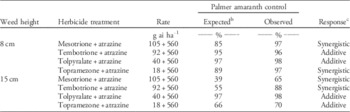
Synergistic responses were observed with the combination of mesotrione and atrazine at both application timings, topramezone and atrazine at the 8-cm application timing, and tembotrione plus atrazine at the 15-cm application timing (Table 3). Weed height at application has previously been reported to influence synergism (Abendroth et al. Reference Abendroth, Martin and Roeth2006). This population of Palmer amaranth possesses non-target site–based resistance to atrazine (Kohrt et al. Reference Kohrt, Sprague, Nadakuduti and Douches2017). Synergism has been observed with atrazine and the HPPD inhibitors in atrazine-resistant weed species; however, the mechanism of resistance can influence the level at which this synergistic interaction occurs. In metabolism-based atrazine-resistant velvetleaf, synergistic interactions were present when atrazine and mesotrione were applied as a tank mixture; whereas in an altered target site–resistant redroot pigweed, synergism occurred with both tank mixtures and when atrazine was applied PRE and mesotrione was applied POST (Woodyard et al. Reference Woodyard, Hugie and Riechers2009b). The lack of synergism in the metabolism-based atrazine-resistant velvetleaf when atrazine was applied PRE followed by mesotrione POST was likely due to atrazine being detoxified prior to mesotrione application.
Joint activity of the combination of HPPD-inhibiting herbicides and atrazine on atrazine-resistant Palmer amaranth control in the field, 21 d after treatment.Footnote a

a This Palmer amaranth population has been confirmed resistant to glyphosate, ALS-inhibiting herbicides, and atrazine (Kohrt et al. Reference Kohrt, Sprague, Nadakuduti and Douches2017). Data were combined over years.
b
Expected control values were calculated using the Gowing (Reference Gowing1960) equation
 $$E\,{\equals}\,A{\plus}( {{{B(100\,{\minus}\,A)} \over {100}}} \right)$$
.
c A synergistic response occurred when the observed control value was statistically greater than then the expected control value at α≤0.05.
Differential Response of Atrazine-Resistant Palmer amaranth (AR) with Four HPPD-inhibiting Herbicides in the Greenhouse
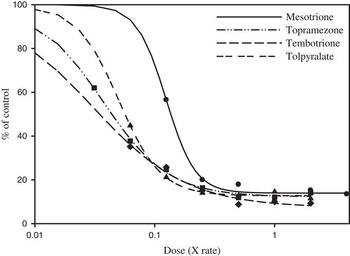
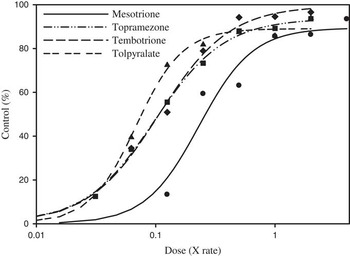
Dose–response experiments were conducted to compare the response of Palmer amaranth to the HPPD-inhibiting herbicides mesotrione, tembotrione, tolpyralate, and topramezone. For the four HPPD-inhibiting herbicides examined, Palmer amaranth was the least sensitive to mesotrione. The doses required to control and reduce Palmer amaranth biomass by 50% (GR50 values) at 14 DAT were 0.23X (24.2 g ha−1) and 0.12X (12.6 g ha−1) the labeled use rates, respectively (Tables 4 and 5; Figures 1 and 2). These doses are in the range of GR50 values reported by Abendroth et al. (2011) and Jhala et al. (Reference Jhala, Sandell, Rana, Kruger and Knezevic2014) for control of Palmer amaranth populations sensitive to HPPD-inhibiting herbicides. According to GR50 values for dry Palmer amaranth biomass, Palmer amaranth responses to tembotrione, tolpyralate, and topramezone were similar, with GR50 values ranging from 0.03X to 0.05X the labeled use rates of these products (Table 4; Figure 1). However, GR50 values for Palmer amaranth control indicated that Palmer amaranth was slightly more sensitive to applications of tolpyralate than tembotrione or topramezone (Table 5; Figure 2). These results are consistent with results that we observed in the field, where tolpyralate was among the most effective and mesotrione was the least effective of the HPPD-inhibiting herbicides for Palmer amaranth control, regardless of application timing (Table 2). Palmer amaranth control with tembotrione and topramezone fell in between tolpyralate and mesotrione, depending on Palmer amaranth height.
Palmer amaranth dry weight percent of control with increasing rates of HPPD inhibitors. Fitted lines calculated from the four-parameter log-logistic model: mesotrione, y=13.96+(100−13.96)/(x/0.12)−3.55, R2=0.91; tembotrione, y=7.32+(100−9.32)/(x/0.03)−1.09, R2=0.94; tolpyralate, y=12.88+(100−12.88)/(x/0.05)−2.47, R2=0.88; and topramezone, y=12.26+(100−12.26)/(x/0.04)−1.58, R2=0.88. Means for dry weight percent control represented by: mesotrione (●), tembotrione (♦), topramezone (■), and tolpyralate (▲).

Percent visual control of Palmer amaranth with increasing rates of HPPD inhibitors 14 d after treatment. Fitted lines calculated from the three-parameter log-logistic model: mesotrione, y=89.4/(x/0.26)1.93, R2=0.91; tembotrione, y=99.5/(x/0.11)1.47, R2=0.93; tolpyralate, y=89.0/(x/0.07)2.23, R2=0.90; and topramezone, y=93.7/(x/0.1)1.48, R2=0.96. Means for percent visual control represented by: mesotrione (●), tembotrione (♦), topramezone (■), and tolpyralate (▲).

Equations, R2 values, and GR50 values calculated from dose–response experiments in the greenhouse to compare the differential response of four HPPD-inhibiting herbicides on atrazine-resistant Palmer amaranth dry weight, 14d after treatment.Footnote a

a This Palmer amaranth population has been confirmed resistant to glyphosate, ALS-inhibiting herbicides, and atrazine (Kohrt et al. Reference Kohrt, Sprague, Nadakuduti and Douches2017).
b GR50 values followed by the same letter are not significantly different at α≤0.05.
Equations, R2 values, and GR50 values calculated from dose–response experiments in the greenhouse to compare the differential response of four HPPD-inhibiting herbicides on atrazine-resistant Palmer amaranth control, 14 d after treatment.Footnote a

a This Palmer amaranth population has been confirmed resistant to glyphosate, ALS-inhibiting herbicides, and atrazine (Kohrt et al. Reference Kohrt, Sprague, Nadakuduti and Douches2017).
b GR50 values followed by the same letter are not significantly different at α≤0.05.
Joint Activity of HPPD-inhibiting Herbicides with Atrazine on AS and AR Palmer Amaranth Populations in the Greenhouse
Mesotrione
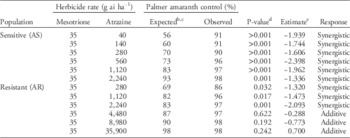
In the AS Palmer amaranth population, a synergistic response was detected when a constant rate of 35 g ha−1 of mesotrione was tank mixed, with all rates of atrazine ranging from 40 to 2,240 g ha−1 (Table 6). The strongest synergistic response, as indicated by the estimate values, occurred when 35 g ai ha−1 of mesotrione was applied in combination with 560 gha−1 of atrazine. Palmer amaranth control with this combination was 23% higher than expected. Synergistic responses were also detected in the AR population. The combination of the single rate of mesotrione with atrazine at rates ranging from 280 to 2,240 gha−1 were all synergistic, and the strongest response occurred when atrazine was at 2,240 gha−1, 2X the labeled atrazine rate. When atrazine was applied at higher rates from 4,480 to 35,900 g ha−1 (4X to 32X), the response in the AR population was additive. The additive response with atrazine applied from the 4X to 32X rate could possibly be due to an interaction of mesotrione with the clay-based formulation of atrazine at these high rates. A visible white film coated leaf surfaces when atrazine was applied at the 32X rate, which may have restricted mesotrione uptake. In addition to reducing uptake, the excess herbicide residue may have reduced photosynthetic electron transport, decreasing herbicide activity.
Joint activity of mesotrione and atrazine applied in combination for control of atrazine-sensitive (AS) and atrazine-resistant (AR) Palmer amaranth biotypes in the greenhouse, 14 d after treatment.Footnote a

a This Palmer amaranth population has been confirmed resistant to glyphosate, ALS-inhibiting herbicides, and atrazine (Kohrt et al. Reference Kohrt, Sprague, Nadakuduti and Douches2017).
b
Expected control values were calculated using the
 $E\,{\equals}\,{{XY} \over {100}}$
explained by Colby (Reference Colby1967).
c Herbicide joint activity was determined by comparing the slope of the log-transformed dose response of atrazine alone with that obtained from atrazine combined with a constant rate of mesotrione (Flint et al. Reference Flint, Cornelius and Barrett1988; Hugie et al. Reference Hugie, Bollero and Tranel2008).
d P-values≤0.05 are indicative of a significant response.
e Significant negative slope estimates indicate a synergistic response, significant positive slope estimates indicate an antagonistic response, and nonsignificant slope estimates equal an additive response.
Tembotrione
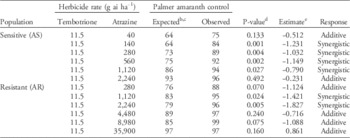
Synergistic responses were also detected in the AS and AR Palmer amaranth populations when a constant rate of tembotrione (11.5 gha−1) was applied with atrazine (Table 7). Unlike the synergistic responses observed with mesotrione, a much narrower range of atrazine rates initiated the synergistic response with tembotrione. Atrazine rates ranging from 140 to 1,120 gha−1 initiated the synergistic responses in the AS population, and only 1,120 and 2,240 gha−1 of atrazine initiated the synergistic responses in the AR population. Additive responses were observed at both the lowest and highest atrazine rates tested in both populations. With the exception of atrazine applied at 35,900 g ai ha−1 (32X) to the AR population, all other additive responses had a negative slope estimate, indicating the potential for synergism. Increases in control from the addition of atrazine to tembotrione have also been reported in a population of HPPD- and triazine-resistant waterhemp (Hausman et al. Reference Hausman, Singh, Tranel, Riechers, Kaundun, Polge, Thomas and Hager2011, Reference Hausman, Tranel, Riechers and Hager2016). Several other researchers have also reported improved and less variable weed control in several weed species, including redroot pigweed and Palmer amaranth, when various rates of atrazine were applied with tembotrione compared with tembotrione applications alone (Stephenson et al. Reference Stephenson, Bond, Landry and Edwards2015; Williams et al. Reference Williams, Boydston, Peachey and Robinson2011).
Joint activity of tembotrione and atrazine applied in combination for control of atrazine-sensitive (AS) and atrazine-resistant (AR) Palmer amaranth biotypes in the greenhouse, 14 d after treatment.Footnote a

a This Palmer amaranth population has been confirmed resistant to glyphosate, ALS-inhibiting herbicides, and atrazine (Kohrt et al. Reference Kohrt, Sprague, Nadakuduti and Douches2017).
b
Expected control values were calculated using the
 $E\,{\equals}\,{{XY} \over {100}}$
explained by Colby (Reference Colby1967).
c Herbicide joint activity was determined by comparing the slope of the log-transformed dose response of atrazine alone with that obtained from atrazine combined with a constant rate of mesotrione (Flint et al. Reference Flint, Cornelius and Barrett1988; Hugie et al. Reference Hugie, Bollero and Tranel2008).
d P-values≤0.05 are indicative of a significant response.
e Significant negative slope estimates indicate a synergistic response, significant positive slope estimates indicate an antagonistic response, and nonsignificant slope estimates equal an additive response.
Tolpyralate
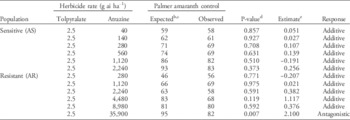
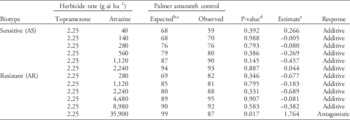
All responses to the combination of the single rate of tolpyralate with atrazine in both the AS and AR Palmer amaranth populations were not significant and therefore additive, with the exception of the combination with the highest rate of atrazine, 35,900 gha−1 (32X), in the AR population (Table 8). The strong antagonistic response (estimate=2.1) at this rate may possibly be due to reduced absorption of the HPPD inhibitor, tolpyralate. Atrazine applied at 32X the labeled rate caused a white film to form on leaf surfaces, possibly due to the clay-based formulation. This clay film may have resulted in the binding of tolpyralate on leaf surfaces, resulting in reduced absorption that could lead to decreased levels of the herbicide reaching the target site in the plant. Another hypothesis for the reduction in herbicide activity may be attributed to reduced light intensity from the clay film decreasing photosynthetic activity. Differential responses of synergism and antagonism have been observed with atrazine combinations with herbicides that inhibit different sites within the carotenoid biosynthesis pathway (Armel et al. Reference Armel, Rardon, McComrick and Ferry2007). Since tolpyralate is pro-herbicide and needs to be metabolized to become herbicidally active (Jeanmart et al. Reference Jeanmart, Edmunds, Lamberth and Pouliot2015), the rate of metabolism to the bioactive form may occur at different rates within different plant species, similar to conversion of the pro-herbicide isoxaflutole to the active diketonitrile (Pallet et al. 1998). If metabolism of tolpyralate to the bioactive occurs too rapidly in Palmer amaranth, and the herbicidal activity does not coincide with that of atrazine, synergism may be lost, regardless of atrazine susceptibility.
Joint activity of tolpyralate and atrazine applied in combination for control of atrazine-sensitive (AS) and atrazine-resistant (AR) Palmer amaranth biotypes in the greenhouse, 14 d after treatment.Footnote a

a This Palmer amaranth population has been confirmed resistant to glyphosate, ALS-inhibiting herbicides, and atrazine (Kohrt et al. Reference Kohrt, Sprague, Nadakuduti and Douches2017).
b
Expected control values were calculated using the
 $E\,{\equals}\,{{XY} \over {100}}$
explained by Colby (Reference Colby1967).
c Herbicide joint activity was determined by comparing the slope of the log-transformed dose response of atrazine alone with that obtained from atrazine combined with a constant rate of mesotrione (Flint et al. Reference Flint, Cornelius and Barrett1988; Hugie et al. Reference Hugie, Bollero and Tranel2008).
d P-values≤0.05 are indicative of a significant response.
e Significant negative slope estimates indicate a synergistic response, significant positive slope estimates indicate an antagonistic response, and nonsignificant slope estimates equal an additive response.
Topramezone
Similar to tolpyralate, no synergistic responses were observed with the combination of the single rate of 2.25 g ai ha−1 of topramezone and atrazine at any rate for both the AS and AR Palmer amaranth populations (Table 9). These results are contrary to the synergistic response that we observed in the field when 18 g ai ha−1 of topramezone was applied with 560 g ai ha−1 atrazine to the 8-cm-tall AR Palmer amaranth population (Table 3). The presence of negative slopes within some of the atrazine rates and topramezone combinations indicates that there is potential for a synergistic response between these herbicides (Table 9). The combination of topramezone with the highest rate of atrazine (32X) on the AR Palmer amaranth population showed a strong antagonistic response (estimate=1.7) and was likely due to possible reductions in topramezone absorption, similar to what was observed with tolpyralate. Topramezone and tolpyralate are members of the benzolpyrazole chemical family (Witschel et al. Reference Witschel2009; Wood Reference Wood2016). Benzolpyrazole herbicides are considered the most herbicidally active members of the known HPPD-inhibiting herbicides (Almsick Reference Almsick2009; Witschel Reference Witschel2009). The potency of these herbicides for inhibition of the HPPD enzyme compared with the triketone herbicides mesotrione and tembotrione may have led to the lack of synergistic responses with topramezone and tolpyralate.
Joint activity of topramezone and atrazine applied in combination for control of atrazine-sensitive (AS) and atrazine-resistant (AR) Palmer amaranth biotypes in the greenhouse, 14 d after treatment.Footnote a

a This Palmer amaranth population has been confirmed resistant to glyphosate, ALS-inhibiting herbicides, and atrazine (Kohrt et al. Reference Kohrt, Sprague, Nadakuduti and Douches2017).
b
Expected control values were calculated using the
 $E\,{\equals}\,{{XY} \over {100}}$
explained by Colby (Reference Colby1967).
c Herbicide joint activity was determined by comparing the slope of the log-transformed dose response of atrazine alone with that obtained from atrazine combined with a constant rate of mesotrione (Flint et al. Reference Flint, Cornelius and Barrett1988; Hugie et al. Reference Hugie, Bollero and Tranel2008).
d P-values≤0.05 are indicative of a significant response.
e Significant negative slope estimates indicate a synergistic response, significant positive slope estimates indicate an antagonistic response, and nonsignificant slope estimates equal an additive response.
The majority of previous research conducted on synergism has focused on only one of the HPPD-inhibiting herbicides: namely, mesotrione in combination with atrazine (Abendroth et al. Reference Abendroth, Martin and Roeth2006; Hugie et al. Reference Hugie, Bollero and Tranel2008; Woodyard et al. Reference Woodyard, Bollero and Riechers2009a, Reference Woodyard, Hugie and Riechers2009b). The novel aspect of the present research is the demonstration of the differential control of Palmer amaranth and joint activity of four different HPPD-inhibiting herbicides applied alone and in combination with atrazine. Differential levels of Palmer amaranth control between the HPPD inhibitors were observed in both the field and greenhouse, with mesotrione being the least effective on Palmer amaranth. The GR50 values from the greenhouse dose–response experiments indicate that tolpyralate>tembotrione=topramezone>mesotrione for HPPD-inhibitor activity for Palmer amaranth control at 14 DAT. Weed height at application also influenced Palmer amaranth control with the HPPD-inhibiting herbicides. Control was lower when HPPD inhibitors were applied to 15-cm-tall Palmer amaranth compared with the 8-cm application timing for all of the HPPD inhibitors, except for tolpyralate, which provided ≥95% control. Even though this population of Palmer amaranth has demonstrated atrazine resistance, the addition of atrazine to some of the HPPD-inhibiting herbicides improved control at both application timings. The less-effective HPPD inhibitors like mesotrione showed the greatest increases in control. This increase in control can be attributed to synergistic interactions between some of the HPPD inhibitors and atrazine.
The joint-activity of atrazine and HPPD inhibitors in the field was synergistic for mesotrione and topramezone at the 10-cm timing and for tembotrione and mesotrione at the 15-cm timing; all other combinations were additive. In the greenhouse, synergism was detected in both AS and AR populations with mesotrione and tembotrione. While trends for synergism in the greenhouse were present with three of the four HPPD inhibitors, they were only significant with mesotrione and tembotrione, the members of the triketone chemical family. This indicates that the independent physical chemical properties, potency, and speed of activity associated with different HPPD-inhibiting herbicides can influence the joint activity with atrazine in both resistant and susceptible populations. Armel et al. (Reference Armel, Rardon, McComrick and Ferry2007) demonstrated similar results showing that joint activity can vary among herbicides within the same mechanism of action.
The results from this research show that even when faced with an AR population of Palmer amaranth, atrazine can still be an effective tool for weed management. Applying atrazine in combination with the HPPD inhibitors can generate a synergistic or additive increase for the control of atrazine-resistant and atrazine-susceptible weed species. These responses can be helpful in controlling AR Palmer amaranth, especially as Palmer amaranth size increases.