Hand hygiene (HH) is essential to decreasing healthcare-associated infections.1 Although direct observation remains the gold standard for monitoring HH, inability to collect comprehensive HH data, human error, and the Hawthorne effectReference Hagel, Reischke and Kesselmeier2 limit its usefulness. Technology to detect HH may improve compliance among healthcare providers when it is part of a comprehensive HH program.Reference Cawthorne and Cooke3 However, healthcare providers have concerns about system accuracy and privacy.Reference Ellingson, Polgreen and Schneider4 The ability to change user perceptions of HH technology has not been demonstrated, even though centers attempting to implement these systems have aimed to increase their user acceptability.
Two electronic hand hygiene monitoring systems (EHHMSs) were pilot tested in 4 inpatient units to assess system performance prior to hospital-wide integration of one of the technologies. User perceptions were assessed using a survey addressing key aspects of the Unified Theory of Acceptance (UTA) and Use of Technology and Technology Acceptance Model (UTTAM).Reference Davis, Bagozzi and Warshaw5,Reference Venkatesh, Morris, Davis and Davis7 We compared survey responses between the 2 pilot studies to determine whether user perceptions are impacted by EHHMS characteristics.
Methods
We tested 2 EHHMSs in 90-day pilot studies at an 865-bed tertiary-care medical center. Pilot study A was conducted on a general medical unit and a pediatric ICU containing collectively 50 rooms and 80 beds. Pilot study B was conducted on a general medical unit and an oncology unit with 60 rooms and 60 beds. Pilot study A was completed in fall 2016 and pilot study B was completed in early 2018. Both systems used wireless technologies. In pilot study A, infrared signals were also used to capture badges. Pilot study B technology provided real-time feedback via beeps/lights to users; no immediate feedback was available in pilot study A. The accuracy of each system was formally assessed and reported previously.Reference Doll, Masroor and Cooper6 Pilot study participation by all personnel in the patient environment was strongly encouraged by hospital leadership but not mandated. Units were provided education before the studies began. Compliance data from direct observers and EHHMS were shared with units monthly throughout the pilot studies. We previously published that system-defined compliance varied between the 2 products; the EHHMS in pilot study B was more accurate than the EHHMS in pilot study A.Reference Doll, Masroor and Cooper6
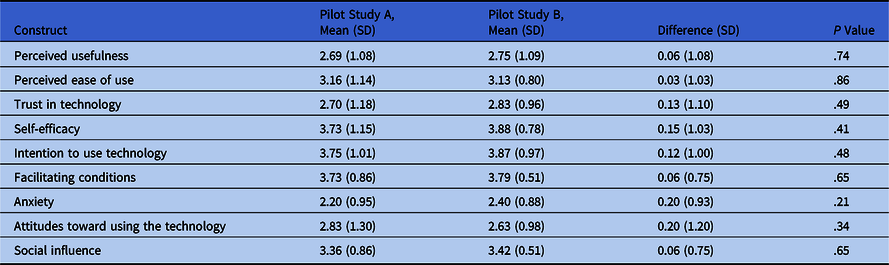
An anonymous survey was developed using the UTA as a theoretical base.Reference Davis, Bagozzi and Warshaw5 Specific constructs addressing key aspects of the UTTAMReference Venkatesh, Morris, Davis and Davis7 were incorporated (Table 1). Respondents used a 5-point Likert agreement scale (1 = strongly disagree, 5 = strongly agree) to answer questions addressing each construct. Surveys requested demographic data including age, gender, role, years of experience, unit, and allowed additional comments regarding the pilot study experience. A Qualtrics survey link was emailed to participants at completion.
Summary of Survey Responses by Pilot Study and Electronic Hand Hygiene Monitoring Systems (EHHMS) Type

Note. SD, standard deviation.
Mean responses to each question and overall construct were calculated. Responses were compared between pilot study A and pilot study B using the Student t test. Open-ended comments were categorized thematically. Statistical analysis was performed using EpiTools.8
Results
Surveys were completed by 93 participants in pilot study A (30% response rate) and 56 participants in pilot study B, for a 33% response rate. Most participants were nurses: pilot study A had 36 nurses, 20 physicians, and 37 other participants, and pilot study B had 34 nurses, 9 physicians, and 13 other participants. Most frequently, participants had 1–5 years of experience: 42 of 93 for pilot study A and 36 of 56 for pilot study B.
Mean responses (of 5 choices) are shown in Table 1 for each construct. Respondents generally agreed with an intention to use the technology, self-efficacy to perform HH, and favorable facilitating conditions. More neutral responses were seen across pilot studies toward social influence and ease of use. Respondents tended to disagree with anxiety toward the technology yet expressed a lack of trust in the technology, and they expressed a lack of perceived usefulness of EHHMS. We detected no difference in responses to any construct between pilot studies A and B.
Inaccuracy was the most frequent thematic concern in open-ended comments in both surveys; it was cited by 18 of 51 of commenters from pilot study A and 19 of 30 from pilot study B. The second most frequent thematic concern was distraction or interruption of workflow (n = 22 of 81).
Discussion
Despite highly variable performance between these 2 EHHMSs, poststudy respondents maintained similar perceptions regarding technology acceptability. During pilot study A, EHHM system-defined compliance was 34%, whereas direct observer data suggested compliance >80%. Calculation of accuracy using simultaneous observations revealed failure to capture events and accuracy of 25% and 54% on the 2 units in pilot study A. Subsequent survey responses highlighting concerns regarding trust, usefulness, and accuracy are not surprising.
However, during pilot study B, EHHMS-defined compliance was 91%, which aligned with observer data >90%. Formal accuracy assessment resulted in compliance >95%. The pilot study B survey respondents remained concerned regarding system accuracy, with perceived usefulness and trust responses matching pilot study A respondents. This finding suggests that perceptions of EHHMSs are not driven by the actual product performance.
This study had several limitations. The survey response rates were low, 30% and 33% for pilot studies A and B, respectively. We used a single-center design, and variability in the extent to which unit leaders shared compliance data with participants.
The fixed perceptions between pilot studies are concerning for implementing EHHMS to enhance infection prevention. For EHHMS to change behaviors, users must have confidence in the system. If perceptions are not driven by EHHMS characteristics or performance, what influences user opinions? Self-efficacy questions reveal a high level of confidence in respondents’ existing HH practices. A lack of acknowledgement of imperfect HH may pose significant hindrance to widespread EHHMS acceptance: several comments noted that the EHHMSs are superfluous because current HH is “good enough.” Clearly, it will be difficult to see value in EHHMS if there is no perceived need for improvement. Future EHHMS studies must move beyond compliance data to demonstrate where and why HH opportunities are most frequently missed. Armed with specific instances to provide context of potential patient harm, infection preventionists may be able to inspire more realistic self-assessments regarding personal HH practices.
Acknowledgments
Financial support
No financial support was provided relevant to this article.
Conflicts of interest
All authors report no conflicts of interest relevant to this article.