The desire to create a national artistic identity was a dominant force in nineteenth-century culture in the United States, as the initial shock of independence began to abate.Footnote 1 Now that they had a country, these new citizens had to decide what that nation's cultural values would be—a task that fell largely on the shoulders of the young nation's authors, artists, and composers. In their efforts to create works that could compete with those of other nations, many artists turned toward the European cultures from which they had emerged in search of models. Art historian Barbara Novak has described the “love–hate relationship” that artists in the United States felt toward Europe during this time period, leading them to adopt elements of European art while at the same time breaking away from those models, often to a surprising extent.Footnote 2 Worthington Whittredge, a painter of the Hudson River School, eloquently summarized the goal of the midcentury U.S. artist: “We are looking and hoping for something distinctive to the art of our country, something which shall receive a new tinge from our peculiar form of Government, from our position on the globe, or something peculiar to our people, to distinguish it from the art of the other nations and to enable us to pronounce without shame the oft repeated phrase ‘American Art.’”Footnote 3
Regarding instrumental music, the benchmark of early-nineteenth-century European musical culture was unquestionably the symphony. Consequently, to compete artistically with their European counterparts, composers in the United States had to create symphonies that, despite paying homage to their European forebears, presented a product unique to the New World. Although most composers in the United States might have agreed with Whittredge on the importance of this lofty task, they did not necessarily agree on the best manner of creating works that truly captured the spirit of the United States. Some composers—George Bristow (1825–98) is one notable example—-continued well into the century to write symphonies in an essentially European style in the belief that the nationality of the composer was sufficient to make a work “American.”Footnote 4 Others, however, felt that a more drastic approach to musical nationalism was in order.
Nationalistic programs represent one major way in which composers attempted to create symphonies that were readily identifiable as “American” in origin. As a result, the use of musical programs designed to commemorate historical events or personages specific to the United States abounded, as well as those aimed at celebrating the nation through its natural landscape. There was nothing peculiar to the United States about program music depicting nature, of course. Beethoven's “Pastoral” Symphony (1808) was a well-known early example (even in the nineteenth-century United States), followed by popular works such as Mendelssohn's Hebrides Overture (1830). Whereas the Romantic tendency toward program music was by no means limited to the United States, many composers there were able to distinguish themselves from their European counterparts by exploiting uniquely “American” subjects.
One of the most prominent—and certainly the most prolific—of these programmatic symphonists was Anthony Philip Heinrich (1781–1861), dubbed the “Beethoven of America” by one critic in 1822—which is to say, while Beethoven was still alive.Footnote 5 In the preface to his first published work, The Dawning of Music in Kentucky (Philadelphia, 1820), Heinrich loudly proclaimed his nationalistic intentions: “The many and severe animadversions, so long and repeatedly cast on the talent for Music in this Country, has been one of the chief motives of the Author, in the exercise of his abilities; and should he be able, by this effort, to create but one single Star in the West, no one would ever be more proud than himself, to be called an American Musician.”Footnote 6
To accomplish the goal of becoming an “American Musician,” many of Heinrich's orchestral works are blatantly patriotic, reflecting on the landing of the pilgrims at Plymouth Rock, for example, or celebrating the deeds of George Washington.Footnote 7 Others of Heinrich's numerous symphonies (he composed more than fifteen) include popular U.S. tunes—particularly “Yankee Doodle”—in an effort to capture the subject matter of these works.Footnote 8 Recently, some scholars have looked more deeply into the subject matter of Heinrich's works, but have found less obvious nationalistic content. Michael Pisani explored the fact that, decades before Dvořák came to the United States, Heinrich wrote a number of symphonies on Native American themes. Similarly, Denise Von Glahn has analyzed the ways in which the nationalistic qualities of Heinrich's The War of the Elements and the Thundering of Niagara tie in with trends toward the aggrandizement of America through its natural landscape.Footnote 9
Despite this recent interest in Heinrich's works, two of his orchestral works have remained largely neglected by scholars interested in the composer's more explicitly nationalistic music: The Columbiad, or Migration of American Wild Passenger Pigeons (ca.1857) and The Ornithological Combat of Kings, or the Condor of the Andes and the Eagle of the Cordilleras (original version ca. 1835; final form 1857).Footnote 10 Both of these symphonies remain unpublished; the manuscripts are held in the Library of Congress. The first, as its title suggests, depicts in vivid programmatic detail most of the important events in the lives of these now-extinct birds. The program for The Ornithological Combat describes an epic battle between the condor and the eagle over the course of four movements. The sheer oddity of a composer writing major orchestral works about birds—particularly with such grandiose titles—is somewhat puzzling to modern audiences. Viewing these symphonies from the vantage point of posterity, it is easy to see them as the musical ramblings of an eccentric composer. In this choice of subject matter, however, Heinrich was entirely a product of the nineteenth century, when a focus on the natural world pervaded the artistic culture of both Europe and the United States. What separates Heinrich from other Romantics, particularly in the United States, is the extent to which he exploited these natural elements for nationalistic ends (and fairly early in the century) and the unique opportunities that his surroundings in the Unites States provided for this subject matter.Footnote 11
Perhaps as a result of their superficial strangeness—coupled with the general unavailability of scores and recordings—the two ornithological symphonies have not been the subject of any extended examination, and they are often treated only briefly in accounts of Heinrich's life (despite the fact that Heinrich himself felt the Ornithological Combat to be his best work).Footnote 12 Yet the composer's choices in the programs for his other symphonic works reveal him to have been a shrewd judge of artistic trends in the nineteenth-century United States. Beginning with his first orchestral work, Pushmataha, a Venerable Chief of a Western Tribe of Indians (1831), Heinrich demonstrated the same interest in Native American themes that characterized the literature and art of the United States during this time. He would return to Native American subjects in a number of works, including the symphonies Manitou Mysteries, or the Voice of the Great Spirit: Gran sinfonia misteriosa Indiana (before 1845) and The Mastodon (1845, later known as The Indian Spirit Bond). These works tie into a popular fascination with Native American cultures and simultaneously represent a celebration of the land (the primeval “America”) that gave birth to these cultures. Heinrich's symphonies on ornithological subjects—surprisingly enough—represent another facet of his musical Americanism, albeit an aspect less obvious to us today. Placing the two works into the context of the mid-nineteenth-century United States reveals these birds to be just as logical a choice for a symphonic program designed to designate the symphony as an overtly chauvinistic work—a critical goal for Heinrich and many of his contemporaries.
Naturalism and Nationalism
The attraction that European Romantics felt to nature as a source of inspiration is well known. In the United States, however, the wild country took on another strand of meaning: it became a major—perhaps the primary—source of national pride. The immensity of wilderness was a unique feature of the nation and, as such, served as a way to distinguish the New World from the more “civilized” Europe.Footnote 13 U.S. painter Thomas Cole famously contrasted the U.S. and European landscapes in his 1836 article “Essay on American Scenery”:
The most distinctive, and perhaps the most impressive, characteristic of American scenery is its wildness.
It is the most distinctive, because in civilized Europe the primitive features of scenery have long since been destroyed or modified—the extensive forests that once overshadowed a great part of it have been felled—rugged mountains have been smoothed, and impetuous rivers turned from their courses to accommodate the tastes and necessities of a dense population—the once tangled wood is now a grassy lawn; the turbulent brook a navigable stream—crags that could not be removed have been crowned with towers, and the rudest valleys tamed by the plow.Footnote 14
Europeans could reminisce on the days of Rousseau's noble savage—and they certainly had their own share of natural wonders to appreciate, despite Cole's dismissal—but only in America was there the perception of a truly unlimited and untamed wilderness.Footnote 15 The goal, for Cole and other artists, was “self-possession, a ‘native’ identity and culture produced through representing America's unique and sublime landscape.”Footnote 16 For Heinrich, too—seeking to establish a musical culture—the “twin themes of Nature and Nation” functioned as two sides of the same coin; praising the wilderness was to praise America and its way of life.Footnote 17 This praise, particularly through evocations of the natural world, largely defines his compositional output, and in particular his symphonies, which gave Heinrich the largest range of musical possibilities for portraying the grandeur of the natural world.
Beyond providing him with subject material for his compositions, the North American wilderness was also a critical element in Heinrich's (auto)biography.Footnote 18 Born in Bohemia, Heinrich moved to the United States in 1810. After a career in business (which eventually left him penniless) and brief stints as a musician in a Philadelphia theater orchestra and a musical director in a Pittsburgh theater, Heinrich retreated in 1818 into solitude in a cabin in rural Kentucky near the village of Bardstown, at which time he turned his attention to composition. Heinrich's own writings (and contemporary reports about him) point out that he never received any instruction in composition but that during his time of seclusion, “never having been taught the elements of harmony, he formed a theory of his own.”Footnote 19 In truth, Heinrich had certainly moved out of his humble accommodations by January 1819, after only a few months. He left Kentucky in 1823, and although he traveled extensively through the most cosmopolitan cities of the United States and Europe, it was with Kentucky that Heinrich remained associated throughout his life—a connection painstakingly cultivated by the composer himself. Decades after he had left, Heinrich would still declare himself to be the humble log-cabin composer, or perhaps “The Western Minstrel” or “The Wildwood Troubadour,” to cite a few of his more frequently used monikers. His time in Kentucky thus presents both the quintessential Romantic retreat into nature and a celebration of the American spirit through communion with its greatest natural asset: the wilderness.
The motif of the wilderness came to the forefront of U.S. thought during the 1820s and 1830s and remained prominent for decades afterwards; its image pervades the work of writers such as William Cullen Bryant and James Fenimore Cooper as well as artists such as Thomas Cole, Frederic Edwin Church, and the members of the Hudson River School.Footnote 20 Many of Heinrich's works serve a similar function in music, and the image of the composer in the wilderness is critical to both his self-representation and the image of him that contemporary critics presented. One concert broadside points out somewhat inaccurately that for “twelve months he dwelt in a solitary log house, with no other companion than his fiddle, living upon roots and water.”Footnote 21 This complex interplay of society and environment is critical to understanding the extraordinarily large role played by nature in his works; celebrating the natural landscape of the United States amounted to celebrating the nation itself. For Heinrich and many of his contemporaries, their works were not merely made in the New World but also by the New World. Although this trend of “naturalistic nationalism” was most visible in literature and the visual arts, it was by no means entirely removed from other aspects of society.Footnote 22 Ornithology represented one outlet of this nationalism, as it gained popularity throughout the nineteenth century and became a source of national pride to both scholars and the general populace alike.
Ornithology
Ornithology was in the air, so to speak, in the nineteenth-century United States. The Ornithological Combat and The Columbiad are products of the same type of nationalistic ornithology found most prominently in the works of Alexander Wilson (1766–1813) and John James Audubon (1785–1851), both of whom are remembered today chiefly for their paintings and writings on North American birds. Wilson, the elder of the two, was the author of American Ornithology (1808–14), which Audubon used as a model for his more famous Birds of America (1827–38) and Ornithological Biography (1831). All these works share the goal of cataloging and celebrating the bird life of North America. The idea of creating such a catalog did not, of course, originate with Wilson or Audubon; such works had appeared in Europe for more than a century.Footnote 23 Rather, the novelty of Wilson's and Audubon's efforts lay in the creation of a catalog of specifically U.S. wildlife. Such a work was a stepping stone for the young nation, demonstrating both that the United States could keep up with Europe in the realm of the natural sciences and that its natural resources were worthy of detailed study.
Wilson was modestly successful in his attempts, but Audubon's texts became internationally known, and the man himself became a celebrity. By the 1830s, newspapers in the United States routinely reported his comings and goings and published excerpts from his writings.Footnote 24 Audubon's biography appeared in encyclopedias in several countries, and it was not entirely out of the ordinary to find poetry written about him and published in newspapers and journals.Footnote 25 It would seem that he almost single-handedly popularized ornithology in the United States; one nineteenth-century reviewer wrote in the American Journal of Science and Arts that Audubon had “aroused among his countrymen an interest in the study of the natural sciences.”Footnote 26 The reasons for Audubon's enormous success certainly had much to do with the excellent quality of his drawings, but his writings were more universally popular, in large part because of the relatively low price of the Ornithological Biography. This work contained, in mostly nonscientific language, observations about the appearance and manners of the birds depicted in The Birds of America, as well as sections he called “Episodes,” which were tales of his adventures in the wilderness as he searched for specimens. The colloquial nature of his writing appealed to a wider audience than did most other quasi-scientific works and in addition painted an appealing image of the man himself. These episodes portray Audubon as something like a character out of one of the very popular James Fenimore Cooper novels: an image of the rugged frontiersman that he worked hard to maintain. Much like Heinrich, Audubon took great pains to play this part to perfection both abroad and in the United States.
To a composer like Heinrich, who sought distinctively “American” subjects for his music, Audubon's fame and the concomitant rise in the popularity of North American ornithology must have seemed like prime material. But Heinrich's connection to ornithology was not limited to observation of popular trends; there was also an added personal element. Although details of their contact are scant, it is clear that during his time in Kentucky the composer became well acquainted with Audubon and his family, who were often in the area around Louisville.Footnote 27 Certainly Heinrich would have been following the career and works of his friend the naturalist, and it seems likely that Audubon's enthusiasm for ornithology would have had an influence on his fellow European emigrant. (Audubon was French by birth.) Furthermore, borrowing programs from popular sources was in keeping with Heinrich's standard practice; as one example, the composer drew extensively from John McIntosh's The Origin of the North American Indians (1843) for his works on Native American themes. The question that remains, then, is why Heinrich chose to portray the particular birds that he did. In other words, what traits of the passenger pigeons of The Columbiad, or the condor and eagle of The Ornithological Combat of Kings, merited such a symphonic apotheosis? An examination of the nineteenth-century writings about, and attitudes toward, these birds is necessary to make the logic behind Heinrich's choices clear.
The Ornithological Combat
At first glance, it is difficult to accept The Ornithological Combat of Kings as a work of U.S. nationalism. In fact, it appears at first to have very little to do with the United States at all; rather, it depicts a battle between the two eponymous birds, both of which are native to South America. Realistically speaking, a physical combat between the condor and the eagle of the sort apparently described by Heinrich's symphony is extremely unlikely; such behavior would be out of character for both birds. However, there was indeed a sort of competition between the two birds: each had supporters for the title of “king” of birds. The combat that Heinrich refers to in his title, then, may be seen to refer more to this struggle than to any sort of physical combat. This mythical battle takes place over the course of four movements:
I. The Combat of the Condor in the Air
II. The Repose of the Condor
III. The Combat of the Condor on Land
IV. The Victory of the Condor
Nothing obvious within the music itself (at least in its final version) indicates a particularly patriotic sentiment, and the piece's subtitle—The Condor of the Andes and the Eagle of the Cordilleras—specifically highlights the two birds' origins in South America. As this symphony illustrates, however, the distinction between North and South America appears not to have been significant for Heinrich; rather, his conception of “America” encompassed the entire New World.Footnote 28 He emphasized this attitude in the proposal for a massive collection of piano pieces entitled “The Musical Week” (which never came to fruition), in which Monday was represented by a version of The Ornithological Combat called “The Condor, The Giant Bird of South America.”Footnote 29 Although the bird is specifically identified as being from South America, Heinrich goes on to state that “all the subjects and associations connected with [The Musical Week], will be exclusively American.” Heinrich's nationalism, the Ornithological Combat makes clear, extended well beyond the borders of the United States.
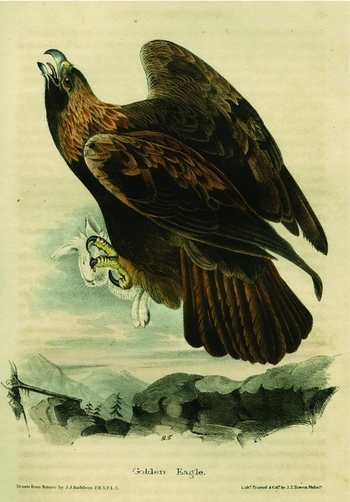
The eagle referred to in the symphony's title is almost certainly the golden eagle rather than the bald eagle, because the golden variety inhabited the more mountainous regions to which the term cordillera refers, whereas the bald eagle was more common in the low lands.Footnote 30 Audubon comments about the golden eagle that “when at a great height in the air, its gyrations are uncommonly beautiful, being slow and of wide circuit, and becoming the majesty of the king of birds.”Footnote 31 An anonymous poem entitled “To the Golden Eagle” in Scientific American (12 February 1848) certainly supported such an assertion:
The January 1849 issue of The Western Miscellany contained an equally laudatory article on the eagle, beginning with the assertion that the bird “is the largest and noblest of all the feathered tyrants of his race; and has obtained among birds the same pre-eminence which the lion is allowed to possess among the quadruped tribes.”
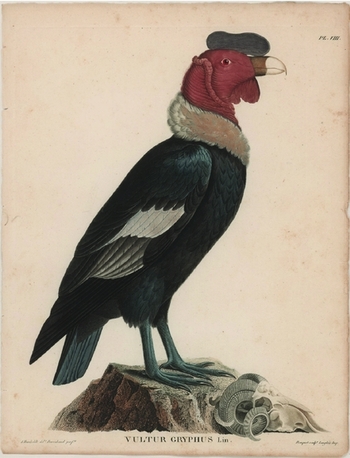
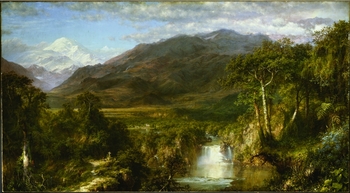
Despite the poet's claim that “No envious rival that can mate/Thy majesty on high!” the golden eagle was not alone in its claims to avian monarchy. The other contender in Heinrich's symphony is the Andean condor, the largest flying land bird in the world. It is native to western South America, where it is currently the national bird of Bolivia, Chile, Colombia, and Peru. The condor was also highly regarded by ornithologists in the United States. Alexander Wilson included the bird in the 1831 edition of American Ornithology, and at least one ornithologist made the specific claim that the bird was a rival to the eagle in terms of grandeur.Footnote 32 The Andes Mountains were a prominent image in the United States in the 1850s, thanks in large part to the paintings of Frederic Edwin Church (1826–1900). Church's enormous landscapes were among the most popular artworks of the midcentury. Chief among these landscapes are his Andes of Ecuador (1855) and Heart of the Andes (1859, see Fig. 3). Although Heinrich had composed most of the music of the Ornithological Combat (in the form of “The Musical Week”) before the emergence of Church's popular depictions of the Andes, the reappearance of the work in the 1850s may be another attempt on Heinrich's part to tap into a growing interest in the Latin American landscape.
John James Audubon, The Golden Eagle (Aquila chrysaetos), from Birds of America (1840–44 ed). From the copy in the Rare Book Collection, the University of North Carolina at Chapel Hill.

Alexander von Humboldt: Vultur gryphus [The Andean Condor], from Recueil d'observations de zoologie et d'anatomie comparée (1811). Image courtesy of the John Carter Brown Library at Brown University.

Frederick Edwin Church, Heart of the Andes (1859). Image © The Metropolitan Museum of Art.

Church's paintings call attention to the grandeur and beauty of the Andes with their near-photographic detail and the sheer size of their canvases—Heart of the Andes is approximately 5½ feet tall and a staggering 10 feet wide. Evidently the public was eager to see these vistas of far-off lands. As art historian Barbara Novak has pointed out, in New York City, Church displayed Heart of the Andes dramatically, “with black crepe curtains, lit it by gas jet, and surrounded [it] . . . with tropical vegetation taken from the site.”Footnote 33 During its exposition in New York from 29 April to 23 May 1859, more than 12,000 people lined up to see the painting. By closing day, it was all but impossible to gain admission to the exhibit, and some art lovers were forced to wait hours to gain even a glimpse of Church's work.Footnote 34
The source of Church's inspiration for his Andean works—and, I think, Heinrich's—was the naturalist Alexander von Humboldt, whose accounts of his travels in Latin America from 1809 to 1814 were published in several languages and widely read throughout the century. Humboldt wrote about the condor specifically and mentioned the bird in his general descriptions of his travels, which were published in London in 1814 and in Philadelphia a year later. (Heinrich lived in Philadelphia from 1816 to 1817.) These writings were highly influential and were read by laymen and scientists alike.Footnote 35 Particularly after 1845, when Humboldt's Cosmos was published in the United States, the naturalist became a major celebrity there and enjoyed a sustained popularity through the 1850s.Footnote 36 It is quite possible that Heinrich knew Humboldt's work when the original version of the Ornithological Combat was composed around 1835. We know with certainty that Heinrich was familiar with Humboldt (if not specifically his writings about the condor) because there is a brief correspondence between the two men in the late 1850s, when Heinrich wrote to the naturalist seeking help in securing European performances of his music. Given Humboldt's increased cultural capital during the 1850s, it is not at all surprising that Heinrich returned to the work during that time, completing its second version in 1857. Possibly the composer thought that the increasing interest in Humboldt's South American adventures, and particularly his depiction of the condor, would bolster the possibility of getting the Ornithological Combat performed in the United States.
The condor's infiltration into the public consciousness is evidenced by numerous nineteenth-century descriptions of the bird in general periodicals of the time. An article in Natural History: The Magazine of Useful and Entertaining Knowledge (October 1830), described the condor in grandiose language:
The Condor, or Vulture of the Andes, holds a conspicuous rank among the tribes which, on account of their [sic] size, their extraordinary strength and ferocity, and their amazing power of flight, are placed at the head of the feathered creation. Distinguished alike by all their qualities, he is moreover remarkable for the lofty station he occupies in the most elevated eminences of our globe, in which he appears to rest in solitary majesty, like a monarch surveying his tributary possessions, or from whence he soars on “ample pinion” to the greatest distance beyond this “visible diurnal sphere.”
Notable here is the description of the bird as a “monarch”—a true avian “king,” as Heinrich's symphonic title indicates. Far from being only a majestic avian specimen, however, the Andean condor was, for some people, imbued with particularly nationalistic qualities. For example, in a work entitled “The Star-Spangled Banner,” appearing in The Philadelphia Album and Ladies' Literary Portfolio (3 May 1834), the (otherwise unknown) poet C. W. D'Oyle made use of particularly patriotic imagery in connection with the bird:
As further evidence that Heinrich was not alone in his pan-continental conception of “America,” in this poem the condor clearly represents the concept of “America” itself, despite the fact that the bird is clearly indicated as being from the Andes in origin.
The Ornithological Combat of Kings, in its final version, is scored for a large symphony (two flutes and piccolo, two oboes, two clarinets, basset horn, two bassoons and contrabassoon, three trombones, ophicleide, serpent, four horns, four trumpets, percussion [triangle, cymbals, snare drum, bass drum, timpani], and strings) and takes slightly less than half an hour to perform. The earlier version of the work seems to be entirely lost, and the only manuscript of the final version is held in the Library of Congress. Somewhat surprisingly, Heinrich does not insert programmatic text within the movements themselves (something he did extensively in The Columbiad, for example), and the music never seems to serve any specifically mimetic function. Rather, it is firmly grounded in the German symphonic tradition. The uniquely “American” quality of the work seems to have been based entirely on the subject matter.
The first performance of The Ornithological Combat took place on 9 June 1836 in Graz, Austria; the early version was at that time entitled The Combat of the Condor, American Characteristic Tonepainting. Footnote 37 The exact circumstances of this concert are unclear, but it was likely arranged at least in part by Heinrich's old friend Ferdinand Rössler, who resided in Graz. The symphony was performed by the Styria Musik-Verein, conducted by Anselm von Hüttenbrenner. August Mandel (also the secretary of the Musik-Verein) contended in a review that “the most striking achievement [of the concert] was the Symphony, The Combat of the Condor, in which the cooperation of all known orchestral instruments is required to represent the strength of the gigantic bird as it wings its way over the topmost peaks of the Andes; while at the same time the work in question acquaints us with certain American folk melodies.”Footnote 38 Again, by nature of the subtitle Heinrich directly identified the work as “American,” likely an attempt to tie the work more directly to Humboldt's writings about South America, which were popular in Europe, or perhaps—as we will see with the passenger pigeons—there was a type of nationalism at play with the very idea of the Andean condor.
Playing into the latter idea is the apparent inclusion of “American folk melodies” in this early version of the symphony. No such tunes appear in the final version of the work, however; and because the manuscript of the early version is no longer extant, we cannot be entirely sure which tunes were included. However, given that Heinrich used “Hail, Columbia” and “Yankee Doodle” on many other occasions (and never, to my knowledge, any other “folk melodies”), it seems reasonable to assume that these were the songs referenced by the reviewer, and that Heinrich removed examples of one or both them at some point during his revision process. Whatever their identities, the fact that conspicuously American melodies were included at all is significant in revealing Heinrich's conception of this symphony and its program as Americanist. Heinrich's Ornithological Combat was a musical way of celebrating the greatness of the American landscape and its wildlife though the invocation of two widely popular and impressive American birds.
The Columbiad, or The Migration of the American Wild Passenger Pigeons
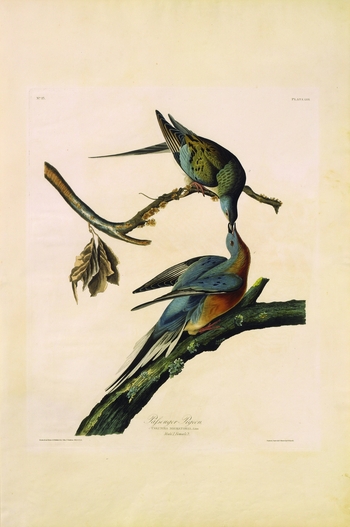
Like the eagle and the condor, passenger pigeons were a particular favorite of readers of ornithological literature, and understandably so. These remarkable creatures, unfortunately extinct today, are thought to have at one time accounted for up to 40 percent of the total bird population of the United States. They caught the attention of a number of authors, including Wilson and Audubon. The program for Heinrich's symphony The Columbiad, or the Migration of the American Wild Passenger Pigeons borrows heavily from both men's accounts of the habits of the birds, down to the nearly identical descriptive language of the sheer number of the birds and the thundering roar created by their mass migrations.
Heinrich was more forthcoming with his sources for the program of this symphony: a paragraph (in German) on the title page of the manuscript identifies the work as being “after a great natural phenomenon, specially explained by the famous naturalists John Audubon, Wilson and others, and personally experienced by the below-named composer of this musical work.”Footnote 39 Some sheets of paper attached to Heinrich's autograph of the symphony quote extensively from Wilson (Figure 4):
The following account of their migrations, the substance of which is taken from Wilson's Ornithology may be relied on as true, however incredible it may seem, for that gentleman either saw what he describes himself, or had his statements from the best authority.
“The fertile regions of Ohio, Kentucky and Indiana abound with beech nuts, which are the principal food of the wild Pigeon; when these nuts are consumed in one place, they discover another supply, often at a distance of seventy or eight miles from the place which they appear to have agreed on among themselves to spend the night. These places are always in the woods, and sometimes occupy a large extent of forest. The surface of the ground is everywhere strewed with the large branches of trees, which have been broken down by the weight of the birds.
“Accounts of the places where these birds build their nests, and hatch their young, are still more extraordinary. In the state of Kentucky, since years ago one of these nestling places extended through the woods, it was said to the distance of forty miles, in a straight line, and was generally several miles wide. Such was the noise made by this vast multitude, that the horses were terrified, the people astonished, and no person could hear another speak, without bawling in his ear. The top of every tree presented a tumult of Pigeons, cording about their young, and fluttering with their wings, so as to produce a perpetual roar like that of thunder. Mingled with this was the frequent crash of falling trees, for the people cut down such as contained the greatest number of nests, so as more readily to come at the young ones. Some trees contained more than one-hundred nests and it was dangerous to walk under them, on account of the frequent fall of large branches, which were broken off by the combined weight of the nests and Pigeons.”
At the time Mr. Wilson was in Kentucky, the Pigeons had consumed most of the food in that part of the country, and had found a feeding place in Indiana sixty or eighty miles distant. From one of these places to the other, they were flying in such vast numbers as to exceed all his belief, though he had received the most wonderful account of their flights from the inhabitants. Our author goes on to state, that for four hours these birds continued their flight in one uninterrupted stream, and he made calculation that if “each square yard of this moving body comprehended these Pigeons, the square yards in the whole space multiplied by three, would give 2,230,272,000 Pigeons in a column one mile broad, moving at the rate of one mile in a minute for four hours.” This, to be sure, is almost an inconceivable multitude, “but” says the author, “it is probably far below the actual amount.”Footnote 40
Audubon, A Pair of Passenger Pigeons (Ectopistes migratorius), from Birds of America (1833). Image courtesy of the North Carolina Museum of Art.

These papers are not in Heinrich's hand, but likely were sent to him in response to some request for information on the pigeons—perhaps from Lucy Audubon. Although this passage certainly would have provided Heinrich with enough background for his program, the inclusion of these papers in Heinrich's scrapbook in the Library of Congress may well demonstrate the composer's detailed knowledge of Audubon's writings on the pigeons. A letter from Lucy Audubon to her son Victor reveals that Lucy was planning to send Heinrich “extracts from the wild passenger pigeon,” likely referring to the relevant portion of the Ornithological Biography (and possibly to the above-quoted passage excerpted from Wilson):Footnote 41
In the summer of 1813 . . . I observed the pigeons flying from north-east to south-west, in greater number than I thought I had ever seen before. . . . The air was literally filled with Pigeons; the light of noon-day was obscured as by an eclipse. . . . At once, like a torrent, and with a noise like thunder, they rushed into a compact mass, pressing upon each other towards the centre. . . . The people were all in arms. The banks of the Ohio were crowded with men and boys, incessantly shooting at the pilgrims. . . . Multitudes were thus destroyed. . . . [At night,] everything was ready, and all eyes were gazing on the clear sky, which appeared in glimpses amidst the tall trees. Suddenly there burst forth a general cry of ‘Here they come!’ . . . The Pigeons, arriving by thousands, alighted everywhere, one above another, until solid masses as large as hogsheads were formed on the branches all round. Here and there the perches gave way under the weight with a crash.Footnote 42
Taken together, these passages by Wilson and Audubon provided Heinrich with an enormous amount of material from which to cull a musical narrative, represented by his lengthy program for the symphony:Footnote 43
Introduction. A Mysterious Woodland Scene, the assembling of the wild passenger pigeons in the ‘far west’ for their grand flight or migration.
I. Andante ed Allegro. The flitting of birds and thunder-like flapping of a passing phalanx of American wild pigeons.
II. The aerial armies alight on the primeval forest trees, which bend and crash beneath their weight.
III. Andante ed Andantino. A twilight scene. The cooing of the doves previous to their nightly repose.
IV. Allegro Mosso. With Aurora comes the conflict of the Beechnuts.
V. Adagio ed Allegretto Cantabile. The vast conclave in grand council resolve to migrate somewhere.
VI. Molto animato. Sudden rise and flight of the myriad winged emigrants.
VII. Più mosso. The alarm of hunters' rifles startles the multitude. The wounded and dying birds sink tumultuously earthward.
VIII. Allegro Agitato. In Brooding agitation the columbines continue their flight, darkening the welkin as they utter their aerial requiem, but passing onward, ever onward to the goal of their nomadic wandering the green savannas of the New World.
IX. Finale. The Columbiad. Marcia grande ed a passo doppio. American folk tunes: Hail Columbia and Yankee Doodle. Footnote 44
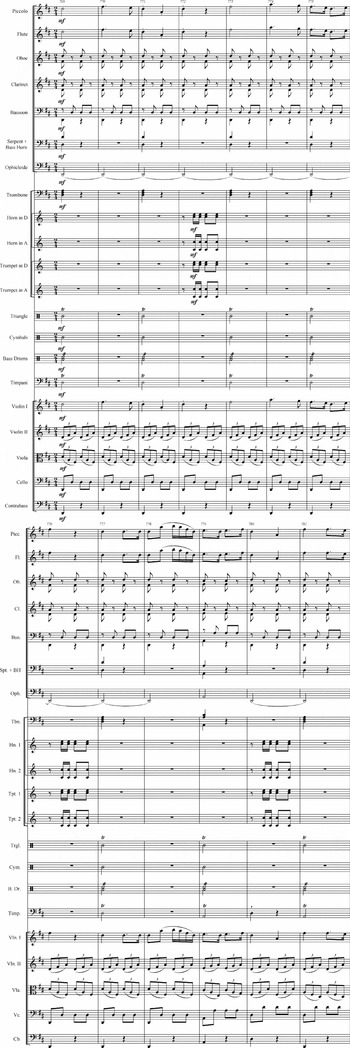
These birds seem to have been a force of nature unto themselves, and, importantly, a uniquely American force of nature. Unlike the condor or golden eagle, which lived in relatively small numbers and in isolated locations, passenger pigeons were seen by millions of citizens in more populated regions of the country. Even those who did not witness the birds firsthand had ample opportunity to learn about their unique behavior. James Fenimore Cooper, for example, included a dramatic description of the migration of the pigeons in chapter 22 of his popular novel The Pioneers (1823).Footnote 45 It is easy to see how a shared experience such as the migration of the passenger pigeons—found only in one specific nation—could become inherently patriotic, an idea that Heinrich again makes explicit by his use of “Hail, Columbia” and “Yankee Doodle” in the symphony's finale. The musical climax of this section is the final arrival of “Hail, Columbia” in the full orchestra (Example 1).
The climactic entry of “Hail, Columbia,” from The Columbiad, mm. 769–80. The melody appears in the first violin and in the piccolo/flute lines.

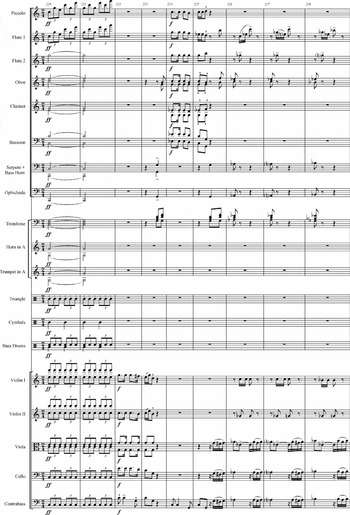
As this example makes clear, Heinrich scored The Columbiad for a massive orchestra. The compositional approach to the program differs significantly from the Ornithological Combat in that program notes corresponding to the Roman numerals provided in the program are placed at appropriate locations throughout the score. Significantly, however, Heinrich did reuse some musical material from his earlier symphony in The Columbiad. In particular, one main theme from the Ornithological Combat, appearing in several movements of that work, makes an appearance during the “thunder-like flapping of a passing phalanx of American wild pigeons” (Example 2). This type of self-quotation was not uncommon for Heinrich, but it does point to a connection between the two works.
The Columbiad, mm. 220–28. The theme appearing in the strings in mm. 222–23 and echoed in the winds in mm. 224–25 also appears prominently in The Ornithological Combat.

The Columbiad appears to have only been performed once, in Prague on 3 May 1857, on an all-Heinrich concert. One anonymous reviewer commented on this particular work that “without question the most successful number of the program was the third: Grande Capriccio Volante,Footnote 46 a characteristic symphonic poem which in its several movements describes the life of the American passenger pigeons in excellent fashion, and for the most part with originality of treatment and piquant orchestration. It closes appropriately with the American folk melodies, Hail Columbia and Yankee Doodle.”Footnote 47 The reviewer's comment that the work closed “appropriately” with the patriotic tunes indicates that the Prague audience understood there to be a clear connection between the birds and the United States. Perhaps Heinrich's own public persona—still the “log-cabin composer” after all these years—was enhanced by the connection between the passenger pigeons and Kentucky (where Wilson, Audubon, and Heinrich all observed them).
Taken individually, passenger pigeons did not possess the grandeur of the Andean condor or the golden eagle. Their fascinating qualities, however—and the popular knowledge of the birds both at home and abroad—made them an obvious choice for a composer seeking to express the wondrous (if not necessarily most appealing) aspects of wildlife in the New World. There also seems to be, in the descriptions of these birds, an echo of the United States itself. At a time when most U.S. citizens had begun their lives in a different country before immigrating to a new homeland, the idea of incessantly traveling birds collectively moving through the country might have struck a familiar chord. Heinrich's description of the birds' fate in his program evokes something akin to that sentiment: “The columbines continue their flight . . . passing onward, ever onward to the goal of their nomadic wandering, the green savannas of the New World.” Similarly, the idea that the birds collectively chose their resting place (the “vast conclave in grand council”) seems to imbue the pigeons with a sort of democracy—a sense that the chosen government of the United States somehow resided within the land itself, predating the official beginning of the nation.
From exploring the context of these two avian symphonies, it is clear that Heinrich intended to write music that connected with the widespread nineteenth-century interest in celebrating the birds of America. The extreme popularity of the writings of Wilson, Audubon, Humboldt, and others in the United States and Europe—in addition to Heinrich's long-lasting personal friendship with Audubon and his family—must have suggested ornithology as a promising avenue for expressing musical Americanism. Furthermore, extolling the natural wonders of the Americas as a mode of artistic expression was certainly in keeping with the literature and visual art in the United States during this time. Furthermore, the idea of depicting the wonders of nature musically was far from rare in the nineteenth century; rather, by doing so, Heinrich was demonstrating himself to be (at least in this respect) an archetypical Romantic. But if musical ornithology makes so much sense, why is it that only Heinrich tapped into this vast potential? Certainly, other U.S. composers explored facets of naturalistic nationalism that we see in Heinrich's other symphonies, as evidenced by works based on the Niagara Falls, such as William Henry Fry's Niagara Symphony (1854) or George Bristow's later Symphony No. 5 for Grand Orchestra and Chorus, op. 62 (“Niagara”; 1893). Similarly, Heinrich was not alone in using Native American subject material for his works; Bristow's Fourth Symphony (1872) contains an “Indian War Dance” in place of a scherzo, and several composers wrote “Hiawatha” symphonies in the late nineteenth century.
Several factors may have contributed to the absence of other avian-themed symphonies in the nineteenth-century United States. The most obvious is the fact that no other composers shared Heinrich's personal connection to Audubon, which may have encouraged the composer to go in an unusual musical direction. In addition, the idea of writing symphonies based on the wildlife of the Americas may have suited Heinrich's presentation of himself as a “rural” composer despite the fact that he spent most of his life in urban centers. He specifically points out that he personally witnessed the phenomenon of the passenger pigeons, for example. In this case, Heinrich's choice of subject matter might have been an effort to maintain his compositional identity and separate himself from other composers more closely associated with metropolitan areas such as New York or Boston.
On the other hand, it may be that other composers would have been interested in ornithological subjects had they been aware of Heinrich's works. As neither of Heinrich's two bird symphonies seems to have ever been performed in the United States, other composers had no way of knowing of their existence. The overall lack of performances for these works is in many ways understandable, however lamentable it may be. The state of symphony orchestras in the United States during the first half of the nineteenth century simply did not permit performances of these works.Footnote 48 Heinrich did have some success in 1842 with getting together a large enough orchestra in New York to play some of his compositions (as well as works by Rossini, Haydn, Beethoven, and Novello), including the patriotic Grand Overture to his incomplete oratorio The Pilgrim Fathers (1842?).Footnote 49 One advertisement described this concert (erroneously) as “the first American Musical Festival,” and Heinrich's music was generally well received.Footnote 50
This festival aside, opportunities were extremely limited for the composer. His best chances were in New York, where he lived in the decades before his death; the Philharmonic Society of New York (later the New York Philharmonic) was also founded in 1842 and was for some time afterwards the only standing symphony in the United States.Footnote 51 Despite Heinrich's involvement with this ensemble (he was even chosen to be the leader of the organizational meeting on 2 April), however, it was clear that the orchestra existed primarily to perform works of the great German masters.Footnote 52 The opportunity for a U.S. composer to secure a performance of a symphony in the United States was limited, even when the work involved no overtly patriotic themes.Footnote 53 In the first several decades of the Philharmonic Society, for example, the only non-European composer whose works were ever performed was Bristow (who was a violinist with the orchestra). His works appeared on the 1846–47 season, and again in 1850, 1856, and 1874. Even then, only his nonprogrammatic pieces were selected for performance. With such a record, Heinrich could hardly have expected the Philharmonic Society to jump at the chance to perform a work featuring “Yankee Doodle,” let alone one about passenger pigeons or condors. Even had they been interested in works by U.S. composers, however, it is questionable whether orchestras in the United States would have been willing (or able) to undertake such technically daunting music as Heinrich's works. As is clear from The Ornithological Combat and The Columbiad, Heinrich often expanded the sheer number of required musicians to epic proportions—a feature that he viewed as a point of pride, or at least as a lure for spectacle-seeking audiences: the third movement of the oratorio The Jubilee (Part 2, 1841), for example, is designated as a “Grand heroic fantasia or Scintillations of Yankee Doodle for all known orchestral instruments.”Footnote 54 For his symphonies, Heinrich envisioned an orchestra truly unlike anything the United States had to offer in the first half of the nineteenth century.
Given this unfavorable climate, it is surprising that Heinrich continued to compose massive orchestral works that had little chance of ever being performed. Perhaps he had reason to anticipate additional European concerts, offering him the chance to be a sort of cultural ambassador, calling the United States's artistic prowess—and, through his subject matter, its natural resources—to the attention of European audiences. Furthermore, his novel position as an “American” composer (albeit one with a good Bohemian background) in a time when such a title would have seemed oxymoronic would have spurred some interest in his work. In particular, his orchestral works based on “exotic” New World programs, such as these ornithological symphonies, would likely have appealed to European audiences. Aside from European opportunities, however, perhaps Heinrich felt that U.S. orchestras would gradually become more accepting of works by U.S. composers, or that public outcry for music from U.S. composers would force such a change. Heinrich's calculated choice of subjects for his works, always appealing to popular taste, suggests that he sought to turn public opinion to his side, creating a demand for his works.
Such demand, unfortunately, never arose for Heinrich's symphonies. After midcentury, the grandiose, programmatic orchestral music favored by Heinrich quickly lost ground to more European-influenced, nonprogrammatic works. In response to complaints against “degenerate” program music lodged by figures such as John Sullivan Dwight, music by U.S. composers began to move toward more traditional European models (in particular Beethoven and Mendelssohn), at the expense of more experimental forms and subject matter.Footnote 55 By the end of the century, the situation was clear: there was little room in the output of John Knowles Paine, George Chadwick, or Horatio Parker for symphonies like The Ornithological Combat of Kings or The Migration of the American Wild Passenger Pigeon.
The lack of any other symphonies on avian themes during the nineteenth century pushes Heinrich's works into an interesting position. Their uniqueness makes it easy to view these two works only as the products of an idiosyncratic composer. On the other hand, however, placing them into the context of the nineteenth-century United States shows us Heinrich's peculiarly “New World” perspective on Romantic naturalism, connected to the European idea of nature but unique in subject matter and musical language. In ornithology a major nineteenth-century U.S. composer found a novel way of celebrating the land and culture of his adopted home.