Introduction
On March 11, 2011, an earthquake of magnitude 9.0 (ie, the Great East Japan Earthquake) struck the northeastern region of Japan. The earthquake was followed by tsunami waves reaching as high as 10 m. Fatalities took place mainly in the coastal areas of Iwate, Miyagi, and Fukushima prefectures. As of June 2019, 15 897 people were killed, and 2532 people were missing.1 The Tokyo Electric Power Company Fukushima Daiichi Nuclear Power Plant (NPP), located in the coastal area of Fukushima prefecture, was severely damaged by the earthquake and the resulting tsunamis. These damages led to the worst nuclear accident since the 1986 Chernobyl disaster—both accidents marked as level 7 on the International Nuclear and Radiological Event Scale. The Fukushima Daiichi NPP suffered power loss and, subsequently, the failure of the cooling systems. This crisis led to plant explosions, reactor meltdowns, radioactive material release, and mandatory evacuation procedures for the surrounding residents.
Unlike the Chernobyl disaster, there were no deaths or cases of radiation sickness from the nuclear accident.Reference Hasegawa, Tanigawa and Ohtsuru2 Nonetheless, the survivors of the Fukushima disaster have experienced a significant burden. In May 2012, more than 164 000 individuals had evacuated the area, and as of December 2018, approximately 43 000 people remained displaced.3 The suffering of the residents was not limited to the rise of adverse health effects directly attributable to radiation exposure.Reference Hasegawa, Tanigawa and Ohtsuru2 People had also raised concerns about the safety of the outdoor environment, food, and waterReference Hamada and Ogino4; the issue was especially pronounced among mothers of young children.Reference Goto, Bromet and Fujimori5 Many residents were subjected to home evacuation, displacement, relocation, work/school changes, and family separation.Reference Hasegawa, Tanigawa and Ohtsuru2, Reference Yoshioka-Maeda, Kuroda and Togari6 Furthermore, several affected groups, such as children and NPP workers, became targets of bullying, discrimination, and stigmatization.Reference Sawano, Nishikawa and Ozaki7, Reference Shigemura, Tanigawa and Nomura8 Decommissioning efforts are still in progress, but the entire process is expected to take several decades to reach an actionable conclusion.
Studies have shown that various disasters affect the lives of the survivors. Study topics range from natural disasters (eg, earthquakes, hurricanes, floods), human-made, nonintentional technological disasters (eg, fires, airplane crashes), and intentional acts (eg, mass shootings, terrorism), or a combination of them.Reference Goldmann and Galea9 Although the survivors experience severe distress from the disaster-related stress exposures, still, a vast majority of them demonstrated resilience. A recent World Mental Health Surveys study showed that the prevalence of disaster-related post-traumatic stress disorder (PTSD) among adult samples was 0.0% to 3.8%.Reference Bromet, Atwoli and Kawakami10 Nonetheless, a few of them have developed various psychiatric disorders—not only PTSD, but also depression and anxiety disorders.Reference Norris, Friedman and Watson11 Given the persistence of these consequences, mental health support for the disaster-affected population is a major public health concern.
As we write this manuscript, 8 years have passed since the Fukushima nuclear disaster. The scarcity of nuclear disasters and the compound nature of this specific disaster (earthquake/tsunami/nuclear accident) has been a challenge for the scientific community, especially when deciphering the mental health effects of the disaster on the affected population. Furthermore, studies from the Chernobyl disaster were not available in this period because research data were published after the dissolution of the Soviet Union in 1991. However, a substantial amount of the literature related to the Fukushima disaster has now been published and provides enough evidence to understand the link between disasters and mental health effects. Nevertheless, each study focuses on a single or a few outcomes, and readers are not always able to grasp the comprehensive view of the research question. In 2017, Ando et alReference Ando, Kuwabara and Araki12 published a systematic review assessing the mental health problems of the Great East Japan Earthquake survivors. However, this review’s focus was not limited to nuclear disaster survivors. Also, two databases were used to identify community-based studies published by 2015, but as time had passed since this study, substantial numbers of literature were published.
To address this issue, we performed a systematic review to attain a more comprehensive understanding of the psychological consequences witnessed among the Fukushima disaster survivors. Specifically, we hypothesized that (1) mental disorder prevalence is high and (2) variations of mental consequences are more extensive in the cases of Fukushima disaster survivors in comparison to survivors of the Great East Japan Earthquake outside of Fukushima (ie, affected by earthquake and tsunami but not nuclear disaster), owing to the complexity of the survivors’ experiences and the spontaneous nature of disasters.
Methods
This systematic review was performed according to the Preferred Reporting Items for Systematic Reviews and Meta-Analyses (PRISMA) statement guidelines,Reference Moher, Liberati and Tetzlaff13 following a predetermined, but unpublished, protocol.
Search strategy
The search for relevant manuscripts was carried out in four literature databases: PubMed, PsycINFO, Psychology and Behavioral Sciences Collection, and ICHUSHI. ICHUSHI is a medical literature database service operated by the Japan Medical Abstracts Society and contains medical articles (mostly in the Japanese language) published in Japan. We developed a search strategy to define keywords relating to the Fukushima nuclear disaster for all searches. Various combinations of terms associated with the Fukushima nuclear disaster were searched in titles, abstracts, and keywords. For example, the following search terms were used for PubMed: “Fukushima nuclear accident,” “Fukushima nuclear plant,” “Fukushima nuclear power station,” “Fukushima Daiichi NPP,” “Fukushima Daiichi disaster,” “Fukushima Daiichi accident,” “2011 Fukushima disaster,” and “2011 Fukushima accident.” For full search terms and search result counts, see Supplementary Table S1 for MEDLINE, Supplementary Table S2 for PsycINFO, Supplementary Table S3 for Psychology and Behavioral Sciences Collection, and Supplementary Table S4 for ICHUSHI. The searches were conducted between August 1 and August 5, 2019.
Inclusion and exclusion criteria
For this review, we included peer-reviewed human studies published either in English or Japanese languages. We included observational studies but not conference proceedings or meeting abstracts. We included studies of individuals who were Fukushima prefecture residents either before or after the Fukushima nuclear disaster and experienced any disaster-related exposure. Inclusion criteria did not include age. Studies with sample size of <10 were excluded from the review.
Outcomes
We defined the outcome measures as “psychological consequences” reported in individuals affected by the 2011 Fukushima nuclear disaster. These consequences include, but not limited to, the following psychiatric/psychological disorders or conditions: organic mental disorders, schizophrenia and related disorders, mood disorders, anxiety disorders, stress-related disorders, and psychosomatic disorders.
Selection of studies
Two review authors (J.S. and T.T.) independently assessed all titles and abstracts. We obtained complete versions of all studies that might have fulfilled the inclusion criteria. We then independently assessed these studies to determine whether they satisfied the inclusion criteria. In the event of any disagreement between the two review authors, discussion based on evidence was facilitated to resolve the disagreement. The screening process was carried out in Rayyan, a web-based literature-screening program.Reference Elmagarmid, Fedorowicz and Hammady14 Rayyan allows for convenient abstract and full-text screening of studies, custom inclusion, and exclusion criteria, as well as custom tags or labels that can be added to each entry. Two review authors (J.S. and T.T.) independently extracted data following the predefined protocol. We did not contact the original study investigators to request any missing data.
Results (Table 1)
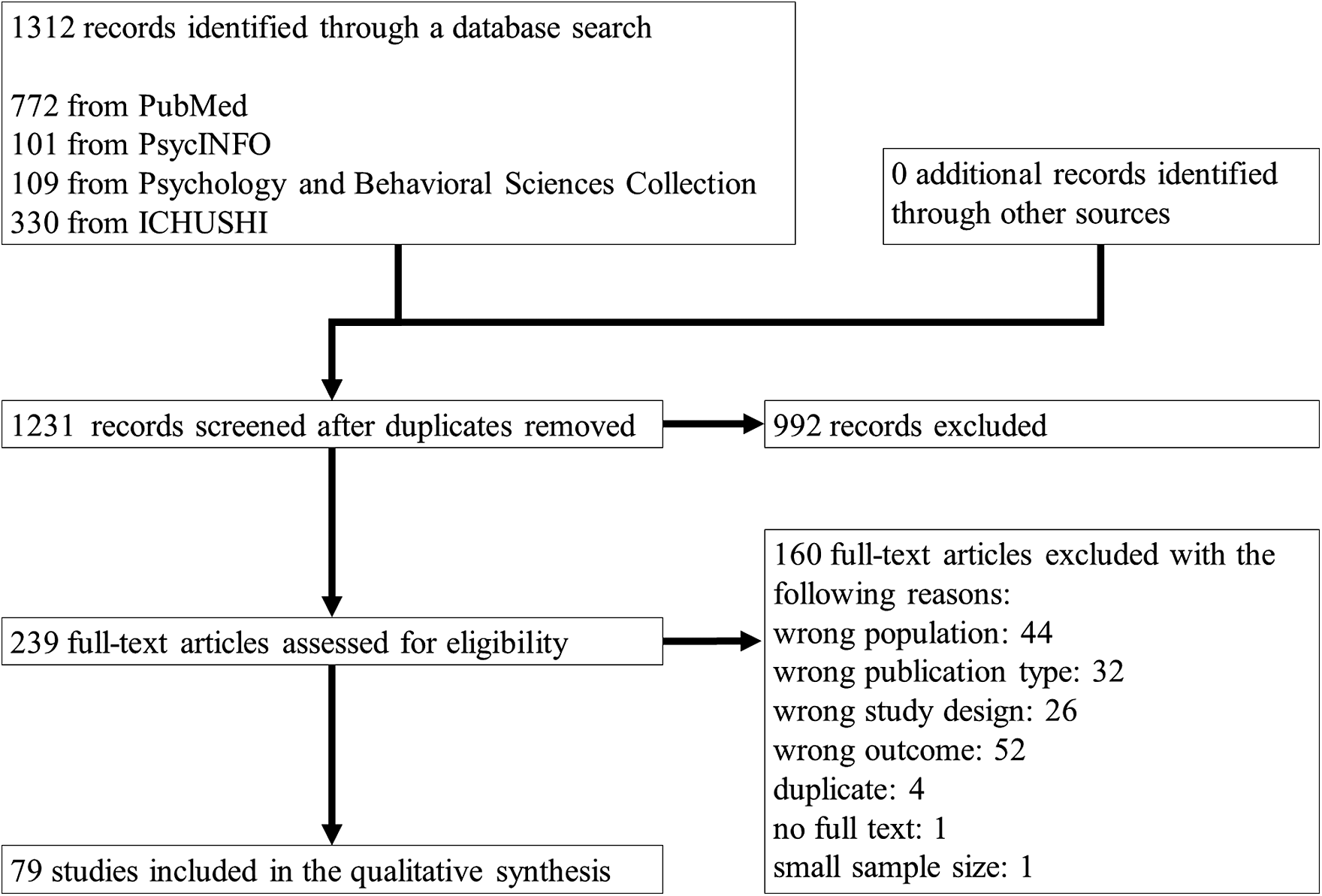
The PRISMA flow chart of the study selection in this systematic review is demonstrated in Figure 1. The search strategy identified 1312 studies. Among them, the eligibility of 239 studies was judged based on titles and abstracts. After excluding 160 studies, 79 studies were included in this review.
The List of Included Studies Reporting Psychological Consequences

Abbreviations: ASD, acute stress disorder; CAGE, CAGE Scale; CES-D, Center for Epidemiologic Studies Depression Scale; DSM-5, Diagnostic and Statistical Manual of Mental Disorders, 5th edition; FY, fiscal year; GHQ, General Health Questionnaire; ICD-10, International Classification of Diseases, 10th edition; IES-R, Impact of Event Scale-Revised; K6, Kessler 6-Item Psychological Distress Scale; K10, Kessler 10-Item Psychological Distress Scale; MINI, Mini-International Neuropsychiatric Interview; n/a, not available; NPP, nuclear power plant; PCL, PTSD checklist; PD, psychological distress; PHQ-9, Patient Health Questionnaire-9; PTG, post-traumatic growth; PTSD, post-traumatic stress disorder; PTSS, post-traumatic stress symptoms; SDQ, Strengths and Difficulties Questionnaire; TEPCO, Tokyo Electric Power Company; WHO-5, World Health Organization-Five Well-Being Index.
Preferred Reporting Items for Systematic Reviews and Meta-Analyses (PRISMA) flow chart of study selection. PRISMA chart in this systematic review. Identification and selection of studies for inclusion.

Study characteristics
A total of 79 manuscripts were extracted for the analysis.Reference Goto, Bromet and Fujimori5, Reference Akutsu, Kaneko and Kodama15–Reference Yoshida, Shinkawa and Urata92 Thirty-one studies (39.2%) were community surveys, Reference Goto, Bromet and Fujimori5, Reference Goto, Bromet and Ota20, Reference Harigane, Suzuki and Yasumura21, Reference Horikoshi, Ohira and Yuuki25, Reference Ishii, Goto and Ota28, Reference Ishii, Goto and Ota29, Reference Itagaki, Ohira and Nagai31, Reference Itagaki, Harigane and Maeda32, Reference Ito, Goto and Ishii34, Reference Iwasa, Takebayashi and Suzuki36, Reference Kunii, Suzuki and Shiga38, Reference Kyozuka, Yasuda and Kawamura41, Reference Mashiko, Yabe and Maeda44, Reference Miura, Nagai and Maeda46, Reference Oe, Maeda and Ohira58-Reference Oe, Fujii and Maeda61, Reference Ohta, Hattori and Arai66, Reference Suzuki, Yabe and Yasumura76, Reference Ueda, Yabe and Maeda82, Reference Uemura, Ohira and Yasumura83, Reference Yabe, Suzuki and Mashiko87, Reference Yoshida, Shinkawa and Urata91 and most of them (n = 24; 30.4%) were from the Fukushima Health Management Study (FHMS)Reference Goto, Bromet and Fujimori5, Reference Goto, Bromet and Ota20, Reference Harigane, Suzuki and Yasumura21, Reference Horikoshi, Ohira and Yuuki25, Reference Ishii, Goto and Ota28, Reference Ishii, Goto and Ota29, Reference Itagaki, Ohira and Nagai31, Reference Itagaki, Harigane and Maeda32, Reference Ito, Goto and Ishii34, Reference Iwasa, Takebayashi and Suzuki36, Reference Kunii, Suzuki and Shiga38, Reference Kyozuka, Yasuda and Kawamura41, Reference Mashiko, Yabe and Maeda44, Reference Miura, Nagai and Maeda46, Reference Oe, Maeda and Ohira58–Reference Oe, Fujii and Maeda61, Reference Ohta, Hattori and Arai66, Reference Suzuki, Yabe and Yasumura76, Reference Ueda, Yabe and Maeda82, Reference Uemura, Ohira and Yasumura83, Reference Yabe, Suzuki and Mashiko87, Reference Yoshida, Shinkawa and Urata91—a governmental cohort study recruiting the entire population living in Fukushima prefecture.Reference Yasumura, Hosoya and Yamashita93 The FHMS recruited all evacuated residents of the Fukushima prefecture as their potential participants, and the study sample size was 73 000+.Reference Yabe, Suzuki and Mashiko87 Several studies used a subset of this database to elaborate on the specific population, such as children,Reference Itagaki, Ohira and Nagai31, Reference Itagaki, Harigane and Maeda32, Reference Mashiko, Yabe and Maeda44, Reference Oe, Maeda and Ohira58, Reference Yabe, Suzuki and Mashiko87 mothers of young children,Reference Goto, Bromet and Fujimori5, Reference Goto, Bromet and Ota20, Reference Ishii, Goto and Ota28, Reference Ishii, Goto and Ota29, Reference Ito, Goto and Ishii34, Reference Kyozuka, Yasuda and Kawamura41 and older adults.Reference Harigane, Suzuki and Yasumura21
For non-FHMS studies (n = 46; 60.5%), a large number of the studies used convenience samples and focused on evacuees (living in and out of the Fukushima prefecture), children, and older adults. Other study populations focused on specific populations, such as hospital patients,Reference Akutsu, Kaneko and Kodama15, Reference Hori, Hoshino and Miura23, Reference Matsumoto, Kunii and Wada45, Reference Miura, Wada and Itagaki47, Reference Niimura, Sakuma and Miura54, Reference Wada, Kunii and Matsumoto85, Reference Wada, Kunii and Matsumoto86 caregivers,Reference Fujitani, Carroll and Yanagisawa19, Reference Sawa, Takase and Noju71 students, Reference Anderson, Prioleau and Taku16, Reference Ishikawa, Motoya and Sasagawa30, Reference Ito, Sasaki and Okabe33, Reference Lieber42, Reference Miura, Miura and Okayasu48-Reference Miura, Miura and Okayasu50, Reference Okazaki, Ootsuyama and Abe62 and workers of various occupations. Specifically, a series of studies were conducted among the NPP workers.Reference Ikeda, Tanigawa and Charvat27, Reference Shigemura, Tanigawa and Nishi74, Reference Shigemura, Tanigawa and Saito75, Reference Tanisho, Shigemura and Kubota78 Other worker populations included decontamination workers,Reference Hidaka, Kakamu and Hayakawa22 dentists that took part in disaster victim identification missions,Reference Shigemura, Someda and Tokuno73 public health professionals and hospital nurses,Reference Nukui, Murakami and Midorikawa57, Reference Yoshida, Orita and Goto90, Reference Yoshida, Shinkawa and Urata92, Reference Shiga94 Japan Self-Defense Force personnel,Reference Nagamine, Yamamoto and Shigemura52 and local government workers.Reference Maeda, Ueda and Nagai43
Quality assessment
About two-thirds of the examined papers (n = 51; 64.6%) were written in English whereas 28 (35.4%) were written in Japanese.Reference Akutsu, Kaneko and Kodama15, Reference Fujita18, Reference Horikoshi, Ohira and Yuuki25, Reference Igarashi, Nishizawa and Noto26, Reference Ishii, Goto and Ota29, Reference Iwagaki, Tsujiuchi and Masuda35, Reference Miura, Wada and Itagaki47–Reference Miura, Miura and Okayasu50, Reference Murakami, Takebayashi and Tsubokura51, Reference Niimura, Sakuma and Miura54, Reference Nishimaki, Orui and Yasumura56, Reference Okazaki, Ootsuyama and Abe62, Reference Okazaki, Ohga and Yokoo63, Reference Ohta, Hattori and Arai66–Reference Sato68, Reference Sato, Ishida and Hattori70, Reference Shiga, Kida and Yokoyama72, Reference Suzuki, Suzuki and Hata77, Reference Tsujiuchi, Komaki and Iwagaki81, Reference Ushijima, Sung and Matsutani84, Reference Wada, Kunii and Matsumoto86, Reference Yamaguchi, Tsujiuchi and Masuda88, Reference Yoshida, Shinkawa and Urata91, Reference Yoshida, Shinkawa and Urata92 Most studies (57; 75.0%) had a single-wave, cross-sectional design. A small portion of the studies had multiple waves of cross-sectional design (n = 15; 19.0%)Reference Akutsu, Kaneko and Kodama15, Reference Goto, Bromet and Ota20, Reference Hori, Hoshino and Miura23, Reference Ikeda, Tanigawa and Charvat27, Reference Ishii, Goto and Ota28, Reference Ito, Goto and Ishii34, Reference Iwagaki, Tsujiuchi and Masuda35, Reference Nagamine, Yamamoto and Shigemura52, Reference Nishi, Susukida and Usuda55, Reference Oe, Maeda and Ohira58–Reference Oe, Fujii and Maeda61, Reference Yabe, Suzuki and Mashiko87, Reference Yamaguchi, Tsujiuchi and Masuda88; among them, three studies (3.8%) conducted a trajectory analysis.Reference Oe, Maeda and Ohira58–Reference Oe, Takahashi and Maeda60 Only four studies (5.1%) used a longitudinal design.Reference Kuroda, Iwasa and Goto40, Reference Miura, Nagai and Maeda46, Reference Tanisho, Shigemura and Kubota78, Reference Yamanouchi, Hiroshima and Takeuchi89 Control groups were used in 13 studies (16.5%).Reference Anderson, Prioleau and Taku16, Reference Ben-Ezra, Shigemura and Palgi17, Reference Igarashi, Nishizawa and Noto26, Reference Ishikawa, Motoya and Sasagawa30, Reference Kyozuka, Yasuda and Kawamura41, Reference Lieber42, Reference Miura, Miura and Okayasu48, Reference Miura, Miura and Okayasu50, Reference Nishi, Susukida and Usuda55, Reference Okazaki, Ootsuyama and Abe62, Reference Orita, Hayashida and Urata64, Reference Sato, Ishida and Hattori70, Reference Sawa, Takase and Noju71
Most of the studies were based on responses from self-administered questionnaires (68; 89.4%). Seven studies (9.2%) used medical records retrospectively for their data.Reference Akutsu, Kaneko and Kodama15, Reference Hori, Hoshino and Miura23, Reference Matsumoto, Kunii and Wada45, Reference Miura, Wada and Itagaki47, Reference Niimura, Sakuma and Miura54, Reference Wada, Kunii and Matsumoto85, Reference Wada, Kunii and Matsumoto86 Only one study (1.3%) used a diagnostic interview to diagnose the study’s participants psychiatrically.Reference Maeda, Ueda and Nagai43 Two studies (2.5%) reported trends of people screening positive in the FHMS,Reference Horikoshi, Ohira and Yuuki25, Reference Ishii, Goto and Ota29 but did not report the content of their intervention. Other than that, there was not a single study that reported on the methods or effects of the psychological interventions on the affected individuals.
Summary of the findings
The outcomes of the selected studies focused on nonspecific psychological distress (PD), depressive symptoms, post-traumatic stress symptoms (PTSS), and anxiety symptoms. The rates of high-risk individuals widely varied between studies, owing to differences in participants’ characteristics, study timing, and outcome measures (eg, diagnostic criteria, rating scale, and cutoff thresholds). These rates tended to be higher in control groups that were unaffected by the nuclear disaster.Reference Ben-Ezra, Shigemura and Palgi17, Reference Lieber42, Reference Miura, Miura and Okayasu48, Reference Nishi, Susukida and Usuda55, Reference Sato, Ishida and Hattori70, Reference Sawa, Takase and Noju71 Only a single study performed a diagnostic interview to measure the prevalence of mental disorders; among the 168 local government workers, the rates for depression and PTSD were 17.9% and 4.8%, respectively.Reference Maeda, Ueda and Nagai43 Nishi et al used the government provided statistical data to measure the PD of the residents of the Fukushima prefecture in comparison to the rest of Japan, before and after the disaster.Reference Nishi, Susukida and Usuda55 The rates of high-risk individuals in the Fukushima prefecture increased from 2010 to 2013, and while there was no difference in high-risk rates between Fukushima and the rest of Japan before the disaster, a significant difference was observed in the aftermath of the disaster.
Most of the studies assessing PD used Kessler’s K6 scale for its measurement.Reference Kessler, Barker and Colpe95 This scale was developed to detect psychiatric disorders according to the Diagnostic and Statistical Manual of Mental Disorders (4th edition).96 Several studies used different versions of the General Health Questionnaire.Reference Goldberg and Williams97–Reference Weiss, Marmar, Wilson and Keane102 The criteria for screen-positive individuals widely differed between studies, and the screening-positive rates ranged from 8.3% to 65.1%.Reference Naiki, Morita and Takada53, Reference Ushijima, Sung and Matsutani84 Likewise, depressive symptoms were measured using different measures and thresholds (eg, Center for Epidemiologic Studies Depression Scale [CES-D],Reference Radloff98 World Health Organization-Five Well-Being Index [WHO-5],Reference Awata, Bech and Yoshida99 Zung Self-rating Depression Scale,Reference Zung100 Patient Health Questionnaire-9 [PHQ-9]Reference Kroenke, Spitzer and Williams101), and rates for screen-positive individuals ranged in-between 12.0% and 52.0%.Reference Tsubokura, Hara and Matsumura79, Reference Ushijima, Sung and Matsutani84
In order to measure PTSS, most studies employed either the Impact of Event Scale-RevisedReference Weiss, Marmar, Wilson and Keane102 or PTSD Checklist-Specific.Reference Blanchard, Jones-Alexander and Buckley103 Rates for high-PTSS individuals fluctuated between 10.5% and 62.6%.Reference Ben-Ezra, Shigemura and Palgi17, Reference Tsujiuchi, Komaki and Iwagaki81 Although many studies assessed anxiety symptoms, mostly in the context of radiation exposure, none of these studies used a standardized measure. Given this limitation, studies were inclined to report high anxiety levels.Reference Hidaka, Kakamu and Hayakawa22, Reference Miura, Nagai and Maeda46, Reference Oe, Maeda and Nagai59, Reference Okazaki, Ootsuyama and Abe62, Reference Sato68, Reference Suzuki, Suzuki and Hata77, Reference Yoshida, Orita and Goto90, Reference Yoshida, Shinkawa and Urata92 Most of the children/adolescent studies used the Strength and Difficulties QuestionnaireReference Matsuishi, Nagano and Araki104—a brief screening questionnaire to evaluate developmental impairments and psychological/psychiatric conditions/disorders for 3- to 16-year-olds—as their study measure.Reference Itagaki, Ohira and Nagai31, Reference Itagaki, Harigane and Maeda32, Reference Lieber42, Reference Mashiko, Yabe and Maeda44, Reference Oe, Maeda and Ohira58, Reference Yabe, Suzuki and Mashiko87 The rates of screen-positive individuals ranged between 16.0% and 25.0%.Reference Itagaki, Harigane and Maeda32, Reference Mashiko, Yabe and Maeda44
For studies using medical records, outcomes were either diagnosis based on clinical assessments or International Statistical Classification of Diseases and Related Health Problems, 10th version (ICD-10).105 These studies reported cases of organic/symptomatic mental disorders (eg, dementia), schizophrenic disorders, and adjustment disorder.Reference Miura, Wada and Itagaki47, Reference Niimura, Sakuma and Miura54, Reference Wada, Kunii and Matsumoto86 However, a relationship between disaster exposure and psychiatric symptoms is not always reported. Matsumoto et al assessed the characteristics of outpatients’ psychiatric conditions in the first month after the disaster and reported that (1) bipolar-I disorder patients were likely to exacerbate and (2) manic switching happened more than depressive switching.Reference Matsumoto, Kunii and Wada45 Wada et al examined psychiatric inpatients for psychiatric symptom changes before and after the disaster.Reference Wada, Kunii and Matsumoto85 Results showed that in two-thirds of the patients, symptoms did not remarkably change, and for several cases, symptoms dramatically improved.
Discussion
The present review shows that the prevalence of mental disorder was overall high in Fukushima survivors, in comparison to the survivors of other disasters. The rates for individuals who screened positive for adverse mental health widely varied owing to fundamental differences in methodology, such as target populations, rating scales, cutoff points, and timing. Nonetheless, large-scale community studies continue to report high rates of psychological issues in the affected individuals, especially in the first few years after the disaster. For example, Oe et al conducted a population study on all the evacuees of the Fukushima prefecture in the years 2012, 2013, and 2014.Reference Oe, Fujii and Maeda61 The study revealed that the percentage of individuals with high PD and PTSS were 11.4% to 12.4% and 17.8% to 19.0%, respectively. Several community studies targeted vulnerable populations such as children and mothers of young children. Rates of children screened positive in the Strengths and Difficulties Questionnaire, ranging in-between 16.0% and 25.0%,Reference Itagaki, Harigane and Maeda32, Reference Mashiko, Yabe and Maeda44 and rates of depressed mothers with young children were as high as 27.6%.Reference Goto, Bromet and Fujimori5 Using predisaster government’s statistical data, Nishi et al compared the rates of distressed individuals before and after the disaster, and show an explicit increase in the incidence of psychological issues after the disaster.Reference Nishi, Susukida and Usuda55
Rates of positively screened individuals fluctuated to a more considerable degree in studies using convenience samples. The rates tended to be higher in vulnerable populations, such as evacuees living in temporary housing,Reference Horikoshi, Iwasa and Kawakami24 mothers of young children,Reference Ushijima, Sung and Matsutani84 nurses,Reference Nukui, Murakami and Midorikawa57 caregivers,Reference Fujitani, Carroll and Yanagisawa19 and NPP workers.Reference Shigemura, Tanigawa and Saito75 Only one study reported no significant difference in PTSS between the study and the control groups among the medical school volunteers.Reference Anderson, Prioleau and Taku16 These results should be interpreted in light of methodological limitations. For example, a study showed a remarkably high PTSS rate among the evacuees (59.4%).Reference Tsujiuchi, Yamaguchi and Masuda80 This study, however, was initiated in March 2012, exactly 12 months after the disaster. Therefore, affected individuals may have experienced heightened, yet generally transient, psychological responses during this time. This phenomenon, known as anniversary reaction,Reference Ye, Fan and Li106 is a possible cause of bias and consideration for future studies.
This review also denoted the advent of a wide variety of mental conditions, affecting Fukushima nuclear disaster survivors after the accident. Several studies analyzed medical records, focused on patients’ psychiatric outcomes, provided information about clinical care, especially in the very acute disaster phase.Reference Akutsu, Kaneko and Kodama15, Reference Hori, Hoshino and Miura23, Reference Matsumoto, Kunii and Wada45, Reference Miura, Wada and Itagaki47, Reference Wada, Kunii and Matsumoto85, Reference Wada, Kunii and Matsumoto86 These studies show that psychiatric outcomes include not only trauma-related disorders but also the onset or worsening of various conditions, such as preexisting organic/symptomatic mental disorders, schizophrenic disorders, mood disorders, and anxiety disorders. Many studies also focused on the anxiety/fear of affected individuals, especially in the context of radiation fear.Reference Hidaka, Kakamu and Hayakawa22, Reference Kuroda, Iwasa and Orui39, Reference Okazaki, Ohga and Yokoo63, Reference Sato68, Reference Shiga, Kida and Yokoyama72, Reference Suzuki, Suzuki and Hata77, Reference Yoshida, Orita and Goto90, Reference Yoshida, Shinkawa and Urata92 None of these studies, however, used standardized rating scales to measure the patients’ anxiety/fear. Therefore, there is a limited understanding of the quality and quantity of anxiety/fear observed in these people.
It is a known fact that the presence of a pre-existing mental disorder is a significant factor for the development of postdisaster PTSD.Reference Bromet, Atwoli and Kawakami10 Interestingly, in a small scale cross-sectional study, some psychiatric inpatients showed symptom improvements in the very first week of the postdisaster recovery phase.Reference Wada, Kunii and Matsumoto85 The report blatantly challenges the predominant claim. This challenge might serve an ideal research topic for future studies to better understand the relationship between existing psychiatric features, disaster exposure, and recovery factors.
Higher prevalence rates of mental illnesses and a wide variety of psychological consequences represent the immense impact of the Fukushima nuclear disaster. First of all, the survivors were exposed to earthquakes and tsunamis. In addition to that, the survivors had experienced substantial distress owing to the nuclear disaster. Radioactive materials are imperceptible, and the individuals were unable to detect health threats all by themselves. Although the radiation exposure dose in Fukushima was considerably lower than that of the Chernobyl disaster,Reference Steinhauser, Brandl and Johnson107 the imperceptible nature of the nuclear disaster heightened fear in the otherwise healthy population.Reference Bromet108 Furthermore, large-scale evacuations were sudden, unplanned, and chaotic.Reference Hasegawa, Tanigawa and Ohtsuru2, Reference Tanigawa, Hosoi and Hirohashi109 The people affected are forced to cope with changes in living environments, interpersonal networks, jobs or schools, and socioeconomic status.Reference Ye, Fan and Li106, Reference Nagai, Ohira and Zhang110–Reference Ohtsuru, Tanigawa and Kumagai111 These abrupt changes disrupt the community on multiple levels, putting a heavy burden on the survivors. The present study assesses the psychological effects in the first 8 years, and longer-term studies from the Chernobyl disaster signifies a similar trend,Reference Bromet108 suggesting that longer-term effects of the Fukushima disaster will be similar to that produced in the Chernobyl disaster.
The present review demonstrates the challenges associated with mental health studies in the aftermath of a large-scale calamity. Given the extreme burden on the affected survivors, including the scientific community, population-based studies are incredibly challenging. Nevertheless, FHMS approached the residents of the entire Fukushima prefecture and published an extensive amount of literature to assess the population’s psychological status. This literature series will become part of basic knowledge in the wake of future nuclear/radiological events.
This review also unveiled several research gaps at the time of this writing. First, almost all studies used self-report questionnaires and have lower reliability than structured interviews. Only one study, constituting public health workers, used a diagnostic interview as a study outcome.Reference Maeda, Ueda and Nagai43 Second, no study reported on the psychological intervention methodologies in use or its effects on the affected residents. This observation is not meant to imply that the interventions are inadequately planned—two studies reported the implementation of telephone support in conjunction with the FHMS.Reference Hasegawa, Tanigawa and Ohtsuru2, Reference Ishii, Goto and Ota29 Still, we are unable to assess the effectiveness of mental health support programs provided to these populations. Third, almost all studies did not have predisaster data to compare with postdisaster data, although some studies did challenge this obstacle by using nationally published statistics. Lastly, a vast majority of studies—including the FHMS studies—did not have comparison groups, so the comparison between the Fukushima disaster survivors and other populations remains unexplored. Further research is needed to compare the conditions faced by survivors of the Fukushima disaster and that of other disasters.
Our study has several limitations. First, our literature search was limited to four databases (not including EMBASE), and limited search terms were used. These search processes might have affected our attempt to capture all the available papers in the scientific community. Our search was limited to manuscripts published before our study, and we have a limited understanding of longer-time effects. We were unable to access other potential studies that were not included in our search strategy, delimiting generalizability. Second, we did not include interventions, which is important outcome about mental health under disasters. A previous systematic review reported in 2013 mention the psychological interventions under community disasters, which emphasized an integration of interventions into emergency medicine and trauma care responses.Reference North and Pfefferbaum112 Another systematic review reported in 2014 demonstrated the efficacy of cognitive–behavioral therapy for victims of earthquake.Reference Pandya113
Conclusion
The present systematic review analyzes the psychological consequences faced by the survivors of the Fukushima nuclear disaster by reviewing the different kinds of literature published in the first 8 years after the incident. The literature review suggests high rates of positively screened individuals and a whole range of mental conditions associated with disaster exposure. However, the majority of these studies were devoid of configured control groups, so future research needs to establish meticulously designed methodologies to confirm these findings. To our surprise, there was no study reporting on psychological intervention methods or effects. Also, few studies assessed the affected people’s resilience in the selected studies. Future studies must be structured to provide adequate and effective care as well as improve an understanding of resilience to the affected survivors. Given the timing of the present review, we are unable to understand the psychological consequences in the long term. We hope that this review will provide insight into ongoing researches and efforts currently targeting the Fukushima nuclear survivors and contribute towards enhancing the well-being of these individuals.
Acknowledgment
We want to thank Editage (www.editage.jp) for English language editing.
Supplementary Materials
To view supplementary material for this article, please visit http://dx.doi.org/10.1017/S1092852920000164.
Disclosures
Jun Shigemura, Takero Terayama, Mie Kurosawa, Yuki Kobayashi, Hiroyuki Toda, Masanori Nagamine, and Aihide Yoshino did not receive funding in connection with this study and do not have an affiliation with or financial interest in any organization that might pose a conflict of interest.