1. INTRODUCTION
Navigational collisions are one of the major safety concerns in many seaports. A number of researchers (Darbra and Casal, Reference Darbra and Casal2004; Liu, Liang et al., Reference Liu and Liang2006; Liu, Pedersen et al., Reference Liu, Pedersen, Okazaki, Fukuto and Tanaka2006; Yip, Reference Yip2008) have reported that collisions account for a substantial portion of major shipping accidents in port waters. Furthermore, growth of shipping traffic over the past decades (Soares and Teixeira, Reference Soares and Teixeira2001) is likely to result in increased traffic movements within port waters, which in turn could increase collision risk in such waters (Chin and Debnath, Reference Chin and Debnath2008). To assess navigational safety in port waters, traditionally researchers have relied on collision statistics. A number of studies have used this approach to examine trends and causes of collisions (Goossens and Glansdorp, Reference Goossens and Glansdorp1998; Akten, Reference Akten2004; Darbra and Casal, Reference Darbra and Casal2004; Liu, Liang et al., Reference Liu and Liang2006) whereas some have examined consequences (i.e., injuries and fatalities) by using the statistics (Darbra and Casal, Reference Darbra and Casal2004; Yip, Reference Yip2008).
The collision-based safety analysis approach is often hampered by several limitations. Firstly, to obtain statistically sound inferences from analysis of collision records it is necessary to have a database of a sufficiently large number of collisions. Since a long time period is required to obtain such a database, this approach is not suitable for short-term safety assessment, where, for example, there is a need to evaluate the effectiveness of a particular type of safety measure at a specific location. Moreover, in the case of assessing safety in a particular location the sample size (i.e., number of collisions in that location) becomes even smaller, and thus it becomes more difficult to obtain statistical soundness in results. This may explain why statistical significances are not reported in many studies (e.g., Darbra and Casal, Reference Darbra and Casal2004; Liu, Liang et al., Reference Liu and Liang2006). The low sample problem also restricts safety analysts from using robust statistical methods, such as regression techniques. Secondly, collision is an outcome of a complex process of interaction involving vessels, pilots, crews, port operators and marine environment. Therefore, it is sometimes difficult to investigate the main causes of collisions just from the numbers of the outcome (i.e., collision) of the process. Finally, this approach to safety analysis is often criticized by many researchers (e.g., Chin and Quek, Reference Chin and Quek1997; Debnath and Chin, Reference Debnath and Chin2006; Songchitruksa and Tarko, Reference Songchitruksa and Tarko2006) as reactive and unethical as it requires sufficiently large number of collisions to take place first, before any preventive or corrective measures are taken.
A promising alternative that overcomes the limitations of the collision-based safety analysis approach is safety analysis using surrogate safety measures, where safety is assessed by analyzing critical vessel interactions or conflicts. This surrogate safety analysis concept was primarily developed in the context of road traffic, and has been employed in numerous studies (see Chin and Quek, Reference Chin and Quek1997). However, it is yet to be comprehensively implemented in navigational safety assessment. In an earlier paper (Debnath and Chin, Reference Debnath and Chin2006) we proposed this concept for navigational safety assessment purpose and discussed its suitability to navigational safety research. We contended that it has great potential to extract meaningful inferences from short-term safety analyses. The key advantage of this safety analysis approach is having a larger database within a shorter period of time as navigational traffic conflicts occur considerably more frequently than collisions. Therefore, it is possible to obtain statistically sound inferences by analyzing conflicts of a significantly shorter time period. The surrogate safety analysis approach also solves the ethical problem of collision-based analysis (i.e., reactive approach) by investigating safety deficiencies proactively. Thus, this approach of safety analysis is an ethically appealing alternative to the traditional approach for fast, reliable and effective safety assessment.
This paper aims to develop an innovative navigational traffic conflict technique (NTCT) for quantitative measurement of collision risks in port waters by employing surrogate safety measures. Two such measures indicating vessels' spatial and temporal proximity are used to measure conflicts quantitatively. By using the measured conflicts, a method is developed for measurement of collision risks in port waters. This methodology is illustrated and validated for fairways in Singapore port. The NTCT, its illustration and validation are presented in subsequent sections.
2. METHODOLOGY
To measure collision risk in a waterway, it is necessary to measure the conflict severities of all vessel interactions in that waterway. A suitable measure of conflict severity is then necessary to measure navigational traffic conflicts (NTC) quantitatively. After critically examining the suitability of conflict measures that were primarily developed to measure road traffic conflicts (RTC), a suitable measure is developed to measure NTC. With the measured conflict severities of all interactions in a waterway, the collision risk in that waterway can be measured by employing the developed NTCT.
2.1. Measurement of navigational traffic conflicts in a vessel interaction
From the history of traffic conflict technique (TCT) development, conflicts are seen as being measured qualitatively or quantitatively. The former method relies on observers to identify and grade conflict severities by their judgments. It is criticized by many researchers (e.g., Glauz and Migletz, Reference Glauz and Migletz1980; Guttinger, Reference Guttinger1982; Chin and Quek, Reference Chin and Quek1997) for its well recognized drawback of inconsistency in observers' subjective judgments. To overcome this drawback many researchers (e.g., Hyden, Reference Hyden1977; Guttinger, Reference Guttinger1982; Chin et al., Reference Chin, Quek and Cheu1991) employed the quantitative measurement method, where conflicts are measured by using surrogate safety measures. This method is usually preferred as it is objective and provides a quantitative measure. In this paper, we espouse this method to develop a suitable measure of NTC.
For quantitative measurement of conflicts, researchers have developed many surrogate measures in the context of road traffic. To employ these RTC measures for measuring NTC it is necessary to critically examine the measures' suitability in measuring NTC. Several RTC measures that may have potential in measuring NTC are examined in the context of navigational traffic in the succeeding section.
2.1.1. Suitability of road traffic conflict measures on navigational traffic conflict measurement
The most commonly used temporal RTC measure is the Time to collision (TTC) (Hayward, Reference Hayward1972), which is defined as the expected time for two vessels to collide if course and speeds of both vessels remain unchanged. To measure TTC, a prerequisite is that collision course must exist between the vessels involved. Therefore, it is not capable of measuring conflicts where a collision course does not exist. But, the vessels could pass each other with a narrow space/time margin, which may be a safety concern. Since TTC can vary throughout the interaction process, researchers considered different points at which TTC should be measured (van der Horst, Reference Horst1990). The most commonly used measure is the minimum registered value of TTC in an interaction process (Chin et al., Reference Chin, Quek and Cheu1991) and the TTC at the onset of taking evasive actions, which is sometimes called Time to accident (TA) (Hyden, Reference Hyden1977). To measure TA, the evasive actions must be observable. However, measuring conflicts depending on observable evasive actions could be misleading (Chin and Quek, Reference Chin and Quek1997). More importantly, it would be difficult to observe such actions in the context of navigational traffic. Based on the TTC concept, Minderhoud and Bovy, (Reference Minderhoud and Bovy2001) proposed two more explorative measures – Time exposed TTC (TET) and Time integrated TTC (TIT). These two measures do not rely on observable evasive actions, but suffer from the limitation of collision course existence criteria. Moreover, they are highly data-intensive and attainable only in simulation environment. Although the other measures of the TTC family are easy to measure and apply, they may not be appropriate to measure NTC due to their limitations.
Researchers (Allen et al., Reference Allen, Shin and Cooper1978) proposed another temporal measure – Post encroachment time (PET) that overcomes the major limitations of the TTC family. The PET is the time lapse between the end of encroachment of a vessel on a potential collision point and the time that the other vessel actually arrives at that point. It is especially suitable for measuring conflicts in which two vessels pass over a common spatial point or area with a temporal difference, regardless of the collision course existence criterion. Although it overcomes this limitation of TTC, it suffers from a couple of major drawbacks. Firstly, only the conflicts involving vessels with transversal trajectories can be measured by PET. Conflicts involving vessels with similar or nearly opposite trajectories cannot be measured because of the absence of any point of collision. Secondly, to measure PET a fixed projected point of collision is required, rather than one that changes with the dynamics of vessel interactions. Several derivatives of the PET measure were also proposed by Allen et al. (Reference Allen, Shin and Cooper1978), such as Gap time, Encroachment time, Initially attempted PET. However, these measures are also constrained by one/both of the limitations of PET. Since NTC can be of several types (such as meeting/head-on, overtaking, crossing, and hitting a stationary vessel) and PET is capable of measuring the crossing type only, the PET measurement family looses its suitability for measuring NTC.
Besides the time-based measures, some other measures that explain spatial or kinematic characteristics of vessel interactions were proposed for measuring RTC. A spatial measure, the Proportion of stopping distance (PSD) represents the ratio of the distance available for manoeuvring to that of the necessary stopping distance to a projected point of collision (FHWA, 2003). A kinematic measure, the Required Deceleration Rate (RDR) is the maximum uniform rate at which a vessel must decelerate to avoid a collision. These two measures are particularly suitable for measuring RTC as the manoeuvring space on a road is very limited. For measuring NTC, they may not be suitable enough due to availability of considerably higher manoeuvring space in navigation, compared to road driving, which allows pilots to alter course and/or slacken speed in order to avoid collisions, instead of stopping.
The foregoing shows that the RTC measures are not suitable for measuring NTC, mainly because of a dimensional difference between the two types of conflicts. The RTC is often measured in one-dimension, whereas the NTC is required to be measured two-dimensionally. Conceptually, the measures of the TTC family are incapable of measuring the NTC in which collision course does not exist between the involved vessels. Although the PET measure and its derivatives can overcome this limitation, use of them is limited to measuring crossing type of conflicts only. The PSD and RDR are capable of measuring all types of NTC, but they do not match the characteristics of navigational traffic. Therefore, to measure NTC effectively it is necessary to develop a measure that would suit two-dimensional traffic characteristics. Measuring NTC spatially as well as temporally would be useful for this purpose.
2.1.2. Development of navigational traffic conflict measure
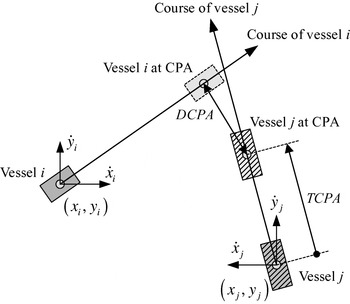
A quantitative measure of NTC is developed which expresses risk of collision in an interaction by employing two proximity indicators. These indicators, Distance at Closest Point of Approach (DCPA) and Time to Closest Point of Approach (TCPA), represent spatial and temporal closeness between a pair of vessels. DCPA and TCPA are respectively the probable distance between a vessel pair at their Closest Point of Approach (CPA) and the time required to reach CPA, given that the course and speed of both vessels remain unchanged. Both indicators are independent of collision course existence criteria and are capable of measuring all types of NTC. Furthermore, they can easily be calculated from vessels' position and speed vectors.
The proximity indicators have been employed in onboard navigation and navigational research for many years. Navigators make use of these parameters in order to assess collision risk in onboard navigation. These are also used in navigational studies of different aspects, such as development and evaluation of navigational support systems (Sato and Ishii, Reference Sato and Ishii1998; Pedersen et al., Reference Pedersen, Inoue and Tsugane2003; Liu, Pedersen et al., Reference Liu, Pedersen, Okazaki, Fukuto and Tanaka2006), traffic density analysis (Merrick et al., Reference Merrick, van Dorp, Blackford, Shaw, Harrald and Mazzuchi2003) and ship domain analysis (Zhu et al., Reference Zhu, Xu and Lin2001; Szlapczynski, Reference Szlapczynski2006). Being used in navigation and navigational studies, the proximal indicators have general acceptability to navigators and researchers.
To derive DCPA and TCPA in a vessel interaction (see Figure 1), let vessels i and j be approaching each other from their current positions (x i, y i) and (x j, y j) at speeds of  and
 respectively at time t. If they maintain their speeds and courses, they will reach CPA after a time period equal to TCPA. By making use of this condition, DCPA and TCPA can be derived in terms of the vessels' current positions and speeds as


A typical vessel interaction showing spatial and temporal proximity indicators.

In general, vessels would keep changing their speeds and courses throughout an interaction process while taking some evasive actions to avoid collision or just taking some precautionary actions. Consequently, the values of DCPA and TCPA would be changing with time, but not necessarily simultaneously increasing or decreasing. Therefore, to express the risk of collision in an interaction at a particular time t, it is necessary to develop a relationship between the risk and the two proximity indicators:

where C(t) is the risk of collision in an interaction at time t and S(t) is a vector of the proximity indicators. The maximum of C(t) in an interaction process, C max, is taken to represent the conflict severity of that interaction. By utilizing the C max values, the method for measurement of collision risk in a waterway is presented in the succeeding section. The method of developing the relationship between collision risk in an interaction and the proximity indicators is discussed in Section 2.3.
2.2. Measurement of collision risk in a waterway
To measure collision risk in a waterway, C max values of all vessel interactions in the waterway need to be obtained for a specified time period. Since the C max values are obtained for continuous measurement of C(t), it is necessary to truncate the measurement at some point in order to eliminate the interactions which produce no risk of collision. The truncation point can be defined by employing the concept of Ship Domain (SD), which is the surrounding effective waters around a vessel that a pilot wants to keep clear of other vessels (Goodwin, Reference Goodwin1975). It means that a pilot senses there is a risk of collision only if another vessel penetrates his vessel's domain. Therefore only the interactions, where vessels are within SD of each other, are considered for conflict analysis. These interactions are termed as encounters throughout this paper.
To characterize the conflict severities of the encounters in a waterway, a probability distribution function (PDF) of C max can be obtained. Since the C max values are truncated at SD in each encounter, a set of truncated distribution need to be chosen to examine their fitness with the observed C max values. Based on the traffic safety pyramid proposed by Hyden (Reference Hyden1987), the frequency distribution of conflict severity observations would be skewed to the right, i.e., higher frequencies for smaller C max values (i.e., lower risk) and vice versa. The right skewed distribution pattern of conflict severity observations is also found in Chin et al. (Reference Chin, Quek and Cheu1991). To obtain a similar distribution, the measure of conflict severity can be used as C′max=(1/(1−C max)). Since C max ranges from 0 (safe, obtained at SD boundary) to 1 (extreme collision risk), the distribution of C′max is left-truncated at C′max=1 and is asymptotic towards the right. Therefore, for the distribution fitting exercise the following truncated distributions can be prescribed: negative exponential, gamma, weibull, lognormal, and loglogistic. To examine which distribution fits the observed data best, the Anderson-Darling (AD) test can be employed. The test statistic (AD 2) measures how well the data follow a particular distribution (see Stephens, Reference Stephens1974). The statistic is obtained as:

where N is the number of observations; F 0(·) is the cumulative distribution function (CDF) of the tested distribution; and D is the observation values sorted in ascending order. The statistic is compared against its critical values at a specified significance level in order to examine the fitness of the distributions (Stephens, Reference Stephens1974).
Once the PDF of C′max ( ) is obtained, its CDF (
 ) can be obtained by considering the proportions of non-conflict and conflict encounters. The non-conflict encounters, where vessels have diverging trajectories although they are within SD of each other, correspond to negative TCPA values and are represented by a probability mass function (PMF) p(0). In contrast, the conflict encounters, where the measured TCPA is non-negative, are represented by . Therefore, the area under the
 is equal to [1−p(0)], which yields:

where C SD is a constant value (=1) of C′max at truncation point (i.e., at SD).
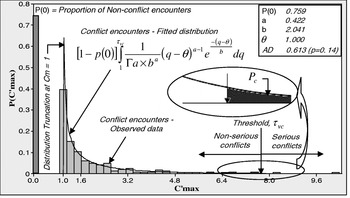
Since C′max represents the severity of conflict, the area under the tail end of  (as shown in Figure 2) can be employed to measure collision risk in terms of probability of serious conflict per encounter. This can be accomplished by setting a threshold value (τ) of C′max which will separate the serious conflicts from the non-serious ones (see Chin and Quek, Reference Chin and Quek1997). A serious conflict corresponds to an encounter that may pose risk of a certain collision. Therefore, the collision risk of a waterway can be expressed as:

A typical PDF of C′max showing distribution truncation and serious conflict threshold.

The risk of collision in any vessel interaction may vary with the size of vessels involved. Perez and Clemente (Reference Perez and Clemente2007) have shown that manoeuvrability and ease in speed adjustments diminishes as vessel size increases and for this reason, vessels of different sizes would produce different levels of risk in an interaction. In order to consider the effects of vessel sizes in computing collision risk, it is necessary to consider a distribution of threshold values instead of a single threshold. The distribution may be obtained by clustering vessels into several vessel classes (VC). The risk of collision is then expressed as:

where p vc is the PMF of VCs, τvc is the threshold value for vessel class vc, M is the number of VCs.
The P c represents collision risk in terms of probability of serious conflict per encounter during a specific time period in a waterway. It could be used as an indicator of the state of safety in that waterway. For this reason, it may be directly employed to compare safety among waterways or time periods, or to evaluate a before-and-after study of navigational facilities.
2.3. Relationship between collision risk in an interaction and proximity indicators
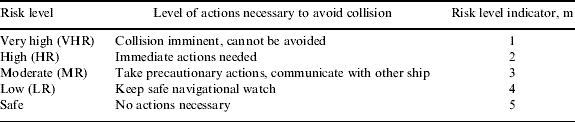
As discussed in Section 2.1.2, to measure collision risk in an interaction, it is necessary to develop a relationship between the risk and the proximity indicators. The relationship can be obtained by employing expert judgments on collision risks which can be collected through a risk perception survey on harbour pilots. In the survey, pilots were asked to rate collision risks in different vessel interactions, which are explained by the two indicators. A five-point risk scale, as shown in Table 1, was developed for this purpose.
Navigational collision risk scale.
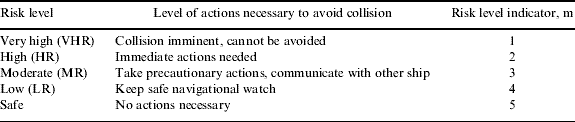
Since the risk levels used in the scale are subjective but ordered in nature, an ordered categorical analysis will be most appropriate to treat such data. An ordered probit model is formulated as:

where r l* is a continuous latent variable measuring perceived collision risk for the l th set of S; Sl is the vector of independent variables (i.e., DCPA and TCPA); β is the vector of regression coefficients; εl is the random error term, which is assumed to be normally distributed with zero mean and unit variance.
The latent variable is mapped on to an observed ordinal variable r, which represents the risk levels used in the scale, as:

where M is number of ordinal categories (as indicated in Table 1) and the threshold values (λ) are unknown parameters describing the boundaries of risk levels.
Based on the normality assumption of the error term, the probability of risk level m for given S can be predicted as:

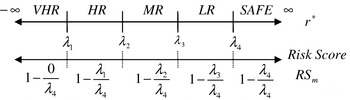
Once the probabilities of each risk level are predicted, associated collision risks can be computed. To do so, risk scores (RS m) are assigned to each risk level based on the thresholds, as shown in Figure 3. The RS m represents the probability of collision for risk level m. Using the proposed risk scale, risk scores for VHR and Safe levels are assigned values of 1 and 0 respectively. The VHR level refers to vessel interactions where collision cannot be avoided, which represents the probability of collision as 1. On the other hand where no action is required under the Safe level, the probability of collision is zero. Therefore, the λ values are normalized to a probability value with the range [0, 1]. Collision risk in an interaction can then be computed as:

Risk scores for subjective risk levels.

To evaluate if the model has sufficient explanatory and predictive power, the likelihood ratio statistics and the McKelvey and Zavoina's R 2 (see Long and Freese, Reference Long and Freese2006) are employed.
To consider the effects of vessel sizes on perceived risk, vessels can be clustered into several VCs according to gross tonnage (GT) and the perceived risk needs to be modelled separately for each VC. The classification based on the Singapore port regulations is used in this study (see Table 2). Further, modelling the risk separately for day and night conditions is necessary as navigational characteristics are different under these conditions (see Akten, Reference Akten2004).
Vessel categories and ship domain in day and night.

3. MEASUREMENT OF COLLISION RISKS IN FAIRWAYS: AN ILLUSTRATIVE EXAMPLE
The proposed NTCT is illustrated for measuring collision risks in the fairways of Singapore port. From the operational definition of fairways (MPA, 2006) they are divided into 15 sections with approximately uniform geometric and traffic control characteristics (see Debnath and Chin, Reference Debnath and Chin2009). In the succeeding sections, the requirements of traffic movement data and its preparation procedure are discussed, followed by results of the ordered probit model which are then used to measure collision risks in the sections.
3.1. Data requirement and preparation
To obtain an overall representative measure of collision risk in a fairway, it may be necessary to measure collision risks separately for day and night conditions. Furthermore, sufficiently large numbers of conflict observations are necessary in order to obtain a statistically fitted distribution of C′max. Uncertainties in the estimated parameters of the proposed distributions could be reduced with increased number of observations. Based on a preliminary analysis, traffic movement data of four hour time periods in day and night conditions are taken for the analysis.
Traffic movement data, obtained from the Vessel Traffic Information System (VTIS) database of Singapore port, are analyzed to measure conflicts. This data include vessels' positions in coordinates, speeds, headings, and their numeric identities. The kinematic information is usually updated at time intervals of few seconds depending on traffic characteristics, thus the data provides detailed trajectories of vessels. After unscrambling the VTIS system data into a computer readable format, a database of vessels' trajectories is obtained in which the trajectories are chronologically listed in segments of update cycles.
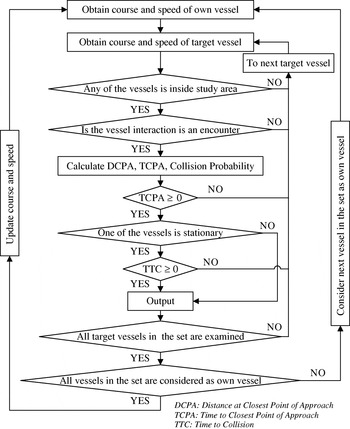
To measure the proximity indicators of encounters and associated risks of collisions in a fairway, a computer program is necessary to analyze the unscrambled database. A block diagram showing the steps of a developed program is presented in Figure 4.
Block diagram of conflict analysis.

The input information necessary for the analysis are the positions, speeds and bearings of vessels plying in and around the fairway in consideration. By utilizing the input data, the proximity indicators and C(t) values are calculated for all possible vessel pairs in the fairway in consideration. To form the pairs, the first vessel in the first update-cycle segment of the database is kept as own vessel, while the rest are considered as target vessel one after another. Before proceeding to analysis, it is necessary to check whether any of the vessels are inside the fairway as the database contains vessel trajectories whole over the port waters. Further, it is necessary to check if the interaction between the vessels is an encounter, which is accomplished by comparing the distance between the vessels with the larger vessel's SD radius. From results of a survey conducted on Singapore port pilots, SD radii of four vessel classes are presented in Table 2. For encounters involving a stationary vessel, it is important to assess whether the dynamic vessel is likely to hit the stationary one or not. This is because often vessels are anchored near the fairway boundary and the fairway vessel may deliberately pass the anchored vessel with a small distance margin while not heading towards the anchored vessel. Such an encounter, which is indicated by a negative TTC, needs to be excluded from the analysis as it may produce false risk of collision. By considering these criteria, C(t) value is obtained for a vessel pair. The procedure of obtaining C(t) values from the proximity indicators is discussed in the succeeding section.
Following a similar analysis the C(t) values are obtained for all vessel pairs in all the update-cycle segments. By taking the maximum of C(t) values over a time period the corresponding C′max values are extracted.
3.2. Relating Collision Risk in an Interaction and Proximity Indicators
A relationship between the risk of collision in an interaction and the proximity indicators is developed by employing risk data obtained through a perception survey conducted on Singapore pilots. In the survey, pilots were asked to indicate their level of perceived risk of collision in terms of the risk levels in the scale, for different values of DCPA and TCPA in day and night conditions. The details of the survey are further discussed in Chin and Debnath (Reference Chin and Debnath2009). A total of 70 responses were obtained with a reasonable response rate of 44%.
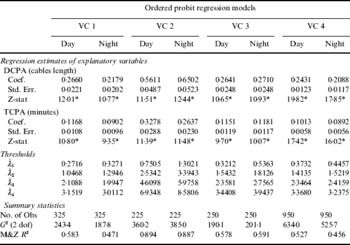
The ordered probit model was calibrated using the maximum likelihood method for each of the vessel class and separately for day and night conditions. Table 3 shows the estimated parameters and goodness-of-fit statistics of all models. The likelihood ratio statistics of all models (e.g., 243·4 and 187·8 for VC1-Day and VC1-Night models respectively) are well above the critical value for significance at 1% level of significance, which implies that the models have a reasonably good fit. The McKelvey and Zavoina's R2 values (e.g., 0·58 and 0·47 for VC1-Day and VC1-Night models respectively) also indicate sufficient predictive power for all models.
Estimates of the ordered probit model.

* significant at 99% significance level
Both DCPA and TCPA show significant positive association with the latent variable in all models (e.g., for VC1-Day model: βDCPA=0·27, p<0·001; βTCPA=0·12, p<0·001). This indicates that collision risk decreases if DCPA and TCPA increase. By utilizing the regression estimates in Equation 11, risk of collision in an interaction can be obtained.
3.2.1. Measuring collision risk
Having extracted C′max values for all vessel pairs in a fairway, the PDF of C′max is obtained by examining fitness of the proposed distributions with observed values. It is obtained through a two step procedure. Firstly, parameters of the proposed distributions are estimated by utilizing the observed data. Secondly, to find the best-fitted distribution, goodness-of-fit of the proposed distributions are examined by using the AD test.
Results of the distribution fitting exercise show that a truncated gamma distribution consistently gives the best fit for all fairways in day and night conditions. The  (Equation 5) can then be rewritten as:

where a and b are the estimated shape and scale parameters of the gamma distribution respectively; θ is the threshold parameter representing the truncation value (=1). A PDF for a typical set of C′max is shown in Figure 2.
Having estimated the parameters in  , risk of collision is measured for all fairways in day and night conditions. In this study, the thresholds of serious conflicts for the four vessel classes are defined based on the specifications of the risk levels used in the proposed risk scale. Since a serious conflict coincides with the transition from the High Risk level to Very High Risk level, the risk scores of the former level are employed to obtain the thresholds. By utilizing the thresholds (presented in Table 4) in Equation 7, risks of collision in the fairways are computed. The probability of a serious conflict in all fairways is found to vary from 1 in 1 000 000 to 5 in 1000 encounters in the day condition, while that in the night vary from 1 in 10 000 to 2 in 100 encounters.
Thresholds for separating serious and non-risk conflicts.

Measured risks show that the probability of serious conflict per encounter is higher in night conditions, compared to day. In daytime, because of better visibility pilots can readily judge speeds, distances between vessels and even any change of courses in order to perceive risk of collision and mitigate it. On the other hand, at night time they need to rely on navigational lights, which could make the perception-mitigation process difficult. This may lead vessels to come closer before taking any evasive actions, resulting in higher collision risks at night.
Measured risks could be employed to compare safety in different fairways and time periods. To further extract meaningful inferences from the risks, measured values for different navigational scenarios can be compared to evaluate safety in those scenarios. For example, if one is interested in evaluating safety in a waterway before and after some changes in its physical or regulatory characteristics, this can be accomplished by comparing the measured risks for the two scenarios. Modern navigational facilities (e.g., Full-bridge simulators, electronic chart display and information system simulator etc.) could be useful for such a before-and-after study.
4. VALIDATION OF METHOD
To validate the proposed NTCT, several issues that were raised in validating TCT for road traffic systems are examined first. Traditionally the validity of TCT is often judged by its adequacy in predicting accidents (Williams, Reference Williams1981) or by evaluating the magnitude of the correlation between conflicts and observed accidents (Spicer, Reference Spicer1971; Spicer, Reference Spicer1973; Zimolong et al., Reference Zimolong, Gstalter and Erke1980). Researchers (Hauer, Reference Hauer1979; Chin and Quek, Reference Chin and Quek1997) criticized the idea of predicting accidents and contended that the intention of a safety study should be to prevent accidents rather than to predict them. Chin and Quek (Reference Chin and Quek1997) further argued that the TCT should primarily be used as an evaluative or diagnostic tool rather than a predictive one. On the other hand, validating TCT by evaluating correlations between conflicts and accidents produced inconsistent findings, as a good number of studies failed to show an acceptable level of correlation. A possible reason for this inconsistency could be the problematic assumption of fixed conflict-accident proportionality and considerable measurement errors (Tarko and Songchitruksa, Reference Tarko and Songchitruksa2005). Hauer (Reference Hauer1979) argued that the expected (i.e., the true value) conflicts and accidents could be correlated, but not the observed ones. Furthermore, relying on accident records for validation purposes contradicts TCT's proactive approach to safety. This dependence could further be problematic in case of navigational collisions as they are very low in numbers. Therefore, it may be a futile exercise to validate the proposed NTCT based on correlations of measured conflicts and observed collisions.
Having grasped the attempts to validate TCT in road safety studies, it is attempted to validate the NTCT by evaluating correlations between measured collision risks and harbour pilots' perceived collision risks in fairways. This approach does not need to rely on observed collision records, thus retains NTCT's proactive nature. Moreover, conceptually it is sensible to compare the measured and perceived risks as pilots are very familiar with port waters, and thus have sufficient knowledge regarding the actual risks in such waters. By analyzing pilots' perceived risks in fairways, Debnath and Chin (Reference Chin and Debnath2009) have also concluded that pilots seem to have a reasonable grasp of the collision risks in fairways.
To gather perceived risks in the fairways, a specifically designed survey was conducted on Singapore pilots. In this survey, pilots were asked to perceive collision risks in the fairways for day and night conditions by utilizing a risk scale ranging from 0 to 4 (safe, low, moderate, high and very high risk). The design considerations and details of the survey are further discussed in Debnath and Chin (Reference Chin and Debnath2009).
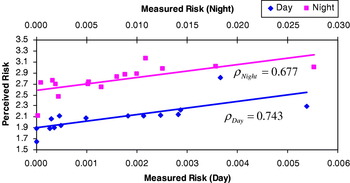
To validate the NTCT, correlations between measured risks and average perceived risks in the fairways for day and night conditions are evaluated (see Figure 5). Results show a Pearson correlation coefficient (ρ) of 0·743 (p=0·002) and 0·677 (p=0·006) for the day and night risks respectively. The reasonably high correlations with acceptable statistical significance imply that the NTCT is valid.
Comparison of the risks measured from conflict analysis and those perceived by pilots.

5. CONCLUSIONS
A proactive approach to navigational safety analysis, namely the Navigational Traffic Conflict Technique, has been innovatively proposed in this paper for quantitative measurement of collision risks in port waters. This approach is an alternative to the collision-based safety analysis approach, which treats safety reactively. In the proposed method, navigational traffic conflicts are measured by two proximity indicators that represent spatial and temporal closeness between a pair of vessels. By employing the measures, conflicts are characterized statistically to measure collision risk in a waterway. The measured risk could be used as an indicator of the state of safety in a waterway.
The proposed method is illustrated for measurement of collision risks in the fairways of Singapore port. Comparison of the measured risks with perceived risks of harbor pilots shows statistically significant and reasonably high correlation (Pearson correlation coefficients of 0·743 and 0·677 respectively for day and night navigation), which imply that the proposed method is valid.
The proactive approach to safety measurement may have great potential in deriving useful inferences on the state of safety in port waters. This method can be employed for evaluation of changes in port waters or facilities. Before-and-after studies can be performed to evaluate their impact on safety in an efficient and quick manner by using navigational simulators. Furthermore, comparison of safety levels between different waterways or time periods or operating conditions can be made by employing this method. This safety measurement method can be applied as a diagnostic and evaluative tool of navigational safety in waters. Since this method provides advantages of short-term safety assessment in a proactive manner, it has great potential to provide more insights into understanding and managing collision risks in port waters. Its potential could further be intensified by devoting future research efforts on this promising arena of navigational safety research.
ACKNOWLEDGEMENTS
The authors gratefully thank the Maritime and Port Authority of Singapore and PSA Marine (Pte) Ltd for the data and support. Special thanks also go to all the harbour pilots who participated in the survey.