INTRODUCTION
Sea cucumbers are important components of the marine ecosystem, distributed all over the world's oceans, generally living near corals, rocks or sea weeds in warm shallow waters (Ridzwan, Reference Ridzwan2007). The fishing of these echinoderms is globally increasing, mainly for export, and there is overexploitation due to demand from Asian markets (Toral-Granda et al., Reference Toral-Granda, Lovatelli and Vasconcellos2008).
The sea cucumber family Holothuriidae is the most diverse in the Holothuroidea class and includes predominantly tropical, shallow-water animals. The family includes five extant genera representing 187 described species: Actinopyga Bronn, 1860 (17 species), Bohadschia Jaeger, 1833 (11 species), Holothuria Linnaeus, 1767 (150 species), Labidodemas Selenka, 1867 (8 species), and Pearsonothuria Levin et al., 1984 (1 species) (Samyn et al., Reference Samyn, Appeltants and Kerr2005, Reference Samyn, Vandenspiegel and Massin2006; O'Loughlin et al., Reference O'Loughlin, Paulay, VandenSpiegel and Samyn2007). Modern treatises about the higher-level systematics of Holothuriidae are scarce. The relationships of the five genera were documented from morphological (Samyn et al., Reference Samyn, Appeltants and Kerr2005) and molecular (Kerr et al., Reference Kerr, Janies, Clouse, Samyn, Kuszak and Kim2005; Kamarul Rahim et al., Reference Kamarul Rahim, Gires and Ridzwan2006) studies. Some new information was presented by Samyn et al. (Reference Samyn, Appeltants and Kerr2005) using morphological data.
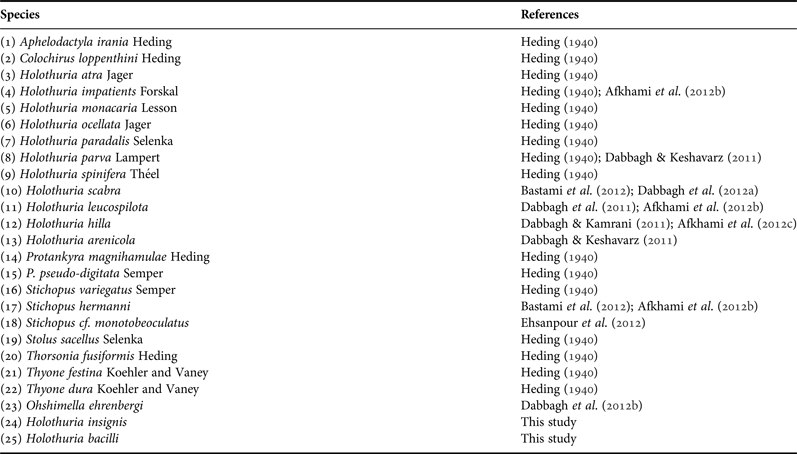
The dominant genus present in the understudied Persian Gulf is Holothuria, where eleven species of this genus have already been recorded from the Iranian coast of the area (Table 1). While the fishes and the corals are rather well documented, other groups, especially invertebrates, need further attention in this region. Despite being consumed as food in many countries for hundreds of years, in Iran, sea cucumbers are not consumed nor well known (cf. Afkhami et al., Reference Afkhami, Ehsanpour, Dabbagh, Sarhadizadeh and Mirzadeh2012a, b).
Species list recorded from Iranian waters of the Persian Gulf.

In the Persian Gulf, like many other water bodies, the identification and distribution of some sea cucumber species has still not been accomplished. In this study, we aim to record the occurrence, for the first time, of two sea cucumber species from the Persian Gulf (Hormuz Island).
MATERIALS AND METHODS
Sea cucumber samples were collected around Hormuz Island (27°5′37.97″N 56°26′43.53″E) on November 2012 during low tide (Figure 1). The samples were then transferred to the laboratory and photographed. The ossicles were subsequently extracted. It is well known that ossicles are the main taxonomic character in holothuroids (Thandar & Samyn, Reference Thandar, Samyn, Heizeller and Nebelsick2004). The ossicles were measured on a transect across a slide prepared from the mid-dorsal region of each specimen. For these means, samples became anesthetized using magnesium chloride (MgCl2) 5% (Jiaxin, Reference Jiaxin2003). In order to extract the ossicles, a small section of the samples made of dorsal and abdominal skin was placed into the commercial bleaching liquid for almost 30 min (Hickman, Reference Hickman1998). This way, white sediments accumulate at the end of the test tube. One drop of liquid was spread on the glass slide, and photographs were taken of the ossicles in order to identify the species using valid identification keys (Conand, Reference Conand1993; Samyn et al., Reference Samyn, Vandenspiegel and Massin2006).
Site sampling of sea cucumber specimens in the Persian Gulf (Hormuz Island).
RESULTS AND DISCUSSION
SYSTEMATICS
Phylum ECHINODERMATA
Class HOLOTHUROIDEA
Order ASPIDOCHIROTIDA Grube, 1840
Family HOLOTHURIDAE Haeckel, 1886
Genus Holothuria (Selenkothuria)
Holothuria (Selenkothuria) bacilla Cherbonnier
(Figure 2)
The specimens are small (less than 100 mm) with an evenly spread brown colour. The ventral mouth is surrounded by 20 short tentacles and the anus is terminal. The ventral podia are large and stiff throughout the trivium. The thinner dorsal podia have no body cuvier and are scattered all over the bivium. The spicules of the ventral integument are extended sticks, with rod-like narrow spines and no side holes, but sometimes with a perforation at one end. The spicules of the dorsal integument are often expanded laterally and make pseudo-plates. Ventral podia are short with smooth sticks, whereas, the tentacles have diverse forms, frequently with prickly ends. They live in shallow water, usually hidden in cavities or under boulders. We also observed only a few specimens – they are not globally well known (cf. Samyn et al., Reference Samyn, Vandenspiegel and Massin2006).
Holothuria (Selenkothuria) bacilla Cherbonnier, 1988. (A) Specimen photographed in aquarium; (B) Rods of tentacles; (C) Dorsal integument of sticks; (D) Plate terminal of the wall of a podion; (E) Sticks to the wall of a podion. Scale A = 10 cm; B, C and E = 20 μm; D = 100 microns (photos by M. Afkhami and M. Ehsanpour).
Phylum ECHINODERMATA
Class HOLOTHUROIDEA
Order ASPIDOCHIROTIDA Grube, 1840
Family HOLOTHURIDAE Haeckel, 1886
Genus Holothuria (Selenkothuria)
Holothuria (Lessonothuria) insignis Ludwig
(Figure 3)
Small sea cucumber, with a size ranging from 2 to 8 cm, which lives under boulders or hides under sand in shallow waters. Colour in life is darkish grey or brown, dorsally (bivium), and striped brown, ventrally (trivium), with whitish dorsal and ventral verrucae in smaller whitish spots distributed throughout the body and indicating the accumulations of spicules. Its coat is thick and rough and its ventral mouth is surrounded by 17–20 tentacles. The anus is terminal, guarded by five papillae. Podia are scattered over the entire body surface. Cuvier organ is formed from a ball of tubes. Plates in podia usually with two rows of holes in the tentacles, which have some very rare sticks. Table pillars are very short and the sticks’ skin is thin, swollen and with perforated ends.
Holothuria (Lessonothuria) insignis Ludwig, 1875. (A) Specimen in aquarium; (B) Turrets of dorsal integument; (C) Irregular and regular button sticks the integument; (D) Buttons dorsal integument; (E) Plate of the wall of a ventral podion. Scale A = 10 cm; B = 10 microns C, D, E = 20 microns (photos by M. Ehsanpour).
Given the confusion of this species with Holothuria pardalis, its distribution is also difficult to establish. Holothuria insignis has been reported in Mozambique (Kerimba Archipelago), Comoros, the Red Sea, Myanmar (Mergui Archipelago), Australia (Bowen), the Philippines (Cebu), China (Hong Kong, Guangdong Province), Vietnam and Indonesia (Ambon). Note, it is a new species for Comoros. Specimens corresponding to this species were incorrectly identified as Holothuria (Theelothuria) maculosa Pearson, 1913 (Samyn et al., Reference Samyn, Appeltants and Kerr2005). On Hormuz Island, a few specimens were taken at low tide, however, most specimens apparently live concealed amongst rocks.
A few surveys have been accomplished throughout the Persian Gulf and the Iranian waters of this water body, which recorded 23 sea cucumber species (Table 1), however, Holothuria bacilli and Holothuria insignis have not been reported until now. Thus, this paper is the first to report a description of these species taken from Hormuz Island (Persian Gulf). In conclusion, the collected specimens provide evidence that Holothuria bacilli and Holothuria insignis are present in Persian Gulf waters.
ACKNOWLEDGEMENTS
We thank Professor Chantal Conand from the University of La Réunion, France and Dr Yves Samyn from the Royal Belgian Institute of Natural Sciences, Belgium for species identification.