Significant Outcomes
-
• The optimal interval for consecutive hot water tail-flick tests is different from that for radiant heat tail-flick tests.
-
• Naloxone reversed prolonged latencies caused by 5 min interval.
-
• Our present results constitute a methodological improvement of an existing technique that would help producing more reliable and accurate data in nociception studies.
Limitations
-
• The present study did not explore how endocrine opioid interferes with the hot water tail-flick tests
Introduction
The rat tail-flick test is widely used to measure the degree of nociception experienced by laboratory animals. It was originally reported by D'Amour and Smith (Reference D'Amour and Smith1) and was later modified by using a radiant heat source on the tail, and subsequently reporting the tail reflex time (Reference Hargreaves, Dubner, Brown, Flores and Joris2,Reference Tjolsen, Lund, Berge and Hole3). The hot water tail-flick immersion test is one of the alternatives (Reference Janssen, Niemegeers and Dony4). In this test, the distal half of the tail of a lightly restrained rat is dipped into circulating water, with the temperature thermostatically controlled within the range of 46–52°C. The latency of the response to the heat stimulus, characterised by a swift flexion of the tail, is measured using a stopwatch. Because the tail-flick test is easy to use, inexpensive and reproducible, it is widely used for studies on nociception, analgesia (antinociception) and development of tolerance to opioid drugs.
Several parameters have been reported to be critical for the tail-flick test. These include intensity of stimulus (Reference Levine, Murphy, Seidenwurm, Cortez and Fields5), tail temperature (Reference Eide, Berge, Tjolsen and Hole6), handling of the animal (Reference Lichtman, Smith and Martin7), site of tail stimulation (Reference Yoburn, Morales, Kelly and Inturrisi8) and interval between consecutive tests. In animal experiments, three consecutive tests per animal should be performed, with the average recorded as the baseline latency. Inappropriate intervals may cause prolonged latencies because of acute stress-induced antinociception, either in opioid or non-opioid form. In radiant heat tail-flick tests, longer than 1-min intervals between two tests are recommended and 3–5 min intervals are commonly used to avoid habituation (Reference Bannon and Malmberg9). To date, however, optimal intervals for hot water immersion tail-flick tests have not been defined. In fact, many researchers have treated the two tests equivalently, although they have different effects on the rat's underlying physiology (Reference Bannon and Malmberg9).
Methods
Subjects
This study has been approved by Animal Care and Use Committee of the Medical School of the Shanghai Jiaotong University and the number of rats used was kept as low as possible. The protocol was abided with NIH Guide for the Care and Use of Laboratory Animals (NIH Publication No. 80-23, revised 1996). Adult male Sprague–Dawley rats weighing 200–220 g were provided by the Shanghai FuDan University Medical Animal Center. Food and water were available ad libitum. Temperature and relative humidity were maintained at 23 ± 1°C and 50–55%, respectively. The animal room was artificially kept on a 12-h light/12-h dark cycle (lights on 08:00–20:00 h).
Tail-flick test
To accustom the rats to the laboratory environment and to reduce stress, rats were allowed to freely move into a towel with the tail left outside. An observer held the rats in towels by hand for several minutes on each of 2 days before the actual tests; the rats’ tails were not dipped into hot water at this point. When the tail-flick tests began, the temperature of the water was kept constant at 52 ± 0.5°C. For each rat, a mark was made 3 cm proximal to the tail tip, which was the exact length of tail immersed in the hot water bath. The tail was immersed in one swift motion. The time between this immersion and the tail-flick reflex was measured using a stopwatch with a resolution of 0.01 s.
Behaviour experiments
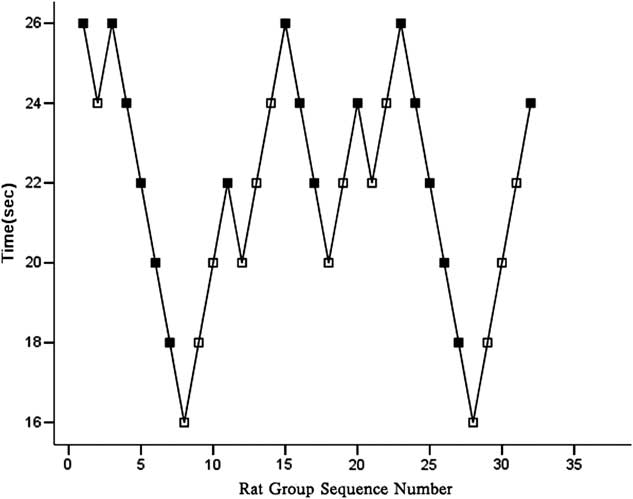
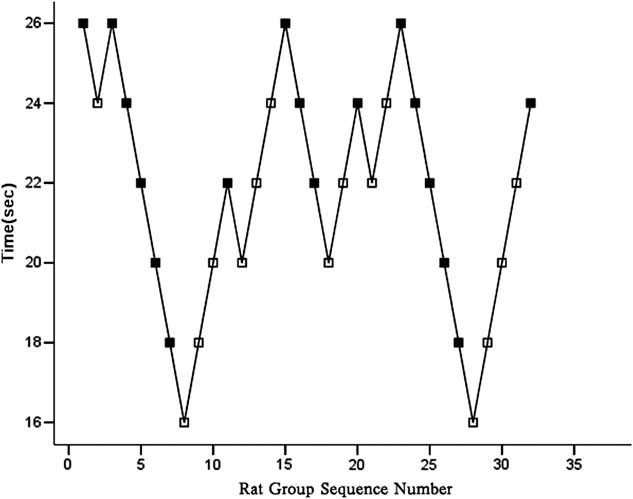
Sixty rats were randomly divided into three groups (n = 20) for three replicate tests at one of three different intervals, that is, 10 s, 3 or 5 min, with one group per interval. After 2 days rest, the same 60 rats were randomly redivided into seven groups. Each group was tested three consecutive times at either 20 s, 30 s, 1 min, 10 min, 20 min, 30 min or 1 h intervals with eight to nine rats in each group. In a third experiment, Dixon's up-and-down design (Reference Jung and Choi10) was used after the rats had an additional 2-day rest. This time, the 60 rats were randomly separated into six groups (n = 10 in each group). One interval was tested in each group two consecutive times, giving a total of three hot water immersion tail-flick tests. If the latency times from the second and third tests were significantly longer than that of the first test according to repeated one-way ANOVA with Tukey's multiple comparison post-hoc test (p < 0.05), it was defined as a response at this interval, and the interval was decreased by 2 s for the next group. Conversely, if the latency times did not change significantly, it was defined as a non-response, and the interval was increased by 2 s for the next group. The initial interval was 26 s and the tests finished when seven ups and seven downs were reached (Fig. 1).
Up-and-down results for time interval between three consecutive hot water immersion tail-flick tests in rats. The data for each group of rats (n = 10) are represented by a square; a black square means response, and a blank square means non-response for the interval set. A response defines the situation where the latency periods of the second and third tests were significantly longer than that of the first test (repeated one-way ANOVA, p < 0.05).
For the naloxone experiment, the 60 rats were randomly divided into two groups, Group N (n = 30) and Group S (n = 30), which were subjected to three consecutive hot water immersion tail-flick tests, as above. Five-minute intervals were used after the first and second tests for all rats in both groups. Following the second test, a very low dose of naloxone (0.1 ng/kg in 1 ml s.c.) was administered to Group N, whereas saline (1 ml s.c.) was used for Group S. The third test was performed in all rats after the 5-min interval.
Statistical analysis
All data are latencies and are expressed as mean ± SD. p < 0.05 was considered statistically significant using one-way ANOVA followed by Tukey's multiple comparison post-hoc test with GraphPad Prism software. The up-and-down sequences were analysed by a logistic regression model (v 9.2; SAS Institute, Cary, NC, USA), which enabled us to derive the interval time for response within 95% confidence limits of the mean.
Results
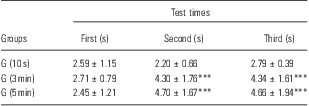
Experiments were performed to determine the interval times between consecutive hot water immersion tail-flick tests that produced a prolonged latency of response. This should allow an optimal interval range, within which latency periods are constant, to be defined. Initially, rats were subjected to three consecutive tests at intervals of either 10 s, 3 or 5 min, and the latency of response was measured for each test. For rats tested at 10-s intervals, no significant difference in latency period between the three consecutive tests was observed (p > 0.05; Table 1). However, when tests were imposed at intervals of 3 and 5 min, the latency periods of the second and third tests were significantly longer than those of the first test (p < 0.001; Table 1). These results showed that the latency of response was prolonged when the interval between tests was 3 min or longer.
The influences of short and long intervals in the latencies of tail-flick test

The data here are mean ± SD.
***p < 0.001 when compared with the corresponded first time latency.
Sixty rats were randomly divided into three groups for three different intervals: 10s, 3 or 5 min. Each group has 20 rats.
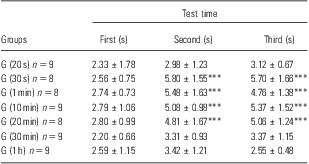
To define the onset of the prolonged latency effect more precisely, the range of interval times was extended from 20 s to 1 h in separate groups of rats, when a prolonged latency effect was observed for intervals of between 30 s and 20 min, inclusively (p < 0.001; Table 2). However, for intervals outside this range, either shorter (20 s) or longer (30 min, 1 h) in duration, the latencies of three consecutive tests were constant.
The optimal intervals for successive tail-flick tests
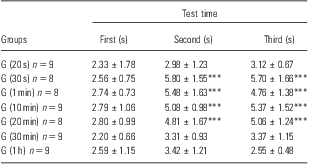
The data here are mean ± SD.
***p < 0.001 when compared with the corresponded first time latency.
Sixty rats were randomly divided into seven groups for seven different intervals for three consecutive hot water tail-flick tests, at least eight rats in one group.
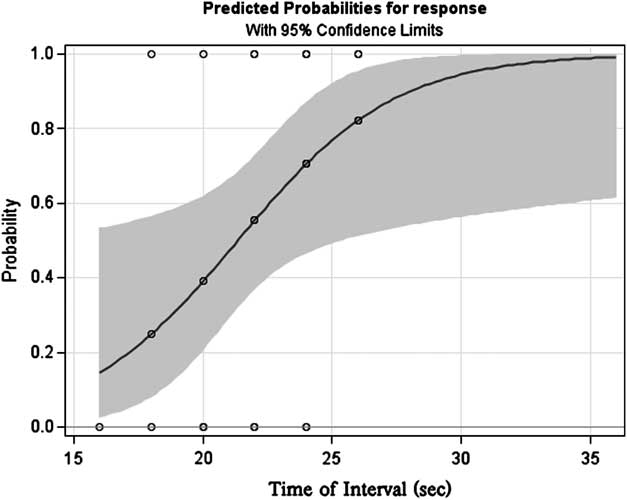
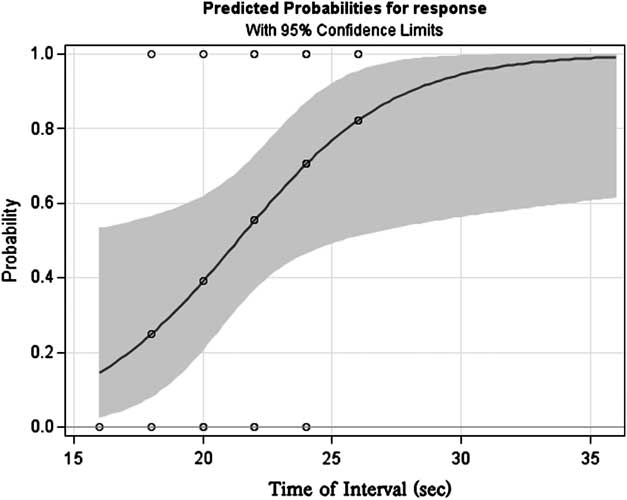
Finally, to corroborate these results, an up-and-down sequence was carried out in which seven ups and seven downs were tested, with the initial interval set at 26 s (between 30 and 20 s) and the last interval being 24 s (Fig. 1). An analysis of these results using a logistic regression model found that if the interval were longer than 32.6 s (95% CI: 26.34 s, 122.44 s), 95% of the rats would exhibit prolonged latency, whereas if the interval were 22.3 s, half of the rats would have prolonged latencies (Fig. 2). This is consistent with the previous results suggesting that the interval between tests should be set at 20 s or shorter to avoid a prolonged latency effect.
The response ED95 value (with 95% confidence intervals) for the interval between consecutive hot water immersion tail-flick tests in rats. Values were calculated from a logistic regression plot of probability of response versus time of interval. A probability of 0.95 was used to derive the ED95 values. A response defines the situation where the latency periods of the second and third tests were significantly longer than that of the first test (repeated one-way ANOVA, p < 0.05, n = 10).
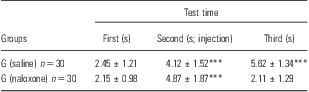
We hypothesised that the effect of interval time on latency period was due to endogenous opioid release, which can be reversed by naloxone (Reference Lal, Miksic and Smith11). To test this, the rats were randomly divided in two equal groups and a series of three consecutive hot water immersion tail-flick tests were performed on both groups. The interval between tests was set at 5 min, which previous results suggested produces extended latency periods for the second and third tests. Immediately after the second test, Group N rats were given a very low dose of naloxone, whereas Group S rats were given a saline control. The third test was then performed in all rats at the end of the interval. As shown in Table 3, the latency periods of both Group N and Group S rats were similar in the first and second tests, with the latencies of the second test significantly longer than those of the first test (p < 0.001), as expected. However, the administration of low dose naloxone to Group N rats after the second test abolished the prolonged latency effect, as judged by the latency times of the third test, which were not significantly different from that of the first test. In the control Group S rats, latencies in the third test remained significantly longer than those of the first test (p < 0.001).
The preventive injection of low dose naloxone kept the latencies stable at 1- and 3-min intervals

The saline or naloxone was injected right after the second time test.
The intervals for the three tests were 5 min.
The data here are mean±SD.
***p < 0.001 when compared with the corresponded first time latency.
The increased latency due to 5 min interval was reversed by low dose of naloxone, as the saline group had even longer latency at the third time test. These results indicated that the increased latency was due to the endogenous opioid release in rats, that is, the acute stress-induced analgesia in opioid form (Table 3).
Discussion
The present study found that, when performing the tail-flick test in a hot water bath, the interval between consecutive tests is an important parameter affecting the latency of response. For intervals of between 30 s and 20 min, inclusively, repeated tests cause significantly increased latency periods, whereas shorter or longer intervals do not. The increased latency, at least for a 5 min interval time, could be reversed by systemic injection of naloxone, suggesting that acute stress-induced antinociception in rats is opioid in nature.
Our results were different from those obtained for radiant heat tail-flick tests, for which a >1 min interval is recommended and commonly practiced to avoid habituation (Reference Carstens and Wilson12). The reason for the discrepancy probably lies in the physiologically distinct effects the two methods have on the rats. Although both methods used thermal stimulus on rodent's tails, the different heat sources used may cause different tail temperatures. In the radiant heat method, the source of heat is an electric bulb, laser beam or infrared light and the heated area of the tail is usually a small spot. In contrast, in the hot water immersion method, a much larger area of the tail is in contact with the heat source. Moreover, the rate at which tail temperature increases is different from that of the radiant heat test, in which the rate is approximately the square root of the time required to provoke a tail-flick response in the rat; this is relatively slow compared with the more or less linear rate of increase in the hot water immersion test (Reference Le Bars, Gozariu and Cadden13).
The role of the tail temperature in tail-flick test latency is controversial. Although it is widely accepted that tail skin temperature exerts a profound influence on the latency of the tail-flick response to radiant heat (Reference Hole and Tjolsen14), Lichtman et al. (Reference Lichtman, Smith and Martin7) suggested otherwise. On the other hand, recent experiments by Carrive et al. (Reference Carrive, Churyukanov and Le Bars15) demonstrated that changes in skin temperature can be a major confounding factor in tail-flick tests (Reference Carrive, Churyukanov and Le Bars15). Nevertheless, there is a negative correlation between tail flick latency and the skin temperature (Reference Berge, Garcia-Cabrera and Hole16) and our results also confirmed hypothesis that ‘the tail flick would return very different values if it was tested a few minutes after’ (Reference Carrive, Churyukanov and Le Bars15).
Stress-induced analgesia is known to play an adaptive role to threat and to be a component of the defensive behavioural response (Reference Berge, Garcia-Cabrera and Hole16). The tail-flick test is prone to habituation of stress-induced analgesia, viz., a reduction in the response with repetitive stimulation (Reference Bodnar, Kelly, Brutus and Glusman17). This habituation increases with a shortening of the interstimulus interval and with the intensity of stimulation (Reference Carstens and Wilson12) in the radiant heat tail-flick test. Stress-induced analgesia could be mediated by at least two distinct neuronal mechanisms: opioid (naloxone-reversible) versus non-opioid (naloxone-irreversible) (Reference Fechir, Breimhorst and Kritzmann18). It is influenced by age, gender and prior experience to stressful, painful or other environmental stimuli (Reference Mogil, Sorge and LaCroix-Fralish19). A low dose of naloxone reversed the hypoalgesia due to repetitive stimulation in our hot water immersion tail-flick tests, indicating that the increased latency was due to acute stress-induced analgesia in opioid form.
This is the first report on the optimisation of intervals for the hot water immersion tail-flick tests, and demonstrates a difference from the radiant heat tail-flick test, helping to clarify confusing results in similar behaviour tests. The radiant heat tail-flick and hot water immersion tail-flick tests are similar in the sense that both use heat to stimulate the tail and both measure the response time. However, the differences in the way these heat sources affect tail-skin temperature necessitate distinct procedures in each test.
In conclusion, ≤20 s or ≥20 min are the optimal intervals for consecutive tests in the hot water tail-flick test. Acute stress-induced analgesia during test repetition was shown to increase the latency of response. This highlights the importance of using distinct procedures for similar tests because of the discrepant physiology involved. Our results constitute a methodological improvement of an existing technique that should help to produce more reliable and accurate data in nociception studies.
Acknowledgements
This research is supported by National Natural Science Foundation of China Grant No. 30972850; Shanghai Healthcare Bureau Research Foundation Grant No. 20114222. The authors wish to thank Mr. Rudolph Weitz for language editing.