INTRODUCTION
Most members of the general population have a preference for dying at home if they are going to perish from a serious illness (Gomes et al., Reference Gomes, Higginson and Calanzani2012). This is in line with preferences found among patients diagnosed with advanced cancer (Kahn et al., Reference Kahn, Gomes and Higginson2014). Patients' choices and possibilities for a home death are influenced by the availability of both healthcare and social support (Pivodic et al., Reference Pivodic, Pardon and Morin2016; Håkanson et al., Reference Håkanson, Öhlén and Morin2015; Kahn et al., Reference Kahn, Gomes and Higginson2014). Many patients with advanced cancer have a wish to live as normally as possible, but their lives are often dominated by their illness and its consequences (Maguire et al., Reference Maguire, Papadopoulou and Kotronoulas2013). Limitations of the activities of daily life and increasing dependence on family members create a growing concern for many patients, and they often feel responsible for causing distress for others (McCarthy & Dowling, Reference McCarthy and Dowling2009; Tishelman et al., Reference Tishelman, Lovgren and Broberger2010). Patients may feel as if they are a burden, and they often experience emotions of guilt, and frustration, as well as low self-esteem (McPherson et al., Reference McPherson, Wilson and Murray2007).
Patients who receive palliative home care are in great need of support from family members, who often take on great responsibilities related to caregiving (Funk et al., Reference Funk, Stajduhar and Toye2010). Family members provide significant assistance with, for example, physical care, symptom management, and emotional and existential support. (Aranda & Hayman-White, Reference Aranda and Hayman-White2001; Hudson & Payne, Reference Hudson, Payne, Hudson and Payne2009; Stajduhar & Cohen, Reference Stajduhar, Cohen, Hudson and Payne2009; MacConigley et al., Reference MacConigley, Halkett and Lobb2010).
Consequently, a patient's well-being is dependent upon the well-being of their family members (Andershed, Reference Andershed2006). However, family members often feel unprepared for this type of situation. When their needs for information and support are unmet, there is a risk of negative consequences for their health and well-being (Hudson & Payne, Reference Hudson, Payne, Hudson and Payne2009). When family members lack understanding of and are unable to respond to new symptoms, a caring gap can emerge, resulting in suffering for both patients and family members (Andershed, Reference Andershed2006).
In recent years, increasing numbers of interventions aimed at supporting family members in palliative care have been described and evaluated (Northouse et al., Reference Northouse, Katapodi and Song2010; Candy et al., Reference Candy, Jones and Drake2011; Holm et al., Reference Holm, Årestedt and Carlander2015a ; Hudson et al., Reference Hudson, Trauer and Kelly2015). However, it is not known whether and how these interventions actually affect the care and/or support provided to patients. It has been suggested that better-supported family members would result in positive experiences for patients (Northouse et al., Reference Northouse, Katapodi and Song2010; Henriksson et al., Reference Henriksson, Årestedt and Benzein2012). However, this has not been studied from the perspective of the patients themselves. Thus, the objective of our study was to explore patients' experiences of care and support at home after a family member's participation in a psychoeducational intervention during palliative care.
METHODS
Design
Our study took a qualitative approach, and interpretive description was employed for the analysis (Thorne, Reference Thorne2008). The study was part of a larger project in which a psychoeducational intervention for family members was evaluated (Holm et al., Reference Holm, Årestedt and Carlander2015 a, b).
The Family-Member-Targeted Psychoeducational Intervention
Based on the theoretical framework laid down by Andershed and Ternestedt (Reference Andershed and Ternestedt2001)—which describes knowing, being, and doing as the principal needs of family caregivers—an intervention using a group format was delivered for family members through three sessions during palliative home care. Each session was planned to last for two hours, and a nurse acted as group leader and participated in all meetings. The content and structure of the intervention followed a manual—consisting of a compendium of evidence-based knowledge on different topics—to ensure consistency. The different topics were presented by healthcare professionals (a physician, nurse, social worker, or priest) and discussed interactively with family members. The focus was on educational, practical, and emotional topics related to family caregiving, and such topics as palliative illness, symptom relief, hygiene, nutrition, and reactions to grief were discussed. The intervention was aimed at providing family members with an approach to support their knowledge-seeking (knowing), which could make them better prepared for both the emotional (being) and practical (doing) aspects of caregiving. As a concrete example, family members were given information about different aids and were also shown how to best assist patients with intimate matters (e.g., toilet visits). They were also given the possibility to reflect upon these kinds of tasks.
This intervention was tested in a randomized controlled trial (Holm et al., Reference Holm, Årestedt and Carlander2015a ) and proved to significantly improve family members' feelings of preparedness and competence for caregiving.
Settings, Procedure, and Participants
The patient population was drawn from six specialized palliative home care units in a metropolitan area of Sweden that delivered the intervention. The units provided 24-hours-a-day care, with home visits occurring from once a week to several times a day, depending on each patient's needs. The units provided care for patients with complex needs and life-threatening illnesses through utilization of a multidisciplinary professional team of physicians, nurses, social workers, occupational therapists, and physiotherapists.
The inclusion criteria for our study were: being able to understand Swedish, being cared for in palliative home care, and having a family member who took part in all three intervention sessions. Patients were initially approached by health professionals at their care setting with a request for permission to invite their family member to the intervention. A letter with study information and a request for participation was sent to a total of 20 patients, which was followed up by a phone call from the first author. Three patients could not be reached and three declined. Altogether, 14 patients accepted the invitation to participate, but 3 later withdrew due to deterioration of their medical condition, resulting in a final number of 11 participants (7 men and 4 women) aged between 54 and 87 years (average age = 68). Six participants identified their family member as a husband or wife, one as a common-law wife, and two as children. For two patients, both their wives and adult children participated. All patients had a diagnosis of advanced incurable cancer. Four were on sick leave, and the remainder were retired.
All participants were informed of the principle of confidentiality and that they could withdraw at any time they chose. Written consent was collected. Approval was granted by a regional ethical review board (No. 2013/934-32).
Data Collection
Qualitative individual interviews were conducted from October of 2013 through to May of 2014. Participants were able to choose the location of the interview, and all except one chose their home. The interviews took place three to six weeks after completion of the intervention. This timeframe was chosen so as to give patients time enough to reflect but to still allow family participation to be fresh in their memories. The interviews lasted on average 30 minutes and began with an open-ended question encouraging participants to describe their experiences related to care and support at home after the family member's participation in the intervention. Questions were then asked about the intervention with relation to practical, communicational, and emotional issues at home. Probing questions were asked as needed to obtain deeper understanding.
Data Analysis
Interpretive description was employed for analysis (Thorne, Reference Thorne2008). The first phase of analysis began with listening to the recorded interviews and reading the transcripts repeatedly to get an overall sense of the content (Thorne, Reference Thorne2008). During the second phase, units of texts were broadly coded according to their content—for example, descriptions of communication between patient and family member, and practical and emotional issues. Notes about ideas and preliminary interpretations were documented in the margins of the text. The memos were utilized to support interpretation of data and themes. In the third phase, the text was condensed into shorter descriptions of the data groupings. These were organized into preliminary themes (e.g., relief and knowledge) based on concepts/words within the text. The final phase included interpretation of data and synthesis/extraction of the common features of participants' experiences into three final themes. During the analysis, the researchers continuously discussed their interpretations and considered alternative interpretations to prevent premature closure.
FINDINGS
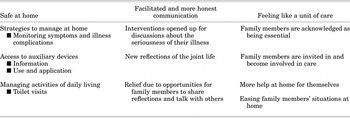
Our findings are presented in terms of the following three themes: “safe at home,” “facilitated and more honest communication,” and “feeling like a unit of care” (see Table 1).
Overview of patients' experiences of care and support at home after a family member's participation in a psychoeducational intervention during palliative care

Safe at Home
Many of the patients were dependent on care and support from family members, and they reported that, despite their own illness and distress, they worried about their family member. It became increasingly clear for some patients that their common everyday life situation would never be the same again:
Before, we used to share everything around the house, but now I cannot manage any house chores at all. I need help with almost everything, even private matters like toilet visits.
The patients also felt that their family member had to deal and struggle with their own distress and manage an increasingly challenging everyday life while at the same time providing support.
Patients hoped for safe care and support at home as a consequence of the family member's participation in the intervention. In their opinion, this was promoted when family members were given the opportunity to share reflections and experiences with other participants and healthcare professionals, which provided a chance to grain new knowledge. They appreciated that their family member learned more about the illness and strategies for managing the situation at home. This made patients feel more confident that their family member would be less afraid of the symptoms or illness-related complications that might occur, and also that they would be better able to help manage the situation in the future. One woman described how her husband came home after a session and how they had talked together about the things that had been discussed in group:
He thought it was educational to get information about the different symptoms and how he could support me. For example, if I had difficulties with eating, he now knew what he could do.
Patients seemed to believe that the intervention facilitated everyday life and increased their possibilities for staying at home for a longer period of time, and maybe even until the time of death. One patient whose wife and son both participated in the intervention felt that their increased knowledge resulted in a sense of safety for him:
Overall, it feels good that they have been given information about what can happen. Life is not forever, and it is good that they talk about that. I feel safe knowing that they know.
None of the patients disapproved of or disliked their family member's participation in the intervention. However, a few felt that the intervention had not yet had any significant impact on their own life:
She has so much experience from her profession in healthcare, so I don't think the sessions are that big a deal for her. I can say that it is not a big deal for us. It can certainly be for others, but I have not been so sick yet.
Some patients hoped that the intervention could provide family members with information and access to auxiliary devices and aids, so that they themselves could stay at home without risking their health of their caregiver:
She received information about how to rise up and out of bed and so on. I got the bed elevated, and that walker is really good. That's one thing they go through—what kind of auxiliary devices there are—and I try everything.
Patients felt that the intervention contributed to helping them to manage the activities of daily living (e.g., toilet visits) in a safe way. Some actually thought that their family member would not have been able to manage to care for them at home for such a long period of time without the knowledge received from the intervention.
A Facilitated and More Honest Communication
Many patients were aware of the seriousness of their illness and actually expressed the thought that they did not have long to live. Some wished to talk about this with their family member, and a majority felt that the intervention did promote communication. It was not always easy to talk about their illness, their current situation, and the future, but the intervention sometimes opened up possibilities for these types of discussions. For example, when conversations about crisis and grief reactions were held in the intervention, this enabled family members to talk about their life together in a way they had not been able to before. The enhanced communication often led to reflections about their own situation of living with severe illness. Patients also described how it was a relief for them that their family member got the chance to talk to someone else about their own feelings. Patients figured that this was a way for the family member to speak about matters outside of their presence. One reported that her husband experienced difficulty in expressing his feelings to family and friends. This made her sad and caused her to worry. She hoped that the intervention had helped him to verbalize his grief:
I hope he could get it off his chest and put words on his grief, even though he did not speak to me about it. I do not know, but hope so.
The same patient felt that she and her husband had a hard time dealing with their feelings and supporting each other with their grief. This was emotionally distressing for her. When she described their situation, her concern about her husband was clearly evident:
Maybe he can get some relief in his grief and share some of his thoughts. He knows that I am sad, and he focuses on comforting me. But he also needs to share his sadness and frustration. It is good that there is someone else to turn to and talk to round the things he cannot talk to me about.
Patients felt that the intervention provided a kind of sanctuary for their family member where it was permissible for them to focus on their own sorrow, hopefully making it more bearable.
Some patients wished to talk honestly and openly with their family member, but this felt very difficult to accomplish. They wanted him/her to be aware and prepared, but they felt that important matters were left unspoken.
They hoped that their family member's participation in the intervention would support their ability to verbalize and sort things out before it was too late. One patient explained that it was very important for him to know that his son knew what to expect for the future and what responsibilities the son would have to take on after his death:
I hope he can get something out of this and that we can talk to each other not having to pretend. He will have to pick up after me, and it is important that he knows what to do.
Some patients reported that they wanted to talk about such issues as economic matters and funeral arrangements, even though these were emotionally demanding topics. They did not want to burden family members with the need to make decisions on these matters on their own. They believed that having these conversations could relieve some of the uncertainties about the impending future.
Feeling Like a Unit of Care
The invitation to participate in the intervention was experienced as a recognition of the fact that the patients and family members were reacting to the cancer as a unit. This also acknowledged their need for guidance and help from healthcare professionals, which was a relief for them. Many stressed the importance of their family members being seen as someone essential, and it confirmed that they were in this together. Patients reported that participation in the intervention contributed to family members feeling appreciated, which also had a positive influence on the patients themselves. Patients also believed that their family member deserved to be confirmed and supported by healthcare professionals:
It shows an interest, to take hold of it. That it is a good thing. It means an awful lot for the family members, and it is important that they are well prepared.
Patients stated that before admission to palliative home care their family member had not always felt welcomed or been involved in their illness and their care. Therefore, most patients had previously coped with everything related to their illness on their own, including hospital visits, treatments, and medication. Along with the deterioration caused by their illness, this had become increasingly difficult to manage. They felt that the intervention had helped them and their family member to manage things together. One patient was grateful for the teamwork she had experienced with her husband and described it as something central and necessary to managing their life at home:
I am very sick. I need to have the mobile toilet next to my bed, and he has to carry me to it. He is not afraid to take care of things like that. We are in this together as a team.
Being viewed as a unit of care could also provoke feelings that they were causing distress for their family member. Patients experienced it as being especially burdensome when they needed assistance with intimate matters. They often worried about how their family member would be able to cope with these kinds of things:
It is a great burden on my wife's shoulders. Without her, I would not have coped for one day.
Patients felt that their feeling of being a burden was reduced, as family members were offered and accepted more help at home after taking part in the intervention. One older patient, cared for by his wife, felt that the intervention had contributed to a more positive attitude toward getting help at home:
After the sessions, my wife has a more positive attitude towards asking for more help at home. Before, she did not want any help at all, but now she has been looking for someone to help out with the cleaning. She has a new attitude towards it. I think that is very positive.
DISCUSSION
To our knowledge, this is the first study to explore patients' experiences of care and support at home after a family member's participation in a psychoeducational intervention during palliative home care. In an earlier study, the intervention proved to be effective in increasing family members' feelings of preparedness and competence around caregiving (Holm et al., Reference Holm, Årestedt and Carlander2015a ). Our findings clearly point out the significance of the intervention in supporting family members, as this support was also beneficial for the patients. They felt that their needs were better met and that their family members became more confident about managing the situation at home without putting their own health at risk. Patients were relieved when their family member was given the opportunity to talk and reflect with others about the situation, and they hoped that the intervention would enhance and contribute to open and honest communication with their family member. It was also of great importance to patients that family members received attention from and were confirmed and supported by healthcare professionals. They felt that they and their family member were recognized as a unit of care and that they both had legitimate needs for guidance and help from healthcare professionals.
Our findings confirm earlier studies suggesting that a family member who is well informed, more prepared, and more competent probably will provide better support and care (Northouse et al., Reference Northouse, Katapodi and Song2010; Henriksson et al., Reference Henriksson, Årestedt and Benzein2012). It has been reported that support within the family should be highly relevant in palliative care, as patients who receive insufficient family support often are more anxious and feel less secure (Milberg et al., Reference Milberg, Wåhlberg and Krevers2014).
Our patients worried about increased dependence on family members and how that would affect family members' ability to cope. This was also found by McCarthy and Dowling (Reference McCarthy and Dowling2009) and Tishelman and colleagues (Reference Tishelman, Lovgren and Broberger2010), where patients were worried about not being able to manage their activities of daily life and felt fearful of being a burden on their family. However, family members' participation in the intervention seemed to decrease these worries, and patients felt relieved when a family member was given the chance to reflect on their emotions and practical challenges through meeting others who found themselves in a similar situation. Dependency often occurs when patients are unable to manage the activities of daily life, which might create a feeling of low self-esteem and cause them to question their being of value to others (Refsgaard & Fredriksen, Reference Refsgaard and Frederiksen2013). The patients in our study felt that it was especially burdensome when they needed assistance with intimate matters (e.g., toilets visits). Eriksson and Andershed (Reference Eriksson and Andershed2008) reported experiences of receiving intimate personal care and found that assistance from family members in the home could feel easier to accept than that from healthcare professionals. One exception to this was being helped by a spouse with incontinence care, which could make the patient feel ashamed, since such help was not deemed an appropriate part of the marital relationship. The patients in our study talked more about the burden they caused for their family member than about concerns about their own personal integrity.
Patients reported that issues around their impending death were avoided, even though they wished to talk about such things with their family member. Patients' feelings can be understood using the theoretical framework laid down by Stroebe and Schut (Reference Stroebe and Schut2015), who described how most people need to cope with their grief together with family members and not in isolation. The patients in our study longed for truthful communication, and some felt that the intervention opened up the possibility for more open discussions at home. By talking with their family member, they could find ways to understand and make sense of their difficult situation and thereby make better decisions about everyday life. Sense-making is a process where knowledge and understanding are constantly challenged and reformulated. People need knowledge and understanding to facilitate sense-making (Öhlén et al., Reference Öhlén, Wallengren-Gustafsson and Friberg2013). The enhanced communication also made it easier for our participants to make plans together. Patients wanted to spare family members having to make difficult decisions after their death. This confirms earlier studies that reported the difficulties involved in discussing end-of-life issues and plans for the future with family members. In line with our work, these studies found that patients were aware that death could happen at any time, and that they wanted to sort things out to prepare for the death and minimize the burden for family members (Lloyd-Williams et al., Reference Lloyd-Williams, Kennedy and Sixsmith2007; Carlander et al., Reference Carlander, Sahlberg-Blom and Hellström2011). Janze and Henriksson (Reference Janze and Henriksson2014) found that family members also wanted to talk about and plan for the future, but they most often waited for the patient to initiate such discussions. Our findings demonstrate that the intervention gave patients and family members the opportunity to approach these difficult issues in an easier fashion, and they became open to more honest communication. Hinton (Reference Hinton1998) found that open communication between patients and family members can increase awareness of the seriousness of the illness, help all involved to better adapt to their situation, and improve the likelihood that patients will remain at home.
We found that patients and family members had to deal with a series of practical and emotional challenges that affected their relationships and everyday life. Patients recognized their changing roles in the family and that family members had taken on more responsibilities in terms of caring activities and the activities of daily living. This agrees with the findings of Hardy and colleagues (Reference Hardy, King and Rodriquez2014), who reported that family members had a difficult time identifying themselves as “carers”—they saw what they did as an extension of the marital relationship. Linderholm and Friedrichsen (Reference Linderholm and Friedrichsen2010) found an unspoken expectation of patients that family members should care for them. Meanwhile, family members sometimes felt doubt and anxiety about how to cope with the role of caregiving and had a great need for support with how to manage it. The influences of serious illness on family roles and identities was described by Carlander and coworkers (Reference Carlander, Sahlberg-Blom and Hellström2011), who found that both the ill patient and family member roles were altered and new asymmetrical relationships developed as the illness progressed. They had to relate to each other in a different way and adapt to the fact that things had to be done in a different way.
METHODOLOGICAL CONSIDERATIONS
To provide for a variety of experiences, participants of different gender and with varied relationships to family members were recruited from six different specialized palliative home care units. One limitation of our study might be that all participants had a diagnosis of cancer, but it is reasonable to assume that the family members of patients with other palliative illnesses would have similar experiences. The analysis was conducted in collaboration with all the authors, which enabled discussions of alternative interpretations. Our findings are presented through interpretive description along with appropriate quotations to strengthen their credibility.
CONCLUSIONS AND IMPLICATIONS
Our study has shown a further dimension to why it is important to support family members during palliative home care. We found that an intervention targeted at family members during palliative home care also benefited the patients. As a result, patients felt safer, experienced facilitated communication, and reported that they and their family member were recognized as a unit of care after the family member participated. Our findings suggest that the intervention could increase the possibility for patients and family members to more successfully manage care at home for longer periods of time.
FUNDING
Ersta Sköndal University College (Stockholm) and Capio Geriatrics (Stockholm) funded this study.
CONFLICTS OF INTEREST
The authors hereby state that they have no conflicts of interest to declare.
ACKNOWLEDGMENTS
We wish to offer our sincerest thanks to all the patients who, despite severe illness, generously contributed their stories. We are also grateful to Capio Geriatrics for partly funding this project.