By asserting that oil, not Islam, hurts gender equality, Michael Ross (Reference Ross2008) has made an important contribution to the debate on whether Islam bodes ill for women (Fish Reference Fish2002; Inglehart and Norris Reference Inglehart and Norris2003; Spierings, Smits, and Verloo Reference Spierings, Smits and Verloo2009). Ross suggests that oil production decreases the number of female workers in countries with occupational segregation. The more women are left out of the formal economy, the fewer opportunities and resources they have for becoming influential political constituencies. According to Ross, “[t]his leaves oil-producing states with atypically strong patriarchal cultures and political institutions” (p. 107). Employing the same set of countries and data used in Ross (Reference Ross2008), I show that the institution of gender quotas, which is omitted from his statistical analyses, offsets the effects of oil rents on women's political representation. Gender quotas increase women's representation in Muslim majority and non-Muslim majority countries and in countries that are oil rich and oil poor.Footnote 1 That “petroleum perpetuates patriarchy” (p. 120) is a tendency, not destiny.
The Role of Political Institutions
Ross recognizes that political institutions affect women's chances of taking office.Footnote 2 His models include measures of democracy, proportional-representation electoral system, closed party lists, and district magnitude. To better capture the causal process by which women are elected, I suggest two modifications.
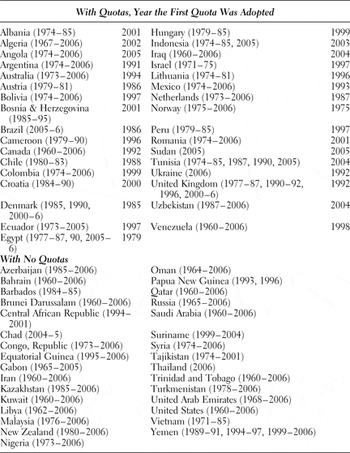
First, include quotas in models of political representation inasmuch as in-depth country and cross-national studies demonstrate that gender quotas have become a “fast track” for women seeking public office since 1995 (Bhavnani Reference Bhavnani2009; Dahlerup and Freidenvall Reference Dahlerup and Freidenvall2005; Htun and Jones Reference Htun, Jones, Nikki and Maxine2002; Jones Reference Jones1998; Paxton, Hughes, and Painter n.d.; Tripp and Kang Reference Tripp and Kang2008). As of 2008, more than 100 countries around the world use voluntary political party and compulsory legal quotas. Out of 49 predominantly Muslim countries, 22 (44.9%) have adopted quotas. Of 64 countries that produced more than $100 in oil rents in a single year, 33 (51.6%) have adopted quotas (see Table 1). Ross's model appears to obtain more accurate estimations by including quotas.
Gender quotas for lower house and unicameral seats in oil-rich countries, 1960–2008 (years where oil rents exceeded $100 per capita)

Note: Several countries dropped their quotas (e.g., Colombia, Egypt). Years of quota adoption are from International IDEA (2009), Dahlerup (Reference Dahlerup2006), and Krook (Reference Krook2009). Oil rent years are from Ross's longitudinal data set.
Second, consider how institutions and natural resources shape one another to better understand the conditions under which resources generate gendered effects. Political institutions may alter the incentive structure that encourages rent-seeking behavior in resource-abundant countries (Mehlum, Moene, and Torvik Reference Mehlum, Moene and Torvik2006; Robinson, Torvik, and Verdier Reference Robinson, Torvik and Verdier2006). In the absence of a quota system, leaders may be more likely to ignore the demands of the female electorate during an oil boom. When quotas are in place, leaders may cater more to women's demands even during an oil boom. In an authoritarian state, leaders may disregard women's demands when oil is plentiful, whereas leaders in a democratic state may seek out female voters by using oil revenues to provide jobs, education, and health care. A similar hypothesis can be made about the effects of electoral systems on the use of natural resources.
Data and Results
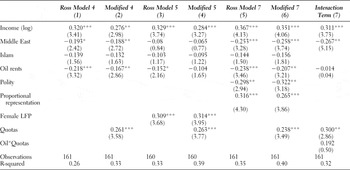
Replicating Ross's cross-sectional analysis, I examine whether political institutions offset the impact of oil on women's political representation. The dependent variable is Female Seats, the percentage of women in lower house and unicameral parliaments in 2002 or the most recent year for which the data are available. Ross's key independent variable is Oil Rents, the value of oil and gas production minus the extraction costs divided by the midyear population. Oil Rents and other economic variables are measured in constant 2000 dollars. I add Quotas, a dichotomous variable of whether voluntary party quotas or any legally mandated quotas were in effect for the election reported in Ross's data set. Information on quotas is compiled from the Global Database of Quotas for Women, Dahlerup (Reference Dahlerup2006), and Krook (Reference Krook2009).
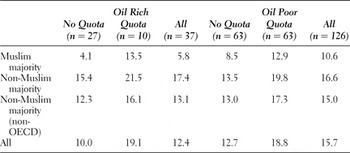
The percentage of women in parliament averages 15.7% in oil-poor countries, in contrast to 12.4% in oil-rich countries (Table 2, replicating Ross's Table 3). I further disaggregate the sample by Quotas. Oil-rich countries with quotas have on average slightly higher rates of female representation than oil-poor countries with quotas, unless the sample is limited to countries not in the Organization for Economic Co-operation and Development (OECD). The descriptive statistics support Ross's idea that oil's impact in developing countries differs from that of OECD countries. Oil-producing countries seem less friendly to women given that 27.0% of oil-rich countries, while half of oil-poor countries have quotas. Nevertheless, the descriptive statistics indicate that quotas should be included in models predicting rates of women's representation. Table 3 reestimates Ross's ordinary least squares (OLS) models (see his Table 4). The presence of quotas is positively and significantly correlated with women's representation when controlling for oil rents, female labor force participation (model 6) and political institutions like democracy and electoral system (model 7). The findings are robust to various model specifications (including region dummies, excluding the two most influential cases) with the exception of a model that includes a control variable for closed lists electoral systems, which had a smaller sample of 88 countries. In a reduced-form simulation using Clarify 2.0, where the value of income is set at the mean and the country is not in the Middle East, the percentage of women in parliament in the absence of oil and absence of quotas is 14%. If quotas are introduced, the percentage increases to 19.1% (an increase of 36%). If there are no quotas and the amount of oil rents is $1,280 (about a one standard deviation rise from 0), the percentage of women in parliament decreases from 14% to 12.1%.
Parliamentary seats held by women, 2002 (percentage)

Note: Oil-rich countries generate at least $100 per capita in oil rents.
Cross-sectional OLS regressions on female seats in parliament

Notes: Dependent variable is parliamentary seats held by women (%), 2002. Robust standard errors in parentheses. All variables are standardized. *Significant at 5%; **significant at 1%; ***significant at 0.1%.
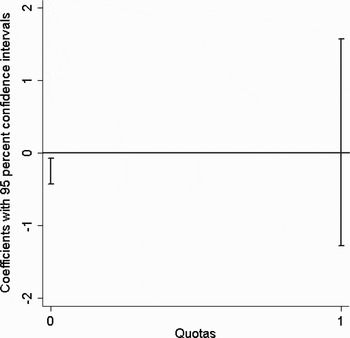
To assess whether institutions mitigate the impact of oil, I include an interaction term (Oil Rents × Quotas) in a baseline model that includes controls for income and the Middle East region (model 7). The standard results table, however, does not provide much useful information when using multiplicative interaction models. In particular, the insignificance of the interaction term does not imply the absence of meaningful intervening effects (Brambor, Clark, and Golder Reference Brambor, Clark and Golder2006, p. 74). To assess whether the marginal effect of oil rents differs between quota and non-quota-holding countries, it is necessary to go an extra step. Figure 1 illustrates how the coefficients and confidence intervals on oil rents vary across different levels of quotas. In the absence of quotas, the effect of oil rents on women's representation is significantly negative, supporting Ross's claim that oil reduces women's representation. In the presence of quotas, the effect of oil rents on women's representation is not statistically significant as zero falls within the 95% confidence interval, which calls for further investigation into the role of institutions.
Coefficients relating oil rents to women's political representation, at different levels of quotas (base model). (Figure assembled with coding from Braumoeller Reference Braumoeller2004.)

Conclusion
In this essay, I have argued that scholars should also consider how political institutions affect the resource curse on women. Four pressing questions emerge:
1. What is the effect of oil on women's mobilization and movement success? Does oil production make it more difficult for women in parliament to influence politics?
2. What are the causal mechanisms by which political institutions mitigate the perverse effects of oil? Do institutions alter the economic aspects of the gendered resource curse (i.e., Dutch disease) or do institutions lessen the resource curse by changing the incentives that rent-seeking leaders face?
3. To what extent are institutions endogenous to natural resources? Why do some oil-producing countries adopt gender quotas while others do not? Quota adoption may not be endogenous to previous levels of female representation (Paxton, Hughes, and Painter, n.d.). Yet Table 2 indicates that quotas may be endogenous to oil production.
4. Do institutions also constrain the ways in which religion influences political outcomes for women? This replication corroborates Ross's claim that Islam, measured by the proportion of the population that are Muslim, does not correlate with lower rates of women's representation. Nuanced analyses suggest that the distribution of resources influences the strength of organized religion (Blofield Reference Blofield2006), as does the relationship between state and societal leaders (Charrad Reference Charrad2001; Htun Reference Htun2003).
Ross's study will inspire scholars to pay more attention to the gendered dimensions of the resource curse. This essay finds, however, that gender quotas may offset the negative effect of oil rents on the presence of women in national parliaments. The widespread adoption of gender quotas has increased women's parliamentary representation in Muslim majority and non-Muslim majority countries and in oil-rich and oil-poor countries. Our understanding of the factors that help improve women's lives will grow, so long as we consider how political institutions mitigate—or exacerbate—the pernicious effect of natural resources on women.