Imidazolinone herbicides are often used POST in peanut and provide control of many broadleaf weeds. However, their potential use is limited by lengthy rotational restrictions (18 mo) for crops such as cotton (Gossypium hirsutum L.) and sorghum (Sorghum bicolor L. Moench) and the development of weeds resistant to the ALS-inhibiting class of herbicides (Grey et al. Reference Grey, Wehtje, Walker and Paudel1995; Matocha et al. Reference Matocha, Grichar, Senseman, Gerngross, Brecke and Vencill2003; Wilcut et al., Reference Wilcut, York, Grichar and Wehtje1995; York and Wilcut Reference York and Wilcut1995). Considering these limitations, it would be beneficial to have additional herbicides with alternative modes of action that are efficacious on herbicide-resistant weeds but do not have lengthy plant-back restrictions.
Pyraflufen-ethyl is a protoporphyrinogen oxidase (PPO) inhibitor that controls a wide range of annual broadleaf weeds (Anonymous 2014b; Shaner Reference Shaner2014). It is used in a number of vegetable, grain, and oil seed crops. It can be applied preplant and PRE in peanut, and a supplemental label was released in 2013 for POST use. Preemergence selectivity of pyraflufen-ethyl is conferred by physical placement (Buchanan et al. Reference Buchanan, Murray and Hauser1982). When applied POST, tolerant plants rapidly metabolize the herbicide to inactive metabolites (Murata et al. Reference Murata, Yamashita, Kimura, Motoba, Mabuchi and Miura2002). The label lists over 60 weeds that are controlled or suppressed when applications are made to broadleaf weeds up to 10 cm in height or to rosettes up to 8 cm in diameter (Anonymous 2014b).
The use of pyraflufen-ethyl POST addresses peanut weed management limitations while providing growers with an effective POST herbicide that manages difficult-to-control broadleaf weeds. Dotray et al. (Reference Dotray, Baughman and Grichar2010) reported that pyraflufen-ethyl applied POST caused significant peanut injury. Across six locations in the Texas Southern High Plains, South Texas, and Texas Rolling Plains, approximately 21% and 29% peanut injury was observed from early-season [28 to 51 d after planting (DAP)] applications of pyraflufen-ethyl at 2.6 and 3.5 g ha−1, respectively. At these same locations, 9% and 10% peanut injury was observed from late-season (93 to 121 DAP) applications. Visual injury translated into yield loss at only one of the six locations, regardless of rate.
Grichar et al. (Reference Grichar, Dotray and Baughman2010) also observed peanut injury from pyraflufen-ethyl in South Texas and the Texas Southern High Plains. In South Texas, 13% leaf burn was observed when pyraflufen-ethyl was applied to peanut 28 to 51 DAP (early POST) at 3 and 4 g ha−1. At the Southern High Plains location, approximately 21% and 34% leaf burn was observed following pyraflufen-ethyl when applied to peanut 93 to 121 DAP (late POST) at 3 and 4 g ha−1, respectively. At the low pyraflufen-ethyl rate, injury translated into yield loss for one of the four locations, while at the high rate, injury translated into yield loss for three of the four locations.
In light of this injury, and the recent addition of a supplemental label for use of pyraflufen-ethyl in peanut, more research is needed on using this herbicide according to the new label. Therefore, the objective of this research was to evaluate peanut tolerance to pyraflufen-ethyl applied in accordance with the new label at various locations across the peanut-growing regions of Texas and Oklahoma.
Materials and Methods
Trials were conducted in the Texas Southern High Plains at Halfway (34.110435°N, 101.564556°W; elevation 1072 m) in 2013 and Seagraves (32.583727°N, 102.395747°W; elevation 1063 m) in 2014; in South Texas at Yoakum (29.277044°N, 97.124533°W; elevation 1153 m) in 2013 and 2014; and in Oklahoma at Fort Cobb (35.153475°N, 98.459064°W; elevation 411 m) in 2014. Soil type, taxonomic class, percent organic matter, and pH are presented in Table 1. Peanut cultivar, planting date, application dates, and harvest date for each experiment are presented in Table 2.
Soil type, taxonomic class, percent organic matter, and pH at each location.

Peanut cultivar, planting date, application date, and harvest date at each location.Footnote a

a Abbreviation: DA, days after.
b Simpson CE, Baring MR, Schubert AM, Melouk HA, Lopez Y, Kirby JS (2003) Registration of ‘OLin’ peanut. Crop Sci 43:1880–1881
c Beasley J, Baldwin J (2009) Peanut Cultivars and Descriptions. http://www.caes.uga.edu/commodities/fieldcrops/peanuts/production/cultiv ardescription.html. Accessed April 28, 2015
d Branch WD (2010) Registration of ‘Georgia-09B’ peanut. Crop Sci 4:175–178
e Tillman BL (2013) Peanut. Quincy, FL: North Florida Research and Education Center, University of Florida
f Baring MR, Lopez Y, Simpson CE, Cason JM, Ayers J, Burow MD (2006) Registration of ‘Tamnut OL06’ peanut. Crop Sci 46:2720
Herbicide applications were made to peanut at the following stages, in accordance with the guidelines on the new pyraflufen-ethyl label: six-leaf, 30 d after (DA) six-leaf, 60 DA six-leaf, 90 DA six-leaf, and in all possible two-application combinations. Pyraflufen-ethyl (ET®, 25 g ai L−1, Nichino America, 4550 New Linden Hill Road, Wilmington, DE 19808) was applied at 3.6 g ai ha−1, using water as a carrier, with a CO2-pressurized backpack sprayer that delivered 94 L ha−1 at 162 kPa (Halfway, Seagraves, and Fort Cobb) or 187 L ha−1 at 207 kPa (Yoakum). A nontreated check also was included. Individual plot size at all locations ranged from two to four rows 7.9 to 9.1 m in length spaced 97 to 102 cm apart. All plots received a dinitroaniline herbicide applied preplant incorporated. Plots were then cultivated and/or hand-weeded as needed throughout the growing season to maintain weed-free conditions. Clethodim (Select Max®, 116 g ai L−1, Valent, PO Box 8025, Walnut Creek, CA 94596) at 0.18 kg ai ha−1 and 2,4-DB (Butyrac®, 240 g ai L−1, Albaugh, 1525 NE 36th Street, Ankeny, IA 50021) at 0.42 kg ae ha−1 was used to control annual grass and broadleaf weed escapes at the South Texas location. Production practices at all locations, including fertilizer, irrigation, fungicides, and insecticides, were applied following local crop management practices (Texas A&M AgriLife Extension Service and Oklahoma Cooperative Extension Service, personal communication).
Overall peanut injury (stunt plus leaf burn) was visually estimated 14 DA each application at Halfway, Seagraves, and Fort Cobb and 3 or 7 DA each application at Yoakum. Injury from pyraflufen-ethyl is most visible 7 to 10 DA application. Peanut injury at Halfway and Seagraves was not estimated 90 DA the six-leaf treatment. A scale of 0 (no injury) to 100 (peanut death) was used to record estimated injury (Frans et al. Reference Frans, Talbert, Marx and Crowley1986). Peanut yield was determined by digging, air-drying in the field for 6 to 10 d, and harvesting two rows per individual plot with a tractor pull–type combine. Yield samples were adjusted to 10% moisture. Pod, shell, and peanut kernel weights were determined from each sample. Grades and total sound mature kernels were determined from a 240- to 250-g pod sample from each plot, following procedures described by the Federal-State Inspection Service (USDA 2015).
Peanut injury, yield, and grade are presented separately by location due to a location effect across years and locations. At each location, the experimental design was a randomized complete block with treatments replicated three or four times. Data were analyzed using PROC MIXED with the pdmix 800 macro included (Saxton Reference Saxton1998), and treatments were separated by Fisher’s Protected LSD at an alpha level of <0.05 using SAS 9.3 software (SAS Institute Inc., Cary, NC). Application timing was listed as a fixed effect and replication was listed as a random effect. The nontreated check was not included in the analysis of peanut injury ratings.
Results and Discussion
Peanut Injury
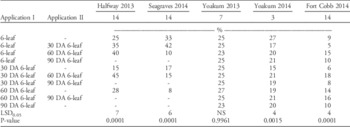
Injury from pyraflufen-ethyl was expressed as white tissue after application and manifested as small necrotic lesions on older leaves. Subsequent new growth did not show the effects of pyraflufen-ethyl. All treatments injured peanut relative to the nontreated control.
Halfway 2013
At Halfway, 15% to 28% peanut injury was noted following single applications of pyraflufen-ethyl when evaluated 14 DAT, with the greatest level of injury observed for the six-leaf and 60 DA six-leaf treatments (Table 3). For two-application treatments, 35% to 45% peanut injury was observed. The greatest level of injury (45%) was observed for the 30 DA six-leaf followed by (fb) 60 DA six-leaf treatment, and at least 35% injury was observed for the six-leaf fb 30 DA six-leaf and six-leaf fb 60 DA six-leaf treatments, respectively.
Visual assessment of peanut injury 3, 7, or 14 days after pyraflufen-ethyl applied at 3.6 g ai ha−1 at six-leaf, 30 days after six-leaf, and 90 days after six-leaf, in single and in all possible two-application sequence treatments at each location.Footnote a

a Abbreviation: DA, days after.
Seagraves 2014
At Seagraves, pyraflufen-ethyl applied at the six-leaf growth stage injured peanut 33% when evaluated 14 DAT (Table 3). Injury following other single-application treatments caused 8% to 17% injury. Injury following two-application treatments ranged from 10% to 42%, with the greatest level of injury observed for the six-leaf fb 30 DA six-leaf treatment.
Dotray et al (Reference Dotray, Baughman and Grichar2010) previously reported that pyraflufen-ethyl caused 33% to 48% peanut injury when applied early POST in the Seagraves peanut-growing region. They also reported that peanut injury increased as herbicide rate increased, and that injury declined over time; however, some injury in the form of plant stunting was still visible at harvest.
Yoakum 2013 and 2014
At Yoakum in 2013, peanut injury 7 DAT was similar following all single-application and two-application treatments, with injury levels ranging from 23% to 27% (Table 3). In 2014 single applications, peanut injury 3 DAT ranged from 15% to 27%, with the greatest level of injury observed for the six-leaf treatment. Injury following two-application treatments ranged from 17% to 21%. When evaluated across three different varieties, Grichar et al. (Reference Grichar, Dotray and Baughman2010) reported that pyraflufen-ethyl caused 13% peanut injury 6 to 8 DA application.
Fort Cobb 2014
At Fort Cobb 14 DAT, peanut injury was observed following all treatments and ranged from 9% to 14% in single-application treatments, with the greatest level of injury observed for the 60 DA six-leaf treatment (Table 3). For two-application treatments, injury ranged from 5% to 18%, and the greatest injury (>15%) was observed for the following treatments: six-leaf fb 60 DA six-leaf, 30 DA six-leaf fb 60 DA six-leaf, and 60 DA six-leaf fb 90 DA six-leaf. Scroggs et al. (Reference Scroggs, Miller, Vidrine and Downer2006) reported that when a combination of pyraflufen-ethyl and glyphosate was applied to soybean [Glycine max (L.) Merr.], injury increased as the rate of pyraflufen-ethyl increased.
Peanut Yield and Grade
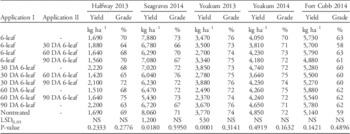
No differences in peanut yield were noted between any pyraflufen-ethyl treatment and the nontreated control at Halfway 2013, Yoakum 2014, or Fort Cobb (Table 4). At Yoakum in 2013, all treatments were similar in yield to the nontreated control with the exception of the following: six-leaf fb 60 DA six-leaf, 30 DA six-leaf fb 60 DA six-leaf, 60 DA six-leaf, and 60 DA six-leaf fb 90 DA six-leaf. On average, yield was reduced 39% for these treatments. At Seagraves, a reduction in yield compared to the nontreated control was observed for all treatments with the exception of the six-leaf and 30 DA six-leaf treatments. The greatest reduction in yield (33%) was noted for the 60 DA six-leaf fb 90 DA six-leaf treatment.
Peanut yield and grade following pyraflufen-ethyl applied at 3.6 g ai ha−1 at six-leaf, 30 days after six-leaf, and 90 days after six-leaf in single and in all possible two-application sequence treatments at each location.Footnote a

a Abbreviation: DA, days after.
No difference between the nontreated control and any herbicide treatment was observed with respect to peanut grade at any location. Other studies also have reported that pyraflufen-ethyl had no effect on grade (Dotray et al. Reference Dotray, Baughman and Grichar2010; Grichar et al. Reference Grichar, Dotray and Baughman2010).
In previous work, Dotray et al. (Reference Dotray, Baughman and Grichar2010) reported that pyraflufen-ethyl applied early (28 to 51 DAP) and late season (93 to 121 DAP) at 2.6 and 3.5 g ha−1 reduced peanut yield compared to the nontreated control in one of six locations in Texas. Grichar et al. (Reference Grichar, Dotray and Baughman2010) also observed peanut yield loss due to pyraflufen-ethyl. Yield following pyraflufen-ethyl application at 3 and 4 g ha−1 was reduced in one of four locations and in three of four locations, respectively.
In summary, pyraflufen-ethyl injured peanut in all single and in all possible two-application treatments. Injury did not translate into yield loss for three of five locations; however, yield reductions (approximately 36%) were observed for Yoakum in 2013 and Seagraves in 2014. Some differences in peanut injury with pyraflufen-ethyl between the South Texas location and the Southern High Plains and Oklahoma locations may be related to planting date, the location of these studies, and peanut cultivar. The planting dates for Yoakum were mid-June, while at the High Plains location the planting dates were late April, and for Oklahoma they were early May. Early June is close to the summer solstice compared to April, and sunlight is more intense as one moves closer to the summer solstice. Also, given that the High Plains and Oklahoma locations are further north than Yoakum (29.277044°N), sunlight is more intense at the Yoakum location. Increased carfentrazone-ethyl (another PPO inhibitor) injury in corn (Zea mays L.), soybean, and wheat (Triticum aestivum L.) was correlated with low light intensity (Thompson and Nissen Reference Thompson and Nissen2002). Grichar et al. (Reference Grichar, Dotray and Baughman2010) evaluated the response of peanut varieties to pyraflufen-ethyl in South Texas and the Texas Southern High Plains. In South Texas, peanut cultivar did not affect peanut injury, yield, or grade in response to pyraflufen-ethyl. However, in the Texas Southern High Plains, a herbicide by peanut cultivar by year interaction was observed for peanut leaf burn, although there was no herbicide by cultivar interaction for peanut stunting, yield, and grade.
Decreases in peanut yield also may be related to application timing: treatments that included an application at the 60 DA six-leaf stage seemed to cause the lowest yields. This period is critical because it is approximately when seed development takes place (Boote Reference Boote1952). Other herbicides have been reported to affect peanut yield when applied during seed development. A study conducted in Texas on Spanish-type peanut indicated that 2,4-DB applied between maximum pegging and early pod (fruit) enlargement reduced yield and affected quality and pod size (Ketchersid et al. Reference Ketchersid, Boswell and Merkle1978). These yield reductions only occurred when 2,4-DB was applied at 0.9 kg ha−1, which is three times the normal use rate (Anonymous 2014a). Additionally, Dotray et al. (Reference Dotray, Grichar, Baughman, Prostko, Grey and Gilbert2012) reported that sequential applications of lactofen during beginning seed to full seed development resulted in peanut yield loss. In previous research conducted in Georgia, applications of acifluorfen caused similar yield reductions when applied at seed initiation (Baughman et al. Reference Baughman, Brecke, Dotray, Grey, Grichar, Karnei, Murphree, Porter, Besler and Brewer2002). According to the supplemental label, pyraflufen-ethyl can be applied POST in peanut. Pyraflufen-ethyl may be a useful tool to control weeds POST if an application timing can be identified that minimizes crop injury to an acceptable level.
Acknowledgments
This study was funded in part by the Oklahoma Peanut Commission, National Peanut Board, and Texas Peanut Producers Board. We thank Texas A&M AgriLife Research – Lubbock, Oklahoma State University Caddo Research Station, and Mr. Robert Weidenmaier for their cooperation and field facilities; and Lyndell Gilbert, Shay Morris, Dwayne Drozd, Robert Peterson, and Dylon Teeter for their technical assistance in this project.