Introduction
Asian agriculture is heterogeneous with a multitude of crops and growing conditions. Agricultural research has made considerable progress in addressing the issue of food security, but agriculture-related health aspects have largely been ignored. For example, in studies from Anupgarh, Rajasthan, India, where intensive agriculture was taken up, farmers adopted huge amounts of pesticides to boost their crop productivity. Exposure of humans to these hazardous chemicals directly in the fields and indirectly through contaminated diet resulted in the occurrence of organochlorine residues in blood (3.3–6.3 mg/l) and milk (3.2–4.6 mg/l) samples from lactating women (Kumar et al., Reference Kumar, Baroth, Soni, Bhatnagar and John2005). High levels of pesticide residues (15–605 times) were observed in blood samples of cotton farmers from four villages in Punjab (Anon, 2005). In the past few decades with the benefits of pesticides being clearly recognized, usage has steadily increased from 2.2 g/ha active ingredient in 1950 (Vasantharaj, Reference Vasantharaj1995) to the level of 381 g/ha by 2007 (which is about 170-fold; Anon, 2009). However, considering the intensity of pesticide use in crops such as cotton and vegetables in India, the insecticidal pressure on unit area is several folds higher than the global average pesticide use. The excessive dependence on chemical pesticides led to the development of resistance in insect pests to insecticides (Kranthi et al., Reference Kranthi, Jadhav, Kranthi, Wanjari, Ali and Russell2002), occurrence of residues in food chain and resurgence of minor pests (Sethi et al., Reference Sethi, Bons and Dilawari2002). This indiscriminate use has increased mortality and morbidity of humans in developing countries (Wilson and Tisdell, Reference Wilson and Tisdell2001). The injudicious use of pesticides caused greater threat to agricultural productivity and the environment. The WHO and the UN Environment Programme estimated that each year three million farm workers in the developing world experienced severe pesticide poisoning, of which about 18,000 were fatal (Miller, Reference Miller2004).
According to Pesticide Action Network Asia Pacific 1999, about 51% of food material is contaminated with residues in the developing world compared with 21% worldwide, of which 20% were above maximum residue limits (MRL) prescribed by FAO standards (Anon, 1999). In other words, 20% of this food is unfit for human consumption, and is still being consumed in the developing countries. However, several cases of pesticide contamination in food, feed, fodder and water are not reported since people are not aware of the consequences of these pollutants. In general, about 50% of the chemical pesticides that are applied to the crops directly go into the soil and other non-targets. The chemical residues from the soil find their way to the aquatic systems or get accumulated in the plant products (grain, root, stem, etc.). Farmers' field schools organized in India on the cotton situation brought out the importance of integrated pest management (IPM) in reducing pesticide-induced risks at farm level without sacrificing the yields (Mancini, Reference Mancini2006). The constraints in the adoption of protective clothing in the tropics were discussed by Kishi (Reference Kishi and Pretty2005). To generate information on various plant protection practices, status of IPM and occurrence of pesticide residues, the present study was undertaken in collaboration with national agricultural research systems (NARS) and non-governmental organizations (NGOs) in India and Nepal.
Methodology
Participatory rural appraisal (PRA) was undertaken in 50 villages in India and 20 in Nepal to generate information on existing plant protection practices and elicit farmers' views related to IPM approaches during 2005–2007. In India, these studies were conducted in collaboration with the State Department of Agriculture (Andhra Pradesh), Centre for World Solidarity (Hyderabad, Andhra Pradesh), Banaras Hindu University (Varanasi, Uttar Pradesh), Indian Institute of Pulses Research (Kanpur, Uttar Pradesh), Community Action for Rural Development (Maharashtra) and other NGO partners. In Nepal, these activities were organized in collaboration with Nepal Agricultural Research Council, National Grain Legumes Research Program and an NGO – Forum for Rural Welfare and Agricultural Reforms for Development.
From each village, 25–30 farmers (10–15% of the community) at random were interviewed to complete a questionnaire covering different plant protection aspects. Importance was given to cover different sectors of the community including gender, size of landholdings, farming experience, age groups and educational levels. Interviews were mainly concentrated to generate information on the ongoing plant protection practices, farmers' perception and their knowledge on various issues related to routine plant protection activities (knowledge means the status of farmers' awareness and know-how about the subject). To differentiate various variables, the data were subjected to two-sample binomial test for proportions using the method of normal approximation described in GENSTAT v 6.0 programs, and the results are discussed below.
Results and Discussion
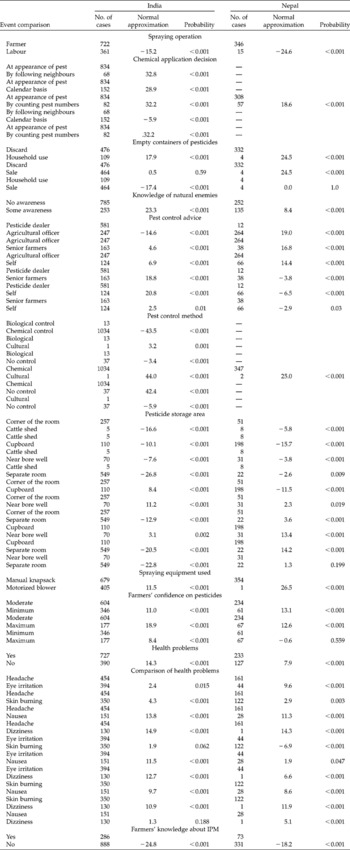
The interactive samples represented 93% males in India and 82% in Nepal. The majority of the farmers (56% in India and 95% in Nepal) possess < 2 ha of rainfed land, and 25% in India and 5% in Nepal had 5–10 ha of holdings. The proportion of rainfed land holdings in Nepal was relatively smaller than in India. Among various groups of farmers, 28% in India and 22% in Nepal were illiterates, only 25% in India and 5% in Nepal had completed high school education and very few graduates were involved in farming. These data also covered farmers from 1 to >50 years of experience, of which about 40% had 11–25 years of farming experience. The details of PRA studies indicating various interactions are given in Table 1.
Comparison of different plant protection events in India and Nepal using two-sample binomial test

Sources of plant protection advice
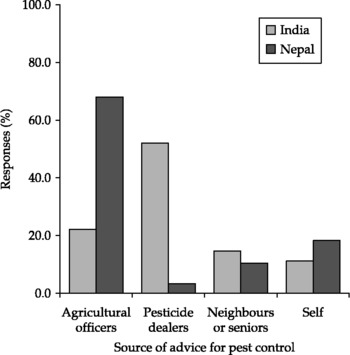
The present study brought out that most of the farmers (52%) in India get their plant protection advice from pesticide dealers, 22% from extension officials, 15% from neighbours and 11% make their own judgement in initiating plant protection. Among Nepal farmers, the majority of them (69%) make their plant protection decisions through advice from agricultural officers, 10% from senior farmers and 17% based on their own experience. Farmers receiving advice from the pesticide dealers were negligible (3%) in Nepal. Thus the decision making in pesticide use was significantly influenced by dealers in India and agricultural extension in Nepal (Fig. 1). This indicated the farmers' dependence on dealers in India, which was primarily due to the credit facility provided by the dealers for major inputs such as pesticides and fertilizers (Anon, 2008). The low dependence of farmers on dealers in Nepal might be due to the weak network of dealers in that country. According to Van Mele et al. (Reference Van Mele, Cuc and Van Huis2001), most of the rice farmers in Vietnam apply chemicals on a calendar basis based on the advice of the pesticide dealers, which increased the number of sprays to 26–37, compared with 3–4 sprays when they follow the advice of extension services. Historically, dealers had provided free advice on pest management and credit to farmers, obviously to encourage sales to promote their trade. In this vicious circle, when crops fail due to pest epidemics, farmers have to either sell their farms to pay off debts or end in some other major consequences such as suicides (Anon, 2008).
Sources of advice to farmers in pest control in India and Nepal.

Initiation of plant protection
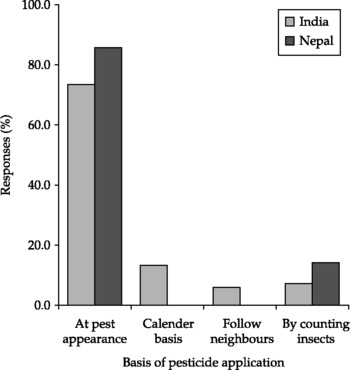
Most of the farmers in India (73%) and Nepal (86%) initiate the plant protection based on the first appearance of the pest, irrespective of their population, crop stage and their damage relationships. Only 7% of farmers in India and 14% in Nepal follow the economic threshold concept by monitoring the pest population based on the crop stages and economic impact. In India, about 6% of the farmers follow the neighbours and 14% follow calendar-based plant protection (Fig. 2). The majority of the farmers are not aware of the economic importance of various pests on their crops, and apply chemicals immediately after noticing the pest or on a calendar basis as a prophylactic. It is necessary to avoid this type of inappropriate decision for saving inputs as well as improving human health and the environment. It is evident from this study that farmers' perception on pests and their impact on yield is limited, and the adoption of economic thresholds is rather complicated without in-depth strategic research inflow and periodic farmer–researcher interactions.
Basis of pesticide application by farmers in India and Nepal.

Pest control methods adopted
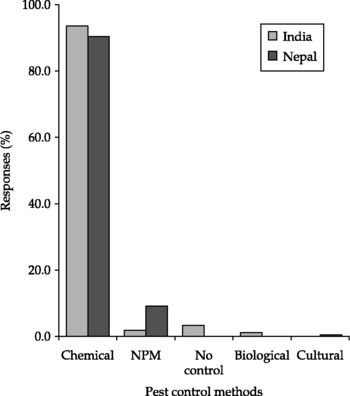
Chemical control was the most commonly adopted strategy by farmers in managing insect pests in India (93%) and Nepal (90%). Though farmers are aware of cultural, biological and other non-chemical pesticidal means, the proportion of their adoption was low ( < 10%) in both the countries (Fig. 3). The high dependence on chemical control was primarily due to their easy availability, credit facility from dealers and intensive publicity from pesticide industries. Green revolution era also concentrated mostly on enhancing production through various means, ignoring the environmental and operational issues (Mancini, Reference Mancini2006). Findings from rice systems in Asia clearly brought out injudicious use of chemicals that were hazardous to human and other non-target organisms (Anon, 2003).
Pest control methods adopted by farmers in India and Nepal.

Though farmers have adopted the use of chemical pesticides for the past four decades, only 16% of the farmers in India and 19% in Nepal have good confidence on the efficacy of pesticides. A majority of the farmers, 54% in India and 65% in Nepal, were sceptical about the efficiency of the chemicals, and 31% in India and 17% in Nepal have very low levels of confidence. This is perhaps due to the occurrence of insecticidal resistance in key pest species (Kranthi et al., Reference Kranthi, Jadhav, Kranthi, Wanjari, Ali and Russell2002) or inappropriate application or selection of chemical. Encouraging farmer participatory research and upscaling extension will play a key role in improving the farmers' confidence in the ongoing plant protection activities and in addressing the common constraints such as insecticide resistance, pest resurgence and pesticide residues of plant protection (Mathews, Reference Mathews2001). Kishi (Reference Kishi and Pretty2005) was of the opinion that replacement of chemical pesticides by non- or less toxic alternatives was the potential option to protect farm health in tropical countries.
Spraying equipment
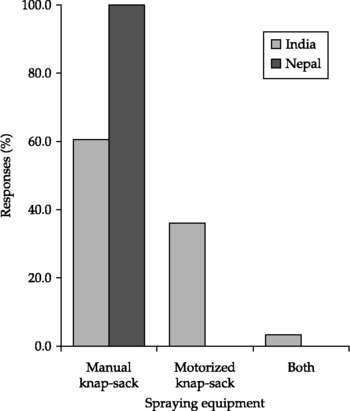
Among the farmers familiar with chemical pesticides, the majority of them (60% in India and 100% in Nepal) were using manual knapsack sprayers. Only 35% of the Indian farming community has adopted motorized knapsacks, while 3% were using both manual and motorized knapsacks to suit their requirements (Fig. 4). Though farmers in India are aware of ultra-low-volume spray devices, their use is limited to only 1%, and a very negligible proportion in Nepal. Though farmers have adopted different sprayers, they were not well aware of the pesticide concentrations and the exact requirement of spray fluid for their effective utilization. According to FAO, 50% of pesticides applied in Pakistan were wasted due to poor spraying equipment and inappropriate application, which was due to lack of training to farmers in safe aspects of pesticide use and appropriate equipment (Anon, 1997). Since awareness of farmers regarding the spray equipment is a key factor for enhancing the effectiveness of chemical pesticides, regular training on equipment and their utilization are of immense value in improving the efficiency of plant protection.
Different types of spraying equipment adopted by farmers in India and Nepal.

Awareness on health
The surveys indicated that 65% of the farming communities in India and Nepal have expressed health problems associated with plant protection. However, only 49% in India were using some level of protective clothing while applying toxic plant protection chemicals. Adoption of protective gear by Nepal farmers (80%) was better than the Indian situation. The studies of MeConnen and Agonafir (Reference MeConnen and Agonafir2002) in Ethiopia indicated that no farm worker ignored the use of personal protective equipment while handling toxic chemicals. However, the studies brought out the facts associated with particular gear such as wearing hand gloves and aprons during hot weather. Cost of the protective equipment and inconvenient weather conditions of the tropics prevent the adoption of protective gear (Kishi et al., Reference Kishi, Irschhorn, Djajadisastra, Satterlee, Strowman and Dilts1995).
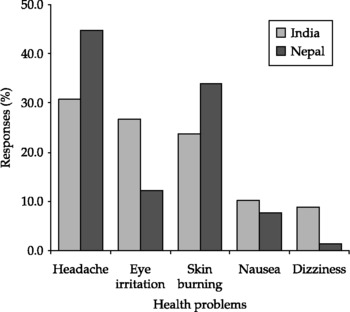
In India, the present study revealed that 31% of farmers complained of headache, 27% eye irritation, 24% skin burning, 10% nausea and 9% dizziness associated with plant protection sprays. A similar trend was also noticed in Nepal (Fig. 5). The studies conducted by Mancini et al. (Reference Mancini, van Bruggen, Jiggins, Ambatipudi and Murphy2005) in the cotton situation in Andhra Pradesh revealed 44% of the sample farmers with moderate to severe health problems. A study in Indonesia reported that 58% of spray equipment had leakages, and in Malaysia, lack of appropriate training in the maintenance of spray equipment and insufficient protective clothing contributed to pesticide poisoning among operators (Anon, 1997). There are several reports emphasizing the ill effects of pesticides associated with acute health problems such as abdominal pain, dizziness, headache, nausea, vomiting, as well as skin and eye problems for workers who handle the chemicals. Additionally, many studies have indicated that pesticide exposure is associated with long-term health problems such as respiratory problems, memory disorders and dermatological conditions (O'Malley, Reference O'Malley1997; Arcury et al., Reference Arcury, Quandt and Mellen2003; Kamel, Reference Kamel2003; Alavanja et al., Reference Alavanja, Hoppin and Kamel2004; Kamel and Hoppin, Reference Kamel and Hoppin2004; Firestone et al., Reference Firestone, Smith-Weller, Franklin, Swanson, Longsteth and Checkoway2005; McCauley et al., Reference McCauley, Anger, Keifer, Langley, Robson and Rohlman2006; Beseler et al., Reference Beseler, Stallones and Hoppin2008; Montgomery et al., Reference Montgomery, Kamel, Saldana, Alavanja and Sandler2008). The present studies confirmed that the majority of the farming community were not aware of appropriate use of plant protection chemicals emphasizing the importance of capacity building of farmers to save them from health-related disasters.
Different health problems encountered by farmers while spraying insecticides.

Application of chemicals, storage and disposal
The majority of the farmers (64% in India and 96% in Nepal) take up plant protection operations by themselves. However, some farmers (32% in India and 4% in Nepal) take assistance from agricultural labour for insecticidal sprays. A small proportion (4%) of the farmers in India besides self, also take assistance from labour for plant protection operations. These variations were mainly based on the size of holdings and the availability of resources with the farmers. Some small farmers also undertake plant protection operations with big farm holders to fetch extra income, exposing themselves more frequently to the toxic chemicals. The present studies were in agreement with the findings of Mancini et al. (Reference Mancini, van Bruggen, Jiggins, Ambatipudi and Murphy2005), where 10 times more poisonous cases were reported with marginal farmers than large farm holders.
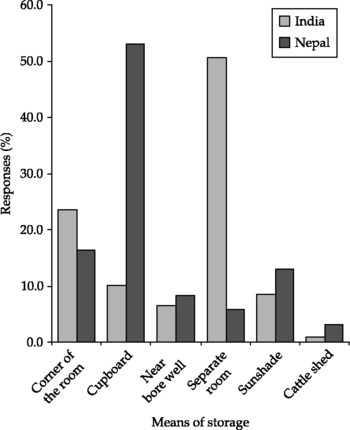
Farmers were aware of the importance of storing toxic chemicals and their consequences. However, due to the lack of resources, about 50% only were storing them in either a cupboard or in a separate room. The other ways of storing chemicals were in a corner of their residence, on sunshades, in cattle sheds or near bore wells in the farm (Fig. 6). Some farmers who are conscious about their ill effects do not store them, but apply them immediately after procuring.
Different ways of pesticide storage adopted by farmers in India and Nepal.

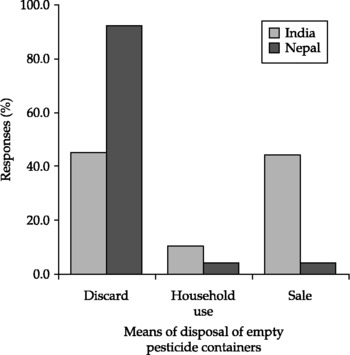
Farmers (45% in India and 92% in Nepal) discard the empty pesticide containers in their farms by burying them. Some farmers (44% in India and 4% in Nepal) sell the containers to scrap buyers. In India, 10% of the farmers and, in Nepal, 4% were using the empty containers for their domestic purposes after thorough cleaning (Fig. 7). The use of empty containers for domestic purposes reflects the innocence and economic status of the farmers. Since a considerable proportion of the community was still not disposing of the used containers appropriately, it is necessary to consider the issue in future capacity building exercises.
Different ways of disposal of empty pesticide containers by farmers in India and Nepal.

Knowledge on IPM
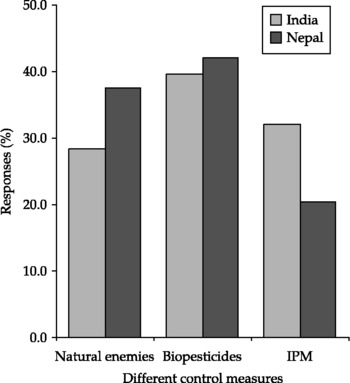
Though IPM has been advocated for two decades, only 38% of the farmers in Nepal were aware of the role of natural enemies and biopesticides, whereas in India, only 28% of the farmers were familiar with natural enemies and 39% about biopesticides. Among the various biopesticides, the majority of the farmers (76% in India and 93% in Nepal) have adopted neem in their pest management programmes. Though the farmers in India and Nepal were aware of biopesticides and natural enemies, their integration into IPM was only 32% in India and 20% in Nepal (Fig. 8). This low adoption of IPM in various crops was primarily due to the non-availability of IPM inputs at farm level, the complexity of IPM modules for different crops, lack of information on the ill effects of toxic chemicals and the existing insufficient extension networks.
Farmers' knowledge about different pest control measures in India and Nepal.

Chemical usage on different crops
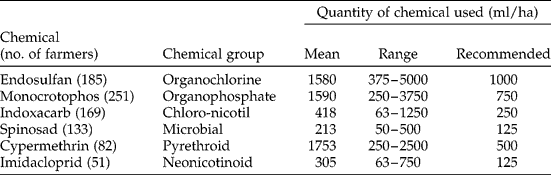
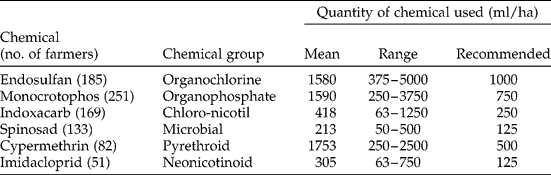
Detailed crop surveys on the chemical usage on different crops brought out the following proportion of pesticide inputs in various crops: cotton (51%), rice (10%), pigeon pea (6%), maize (2%), chickpea (1%), groundnut (2%) and chilli (28%) of the total pesticides usage in the selected project locations. In Asian agriculture, about 80% of the plant protection chemicals utilized were in cotton and vegetables, where the area was only about 5% of the total. A similar trend was also noticed in India with 75% of the chemical use in these crops covering only 5% of the cultivated area (Vasantharaj, Reference Vasantharaj1995). Of these, chilli was found to be a highly intensive crop with 15–20 sprays in a 6-month period contributing to heavy residues in products hindering the exports. Results from Table 2 clearly revealed the use of excess dosage of plant protection chemicals by farmers. This could be due to their ignorance, low confidence on their efficacy, lack of effectiveness due to the occurrence of insecticidal resistance in key species and inappropriate application. Since intensive plant protection was in a limited area responsible for major residue and environmental issues, it should be given high priority to reverse the ill effects caused by the chemicals.
Quantities of common pesticides used by farming communities and their recommended doses
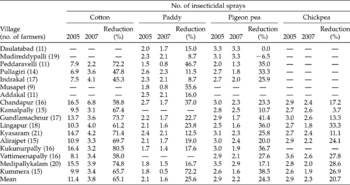
The studies related to pesticide use after the implementation of IPM in 17 selected villages indicated substantial reduction in pesticide application from 11 to 4 sprays in cotton, 2.1 to 1.6 in rice, 2.9 to 2.2 in pigeon pea and 2.9 to 2.3 in chickpea during 2005 and 2007 (Table 3). This impact was primarily due to the periodic farmer–researcher interaction training imparted to the farmers and their keenness on judicious use of chemical pesticides. Mancini (Reference Mancini2006) also discussed similar results with about 75% reduction in pesticide use in contact villages compared with 28% in non-contact villages without compromising crop yields through farmer field schools.
Comparison of pesticide use in selected villages before and after IPM implementation

—, absence of crop in the village.
The crop samples analysed for pesticide residues in 15 contact (41 samples) and 5 non-contact (15 samples) villages revealed the presence of pesticide residues in all samples, of which 38 samples had residues below 0.001 ppm. However, one sample each of Dolichos and tomato only had residues of monocrotophos and chlorpyriphos above the maximum residue level (MRL) prescribed by FAO. According to Melchett (Reference Melchett2008), the level of pesticide residues in juice drinks in the UK was on an average 34 times more than those permitted in drinking water and sometimes up to 300-fold. Studies conducted by Bai et al. (Reference Bai, Zhou and Wang2006) in vegetables in the Shaanxi area of China revealed the occurrence of residues of five organophosphorus pesticides ranging from 0.004 to 0.257 ppm in 18 out of 200 samples, and the residue levels exceeded MRLs. The occurrence of pesticide residues from the present study in all samples clearly indicate the status of residues and the need for developing strategies for their management.
Conclusions
This study brought out the status of adoption levels of different plant protection options by the farmers in India and Nepal. Lack of farmers' knowledge and their dependence on pesticide dealers made chemical control the most adopted strategy among the farmers. Several farmers reported the side effects of pesticide application, but have neither adopted the full protective clothing nor paid attention in appropriate disposal of empty pesticide containers. Though IPM implementation resulted in substantial reduction in pesticide application, the issue of pesticide residues needs to be addressed.
Acknowledgements
The financial support provided by World Bank to undertake this research through DM-2005 and the technical support provided by NARS and NGOs of India and Nepal, are gratefully acknowledged.