I think you get the gist of it, that it's almost a nonissue for most of the population.
High-ranking administrator, UT AustinFootnote 1This statement reflects the view of the administration of The University of Texas at Austin on how Campus Carry is perceived on campus two and half years after the law came into force. This perspective is grounded in the point that no significant concealed-carry-related incidents have taken place on university grounds, and yet it neglects the fact that UT Austin's own policy has effectively erased the matter from everyday campus life. Only the most persistent opposition is still visible, appearing in the form of faded “Gun-Free UT” posters in central campus windows, signs on some faculty and staff doors to “ask me about my gun policy,” and occasional press coverage, mostly about a lawsuit (lost, appealed, and then lost again) brought by several UT Austin professors on the basis of Campus Carry limiting their First Amendment rights of freedom of speech in the classroom.Footnote 2 Things have certainly settled since student demonstrations by groups like Cocks Not Glocks made international headlines, satirizing the absurdity of weapons being allowed on campus but not the display of sex toys, briefly putting Austin on the map as the center of gun-control activism in the United States.Footnote 3
While the campus community overall expressed major reluctance toward the law, as a publicly funded university UT Austin had no choice but to implement it. Like other states that have passed Campus Carry legislation, Texas required all public higher-education institutions to allow concealed carry; unlike other states, however, it empowered them to establish their own firearms policy, including, for example, identification of campus-specific gun-free zones.Footnote 4 One stipulation of this freedom of policy implementation was that it could not have the effect of prohibiting the practice of Campus Carry itself. While UT Austin has faithfully followed the spirit of this requirement since the law went into effect in August 2016, a central idea in the university's policy was also to keep out of sight the reality that some people on campus are carrying guns.
For those preparing UT Austin's policy, one goal was for “the university to look as much like it does now when you are finished,” instead of having a visible profusion of gun-carrying restrictions that might signal the presence of firearms.Footnote 5 Consequently, very few places have signs that explicitly hint at concealed carry – and none of them have a picture of a gun (i.e. a “no guns” symbol), which elsewhere in Texas commonly accompanies the statutory text.Footnote 6 Preventing images of guns had the significant effect of denying the single-occupiers of private offices this way of communicating their personal policy, instead allowing it by oral notification only. Another extraordinary measure has been the practice of not communicating Campus Carry to incoming students at the university. While information is available on UT Austin's website, no one is invited to look at it.Footnote 7 One justification given is based on the presumption that very few people carry on campus. An administrator who played a central role in UT Austin's Campus Carry Implementation Task Force recalled their estimate of less than 1 percent of the entire student population having a handgun license, adding, “And that's just talking about people that might have licenses. It's not necessarily that they are carrying.”Footnote 8 Thus the reluctance toward having the law in the first place has deliberately been transformed into keeping it out of sight – and out of mind – as a “nonissue” best forgotten.Footnote 9
In this essay, we bring to the fore the complexity of Campus Carry ignored by the university's modus operandi. In order to broadly and in a generalizable manner study students’ opinions regarding Campus Carry at UT Austin, we conducted a survey. This complemented the overall research project,Footnote 10 providing statistically significant data on viewpoints that had emerged in literature and prior interviews with faculty, students, and staff. The survey was performed in February–March 2019 among undergraduate students. The sample (1,204 respondents) is generally representative of UT Austin's undergraduate student body in terms of areas of study, gender, ethnicity, and age. When considering the results, the age of the respondents does matter. UT Austin has a relatively young undergraduate student body,Footnote 11 twenty years old being the mean. Most undergraduates we surveyed had no experience of UT Austin before the law or the protests in 2016. Furthermore, less than half (39 per cent) of the respondents were twenty-one, the age required by Texas law to obtain a license to carry (henceforth LTC), which grants the right to bring a concealed handgun on campus.
The survey was conducted in class, mainly by people answering it on the Web with their own portable devices; alternatively, they could fill out a paper copy. Participation was voluntary and anonymous. The primary analysis method used is descriptive statistics. The results allow us to outline the importance of the Campus Carry issue for UT Austin undergraduates, revealing that supporters and opponents of the law have strong – and often differing – points of view on many aspects of it. In this respect, the results mirror previous academic research on the presence of firearm-carrying civilians on campus. Adding to that understanding, we show how opinions range significantly even among supporters and opponents, especially when it comes to where concealed carry should be allowed. Finally, we demonstrate that the number of students carrying on campus is higher than the university's estimate.
THE MAIN CONTROVERSIES
In a society where civilian carry of concealed handguns is increasingly being legalized, the current dispute largely boils down to the question whether it should be allowed without restrictions or whether some “specific places” should be excluded on the basis of population and the activities conducted there. The core argument of Campus Carry supporters is quite straightforward, as they maintain that US citizens’ rights to self-arm and defend themselves should not be compromised “just because someone happens to be on a college campus.”Footnote 12
In the research-informed policy debate, however, the main arguments why colleges and universities should be excluded include negative impacts on learning environments and public health, and the fact that college campuses are rather safe places. The argument for academic autonomy also maintains that each institution should possess the power to establish its own policy – whatever is deemed suitable for its specific case – to promote both learning and campus security.Footnote 13 For many, the presence of firearms provokes feelings of suspicion and fear, as well as perceptions of danger in the learning environment, causing a “chilling effect” on free and open debate, especially when it comes to controversial topics.Footnote 14 Scholars of public health have also drawn attention to other kinds of risk associated with students’ easy access to guns. The still ongoing mental development of the young, as well as age-related behaviors such as binge-drinking and drug abuse, can be linked to increased recklessness, poorer self-control, and the tendency to make bad, irreversible decisions, including violent altercations and suicides.Footnote 15
Although school shootings seem frequent and an actively touted fear scenario in the US is that of an “active shooter,” it is in fact rare to become a victim of homicide on a college or university campus. In fact, an empirical study conducted jointly by the Secret Service, the Office of Education, and the FBI, covering cases over more than a century, concluded that the chances of being the random victim of a fatal attack by a stranger or unknown person on a college campus have been, and remain, exceptionally small.Footnote 16 Another study discovered that violent crime rates on campuses, including forcible sex offenses and aggravated assault, were about one-tenth of the US national average from 1997 to 2010.Footnote 17 Studies also maintain that the presence of gun-carrying civilians does not reduce the future likelihood of mass shootings or the number of casualties involved.Footnote 18
Surveys carried out among the faculty, staff, and students of various higher-education institutions – mostly prior to implementation – have demonstrated a broad consensus to stave off the permitting of licensed gun holders on their campuses.Footnote 19 Contrary to what proponents of Campus Carry laws like to argue, they also show that the majority of people felt safe there before such laws. Important for our discussion is the finding of previous surveys that not all who support or practice concealed carry off campus necessarily support it on campus.Footnote 20 This perspective of specifically excluding universities as a place for guns can differ between segments of the academic community, however. Whereas faculty and staff have generally rejected Campus Carry, students have shown more interest; for instance, in a study spanning universities in five states in the Great Lakes area, Thompson et al. reported approximately a fifth of students supporting the idea.Footnote 21 However, research on the actual impacts of the law is still scarce and, consequently, one identified research gap is how campus gun policy at a particular institution affects various perceptions of community life and the overall sense of safety and well-being.Footnote 22 This comprises the crux of our paper.
THE GREY AREAS
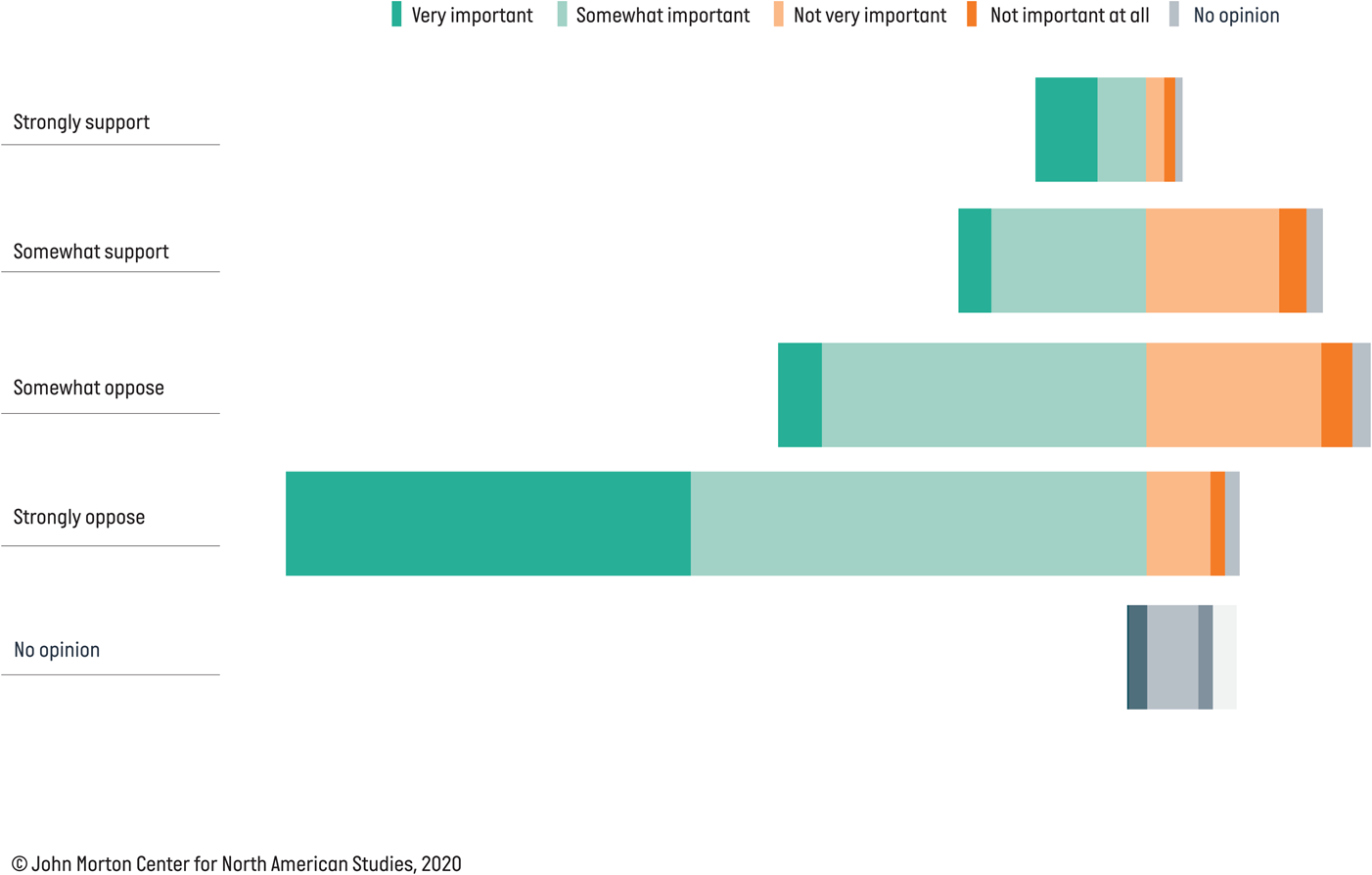
Contrasting with the administration's perspective, Campus Carry remains a critical issue in the academic community. The survey verified this perception, revealing that nearly three quarters (72 percent) of undergraduates perceived it to be very or somewhat important; this feeling was common among the wider student body, but especially pronounced among those with a clear stance one way or the other (Figure 1). Indeed, Campus Carry is still a hotly contested issue: 71 percent opposed the law, 24 percent supported it, and only 5 percent did not have an opinion.
The importance of Campus Carry for undergraduates at UT Austin, supporters and opponents separated. The bar size represents the number of respondents in each combined group.

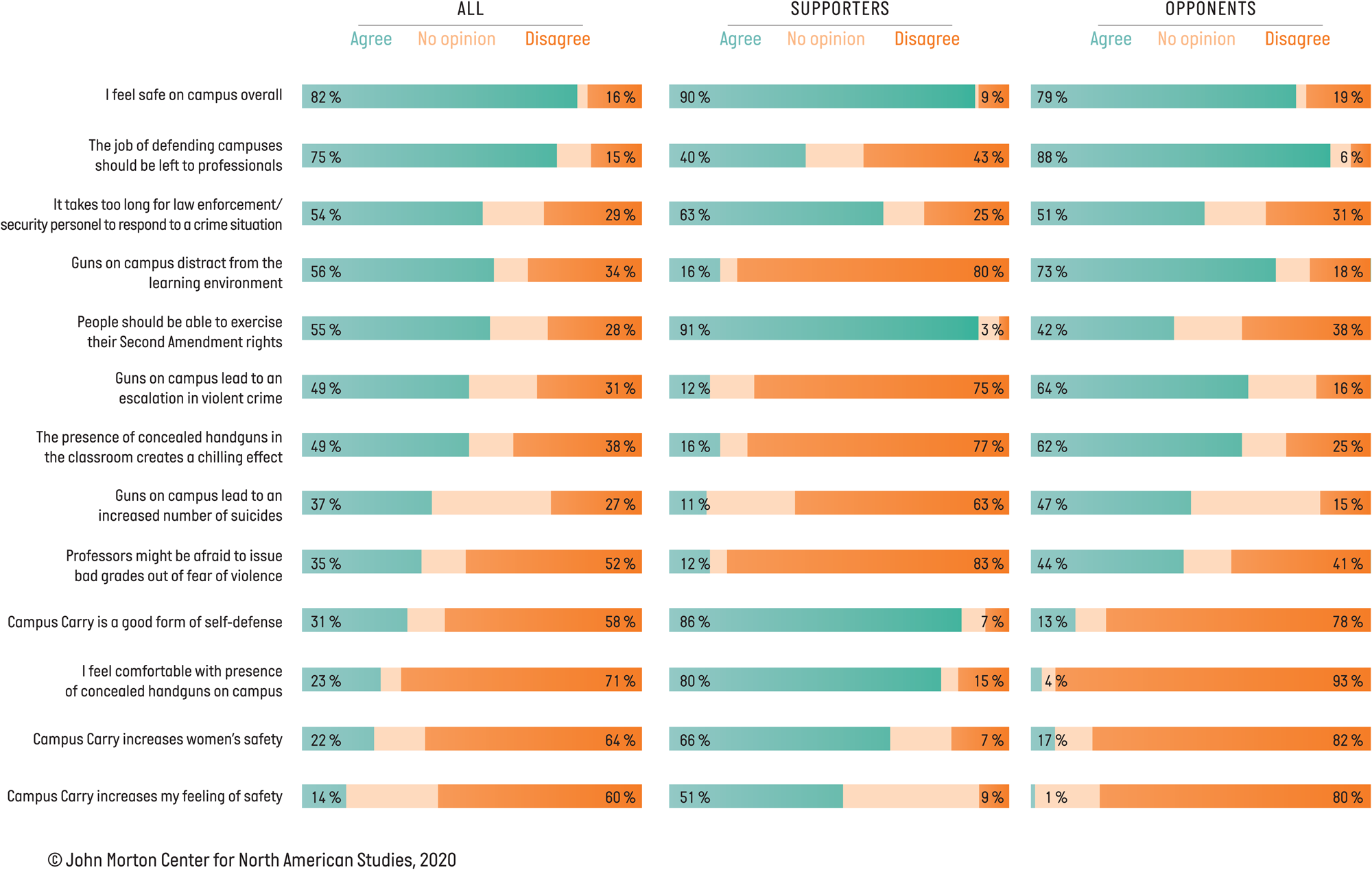
Opinions on Campus Carry are not always straightforward, however, being intertwined with multiple aspects of security and gun policy in general. To provide nuance to this complex picture, we can go beyond a mere division of supporters and opponents of the law by differentiating the opinions within the groups, in Figure 2. The results show that the majority of students felt safe on campus independently of Campus Carry, and that they would have rather left security issues to professionals, although they also tended to be critical about their response time. More specifically in terms of concealed carry on campus, seven out of ten students did not feel comfortable with it. The public-health risks indicated in the literature, including an increased likelihood of suicides and violent crime,Footnote 23 were well recognized by the students. Potential detrimental impacts on the learning environment, such as guns causing a distraction or creating a chilling effect on classroom conversations,Footnote 24 represented another perceived problem, although students believed that instructors would be able to maintain integrity in giving grades.
Opinions on Campus Carry: all respondents, supporters, and opponents.

Figure 2 illuminates how the views of the law's supporters and opponents differ with regard to these issues, as one would expect.Footnote 25 Yet it is important to note that both groups are also internally divided, and not all questions are approached as black-and-white from either perspective. For instance, while opponents of Campus Carry are seriously troubled by the law in a range of ways, more of them (42 percent) believed that people should be able to exercise their Second Amendment rights than not (38 percent). Suggesting resistance to carrying on campus rather than dislike of concealed carry in general, this distinction has also been noted by previous studies.Footnote 26
Particularly interesting are the areas where the supporters’ views diverge considerably from their peers, as this suggests some room for discussing the content of reasonable campus gun policies, both in Texas, where universities have some discretion, and more broadly in the states which are discussing implementing or modifying the law. In Figure 2, perhaps most noteworthy is that 40 percent of the supporters of the law stated that the job of defending campus should be left to professionals. Overall, this viewpoint completely undermines the whole idea of Campus Carry to add armed civilians to a scene formerly managed only by armed campus police professionally trained to mitigate and neutralize threats. A more detailed analysis revealed that this segment of supporters was more cautious, recognizing the potentially harmful side effects of Campus Carry, and more trustful of professionals arriving in time.
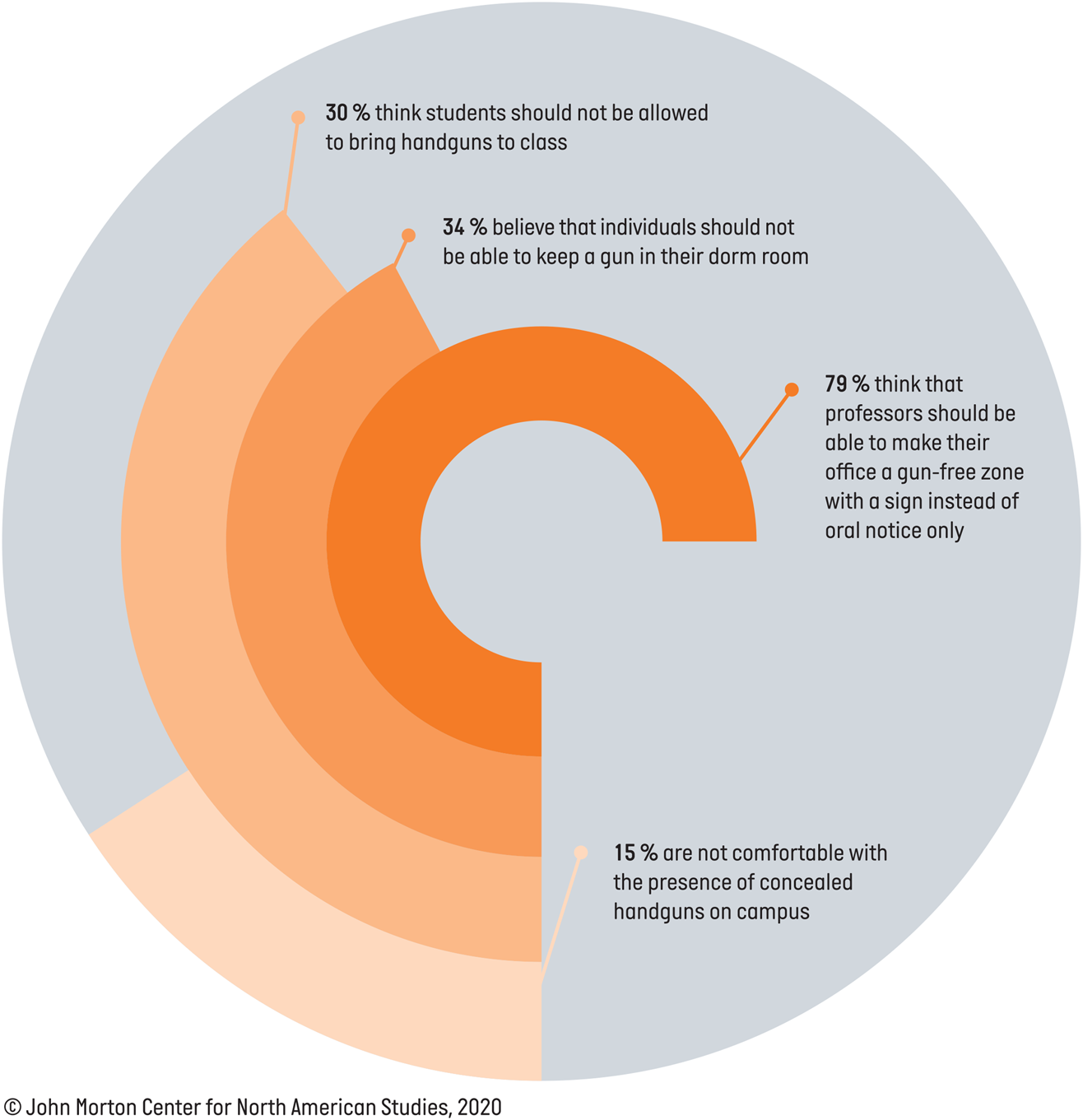
The question of where concealed carry should be allowed on campus is equally complex. Those opposed to Campus Carry are nearly unanimous in their response of “nowhere.” However, the picture is not so clear among supporters of Campus Carry. While the vast majority are comfortable with guns on campus in general, as one would expect, there is an increasing split of opinions regarding specific areas. Imagine the university as an onion (see Figure 3), with each layer of its skin representing an area with a different level of acceptance of firearms. Hitting the nerve of one of the most disputed questions in the Campus Carry debate – namely the effect of firearms being present in the learning environment – more than a quarter of supporters did not support fellow students carrying next to them in class. These supporters also belong to a more cautious segment, being less trustful in the sufficiency of LTC training, and only 15 percent of them feel safe with fellow students carrying in class (as opposed to 62 percent of supporters on average). One-third felt that dorm rooms should be off-limits, which is in line with UT Austin's current policy but different from some other Texan universities.Footnote 27 And four out of five supporters of Campus Carry stated that professors should be able to make their office a gun-free zone with a sign, instead of having to give oral notice, as is the current university policy.
Opinions of supporters of Campus Carry regarding concealed carry in different areas of campus.

THE PERCEPTION GAP
For most at UT Austin the question of Campus Carry represents a lived experience both colored by and expressed through strong opinions, with guns as an inescapable and undeniable reality. But how prevalent are they really? Remembering that the university administration itself estimated the number of people carrying on campus to be less than 1 percent, it is significant that others have a very different picture; for example, a quarter (26 percent) of surveyed undergraduates estimated the figure to be more than 5 percent, with this being even more pronounced among opponents of the law.
This perception gap is partly due to the lacuna of existing research on how many students actually bring guns on campus. One can cite a study conducted at a single public university in rural eastern Texas already in 2012 (i.e. before the law went into effect), which concluded that 10–82 percent of the classes would have at least one – and likely more – carrying license holders,Footnote 28 but it does not reveal the percentage of students owning a gun, possessing an LTC, or thinking of obtaining one.Footnote 29 To get a current idea of such per capita figures, these questions were included in the survey.
Many UT Austin students have at least some personal experience with guns, since 40 percent of them reported growing up in a household with firearms – a figure roughly in line with the US average.Footnote 30 Not surprisingly, such history was nearly twice as likely among supporters of Campus Carry (60 percent) than among opponents (34 percent). But while gun ownership is common in Texas and does not require a permit, buying a gun from a licensed dealer has an age limit. Therefore, probably given their young age, only 11 percent of surveyed undergraduates themselves owned a gun. Again there was a major difference between supporters (26 percent) and opponents (6 percent); of the former, 10 percent even reported having a trove of five or more. In a multiple-choice question, supporters of Campus Carry most frequently identified self-protection (71 percent) as their reason for gun ownership, while only a quarter of opponents (28 percent) selected it, after hunting, having a hobby, and protecting family.
In terms of concealed carry specifically, undergraduate gun owners were asked whether they possessed an LTC or planned to get one. Among this group, 12 percent already had an LTC, while as many as half (48 percent) had plans to get one.Footnote 31 This large number can be understood in two ways: reflecting students who had yet to come of age, as twenty-one-year-olds comprise a comparatively high percentage of those applying for and being granted a new license,Footnote 32 and the increasing trend of US citizens to acquire an LTC, both nationwide and in Texas.Footnote 33 Extrapolating from the sample, the share of undergraduates with an LTC in spring 2019 comprised 1.2 percent. One-third reported carrying on campus regularly, one-third rarely, and one-third never. Based on UT Austin's student body (40,804 undergraduates in September 2019), this means that 490 individual undergraduates have a license to bring a handgun on campus premises: 163 do it frequently and another 163 infrequently. That adds up to a considerable number of concealed handguns at the university, and it is only expected to grow. Even if those students now having an LTC graduated by the time their younger peers planning to get one turned twenty-one, the overall share of licensed students could well surpass the 2.3 percent per capita rate of LTC holders in Travis County, where UT Austin is located.Footnote 34 Furthermore, even the current share exceeds the university's estimate of LTC holders – among undergraduates alone. In terms of the total number of armed individuals on campus, it is important to remember that our sample did not include graduate students, faculty, or staff, whose age does not restrict their access to an LTC and are thus on a per capita basis more likely to carry.
CONCLUSIONS
For UT Austin undergraduate students, Campus Carry is not a “nonissue” as much as the university administration might like to think. Opinions are strongly divided, with three times as many opponents of the law as supporters, and most undergraduates think that it is an important matter. This calls into question the “sweep-it-under-the-rug” tactics chosen by the university leadership. Moreover, as more and more students get an LTC, exceeding the university's estimate of how many people are carrying on campus, the reality of Campus Carry will only become more pronounced.
In many students’ minds, Campus Carry is negatively associated with well-known concerns regarding public health and the learning environment. Furthermore, because the views of both supporters and opponents are not black-and-white, with even part of the former wanting stricter limitations on the policy than currently exist, there appears to be a need for continued exploration of the matter. For example, a future point of discussion at UT Austin could involve making single-occupant offices off-limits by means of a sign, with or without a gun image, or increasing transparency of the policy choices. Overall, the results presented in this essay suggest further possibilities in finding a sensible campus-focussed balance, in which guarantees of Second Amendment liberties, personal safety concerns, and learning-environment interests can be reconciled.Footnote 35