

1. Introduction
It appears to be a universally acknowledged truth that an age of proportionality is upon us.Footnote 1 It is said that the concept has experienced an “extraordinary recent upswing in its fortunes” and has “assumed a central place in… efforts to lay down standards for legitimate state conduct, and for judicial oversight of the exercise of power in a range of areas within human rights, administrative, public, international, and private law”.Footnote 2 Its proponents call it the “ultimate rule of law”.Footnote 3 Its opponents accuse it of undermining liberalism,Footnote 4 assaulting rights,Footnote 5 and offering a false promise that competing values can be rationally reconciled through adjudication. Yet it marches on, indefatigable.Footnote 6 In UK administrative law, though the Wednesbury unreasonablenessFootnote 7 test of substantive judicial review has traditionally ruled the roost, under the radiating influence of proportionality jurisprudence pursuant to the Human Rights Act 1998,Footnote 8 it is now de rigueur in academic commentary to ponder the displacement of the former in light of proportionality’s purportedly more structured and transparent framework.Footnote 9 More broadly, the idea of proportionality has left its mark across the globe in both customary and less well-trod domains of constitutional and administrative law,Footnote 10 international law,Footnote 11 criminal law,Footnote 12 labour law,Footnote 13 and pockets of (particularly European) private law.Footnote 14
To date, Anglo-Commonwealth contract scholars have remained, for the most part, neither shaken nor stirred by proportionality. Constitutional values have occasionally crept into private law with a “horizontal effect”, and may implicate the use of a public law proportionality analysis,Footnote 15 yet what of the quotidian general law of contract? Consider the following: “Only when depriving the claimant of his or her rights is a proportionate response based on the relevant illegality policies, should the defence succeed.”Footnote 16 A penalty is a “secondary obligation which imposes a detriment on the contract-breaker out of all proportion to any legitimate interest of the innocent party in the enforcement of the primary obligation”.Footnote 17 The cost of cure damages will not be awarded where the “cost of reinstatement would be wholly disproportionate to the non-monetary loss suffered”.Footnote 18 These rumblings of a proportionality principle suggest that what could once have been written off as judicial rhetoric may have begun to take root and ramify in various contract doctrines.
In this paper, I explore the emerging use of the proportionality concept in contract doctrine, first in an attempt to understand its internal structural logic, and secondly, to situate its invocation within the existing discourse on private law theory. In other words: what are judges doing when they (consciously or perhaps unconsciously) appeal to “proportionality” in this domain? Moreover, what does this say about the ideology of adjudication? To anticipate the analysis that follows, in rationalising the idea of proportionality in contract, I draw insights from the use of proportionality in other domains of law (in particular public law) to uncover the internal rationality of proportionality analysis as a framework for providing a means-ends rationality review coupled with a process of balancing competing considerations in contract adjudication. Moving from its structural logic to its normative basis, I argue that proportionality as a mode of private law adjudication is significant as a method of pragmatic justification, expressing an aspiration towards a structured and transparent mode of argumentation that is anti-formal and anti-ideological. This mode of reasoning focuses from the bottom-up on the contextual considerations that judges struggle with in specific cases, and occupies a distinct space against existing normative accounts in private law driven by, for instance, “top-down” rights-based ideologies on the one hand, or critical and communitarian perspectives on the other. Proportionality thus presents itself as a substantive justificatory framework for the accommodation of plural and competing values.
While proportionality holds out this promise, it is also besieged with charges that it legitimates a neo-liberal view of “freedom of contract”; that any sort of balancing takes on the impossible task of weighing incommensurable values and is ultimately unconstrained; and that it collapses the public-private boundary. I conclude by addressing these challenges, suggesting where these concerns entail caution, and where they may have been, if you like, blown out of proportion.
2. A Proportionality Framework for Contract Law
2.1 Basic Building Blocks
What is proportionality? Is there a shared idea that underpins the multifarious uses of the concept, which can be usefully transposed to the domain of contract? We can begin with a recent attempt to pin down a “clear formal meaning to proportionality”.Footnote 19 According to Lacey:
An appeal to proportionality indicates a claim about the existence of a broad moral or practical equivalence or comparability between two different phenomena: a wrongful act and a punishment; an assault and a reaction in self-defence; a piece of negligent conduct and an award of damages; a prima facie discriminatory impact and a compensating legitimate purpose; a perceived social problem or danger and a governmental response which imposes certain social costs or impinges upon certain rights.Footnote 20
At a general level, this definition is not incorrect. Yet more needs to be said about the nature of the relationship between the two phenomena sought to be brought into proportion. It is not sufficient to invoke “equivalence” and “comparability”, which are in the same neighbourhood as a wide range of concepts. Commensurability, substitutability, compatibility, and parity are examples that come to mind,Footnote 21 concepts we intuitively desire to distinguish from proportionality.
So, what is the relationship that proportionality expresses? One key ingredient in the idea of proportionality is the relationship between means and ends, viz, a means-ends rationality.Footnote 22 First, we may test the rationality of the connection between the aim and the means adopted in pursuit of the aim. Related to the above is the idea that the means should be necessary to achieve the ends in mind. If there is an equally (or more) effective alternative that imposes a lesser burden, it may not be completely rational to adopt the contemplated means. In determining necessity, we might ask what the “least restrictive” solution is, in the sense of imposing the least burden on the legal actor as well as other parties.
Proportionality as means-ends rationality helps to shed light on the divergent uses of the concept across law’s empire. Hence, in a doctrine originating with Aquinas, we understand that the use of force in the law of self-defence must conform to the principle of proportionality; the aim being the protection of the state and the means being the use of force, which in turn must be connected to self-preservation (not some other aim) and necessary under the circumstances.Footnote 23 The test of means-ends rationality is also discernable in criminal law, a domain in which the proportionality principle is well-established. Here, proportionality is often associated with retributivism. Fish tells us that the lex talionis in the Old Testament “sanctified proportionality as a moral principle of punishment”.Footnote 24 Likewise, we might say “punishment is justified in response to, by reason of, and in proportion to, the offender’s desert”.Footnote 25 In fact the idea of proportionality is not confined to a narrow retributive frame, but is “better understood as an external limitation on the state’s power to incarcerate or execute individuals, and this limitation applies whether the state is punishing to exact retribution, to deter, to incapacitate, or… to pursue some amalgam of ill-defined and possibly conflicting purposes”.Footnote 26 This resonates with the broad understanding of means-ends rationality—whether the goal is retribution, deterrence, rehabilitation, restoration and so on—the relevant criminal sanction must bear a rational connection to, and be necessary to achieve, the aims of the law. In this vein we can see the relevance of means-ends rationality to the sphere of private law. In Aristotelian thought, it is said that proportionality governs the “relationship between a distributive principle and the shares apportioned thereby”.Footnote 27 Yet proportionality is also pertinent to corrective or transactional justice, in that it structures the relation between the aim of correcting the relevant rights-infringement and the remedy awarded, by requiring rational connection and necessity.
In addition to means-ends rationality, proportionality encompasses the notion of balancing. Proportionality is said to be the “embodiment of the notion of justice and can therefore be found in the image of Lady Justice holding scales”.Footnote 28 Balancing goes beyond means-ends reasoning, accepting that a particular legal measure may be rationally connected to and necessary for the aim in question, but nonetheless overridden by competing values, including rights, (individual or collective) interests, or (social or legal) policies. As Möller observes, balancing works “to determine which of the two (or more values) at stake takes priority in the concrete circumstances of the case”.Footnote 29 More abstractly, it can be said that “proportionality’s real value derives from the way it integrates and balances an order of values to which it is somehow both extrinsic and intrinsic”, hence “stabilis[ing] and sanction[ing] a normative frame”. Footnote 30
2.2 Proportionality in Public Law
The abstract framework of proportionality finds its most mature instantiation in public law. For our purposes, the sub-concepts which constitute the proportionality principle in public law adequately express the foundational twin ideas of means-ends rationality and balancing. At the same time, the case law and academic jurisprudence in public law have their own distinctive trajectory, with conceptual and normative debates taking place at peculiar sites of contestation, not all of which are relevant for our purposes. Hence it is essential to first demarcate the core of the proportionality principle in public law, and secondarily isolate the fissures and fractures in the framework.
In public law, the proportionality test is said to be a “doctrinal tool for the resolution of conflicts between a right and a competing right or interest, at the core of which is the balancing stage which requires the right to be balanced against the competing right or interest”.Footnote 31 Proportionality requires that i) the policy interfering with the right must pursue a legitimate goal (e.g., the preservation of public safety and protection of minors); ii) there must be a rational connection between the policy and the achievement of the goal (the policy must achieve the goal at least to a small extent, as opposed to not contributing in the slightest); iii) the policy must be necessary in that there is no less restrictive policy that achieves the legitimate goal equally well; iv) the values pursued by limiting the right are balanced against the value of the right encroached upon and the deleterious effects of the limitation (yielding a “fair balance between the public interest and the private right”).Footnote 32
Controversy manifests at various points in the structure of the proportionality analysis. For one, the very idea of proportionality might be rejected in favour of an alternative categorisation of rights approach with different levels of judicial scrutiny, as in American constitutional law.Footnote 33 Even within proportionality, each step in the framework is open to debate. We might query how demanding the test of a legitimate goal should be;Footnote 34 the required degree of connection between the aim and the policy;Footnote 35 or the operation of the necessity test where the alternative measure is less restrictive but not equally effective or requires additional public resources.Footnote 36 Balancing is highly controversial, and debates range over the technical structure and limits of the exercise, particularly under the influence of Alexy’s “weight formula”. This formula seeks to formalise the test as a ratio that takes into account variables such as the abstract weight of the competing values, the gradated intensity of interference with the right, and the extent of importance of satisfying countervailing principles or policies, as well as the reliability of empirical assumptions regarding the above.Footnote 37
2.3 From Public law to Contract law
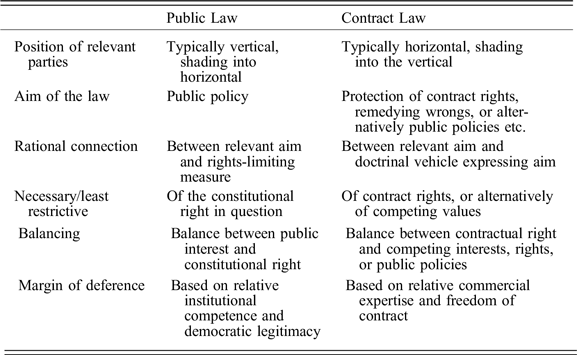
Notwithstanding these controversies, the core features of proportionality remain fairly serviceable, and with some adjustment can be adapted to fit our purposes. Preliminarily, in comparing the proportionality framework in public and contract law, one must take into account the position of the relevant parties, or what might be termed the “puzzle of horizontality”.Footnote 38 While I deal with the objection that the use of the proportionality concept breaches the public-private boundary below, it may be helpful at this juncture to point out the general relevance of positionality. As Goldberg notes, private law “defines the rights and duties of individuals and private entities as they relate to one another”, in contrast to public law which “establishes the powers and responsibilities of governments, [and] defines the rights and duties of individuals in relation to governments”.Footnote 39 Taking this thought further, we might say that the positionality in public law is typically vertical (state-private party), shading into the horizontal where the state draws on constitutional or public values in mediating what is primarily a private relationship between non-state actors. On the other hand, the positionality in contract law is typically horizontal (between private parties), shading into the vertical where an imbalance in contracting power exists such that the stronger party’s sphere of influence parallels in certain respects that of the state and accordingly should be subjected to both private and public norms of restraint and accountability.
Moreover, while the relevant “aim” in public law normally refers to a public policy goal operationalised through legislative or executive action, the “aim” of the law in the contractual context must be understood more capaciously to include other values, be they rights-protection, remedying wrongs, or other public policies. Hence, while proportionality is relevant to public policy limitations on contractual rights (e.g., whether it is a proportionate response not to enforce a contract tainted by illegality), proportionality can also be applied to the aim of enforcing contractual rights taken in relation to competing values. For example, whether it is proportionate to enforce an agreed liquidated damages clause or other secondary obligation imposing a detriment on breach of a primary obligation given the relevant interest of the innocent party protected by the clause. One way of understanding this is that in the public context, the spotlight is on the proportionality of the limiting measure taking the constitutional right as a prima facie-controlled variable. However, in the private law context, the test of proportionality can cast the spotlight on the limiting measure (public policy circumscribing contractual rights) as well as on the contract right itself, taking into consideration the existence of irreducibly competing considerations as the controlled variable. In relation to the stated aim of the law (public policy, or giving effect to contract rights and upholding the pacta sunt servanda principle), the doctrinal vehicle expressing that aim (illegality, liquidated damages subject to the penalty doctrine, cost of cure damages) should have a rational connection and be necessary for achieving that aim. Lastly, as with public law, the balancing stage requires practical reasoning to reach a fair balance of all the relevant considerations, principles I seek to illustrate in the re-interpretation of the case law below.
One final feature is worth transplanting from the public law framework. In public law, it is critical to tailor the intensity of review and degree of deference within the proportionality test. The degree of scrutiny applied to review the measure under question, or on the flip side, the extent of deference accorded to administrative decision-makers, is an important variable that finds expression in the concept of the “margin of appreciation” in the European Court of Human Rights jurisprudence and the associated idea of the “margin of discretion” within domestic law.Footnote 40 The notion of deference is often bifurcated into “expertise-based” and “democracy-based” deference.Footnote 41 The former refers to more practical considerations of relative institutional competence, for instance when the decision-maker has access to particular expertise that the judiciary does not, as is with “polycentric” questions of macro-economic policyFootnote 42 or the determination of public emergencies.Footnote 43 The latter form of deference is normative rather than merely factual or instrumental, and rests on the idea that the decision-maker’s views are ascribed weight due to its democratic credentials or constitutional legitimacy, in contrast to the judiciary whose legitimacy is a function of its independence and objectivity.Footnote 44
In contract law, a parallel notion appears to be at work. Naturally, deference in the sphere of contract does not involve deference of an international tribunal to domestic systems, nor of the judiciary to other branches of government within a system, but that of courts deferring to private parties exercising contractual autonomy. As with public law, deference in contract has both practical and normative prongs. Anticipating the analysis below, we see that courts apply a “low level of review” in reviewing the relationship between liquidated damages or other secondary provisions in a commercial contract, and the legitimate interest it serves to protect. Arden LJ in Murray v. Leisureplay Plc Footnote 45 affirmed that “parties are allowed a generous margin”Footnote 46 since they are best placed to determine pre-estimates of losses from breach or stipulate how their various commercial interests might be secured. Secondly, the normative aspect of deference relates to the need to respect party autonomy (regardless of the court’s expertise) where parties are of relatively equal bargaining power, reflected in the observation that in “commercial contracts, great caution should be exercised before striking down a clause as penal”.Footnote 47 Conversely, where there appears to be an imbalance of bargaining power in contracting, the margin of deference is narrower.
The following table sets out the basic points of comparison and contrast explored above:
Proportionality Framework in Public Law and Contract Law
2.4 Structural and Normative Points of Comparison
In considering the relationship between the general conceptions of proportionality in public law and contract law, it may be helpful to further distinguish between the structural and normative aspects of comparison and contrast.Footnote 48 The structural logic of proportionality refers to its means-ends rationality and balancing components, or what Alexy refers to as the “formal” dimension of proportionality reasoning—its “formula language”, in contrast to the substantive moral “inputs” that are provided “from the outside”,Footnote 49viz, the type and range of values that one filters through the balancing analysis.
At the structural level, one can trace the logic of proportionality as it operates across different domains. For instance: in constitutional law, proportionality is used to determine the justifiability of the legislature’s restriction on a constitutional guarantee of free speech through a criminal law prohibiting public communications that wilfully promote hatred against identifiable groups;Footnote 50 in European Union administrative law, the European Court of Justice is required to consider the lawfulness of a directive prohibiting the use of certain hormones in livestock farming against arguments that other means of consumer protection were available and that it would impose considerable financial costs on traders;Footnote 51 in localised versions of administrative law, in which the benefits of an immigration policy, imposing a rule that spouses or civil partners of British citizens would not be permitted to enter the United Kingdom if they were under 21 years old, are outweighed by the burdens on the right to respect for private and family life;Footnote 52 in public-private settings (e.g., dealings between public bodies and private individuals), in which a court assesses the proportionality of making an order for possession of a person’s home at the suit of a public authority landlord, taking into account the right of respect for one’s home.Footnote 53
Notwithstanding the existence of inevitable boundary disputes,Footnote 54 the skeletal framework of proportionality analysis remains shared across these different domains, including the domain of contract law, which I explore below. To anticipate the analysis, as is the case when we use the proportionality vehicle to determine whether a constitutional right to free speech is justifiably limited by a law prohibiting hate speech, we might invoke the proportionality concept to evaluate whether a contractual right to freight due is justifiably limited by a judicial determination to render the contract illegal and unenforceable in circumstances in which a shipowner commits an offence of overloading.Footnote 55 In both cases, there is a structural similarity whereby different types of rights assertible in public or private domains are balanced against competing values. The structural analogy that I look to draw is potentially of interest in itself insofar as it implicates a domain of legal doctrine that is not commonly thought of as involving the use of the proportionality concept. A reinterpretation of case law through this lens enables us to see the more general logic of proportionality at work within the technical, and at times fragmented, doctrinal landscape of the common law of contract.
In public law, the normative basis of proportionality’s structure is widely discussed, and we might ask if a similar inquiry is opened by recognising the operation of proportionality logic in contract. For instance, theories of constitutional proportionality range roughly from the more “monistic” to the more “pluralistic”. Jacob Weinrib has recently defended a persuasive “dignitarian” account of proportionality, in which “[p]roportionality reflects the absolute duty of government to bring the existing legal order into the deepest possible conformity with human dignity”.Footnote 56 The basic idea appears to be that constitutional rights are incidents of an overarching state obligation to “respect, protect, and fulfil human dignity”; however, because rights will invariably conflict with other incidents of this obligation, proportionality is invoked to mediate such conflicts.Footnote 57 Objectives of the state that are integral to the dignitarian idea (e.g., public safety, health, and order), are recognised as being reconcilable with dignity, but not extrinsic considerations of “policy, preference, tradition, utility, and administrative convenience”.Footnote 58 Other theories in a more pluralistic vein do not ground proportionality in a single ultimate value; for instance, Mattias Kumm understands proportionality analysis as flowing from the right of members of a liberal democracy to demand public reasons-oriented justifications, with the content of those reasons open to various considerations within the scope of “good faith collective judgments as to policy”.Footnote 59 Likewise, Vicki Jackson alludes to multiple instrumental benefits of proportionality analysis, including its broad justificatory base that “embrac[es] a wider range of reasons than those that resort to text, precedent, and history alone”,Footnote 60 while Beatty’s pragmatic conception of proportionality understands its chief virtue to be its capacity for “a very focused factual inquiry as to the good and bad effects of specific acts of state”.Footnote 61
In due course I will defend a normative account of proportionality in contract from a more pluralistic and pragmatic perspective, given that my examination of the contract case law demonstrates how courts take into account the importance of contractual rights and interests alongside considerations of substantive fairness, social utility, and other policy considerations, which are not easily reducible into an “autonomy” or “dignity-based” conception of contract. This does not lead to the conclusion that a similar “pragmatic” perspective infuses the public conception of proportionality—I will leave the question open for the purposes of this paper, envisaging the possibility that different domains using the same structural logic of proportionality are explicable via a diverse number of normative accounts.
3. Proportionality Reasoning in Contract Doctrine
3.1 Illegality
After a period of vacillation between a “rule-based” and more flexible “range of factors” approach to the illegality defence in common law,Footnote 62 the UK Supreme Court by a majority in Patel v. Mirza Footnote 63 has settled for the latter, with Lord Toulson’s leading judgment restating the relevant considerations as follows:Footnote 64
[O]ne cannot judge whether allowing a claim which is in some way tainted by illegality would be contrary to the public interest, because it would be harmful to the integrity of the legal system, without (a) considering the underlying purpose of the prohibition which has been transgressed, (b) considering conversely any other relevant public policies which may be rendered ineffective or less effective by denial of the claim, and (c) keeping in mind the possibility of overkill unless the law is applied with a due sense of proportionality. We are, after all, in the area of public policy.
The express reference to the “proportionality” principle is significant. It is consistently emphasised in Lord Toulson’s judgment, in which he quotes McHugh J’s observation in Nelson v. Nelson Footnote 65 that it “is not in accord with contemporaneous notions of justice that the penalty for breaching a law or frustrating its policy should be disproportionate to the seriousness of the breach”,Footnote 66 and he also cites ParkingEye Ltd v. Somerfield Stores Ltd Footnote 67 for the proposition “[r]espect for the integrity of the justice system is not enhanced if it appears to produce results which are arbitrary, unjust or disproportionate”.Footnote 68 It is also useful to refer to the earlier Singapore Court of Appeal decision in Ting Siew May v. Boon Lay Choo Footnote 69 on the enforceability at common law of contracts entered into with an illegal or unlawful object. In this case the court endorsed an umbrella “principle of proportionality”,Footnote 70 which involves consideration of “(a) whether allowing the claim would undermine the purpose of the prohibiting rule; (b) the nature and gravity of the illegality; (c) the remoteness or centrality of the illegality to the contract; (d) the object, intent, and conduct of the parties; and (e) the consequences of denying the claim”.Footnote 71 Both Ting Footnote 72 and Patel Footnote 73 also make reference to the Consultative Report by the Law Commission,Footnote 74 which emphasised that:
Ultimately a balancing exercise is called for which weighs up the application of the various policies at stake. Only when depriving the claimant of his or her rights is a proportionate response based on the relevant illegality policies, should the defence succeed.
This notion of balancing continues to be recognised in the recent jurisprudence; for instance, in Singularis Holdings Ltd v. Daiwa Capital Markets Europe Ltd,Footnote 75 in which the court observed that the Patel “test involves balancing multiple policy considerations and applying a proportionality approach”.Footnote 76
The sub-principles of the unified proportionality framework outlined above may also assist us in rationalising the case law. First, the aim of the law is considered. This refers to the “purpose of the prohibition transgressed”—the policy rationale underlying the relevant criminal, administrative, or common law prohibition. Second, non-enforcement of the contract must bear a rational connection to the stated aim. We are essentially asking: does the measure taken (non-enforcement) contribute at least in some part to the aim in mind? In this respect, rational connection dovetails with the factor that is commonly described as the “remoteness”, “proximity”, or “centrality” of the illegality to the contract. There is a clear connection between promoting criminal deterrence and prohibiting the enforcement of a contract for murder, given the centrality of the illegality to such a contract. Conversely, if the illegality is particularly remote compared to the contract, the contract has not been directly harnessed toward an illegal purpose, and consequently, there is little or no logical link between non-enforcement and achievement of the intended policy.
For example, in Ting, the prospective purchasers of a landed property sought to enforce an option to purchase against the sellers, which the latter contended was unenforceable since the option had been unlawfully backdated for the purposes of enabling the purchasers to obtain a larger credit facility than they were otherwise entitled to under the revised housing loan regulations at that time. The Singapore Court of Appeal held the option to be unenforceable, as the use of the backdated option was an overt or integral step in the purchasers’ plan to circumvent the regulations put in place to foster price stability in the property market.Footnote 77 There is a rational connection between prohibiting a backdated option meant to circumvent the regulations and promoting the stated aim of the loan regulations. A different result was reached in 21st Century Logistical Solution v. Madysen,Footnote 78 which concerned a contract for sale of goods and the form of VAT fraud known as “missing trader” or “carousel fraud”. The claimant was incorporated to buy goods from abroad without VAT and to sell them within the UK with VAT added and pocket the VAT without accounting to the tax authorities. When the claimant (in liquidation) sought to enforce the debt against the defendant-purchaser, the latter argued that the contract was unenforceable. However, the court held that the contract was a “straightforward agreement for the sale of goods” and “[i]n and of itself a lawful contract”, merely providing the opportunity to profit from the intended fraud, which required the further critical act of failing to account to the tax authorities.Footnote 79 Here, there is less of a rational connection between the aim of preventing VAT fraud and non-enforcement.
While in many cases the threshold requirement of a rational connection might be met, the necessity test filters out prohibitions on enforceability when less restrictive alternatives exist to achieve the aim of the law. In ParkingEye, for example, the contract contemplated an arrangement in which the claimant provided an automated parking system and was allowed to charge customers whose stay exceeded the free parking time and to retain such “fines”. The claimant had made false representations regarding its authority to commence proceedings in its demand letters to recover the “fines” and the defendant raised the illegality defence, which was rejected. From the perspective of the necessity test, it is interesting to note that ParkingEye was already found guilty of the tort of deceit,Footnote 80 and that the defendant had also raised illegalities arising from the Theft Act 1968, Fraud Act 2006, and the Administration of Justice Act 1970 (though the latter criminal offences were not made out).Footnote 81 Consequently, it could be said that non-enforcement was not necessary—the aim of sanctioning and deterring the claimant’s deceitful conduct could be achieved through less restrictive means without impinging on its contractual rights.
Relatedly, the test of necessity also accounts for the difference in treatment between the enforcement of an illegal contract and restitutionary recovery of benefits conferred pursuant to such a contract. A Patel-like contract contemplating the transfer of sums for the purpose of betting on shares using insider information would arguably be difficult to enforce in court, but both the majority and minority in Patel had no difficult awarding restitution for the sums transferred. Generally speaking, enforcement would directly undermine the aims of the law, and hence might be necessary in many cases; however, restitution is less likely to be necessary when a less restrictive policy of non-enforcement is available, or in some cases, applicable regulatory sanctions (e.g., confiscation orders under the Proceeds of Crime Act 2002).Footnote 82 Hence, the logic of the necessity test also accounts for Lord Sumption’s understanding of the much-contested reliance principle, viz, that the “illegality principle applies no more widely than is necessary to give effect to its purpose of preventing legal rights from being derived from illegal acts”.Footnote 83 In other words, to maintain consistency with the aim of the prohibiting law, we ask: is there an equally effective alternative which is less intrusive of private rights?
At the balancing stage, the illegality jurisprudence reasons through the full range of factors, including, on the one hand, the importance of achieving the aim of the law, the nature and gravity of the illegality, the relative blameworthiness of the parties, and on the other end of the scales, the degree of incursion into private rights, and the consequences of denying the claim for the parties, as well as the legal system more generally.
One illustration of balancing is the recent High Court decision in Harb v. Aziz,Footnote 84 which concerned Mrs Harb’s claim that she was contractually entitled to a significant sum as well as two properties that Prince Aziz had promised her, in exchange inter alia for the withdrawal of certain allegations she had made about Prince’s father, King Fahd (with whom she had a previous relationship). While the court held that the agreement was not enforceable on account of a lack of intention to create immediate legal relations and uncertainty,Footnote 85 the court rejected the Prince’s invocation of the illegality defence. This in turn was based on Mrs Harb performing the contract by giving a false statutory declaration that retracted allegations made in a previous affidavit regarding King Fahd’s methadone use. In coming to the conclusion that it would be “disproportionate” to prevent Mrs Harb from enforcing the agreement,Footnote 86 the court weighed on one side the “important purpose” of ensuring the truthfulness of statutory declarations (emphasised by regulatory penalties for false declarations pursuant to Section 5(a) of the 1911 Perjury Act), counter-balanced with the fact that: i) Mrs Harb’s conduct was not “of great seriousness” given that the drug use allegations were “of no particular consequence other than for the King’s reputation”; ii) the Prince was “nearly as culpable” as Mrs Harb for demanding that she retract allegations known to be true; and iii) in addition to respecting the general policy of pacta sunt servanda, there were beneficial effects associated with encouraging settlement agreements, which commonly include formal withdrawals of allegations believed to be true.Footnote 87
In undertaking the proportionality analysis above, understandably, courts are not to take an overly deferential approach. While some deference should invariably be accorded to party autonomy, in cases of illegality, the court is best equipped to consider the nature, seriousness, and effects of illegal activity facilitated by contractual undertakings. Accordingly, the margin of deference based on relative expertise is a fairly narrow one, compared with cases concerning primarily bilateral considerations discussed below.
3.2 The Penalty Doctrine
The concept of proportionality has also taken centre stage in the reformulated penalty doctrine following the UK Supreme Court decision on the combined cases of Cavendish Square Holding BV v. Talal El Makdessi and ParkingEye Limited v. Beavis,Footnote 88 in which Lord Neuberger and Lord Sumption described the “true test” for a penalty as that of a “secondary obligation which imposes a detriment on the contract-breaker out of all proportion to any legitimate interest of the innocent party in the enforcement of the primary obligation”.Footnote 89 Lord Hodge also echoed the proportionality formula, referring to a liquidated damages clause as penal where there exists “an extravagant disproportion between the stipulated sum and the highest level of damages that could possibly arise from the breach”.Footnote 90
Our suggested analytical framework offers a rationalisation of proportionality in this context. The aim of the penalty doctrine is to protect the legitimate business interests of the innocent party in enforcing the primary obligations under the contract. Following Cavendish, these interests can be wide-ranging, though they “must be proven, not merely asserted”.Footnote 91 The focal point of the analysis is the courts’ limited review of the parties’ means-ends rationality in the stipulation of the secondary obligation used to protect the legitimate interest undergirding the primary obligation. To this end, the secondary obligation usually has a rational connection contributing to the aim; however, depending on the breadth of the identified interest, concerns may be raised as to whether it is necessary to stipulate the secondary obligation in the manner provided.
Hence, in the locus classicus of Dunlop Pneumatic Tyre Co Ltd v. New Garage & Motor Co Ltd,Footnote 92 a liquidated damages provision for the breach of a resale price maintenance clause was legitimately founded upon the necessity of “prevent[ing] disorganization of [the manufacturer’s] trading system and the consequent injury to their trade in many directions”.Footnote 93 In cases concerning secondary obligations providing for the uplift of interest after a default,Footnote 94 the stipulation may be upheld as necessary, taking into account the affected credit risk of the defaulting debtor as well as the cost of loan administration.Footnote 95 In the ParkingEye appeal, the secondary obligation imposing an overstaying charge was founded upon a legitimate interest in the efficient management of customer parking which extended beyond the recovery of pecuniary loss.Footnote 96 Indeed, while Lord Atkinson’s earlier formulation of the penalty test in Dunlop was unnecessarily formalised as “immutable rules of general application which exhaust the field”,Footnote 97 his observations may also be viewed as useful proxies for determining necessity. For instance, it would be unnecessary to stipulate an extravagantly higher sum than the amount of loss incurred when the aim is pre-estimation of loss, unnecessary to provide for a larger sum where the breach consists only of the non-payment of money, and unnecessary to stipulate a single flat sum when the breaches constituted events of varying gravity.Footnote 98
Conversely, a lack of necessity can be challenged when the secondary obligation falls short of being “founded upon objective reference to some norm”.Footnote 99 In the recent decision of Vivienne Westwood Ltd v. Conduit Street Development,Footnote 100 the court considered as “very substantial and disproportionate”, a clause in a side letter to a lease (granting a rent concession) which provided that the breach of any terms of the side letter would require the tenant to pay the higher original rent with retrospective effect.Footnote 101 This stipulation was unnecessary to protect the landlord’s interests in preserving cash flow and the value of the reversion, in light of the fact that the rent increase applied in the same manner for both less and more serious breaches, and was in addition to interest on overdue payments, costs incurred, and damages for losses caused by the breach—which could be seen as less restrictive or less onerous alternatives to secure the landlord’s interests.Footnote 102
A wide margin of deference is observable in penalty jurisprudence, attesting to the fact that in contrast to the illegality doctrine, which is concerned with public policy, the starting point is the recognition both of party autonomy as normative ideal as well as relative commercial competence in stipulating the appropriate means of facilitating the achievement of legitimate commercial aims. These considerations are exemplified in the observations in Cavendish that the clause must be one that is “out of all proportion”Footnote 103 to the legitimate interest for courts to consider striking it down, and that in a “negotiated contract between properly advised parties of comparable bargaining power, the strong initial presumption must be that the parties themselves are the best judges of what is legitimate in a provision dealing with the consequences of breach”.Footnote 104 This notion of commercial deference is brought home in the classic case of Clydebank Engineering and Shipbuilding Co Ltd v. Yzquierdo Castaneda,Footnote 105 involving a liquidated damages provision for the late delivery of motor torpedo boats, in which it was observed that the loss due to late delivery “does not admit of precise proof or calculation; and it would be preposterous to expect that conflicting evidence of naval or military experts should be taken as to the probable effect of the suppression of the rebellion in Cuba or on the war with America”.Footnote 106
Accordingly, the margin of deference suggests a limited rationality review and reduced scope for balancing in this context. Nonetheless, it is not completely absent, as considerations of substantive fairness or public interest do appear to be factored in on occasion. For instance, it appears that freedom of contract in stipulating secondary obligations may be balanced against market norms in some circumstances, as in First Personnel Services v. Halfords,Footnote 107 in which an interest clause for wages paid pursuant to a contract for the supply of workers was considered to be “extravagant” and “so completely out of line with commercial norms”, hence penal and unenforceable.Footnote 108 Likewise, the Supreme Court in the ParkingEye appeal (jointly decided with the Cavendish case) observed that the relevant interests extended beyond that of the landowners of the carpark to that of the car park manager in meeting the cost of management and that of the general body of users of parking facilities.Footnote 109 It has been pointed out that the determination of the scope of legitimate interests can thus “take into account the interests of third parties and even society as a whole”,Footnote 110 and that the provision in ParkingEye was “legitimated by the general social utility of the business in which the innocent party [was] engaged”.Footnote 111 Here, it appears that “balancing” has crept into the analysis where what would otherwise have been purely an internal determination of legitimate interests is supplemented by the external weight of social utility in validating a secondary stipulation. While one can critique whether balancing is appropriately conducted or appropriate at all, the point for our purposes is that it remains at times a subordinate component of the proportionality framework even in this context, in which commercial deference suggests that courts should focus primarily on a means-ends rationality review.
3.3 Cost of Cure Damages
Proportionality also plays a role in determining the availability of cost of cure damages for breach of contract, which are subject to the criteria that a cure should be intended and that the incurrence of this cost is reasonable.Footnote 112 The key notion of reasonableness itself rests on proportionality as Lord Mustill observed in the iconic case of Ruxley Electronics and Construction v. Forsyth:
[T]he test of reasonableness plays a central part in determining the basis of recovery, and will indeed be decisive in a case such as the present when the cost of reinstatement would be wholly disproportionate to the non-monetary loss suffered by the [owner].Footnote 113
The disproportionality formula was echoed by Lord Bridge (holding the cost of cure “so great in proportion to any benefit”Footnote 114) and Lord Lloyd (expenditure would be “out of all proportion” to the good to be obtained),Footnote 115 and continues to be applied in recent case law.Footnote 116
Our framework makes sense of the proportionality concept in the cost of cure cases. The aim of the law is to protect the rights that parties have acquired under a contract, and to this end, the law fashions default remedies to put the claimant into as good a position “as if the contract had been performed”.Footnote 117 I do not doubt that a baseline of intrinsic value is attached to all contractual rights, which might be cashed out in the form of “vindicatory damages”Footnote 118 or perhaps an award for the loss of the innocent party’s power to waive or modify primary contractual duties,Footnote 119 even when no other contractual interests are infringed. Nonetheless, given that contract law is for all practical purposes, a facilitative power-conferring instrument, parties invariably have practical aims in contracting, and accordingly, the purposes of contracting must be considered when providing the relevant remedial measure(s) to protect the composite idea of the “performance interest”. The measure of the awarded damages should be proportionate to the particular contractual aims in the sense of bearing a means-ends rationality. While they often do possess some connection, the issue is often whether the measure in question is necessary. When the aim of contracting is primarily financial, as in situations in which the claimant has intended to sell the defective property, it is said that diminution of market value would be the appropriate measure;Footnote 120 in other words, the additional cost of cure damages would be unnecessary in relation to this aim. When the aim of contracting includes the provision of non-pecuniary benefits, it becomes necessary to award an additional remedial measure of loss of amenity damages, as with Ruxley, in which the intermediate sum of £2,500 was awarded rather than a significantly higher cost of cure sum, for the failure to construct a swimming pool to the required depth.Footnote 121 On the other hand, when the aim of contracting is for a safe habitable dwelling and defects threaten the stability of the house, as in Bellgrove v. Eldrige,Footnote 122 an award of the cost of demolition and reconstruction is not excessive but necessary to give effect to the contractual purpose. In other cases in which cost of cure is awarded, “intention to cure” arguably constitutes extrinsic evidence of subsequent conduct that goes some way to confirm that the innocent party indeed had a contractual aim which was as a matter of necessity satisfied by no less than a cost of cure remedy; hence in Ruxley, intention was said to be relevant “to the reasonableness and hence to the extent of the loss which has been sustained”.Footnote 123
In assessing the relevant measures of damages as a means to achieve the contractual aims, courts generally accord a due margin of deference in the recognition of freedom of contract, by requiring that the cost of cure be “wholly disproportionate”Footnote 124 before judicial intervention is warranted. At the same time, as we have seen in the penalty jurisprudence, some traces of balancing remain present. As a point of comparative law, the starkest examples of this are in the much-debated American case law on economic waste,Footnote 125 for instance the classic cases of Jacob & Youngs v. Kent Footnote 126 (concerning the New York Court of Appeals’ award of nominal damages for the installation of a different brand of pipes that did not differ in quality, cost, or appearance) and Eastern S.S. Lines v. United States Footnote 127 (in which a steamship company was denied the costs of restoration given that such costs would have been double the value of the restored ship). Although Anglo-Commonwealth contract law does not appear to have an equivalent doctrine, it could be argued that our courts at times consider extrinsic considerations of social utility in determining the appropriateness of cost of cure damages. Tito v. Waddell (No 2); Tito v. A-G Footnote 128 could be understood in this vein since the prohibitive cost of replanting an island (as per the agreement between the mining company and islanders) would yield correspondingly little benefit in terms of market value given the poor condition of the island, and similarly aspects of Ruxley, in which one looks at the cost of cure in relation to the total price of the pool (one-third) or the difference in market value with increased depth (nil). Here, courts could be understood as both reviewing the necessity of various damages measures, as well as taking the position that even if these were necessary to protect the performance interest, they would not be awarded if the result would be to direct financial resources to inefficient or socially wasteful projects. Hence, it is possible to read these cases as endorsing a limited role for balancing.
4. Proportionality, Pragmatism, and Private Law
Of course, much more could be said regarding the internal logic of proportionality in contract doctrine. We might ask whether the proportionality principle has remedial implications; for instance, allowing the enforceability of a liquidated damages clause only to the extent that it is proportionate with the relevant legitimate interest.Footnote 129 Indeed, radical revisions might follow from a root and branch application of proportionality, such as the removal of any default bar against punitive damages in English contract law, instead subjecting availability to a test of “proportionality” taking into account the purposes of retribution, deterrence, and denunciation of egregious conduct.Footnote 130 However, I hope to have piqued enough of the reader’s interest by analysing the logic of proportionality in areas which have expressly invoked the concept in recent years.
Our attention now turns to the role and significance of proportionality as situated against the currents of contemporary private law discourse. Proponents of proportionality in public law often describe its advantages as follows. Proportionality, as Barak observes, holds out the promise of “counter-formalism”.Footnote 131 Similarly, Cohen-Eliya and Porat argue that proportionality is the doctrinal embodiment of what is described as a “culture of justification”, in which the proportionate outcome is the one that is “the result of a proper balance between conflicting considerations and reflect[s] an appropriate means-end rationality”,Footnote 132 and legitimate decision-making is “justified in terms of its cogency and persuasiveness, that is, its rationality and reasonableness”, rather than its authorisation to act within pre-determined spheres as is the case within a “culture of authority”.Footnote 133 Moreover, the justificatory process under a proportionality review is “structured and transparent” given the sequencing and defined ordering of issues addressed under the framework, which also assists in it being “meaningful, or at least understandable to the parties and other audiences”, thus contributing to a methodological stability.Footnote 134 Most importantly, perhaps, proportionality aspires toward ideological neutrality by providing a pragmatic resolution suited to accommodating contextual considerations in a given conflict. Beatty argues that “[p]ragmatism, like proportionality, privileges the perspective of those who are actually party to a dispute”, where “as a practical matter… purposes and goals are evaluated in terms of their means and effects rather than on the basis of whether, against some master value, they are inherently good or bad”.Footnote 135 Likewise, Barak observes that proportionality reasoning replaces general discussions over competing values (e.g., family life and national security) with “a much more specific discussion”, which allows for “the appropriate considerations in the proper context”.Footnote 136
These characteristics of proportionality reasoning are arguably applicable in the contractual context as well, which distinguishes it as a mode of private law reasoning which we may label pragmatic justification—a structured mode of argumentation that is anti-formal and anti-ideological, in contrast to “top-down” ideological accounts of private law. Proportionality analysis via the “range of factors” approach to illegality stands in contrast with rule-bound approaches, which inescapably run into problems given inevitable fact-sensitivity in the application of the illegality doctrine, as is evident from well-known critiques of the technical application of the “reliance” approach, or overly-blunt distinctions between illegality in formation as opposed to performance, which I will not rehearse in detail here.Footnote 137 This approach, as we saw above in the Harb case, is structured around Lord Toulson’s trio of considerations in Patel,Footnote 138 and while it may not provide a closed list of every possible factor,Footnote 139 it seeks as far as possible to transparently identify these factors in the balancing exercise.
Moreover, proportionality as pragmatic justification provides a better and more appealing explanation of judicial philosophy in the contract cases discussed above, and an important counterpoint to the dominant ideological positions; for instance, rights-based accounts from an austere liberal or neo-liberal tradition, or more progressive and critical communitarian perspectives. By “pragmatic”, I mean to gesture at this tradition’s tenets of anti-foundationalism and fallibilism (i.e., the notion that beliefs are open to rational revision), without taking any particular or fully fleshed out theory of truth (given that pragmatists themselves differ in their strategies, including evading, reframing or changing the question).Footnote 140 This is the sense in which Zipursky uses the term “pragmatic conceptualism” in private law theory—starting with “human practices [that] take center stage in explaining certain concepts”, as opposed to, for instance, a top-down Weinribian approach, which is “metaphysically elaborate” by adopting “an Aristotelean ontology for tort law”.Footnote 141 Hence, it is argued, “to understand the concepts and principles within an area of the law is to grasp from within the practices of the law the pattern of verbal and practical inferences that constitute the relevant area of law”.Footnote 142 Moreover, commitment to this bottom-up methodology is decidedly anti-instrumentalist, given that we do not start the proportionality analysis with the goal of maximising or achieving any master value, even though the term “pragmatism” is occasionally associated with strains of legal realist thought, in which conceptual flux is taken as a licence to reshape law as a means to a set of political ends.Footnote 143
At the same time, it should be acknowledged that many leading theories of private law would contend that their theories should not be taken as exclusively “top-down”. As a prominent example, Weinrib argues that the corrective justice account of private law “orient[s] itself to the features salient in legal experience” and “understands those… features as they are understood from within law”, which include the shared understandings of participants in juristic activity.Footnote 144 Private law is made coherent only through the unifying structure of corrective justice alongside Kantian right supplying the moral standpoint for understanding the rights protected in private law.Footnote 145 From our perspective, the problem with theoretically elegant accounts that reach a reflective equilibrium on particular master values as immanent with certain fields of law, is that the theory may not be sufficiently elastic when encountering new areas of practice, and the theorist might be tempted to preserve coherence at the expense of revision.Footnote 146 Hence, while not beginning as “top-down”, the theory may incline in this direction over time.
For our purposes, the pragmatic method, with its bottom-up, anti-ideological, and pluralistic frame of thought, avoids these problems, and also exhibits interpretive fidelity to the case law. As we saw from the above analysis in the cost of cure cases, courts in Ruxley-type scenarios look at a variety of aims (pecuniary and non-pecuniary) in entering into a contract, and tailor the remedy for the breach by giving an award, which is necessary to achieve that aim, while at times balancing the protection of rights against the overall social cost of the award, especially when the variance between the two is especially stark. It does not start and end with one ultimate value (e.g., the protection of contractual rights), but takes this into account in the means-ends and balancing tests. A purely rights-based view, like that adopted by Stevens, sees the Ruxley decision through a single lens—the objective value of the contractual right was infringed. Hence, this view is forced to reinterpret the awarded sum of £2,500 (for failure to construct the pool to a required depth) as representing the objective value of the right infringed (rather than subjective loss of amenity), and any further damages claim being seen as one for consequential loss.Footnote 147 The rich and subtle texture of the proportionality analysis is missing from this approach.
It is worth clarifying that proportionality is not anti-rights, but rather that it is open to the idea that rights can be specified in different ways, protecting a range of contractual interests; moreover, contractual rights may be limited by a range of competing considerations,Footnote 148 propositions which some rights-based accounts would arguably be able to accept in principle.Footnote 149 My account challenges more parsimonious rights theories (e.g., Stevens’), which de-prioritise variables, such as a claimant’s context-specific amenity interest and the overall social utility of awarding the cost of cure damages, variables which vary from case to case, and explain why proportionality-balancing is a core and unavoidable feature of contract adjudication.
On the other hand, my account also stands against a critical view, which is compelled to observe each dispute within a wider conflict; for instance, between the forces of individualism and altruism,Footnote 150 or contract and community.Footnote 151 The problem with this top-down approach is that while certain domains of contract reflecting structural inequalities of bargaining power (e.g., employment or landlord-tenant relationships) can map onto wider political concerns (in which the parties’ individual positions mirror their social classes and institutionalised advantages or disadvantages), it is reductive to take every contract dispute, including those like Ruxley (concerning a contractor and a well-resourced individual), which do not involve such structural inequalities, as a proxy for a political ideological contest without regard to the plurality of localised considerations particular to the dispute. While such disputes may involve the contextual balancing of values, it is not in a way that conspicuously inclines towards the triumph of one ideology over another.
Accordingly, the pragmatic justificatory mode of analysis reflected in proportionality discourse stands out against its ideological counterparts in the canon of private law theory, precisely due to its “bottom-up” commitments. This orientation does not map neatly onto any existing body of thought, but as a (brief) point of wider relevance, I would venture that it has the ability to re-draw certain boundary lines within scholarship. Hence, the pragmatic frame of mind would include leading doctrinal (and anti-realist)Footnote 152 scholars (e.g., Burrows) who take no explicit ideological stance, but see that the “role of judges in balancing countervailing policies as well as different rights is surely… unavoidable”.Footnote 153 At the same time, it also includes less ideologically-driven realists, such as Llewellyn and Dagan,Footnote 154 who are committed to “situation-sense” in resolving particular disputes. This is achieved by starting with the instant case and placing this within a broader frame of recurrent sphere-specific problems,Footnote 155 hence eschewing a “top-down” starting point for the analysis. On the other hand, the pragmatic approach stands in contrast with those who see a master value in contract law, whether coming from a Kantian, libertarian, law and economics, or communitarian perspective.
5. Proportionality Evaluated
5.1 Neutrality and Legitimation
One form of proportionality scepticism finds its aspiration towards neutrality unconvincing. Kennedy observes, in the context of private law, that “the move to proportionality represents the simultaneous de-rationalisation and politicisation of legal technique”, which can be understood as “the tragic loss of the coherence and ethical power” of law, or perhaps “as disenchantment… the belated attainment of legal maturity”.Footnote 156 He posits that “[b]alancing is obviously an attractive method for any institution” seeking proposals “that have a chance of broad acceptance” across social justice and neo-liberal schools of thought.Footnote 157 Neutrality is, in this view, not possible, but merely masked by proportionality rhetoric. Lacey arguably takes this thought further in her “speculative thesis” that appeals to proportionality in private law to serve as a legitimating device for the expansion of market culture and attenuation of welfare institutions, citing Cavendish as a case in which the court paid lip service to “disproportionality as the basis for constraining an exercise of private power”, but in fact “proportionality was a condition for the court legitimately to give this aspect [a liquidated damages clause] of the private agreement legal authority”.Footnote 158 The idea that law is capable of “constraining—indeed proportioning—power” is hence likened to how the “unspecific appeal to “community” provided a comforting fantasy of connection and interdependence in an increasingly atomistic and competitive world”.Footnote 159
Our examination of proportionality at close range reveals situations in which these forceful critiques of proportionality may have been too indiscriminate. As we have seen, proportionality serves as an operational schema for the resolution of difficult cases applying the illegality, cost of cure, and penalty doctrines. To suggest that proportionality is simply a fig leaf for any decision emerging from ideological contest and compromise assumes that all judges begin the analysis with political pre-commitments which they seek to inject into the analysis, or that they reason backward to achieve a decision consistent with such pre-commitments—an assumption which is too sweeping and unsubstantiated. Moreover, Lacey’s reference to Cavendish to illustrate that proportionality legitimates a neo-liberal market ideology is unwarranted. In Cavendish, a clause allowing the buyer of a business to withhold the final two instalments of the purchase price and acquire the sellers’ shares at a price excluding goodwill, upon breach of the sellers’ non-competition covenants, was not struck down as penal since the buyer had a legitimate interest in maintaining the goodwill of the business which had factored into the given consideration. Thus, the buyer’s secondary “withholding” rights were necessary to protect their legitimate interests undergirding the non-competition clauses. In upholding these rights, the courts gave the parties a wide margin of deference given that the contract was negotiated over time between sophisticated commercial parties with legal advice.Footnote 160 Taking into account the relevant means-ends rationality and the particular bargaining positions of the parties, the fine-grained proportionality analysis in this case suggests that it does not per se signal a triumph for neo-liberalism. Different contextual considerations have led to different results in other cases. Proportionality operates pragmatically rather than ideologically.
5.2 Incommensurability and Indeterminacy
However, proportionality’s aspiration to neutrality does not mean that it can produce a single right answer in every case. There are different ways of making this point. It is often argued that proportionality analysis requires incommensurable values to be balanced.Footnote 161 The notion of incommensurability has been expressly invoked in the illegality context, where Lord Sumption, in criticising the range of factors approach adopted by the majority in Patel, argued that a test which is “dependent on the perceived relevance and relative weight to be accorded in each individual case to a large number of incommensurate factors leaves a great deal to a judge’s visceral reaction to particular facts”.Footnote 162
Incommensurability often refers to a family of intuitions as to the possibility of rational resolution in difficult cases. Firstly, insofar as it refers to the possibility of evaluating differences expressed in terms of a single common unit across a cardinal scale,Footnote 163 only a select number of determinations can be made in this manner (e.g., length, weight, and temperature). Unless one is a dyed-in-the-wool utilitarian, a single common metric cannot be what we require before we can reason through genuinely competing values in law.
Secondly, (in)commensurability can refer to what philosophers call (in)comparability, viz, the possibility of identifying a “covering consideration” as the basis for evaluation. We can only sensibly say that one item is better than another with respect to length, beauty, morality, and so on.Footnote 164 For instance, in illegality cases, we do not weigh the relevant considerations in a completely abstract or directionless manner—the comparison of the relevant range of factors occurs with respect to the overall determination of whether enforcing the contract would be consistent with the aim of the prohibiting law. To this end, it is necessary to compare, inter alia, the gravity of the infraction and the consequences of denying the claim.
Thirdly, the charge of incommensurability could be associated with the idea that some hard cases are “stalemate” situations. In this case, the burden of proof is on those raising this objection to adduce at least prima facie evidence. No doubt many illegality cases are difficult to work through, but in each individual case, values contemplated in the abstract tend to take on perceptible weight in the process of legal reasoning. This basic intuition has been variously described by theorists—some call it thinking at the “margin”,Footnote 165 weighing “trade-offs” in concrete cases,Footnote 166 or comparing the “particular instantiations” of values.Footnote 167 This is manifested in illegality cases (e.g., Harb) in which factors, such as the nature and seriousness of the illegality, culpability, and relative value of freedom of contract, will acquire particular instantiations and stack up differently.
Consequently, the invocation of the incommensurability objection appears to have the most force where it is associated with standard objections of vagueness or indeterminacy in legal reasoning. The elasticity of the proportionality exercise should not lead us to think that it is in the final analysis an “intuitionistic” or “impressionistic” mode of adjudication.Footnote 168 As Alexy notes in the context of constitutional law, placing weight on various considerations is inescapable in proportionality reasoning, and there is likely to be a core of consensus on various components of the analysis, such that no one is likely to say that a total ban on tobacco is merely a “light interference” with producers’ freedom of profession, or that a duty to simply set out health warnings is a “serious interference” with the liberty of traders.Footnote 169 While there will clearly be complex cases, and judges can and do differ on their conclusions, we should also allow for the fact that proportionality’s structured and non-ideological framework reduces the range of indeterminacy by disciplining the analysis towards the relevant means-ends rationality and heightening the visibility of considerations weighted in the balancing exercise.
5.3 The Public-Private Boundary
Finally, we might ask if the invocation of proportionality implies an illegitimate blurring of the public-private divide. Whether these risks are genuine depends on how one conceptualises the public and private domains, as well as their overlap and intersections.Footnote 170 While a full account is beyond the scope of this paper, it is possible to understand “private” and “public” as a continuum. At one polarity, there is a picture of pure private ordering in which norms are generated bottom-up from within the relevant community and disputes are resolved privately. This is highlighted in Ellickson’s well-known case study of the residents of Shasta County who depend largely on self-help and informal control to create and enforce order without law.Footnote 171 At the other end is the picture of the constitutional state where public law mainly refers to the vertical rights that individuals have in constraining the exercise of state power. As we move along the continuum, we reach an area that we might label as “traditional private law”, viz, the law of interpersonal obligations administered and enforced by public courts and judges, where the focal points of debate are the “public-ness” of the sources of private law norms (e.g., lex mercatoria, the common law of contract, and statutory regulation), as well as the “public-ness” of the content of these norms (for instance, whether considerations of distributive justice can supplement the norms of corrective justice, and the extent to which there is room for public policy to supplement doctrinal reasoningFootnote 172).
The following stop along the continuum is an important destination which we might term “constitutionalised private law”. This is the domain of horizontal effect, where constitutional values seep into private law reasoning through a variety of means. Horizontal effect is engaged where a legislative provision governing a contract between private parties is alleged to be incompatible with such rights;Footnote 173 a pure public authority or a hybrid body makes a contract with a private person;Footnote 174 or in a private dispute for which the court is obliged as a “public authority” interpret the law in line with Convention rights.Footnote 175 This infusion of private law with public values raises legitimate concerns as to the “total constitutionalisation of private law”,Footnote 176 where the “balance of interests contained in private law may be disrupted by directly effective human rights”.Footnote 177 In some cases (e.g., employment contracts), one party wields significant “public-like” power such that public norms of accountability are engaged, and proportionality analysis is accordingly utilised as a check on the exercise of this power in various contexts, including employment discrimination, privacy, disciplinary action, and dismissal.Footnote 178 In other situations, the disruption via public norms appears less welcome as legal actors tactically invoke constitutional values, since a “large corporation or bank can claim its rights to property, liberty, or to freedom of speech just as easily as the ordinary individual” (e.g., to demand enforcement of a security). The individual can argue that a right to autonomy encompasses “proper possibilities for self-determination, unconstrained by pressure or deficits in information” in seeking to set aside a contract.Footnote 179
The use of proportionality language in general contract doctrine is distinct from the invocation of a public law-proportionality analysis in the constitutionalised private law context. The case law on illegality, penalties, and cost of cure damages does not appear to be constitutionally inflected; hence they do not raise the particularly thorny issues of disruption highlighted above. That is not to say they do not raise any “public” concerns at all—rather, the use of the term “public” here must refer to standard concerns regarding the sources and content of traditional private law, in particular the extent to which public policy can limit the enforceability of illegal contracts, whether public interests can enter the scales in determining the validity of a liquidated damages provision, or whether consequentialist considerations can limit the cost of a cure remedy. Hence, our answer is not so much that there is no breach of any public-private boundary, but that these public concerns have been here all along, and that proportionality enables us to better identify such issues and structure our analysis accordingly.
6. Conclusion
I have argued for an interpretation of the emerging principle of proportionality in contract law as embodying a pragmatic justificatory framework for the accommodation of plural and competing values, encompassing both a thinner means-ends rationality review and a thicker balancing component. This is relevant for constraining both public decision-making affecting contractual enforceability (illegality), as well as private decision-making in specifying contractual interests, aims, or purposes, and the mechanisms for achieving these (penalty doctrine and cost of cure damages). More broadly, we have seen how proportionality expresses an aspiration towards a structured and transparent mode of argumentation that is anti-formal and anti-ideological, situating itself against “top-down” theories, such as rights-based accounts or critical and communitarian approaches. While proportionality critics may suggest that it stands accused of legitimation, incommensurability, and indeterminacy, as well as collapsing the public-private boundary, we have seen that these criticisms are somewhat overstated, and that proportionality has the resource by which they can be addressed. Hence, for the present, we might take an attitude of cautious optimism towards the trajectory of proportionality, or in other words, remain “proportional about proportionality”.Footnote 180


