Introduction
Studies on the recent debate about changing citizenship norms caused by economic advances and societal transformation have focused mainly on the United States and Western advanced democracies and largely neglected East Asian countries, even though socio-economic transformations have occurred in many of them, along with rapid political and economic development in the region over the past decades. In particular, a different concept of ‘citizenship norms’, i.e. being a good citizen, may have quietly emerged with the embedded cultural and social contexts that are formed and established under the strong influence of a value system stemming from Eastern cultural and religious factors.
The purpose of this study is to investigate the important economic and socio-cultural factors in explaining the concepts of ‘duty-based citizenship’ and ‘engaged citizenship’ in Taiwan – an East Asian country with a traditional value system stemming from Eastern religions that experienced a political transformation from an authoritarian system to a democratic system in the early 1980s. Its process of democratic solidification, economic liberalization, and globalization has caused a growing income inequality that might lead to a greater gap between the nation's rich and poor in political representation. As described by Dalton (Reference Dalton2008), Inglehart and Catterberg (Reference Inglehart and Catterberg2002), and Inglehart (Reference Inglehart2008), when a country transforms to a post-materialist society, ‘engaged citizenship’ becomes the main democratic value for people to fulfill their social responsibilities through various unconventional forms of political participation. Thus, it is interesting to address some important questions from a socio-cultural perspective. Do socio-cultural factors significantly influence the formation of citizenship norms in an East Asian new democracy? Do the concepts of ‘duty-based citizenship’ and ‘engaged citizenship’ have different impacts on people's political participation in an East Asian new democracy? Will this trend further deteriorate the political inequality between the rich and the poor?
This study addresses these questions through an empirical investigation, with data drawn from the Taiwan Social Change Survey (TSCS) 2004. The findings from this study can help clarify the determinants of citizenship norms in Taiwan, as well as their impact on the inequality of political participation caused by the rising economic inequality. Given the fact that the majority of recent empirical studies in this field have focused on the United States and Western advanced democracies, this study will investigate whether socio-cultural factors are important in explaining the norms of ‘engaged’ citizenship and ‘duty-based’ citizenship in an East Asian new democracy. This study also investigates the effects of citizenship norms on conventional and unconventional forms of political participation.
Citizenship norms and the decline in political participation
It has been well documented that conventional types of political participation, such as voting and engagement in political party activities, have declined in recent years in the United States and many Western advanced democracies (Brady et al., Reference Brady, Verba and Schlozman1995; Inglehart and Catterberg, Reference Inglehart and Catterberg2002; Flanagan and Lee, Reference Flanagan and Lee2003; Blais and Rubenson, Reference Blais and Rubenson2013). A more recent argument for this trend, however, suggests that to fully explain the solidification of a democratic system, it is necessary to shift attention to the changing norms of citizenship, instead of simply focusing on the conventional type of political participation such as voter turnout (Dalton, Reference Dalton2008; Inglehart, Reference Inglehart2008; Oser and Hooghe, Reference Oser and Hooghe2013). Empirical evidence from the United States and Western advanced democracies argues that when citizenship norms are appropriately examined, it indicates that even though turnout rates are lower in elections, people are still strongly engaged in various forms of political participation in terms of their citizenship norms.
Researchers have suggested somewhat different understandings of describing this new trend of political engagement. Most notably, these can be interpreted as the concept of defining ‘being a good citizen’ with the classification of ‘duty-based citizenship’ and ‘engaged citizenship’ (Dalton Reference Dalton2008). According to these understandings of citizenship norms, even an individual who does not emphasize conventional forms of political activity, like voting to be a good citizen, may still normatively engage in many unconventional forms of political activities as a good citizen. Indeed, previous literature, such as Inglehart and Catterberg (Reference Inglehart and Catterberg2002), Copeland (Reference Copeland2014), Dalton (Reference Dalton2008), Dalton et al. (Reference Dalton, Van Sickle and Weldon2010), van Deth (Reference Van Deth2009), Bolzendahl and Coffé (Reference Bolzendahl and Coffé2013), and Oser and Hooghe (Reference Oser and Hooghe2013) emphasizes that far from being politically disengaged, people who have ‘engaged citizenship’ norms are usually supportive of elite-challenging political activities, such as protesting, signing petitions, or boycotting products for political or ethical reasons. Moreover, these studies also show that people who have embraced citizenship norms tend to have stronger post-modern values in supporting political engagement that concerns issues such as environmental conservation and human rights.
Dalton's (Reference Dalton2008) studies on citizenship norms are among the most influential on this topic. His studies on the concept of ‘being a good citizen’ have led to groundbreaking research in this field. Most importantly, there is a specific argument about the linkage between citizenship norms and political participation. While studies by scholars such as Pattie and Seyd (Reference Pattie and Seyd2003) and Norris et al. (Reference Norris, Walgrave and Van Aelst2005) have also discussed many aspects, Dalton specifically proposes that this new form of citizenship norms is best described as ‘engaged’, not only because people place high values on democratic norms, but also because it indicates new ways of political engagement, along with the shifting values and attitudes toward democracy and public affairs. Dalton's argument asserts that researchers who emphasize only voting and electoral-related political behaviors substantially overestimate people's disengagement with democracy. As a result, the approach of focusing on voter turnout and electoral-related engagement is empirically inadequate to fully explain the overall changes in political participation. To fully capture the pattern of people's engagement in democracy, it is necessary to take a different approach to understand the changing pattern of political participation.
The groundbreaking approach of this new concept of good citizenship provides further insights into the impacts of upcoming changes in political behaviors caused by generational changes in population and the advances in information technology. Indeed, Dalton (Reference Dalton2008) suggests that values changing to those of post-materialism and modernization among younger generations are the main reason for the increasing prevalence of engaged citizens and the decline in duty-based citizens. Therefore, focusing only on the decline in a duty-based citizenship norm and examining the decline in voter turnout would be inadequate. Instead, it should be understood that even though the declining electoral turnout is evident, people are still actively engaged in political affairs in different ways and will likely be politically active in the future. This argument suggests that ‘engaged citizenship’ will lead to an expected increase in the prevalence of political engagement over time in many advanced democracies.
Some other studies in this field have also shown that the main reason for explaining the decline in electoral turnout is the generational changes in values (Blais and Rubenson, Reference Blais and Rubenson2013). This implies that, in order to better recognize the pattern of their future political engagement, targeting young people's attitude toward normative values is necessary (Kittilson and Dalton, Reference Kittilson and Dalton2011; Blais and Rubenson, Reference Blais and Rubenson2013; Oser and Hooghe, Reference Oser and Hooghe2013). In particular, with the development of the Internet and new forms of media, previous studies have found that media use has strong effects on civic culture and political engagement (Kittilson and Dalton, Reference Kittilson and Dalton2011; Gil de Zúñiga and Valenzuela, Reference Gil de Zúñiga and Valenzuela2011; Swigger, Reference Swigger2013; Weinstein, Reference Weinstein2014). It is in fact argued that media use enhances information acquisition, community formation, and the promotion of civic-oriented behaviors, as well as providing lower-cost opportunities to involve people in public affairs and to enable them to express their personal opinions. As a result, the change in the range of available media may significantly alter people's perceptions about political parties, politicians, and public policies, and therefore change the existing political institutions and the pattern of people's political engagement.
Culture, developments, and citizenship norms
Previous literature on shifting values has consistently observed a rise in new citizenship norms in the United States and European countries (Inglehart and Catterberg, Reference Inglehart and Catterberg2002; Flanagan and Lee, Reference Flanagan and Lee2003; Inglehart, Reference Inglehart2008). As the most notable study, Dalton (Reference Dalton2008) focuses on engaged citizenship in the United States and speculates that the findings from there can be generalized for other advanced democracies over time. Moreover, Dalton's (Reference Dalton2008) argument has been supported by studies investigating the cases of Eastern Europe (Coffé and van der Lippe, Reference Coffé and van der Lippe2010) and Scandinavian countries (Oser and Hooghe, Reference Oser and Hooghe2013). It is believed that more empirical research, covering countries across different geographical regions and cultural dimensions, is necessary to obtain a better understanding of the generalizability of the research into the changing of citizenship norms and the impact on various forms of political participation. From the perspective of political culture, the political system is usually formed by value systems consisting of culture, social norms, moral traditions, people's ideological orientation and subjective attitudes about the political institutions, and the responsibilities of a citizen toward his/her country and society (Alesina and Guiliano, forthcoming; De Koster and Van Der Waal, Reference De Koster and Van Der Waal2007; Inglehart, Reference Inglehart2000; Lewis et al., Reference Lewis, MacGregor and Putnam2013; Lipset, Reference Lipset1959). Therefore, in addition to economic factors, social and cultural features also affect people's perceptions about citizenship norms such as ‘being a good citizen’, that is differences in social and cultural contexts may lead to different understanding of citizenship norms.
The argument about political culture has caused a debate over whether many East Asian countries dominated by the ‘Asian values’ of Confucianism, Buddhism, Taoism, and folk relegions are fundamentally different from Western societies in attitudes toward political institutions and support of democracy (Diamond and Plattner, Reference Diamond and Plattner1998; Flanagan and Lee, Reference Flanagan and Lee2003; Hsieh, Reference Hsieh2000; Park and Shin Reference Park and Shin2006; Pye, Reference Pye1985; Shin, Reference Shin2012). The critical concern is that people's ideological orientation cultivated by these ‘Asian values’ – which emphasize more on obedience to authority, social hierarchy, social stability, social harmony, and collective interests – might lead to differences in the perceptions about duty-based citizenship and engaged citizenship (Pye, Reference Pye1985; Park and Shin Reference Park and Shin2006). In other words, the argument of ‘Asian values’ suggests that the cultural basis of East Asian societies might be more favorable towards forming a duty-based citizenship that emphasizes social orders and collective interests versus engaged citizenship, which is more related to the liberal or communitarian norms of citizenship. In contrast, Bell (Reference Bell2006), Fukuyama (Reference Fukuyama1995), Kim (Reference Kim1994), and Sen (Reference Sen1999) advocate that the argument of the incompatibility of Asian values with liberal democracy is only potentially motivated to legitimate authoritarian rule.
Compared with Western countries, the literature has argued that the value systems of East Asian societies, emphasize more on social stability, social cohesion, conformity, tolerance, and obedience to government authorities (e.g., Wright, Reference Wright, Wright and Twitchett1962; Berling, Reference Berling1982). The meaning of people's rights and attitudes toward a political system in the political discourse of East Asian societies may differ significantly from the Western Anglo-American traditions that focuss on individual rights (Bell, Reference Bell2006; Huntington, Reference Huntington1996; Pye, Reference Pye1985; Tu, Reference Tu1996). However, only a few studies have empirically explored how the value systems in East Asian countries affect the process of democratization and people's attitudes toward political institutions (e.g., Blondel and Inoguchi, Reference Blondel and Inoguchi2006; Chu et al., Reference Chu, Diamond, Nathan, Shin, Yun-Han, Diamond, Nathan and Shin2008; Dalton and Ong, Reference Dalton and Ong2006; Dalton and Shin, Reference Dalton and Shin2014; Fetzer and Soper, Reference Fetzer and Soper2007; Park and Shin, Reference Park and Shin2006; Welzel, Reference Welzel2011). For example, Park and Shin (Reference Park and Shin2006) show that attachment to Confucian Asian values makes it more difficult to reject authoritarian rule than to embrace democracy. Their findings suggest that Asian values detract from cultural democratization primarily by keeping the mass public oriented toward the virtues of authoritarian politics. Adversely, Dalton and Ong (2005) indicate that orientations toward authority in Asian societies are not an obstacle to the formation of democratic norms among contemporary publics. As the trend of post-modernism, which Flanagan and Lee (Reference Flanagan and Lee2003), Inglehart (Reference Inglehart2008), and Dalton (Reference Dalton2008) argue for, continues to lead to changes in attitudes toward politics, whether cultural factors have a significant influence on the concept of being a good citizen in East Asian societies becomes important for the development and consolidation of democracy in this region.
Culture and religion in Taiwan
Buddhism, Taoism, and folk religions are considered traditional religions in Taiwan. Taoism is a traditional Chinese religion and became widespread as early immigrants from mainland China moved to Taiwan during the seventeenth and eighteenth centuries. Folk religions in Taiwan are a mixture of ethical ideology and philosophy of Confucianism, Buddhism, and Taoism (e.g., Jordan, Reference Jordan1985; Katz, Reference Katz2003). Therefore, Confucianism is often considered as a system of social and ethical philosophies that defines accepted standards of behaviors in everyday life (Yao, Reference Yao2000). Even though it is not mutually exclusive to Confucianism, Taoism considers Tao (way or path) as the ultimate origin of all creation and the force that lies behind the functions and changes in the natural world. In principle, Taoism asserts that the order and harmony of nature are more stable and enduring than any institutions constructed by humans, and human life can only flourish in accordance with the natural way of things (Berling, Reference Berling1982; Kirkland, Reference Kirkland2004).
As the basis of Asian values, there are at least two important concepts embedded in Confucianism and Taoism that are related to people's perceptions about citizenship norms. On the one hand, Confucianism and Taoism emphasize the concept of virtue governance. When a political leader's behavior follows moral doctrines, his or her personal virtue can spread positive values throughout the country, and the leader can achieve more of the collective interests by doing less and allowing everything to function smoothly. On the other hand, Confucian tradition also stresses the principle of meritocracy such that personal efforts can break through the barriers of social class and the hierarchic structure in society (Berling, Reference Berling1982; Yao, Reference Yao2000). As a result, it is expected that the concept of virtue governance might lead to a positive attitude toward duty-based citizenship, while the emphasis of meritocracy potentially promotes the value of self-determination and strengthens engaged citizenship. The effects of Confucianism and Taoism on the formation of citizenship norms may depend on the interplay of these two features.
Buddhist beliefs, in contrast, are based on the law of Karma, which is the principle that good conduct will be rewarded and evil conduct will be punished (Gethin, Reference Gethin1998). While confronting the problems of society, Buddha Dharma provides the general principles through which society can be guided toward greater humanism, improved welfare of its members, and more equitable sharing of resources. The influence of Buddhism on attitudes toward democracy can be perceived in advocating tolerance, freedom of choice, and equality. These Buddhist values require the government to protect its citizens from exploitation with political justice and economic welfare to achieve the way of salvation. Thus, Buddhism encourages the spirits of social cooperation and active social participation, while stressing the importance of establishing political and social systems in accordance with humanitarian principles (Dhammanada, Reference Dhammanada2002). These Buddhist values tend to have a positive influence on the formation of duty-based citizenship and engaged citizenship.
Purposes of the research
As discussed in some previous literature (e.g. Tu, Reference Tu1996; Weller, Reference Weller2000; Laliberté, Reference Laliberté2004; Katz, Reference Katz2003), these beliefs of Eastern religions and moral principles have shaped the form of self-governance in many activities organized by social groups. They have also established the long-standing traditions for the relationships among people, society, authority, and the government in Taiwan. As a new East Asian democracy, Asian values have been shaped by over 20 years of democracy in Taiwan after the lifting of martial law in 1987. During this course of development, Taiwan has experienced drastic social and political movements. The democratization of Taiwan has followed a steady path by moving from the one-party rule of authoritarianism to a liberal democracy with multiple-party competition. In 2000, the Nationalist Party (KMT) lost to the Democratic Progressive Party (DPP) in the presidential election, ending its more than 60 years of being the ruling political party in Taiwan since retreating from mainland China in 1938. At the same time, the average level of educational attainment has continued to increase with a series of educational reforms and policies at enhancing human capital for further economic development. The demand for democratic reform, especially among those with a better education, is probably attributed to the enormous changes in social and economic conditions (Dalton and Shin, Reference Dalton and Shin2014). These phenomena appear to be consistent with the literature emphasizing that economic modernization generally leads to political modernization with the emergence of emancipative values that are more supportive of democracy (Acemoglu and Robinson, Reference Acemoglu and Robinson2005; Dalton and Shin, Reference Dalton and Shin2014; Flanagan and Lee, Reference Flanagan and Lee2003; Inglehart and Welzel, Reference Inglehart and Welzel2005; Welzel, Reference Welzel2013).
The growing income inequality, resulting from the trends in economic liberalization and globalization, has more recently begun to cause disparity in political representation between the rich and the poor when pursuing political outcomes with public policies to meet their respective needs. In particular, redistribution policies to reduce income inequality have drawn the most attention from voters, policy makers, and politicians, as well as scholars in the fields of economics, sociology, and political science. The understanding of this empirical observation is often taken with a concern for the solidification of democracy in a country, because it is possible that the interests of the poor can gradually be neglected when considering policy formation if their political representation continues to decline.
Previous studies have shown that value patterns vary largely across different cultural and geographical areas (Dalton, Reference Dalton2008; Inglehart, Reference Inglehart2008; van Deth, Reference Van Deth2009). Based on these previous studies, it is expected that the case of Taiwan examined in this study should display different patterns of ‘duty-based citizenship’ and ‘engaged citizenship’ from those found in the United States and Western advanced democracies. Due to the lack of empirical research on citizenship norms in East Asian democracies, this study fills such a gap by investigating the determinants of citizenship norms and their corresponding effects on political behavior in Taiwan from the perspective of the cultural and social contexts. We expect that religion, as an important cultural factor, strongly influences the citizenship norms in Taiwan with the value changes resulting from its rapid economic and political transformation. At the same time, affiliations with different religions can lead to different perceptions about duty-based citizenship and engaged citizenship. From a comparative perspective, the roles of duty-based citizenship and engaged citizenship in determining the patterns of political participation in Taiwan are of interest when explaining the differences between Western democracies and East Asian new democracies.
Despite the accomplishments in studying political engagement and the changing norms of citizenship in many Western advanced democracies, researchers have paid less attention to the cases of East Asian democracies, which mostly have different social and cultural contexts that are critical for the formation of citizenship norms. The empirical analysis in this study intends to address at least four important questions. First, does religion play an important role in shaping citizenship norms? Second, what are the determinants of engaged and duty-based citizenship norms defined by Dalton (Reference Dalton2008) for an East Asian democracy, and are these determinants substantially different from those found in the United States and Western advanced democracies? Third, what are the roles of the cultural and social factors in forming the citizenship norms in an East Asian democracy such as Taiwan, and does religion play an important role in forming the concept of ‘being a good citizen’? Fourth, what are the relationships between citizenship norms and political participation in a new East-Asian democracy such as Taiwan? This research should provide interesting results for other emerging democracies in the same region. The empirical findings from this study also contribute to the literature on citizenship norms and to an understanding of the recent developments in East Asian democracies.
Data and method
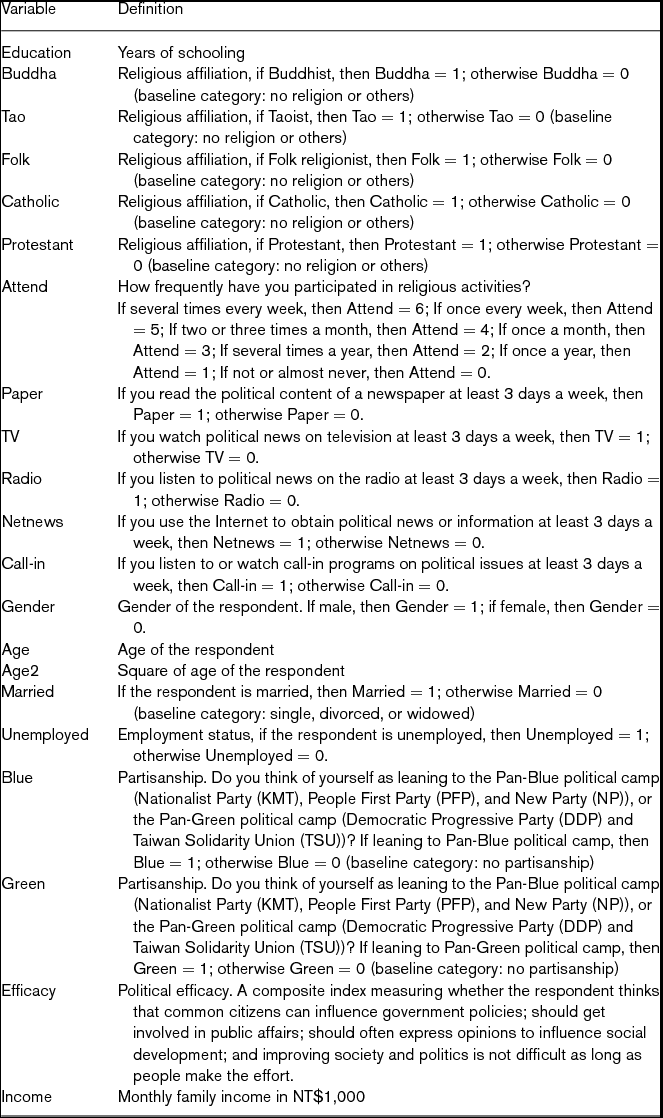
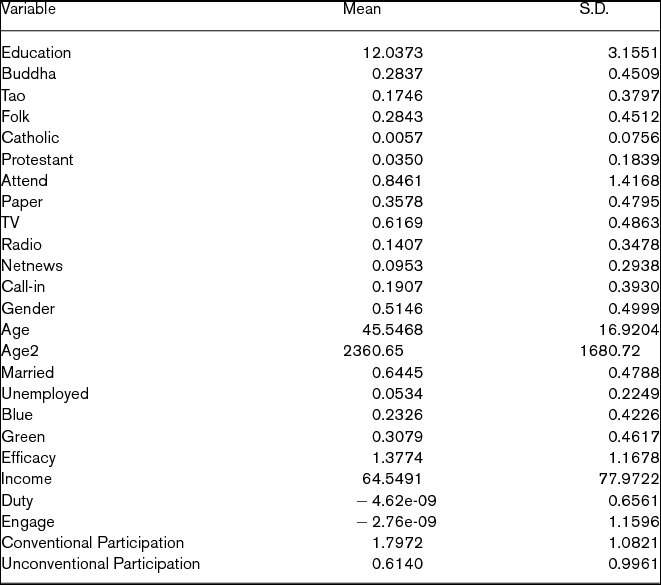
This study uses data from the 2004 Taiwan Social Change Survey (TSCS) to examine the determinants of citizenship norms, as well as the relationship between citizenship norms and various types of political participation. Since 1984, the TSCS has been conducted annually, with different main topics, by the Institute of Sociology at Academia Sinica. Starting in 2002, the TSCS joined the International Social Survey Programme (ISSP) and became part of an East Asian survey team that initiated the East Asian Social Survey (EASS) in 2003. The 2004 TSCS consists of two modules: Religion and Culture, as well as Citizenship. We utilize the Citizenship Module, which contains information about respondents’ perceptions of the concepts of ‘citizenship norms’, being a good citizen, as well as respondents’ political participation and partisanship, along with respondents’ socioeconomic characteristics. After excluding from the sample those who were ineligible to vote and those for whom there was insufficient information about their engagement in political behaviors, there were 1,741 observations in this study. Appendices 1 and 2 provide definitions of the variables used. Appendix 3 presents the descriptive statistics of the variables. The study examines the relationship between citizenship norms and engagement in conventional and unconventional types of political participation.
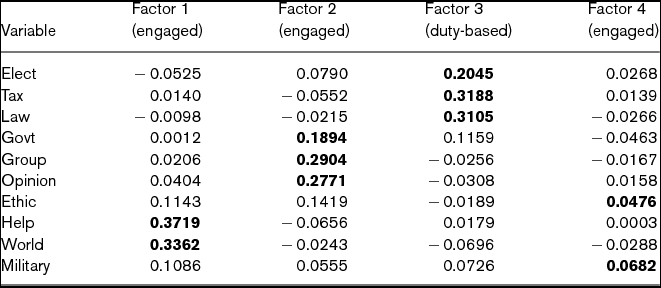
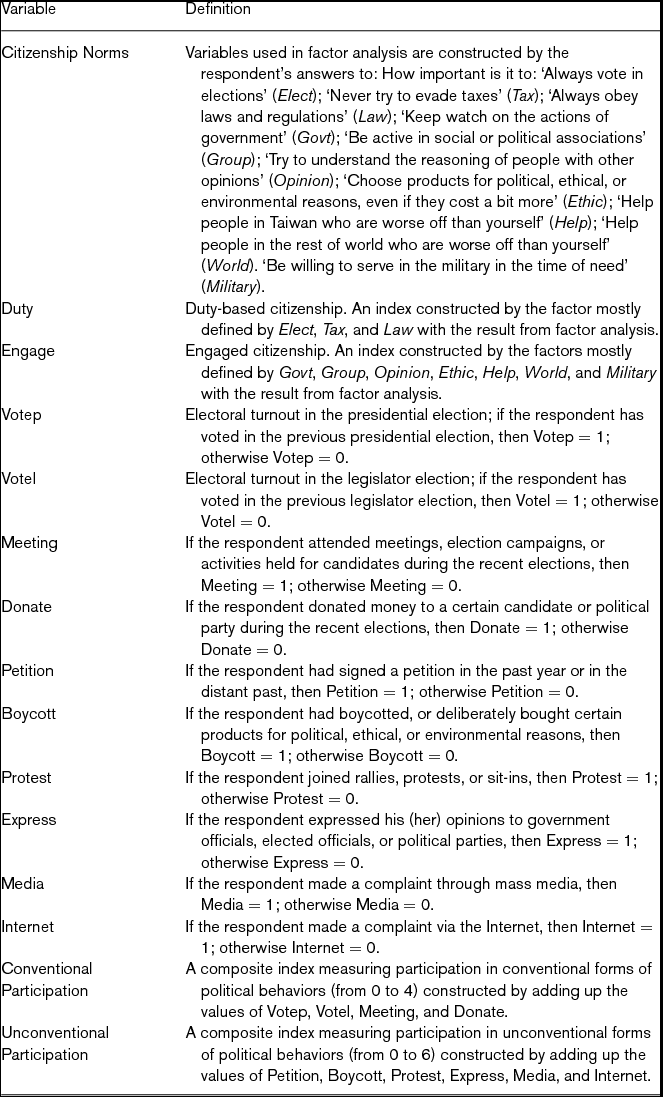
Following the definitions of Dalton (Reference Dalton2008), we use ‘duty-based citizenship’ and ‘engaged citizenship’, respectively, as the dependent variables in estimating the factors explaining citizenship norms. More specifically, we first use factor analysis to obtain factor scores with the variables constructed from respondents’ answers to the following questions by first asking: In being a good citizen how important is it to: (1) Always to vote in elections (Elect); (2) Never try to evade taxes (Tax); (3) Always obey laws and regulations (Law); (4) Keep watch on the actions of government (Govt); (5) Be active in social or political associations (Group); (6) Try to understand the reasoning of people with other opinions (Opinion); (7) Choose products for political, ethical, or environmental reasons, even if they cost a bit more (Ethic); (8) Help people in Taiwan who are worse off than yourself (Help); (9) Help people in the rest of world who are worse off than yourself (World); (10) Be willing to serve in the military in a time of need (Military). Table 1 reports the scoring coefficients for the extracted four factors.
Factor analysis of citizenship norms

Notes: Extraction method: principal components analysis. Scoring coefficient based on varimax rotated factors.
With the results from the factor analysis, we construct an index of duty-based citizenship (Duty), which is the factor (Factor 3) mostly defined by Elect, Tax, and Law. Similarly, an index measuring engaged citizenship (Engage) is also constructed by adding up the factors mostly defined by Help, World, Group, Opinion, Ethic, and Military (Factors 1, 2, and 4). In accordance with Dalton's (Reference Dalton2008) description, duty-based citizenship primarily involves norms of social orders, while engaged citizenship is related to liberal or communitarian norms of citizenship.
To examine the formation of citizenship norms, we mainly focus on the effects of age, education, religion, and the ways of attaining information about political affairs. In particular, a growing body of recent research emphasizing the linkage between culture and political institutions has emerged in recent years (e.g. Greif, Reference Greif1994; Alesina and Giuliano, forthcoming), while the widespread usage of new media and information technology has drawn attention from scholars studying civic society and political behaviors (e.g. Kittilson and Dalton, Reference Kittilson and Dalton2011; Gil de Zúñiga and Valenzuela, Reference Gil de Zúñiga and Valenzuela2011; Swigger, Reference Swigger2013; Weinstein, Reference Weinstein2014). It is interesting to examine whether religion plays a significant role in the formation of citizenship norms for an East Asian country such as Taiwan. Therefore, aside from education (years of schooling), we also construct the variables of religious affiliations (Budda, Taoist, Folk, Catholic, and Protestant) and frequency of religious attendance (Attend), as well as five variables representing the frequently used ways for a citizen to obtain information about political affairs: reading newspapers (Paper), watching television (TV), listening to the radio (Radio), using the Internet (Netnews), and listening to or watching call-in programs (Call-in). With these constructions of religious and media variables, we can conduct estimations on the effects of cultural factors in the formation of ‘duty-based citizenship’ and ‘engaged citizenship’.
To analyze the relationship between citizenship norms and political participation, we construct variables for both conventional types and unconventional types of political participation. The conventional types of political participation include electoral turnout in the last presidential election (Votep), electoral turnout in the last legislator election (Votel), attending meetings, election campaigns, or activities held for candidates during elections (Meeting), and donating money to a certain candidate or political party during elections (Donate). In contrast, the unconventional types of political participation include signing a petition (Petition), boycotting or deliberately buying certain products for political, ethical, or environmental reasons (Boycott), joining a protest (Protest), expressing opinions to government officials, elected officials or political parties (Express), making a complaint through mass media (Media), and making a complaint via the Internet (Internet).
As mentioned previously, the Western literature emphasizes that duty-based citizenship often can nurture voting- and campaign-related activities, and engaged citizenship stimulates protest and other elite-challenging forms of action. To further examine these potential relationships, we construct an index measuring the frequency of participation in conventional forms of political behaviors (Conventional Participation) by adding up the values of Votep, Votel, Meeting, and Donate. In contrast, a variable (Unconventional Participation) measuring the frequency of participation in unconventional, elite-challenging, forms of actions is set up by summing up the values of Petition, Boycott, Protest, Express, Media, and Internet.
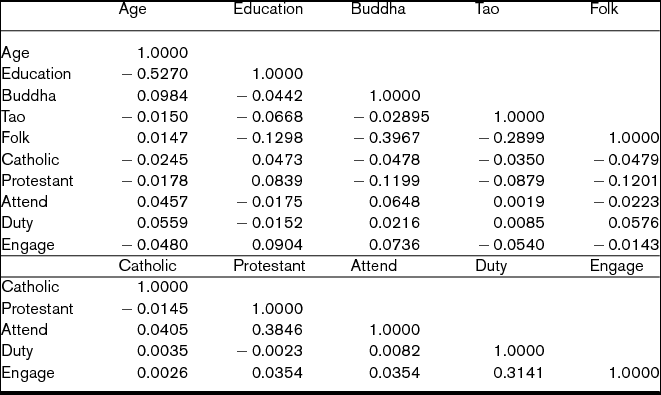
Before discussing our empirical results, it is helpful to briefly describe the correlations between the core predictors (age, education, and religion) and duty-based citizenship and engaged citizenship. As Table 2 reports, age is positively correlated with duty-based citizenship and negatively correlated with engaged citizenship, while education is negatively correlated with duty-based citizenship and positively correlated with engaged citizenship – that is, people who are older have a higher level of duty-based citizenship than individuals who are younger. By contrast, people with more education possess a lower level of duty-based citizenship and a higher level of engaged citizenship than individuals with less education. Moreover, duty-based citizenship is positively correlated with affiliations to Buddhism, Taoism, folk religions, and Catholicism, but negatively correlated with Protestantism. At the same time, engaged citizenship is positively correlated with affiliations to Buddhism, Catholicism, and Protestantism, but negatively correlated with Taoism and folk religions. Generally speaking, there are interesting differences in the patterns of correlations between the core predictors and citizenship norms.
Correlation coefficients between core predictors and citizenship norms
Source: Taiwan Social Change Survey 2004.
Empirical results
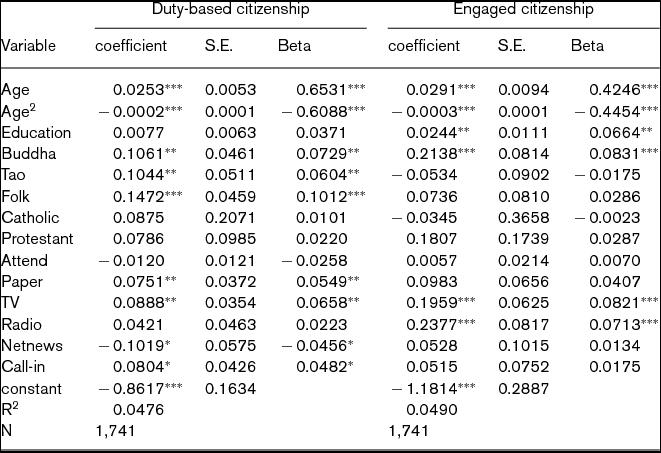
To examine the formation of citizenship norms and the effects of citizenship norms on political participation, we first investigate the roles of age, education, and religion in explaining duty-based citizenship and engaged citizenship. From the results of OLS estimations in Table 3, age has an inverted-U shaped relationship with duty-based and engaged citizenship norms, while education is positively associated with engaged citizenship, but is not significantly associated with duty-based citizenship. In other words, people with a higher level of education are likely to have a higher level of engaged citizenship than people with less education, but education is not a significant predictor of duty-based citizenship. As age increases, duty-based and engaged citizenship norms get stronger initially, but as age continues to increase to a certain level, duty-based and engaged citizenship norms begin to decline. Consistent with the arguments of value change (e.g., Inglehart, Reference Inglehart2008; Dalton, Reference Dalton2008), this suggests that there is a generational difference in the concept of being a good citizen. In addition, education does play a significant role in the formation of citizenship norms, and this effect appears to be important only for the cultivation of engaged citizenship, but not for duty-based citizenship.
OLS estimation results of predicting duty-based citizenship and engaged citizenship norms with factor analysis
Notes: ***, **, and * denote significance at 1%, 5%, and 10%, respectively. Beta indicates the standardized coefficient.
The religious factors are also important when explaining the formation of citizenship norms. More specifically, the affiliations of Buddhism, Taoism, and folk religions are positively associated with duty-based citizenship. While Buddhism is significantly positively associated with engaged citizenship, the religious affiliations of Taoism, folk religions, Catholicism, and Protestantism are insignificant in explaining the formation of engaged citizenship.Footnote 1 Moreover, the frequency of religious attendance is not a significant predictor for duty-based or engaged citizenship. Consistent with the findings from previous studies on Western societies (e.g. Schyns and Koop, Reference Schyns and Koop2009; Coffé and van der Lippe, Reference Coffé and van der Lippe2010) suggesting that religions influence citizenship norms, we also find that some religious affiliations are strongly related to citizenship norms. By contrast, the Eastern traditional religions of Buddhism, Taoism, and folk religions are positively associated with duty-based citizenship, but do not have a significant influence on the norms of engaged citizenship.Footnote 2 In other words, the traditional religions continue to have a positive influence in promoting the norms of social orders defined by duty-based citizenship, while education tends to enhance the importance of the liberal or communitarian norms of engaged citizenship in Taiwan.
As for the effects of media use, those people who obtain information about political affairs through newspapers, television news, and call-in programs tend to have a higher level of duty-based citizenship, while individuals who frequently use the Internet to obtain political information have a lower level of duty-based citizenship. With the provision of a new platform for political discussions and expressing opinions about political affairs, and with a lower cost and a faster path of information transmission, Internet use has a negative impact on the formation of duty-based citizenship. In contrast, watching television news and listening to political news on the radio are positively associated with the formation of engaged citizenship. The estimated coefficient of using the Internet to obtain political information is also positive, but it is insignificant for explaining the formation of engaged citizenship. In short, watching political news on television has positive effects on the formation of duty-based citizenship and engaged citizenship, while using the Internet for obtaining political news and information leads to a lower level of duty-based citizenship. In other words, Internet use reflects the changing concepts of being a good citizen, as it potentially lowers the norms of duty-based citizenship.
Despite previous studies (e.g. Kittilson and Dalton, Reference Kittilson and Dalton2011; Gel de Zúñiga and Valenzula, Reference Gil de Zúñiga and Valenzuela2011; Swigger, Reference Swigger2013; Bimber and Copeland, Reference Bimber and Copeland2013; Weinstein, Reference Weinstein2014) suggesting that media use has a strong influence on political participation, whether the effects are positive or negative and whether the changes show up in patterns of participation remain less clear. Researchers studying the relationship between Internet use and civic engagement argue that informational use of the Internet can promote civic engagement by enhancing information acquisition, facilitating community formation, and promoting civic-oriented behaviors, as well as providing lower-cost opportunities for involvement in public affairs and expressing personal opinions (e.g. Eveland, Reference Eveland2004; Shah et al., Reference Shah, Kwak and Holbert2001). However, previous studies have not extensively examined the relationship between media use and citizenship norms. With the availability of a wider range of media derived from new information technology, the changes in people's perceptions of political parties, politicians, and public policies may lead to a changing concept of being a good citizen. The results from this study provide some further understanding about the role of media use in the formation of duty-based and engaged citizenship norms.
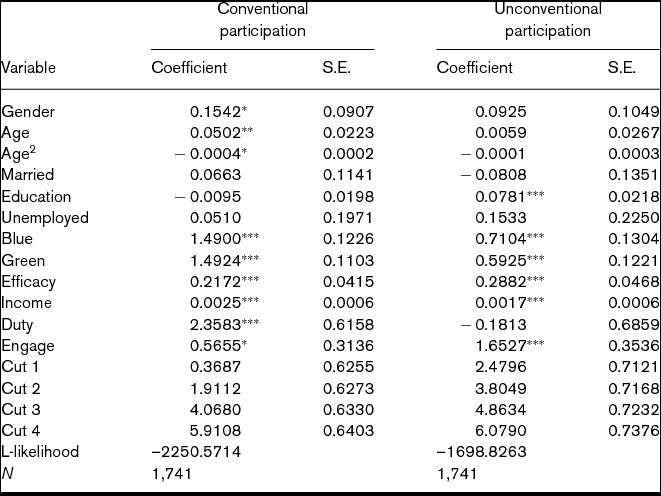
After examining the factors explaining citizenship norms, we further investigate the effects of duty-based citizenship and engaged citizenship on conventional and unconventional forms of political participation. From the results of ordered logit estimations in Table 4, duty-based citizenship and engaged citizenship are positively associated with conventional participation, but the estimated coefficient of duty-based citizenship is much larger than that of engaged citizenship. This implies that the role of duty-based citizenship in stimulating voting and campaign activities is much stronger than engaged citizenship – that is, people with a higher level of duty-based citizenship norms are more likely to vote in elections, as well as to attend political meetings, election campaigns, or activities held for candidates during elections, and are also more likely to make political donations. By contrast, people with a higher level of engaged citizenship are more likely to engage in unconventional forms of political participation. However, duty-based citizenship is not a significant predictor for unconventional participation.
Ordered logit estimation results for predicting political participation
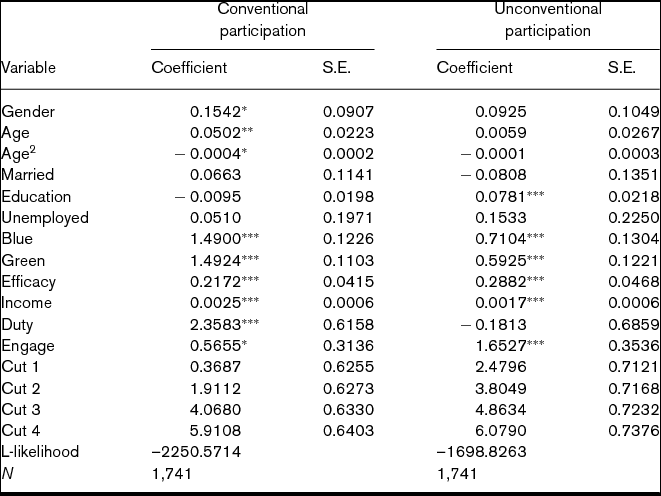
Note: ***, **, and * denote significance at 1%, 5% and 10%, respectively.
Consistent with the previous literature (e.g., Dalton, Reference Dalton2008; Flanagan and Lee, Reference Flanagan and Lee2003), these results indicate that the norms of duty-based citizenship are strongly related to engagement in conventional forms of political participation, but the norms of engaged citizenship tend to enhance participation in elite-challenging forms of unconventional political activities.Footnote 3 In other words, those who have a higher level of engaged citizenship are more likely to boycott certain products for political, ethical, or environmental reasons, to join a protest, to express opinions to government officials, to make a complaint through mass media, or to make a complaint via the Internet.
As for other demographic variables, age has an inverted-U shape relationship with conventional political participation. Partisanship, political efficacy, and income are positively associated with the engagement in both conventional and unconventional political participation.
In summarizing the results of Tables 3 and 4, religion as a cultural factor does play a significant role in the formation of citizenship norms. Furthermore, the influence of duty-based citizenship, in promoting the conventional types of political participation, is much stronger than that of engaged citizenship. However, unconventional forms of political participation can be enhanced by the stronger norms of engaged citizenship. This also provides a piece of empirical evidence for the argument, that changing citizenship norms caused by economic and social development can explain the decline in election turnout and engagement in activities organized by political parties. With the growing emphasis on the norms of engaged citizenship, it is expected that people will be more engaged in unconventional political participation and less so in conventional political participation.
Conclusion
The decline in conventional types of political participation, such as electoral turnout and engagement of political parties, has raised numerous concerns about the functioning of political systems in many Western advanced democracies. Some previous studies argue that this declining trend is caused by decreasing political interest and involvement, partly resulting from growing income inequalities, while others suggest that it is a result of diversifying patterns of political engagement accompanying changing citizenship norms caused by economic and social development. It is inadequate to simply focus on the conventional types of political participation, and to conclude that the decline in electoral turnout and party engagement could be harmful to the functioning of a democratic system and potentially increase the inequality of political presentation between the rich and the poor. Therefore, it is necessary to examine further the relationship between changing citizenship norms and political participation in both conventional and unconventional forms. Despite this, changing citizenship norms are well-documented for many Western countries, while very few studies emphasize differences in the socio-cultural contexts of the East Asian new democracies. The important socio-cultural factors shaping citizenship norms and the relationship between citizenship norms and patterns of political participation in East Asian democracies remain less understood.
This study investigates the role of religion in shaping the norms of citizenship from a cultural perspective for an East Asian country that has fundamental differences in social contexts from Western advanced democracies. Using data drawn from the Taiwan Social Change Survey, we find that Eastern religions of Buddhism, Taoism and folk religions are important in explaining the formation of the concept of being a good citizen. Age and education are also important predictors for the perceptions of citizenship norms. This study further examines the relationships between citizenship norms and various conventional and unconventional types of political participation. The empirical results from this study suggest that duty-based citizenship and engaged citizenship show significant differences in their effects on political participation.
The main findings can be summarized as follows. First, Buddhism, Taoism, and folk religions are positively associated with duty-based citizenship, while Buddhists have a higher level of engaged citizenship compared to non-religious people. Second, age has inverted U-shaped relationship with both duty-based citizenship and engaged citizenship, and education is positively associated with engaged citizenship, but not significantly correlated with duty-based citizenship. Third, media use also has a strong influence on the formation of citizenship norms. Specifically, obtaining information about political affairs, by reading newspapers, watching television news, and listening to or watching call-in programs, leads to a higher level of duty-based citizenship, while those who obtain political information through the Internet tend to have a lower level of duty-based citizenship. At the same time, watching television news and listening to political news on the radio have a positive relationship with engaged citizenship. Fourth, duty-based citizenship leads to a higher likelihood of engagement in conventional political participation such as voting and campaign activities, whereas engaged citizenship tends to increase the probability of participating in unconventional forms of elite-challenging political behaviors.
From the perspective of value changes, Taiwan has experienced drastic social and political movements since the 1980s as its economy continues to develop steadily. After moving from the one-party rule of authoritarianism to a liberal democracy with multiple-party competition, the process of democratic consolidation is not yet complete, but is at least on a smooth path in Taiwan. In this study, we have empirically demonstrated that the Asian values, reflected by the cultures of Buddhism, Taoism, and folk religions, still influence the norms of duty-based citizenship. This implies that citizenship norms based on Asian values tend to emphasize social orders and collective interests through the obligations of citizens to society in maintaining a stable political system.
In contrast, there are generational differences in the understanding of being a good citizen, and education leads to a greater importance of individual choices, freedom, and mutual benefits described by liberal and communitarian norms. Consequently, we have also identified empirical support that duty-based citizenship is related more to the conventional types of political participation, while engaged citizenship, strongly influenced by education, leads to more non-compliant modes of elite-challenging political behaviors. Socioeconomic modernization along with increased education in Taiwan has contributed to the changes from authoritarian to liberal values and the transition to liberal democracy.
Even though there are many cultural similarities among Taiwan, Japan, South Korea, and other East Asian countries, this study of the case of Taiwan still provides valuable results, as a reference for, or comparison with, other countries in the region. For example, Taiwan, Japan, and South Korea are all strongly influenced by Confucianism and Buddhism, but there are some differences in their respective courses of transition to democracy and processes of economic development. Japan started its transition to democracy after World War II, South Korea experienced a series of authoritarian civilian governments and formed a democratic regime in the late 1980s, and Taiwan began its process of democratization in 1988 with the launch of a democratic government election.
As for traditional culture and religions, Japan is dominated by Shinto and Buddhism, religion in South Korea is mainly characterized by Buddhism, Protestantism, and Catholicism, and the traditional religions in Taiwan consist of Buddhism, Taoism, and folk religions. The cultural values emphasizing social orders and collective interest influenced by the religious beliefs of Buddhism, Taoism, and folk religions often provide a stabilizing effect for the political and economic development of East Asian countries. Religion is significant for shaping people's attitude toward political institutions and fostering the norms of duty-based citizenship. As many East Asian countries continue to advance economically, the influence of education upon enhancing the norms of engaged citizenship will become increasingly important.
For future research, it will be interesting to investigate the role of religion in the formation of citizenship norms by comparing the differences across East Asian countries either with similar or different levels of democratic consolidation. In the social contexts of East Asian countries, education and traditional values may be the critical components for defining citizenship norms as socioeconomic modernization continues to take place, leading to different consequences in different countries in the region. Furthermore, there are other countries such as Thailand, Myanmar, Indonesia, and Mongolia with more or less cultural similarities, but substantially lower levels of socioeconomic modernization than that of Taiwan. This is another area that can be further explored.
About the author
Wen-Chun Chang is a professor at the Department of Public Finance, National Taipei University, Taiwan. Professor Chang received his Ph.D. in Economics from the University of Maryland, College Park. His research interests include charitable giving, religious economics, happiness studies in economics, social capital, and political economy in Taiwan. His research has been published in Journal of East Asian Studies, Social Indicators Research, Journal of Happiness Studies, International Journal of Social Economics, Review of Social Economy, and B.E. Journal of Economic Analysis and Policy.
Definitions of independent variables
Definitions of dependent variables
Descriptive Statistics of Variables (N = 1741)