High prevalence of bacterial coinfection has been reported in prior influenza pandemics, more commonly with Streptococcus pneumoniae, Haemophilus influenzae, or Staphylococcus aureus. Reference Morris, Cleary and Clarke1 However, influenza pandemics may not be analogous to the coronavirus disease 2019 (COVID-19) pandemic despite early widespread empiric antibiotic treatment of patients with COVID-19 at rates ranging from 50% to 90%. Reference Rawson, Moore and Zhu2–Reference Karaba, Jones and Helsel4 Multiple studies have identified low incidence of community-onset bacterial coinfection (1.2%–3.5%) among hospitalized COVID-19 patients. Reference Vaughn, Gandhi and Petty3–Reference Zhou, Yu and Du5 Although they decreased from the initial surge, reports of persistently high rates of antibiotic use (50%) continue despite these findings. Reference Vaughn and Flanders6,7 Inappropriate prescribing of antibiotics in the context of COVID-19 management comes at the risk of worsening the emergence of antimicrobial-resistant pathogens. Reference Clancy and Nguyen8
Drivers of antibiotic use in patients with COVID-19 are uncertain, but they may relate to concern for coinfection based on prior pandemics. In addition, the incidence of hospital-acquired coinfection (5%–7%), Reference Rawson, Moore and Zhu2,Reference Garcia-Vidal, Sanjuan and Moreno-García9,Reference Lansbury, Lim, Baskaran and Lim10 especially in critically ill COVID-19 patients (14%), Reference Lansbury, Lim, Baskaran and Lim10 may be higher than community-onset coinfection. This finding may be due to prolonged ICU length of stay, duration of mechanical ventilation, and/or increased number of device days in patients with COVID-19. However, limited data exist on types of coinfection, frequency of specific pathogens, risk factors for the development of coinfection, and clinical outcomes among hospitalized COVID-19 patients with coinfection. Reference Karaba, Jones and Helsel4,Reference Garcia-Vidal, Sanjuan and Moreno-García9
Determining the incidence and predictors of community-onset and hospital-acquired coinfection 11 is vital for promoting judicious antibiotic use in patients with COVID-19. Understanding these aspects could potentially inform and reduce unneccessary antimicrobial use. Therefore, we leveraged a statewide, multihospital registry to conduct an observational study to determine patterns, predictors, and associated outcomes of community-onset and hospital-acquired coinfection in hospitalized patients with COVID-19.
Methods
Study design, data collection, and patient sampling
Mi-COVID 19 is a statewide collaborative quality initiative, funded by Blue Cross Blue Shield of Michigan and Blue Care Network, with the aim of rapidly gathering data and developing best care practices for hospitalized patients with COVID-19. Reference Vaughn, Gandhi and Petty3 Mi-COVID-19 includes 38 hospitals in the State of Michigan. Participating hospitals vary in size, academic status, and urbanicity.
From March 16, 2020, to August 14, 2020, professional abstractors at each hospital screened consecutive patients with COVID-19 for eligibility. Eligible patients were those with a confirmed positive PCR for SARS-CoV-2. Patients were ineligible if they met any of the following criteria: (1) aged <18 years, (2) pregnant, (3) left against medical advice, (4) initiation of comfort care or hospice within 3 hours of hospitalization, or (5) length of stay >120 days. Patient data, collected via medical record review from 90 days prior to admission until death or discharge, included laboratory results, vital signs, imaging, and treatment data. In addition, symptoms were collected from the day of admission. Similar to prior studies, Reference Vaughn, Flanders and Snyder12,Reference Petty, Vaughn and Flanders13 data were abstracted using a structured data collection template with a standardized data dictionary. For hospitals unable to abstract data for all eligible patients, a sample of patients were selected for abstraction using a pseudo-random sampling strategy (by minute of discharge).
Exposures and outcomes
The primary outcome was bacterial or fungal coinfection. A coinfection was defined as a positive respiratory or blood culture with a pathogenic organism, following National Health Safety Network (NHSN) criteria. 14 For positive respiratory cultures, we classified the result as possible or probable pneumonia versus contamination (eg, Candida or coagulase-negative Staphylococcus was considered contamination, see the Appendix online). Infections were further defined as probable versus possible, central-line–associated bloodstream infection (CLABSI), or ventilator-associated pneumonia (VAP) (Table 1). Only the first infections were described, and some patients had multiple pathogens if blood and respiratory cultures were positive on the same initial day.
Definitions

Note. CVC, central venous catheter; CAP, community-acquired pneumonia; HAP, hospital-acquired pneumonia.
a A coinfection was defined as a positive respiratory or blood culture with a pathogenic organism, following National Health Safety Network (NHSN) criteria.
b Bloodstream or respiratory infection occurring within the first 3 d of hospitalization (to ˜48 h) were classified as community-onset infection. Cultures occurring later were defined as hospital-acquired infection.
Variables were assessed for their association with community-onset or hospital-acquired coinfection. Bloodstream or respiratory infection occurring within the first 3 days of hospitalization were classified as community-onset infection. Cultures occurring later were defined as hospital-acquired infection. We assessed the following variables: (1) patient demographics, (2) duration of COVID-19 disease, (3) signs or symptoms, (4) severity of illness (eg, mode of respiratory support), (5) laboratory values, and (6) care location (eg, floor, ICU).
Secondary outcomes included in-hospital mortality, 60-day post-discharge mortality, readmission, and discharge to post acute care facility. For community-onset coinfection, additional outcomes included duration of invasive mechanical ventilation and length of hospitalization.
Statistical analysis
We characterized patients with and without coinfection using descriptive statistics with percentages for patient characteristics and median (IQR) for continuous variables. To compare characteristics between patients with versus without coinfection, we used χ2 tests for categorical variables and nonparametric Wilcoxon rank-sum tests for continuous variables. To identify characteristics associated with community-acquired and hospital-acquired coinfection, we fit separate multivariable models comparing characteristics to patients without coinfection. Multivariable analysis required 2 steps: (1) Logistic regression models were fit using stepwise selection with the Schwartz-Bayes information criterion to determine model fit. Reference Buckland, Burnham and Augustin15 (2) Selected characteristics from these models were fit in logistic general estimating equations (GEE) models accounting for clustering at the hospital level. The results from the GEE model are presented as adjusted odds ratios (aORs) with 95% confidence intervals, and P values. Finally, we compared patient outcomes between each coinfection group (ie, community onset vs hospital acquired) and the noncoinfected group. Unadjusted results from logistic (negative binomial for count outcomes: LOS and days of invasive mechanical ventilation) GEE models accounting for hospital clustering are presented, as well as multivariable GEE models adjusting for variables associated with each outcome (see Appendix online). All statistical analysis was conducted using SAS version 9.4 software (SAS Institute, Cary, NC).
Institutional review board approval
As the purpose of Mi-COVID-19 is to measure and improve the quality of existing care practices, this project received a “not regulated” status by the University of Michigan Medical School Institutional Review Board, and informed consent was not required.
Results
Baseline demographics
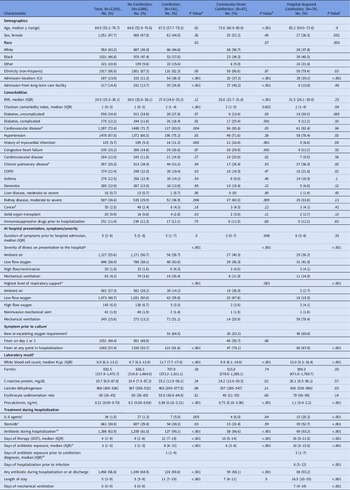
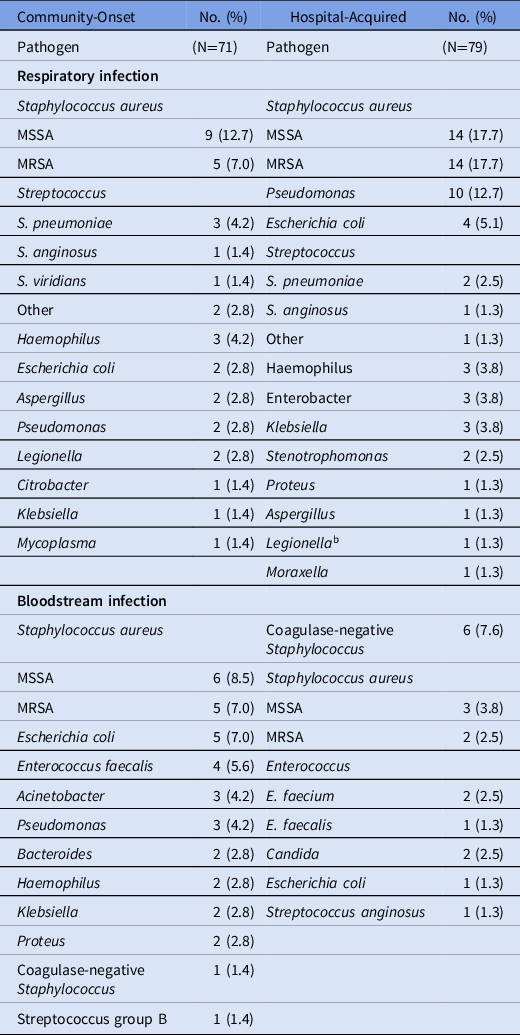
From March 16, 2020, through August 14, 2020, 2205 sampled patients hospitalized for COVID-19 at 38 hospitals met inclusion–exclusion criteria. Of those, 538 (24.4%) died within 60 days, and 141 (6.4%) had a coinfection (Table 2). The frequency of community-onset coinfection (n = 67, 3.0%) was similar to that of hospital-acquired coinfection (n = 74, 3.4%) (Table 2). Most patients (n = 1,458 66.1%) had a blood culture (n = 1,418, 64.3%) and/or a respiratory culture (n = 295, 13.4%) during hospitalization. Of patients diagnosed with a coinfection, the median age was 68 years (interquartile range [IQR], 58–78), 79 (56%) were male, 35 (24.8%) were admitted from a long-term care facility (LTCF). The most common comorbidities were cardiovascular disease (n = 117, 83.0%) and chronic kidney disease (n=52, 36.9%). Among patients who received invasive mechanical ventilation, the coinfection rate was 20.9% (72 of 345). Only 5 patients (3.5%) with a coinfection had a fungal infection, and the remainder had bacterial infections (Table 3). Most patients with a coinfection (127 of 141, 90.1%) received antibiotics. Among patients without a coinfection, 1,259 (61.0%) of 2,064 received an antibiotic at some point during hospitalization for a median of 2 days (IQR, 1–5) (Supplementary Table 1 online).
Baseline Demographics of Coinfected vs Noncoinfected Patients Hospitalized Patients for COVID-19 Across 38 Michigan Hospitals

Note. SAR, subacute rehabilitation center; BMI, body mass index; COPD, chronic obstructive pulmonary disease;
IQR, interquartile range. Units are no. (%) unless otherwise specified.
a Comparison of non-coinfected to all coinfection.
b Comparison of non-coinfected to community-onset coinfection.
c Comparion of non-coinfected to hospital-acquired coinfection.
d Defined as combination of hypertension, congestive heart failure, atherosclerosis.
e Defined as COPD or asthma or chronic pulmonary disease or structural lung disease.
f Defined as leukemia, lymphoma, solid tumor.
g Based on WHO criteria: (1) ambient air, (2) low-flow oxygen, (3) high flow oxygen or noninvasive mech ventilation, (4) mechanical ventilation
h At any point during hospitalization up to day culture is sent: (1) no supplemental oxygen; (2) low-flow oxygen, (3) heated high-flow nasal cannula, (4) noninvasive mech ventilation, (5) mechanical ventilation.
i 1 day before or day of culture.
j Either type of oxygen support or amount of oxygenation support.
k Within 1 day of culture, day prior or day of culture for those infected.
l Tocilizumab, sarilumab.
m Any antibiotic, excluding azithromycin alone.
n Solumedrol, hydrocortisone, prednisone, prednisolone, dexamethasone.
m For hospital-acquired infections.
o Any dose of antibiotic on any day counts as 1 day.
Pathogens Identified in Patients Hospitalized for COVID-19 and a Coinfection a

Note. MSSA, methicillin-susceptible Staphylococcus aureus; MRSA, methicillin-resistant Staphylococcus aureus.
a First infection only, some patients with multiple pathogens.
b Legionella case met CDC criteria for possible healthcare-associated infection.
Of those with community-onset coinfection, 35 (49.3%) of 71 were respiratory infections, and 6 (50.7%) of 71 were bloodstream infections (Table 3). Among patients admitted to the intensive care unit (ICU) on day 1 of hospitalization, 25 (10.7%) of 233 had a community-onset coinfection, compared to 42 (2.2%) of 1,873 of patients admitted to the general floor. The most common pathogens identified in community-onset coinfection were Staphylococcus aureus (methicillin-susceptible Staphylococcus aureus (MSSA) (15 of 71, 22.1%,) and methicillin-resistant Staphylococcus aureus (MRSA) (10 of 71, 14.1%) followed by Streptococcus spp (7 of 71, 9.8%) and E.coli (7 of 71, 9.8%). Of 33 respiratory infections, 33 (90.9%) were defined as probable pneumonia.
Of those with hospital-acquired coinfection, 61 (77.2%) of 79 were respiratory infections, whereas 18 (22.8%) of 79 were bloodstream infections. The most common pathogens identified in hospital-acquired coinfection were S. aureus (MSSA, 17 of 79 or 21.5%, and MRSA, 16 of 79 or 20.3%) followed by Pseudomonas (10 of 79, 12.7%). The most common bloodstream pathogen was coagulase-negative Staphylococcus (6 of 18, 33.3%) and MSSA. Of 18 of hospital-acquired bloodstream infections, 9 (50%) were CLABSI, but only 9 (4.3%) of 210 patients with a central line had a coinfection. Of hospital-acquired respiratory infections, 33 (54.1%) of 61 met criteria for probable pneumonia, and 28 (45.9%) of 61 hospital-acquired respiratory infections were VAP. Hospital-acquired infection occurred a median of 8 days (IQR, 5–12) after admission, and 59 (81%) of 73 patients diagnosed with a hospital-acquired coinfection were in the ICU at the time of diagnosis.
Characteristics associated with coinfection
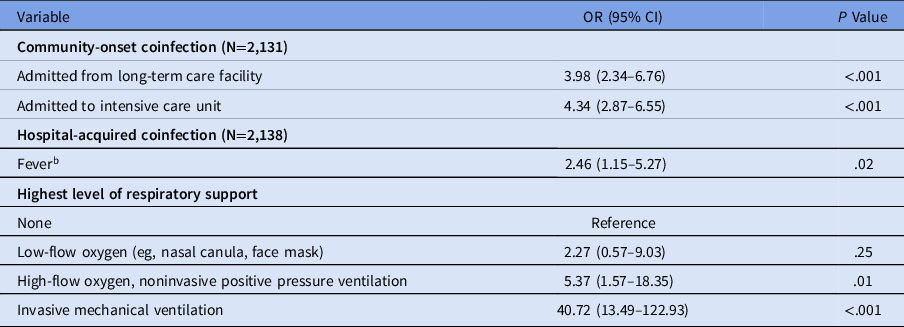
In bivariate analyses, multiple characteristics were associated with community-onset coinfection, including (among others) older age, female sex, admission to the ICU, admission from an LTCF, cardiovascular disease, cerebrovascular disease, and chronic kidney disease (Table 2). In the multivariable model (Table 4), admission to the ICU (OR, 4.34; 95% CI, 2.87–6.55; P < .001) and admission from an LTCF (OR, 3.98; 95% CI, 2.34–6.76; P < .001) were associated with community-onset coinfection.
Multivariable Models of Predictors Associated with Coinfection in Patients Hospitalized for COVID-19 a

Note. OR, odds ratio; CI, confidence interval.
a Community-onset and hospital-acquired coinfection were modeled separately.
b During hospitalization up to time of culture.
In bivariate analyses, several characteristics were also associated with hospital-acquired coinfection, including admission to the ICU on day 1, uncomplicated diabetes, hypertension, chronic pulmonary disease, more severe illness on hospital presentation, and elevated white blood cell count (Table 2). In the multivariable model (Table 4), fever at any time up to infection (OR, 2.46; 95% CI, 1.15–5.27; P = .02) and higher levels of respiratory support during hospitalization (eg, low flow oxygen vs invasive mechanical ventilation) up to time of infection were found to be most predictive of hospital-acquired coinfection. Of those with a hospital-acquired coinfection, 51 (68.9%) of 74 had a fever within 3 days prior to culture.
Patient outcomes
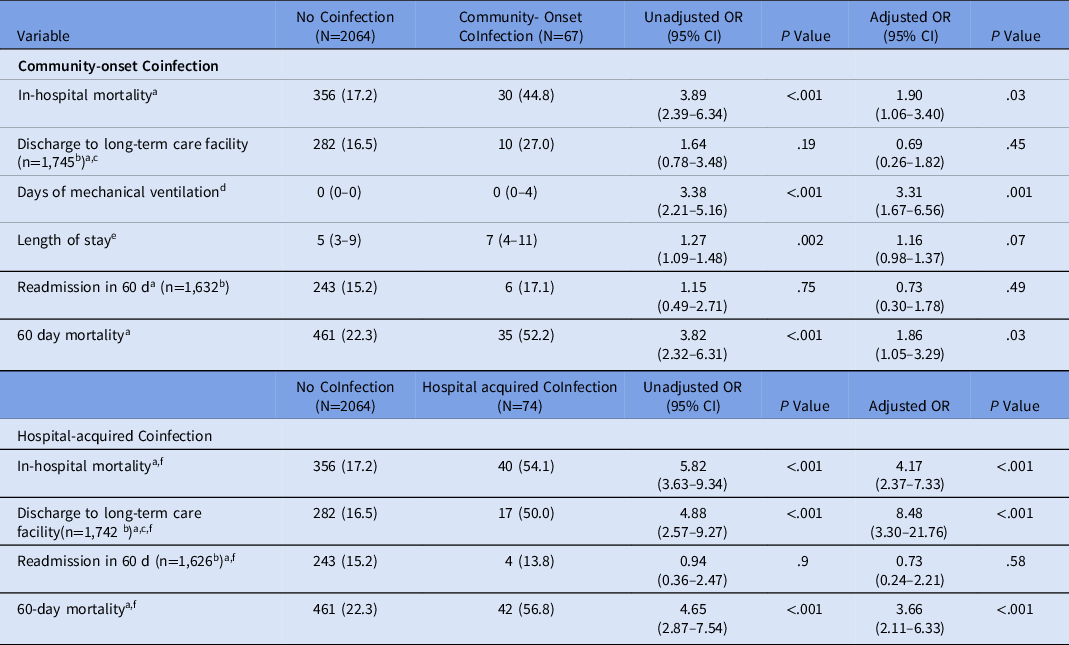
After adjustment, community-onset coinfection was associated with longer duration of invasive mechanical ventilation (OR, 3.31; 95% CI, 1.67–6.56; P = .001) and higher in-hospital (OR, 1.90; 95% CI, 1.06–3.40; P = .03) and 60-day mortality (OR, 1.86; 95% CI, 1.05–3.29; P = .03). (Table 5). Similar to community-onset coinfection, hospital-acquired coinfection (compared to no coinfection) was associated with a higher in-hospital mortality rate (OR, 4.17; 95% CI, 2.37–7.33; P ≤ .001) and 60-day mortality rate (OR, 3.66; 95% CI, 2.11–6.33; P < .001) (Table 5). Patients with (vs without) a hospital-acquired coinfection also had higher rates of discharge to LTCF (OR, 8.48; 95% CI, 3.30–21.76; P < .001). No other differences in secondary outcomes were identified.
Outcomes Associated with Coinfection in Hospitalized Patients for COVID-19

Note. OR, odds ratio; CI, confidence interval.
a Mortality, readmission, and discharge to long-term care facilty were adjusted for age, Charlson comorbidity index, admission from nursing home, insurance type, admission to ICU.
b Removed those who died in the hospital and without follow up data.
c Includes long-term acute-care facility, skilled nursing facility, inpatient rehabilitation, subacute rehabilitation facility.
d Days of mechanical ventilation was adusted for age, Charlson comorbidity index, admission from nursing home, admission to ICU.
e Length of stay was adjusted for age, gender, Charlson comorbidity index, admission from nursing home, insurance type, admission to ICU.
f Hospital-acquired outcomes are additionally adjusted for tocilizumab and steroid use (prior to infection).
Discussion
In this study of 2,205 patients hospitalized for COVID-19 from 38 hospitals in Michigan, community-onset and hospital-acquired coinfection were uncommon, but most patients admitted for COVID-19 received antibiotics. Coinfection was more common in patients who were critically ill, especially those who received invasive mechanical ventilation. The predominant pathogen in both types of coinfection was MSSA. Admission from an LTCF or admission to the ICU on day 1 were associated with community-onset coinfection, and fever during hospitalization and higher levels of respiratory support were associated with hospital-acquired coinfection. Both community-onset and hospital-acquired coinfection were associated with with higher in-hospital and 60-day mortality.
In prior pandemics, reports of bacterial coinfection were typically limited to case series of critically ill patients or nonsurvivors, skewing to higher rates of coinfection. In the 1918 Spanish influenza pandemic, case series of outbreaks in camps described high rates of bacterial coinfection in nonsurvivors (28%–95%), most commonly Streptococcus pneumoniae and Haemophilus influenzae. Reference Morris, Cleary and Clarke1 During the 2009 swine influenza pandemic, high rates (30%–50%) of bacterial coinfection were reported in the critically ill or nonsurvivors, and S. pneumoniae and S. aureus were the most common pathogens. Reference Brandt, Harrison and Pass16 In contrast, limited data indicate that the rates of coinfection were low in previous coronavirus epidemics, Reference Assiri, Al-Tawfiq and Al-Rabeeah17 and we found low rates of coinfection in patients with COVID-19, including those admitted to the ICU.
In our multicenter study, 6.4% of hospitalized patients with COVID-19 had a coinfection. Prior single-center studies have varied with regard to rates of coinfection in hospitalized patients with COVID-19, from 0% to 15%, Reference Vaughn, Gandhi and Petty3,Reference Zhou, Yu and Du5,Reference Garcia-Vidal, Sanjuan and Moreno-García9,Reference Bhatraju, Ghassemieh and Nichols18 and only a few provide detailed information about the types of coinfection and pathogens. Reference Vaughn, Gandhi and Petty3,Reference Karaba, Jones and Helsel4,Reference Garcia-Vidal, Sanjuan and Moreno-García9 Importantly, our study and multiple other studies have observed that community-onset coinfections are uncommon (1.2%–3.2%), yet most patients still received antibiotics. Reference Vaughn, Gandhi and Petty3,Reference Karaba, Jones and Helsel4,Reference Garcia-Vidal, Sanjuan and Moreno-García9 Consistent with our study, a study from Spain of 989 hospitalized adults with COVID-19 found a 7.2% coinfection rate and similar rates of community-onset (3.1%) and hospital-acquired coinfection (4.7%). Pathogens identified were also similar with Streptococcus pneumoniae and Staphylococcus aureus most common for community-onset coinfection, and S. aureus and Pseudomonas aeruginosa most common for hospital-acquired coinfection. Other parallels to our study were that hospital-acquired coinfection occurred after the first week of hospitalization (median, 8 days) and VAP was the most common type of hospital-acquired coinfection.
When considering patients requiring invasive mechanical ventilation, we found a higher rate of coinfection (20.8%) compared to nonventilated patients. However, these rates were lower than the results from a single-center study in which 40% of patients with COVID-19 requiring invasive mechanical ventilation developed a bacterial coinfection and with 32% developing VAP. Reference Somers, Eschenauer and Troost19 Notably, both this study and our study found that MSSA rather than MRSA was the most common pathogen in patients with coinfection. Reference Somers, Eschenauer and Troost19 As seen in other studies of coinfection, we found the pathogen distribution for community-onset and hospital-acquired coinfection was diverse and highlights the importance of performing appropriate microbiologic evaluation in patients with suspected coinfection. Reference Garcia-Vidal, Sanjuan and Moreno-García9,Reference Lansbury, Lim, Baskaran and Lim10 Finally, we found that pulmonary aspergillosis was a rare coinfection despite multiple reports of COVID-19–associated pulmonary aspergillosis in critically ill patients with COVID-19, Reference Marr and Tornheim20 though we only identified this based on culture, so this may be underdiagnosed in our cohort.
We found that certain factors were predictive of patients with COVID-19 developing a community-onset or hospital-acquired coinfection. Patients admitted from a LTCF and critically ill patients requiring ICU admission on day 1 of hospitalization were more likely to have a community-onset coinfection. Our findings are consistent with prior studies that patients with COVID-19 requiring ICU admission were more likely to have a community-onset coinfection. Reference Karaba, Jones and Helsel4,Reference Garcia-Vidal, Sanjuan and Moreno-García9 Interestingly, another study of community-onset coinfection in the setting of COVID-19 found that patients with both respiratory and nonrespiratory coinfection were more likely to live in a LTCF compared to patients with only respiratory coinfection. Reference Karaba, Jones and Helsel4 We found that patients with hospital-acquired coinfection were more likely to have fevers preceding the diagnosis of coinfection and require higher levels of respiratory support. VAPs and CLABSIs made up half of hospital-acquired coinfection, and most patients (81%) were in the ICU at the time of coinfection diagnosis. Thus, prevention of hospital-acquired coinfection in patients with COVID-19 requires the same measures employed to prevent CLABSI and VAP in other critically ill patients.
Knowledge about the incidence and predictors of community-onset and hospital-acquired coinfection better equips stewardship and infection prevention efforts to reduce antibiotic use. For example, stewardship efforts could be effective in promoting avoidance of antibiotics in noncritically ill hospitalized patients with COVID-19 who have a low risk of coinfection. In considering antibiotic selection, MRSA was less common than MSSA, and the overall rate of MRSA community-onset coinfection was very low. Thus, empiric MRSA coverage is not warranted in most patients with suspected community-onset coinfection. Rather, individual patients should be assessed for risk factors for MRSA, consistent with the ATS/IDSA CAP guidelines. Interventions reducing unnecessary antibiotics in COVID-19 patients could potentially reduce the global emergence of multidrug-resistant organisms, adverse events such as renal injury, and even mortality. The higher incidence of hospital-acquired coinfection occurring later in the hospital stay (median, 8 days) also highlights the importance of conserving antibiotics early in the hospitalization to reduce total antibiotic exposure and possibly reduce the risk of antibiotic-resistant organisms causing VAP in mechanically ventilated patients with COVID-19.
Our study found that patients with COVID-19 and community-onset or hospital-acquired coinfection had increased in-hospital and 60-day mortality compared to patients without a coinfection. Having a community-onset coinfection was also associated with longer durations of mechanical ventilation, and hospital-acquired coinfection was associated with increased incidence of discharge to a LTCF when compared to patients without a coinfection. To our knowledge, only 1 study has evaluated clinical outcomes for patients with both community-onset and hospital-acquired coinfection. Compared to patients without coinfection, these researchers found no difference in length of hospital stay, length of ICU stay, or mortality with community-onset coinfection, but they found a longer length of stay and higher mortality for patients with hospital-acquired coinfection. Reference Garcia-Vidal, Sanjuan and Moreno-García9 Another single-center study evaluating only community-onset coinfection found that length of stay did not differ from patients without coinfection, but these researchers did not evaluate other clinical outcomes. Reference Karaba, Jones and Helsel4 A meta-analysis evaluating 30 studies with 3,834 hospitalized patients with COVID-19 found a coinfection rate of 7%, and patients with coinfection were more likely to die compared to patients without a coinfection. However, these researchers did not differentiate between hospital-acquired and community-acquired infections. Reference Lansbury, Lim, Baskaran and Lim10 In the existing literature, clinical outcomes data for patients with coinfection are scarce, and our study provides a comprehensive assessment of clinical outcomes for hospitalized patients with COVID-19 and coinfection.
Our study has several limitations. First, the observational retrospective design limited our ability to detect coinfection in patients who did not have a culture sent despite a clinical change, potentially underreporting the true incidence. This may have occurred more commonly in the setting of COVID-19 given concerns regarding aerosolization and exposure. Additionally, we did not have laboratory markers, such as procalcitonin, to make comparisons among all patients. Second, these data are limited by documentation, so it is possible that symptoms or device placement were underreported. Third, despite using rules to define pathogen versus commensal or colonization, we may still be overreporting the incidence of infection. Fourth, all confounders for an association of outcomes can never be fully adjusted for. Fifth, this cohort represents the early phase of the pandemic, and treatment options and mortality rates have improved since that time. Sixth, radiographic findings were often nonspecific and were not collected daily or consistently for all patients after admission.
The strengths of our study include its large size and the inclusion of data from a diverse set of hospitals serving a variety of communities across the State of Michigan, one of the states most heavily affected by the COVID-19 pandemic. Second, the detailed data abstraction allows for a more thorough risk factor analysis than has been previously completed and a comprehensive review of clinical outcomes. Third, to our knowledge, this is the first multicenter study of coinfection in COVID-19, which improves generalizability.
In conclusion, despite both community-onset and hospital-acquired coinfection being uncommon, most patients hospitalized with COVID-19 received antibiotics. Our study identified predictors of community-onset and hospital-acquired coinfection, which could focus stewardship strategies toward reducing unnecessary antibiotic use in non–critically ill patients with COVID-19. Additionally, a comprehensive evaluation of clinical outcomes found that patients with coinfection have worse clinical outcomes.
Acknowledgments
We acknowledge all participating collaborative quality initiatives (CQIs) and their members: Hospital Medicine Safety (HMS) Consortium, Michigan Bariatric Surgery Collaborative (MBSC), Michigan Surgical Quality Collaborative (MSQC), Michigan Arthroplasty Registry Collaborative Quality Initiative (MARCQI), Michigan Value Collaborative (MVC), Michigan Emergency Department Improvement Collaborative (MEDIC), Michigan Radiation Oncology Quality Collaborative (MROQC), Michigan Anticoagulation Quality Improvement Initiative (MAQI2), Michigan Spine Surgery Improvement Collaborative (MSSIC), Integrated Michigan Patient-Centered Alliance in Care Transitions (IMPACT), Michigan Trauma Quality Improvement Program (MTQIP).
This manuscript does not represent the views of the Department of Veterans’ Affairs or the US government. This material is the result of work supported with resources and use of facilities at the Ann Arbor VA Medical Center.
Financial support
Support for Mi-COVID-19 is provided by Blue Cross and Blue Shield of Michigan and Blue Care Network, as part of their Value Partnerships program.
Conflicts of interest
L.A.P. reports grants from Blue Cross Blue Shield of Michigan. S.A.F reports grants from Blue Cross Blue Shield of Michigan and the Agency for Healthcare Research and Quality (AHRQ). V.M.V reports speaking fees from Thermo Fisher Scientific. K.E.K is the medical director of the Michigan Emergency Department Improvement Collaborative, a statewide quality network focused on improving care in emergency departments funded by Blue Cross Blue Shield of Michigan and Blue Care Network. S.K. reports being a consultant to Janssen, Pfizer, Portola/Alexion, Briston Myer Squibb, Norvartis, CSL Behring, and has received research funding from Janssen, BMS, Osmosis research. H.C.P. reports grants from AHRQ, the National Institutes of Health, and the Department of Veterans’ Affairs, outside the submitted work. H. C. P. also serves on the Surviving Sepsis Campaign Guidelines. T.N.G reports grants from Blue Cross Blue Shield of Michigan. All other authors report no conflicts of interest relevant to this article.
Supplementary material
To view supplementary material for this article, please visit https://doi.org/10.1017/ice.2021.341