Introduction
Individuals with bipolar disorder (BD) have higher rates of obesity and related cardiovascular risk factors such as hypertension and diabetes mellitus (DM) when compared with people in the general population (Wildes et al., Reference Wildes, Marcus and Fagiolini2006; McElroy and Keck, Reference McElroy and Keck2012; Czepielewski et al., Reference Czepielewski, Daruy Filho, Brietzke and Grassi-Oliveira2013; Mansur et al., Reference Mansur, Brietzke and McIntyre2015; Sayuri Yamagata et al., Reference Sayuri Yamagata, Brietzke, Rosenblat, Kakar and McIntyre2017). Furthermore, obesity and metabolic syndrome (MetS) in BD are associated with poorer outcome (Fagiolini et al., Reference Fagiolini, Chengappa, Soreca and Chang2008; McIntyre et al., Reference McIntyre, Danilewitz, Liauw, Kemp, Nguyen, Kahn, Kucyi, Soczynska, Woldeyohannes, Lachowski, Kim, Nathanson, Alsuwaidan and Taylor2010; Czepielewski et al., Reference Czepielewski, Daruy Filho, Brietzke and Grassi-Oliveira2013). Obesity and increased body mass index are related to the decreased quality of life, chronicity and more pronounced functional impairment in BD (Kolotkin et al., Reference Kolotkin, Crosby, Corey-Lisle, Li and Swanson2006; Calkin et al., Reference Calkin, Van De Velde, Růžičkova, Slaney, Garnham, Hajek, O'Donovan and Alda2009; McElroy et al., Reference McElroy, Kemp, Friedman, Reilly-Harrington, Sylvia, Calabrese, Rabideau, Ketter, Thase, Singh, Tohen, Bowden, Bernstein, Brody, Deckersbach, Kocsis, Kinrys, Bobo, Kamali, McInnis, Leon, Faraone, Nierenberg and Shelton2016).
BD is also associated with significant brain imaging abnormalities and cognitive deficits. Meta-analyses and findings of ENIGMA consortium provided evidence for significant changes in brain structure and volume in BD. Functional imaging studies in BD found evidence for abnormal patterns of functional connectivity in task-based and resting state studies (Chen et al., Reference Chen, Suckling, Lennox, Ooi and Bullmore2011; Hajek et al., Reference Hajek, Alda, Hajek and Ivanoff2013; Vargas et al., Reference Vargas, López-Jaramillo and Vieta2013). Moreover, in cortical regions, there is substantial evidence for reduced cortical thickness in frontal, temporal, and parietal regions in BD (Bora et al., Reference Bora, Fornito, Yücel and Pantelis2010; Hibar et al., Reference Hibar, Westlye, Doan, Jahanshad, Cheung, Ching, Versace, Bilderbeck, Uhlmann, Mwangi, Krämer, Overs, Hartberg, Abé, Dima, Grotegerd, Sprooten, Bøen, Jimenez, Howells, Delvecchio, Temmingh, Starke, Almeida, Goikolea, Houenou, Beard, Rauer, Abramovic, Bonnin, Ponteduro, Keil, Rive, Yao, Yalin, Najt, Rosa, Redlich, Trost, Hagenaars, Fears, Alonso-Lana, van Erp, Nickson, Chaim-Avancini, Meier, Elvsåshagen, Haukvik, Lee, Schene, Lloyd, Young, Nugent, Dale, Pfennig, McIntosh, Lafer, Baune, Ekman, Zarate, Bearden, Henry, Simhandl, McDonald, Bourne, Stein, Wolf, Cannon, Glahn, Veltman, Pomarol-Clotet, Vieta, Canales-Rodriguez, Nery, Duran, Busatto, Roberts, Pearlson, Goodwin, Kugel, Whalley, Ruhe, Soares, Fullerton, Rybakowski, Savitz, Chaim, Fatjó-Vilas, Soeiro-de-Souza, Boks, Zanetti, Otaduy, Schaufelberger, Alda, Ingvar, Phillips, Kempton, Bauer, Landén, Lawrence, van Haren, Horn, Freimer, Gruber, Schofield, Mitchell, Kahn, Lenroot, Machado-Vieira, Ophoff, Sarró, Frangou, Satterthwaite, Hajek, Dannlowski, Malt, Arolt, Gattaz, Drevets, Caseras, Agartz, Thompson and Andreassen2018). Studies investigating subcortical regions provided evidence for subtle changes in the hippocampus, amygdale, thalamus, and lateral ventricles (Hibar et al., Reference Hibar, Westlye, van Erp, Rasmussen, Leonardo, Faskowitz, Haukvik, Hartberg, Doan, Agartz, Dale, Gruber, Krämer, Trost, Liberg, Abé, Ekman, Ingvar, Landén, Fears, Freimer, Bearden, Sprooten, Glahn, Pearlson, Emsell, Kenney, Scanlon, McDonald, Cannon, Almeida, Versace, Caseras, Lawrence, Phillips, Dima, Delvecchio, Frangou, Satterthwaite, Wolf, Houenou, Henry, Malt, Bøen, Elvsåshagen, Young, Lloyd, Goodwin, Mackay, Bourne, Bilderbeck, Abramovic, Boks, van Haren, Ophoff, Kahn, Bauer, Pfennig, Alda, Hajek, Mwangi, Soares, Nickson, Dimitrova, Sussmann, Hagenaars, Whalley, McIntosh, Thompson and Andreassen2016). Diffusion tensor imaging studies also provided evidence for widespread disruption in white matter integrity in BD (Vederine et al., Reference Vederine, Wessa, Leboyer and Houenou2011). In BD, white matter volume reduction in corpus callosum and posterior cingulate is a consistent finding across studies (Pezzoli et al., Reference Pezzoli, Emsell, Yip, Dima, Giannakopoulos, Zarei, Tognin, Arnone, James, Haller, Frangou, Goodwin, McDonald and Kempton2018). BD is associated with significant cognitive impairment in a wide range of domains including attention, processing speed, executive functions, and memory (Torres et al., Reference Torres, Boudreau and Yatham2007; Arts et al., Reference Arts, Jabben, Krabbendam and van Os2008; Bora et al., Reference Bora, Yucel and Pantelis2009; Bourne et al., Reference Bourne, Aydemir, Balanzá-Martínez, Bora, Brissos, Cavanagh, Clark, Cubukcuoglu, Dias, Dittmann, Ferrier, Fleck, Frangou, Gallagher, Jones, Kieseppä, Martínez-Aran, Melle, Moore, Mur, Pfennig, Raust, Senturk, Simonsen, Smith, Bio, Soeiro-de-Souza, Stoddart, Sundet, Szöke, Thompson, Torrent, Zalla, Craddock, Andreassen, Leboyer, Vieta, Bauer, Worhunsky, Tzagarakis, Rogers, Geddes and Goodwin2013; Bora et al., Reference Bora, Hıdıroğlu, Özerdem, Kaçar, Sarısoy, Civil Arslan, Aydemir, Cubukcuoglu Tas, Vahip, Atalay, Atasoy, Ateşci and Tümkaya2016; Dickinson et al., Reference Dickinson, Becerra and Coombes2017; Raucher-Chéné et al., Reference Raucher-Chéné, Achim, Kaladjian and Besche-Richard2017).
However, the course of cognitive impairment and brain imaging abnormalities (e.g. temporality) in BD is controversial. Neurocognitive impairment and brain imaging abnormalities in BD are already evident in first-episode BD (De Peri et al., Reference De Peri, Crescini, Deste, Fusar-Poli, Sacchetti and Vita2012; Lee et al., Reference Lee, Hermens, Scott, Redoblado-Hodge, Naismith, Lagopoulos, Griffiths, Porter and Hickie2014; Bora and Pantelis, Reference Bora and Pantelis2015). Furthermore, neuroimaging alterations and neurocognitive deficits in BD may predate first-episode of mania (Ratheesh et al., Reference Ratheesh, Lin, Nelson, Wood, Brewer, Betts, Berk, McGorry, Yung and Bechdolf2013; Metzler et al., Reference Metzler, Dvorsky, Wyss, Müller, Traber-Walker, Walitza, Theodoridou, Rössler and Heekeren2014, Reference Metzler, Dvorsky, Wyss, Müller, Gerstenberg, Traber-Walker, Walitza, Theodoridou, Rössler and Heekeren2015; Bora, Reference Bora2015; Chang et al., Reference Chang, Garrett, Kelley, Howe, Sanders, Acquaye, Bararpour, Li, Singh, Jo, Hallmayer and Reiss2017, Lin et al., Reference Lin, Shao, Lu, Chen, Lu, Li, Kong, So and Xu2018). On the other hand, observations of additional magnetic resonance imaging (MRI) changes in BD at follow-up (Lim et al., Reference Lim, Baldessarini, Vieta, Yucel, Bora and Sim2013) are reported. However, currently, it is not known whether longitudinal MRI changes in BD are related to comorbidity, state variables, illness progression or effects of treatment. One of the potential factors that can mediate brain imaging findings in BD is obesity and associated cardiovascular risk factors. Metabolic abnormalities are already evident at first-episode BD (Pillinger et al., Reference Pillinger, D'Ambrosio, McCutcheon and Howes2018). Also, while post-onset cognitive decline is not a general feature of BD (Samamé et al., Reference Samamé, Martino and Strejilevich2014; Bora and Özerdem, Reference Bora and Özerdem2017), it is likely that obesity and MetS related brain changes in BD can be associated with progressive cognitive deficits in the minority of patients. On the other hand, one may also argue that pre-existing cognitive deficits in BD might be related to poor decision making and life choices which can lead to obesity and MetS.
In the general population, obesity and MetS and its components are important risk factors for incident cognitive impairment and dementia (Biessels et al., Reference Biessels, Staekenborg, Brunner, Brayne and Scheltens2006; Yaffe, Reference Yaffe2007; van den Berg et al., Reference van den Berg, Kloppenborg, Kessels, Kappelle and Biessels2009; Qiu and Fratiglioni, Reference Qiu and Fratiglioni2015). Similarly, obesity and components of MetS negatively influence the integrity of brain structure (Friedman et al., Reference Friedman, Tang, de Haas, Changchien, Goliasch, Dabas, Wang, Fayad, Fuster and Narula2014; Willette and Kapogiannis, Reference Willette and Kapogiannis2015). However, the relationship between obesity/MetS and neurocognition/neuroimaging has received limited attention in patients with BD.
Our aim was to systematically review, using meta-analytic methods when possible, the available studies reporting on the association between obesity and/or MetS components and cognition and neuroimaging alterations in BD. We hypothesized that obesity and MetS components would be associated with the severity of cognitive deficits and brain imaging abnormalities in BD.
Methods
Study selection
PRISMA guidelines were used in conducting this meta-analysis (Moher et al., Reference Moher, Liberati, Tetzlaff and Altman2009). A literature search was conducted using the databases Pubmed, PsycINFO, and Scopus to identify the relevant studies (January 1990–February 2018) using the combination of keywords as follows: (bipolar disorder) AND (‘obesity’ OR ‘metabolic syndrome’ OR ‘diabetes’ OR ‘hypertension’ OR ‘dyslipidemia’) AND (cognition OR MRI). Reference lists of published reports were also reviewed for additional studies. One of the authors (E.B.) initially reviewed target papers and other two authors re-reviewed the excluded and included papers and re-searched for potential missed articles. Final decision of inclusion of selected reports was given jointly. Inclusion criteria for the qualitative part of the review were studies that: (1) examined cognitive abilities or MRI findings in BD; (2) investigated the association of these biomarkers with obesity or MetS or its components [abdominal obesity/body mass index (BMI), diabetes/hyperglycemia, hypertension/increased systolic pressure, increased triglyceride levels, low HDL (or high LDL)]. For the quantitative part of the review (meta-analysis), there were additional inclusion criteria: (1) reported sufficient data to calculate the effect size and standard error of the neuropsychological measure including results of parametric statistics (i.e. t and F values); (2) compared the performances of patients with BD with and without obesity, MetS (or components) and (3) minimum of four studies meeting inclusion criteria were available for meta-analysis of cognitive domains for each of the group comparisons [i.e. BD with and without MetS component of interest (or MetS)].
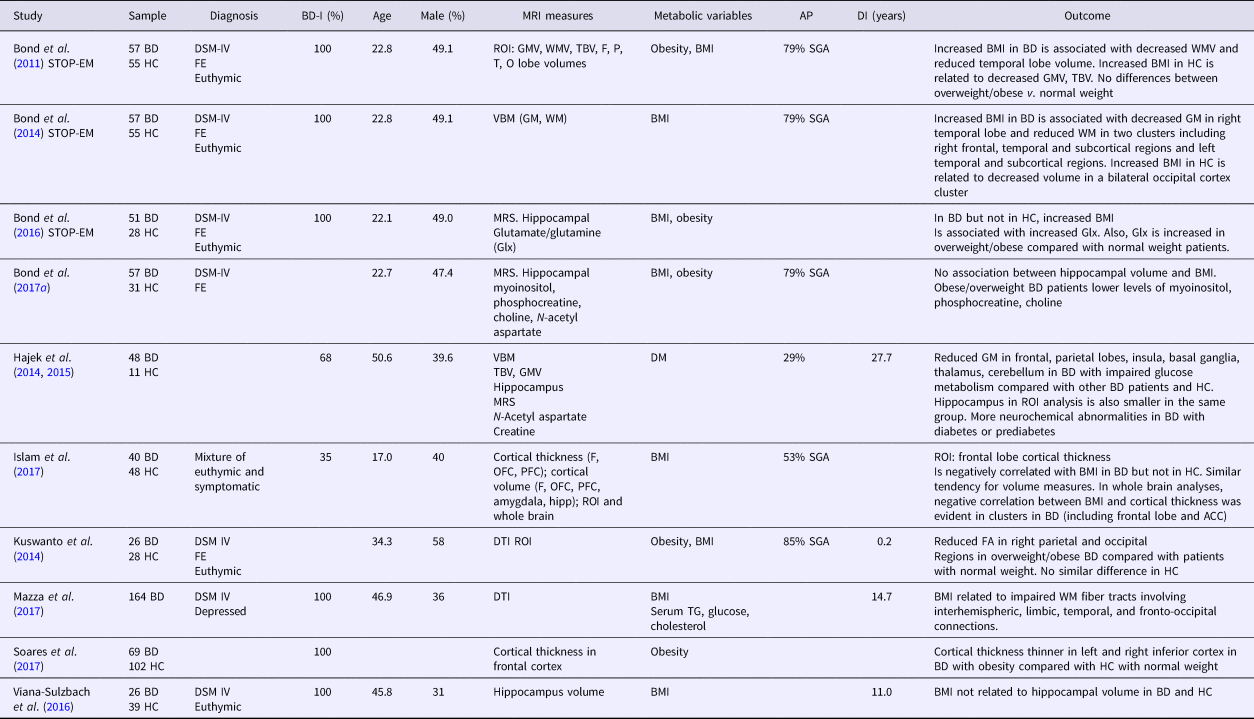
The selection process is summarized in Fig. 1. Initial search identified 92 articles and 37 of these articles, which were potentially relevant, were checked for inclusion criteria. Fourteen of these studies were not meeting inclusion criteria (i.e. no cognitive or obesity data, results for a mixed schizophrenia-BD sample, cognitive data being overlapping with another study included). We contacted one of the authors of a paper that did not report sufficient data to calculate effect sizes in the original version (La Montagna et al., Reference La Montagna, Stella, Ricci, Borraccino, Triggiani, Panza, Seripa, Miscio, Bellomo and Lozupone2017). A total of 23 studies were included in the qualitative part of the current systematic review and seven of these studies were included in the meta-analysis (Tables 1 and 2). Three studies reporting on the components of MetS were not included in the meta-analysis as their number was not sufficient to conduct a meta-analysis for the effect of a component of MetS (Bai et al., Reference Bai, Li, Tsai, Tu, Chen and Su2016; Naiberg et al., Reference Naiberg, Newton, Collins, Dickstein, Bowie and Goldstein2016a, Reference Naiberg, Newton, Collins, Bowie and Goldstein2016b). In remaining seven studies, we were able to conduct meta-analyses for neurocognitive studies comparing performances of BD patients with (n = 462) and without (n = 269) obesity/overweight. We were not able to conduct a meta-analysis of MRI studies comparing overweight/obese BD patients with normal weight BD patients due to differences in MRI methodologies across available studies. In addition, it was not possible to conduct meta-analyses for the effects of co-morbidity of hypertension, MetS, DM, and dyslipidemia due to a small number of studies available.
Flow diagram for systematic review of studies investigating the neuroimaging and neurocognitive correlates of obesity and other components of MetS in BD.

Characteristics of the neuropsychological studies included in the current systematic review and meta-analysis

MetS, metabolic syndrome; TMT, trail making test; LNS, letter number sequencing; CPT, continuous performance test; WCST, Wisconsin card sorting test; DM, diabetes mellitus; HY, hypertension; BMI, body mass index; AP, antipsychotic use; WC, waist circumference; WHR, waist to hip ratio; *, included in the meta-analysis.
Characteristics of the neuroimaging studies included in the current systematic review

MetS, metabolic syndrome; DM, diabetes mellitus; HY, hypertension; BMI, body mass index; DI, duration of illness; AP, antipsychotic use.
Statistical analyses
When available, overall cognitive test score was used as a measure of general cognition. In other studies, an effect size for general cognition was calculated by averaging effect size of individual cognitive domains. The same method was also used to calculate the effect size of cognitive domains if more than one cognitive variable was available for a cognitive domain. Cognitive domains included in the current review were memory, processing speed, attention, executive functions, and working memory (see eTable 1 in the online Supplementary material for cognitive tests under each domain).
Meta-analyses were performed using packages in R environment (OpenMetaAnalyst, Metafor) (Viechtbauer, Reference Viechtbauer2010; Wallace et al., Reference Wallace, Dahabreh, Trikalinos, Lau, Trow and Schmid2012). Effect sizes were weighted using the inverse variance method and a random effects model (DerSimonian–Laird estimate) (p value for significance <0.05). Homogeneity of the distribution of weighted effect sizes was tested with the Q-test. Tau-squared (τ 2), an estimate of between-study variance, was used as a measure of the magnitude of heterogeneity in the random effects model. The possibility of publication bias was assessed with a regression test for funnel plot (Egger's test). Fail-safe N test was also used. Fail-safe N describes the robustness of a significant result by calculating how many studies with effect size zero could be added to the meta-analysis before the result lost statistical significance. Subgroup analyses were performed for studies that included only chronic patients. Q bet test was used to compare the strength of associations (with obesity) for different cognitive domains. This was conducted for the comparison between cognitive domains that each was reported in at least five studies (executive functions, verbal memory and processing speed).
Results
Neurocognition
Obesity and cognitive findings in BD
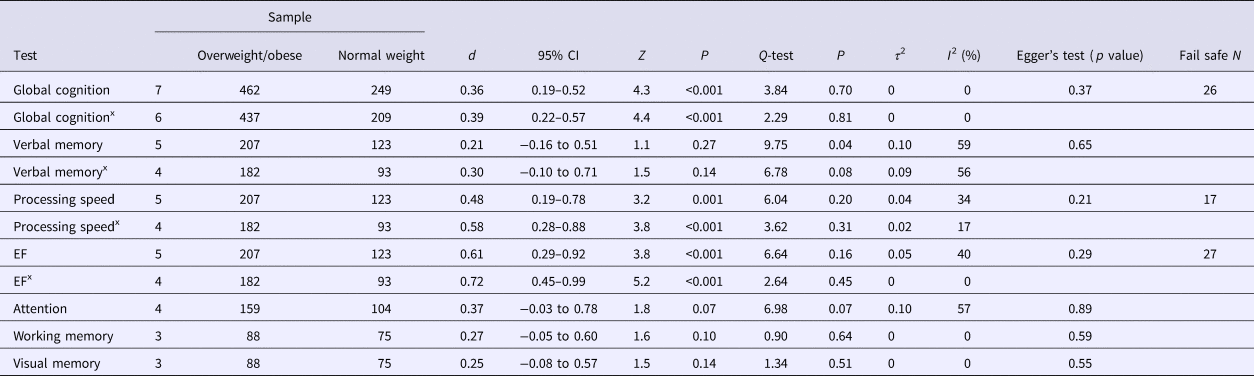
Global cognition was significantly impaired in overweight/obese compared with normal weight patients with BD [d = 0.36, confidence interval (CI) = 0.19–0.52] (Table 3 and Fig. 2). The effect size for impairment in global cognition was larger in a subgroup analysis of chronic studies after the exclusion of the single FE (Silveira et al., Reference Silveira, Kozicky, Muralidharan, Bücker, Torres, Bond, Kapczinski, Kauer-Sant'Anna, Lam and Yatham2014) study (d = 0.39, CI = 0.22–0.57). In meta-analyses of individual cognitive domains, patients with BD + obesity/overweight performed significantly worse than normal-weight patients with BD in executive functions (d = 0.61, CI = 0.29–0.92) (Fig. 3) and processing speed (d = 0.48, CI = 0.19–0.78) (Fig. 4) but not in verbal memory, visual memory, attention, and working memory. The distribution of effect sizes for each of these cognitive domains was homogeneous except for the moderate level of heterogeneity in verbal memory (I 2 = 59%, τ 2 = 0.10) and attention (I 2 = 57%, τ 2 = 0.10). The effect of being overweight/obese in BD on cognition was also more pronounced for executive functions in chronic patients (d = 0.72, CI = 0.45–0.99) and processing speed (d = 0.58, CI = 0.28–0.88). Statistical analysis of funnel plots found no evidence of publication bias for any of the measures. The funnel plot for global cognition is reported in the online Supplementary material (eFig. 1). Fail-safe N number for global cognition, executive functions, and processing speed were large (17–26), suggesting that positive findings in the previous analyses were robust. There were no changes in estimated effect sizes in between-group differences for global cognition and individual cognitive domains in trim and fill analyses (Table 3). The effect sizes of the relationship between obesity and executive was significantly more pronounced than association between obesity and verbal memory (Q bet = 4.7, p = 0.03). There was no statistically significant difference of the strength of the effect of obesity on processing speed compared with verbal memory (Q bet = 2.1, p = 0.14).
Forest plot of global cognitive differences between obese/overweight v. normoweight patients with BD.

Forest plot of processing speed differences between obese/overweight v. normoweight patients with BD.

Forest plot of differences in executive functions between obese/overweight v. normoweight patients with BD.

Mean weighted effect sizes for neurocognitive differences between overweight/obese and normal weight BD

d, Cohen's d; CI, confidence interval; x, chronic BD patients [first-episode study of Silveira et al. (Reference Silveira, Kozicky, Muralidharan, Bücker, Torres, Bond, Kapczinski, Kauer-Sant'Anna, Lam and Yatham2014) excluded]; EF, executive functions
There were insufficient number of studies to conduct meta-analyses on any putative association between obesity and social cognition in BD. One study did not find significant differences in social cognition in overweight/obese and normal weight patients with BD (La Montagna et al., Reference La Montagna, Stella, Ricci, Borraccino, Triggiani, Panza, Seripa, Miscio, Bellomo and Lozupone2017). A separate study found a significant relationship between the increased waist-to-hip ratio and reduced performance in theory of mind tasks (Lackner et al., Reference Lackner, Birner, Bengesser, Fellendorf, Platzer, Queissner, Kapfhammer, Reininghaus, Weiss, Wallner-Liebmann and Reininghaus2016b). Several studies evaluated the effect of BMI on cognition as a dimensional variable. Depp et al. (Reference Depp, Strassnig, Mausbach, Bowie, Wolyniec, Thornquist, Luke, McGrath, Pulver, Patterson and Harvey2014) found a significant negative relationship between BMI and processing speed, executive functions, and verbal memory performances. Yim et al. (Reference Yim, Soczynska, Kennedy, Woldeyohannes, Brietzke and McIntyre2012) found a similar finding for processing speed (and trend-level relationship for other cognitive domains). However, not all studies found a significant relationship between BMI and neurocognition in BD (Silveira et al., Reference Silveira, Kozicky, Muralidharan, Bücker, Torres, Bond, Kapczinski, Kauer-Sant'Anna, Lam and Yatham2014; Lackner et al., Reference Lackner, Bengesser, Birner, Painold, Fellendorf, Platzer, Reininghaus, Weiss, Mangge, McIntyre, Fuchs, Kapfhammer, Wallner-Liebmann and Reininghaus2016a).
Hypertension and cognitive findings in BD
All four studies (Depp et al., Reference Depp, Strassnig, Mausbach, Bowie, Wolyniec, Thornquist, Luke, McGrath, Pulver, Patterson and Harvey2014; Hubenak et al., Reference Hubenak, Tuma and Bazant2015; Naiberg et al., Reference Naiberg, Newton, Collins, Dickstein, Bowie and Goldstein2016a, Reference Naiberg, Newton, Collins, Bowie and Goldstein2016b) that investigated the relationship between hypertension (or blood pressure) and cognitive impairment in BD reported a significant relationship between more severe cognitive deficits and categorical or dimensional assessment of blood pressure.
Dyslipidemia and cognitive findings in BD
Two studies (Hubenak et al., Reference Hubenak, Tuma and Bazant2015; Naiberg et al., Reference Naiberg, Newton, Collins, Dickstein, Bowie and Goldstein2016a) investigated the relationship between dyslipidemia and cognitive impairment in BD. One of these studies found a significant relationship between executive dysfunction and triglyceride levels (Naiberg et al., Reference Naiberg, Newton, Collins, Dickstein, Bowie and Goldstein2016a). Dyslipidemia was not significantly associated with cognitive impairment in BD in the second study (Hubenak et al., Reference Hubenak, Tuma and Bazant2015).
Diabetes mellitus and cognitive findings in BD
Three studies (Tsai et al., Reference Tsai, Lee, Chen and Huang2007; Hubenak et al., Reference Hubenak, Tuma and Bazant2015; Naiberg et al., Reference Naiberg, Newton, Collins, Dickstein, Bowie and Goldstein2016a) investigated the relationship between dyslipidemia (or glucose levels) and cognitive impairment in BD. There was no evidence of a significant relationship between glucose levels (or DM) or cognitive impairment in two of these studies (Hubenak et al., Reference Hubenak, Tuma and Bazant2015; Naiberg et al., Reference Naiberg, Newton, Collins, Dickstein, Bowie and Goldstein2016a). On the other hand, a late-life study found a significant effect of co-morbid DM on the level of general cognitive impairment in BD (Tsai et al., Reference Tsai, Lee, Chen and Huang2007).
MetS and cognitive findings in BD
Only three studies have compared cognitive performances of BD patients with or without MetS (Hubenak et al., Reference Hubenak, Tuma and Bazant2015; Bai et al., Reference Bai, Li, Tsai, Tu, Chen and Su2016; Lackner et al., Reference Lackner, Bengesser, Birner, Painold, Fellendorf, Platzer, Reininghaus, Weiss, Mangge, McIntyre, Fuchs, Kapfhammer, Wallner-Liebmann and Reininghaus2016a, Reference Lackner, Birner, Bengesser, Fellendorf, Platzer, Queissner, Kapfhammer, Reininghaus, Weiss, Wallner-Liebmann and Reininghaus2016b). In these studies, global cognition (Hubenak et al., Reference Hubenak, Tuma and Bazant2015), executive functions (Bai et al., Reference Bai, Li, Tsai, Tu, Chen and Su2016), and social cognition (Lackner et al., Reference Lackner, Bengesser, Birner, Painold, Fellendorf, Platzer, Reininghaus, Weiss, Mangge, McIntyre, Fuchs, Kapfhammer, Wallner-Liebmann and Reininghaus2016a, Reference Lackner, Birner, Bengesser, Fellendorf, Platzer, Queissner, Kapfhammer, Reininghaus, Weiss, Wallner-Liebmann and Reininghaus2016b) were more impaired in patients with MetS compared with patients without MetS.
MRI findings
Obesity and brain imaging findings in BD
Five brain imaging studies in BD (Bond et al., Reference Bond, Lang, Noronha, Kunz, Torres, Su, Honer, Lam and Yatham2011, Reference Bond, da Silveira, MacMillan, Torres, Lang, Su, Honer, Lam and Yatham2016, Reference Bond, Silveira, MacMillan, Torres, Lang, Su, Honer, Lam and Yatham2017a; Kuswanto et al., Reference Kuswanto, Sum, Yang, Nowinski, McIntyre and Sim2014; Soares et al., Reference Soares, Lavagnino, Mwangi, Cao, Wu, Sanches and Zunta-Soares2017) investigated the effect of BMI as a categorical variable (obese/overweight v. normal weight). Kuswanto et al. (Reference Kuswanto, Sum, Yang, Nowinski, McIntyre and Sim2014), a DTI study, found reduced FA in the right parietal and occipital regions in overweight/obese BD compared with patients with normal weight. Soares et al. (Reference Soares, Lavagnino, Mwangi, Cao, Wu, Sanches and Zunta-Soares2017) reported that reduced cortical thickness in the left and right inferior frontal cortex in BD compared with healthy controls was only evident in obese patients. The findings of Stop-EM study found a more severe neurochemical impairment in the hippocampus of obese/overweight compared normal weight patients (Bond et al., Reference Bond, da Silveira, MacMillan, Torres, Lang, Su, Honer, Lam and Yatham2016, Reference Bond, Silveira, MacMillan, Torres, Lang, Su, Honer, Lam and Yatham2017a, Reference Bond, Torres, Lee, Kozicky, Silveira, Dhanoa, Lam and Yatham2017b) but no similar finding was evident for volumes of cortical regions (Bond et al., Reference Bond, Lang, Noronha, Kunz, Torres, Su, Honer, Lam and Yatham2011). Six other brain imaging studies investigated BMI as a dimensional variable (Bond et al., Reference Bond, Lang, Noronha, Kunz, Torres, Su, Honer, Lam and Yatham2011, Reference Bond, Ha, Lang, Su, Torres, Honer, Lam and Yatham2014, 2015; Viana-Sulzbach et al., Reference Viana-Sulzbach, Pedrini, Bucker, Brietzke and Gama2016; Islam et al., Reference Islam, Metcalfe, MacIntosh, Korczak and Goldstein2017; Mazza et al., Reference Mazza, Poletti, Bollettini, Locatelli, Falini, Colombo and Benedetti2017). Increased BMI was related to disrupted microstructure (Mazza et al., Reference Mazza, Poletti, Bollettini, Locatelli, Falini, Colombo and Benedetti2017) and volume (Bond et al., Reference Bond, Lang, Noronha, Kunz, Torres, Su, Honer, Lam and Yatham2011, Reference Bond, Ha, Lang, Su, Torres, Honer, Lam and Yatham2014) of white matter, reduced gray matter volume in temporal lobe (Bond et al., Reference Bond, Lang, Noronha, Kunz, Torres, Su, Honer, Lam and Yatham2011, Reference Bond, Ha, Lang, Su, Torres, Honer, Lam and Yatham2014), reduced cortical thickness in frontal lobe (Islam et al., Reference Islam, Metcalfe, MacIntosh, Korczak and Goldstein2017), and neurochemical abnormality (Bond et al., Reference Bond, da Silveira, MacMillan, Torres, Lang, Su, Honer, Lam and Yatham2016) but not related to reduced hippocampal volume (Viana-Sulzbach et al., Reference Viana-Sulzbach, Pedrini, Bucker, Brietzke and Gama2016).
Diabetes mellitus and brain imaging findings in BD
Three studies have investigated the relationship between MRI findings and DM (or glucose levels) (Hajek et al., Reference Hajek, Calkin, Blagdon, Slaney, Uher and Alda2014, Reference Hajek, Calkin, Blagdon, Slaney and Alda2015; Mazza et al., Reference Mazza, Poletti, Bollettini, Locatelli, Falini, Colombo and Benedetti2017). One of these studies (Hajek et al., Reference Hajek, Calkin, Blagdon, Slaney, Uher and Alda2014) found more extensive gray matter deficits in frontoparietal and subcortical regions and hippocampus in patients with abnormal glucose metabolism compared with other patients. The other study (Mazza et al., Reference Mazza, Poletti, Bollettini, Locatelli, Falini, Colombo and Benedetti2017) found that disrupted white matter integrity and high glucose levels using DTI. The strongest correlations were observed in the body of the corpus callosum, the fornix, and the left external capsule. Finally, Hajek et al. (Reference Hajek, Calkin, Blagdon, Slaney and Alda2015) reported neurochemical abnormalities in BD patients with diabetes and prediabetes compared with euglycemic BD patients.
Other components of MetS and brain imaging findings in BD
Mazza et al. (Reference Mazza, Poletti, Bollettini, Locatelli, Falini, Colombo and Benedetti2017) investigated the relationship between serum triglyceride/cholesterol levels and white matter integrity using DTI and found a significant relationship between disrupted white matter integrity and increased serum levels of both measures. The signal peak for serum triglyceride was forceps major and signal peaks for serum cholesterol were right superior longitudinal fasciculus, right posterior thalamic radiation, left inferior fronto-occipital fasciculus, and genu of the corpus callosum (Mazza et al., Reference Mazza, Poletti, Bollettini, Locatelli, Falini, Colombo and Benedetti2017).
No study has investigated the relationship between hypertension and MRI changes in BD. No study has compared MRI abnormalities in patients with and without MetS yet.
Discussion
The current qualitative and quantitative systematic review was undertaken to summarize and synthesize the available evidence regarding neurocognitive and neuroimaging correlates of obesity and other components of MetS in BD. The quantitative part of the review suggests that overweight/obese BD patients have significantly more severe cognitive deficits compared with normal weight patients with BD. In the qualitative review of neurocognitive functions, there was evidence for a relationship between other components of MetS and cognitive impairment in BD. There was also evidence for more severe brain imaging abnormalities in BD patients with co-morbid obesity, dyslipidemia and diabetes compared with other patients with BD.
Neurocognitive findings
There was a modest but a significant relationship between obesity and cognitive deficits in BD (d = 0.36). The most robust differences between obese/overweight v. normal weight patients with BD were evident in measure of executive functions (d = 0.61) and processing speed (d = 0.48). Furthermore, neurocognitive differences between obese/overweight and normal weight patients in other cognitive domains were not statistically significant. However, it is important to note that estimated effect sizes for other cognitive domains (working memory, attention, verbal, and visual memory) ranged from 0.21 to 0.37 but were not statistically significant. It is likely that obesity in BD is associated with more severe global cognitive deficits but current meta-analysis was underpowered to show significant but modest relationship between some cognitive domains and obesity.
It is also important to consider potential interactive effects of obesity and BD on neurocognition. Previous meta-analyses have established that obesity is associated with lower performance in cognitive functions in the general population (Cook et al., Reference Cook, Cheng, O'Dwyer, Raymond, Rooney, Steinbeck and O'Connor2014; Yang et al., Reference Yang, Shields, Guo and Liu2018). In these meta-analyses, the effect sizes for the relationship between obesity and lower performance in executive dysfunction, memory, working memory, and processing speed ranged from 0.25 to 0.37 (Cook et al., Reference Cook, Cheng, O'Dwyer, Raymond, Rooney, Steinbeck and O'Connor2014; Yang et al., Reference Yang, Shields, Guo and Liu2018). In the current meta-analysis, the effect size for executive function (d = 0.61) was significantly larger than reported in the general population and effect size for executive function was significantly larger than verbal memory. These findings suggest that the relationship between obesity and cognitive functioning is similar in general population and BD for most domains but BD might be characterized by more pronounced relationship between obesity and some cognitive domains, particularly executive functions. It seems that obesity and BD have an interactive effect on executive dysfunction. Cognitive reserve hypothesis might provide a potential explanation for interaction of BD and obesity on executive dysfunction as BD seems to be associated with decreased reserve not in basic cognitive abilities but in high-order cognitive functions that develop during late adolescence and young adulthood (Bora, Reference Bora2015; Forcada et al., Reference Forcada, Mur, Mora, Vieta, Bartrés-Faz and Portella2015; Anaya et al., Reference Anaya, Torrent, Caballero, Vieta, Bonnin Cdel and Ayuso-Mateos2016).
The cognitive impairment in BD is characterized by deficits with medium to large effect sizes in executive functions, memory, processing speed, attention, working memory and social cognition (Torres et al., Reference Torres, Boudreau and Yatham2007; Arts et al., Reference Arts, Jabben, Krabbendam and van Os2008; Bora et al., Reference Bora, Yucel and Pantelis2009; Reference Bora, Hıdıroğlu, Özerdem, Kaçar, Sarısoy, Civil Arslan, Aydemir, Cubukcuoglu Tas, Vahip, Atalay, Atasoy, Ateşci and Tümkaya2016; Dickinson et al., Reference Dickinson, Becerra and Coombes2017; Raucher-Chéné et al., Reference Raucher-Chéné, Achim, Kaladjian and Besche-Richard2017). While neurodevelopmental abnormalities might play a significant role in cognitive deficits in BD (Bora, Reference Bora2015), current findings suggest that obesity can contribute to further cognitive decline, particularly in executive functions and processing speed, in some patients with BD. Medium-sized effect of obesity on executive functions and processing speed in BD, which were relatively specific, are likely to be clinically relevant and can contribute to more significant functional deficits observed in obese patients with BD.
In comparison to obesity, relatively few studies have investigated the relationship between neurocognition and MetS, hypertension, diabetes, and dyslipidemia. However, the preliminary evidence suggests that cognitive deficits in BD are also related to these cardiovascular risk factors with the strongest association with hypertension (Table 1). The evidence was mixed for dyslipidemia and diabetes, and there is a need for further studies to confirm or refute whether a relationship exists between neurocognitive impairment in BD and these cardiovascular risk factors.
It is speculated that the cumulative effect of changes (i.e. vascular and inflammatory) related to cardiovascular risk factors may portend cognitive decline in some patients with BD. However, it is important to note that neurocognitive deficits can also contribute to higher prevalence of obesity and other components of MetS in BD rather than vice versa. There might be bidirectional relationship between cognitive functions and obesity. Moreover, it is important to consider the potential role of confounders which can exacerbate the association between obesity (and other components of MetS) and cognitive impairment including between-group differences in medications, poor diet, sedentary behavior, illness severity and socioeconomic factors. Longitudinal studies investigating effects of the development of obesity and related cardiovascular factors starting from early years of the psychotic disorder can help to disentangle cause and effect and can differentiate the characteristics of cognitive deficits that predates the onset of obesity and MetS from the cognitive impairment that appears because of cardiovascular risk factors. Our findings suggest that the relationship between obesity and more severe cognitive deficits might be more evident in patients with chronic illness highlighting cumulative effects of medical co-morbidity but not ruling out the possibility the cognitive deficit predates incident metabolic morbidity. A single first-episode study found no relationship between obesity and more severe cognitive deficits in BD (Silveira et al., Reference Silveira, Kozicky, Muralidharan, Bücker, Torres, Bond, Kapczinski, Kauer-Sant'Anna, Lam and Yatham2014). Furthermore, a separate first-episode study (Bond et al., Reference Bond, Silveira, MacMillan, Torres, Lang, Su, Honer, Lam and Yatham2017a, Reference Bond, Torres, Lee, Kozicky, Silveira, Dhanoa, Lam and Yatham2017b) found that lower cognitive function might be a predictor of weight gain rather than being its consequence in early phases of BD. Other evidence suggests that higher BMI might be related to more severe cognitive deficits in individuals with familial-high-risk for BD but the direction of this association is not clear yet (McIntyre et al., Reference McIntyre, Mansur, Lee, Japiassú, Chen, Lu, Lu, Chen, Li, Xu and Lin2017).
Taken together, our findings might have potential implications for the management of patients with BD. In the general population, there is some evidence suggesting that weight management programs and bariatric surgery can improve cognition (Siervo et al., Reference Siervo, Arnold, Wells, Tagliabue, Colantuoni, Albanese, Brayne and Stephan2011; Handley et al., Reference Handley, Williams, Caplin, Stephens and Barry2016; Veronese et al., Reference Veronese, Facchini, Stubbs, Luchini, Solmi, Manzato, Sergi, Maggi, Cosco and Fontana2017). Weight reduction trials should also be considered to be designed in BD to test the effectiveness of a similar approach in improving cognition in these patients.
Brain imaging findings
Current evidence suggests that obesity and each of the individual components of MetS, which are well-established risk factors for atherosclerosis, might have a negative effect on cognition in BD. These neurocognitive deficits might be potentially related to metabolic changes associated micro- and macro-cerebrovascular alterations leading to structural and functional abnormalities in the brain. Indeed, a recent comprehensive review suggested that all cardiovascular risk factors including HT, DM, increased adiposity, and hyperlipidemia are independently associated with changes in brain imaging including abnormalities in white matter microstructure and functional connectivity, gray matter reductions and white matter hyperintensities (Friedman et al., Reference Friedman, Tang, de Haas, Changchien, Goliasch, Dabas, Wang, Fayad, Fuster and Narula2014).
The qualitative review of brain imaging studies in BD provided strong evidence for a relationship between increased BMI, both categorically and dimensionally. The most consistent finding of these studies was the more widespread abnormalities in white matter volume and microstructure in obese/overweight compared with other patients with BD. The preliminary evidence also suggests that relatively reduced thickness in frontal lobe and reduced volume in temporal lobe might be a feature of obese/overweight patients in comparison with BD patients with normal weight. The relationship between obesity and brain imaging findings in BD was evident in both chronic and first-episode samples. In fact, preliminary evidence suggests that a similar relationship might be evident also individuals at familial-high-risk for BD (Mansur et al., Reference Mansur, McIntyre, Cao, Lee, Japiassú, Chen, Lu, Lu, Chen, Li, Xu and Lin2018).
Unfortunately, there were a very small number of studies that investigated the neuroimaging correlates of cardiovascular risk factors (other than obesity). No study investigated the effect of hypertension and MetS on MRI findings. However, there was preliminary evidence suggesting that widespread abnormalities in white matter structure were associated with dyslipidemia and diabetes in BD. In addition, impaired glucose metabolism in BD may be associated with reduced frontoparietal and subcortical volumes.
Another consideration is whether neuroimaging changes associated with obesity and related factors are specific to BD. A number of studies in this review also included a healthy control group. In general, the relationship between neuroimaging changes and obesity was more evident in BD samples (Table 2).
The current systematic review has a number of limitations. The cross-sectional nature of the most of the studies involved is an important consideration for establishing the nature of the relationship between obesity/other components of MetS, brain imaging findings cognitive deficits in BD. The number of studies available was small, especially for cardiovascular risk factors other than obesity. Some cognitive domains were investigated by a smaller number of studies. The heterogeneity of cognitive tasks used to assess cognitive domains is another consideration. Many studies did not include data regarding other variables which may contribute to cardiovascular risks such as medication, alcohol use and physical exercise levels. Another consideration is the possible effect of publication bias. We found no evidence of publication bias in the current meta-analysis. However, because the available literature is small, it is not possible to rule out the effect of publication bias on current findings.
In conclusion, our findings suggest that there is consistent evidence for a significant relationship between obesity and more severe cognitive impairment. Emerging evidence suggests that similar might be true for neuroimaging abnormalities in BD. The preliminary evidence also suggests that other MetS components e.g. hypertension might also be related to more pronounced brain imaging and neurocognitive findings in BD. Mechanistic studies will be required to fully understand pathoetiological mechanisms, directions of causality while interventional proof of concept studies should evaluate whether correcting MetS components have salutary effects on both neurocognitive and or neuroimaging measures.
Supplementary material
The supplementary material for this article can be found at https://doi.org/10.1017/S0033291718003008
Acknowledgements
Dr Bora is supported by The Scientific and Technological Research Council of Turkey (TÜBİTAK)BİDEB2232 fellowship. The authors would like to thank authors of La Montagna et al. (2017) for providing additional information.
Conflict of interest
None.
Financial support
None.