Introduction
Thyroglossal duct cyst is an embryological remnant of normal thyroid gland development. It can be found anywhere along the tract of descent from the foramen caecum, and usually presents as a midline neck mass, which can be diagnosed easily. Thyroglossal duct cyst carcinoma is a rare clinical entity which appears similar to a benign cyst.
In this case report, we present a woman with papillary thyroid carcinoma within a thyroglossal duct cyst, whose initial diagnosis was complicated by her presentation with obstructive sleep apnoea (OSA) and without a neck mass.
Case report
A 39-year-old woman had initially presented with snoring and excessive daytime somnolence, five years before the current presentation. At this earlier stage, further enquiry had not revealed any complaint of dyspnoea, dysphagia or dysphonia. Her Epworth Sleepiness Scale score had been 13, indicating moderate sleepiness. Clinical examination had been normal except for bilateral tonsillar hypertrophy. There was no palpable neck mass, and hypopharyngeal examination had revealed a prominent tongue base with no mass. She had been noted to have a low-lying palate with a long uvula. Nocturnal polysomnography had shown evidence of severe OSA, with an elevated total apnoea-hypopnoea index of 66 and multiple episodes of oxygen desaturation, with a nadir reaching 75 per cent in the rapid eye movement stage of sleep. The patient was hence diagnosed with OSA and subsequently underwent uvulopalatopharyngoplasty. Post-operatively, she had reported a significant improvement in sleep quality and snoring. Her Epworth Sleepiness Scale score had improved to 1. She had then defaulted from follow up.
Five years post-operatively, the patient now represented with worsening snoring and excessive daytime somnolence, again without any symptoms of dyspnoea, dysphagia or dysphonia. Her Epworth Sleepiness Scale score was now 14.
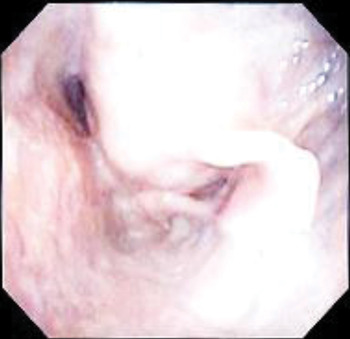
Physical examination revealed a 2 × 2 cm, anterior, midline neck mass which moved with swallowing. Nasendoscopy revealed partial airway occlusion secondary to a large, cystic swelling involving the left aryepiglottic fold (Figure 1).
Nasendoscopic view showing a large, cystic swelling involving the left aryepiglottic fold and partially occluding the airway.

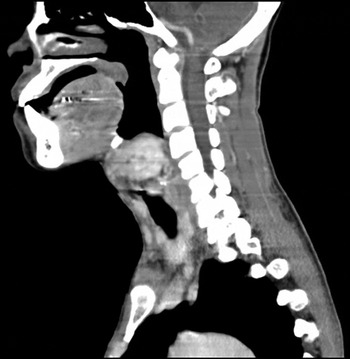
Computed tomography (CT) scanning confirmed a 5 cm, enhancing, submucosal lesion abutting the hyoid cartilage and compressing the supraglottic laryngeal airway and left pyriform fossa (Figure 2). Enhancing cervical nodes with a cystic component were noted bilaterally.
Sagittal computed tomography scan showing a submucosal, enhancing lesion in the pre-epiglottic and paraglottic region, which is compressing the supraglottic laryngeal airway.

Fine needle aspiration cytology (FNAC) was performed, with results suggestive of papillary thyroid carcinoma of a thyroglossal duct cyst.
The patient underwent a Sistrunk procedure and total thyroidectomy with bilateral neck dissection and central neck dissection. The thyroidectomy specimen was negative for malignancy, but four out of 15 right-sided neck lymph nodes and three out of 13 lymph nodes on the left tested positive for metastasis.
Post-operatively, the patient received radioactive iodine and hormonal thyroid suppression therapy, and recovered well.
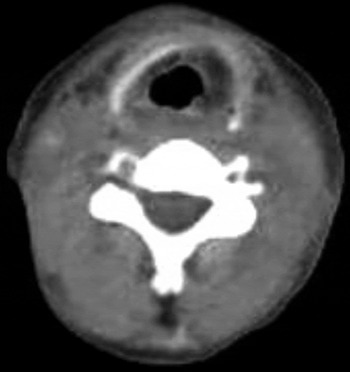
On repeated CT scanning, airway patency was restored at the level of the previous tumour obstruction (Figure 3). The patient's snoring and excessive daytime somnolence also resolved completely, and her Epworth sleepiness scale score improved from 14 to 0.
Axial, post-operative computed tomography scan showing a patent airway at the site of the previous tumour obstruction.

Discussion
Thyroglossal duct cyst is the commonest congenital neck mass encountered by otolaryngologists. However, a thyroglossal duct cyst carcinoma is a rare clinical entity, found in only approximately 1 per cent of all patients operated upon for thyroglossal duct cyst.Reference Motamed and McGlashan 1
Accurate pre-operative diagnosis of this condition is uncommon, as most presentations of thyroglossal duct cyst carcinoma are indistinguishable from their benign counterpart. The specificity of FNAC is low, generally reported as only approximately 50 to 66 per cent.Reference Yang, Haghir, Wanamaker and Powers 2 , Reference Bardales, Suhrland, Korourian, Schaefer, Hanna and Stanley 3 Diagnosis is mostly incidental on post-operative histological examination. However, in our patient an accurate diagnosis was made on FNAC during her second presentation.
Thyroglossal duct cyst carcinoma was previously thought to be the result of metastatic thyroid disease. It is now recognised that these tumours arise de novo, although approximately 25 per cent may be associated with a synchronous malignancy in the thyroid gland.Reference Patel, Escrig, Shaha, Singh and Shah 4
Our patient underwent a Sistrunk procedure. Intra-operatively, the resected specimen was sent for frozen section analysis, which confirmed the FNAC diagnosis of papillary thyroid carcinoma arising from the thyroglossal duct. Therefore, we proceeded to a total thyroidectomy with bilateral selective neck dissection and central neck dissection. This was done to facilitate post-operative radioactive iodine therapy, which was necessary as the patient already had cervical lymph node involvement as seen on the neck CT scan.
-
• Thyroglossal duct cyst carcinoma is rare, seen in 1 per cent of thyroglossal duct cyst cases
-
• Correct pre-operative diagnosis is rare, due to benign symptomatology
-
• Fine needle aspiration cytology specificity is low (50–66 per cent)
-
• Current management is concomitant total thyroidectomy (allowing radioiodine therapy) and neck dissection
-
• Atypical presentation is possible (e.g. obstructive sleep apnoea)
Post-operatively, the patient's snoring and excessive daytime somnolence resolved completely, and her Epworth Sleepiness Scale score improved from 14 to 0. As her OSA seemed to have resolved clinically, a second polysomnogram was postponed due to financial considerations.
Atypical presentations of benign thyroglossal duct cysts, such as dysphagia, dysphonia and acute upper airway obstruction, have been reported and pose a diagnostic dilemma.Reference Sauvageau, Belley-Côté and Racette 7 – Reference Brown, Albernaz and Emery 9 However, atypical presentations of thyroglossal duct cyst carcinoma, such as the obstructive sleep apnoea seen in our patient, have not previously been reported. To the best of our knowledge, our patient is the first reported case of a thyroglossal duct cyst carcinoma initially presenting with severe OSA, treated initially with uvulopalatopharyngoplasty with significant improvement in OSA symptoms. Retrospectively, our patient's OSA was possibly due to a multi-level obstruction with retrograde extension of the tumour and laryngeal obstruction. The absence of a neck mass at initial presentation further complicated the correct diagnosis of thyroglossal duct cyst carcinoma. Even though the patient's snoring and excessive daytime somnolence improved after her uvulopalatopharyngoplasty, this operation only delayed the correct diagnosis; the underlying carcinoma continued to grow, until she presented again, five years later, with worsening snoring and excessive daytime somnolence, leading to the correct diagnosis.
Conclusion
Thyroglossal duct cyst carcinomas may present atypically, posing a diagnostic dilemma for the clinician. The described case represents the first report of atypical presentation of thyroglossal duct carcinoma as OSA. It is essential that patients diagnosed with OSA undergo a thorough otolaryngological examination to exclude any underlying pathology. Imaging such as CT can be helpful in cases with submucosal lesions, as in our patient.