Introduction
With significant health care changes set to take place in the United States, policymakers and clinicians have focused more attention on the impact of health care funding status on medical outcomes. Despite health reform, the United States continues to lag behind the health systems of most other industrialized countries, with approximately 27 to 28 million Americans still projected to remain uninsured for health care following implementation of the Affordable Care Act.Reference Price and Eibner 1 Access to medical care and outcomes of medical treatment related to insurance status have been well studied and documented in the United States. However, the role of insurance status on outcomes of trauma patients has only recently begun to receive attention. Although certain subsets of trauma patients have been studied, such as pediatricReference Hakmeh, Barker, Szpunar, Fox and Irvin 2 , Reference Brown 3 and burnReference Farrell, Gamelli and Sinacore 4 patients, there are still scant data regarding outcomes for the majority of adult trauma patients.
While there are a variety of reasons why trauma patients may be flown to a trauma center, helicopter transport in the trauma population is still performed most commonly when the severity of injury is assessed in the field to require faster transport time than can be accomplished by ground transportation.Reference Medvecz, Hill, Brywczynski, Gunter, Davidson and Guillamondegui 5 - Reference van Wijngaarden, Kortbeek, Lafreniere, Cunningham, Joughin and Yim 7 Currently, no studies exist in the literature focusing on outcome disparities in prehospital helicopter transport patients in regards to their insurance status.
Insurance status is often unknown initially in the trauma setting, and therefore, plays no role in how a patient is first managed. Americans living at, or just above, the poverty level are much less likely to have health insurance compared to their higher-income counterparts.Reference Cohen and Martinez 8 The reason for this association is unclear as reverse causation and confounding variables remain possible explanations. Unfunded trauma patients lack access to medical care prior to their injuries, which may account for a worse pre-existing health status compared to insured patients. In the setting of an acute, severe injury, the underlying health of a patient can play a crucial role in outcome and survival. The hypothesis of this study was that uninsured trauma patients who underwent air transport to a trauma center would have worse clinical outcomes as compared to insured trauma patients.
Methods
This was a retrospective study performed at a Level I Trauma Center over a 5-year period from August 2006 through July 2011, comparing trauma outcomes of health care insured patients to uninsured patients. After receiving Institutional Review Board approval from the University of Florida, College of Medicine - Jacksonville (Florida USA), information was obtained from the Center's Trauma I Registry. All patients aged 18 years and older who arrived by prehospital helicopter transport were included in the study. Funding status was classified into two groups: unfunded and funded. Patients without insurance were identified as “self-pay” or “none” and classified as unfunded, while patients with any type of insurance were classified as funded. Both private and government insurance were included in the funded category. Patients missing information regarding insurance status were excluded from the study. Injury severity scores (ISS) were compared, while the main outcomes of interest evaluated in the study were duration of stay in the intensive care unit (ICU), duration of hospitalization, and mortality. A t test was used to analyze ISS, while a chi-square statistic was utilized for mortality. An analysis of covariance (ANCOVA) statistic was completed using ISS as a covariate to compare average length of ICU days and hospital days while controlling for severity of injury. This was achieved by identifying the relationship between ISS and the dependent variables, removing that effect, and then analyzing the relationship between the true variables of interest (funding status and duration of hospital and ICU stay).
The trauma registry is based on national standards supported by the American College of Surgeons and the National Trauma Data Bank (Chicago, Illinois USA), with data entered by trained and certified personnel. Data from medical records are retrieved electronically and then entered manually into the database. Validation reports are run for each record.
Results
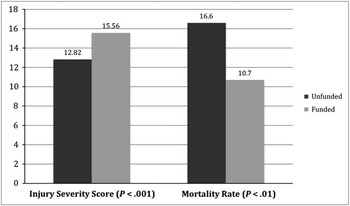
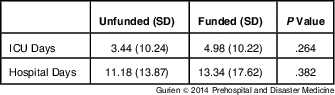
During the 5-year period of August 2006 through July 2011, a total of 1,877 adult patients underwent prehospital flights to a state-verified Level I Trauma Center, with 14% (259/1,877) classified as unfunded and 86% (1618/1,877) classified as funded. The dataset contained three missing data points for hospital stay and two missing data points for ICU stay, all of which were excluded from the analysis. As shown in Figure 1, unfunded patients had a significantly lower average ISS [12.82 (SD = 10.98) vs 15.56 (SD = 11.98); P < .001], but a significantly higher mortality rate (43/259 = 16.6% vs 174/1,618 = 10.7%; P < .01) compared to funded patients. Unfunded patients had a 1.54 relative risk of death (95% CI, 1.136-2.098) compared to funded patients. Using ANCOVA to control for ISS, neither mean ICU stay nor duration of hospitalization was significantly different between the two groups (Table 1).
Comparison of Injury Severity Score and Mortality Based on Funding Status.

Mean Length of ICU and Hospital Stay with ISS Controlled For
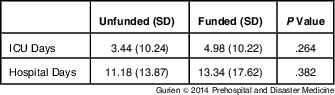
Abbreviations: ICU, intensive care unit; ISS, injury severity score.
Using the information from the Trauma I Registry, demographics were analyzed for gender, race, and age. The genders of patients were compared using a chi-square test, and were found to be significantly different (P < .001), with 91.5% of women (n = 551) as opposed to 84.0% of men (n = 1,328) classified as funded. Race was also compared using a chi-square analysis. Subjects were categorized into one of three groups: Caucasian (n = 1,534), African-American (n = 229), or Other (n = 116). Caucasians were significantly more likely to be funded (88.1%; P < .001) compared to African-Americans (78.1%) or Other (76.7%). Finally, a t test was used to compare the age between funded and unfunded subjects. Funded patients were significantly (P < .001) older [mean age = 42.7 years (SD = 18.43)] compared to unfunded patients [mean age = 35.1 years (SD = 13.25)].
Discussion
These results suggest that unfunded patients have worse outcomes following less significant injuries. Level I Trauma Centers serve both populations of insured and uninsured trauma patients, with insurance status playing an important role in the outcomes of these patients, specifically mortality. While those in the medical community would like to believe that insurance status does not impact how health care is delivered to patients, for certain types of injuries, it does appear to affect practitioners’ decisions to order diagnostic tests or perform surgery.Reference Bolorunduro, Haider and Oyetunji 9 , Reference Gundle, McGlaston and Ramappa 10 While this may account for some of the difference seen in mortality rates, it is unlikely to explain the large relative risk attributed to lack of insurance since, in the acute setting of trauma when there is a life-threatening injury, insurance status is usually unknown to the trauma team. Previous studies, such as the one conducted by Tepas and colleagues,Reference Tepas, Pracht, Orban and Flint 11 have suggested that this difference in mortality may be due to high-risk behavior and more severe injuries found in uninsured trauma patients, yet the analysis performed in this study indicated that unfunded patients had a lower ISS compared to the funded population. However, their study was limited to patients involved in motor vehicle crashes, while this study included trauma patients who experienced all mechanisms of injury. The contrast in findings regarding injury severity could possibly be explained by the difference in mechanism of injury.
There exists another possible explanation for the worse outcomes seen in unfunded patients: uninsured individuals who lack access to medical care may have an inferior health status compared to their insured counterparts. In patients who sustain a severe enough injury requiring transport to a trauma center by helicopter, this imbalance in baseline health may be the cause of the mortality difference demonstrated in this study. If the difference in outcomes cannot be attributed to variations in the quality of health care delivered to patients or to the severity of injury, perhaps the answer lies in disparities that exist in the baseline health status.
In the United States, the public agrees that quality of health care for critically ill or injured patients should not be different based on funding or insurance status. Yet, this same sentiment does not exist when it comes to routine health care. Preventive medicine is based on the concept of prevention, early diagnosis, and/or minimization of effect of disease. However, this component of public health is denied to those without insurance in the United States. The obvious ramification is that uninsured individuals are at a higher risk for developing severe disease. But this lack of access to health care may have other unforeseen consequences, as the poor quality of overall health of unfunded patients places them at a higher risk for worse outcomes when they become acutely ill or injured. Besides its implication on clinical outcomes for individuals, this also adds a burden to limited resources and the overall cost to the health care system.
With regard to percentage of the population receiving health insurance, the United States remains the lowest amongst all the Organization for Economic Co-operation and Development (OECD; Paris, France) nations. 12 While more than three-quarters of OECD countries provide access to health care to over 99% of their citizens, 12 tens of millions of Americans will continue to remain uninsured following one of the largest reforms to its health care system in decades.Reference Price and Eibner 1 Yet the United States continues to spend the largest percentage of its gross domestic product (over 17%) on health care, while its life expectancy at birth remains below the average when compared to other OECD nations. 12 Until the United States is able to provide universal health care coverage to all of its citizens, it will likely continue to trail behind the rest of the industrialized world in health outcomes.
Among industrialized countries, the health care insurance problem remains unique to the United States, and developing countries that have begun to dedicate resources towards expanding their health systems can learn from the difficulties now facing the United States due to low health insurance coverage rates. Additionally, for industrialized countries that have universal health care, this study highlights the importance of focusing efforts on ensuring that people in communities with traditionally low rates of health care utilization receive improved access to health care in meaningful ways.
Limitations
Limitations of this study include its retrospective nature. While it was determined that a difference does exist in clinical outcomes based on insurance status, the cause of these results can only be speculated upon. Further investigation is warranted to determine the etiology of the difference in mortality as identification of these patients and implementation of appropriate early intervention may improve outcomes for the unfunded trauma population. Also, no distinction was made between government and private insurance for subjects who were classified as funded. Future studies to determine if type of insurance plays a role in outcomes should be conducted. In addition, this study was limited to those who underwent prehospital helicopter transport. Subsequent studies may look to expand the patient population to include all trauma patients to eliminate any confounding factors that may exist in this population.
This study was conducted at a single institution within the United States. While this may improve the internal validity of the study, it compromises how generalizable these results are to institutions in other geographic locations across the United States and the rest of the world.
Comorbidities were not included in the study, as it is not feasible to ascertain pre-existing conditions in patients who do not regularly see health care providers. These patients will often deny any past medical history since they have not seen a physician in a number of years, and therefore have not been given a formal diagnosis. However, a prospective study could be performed that specifically evaluates patients for newly diagnosed comorbidities during their hospital stays, such as diabetes and hypertension, to evaluate for any confounding factors.
Although comorbidities could not be compared, the analysis of demographic information showed that older individuals, females, and Caucasians were more likely to be funded compared to their counterparts. Since funded patients had better outcomes in terms of mortality, it is interesting to see that, as a group, they were more likely to be older, since younger individuals usually have less medical problems and therefore a greater reserve compared to older individuals. Although unfunded patients were younger, perhaps the health benefit one would normally expect to see was absent due to lack of routine medical care. In regards to the difference in race and gender, these differences should be studied more in depth in the future to determine if they play any role in the difference in outcomes seen in this study. Income, wealth, and other measures of socioeconomic status were not controlled for, so perhaps a portion of the effect seen on mortality may be attributed to differences in socioeconomic status between the two groups.
This study was unique in that patients with all mechanisms of injury were included, with comparison based only on ISS rather than type of mechanism. While this expanded the subject population to look at all types of trauma patients, further evaluation could provide valuable information regarding if mechanism of injury was different between the two groups and played a role in outcomes.
Conclusion
Health care uninsured patients flown to a trauma center were more likely to have a lower ISS, yet have a significantly higher mortality, compared to insured patients. However, no difference in length of ICU stay or hospital stay was seen between the two groups after controlling for ISS. Although the reasons for the differences in outcomes are unclear, future studies focused on determining baseline health disparities between funded and unfunded patients may be beneficial.