Introduction
The Sixteen Kingdoms (304–439) and Northern Dynasties (386–581) periods are considered to have been two of the most politically chaotic periods in Chinese history, awash in intense social and cultural change.Footnote 1 The so-called ‘Five Barbarians’ 五胡, a collection of five Inner Asian groups consisting of the Xianbei 鮮卑, Xiongnu 匈奴, Jie 羯, Di 氐, and Qiang 羌, established the ‘Sixteen Kingdoms’ 十六國 and vied for supremacy over North China. Studies of the northern states and their rulers have generally been considered through the lens of acculturation.Footnote 2 Take, for example, the Northern Wei (386–534) dynasty, whose Xianbei rulers unified North China in 439. Emperor Xiaowen’s 孝文帝 (r. 471–499) ‘Sinicization policies’ are hailed as the centrepiece of state adherence to ‘Chinese’ customs and institutions. Scholars have pointed to his ‘Sinicization policies’, which include the reformation of costumes, alteration of surnames, changes to family registrations, and ban of the Xianbei language.Footnote 3 One of the most deliberated-upon debates of this period has concerned their acceptance of Han institutions and cultures, and thus their gradual Sinicization.
Instead of focusing on a narrative of one-sided acculturation, this article approaches this period from the perspective of the northern rulers who had to quickly adapt their rulership over diverse groups of peoples. ‘Cosmopolitanism’ has generally been associated with the succeeding Sui-Tang dynasties (581–907).Footnote 4 The study of Sui-Tang cosmopolitanism, pioneered by Xiang Da 向達 in his collection of 23 papers on the history of cultural exchange between the Tang dynasty and foreign states, has come to describe an inclusive society with an elite class readily consuming and engaging with foreign cultural imports such as religion, art forms, and material culture.Footnote 5 Much of this scholarship, best exemplified by Edward Schafer’s book, The Golden Peaches of Samarkand, predominantly cites literary sources depicting the exotic tastes of the elites.Footnote 6 Departing from this literature, there has been an increase in studies that demonstrate Sui-Tang cosmopolitanism from the perspectives of pluralistic society and institutions. The important work of Chen Yinke 陳寅恪 brought attention to the non-Han ancestry of the Northern Dynasties’ rulers and local elites, tying their origins to Sui-Tang institutions.Footnote 7 Charles Holcombe argued for cosmopolitanism in the first half of Tang based on the active participation of non-Han peoples in politics, administration, and economic activities.Footnote 8 Expanding on these works, Jonathan Skaff highlighted the contributions that ecological and ethnographical diversity made to cosmopolitanism in the Sui-Tang empires by exploring the integration of Turko-Mongol peoples into Sui-Tang imperial institutions. His book meticulously delineates the mutually beneficial relationship between the Turko-Mongol elites and the Sui-Tang emperors and government officials.Footnote 9
Recent studies have pointed to the manifestations of cosmopolitanism prior to Tang. Chen Sanping analysed the Central Asian influence of the Tuoba, a branch of the Xianbei Inner Asian group, on Chinese culture, language, governance, and politics.Footnote 10 He argued that the Tuoba were major contributors to a chain of events culminating in the cosmopolitanism of the Tang dynasty. Ch’oe Jinyŏl, in his article on Luoyang, the capital city of Northern Wei, characterized it as a ‘salad bowl’.Footnote 11 Underscoring the diversity of non-Han peoples living in the capital and examining the markets where ‘foreign’ goods were traded, he presented a cosmopolitan city in which peoples of many different cultures coexisted. Most recently, Scott Pearce noted how Luoyang at the time of Northern Wei was rich with and full of foreign goods, and should be considered a predecessor to Chang’an of Tang.Footnote 12 Pak Han-je’s theory of ‘Sino-Barbarian Synthesis’ (hohan cheje, 胡漢體制), first introduced in 1988, provides a framework for understanding ethnic integration during the Northern and Southern Dynasties period (420–589).Footnote 13 Pak’s theory refuted the one-sided process of assimilation and argued that multiple cultures of ‘Han and hu 胡’ during this period contributed to the making of an integrated Sui-Tang empire.Footnote 14
My approach to cosmopolitanism during this period builds on these prior studies which viewed cosmopolitanism through the lenses of a pluralistic society and institutions. In particular, I adopt tenets of ‘cosmopolitan politics’ put forward by Mylas Lavan, Richard E. Payne, and John Weisweiler in their edited volume Cosmopolitanism and Empire: Universal Rulers, Local Elites, and Cultural Integration in the Ancient Near East and Mediterranean. In their observation of ancient empires from the early first millennium bce to the first millennium ce, they argued that ‘cosmopolitanism—a complex of practices and ideals that enabled certain individuals not only to cross cultural boundaries, but to establish an enduring normative framework across them—was an indispensable instrument of imperial rule’.Footnote 15 They contended that rulers of vast empires were prudent in managing differences in their rule over large, heterogeneous populations, predominantly with regard to relations between imperial elites and ‘pre-existing concentrations of power’ or local elites.
Similarly, this article views cosmopolitanism within the scope of the elite class and explores practices that helped bridge divisions between imperial and local elites. The multicultural society of the Sixteen Kingdoms and Northern Dynasties periods posed a unique challenge from a rulership standpoint as non-Han rulers struggled to survive in a rapidly changing environment, while having to devise various strategies to rule over Han and non-Han peoples.Footnote 16 The northern rulers enforced practices to integrate the local elites in their attempt to rule over dispersed, heterogeneous populations, especially after the unification of the northern states by Northern Wei. Central to this article are practices pertaining to imperial women which were observed by the Northern Dynasties. The use of women as the medium through which to connect groups of people was an ancient practice that had been used by many societies. One of the simplest, yet most effective, methods of tying groups together was through marriage. Take, for example, the heqin 和親 policy first practised under the rule of Emperor Gaozu of Han (r. 202–195 bce). Wary of an invasion by his northern neighbours, the Xiongnu, Emperor Gaozu’s adviser Liu Jing 劉敬 suggested that he send his daughter to be married to the Xiongnu ruler in the hope that an offspring would contribute to an alliance between the two states.Footnote 17 Emperor Gaozu eventually sent an imperial princess to the Xiongnu and cemented an era of peace between Han and the Xiongnu that lasted centuries. The practice of heqin intermarriage demonstrated the efficacy of women mediating in the establishment of friendly relations with neighbouring states. However, practices concerning imperial women were crucial tools in the policy portfolio of rulers, not only for diplomacy, but also political stability and state-building in pluralistic societies.
An important contribution with regard to marriage systems, intermarriages, and women’s roles in the medieval period, particularly those of non-Han states, is Jennifer Holmgren’s article on the biographies of empresses in the History of Northern Wei (Wei shu 魏書). She analysed how later historians minimized the role that Tuoba leaders’ wives played in the founding of the Northern Wei dynasty. Even though the early Tuoba rulers were dependent on intermarriages with Han and non-Han groups, she conjectured that Chapter 13 of Wei shu, which emphasized a male-dominant, militant Tuoba leadership, was most likely added later by Tang historians. By giving prominence to a Tuoba leadership that emerged from a male-dominant military, the Tang historians implied limited latitude for female participation.Footnote 18 Her 1983 article on the Northern Wei harem system dealt with the Tuoba’s adaptation of the institutions of concubine, empress, and empress dowager. She observed that the Tuoba leadership’s fear of female and distaff participation in politics can be attributed to their position as a minority group whose power was rooted in their ties to the emperor and their military prowess. Maternal kin power constituted a potential threat to the traditional powers allotted to the emperor’s paternal relatives and hence Northern Wei enforced practices pertaining to the appointment of heirs-apparent and consorts.Footnote 19 In her 1991 article on marriage practices in Han and non-Han states, Holmgren highlighted differences in strategies that non-Han states adopted for imperial marriages as well as the political role of the emperor’s wife. She touched on the Northern Wei marriage system, arguing that it was designed in the common interest of the ruling and collateral families to deny both Han and non-Han outsiders’ access to the throne through marriage. She specified that the Northern Wei rulers employed three strategies to separate the wives’ biological capacity to produce an heir from their political role. First, mothers of eldest sons were never appointed to the rank of empress. Second, not every emperor appointed empresses and, if they did, those empresses were childless and purely symbolic, mostly coming from recently conquered states. Third, imperial princesses were married off to members of refugee groups or non-Han peoples.Footnote 20 Alongside Holmgren, Keith McMahon offered a sweeping study of imperial women in his book Women Shall Not Rule, demonstrating the nomadic influence on imperial practices such as successor selection and polygamy.Footnote 21 More recently, Zheng Yaru 鄭雅如 examined the Northern Wei’s adoption of the concepts of legitimate and non-legitimate 嫡庶 wife and offspring, giving particular attention to Emperor Xiaowen’s reign.Footnote 22
Building on these previous works, this article uncovers and examines three practices concerning imperial women and marriage systems during the Sixteen Kingdoms and Northern Dynasties periods. First, the Northern Wei court forwent the appointment of crown princesses (huang taizi fei 皇太子妃 or taizi fei 太子妃), namely the legitimate wives of crown princes (huang taizi 皇太子 or taizi 太子). Unlike its counterparts such as Liu-Song 劉宋, Qi 齊, Liang 梁, and Chen 陳 to the south, Northern Wei did not install any crown princesses during its approximately 150-year span.Footnote 23 Second, Northern Wei implemented an intermarriage system that took a structured approach to the selection of spouses from certain ethnic backgrounds for members of the imperial family. The Northern Wei court actively used the practice of intermarriage to realize sociopolitical integration among Han and non-Han peoples. Third, Former Zhao and Northern Zhou chose to install coterminous empresses, that is, empresses who served in their roles concurrently. These northern states used this system to gain powerful Han and non-Han allies, while also keeping them in check.
I argue that these practices centred on imperial women helped northern rulers to consolidate power during a period of turbulence by integrating local elites of diverse backgrounds into their courts. These intergroup interactions were not limited solely to those that took place between Han and non-Han peoples. Political relationships during this period were complex, with northern rulers paying special attention to the balance among non-Han groups as well.Footnote 24 The resulting cultural diversification in the make-up of the imperial court promoted political harmony in a time of dissonance. Imperial women were critical to the creation of cosmopolitan societies in North China prior to Tang.
The absence of crown princesses in Northern Wei
Succinctly articulated by McMahon, each dynasty had their own harem systems and terminologies based on examples in the Rites of Zhou (Zhouli 周禮) as well as those established during the Qin (221 bce–206 bc), Han (202 bce–220 ce), and preceding dynasties. These harem systems organized the ranks of the palace ladies to correspond to those of male court officials at an equivalent level.Footnote 25 Likewise, the emperors of Northern Wei also implemented their own imperial harem system that adopted aspects of these prior rank systems, yet differed in some ways. As Holmgren noted, non-Han states did not completely adopt Chinese models of marriage, but modified, selected, or integrated them.Footnote 26 While all dynastic harem systems varied from one another, a close look at the Northern Wei harem system reveals a conspicuous difference that set Northern Wei apart.
Northern Wei abstained from appointing the principal wives of the crown princes as crown princesses. While records describing the titles and origins of empresses and concubines are dispersed throughout the History of Northern Wei, the History of Northern Dynasties (Bei shi 北史), and the epitaphs of the period, not a single record of a crown princess being appointed can be found. When viewed in conjunction with other Northern Wei practices, this seems connected to the court’s focus on preventing the rise of maternal kin power. Extant records point to Emperor Daowu 道武帝 (r. 386–409), the founder of Northern Wei, as likely to have been the first ruler to enforce this practice. When establishing new institutions, he granted posthumous titles to eight generations of his paternal ancestors and gave their wives the same titles, as he had no knowledge of the structure of their harems. He also put together his own harem, consisting of an empress (zhonggong 中宮) and multiple concubines, who were given the title of Mesdames (furen 夫人).Footnote 27 Importantly, missing from these new institutions were ranks for the harem of the crown prince. For instance, the imperial harem during the Han dynasty, which served as a basis for later dynastic harems, had three ranks for the harem of the crown prince, including crown princess (fei 妃), ‘Lady of Excellence’ (liangdi 良娣), and ‘Child-bearing Concubine’ (ruzi 孺子).Footnote 28 Choosing not to adopt the official harem structure from preceding dynasties for the crown prince, Northern Wei emperors occasionally offered titles to the crown princes’ concubines; however, they did not appoint crown princesses.
According to the preface of the ‘Biography of Sons of Emperor Jingmu’ 景穆帝 in Wei shu, no official titles were given to crown princesses or concubines of crown princes before Emperor Wencheng 文成帝 (r. 452–465). After becoming emperor, Wencheng granted the posthumous title of Jingmu to his father Tuoba Huang 拓跋晃 (428–451) and the title of ‘Lady of the Pepper Chamber’ (jiaofang 椒房, lit. ‘pepper tree residence’) to his father’s palace ladies who had given birth to sons.Footnote 29 Notably, crown princesses were not installed even after Wencheng’s reign. Emperor Xiaowen’s reformation of the system of empresses and concubines also did not officially establish a ranking system for the harem of the crown prince.Footnote 30 Xiaowen did, however, bestow the titles of ‘Left and Right Child-bearing Concubines’ 左右孺子on the daughters of Liu Changwen 劉長文 and Zheng Yi 鄭懿 for his crown prince Yuan Xun 元恂 (483–497). Interestingly, at the same time, while Xiaowen had selected the daughter of the Minister of Education 司徒 Feng Dan 馮誕 for the crown prince, there is no further reference to Feng Dan’s daughter being installed as the crown princess.Footnote 31 While it is plausible that there were vacancies in the imperial harem during the early stages of state-building when institutions were less established, the absence of crown princesses even after Xiaowen’s period cannot be overlooked, considering the comprehensive reformation of the imperial harem.Footnote 32
In contrast to the principal wives of crown princes, the principal wives of other princes in the period were officially appointed and bestowed with the title of princess-consort 王妃. For instance, Yuan Yong 元雍, Prince of Gaoyang 高陽王 and the son of Xianwen 獻文帝 (r. 465–471), appointed the sister of Cui Xian 崔顯 of the Boling 博陵 Cui family as princess after his previous princess-consort née Lu 盧氏 died.Footnote 33 Yuan Yong had been given a princely title during the reign of Xiaowen in 485 and later became an adviser to the young Emperor Xiaoming 孝明帝 (r. 515–528). Apart from the official dynastic histories, epitaphs also corroborate the existence of Northern Wei princess-consorts. According to the epitaph of Lady Qu 麴氏, she was the princess of Yuan Changshou 元長壽, a son of Tuoba Huang.Footnote 34 The cases of Lady Shi 石氏, the second princess-consort 次妃 of Yuan Ji 元繼, Prince of Jiangyang 江陽王 and descendant of Daowu, and Lady Li 李氏, the principal wife of Yuan Hao 元顥, Prince of Beihai 北海, both affirm the appointment of princess-consorts.Footnote 35 A discussion held during the reign of Emperor Xuanwu 宣武帝 (r. 499–515) offers important insight into the titles of princess-consort and ‘consort’ 妃 given to the wives of princes.
[Yuan] Kuang presented a memorial stating that the principal wives of imperial princes, first regional princes, and second regional princes were all called ‘princess-consort’ (fei), but wives of third regional princes and below were all called ‘principal wife’ (qi). They cannot have an equal title of princess-consort as above, but also cannot reach the titles of the wives of fifth rank officials below, which is questionable. Emperor Xuanwu answered, ‘when husbands are regarded highly in the court, their wives are made glorious in the house. Nothing is decided for women, so they ascend depending on their husbands. Since third regional princes have already been conferred as princes, the princess title should also be equivalent. The word “principal wife” means being equal and if it is already equal in reason, it can follow the example of the princess-consort’. Starting from now, the title of the wives of third regional princes was decided.Footnote 36
匡奏親王及始藩、二藩王妻悉有妃號, 而三藩已下皆謂之妻, 上不得同為妃名, 而下不及五品已上有命婦之號, 竊為疑。詔曰: ‘夫貴於朝, 妻榮於室, 婦女無定, 升從其夫。三藩既啟王封, 妃名亦宜同等。妻者, 齊也, 理與己齊, 可從妃例。’自是三藩王妻名號始定。
According to the record, the wives of first and second regional princes were already appointed as princesses-consorts before Xuanwu accepted the petition to offer titles to the wives of third regional princes. Throughout the span of the Northern Wei dynasty, the wives of emperors and imperial princes were all bestowed with official ranks and titles, and only crown princesses were not included in the statutes. The absence of crown princesses seems to have been an intentional choice by the Northern Wei court.
The practice of forgoing the installation of crown princesses seems to be connected to the renowned Northern Wei practice concerning empresses and concubines, namely zigui musi 子貴母死, ‘if the son is to be exalted, the mother is killed’.Footnote 37 Zigui musi was a form of matricide in which the mother of the heir was killed. Its purpose was to curtail the rise of maternal kin power.Footnote 38 In Wei shu, this practice was recorded as an ‘old institution’ 舊制 or an ‘old statute’ 舊法.Footnote 39 However, it does not seem to have been practised in Dai 代, during Northern Wei predynastic times.Footnote 40 Moreover, earlier historical records such as the History of Later Han (Hou Han shu 後漢書) do not describe the practice. The records of the earlier Xianbei people instead emphasized the maternal kin power of other powerful groups.Footnote 41 Women in the northern non-Han groups were known to have enjoyed more freedom and power compared to their Han counterparts. They often assumed the role of advisers, while also having more liberty in their everyday lives and are known to have engaged in activities such as horseback riding and archery.Footnote 42 The principal wives of rulers prior to the Northern Dynasties period also came from powerful groups.Footnote 43 The zigui musi practice was most likely not an old institution or statute inherited from earlier Xianbei groups, but rather a policy introduced during Northern Wei.Footnote 44 Aware of predynastic maternal kin power, zigui musi was conceived of to preclude the rise of such power by killing the mothers of crown princes.Footnote 45
Similarly, the practice of forgoing the installation of crown princesses shared the common goal of preventing the rise of maternal kin power in court. The purpose of investing a crown princess was to confer on her the title of empress in the future. While many unexpected situations such as the deposition of the crown prince could preclude the elevation in status, the crown princess would typically become an empress when the crown prince acceded to the throne. Fear of maternal kin power not only gave rise to zigui musi, but also led to the careful selection of empresses.Footnote 46 Northern Wei empresses who were appointed during their husbands’ tenure did not have sons and came from the non-Han ruling families of relatively weaker conquered states without the usual retinue of maternal kin in court.Footnote 47 The absence of crown princesses not only averted the rise of powerful crown princesses, but also allowed the court to control the position of empress and, in turn, prevent the rise of maternal kin power. Moreover, zigui musi dictated the death of a crown princess if she bore a son. Take as an example Lady Lin 林氏, a concubine of Xiaowen, who was killed due to zigui musi when her son was appointed as crown prince. Her sacrifice was all for naught as her son was then deposed, failing to ascend the throne.Footnote 48 Forgoing the appointment of crown princesses prevented meaningless sacrifice stemming from the practice of zigui musi. This practice can also be viewed from the perspective of the primogeniture succession system, the prevailing succession rule favouring first-born males as legitimate heirs to the throne.Footnote 49 As the first-born male would become the heir regardless of the rank of his mother, who would consequently be killed due to zigui musi, the traditionally key position of crown princess would be rendered inherently superfluous. Altogether, through the dual practices of zigui musi and abstaining from the appointment of crown princesses, Northern Wei rulers intended to stabilize their rule by preventing the rise of potential maternal kin power in court.
Intermarriage practices in the Northern Wei court
In addition to these two practices, intermarriage practices in the Northern Wei court present a clearer picture of how Northern Wei rulers consolidated their rule over a vast unified territory. An examination of the marriage partners of the imperial family reveals that the intermarriage practices of Northern Wei tied the imperial family to diverse groups of conquered local elites, or pre-existing nodes of power. Not only was the Northern Wei court especially conscious and selective of the Han and non-Han backgrounds of marriage partners, but certain positions in the imperial family were also effectively used to bridge divisions between imperial and local elites for the political purpose of consolidating rule over a dispersed, heterogeneous population. The most conspicuous intermarriages were those of the emperor, who often took wives from different ethnic groups.
Empresses from Northern Wei can be separated into two distinct categories: those who were granted posthumous titles and empresses who were appointed during their husbands’ reigns. The empresses in the first group, who were originally concubines of the crown princes or emperors, were simultaneously the victims of the zigui musi practice and the mothers of emperors. They received posthumous titles only after their sons had ascended the throne, and memorial ceremonies were offered for them in the Imperial Ancestral Temple 太廟.Footnote 50 Lady Du 杜氏, the posthumous empress of Emperor Mingyuan 明元帝 (r. 409–423), was selected for her background as ‘an offspring of a good family’ (liangjiazi 良家子) when Mingyuan was still a crown prince, later becoming a ‘Noble Concubine’ 貴嬪 during Mingyuan’s reign. She received the title of empress posthumously after her son Emperor Taiwu acceded to the throne.Footnote 51 Lady Yujiulü 郁久閭氏, the posthumous empress of Jingmu, was in residence at the Eastern Palace 東宮, where her husband lived when he was the crown prince.Footnote 52 While she did not officially hold a title while she was alive, as her husband failed to ascend the throne, she was later appointed as empress posthumously by her son, Emperor Wencheng. Similarly, Lady Li 李氏 was selected by Wencheng to enter the Eastern Palace, and after her husband Emperor Xianwen succeeded his father, she became ‘Noble Lady’ 貴人. After her son Xiaowen became emperor, she was posthumously installed as empress.Footnote 53 Notably, none of these three posthumous empresses was given a rank when they were still in the crown princes’ harems.
Empresses who were appointed by emperors and bore no sons comprise the second category. These empresses were from the ruling families of conquered non-Han peoples. Empress Daowu née Murong 道武皇后慕容氏 entered the Northern Wei court after the pacification of Later Yan 後燕.Footnote 54 Also, Empress Mingyuan née Yao 明元皇后姚氏 was the daughter of Yao Xing 姚興 of Later Qin 後秦; Empress Taiwu née Helian太武皇后赫連氏 was the daughter of Helian Bobo 赫連勃勃 of Xia 夏; and Empress Wencheng née Feng 文成皇后馮氏, known as Empress Dowager Wenming 文明太后, was from the imperial family of Northern Yan 北燕.Footnote 55
These appointed empresses came from relatively weaker conquered non-Han states. Jennifer Holmgren named these empresses ‘captive concubines’ and argued that they were preferred as empresses simply because their decimated and scattered families could not pose a threat to the authority of the imperial household.Footnote 56 However, empresses from the latter half of Northern Wei cannot be considered to have come from less prominent backgrounds. The empress of Xuanwu was the daughter of Yu Jing 于勁, who was formerly from the Wuniuyu 勿忸于 clan, a powerful Xianbei group.Footnote 57 The empress of Xiaoming was the niece of his mother Empress Dowager Hu.Footnote 58 Emperor Xiaozhuang’s 孝莊帝 (r. 528–531) empress was the daughter of Erzhu Rong 尒朱榮, a Xiongnu general. The empresses of Prince of Donghai 東海王 (r. 530) and Emperor Jiemin 節閔帝 (r. 531–532) were the daughters of Erzhu Zhao 尒朱兆.Footnote 59 And the empress of Xiaowu 孝武帝 (r. 532–535), the last empress of Northern Wei, was the daughter of Gao Huan 高歡.Footnote 60 Compared to the earlier years of Northern Wei, empresses in the dynasty’s later years started to wield immense power, utilizing their influence to put their own groups in power. An example is Empress Dowager Wenming 文明皇太后 whose two nieces became empresses of Xiaowen.Footnote 61
Appointed empresses served as a way to seek friendly relations with the non-Han conquered groups from which the empresses hailed. In addition to the timely nature of the intermarriages after the conquest of these states, the Northern Wei rulers were familiar with the use of intermarriage to create friendly relations, mirroring the heqin practice established during the Han dynasty.Footnote 62 Even before the establishment of Northern Wei during Dai (310–376), Tuoba Shiyijian, the grandfather of Emperor Daowu, received Lady Murong, the daughter of Emperor Wenming of Former Yan, as his primary wife to ‘continue good terms’ (jihao 繼好) with Former Yan.Footnote 63 Likewise, Emperor Daowu sought a marriage alliance with Yao Xing of Later Qin and initially sent 4,000 horses, which Yao Xing accepted. However, Yao Xing later reneged on the offer due to Daowu, having already installed an empress, eventually leading to war.Footnote 64 Northern Wei rulers pursued marriage alliances and were cognizant of the strategic use of intermarriage to establish peace from the outset. Importantly, intermarriage was used to create alliances with conquered groups even during Dai. For instance, Tuoba Yulü 拓跋鬱律 (d. 321) married his daughter to Liu Lugu 劉路孤, a cousin of the Tiefu-Xiongnu chieftain, after Liu Lugu defected to Dai.Footnote 65 Also, after Tuoba Shiyijian 拓跋什翼犍 defeated Tiefu, he married his daughter to their chieftain Liu Wuhuan 劉務桓 who defected to Dai.Footnote 66 In a continuation from Dai, the Northern Wei court used the practice of intermarriage to manufacture a peace over conquered territories. With the exception of the posthumous empresses who were victims of zigui musi, marrying elite women from different subjugated groups and appointing them as empresses aided Northern Wei emperors in their efforts to bring diverse conquered groups of people under their rule.Footnote 67
This intermarriage system to consolidate rule over a dispersed, heterogeneous population extended beyond the role of empress. Take, for example, the other members of the emperors’ harems who stand in stark contrast to the non-Han backgrounds of empresses. Starting from mid-Northern Wei during the reign of Xiaowen, the emperor focused on domestic policies to diversify and integrate the upper classes. One of these policies was the New Ranking System of the Clans (known as ding xingzu, 定姓族), providing a platform for the two groups, Han and Xianbei, to establish relations. Through this policy, the eight elite Xianbei family names Mu 穆, Lu 陸, He 賀, Liu 劉, Lou 樓, Yu 于, Ji 嵇, and Yu 尉 were made equal to the Four Great Families of Han 漢族四姓, which included the Cui Family of Qinghe 淸河崔氏, the Zheng Family of Xingyang 滎陽鄭氏, the Lu Family of Fanyang 范陽盧氏, and the Wang Family of Taiyuan 太原王氏.Footnote 68
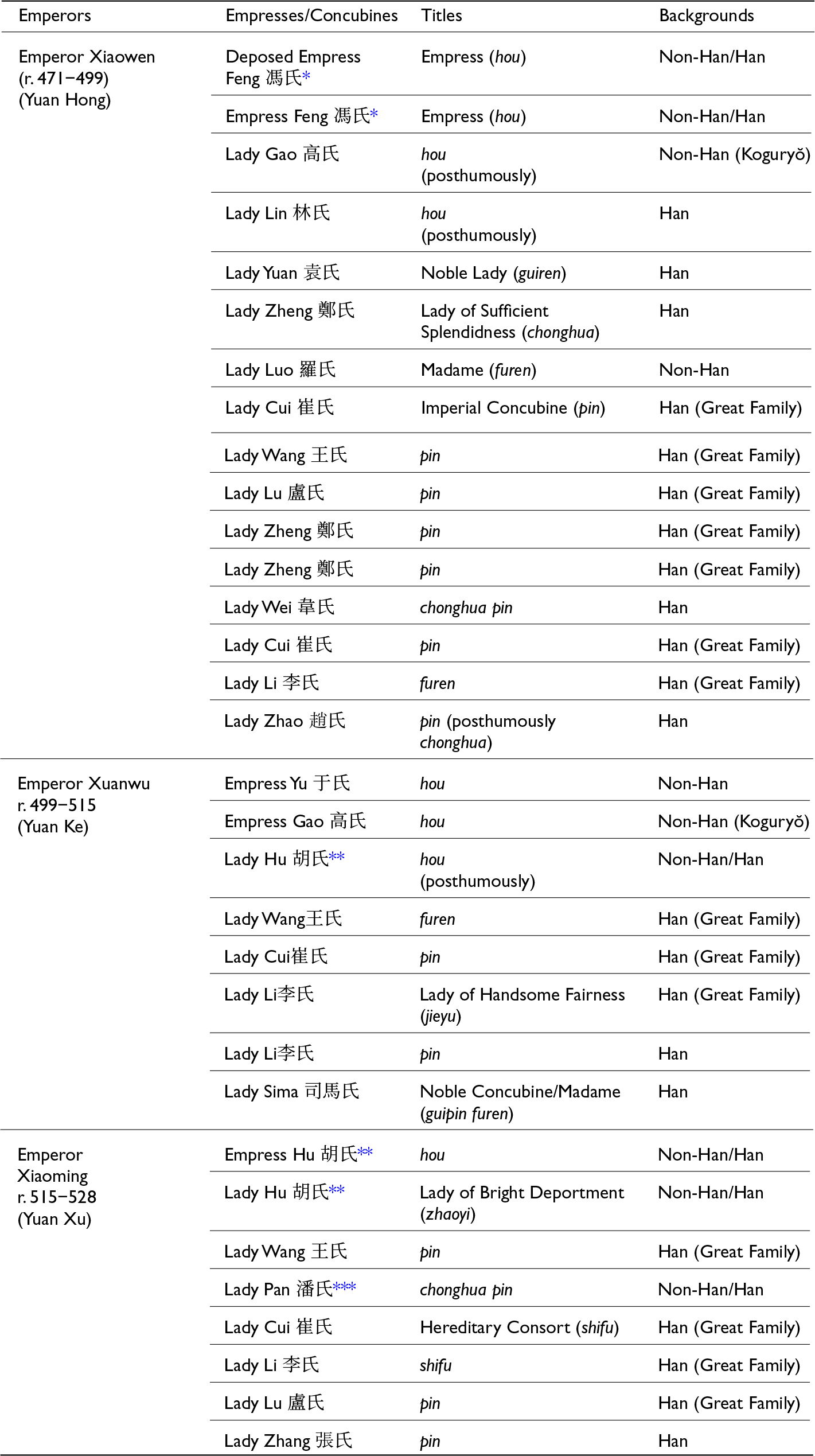
Along with these domestic policies, at the same time Xiaowen took several concubines of Han origin.Footnote 69 According to Comprehensive Mirror in Aid of Governance (Zizhi tongjian 資治通鑑), Xiaowen cherished the Four Great Families, and so in 496, he accepted their daughters as concubines. Later, he accepted a daughter from the Li family of Longxi as his furen. His acceptance of Han concubines extended beyond himself as he also encouraged imperial princes to marry women from the Great Families.Footnote 70 As can be seen in Table 1 in the Appendix, 12 out of Xiaowen’s 14 concubines were of Han origin.Footnote 71 Of the 12, seven were from the Great Families.Footnote 72 This trend of installing concubines of Han origin continued in the reigns of his successors, Xuanwu and Xiaoming. Five out of Xuanwu’s six concubines were of Han origin, including three from the Great Families: one from the Wang family of Langye 琅邪王氏, one from the Cui Family of Qinghe, and one from the Li family of Zhaojun 趙郡李氏.Footnote 73 Five out of Xiaoming’s seven concubines were from Han families and four of them were from the Great Families.Footnote 74 This trend becomes untraceable after Emperor Xiaoming due to a lack of records on emperors’ concubines. However, based on the aforementioned cases alone, it can be surmised that the Northern Wei policy of emperors accepting concubines from predominantly Han families endured for approximately 50 years after Xiaowen. While Northern Wei empresses were of non-Han backgrounds, the fact that the majority of the emperors’ concubines were of Han origin demonstrates the emperors’ intent to involve people from all backgrounds, including Han peoples, in their court.Footnote 75
Outside of the harem of emperors, princesses were also a useful medium to connect the imperial family with other groups. Unlike the dichotomy seen between empresses and concubines, Northern Wei princesses were married into an assortment of Han and non-Han groups. According to Li Jinhe 李金河, who compiled data on a total of 50 recorded marriages of Northern Wei princesses, 20 were married to men of Han origin, 25 to men with a Xianbei background, and five to men from other non-Han groups.Footnote 76 With the Northern Wei court critically needing support from the Xianbei, many of the princesses were married to men from various Xianbei groups who followed the Tuoba group when they established Northern Wei.Footnote 77 The number of marriages increased during the reigns of Xiaowen and Xuanwu.Footnote 78 Of these marriages, a total of 17 were with men from the Han Great Families.Footnote 79
Princesses were convenient political assets to use to create friendly relations with diverse local elites, including not only leaders of refugee groups from other states and members of select non-Han lineage, but also the Han elite.Footnote 80 This seems particularly true after Xiaowen implemented the New Ranking System of the Clans. In addition to accepting Han concubines, Xiaowen conducted reciprocal intermarriages with the Lu family of Fanyang. He received Lu Min’s 盧敏 daughter as his concubine and his daughter Grand Princess of Jinan 濟南長公主 was married to Lu Min’s nephew, Lu Daoqian 盧道虔. Lu Daoyu 盧道裕, another nephew of Lu Min, was married to Xiaowen’s sister, Grand Princess of Lelang 樂浪長公主.Footnote 81 Accepting a plurality of Han concubines and the cases of intermarriage during Xiaowen’s reign strongly indicate his intent to create robust connections with the Han elite.
Princes and male members of the Tuoba family were also married to women of the Han Great Families.Footnote 82 With all members of the imperial family, including empresses, concubines, princesses, and princes, at their disposal, the Northern Wei rulers enforced an intermarriage practice that integrated people of diverse group origins into the imperial family and the upper classes. However, it is important to note that many of the concubines of Han origin in the harems of the Northern Wei emperors were not bestowed with particularly high ranks.Footnote 83 Among the seven concubines from the Great Families in Xiaowen’s harem, with the exception of a concubine from the Li family of Longxi who was bestowed with the title of furen, the rest were given the title of Imperial Concubine (pin 嬪). Similarly, Xuanwu only appointed one concubine from the Great Families as furen and Xiaoming appointed one out of the four concubines from the Great Families as pin, with the other three given the title of Hereditary Consorts (世婦 shifu).Footnote 84 A passage in the ‘Biography of Empress Xiaoming’ provides further insight into this principle of conferral.
Emperor Suzong (Xiaoming) had quite the drinking manner. [He] only favored Lady Pan, thus the empress and imperial concubines were not favored. The empress dowager selected [concubines] for Suzong so that not only one would be favored. At the time, the daughters of Cui Xiaofen of Boling, Lu Daoyue of Fanyang, and Li Zan of Longxi etc. became nothing other than Hereditary Consorts.Footnote 85
肅宗頗有酒德, 專嬖充華潘氏, 后及嬪御並無過寵。太后為肅宗選納, 抑屈人流。時博陵崔孝芬、范陽盧道約、隴西李瓚等女, 但為世婦。
When the mother of Xiaoming, Empress Dowager Ling née Hu, selected his concubines from the Great Families, she made them ‘nothing other’ (dan 但) than shifu.Footnote 86 She intentionally appointed these concubines of Han origin to relatively low ranks.Footnote 87 The divide between non-Han empresses and Han concubines, and the relatively lower status of the Han concubines compared to their non-Han counterparts, suggest that the Northern Wei court made distinctions in the selection of marriage partners in their system of political intermarriage.Footnote 88
Installation of coterminous empresses in the northern states
Beyond the borders of the Northern Wei state, other northern states during the Sixteen Kingdoms and Northern Dynasties periods employed imperial women to consolidate their rule. Among the many uses of imperial women was the practice of installing multiple empresses, or coterminous empresses, which, while not uncommon for nomadic rulers, is quite rare in Chinese history.Footnote 89 Coterminous empresses were those who served in their roles concurrently. They first appeared during the reign of Liu Cong 劉聰 (r. 310–318) of Former Zhao, who appointed his original empress as Senior Empress 上皇后 and his concubines as Left and Right Empresses 左右皇后.Footnote 90 Commenting on this occurrence in his Nian’ershi zhaji 廿二史箚記, Zhao Yi 趙翼 (1727–1814), an eminent scholar of the Qing period, observed that ‘when troubled dynasty arrived, law and discipline were completely absent and there have been cases of installing plural empresses simultaneously’ (至荒亂之朝, 則漫無法紀, 有同時立數后者。).Footnote 91 Along with the case of Liu Cong, Zhao Yi cited two other cases of coterminous empresses. The next case was of Sun Hao 孫皓 (r. 264–280) of Wu 吳, one of the Three Kingdoms.Footnote 92 After Sun Hao expelled his empress Lady Teng 滕氏, many women in the palace wore the royal seal of empress.Footnote 93 The last case featured Emperor Xuan 宣帝 (r. 578–579) of Northern Zhou who appointed five empresses. In his assessment of the practice of coterminous empresses, Zhao Yi deemed the reigns of Sun Hao and Emperor Xuan to have marked the end of their respective dynasties, and regarded Former Zhao, one of the Sixteen Kingdoms, as an example of turmoil and troubled times. Therefore, he concluded that this practice only appeared during disordered times.Footnote 94 An analysis of these cases proves Zhao Yi’s statement to be inaccurate, as out of the three cases, only Liu Cong and Emperor Xuan officially appointed coterminous empresses. Sun Hao did not officially appoint any of his palace ladies as empresses.Footnote 95
In Former Zhao, Liu Cong appointed several empresses after the death of Empress Huyan 呼延皇后. At first, he installed two daughters of Grand Guardian 太保 Liu Yin 劉殷 as Left and Right Noble Concubines 左右貴嬪, and four granddaughters of Liu Yin as Noble Ladies 貴人.Footnote 96 Among them, Left Noble Imperial Concubine née Liu 左貴嬪 劉氏 became an empress.Footnote 97 Later, he appointed two daughters of Capital Protector 中護軍 Jin Zhun 靳準 as Left and Right Noble Imperial Concubines 左右貴嬪 and installed them as Senior Empress 上皇后 and Right Empress 右皇后. Concurrently, Noble Consort Liu 貴妃 劉氏 was installed as Left Empress 左皇后.Footnote 98 After Senior Empress née Jin was dethroned due to her infidelity, Senior Empress Fan 樊氏 and Left Empress née Wang 王氏 were also appointed.Footnote 99
The coterminous practice in Former Zhao helped contain the power of influential men in court. Apart from Liu Yin, Empress Liu’s father, whose power in court is unclear, records show that the fathers of the other empresses wielded abundant power. Jin Zhun seized control of the military, and after the death of Liu Cong, staged a coup and killed Liu Can, the successor of Liu Cong, installing himself as the Great King of Han 漢大王.Footnote 100 When Liu Cong appointed Wang Shen’s 王沈 adopted daughter as Left Empress and Xuan Huai’s 宣懷 daughter as Middle Empress 中皇后, both Wang and Xuan became central nodes of power in court. Their authority is illustrated by an episode in which an official who petitioned for the removal of Wang Shen’s daughter as Left Empress was executed in the Eastern Market 東市. Before his execution, the official accused Jin Zhun and Wang Shen of being the main instigators of the state’s ruin.Footnote 101 By installing the daughters of these powerful men as coterminous empresses and pitting these influential factions against one another, Liu Cong created a system of checks and balances in an attempt to contain his political rivals and stabilize his own power.
Liu Cong’s appointment of coterminous empresses should also be understood in the context of the dual administration system, one of the founding principles of Former Zhao. In his reformation of the bureaucracy, Liu Cong created the positions of Left and Right Directors of Convict Labor 左右司隸 tasked with managing 200,000 Han households, and the positions of Left and Right Wing Commanders of Chanyu 單于左右輔 were charged with supervising 100,000 non-Han groups.Footnote 102 In adhering to this policy established by his predecessors, Liu Cong demonstrated his dedication to continuing a confederation consisting of both Han and non-Han peoples.Footnote 103 With respect to his empresses, Liu Cong accepted both non-Han and Han women, even though the records are not always clear about their backgrounds. His first empress, Lady Huyan, hailed from a prominent Xiongnu group.Footnote 104 Liu Cong also particularly favoured Empress Liu’s family which was of Han origin. Her father, Liu Yin, was a descendant of Duke Kang of Liu of Zhou 周劉康公, and many of his daughters and granddaughters also served as Liu Cong’s concubines. When Emperor Huai 懷帝 (r. 307–313) of the Jin dynasty was held captive, Liu Cong held a banquet for him and appointed him as Duke of Kuaiji Commandery 會稽郡公. As a gesture of goodwill, he gave Emperor Huai one of his concubines, Lady Liu, the granddaughter of Liu Yin, who was introduced as ‘a granddaughter of a famous minister’ 名公之孫, to be his principal wife.Footnote 105 In Former Zhao, the appointment of coterminous empresses seemed to have also served the purpose of further integrating Han and non-Han elites.
In Northern Zhou, the coterminous empress practice was first enforced by Emperor Xuan. His rise to the throne was tumultuous on account of the purge of imperial princes and powerful courtiers who tried to usurp power following the death of his father, Emperor Wu 武帝 (r. 561–578).Footnote 106 To consolidate his position after the purge, he enlisted the help of his father-in-law, Yang Jian 楊堅 (r. 581–604), the future founder of Sui, who claimed Han descent and had extensive Xianbei military experience.Footnote 107 After Emperor Xuan ascended the throne, Yang Jian was swiftly appointed Senior Pillar of the State 上柱國, Grand Marshal 大司馬, and Grand Rear Councillor 大後丞.Footnote 108 However, to keep Yang Jian’s influence over the court in check and secure his son’s succession, Emperor Xuan abdicated and installed his son as Emperor Jing 靜帝 (r. 579–581), but he still continued to hold the reins in court, naming himself Heavenly Primary Emperor 天元皇帝.Footnote 109 After abdicating and crowning his son, Emperor Xuan started installing coterminous empresses. Women who should have been installed as empress dowagers were installed as empresses as well.Footnote 110 Therefore, during the reign of Emperor Jing, there were effectively two emperors and six empresses, including Emperor Jing’s empress Lady Sima.Footnote 111 For Emperor Xuan, these empresses were part of a key strategy to counterbalance the power of Yang Jian.
According to a passage in the History of Northern Zhou (Zhou shu 周書), Emperor Xuan first installed Empress Yang as Heavenly Primary Empress 天元皇后 and later, the other empresses:
Later, the emperor called himself Heavenly Primary Emperor, and the empress Heavenly Primary Empress. Before long, he installed Heavenly Empress and, Left and Right Empresses, which together with [the Heavenly Primary] Empress, makes four empresses. In the second year, he announced, ‘Emperor Shun married two women, and [this was because] the virtue of the empresses made a pair with the emperor. There are four constellations in the sky, the configuration of consorts is therein shining brightly’… Before long, he appointed Heavenly Middle Great Empress, which together with [other four] empresses makes five empresses.Footnote 112
帝後自稱天元皇帝, 號后為天元皇后。尋又立天皇后及左右皇后, 與后為四皇后焉。二年, 詔曰: ‘帝降二女, 后德所以儷君; 天列四星, 妃象於焉垂耀。…’ 尋又立天中大皇后, 與后為五皇后。
Wanting to follow the configuration of the four constellations, Emperor Xuan appointed four empresses and later decided on one more empress. Empress Yang 楊皇后 was the daughter of Yang Jian and held the title of crown princess when Emperor Xuan was still the crown prince. Other than Lady Zhu, the other three were consorts (fei) before they were installed as empresses.Footnote 113 Empress Chen 陳皇后, the daughter of Great General 大將軍 Chen Shanti 陳山提, was initially appointed Virtuous Consort 德妃, while Empress Yuan 元皇后, the daughter of Commander 開府 Yuan Sheng 元晟, was initially appointed as Noble Consort 貴妃.Footnote 114 Empress Yuchi 尉遲皇后, a granddaughter of Yuchi Jiong 尉遲逈, was formerly married to Duke of Xiyang 西陽公, Yuwen Wen 宇文溫, and later entered the palace as Long Noble Consort 長貴妃.Footnote 115 While Empress Zhu became empress as the mother of Emperor Jing, she seems to have been the only empress to have not hailed from an illustrious family, nor did she hold a rank before her appointment.Footnote 116
Emperor Xuan employed the coterminous empress practice to enact a system of polyarchy to stabilize his family’s rule. He brought Lady Yuchi, who was already married to his cousin Yuwen Wen 宇文溫, to the palace and installed her as a consort.Footnote 117 Emperor Xuan chose to make Lady Yuchi a concubine since this would guarantee the support of her grandfather Yuchi Jiong 尉遲迥, who had been Grand Preceptor 太師 and Senior Pillar of the State since the reign of Emperor Wu.Footnote 118 He later appointed her as Heavenly Left Great Empress and her grandfather as Grand Senior Adviser 大前疑 in the second month of 579.Footnote 119 Similarly, the daughter of Sima Xiaonan 司馬消難 was appointed as an empress of Emperor Jing. Of Han descent, Sima Xiaonan was a Military Inspector of Yuzhou 豫州刺史 who defected from Northern Qi.Footnote 120 Following Yang Jian’s appointment as Grand Senior Adviser in the seventh month of 579, Emperor Xuan appointed Sima Xiaonan as Grand Rear Councillor, and a few days later, installed his daughter as an empress.Footnote 121 In addition, Emperor Xuan appointed Chen Shanti, whose daughter was Heavenly Middle Great Empress Chen, as Senior Pillar of the State and Grand Chamberlain for the Imperial Clan 大宗伯.Footnote 122 Coincidentally, Emperor Xuan’s death resulted in a power struggle among the fathers of the empresses, with Yang Jian on one side and Yuchi Jiong and Sima Xiaonan on the other. Emperor Xuan’s efforts to create a stable polyarchal system ultimately failed as his son Emperor Jing was dethroned by Yang Jian.
This coterminous empress practice was based on the principles of Northern Zhou’s state ideology. Yuwen Tai 宇文泰 (507–556), who played a crucial role in the founding of Northern Zhou, put in place policies to satisfy both Han and non-Han peoples. One of his policies was the use of the Rites of Zhou (Zhouli 周禮) for Northern Zhou’s bureaucratic system.Footnote 123 Pak Han-je argued that the adoption of Zhouli was not a show of Sinicization, but, rather, the pursuit of an era when there was no distinction between Han and non-Han peoples. Using the Rites of Zhou as the basis of his political ideology, Yuwen Tai also created the Twenty-Four Armies, a militia system later called fubing 府兵.Footnote 124 Tōdō Kōjun 藤堂光順 asserted that relations and positions within the fubing system should be understood as ‘tō’i’ 等夷 or of equal rank.Footnote 125 Apart from Empress Zhu, who came from a relatively humble background, the other empresses’ fathers were all given equivalent ranks of Senior Pillars of the State by Emperor Xuan under the fubing system.Footnote 126 Emperor Xuan used the system to assign all the fathers of the empresses the same rank to not only build a system of checks and balances within court but also to preserve the founding principles of Northern Zhou by promoting parity in court. His intent is further revealed by his attempt to appeal to Han officials and people by invoking an ancient mythical figure in his appointment of coterminous empresses. He cited the legendary Chinese mythical figure, Emperor Shun (Yu Shun 虞舜), who had two wives, the daughters of Emperor Yao 堯.Footnote 127 Stemming from principles of Han and non-Han coexistence, the practice of coterminous empresses in the Northern Dynasties served as a rulership strategy to suppress hostile forces in court, stabilize the rule of the imperial family, and promote integration between Han and non-Han peoples.Footnote 128
Conclusion
The chaotic political environment of the Sixteen Kingdoms and Northern Dynasties periods compelled the northern rulers to adopt practical strategies in their rule over dispersed, heterogeneous populations. The endeavour to consolidate power and to integrate diverse elites was not mutually exclusive as the pursuit of one could quite often overlap with the other. This article has uncovered and examined three of these practices which contributed to the advancement of cosmopolitanism prior to Tang.
For Northern Wei, one of their weightier concerns centred around the influence of maternal kin power. Prior to the founding of the dynasty, the influence of mothers, especially those who originated from highly esteemed groups, was acknowledged and an accepted part of the power dynamics in earlier Xianbei society. To preclude the rise of such maternal kin power, the Northern Wei court famously established the practice of zigui musi to kill the mothers of crown princes. Purging the mothers of future emperors helped prevent the emergence of additional centres of power in court. Similarly, the Northern Wei court enforced another practice that aimed to control maternal kin power. An examination of the records shows that no crown princesses were installed throughout the Northern Wei dynasty. This was exceptional as the principal wives and harems of Northern Wei emperors and imperial princes were all bestowed with official ranks and titles. Forgoing the appointment of crown princesses complemented the zigui musi practice by preventing the potential rise of powerful crown princesses and their maternal kin.
The absence of crown princesses coincided with the intermarriage practices of Northern Wei which connected the imperial family to diverse local elites. With the exception of posthumous empresses who were victims of zigui musi, appointed empresses hailed from the ruling families of various subjugated non-Han groups. In stark contrast to empresses, the vast majority of the emperor’s concubines were of Han origin, many of whom came from the Great Families. Outside of the harem of emperors, imperial princesses were wedded to a diverse group of Han and non-Han peoples, while princes were married to women of the Han Great Families. With all members of the imperial family at their disposal, emperors used the intermarriage system to include elites of all backgrounds in the court and tie them to the imperial family. These practices worked alongside the New Ranking System of the Clans introduced by Emperor Xiaowen which encouraged relations between Han and Xianbei peoples, demonstrating the intent of the rulers to integrate the upper classes. By embracing the conquered peoples and maintaining friendly relations with Han aristocratic families, the Northern Wei rulers nurtured coexistence in their courts.
Apart from Northern Wei, the Former Zhao and Northern Zhou dynasties also observed practices that contributed to cosmopolitan societies, namely the installation of coterminous empresses. Liu Cong of Former Zhao appointed several coterminous empresses following the death of Empress Huyan, and Emperor Xuan of Northern Zhou appointed six coterminous empresses for him and his son. Most of these empresses came from powerful families of both Han and non-Han backgrounds. These emperors attempted to strengthen their own power by connecting the families of these empresses to the imperial family; at the same time they also created a system of checks and balances by appointing these women to the same rank so as to pit various dominant court factions against one another. When considering the bureaucracies and administrations of both Former Zhao and Northern Zhou, which favoured coexistence between Han and non-Han peoples, the emperors also seem to have implemented the coterminous empress system as a platform of parity for elites of diverse backgrounds.
Rulers of the northern states enforced these practices to stabilize their rule over pluralistic societies. While only glimpses of the intent behind these practices can be seen, these practices ultimately provided a path for imperial families and elites of diverse backgrounds to connect and cross cultural boundaries. By tying these local elites to their respective imperial families, northern rulers integrated pre-existing nodes of power into court and brought stability to their rules over a multicultural populace. Imperial women were central to these practices as they helped maintain a delicate balance of power in the courts of the northern states and contributed to the making of cosmopolitan societies prior to Tang.
Acknowledgements
I thank Annie Chan and Pamela Crossley for their comments on earlier drafts of this article, both anonymous reviewers of MAS for their thorough comments, and editors Johan Elverskog and Sumit Guha for guiding me through the publication process.
Competing interests
The author declares none.
Appendix
Titles and backgrounds of empresses and concubines between the reigns of emperors Xiaowen and Xiaoming.

* The Feng family was ethnically Han. However, considering that they were the direct successors of Northern Yan 北燕, one of the Sixteen Kingdoms, founded by the Murong group, I designate them as both non-Han and Han.
** I deduce that Empress Dowager Hu and her relatives were either of non-Han origin or heavily influenced by Xianbei culture. Their ancestors were the followers of Later Qin rulers. Also, there is a possibility that the Hu family are descendants of the Hegu 紇骨 group, a non-Han surname. Here, I designate them as non-Han/Han.
*** Lady Pan’s origins are unclear in the records.