Introduction
Studies examining staff–patient agreement on needs for care, conducted in different settings and among patients with different mental health conditions, have consistently shown that professionals and service users display divergent opinions regarding the presence of needs and whether or not needs have been met (Slade et al. Reference Slade, Phelan and Thornicroft1998; Lasalvia et al. Reference Lasalvia, Ruggeri, Mazzi and Dall'Agnola2000; Hansson et al. Reference Hansson, Vinding, Mackeprang, Sourander, Werdelin, Bengtsson-Tops, Bjarnason, Dybbro, Nilsson, Sandlund, Sorgaard and Middelboe2001; Ochoa et al. Reference Ochoa, Haro, Autonell, Pendas, Teba and Marquez2003). Patients and staff prioritize different aspects of care and relate to different types of information in defining an unmet need. Patients are more concerned with problems related to social integration in the community, whereas staff seem to attach a higher priority to the impairments and deficits associated with diagnosis and its psychiatric treatment (Comtois et al. Reference Comtois, Morin, Lesage, Lalonde, Likavcanova and L'Ecuyer1998; Lasalvia et al. Reference Lasalvia, Ruggeri, Mazzi and Dall'Agnola2000). These findings suggest that staff and patient ratings are not interchangeable when assessing needs and therefore, in order to plan and provide effective needs-led mental health care, it is not sufficient to assess staff or patient views alone. Instead, it is necessary to take both perspectives into account and to negotiate care goals on the basis of both the subjective views of the patient and the professional's judgement (Thornicroft & Tansella, Reference Thornicroft and Tansella2005).
The few studies published on this topic have been conducted in primary care settings and report better clinical outcomes when practitioners and patients agree about the nature of patients' core presenting problems (Starfield et al. Reference Starfield, Wray, Hess, Gross, Birk and D'Lugoff1981; Gabbay et al. Reference Gabbay, Shiels, Bower, Sibbald, King and Ward2003). No previous research has assessed whether good staff–patient agreement on needs has any impact on mental health outcome in patients treated in specialist services. We hypothesized that greater staff–patient agreement would lead to a more favourable treatment outcome in patients receiving community psychiatric care; this more favourable outcome is assumed to be mediated through higher treatment uptake that, in line with a model of care based on partnership, would be derived from a more positive therapeutic relationship and more appropriate joint decisions.
In this paper we aimed to assess whether, and to what extent, agreement on needs for care between staff and patients predicts treatment outcome in a sample of subjects receiving community-based psychiatric care. Specifically, we expected that higher levels of staff–patient agreement at baseline would predict at 4 years: (1) a more favourable clinical and social outcome and (2) greater satisfaction with life and satisfaction with the care received.
Method
Design
This was a naturalistic 4-year prospective longitudinal study, conducted within the context of the South-Verona Outcome Project (SVOP; Ruggeri et al. Reference Ruggeri, Bisoffi, Fontecedro and Warner2001, Reference Ruggeri, Leese, Slade, Bonizzato, Fontecedro and Tansella2004; Lasalvia et al. Reference Lasalvia, Ruggeri and Santolini2002, Reference Lasalvia, Bonetto, Malchiodi, Salvi, Parabiaghi, Tansella and Ruggeri2005). Staff–patient agreement on needs for care was assessed at baseline (T0) on a 3-month treated prevalence cohort attending the South-Verona Community-based Mental Health Service (CMHS; Tansella et al. Reference Tansella, Amaddeo, Burti, Ruggeri, Godberg and Thornicroft1998). At 4 years (T1), both staff- and patient-rated needs were reassessed with a set of staff- and patient-rated outcome measures. Patients were only interviewed after informed consent had been gained. Research staff explained the purpose of the study, gave full details to each patient in writing and made clear that participation was voluntary; potential participants were told that they could choose whether to participate or not, or to participate and withdraw at a later time. Confidentiality was fully preserved. The study obtained the ethical approval by the research ethics committee of the Academic General Hospital of Verona.
Outcome measures
Needs for care were assessed using both patient (CAN-P) and staff (CAN-S) versions of the Camberwell Assessment of Need (CAN; Phelan et al. Reference Phelan, Slade, Thornicroft, Dunn, Holloway, Wykes, Strathdee, Loftus, McCrone and Hayward1995), which comprises 22 items grouped into five conceptual domains (health, basic, social, service, and functioning). For each CAN item, the need rating is made: 0 (no problem), 1 (no/moderate problem because of intervention, i.e. met need), 2 (current serious problem, i.e. unmet need), 9 (not known); for the purpose of analysis, ratings 0 and 9 were combined according to Slade et al. (Reference Slade, Phelan and Thornicroft1998).
Psychopathology was assessed by the ‘expanded version’ of the Brief Psychiatric Rating Scale (BPRS; Ventura et al. Reference Ventura, Green, Shaner and Lieberman1993); social disability was assessed by the ‘Social role’ section of the Disability Assessment Schedule (DAS; WHO, 1988); global functioning was assessed by the Global Assessment of Functioning Scale (GAF; APA, 1994); subjective quality of life was measured by the Lancashire Quality of Life Profile (LQL; Oliver et al. Reference Oliver, Huxley, Priebe and Kaiser1997); satisfaction with services was assessed by the Verona Service Satisfaction Scale (VSSS; Ruggeri & Dall'Agnola, Reference Ruggeri and Dall'Agnola1993); and sociodemographic, service utilization and diagnostic data were extracted from the South-Verona Psychiatric Case Register (PCR; Tansella et al. Reference Tansella, Amaddeo, Burti, Ruggeri, Godberg and Thornicroft1998).
Statistical analyses
Agreement in each staff–patient pair for the five CAN domains was calculated following the procedure described in Gabbay et al. (Reference Gabbay, Shiels, Bower, Sibbald, King and Ward2003). In detail, for each of the 22 items of the CAN, a weight was allocated: 2 if the pair agreed perfectly; 1 if the two subjects identified a need of different level; 0 if a subject identified a met need and the other no need; −1 if a subject identified an unmet need and the other no need. A score for each pair was computed by simple aggregation of the item weights pertaining to the five CAN domains. These raw scores were transformed into percentage scores (min=0%, max=100%) and used as levels of concordance: good ⩾90%, adequate 80–90%, poor <~80% (House et al. Reference House, House and Campbell1981).
To explore the effect of staff–patient agreement at baseline on outcome variables at follow-up, we performed a series of multiple block-stratified regression analyses (Ruggeri et al. Reference Ruggeri, Bisoffi, Fontecedro and Warner2001) with staff-rated (CAN-S, BPRS, GAF, DAS) and patient-rated (CAN-P, LQL, VSSS) outcome measures considered in turn as dependent variables (total scores and dimensions) and the agreement score in the five CAN domains as predictors. Diagnosis (being psychotic), clinical assessments at baseline (GAF, BPRS, DAS), service utilization in the previous year (number of admissions, out-patient contacts, day-care contacts, community care interventions) and levels at baseline of the same instruments considered as dependent variables were entered into the first four blocks to control for their effects. To explore the effect of staff–patient agreement at baseline on changes over 4 years in outcome variables, we followed the strategy described above, using residual change scores (Lasalvia et al. Reference Lasalvia, Bonetto, Malchiodi, Salvi, Parabiaghi, Tansella and Ruggeri2005).
Sensitivity analyses were performed to assess the robustness of results with respect to: (i) agreement scoring, (ii) clustering of clinical ratings for the different multidisciplinary teams, and (iii) adjustment for measurement errors in the clinical assessments. For point (i), the models were refitted with agreement coded in a more conservative way: 1 (perfect agreement) and 0 (disagreement). For point (ii), each patient was nested within the specific multidisciplinary team that their key professional belonged to (two-level hierarchical structure); multilevel regressions (which did not use the block strategy) were fitted with the same set of independent variables, considering in turn as agreement scoring the −2, −1, 0, 1 scale and the dichotomous one. For point (iii), structural equation models (Raykov et al. Reference Raykov, Tomer and Nesselroade1991; Dunn et al. Reference Dunn, Everitt and Pickles1993) were fitted, estimating underlying latent factors for psychopathology (measured by three observed variables: BPRS, GAF and DAS), subjective aspects of life (measured by two observed variables: LQL and VSSS), needs for care (measured by two observed variables: CAN-P and CAN-S) and patient–staff agreement (measured by five observed variables: percentage agreement on basic, social, health, services and functioning). Diagnosis and service utilization were not included in the models because we assumed that these variables were assessed without measurement errors; moreover, among the observed variables we considered only total scores for having a reasonable sample size with respect to the number of parameters to be estimated. The fit of the models, estimated by maximum likelihood, was assessed by the Bentler–Bonett normed fit index (Bentler & Bonett, Reference Bentler and Bonett1980), which should be at least 0.90.
All analyses were performed using SPSS version 14.0 (SPSS Inc., Chicago, IL, USA), with the exception of multilevel regression models and structural equation models for which stata version 8.0, ‘gllamm’ command (Stata Corporation, College Station, TX, USA), and amos version 7.0 (SPSS Inc.) were used respectively.
Results
Characteristics of the study cohort
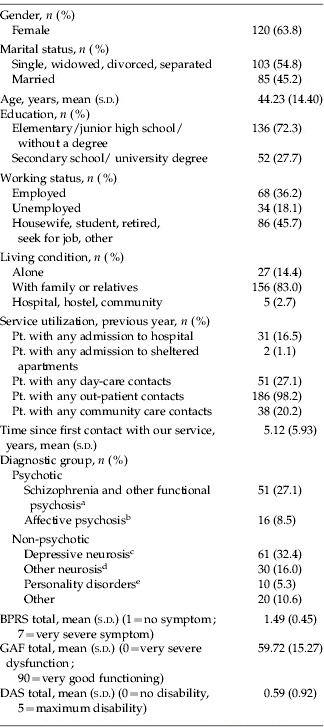
At baseline, 251 patients completed the entire set of instruments. At 4 years, 10 patients from the baseline cohort had died, one was affected by a severe cognitive impairment. Of the 240 patients eligible, 14 could not be located. A total of 188 (78%) completed both clinical evaluations (BPRS, GAF and DAS) and self-rated measures (LQLP and CAN-P) at follow-up; this cohort included both subjects in contact (n=110) and not in contact (n=78) with the CMHS and represents the study cohort. For patients still in contact with the CMHS after 4 years (n=110), the CAN-S and the VSSS were also completed at follow-up. The sociodemographic and clinical characteristics of the study cohort are presented in Table 1. Overall, the study cohort appeared relatively poor symptomatically and showed low levels of social disability, as indicated by BPRS, GAF and DAS mean scores.
Sociodemographic, service utilization and clinical characteristics of the study cohort at baseline (n=188)

BPRS, Brief Psychiatric Rating Scale; GAF, Global Assessment of Functioning; DAS, Disability Assessment Schedule; s.d., standard deviation.
a Includes the following ICD-10 diagnoses: F20, F21, F22, F23, F24, F25, F28, F84.
b Includes the following ICD-10 diagnoses: F30, F31, F32.2, F33.3.
c Includes the following ICD-10 diagnoses: F32 (F32.0, F32.1, F32.2, F32.8, F32.9), F33 (F33.0, F33.1, F33.2, F33.9), F43.1, F41.2, F43 (F43.20, F43.21, F43.22).
d Includes the following ICD-10 diagnoses: F40, F41 (F41.0, F41.1, F41.3, F41.8, F41.9), F42, F44, F45, F48, F54.
e Includes the following ICD-10 diagnoses: F34, F52, F60, F61, F62, F63, F64, F65, F66, F68, F69.
Staff–patient agreement at baseline
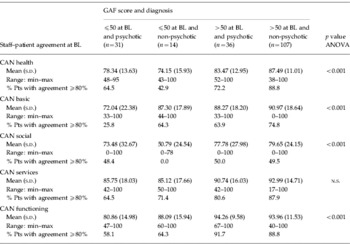
Staff–patient agreement was adequate for the health (80.8%), basic (84%), services (88.4%) and functioning (88.6%) domains but it was poor for the social (73.6%) domain. Table 2 presents the baseline levels of staff–patient agreement in the five needs domains by patients' clinical severity, as measured by the GAF, and the psychiatric diagnosis (psychotic versus non-psychotic).
Baseline levels of staff–patient agreement in the five need domains by clinical severity, as defined by combining levels of GAF scores and the psychiatric diagnosis

GAF, Global Assessment of Functioning; BL, baseline; ANOVA, analysis of variance; CAN, Camberwell Assessment of Need; s.d., standard deviation; n.s., not significant.
As expected on the basis of previous findings (Lasalvia et al. Reference Lasalvia, Ruggeri, Mazzi and Dall'Agnola2000), patients with more severe clinical conditions tended to show poorer agreement than those with less severe clinical conditions. However, the majority of staff–patient pairs in both groups tended to display at least adequate levels of agreement in each need domain. This suggests that the low average levels of staff–patient agreement found in the more severe psychotic patients do not reflect an overall generalized phenomenon, but are mainly due to the small number of staff–patient pairs that display the poorest agreement.
Agreement as predictor of levels of clinician-rated outcome at 4-years
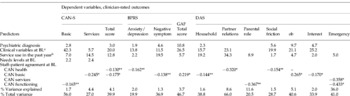
The results of the regressions for levels of clinician-rated needs, symptoms, global functioning and social disability are presented in Table 3 (only subscales predicted by staff–patient agreement are shown). Overall, these findings show that, adjusted for other confounders, the patients showing better agreement with their treating clinicians tended to display lower levels of staff-rated needs and psychopathology, higher global functioning and lower social disability at 4 years. Specifically, staff–patient agreement significantly impacted on two of the five CAN domains (basic and services), on global psychopathology and on two of the four BPRS factors (anxiety-depression and negative symptoms), on levels of global functioning and on seven of the eight items of the ‘Social role’ section of the DAS.
Staff–patient agreement as predictor of levels of clinician-rated and patient-rated outcomes at 4 years (n=188). Multiple block-stratified regression models: adjusted R2 are reported; for staff–patient agreement block, estimated β coefficients are also shown


CAN, Camberwell Assessment of Need (CAN-S, staff version; CAN-P, patient version); BPRS, Brief Psychiatric Rating Scale; GAF, Global Assessment of Functioning; DAS, Disability Assessment Schedule; BL, baseline; LQL, Lancashire Quality of Life Profile.
a Includes BPRS mean score, DAS mean score, GAF score.
b Includes admissions, out-patient contacts, day-care contacts, community care contacts.
* p<0.01, ** p<0.05.
Agreement as predictor of levels of patient-rated outcome at 4 years
Table 3 also shows the results of regression analyses for levels of self-rated needs, quality of life and satisfaction with services (again only subscales predicted by staff–patient agreement are shown). Overall, these findings indicate that, adjusted for the other confounding variables, patients showing better agreement with their treating clinicians tended to display lower levels of self-rated needs and higher levels of subjective quality of life at 4 years. Specifically, staff–patient agreement makes a significant contribution in explaining levels of self-rated needs in one of the five CAN domains (social), levels of overall quality of life and satisfaction with life in six of the 12 LQL domains (free time, money, house, family retains, health and affect balance). However, staff–patient agreement does not seem to have any significant effect on levels of satisfaction with services.
Agreement as predictor of changes in clinician-rated outcomes over the 4-year follow-up
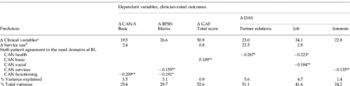
Table 4 presents the results of the regressions exploring the predictive value of baseline staff–patient agreement on changes in clinician-rated outcomes over the 4-year study period (only subscales predicted by staff–patient agreement are reported). Overall, these findings indicate that a good agreement on needs with their treating professionals gave patients a greater opportunity to gain additional improvements in clinician-rated outcomes over time. Specifically, staff–patient agreement predicted a reduction in staff-rated needs in one of the five CAN domains (basic), a reduction in symptom levels in one of the four BPRS factors (maniac excitement symptoms), an increase in global functioning and an improvement in three of the eight items of the DAS (relationship with partner, occupational role, interests and information).
Staff–patient agreement as predictor of changes in clinician-rated and patient-rated outcomes over the 4-year follow-up (n=188). Multiple block-stratified regression models: adjusted R2 are reported; for staff–patient agreement block, estimated β coefficients are also shown


CAN, Camberwell Assessment of Need (CAN-S, staff version; CAN-P, patient version); BPRS, Brief Psychiatric Rating Scale; GAF, Global Assessment of Functioning; DAS, Disability Assessment Schedule; BL, baseline; LQL, Lancashire Quality of Life Profile; VSSS, Verona Service Satisfaction Scale.
a Includes BPRS mean score, DAS mean score, GAF score.
b Includes admissions, out-patient contacts, day-care contacts, community care contacts.
* p<0.01, ** p<0.05, Δ, residual change scores.
Agreement as predictor of changes in patient-rated outcomes over the 4-year follow-up
The results of the regressions exploring the predictive value of baseline staff–patient agreement on changes in patient-rated outcomes over the 4-year study period are also presented in Table 4 (again only subscales predicted by staff–patient agreement are reported). Overall, these findings indicate that, accounting for the effect of the other clinical variables, a good agreement on needs with their treating professionals gave patients a greater opportunity to gain additional improvements in self-rated needs, subjective quality of life and satisfaction with the care received. Specifically, staff–patient agreement predicted a reduction in patient-rated needs in one of the five CAN domains (basic), an improvement in global quality of life and satisfaction with life in seven of the 12 LQL domains (free time, money, job, house, family relationships, health and affect balance) and an increase in two of the seven dimensions of the VSSS (access and types of interventions).
Sensitivity analyses
Two sensitivity analyses were performed to check the effect of: (1) a more conservative agreement scoring (0=disagreement v. 1=agreement), and (2) clustering for different multidisciplinary teams. Both the analyses had only a minor impact on the agreement–outcome associations (detailed data are available on request from the authors).
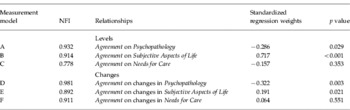
A further sensitivity analysis was performed to check the effect of adjustment for measurement errors in the clinical assessments. The path diagrams are available from the authors, while the corresponding standardized regression weights are shown in Table 5 (standardized regression weights for the other variables included in the models are also available on request).
Measurement models: standardized regression weights are reported for only patient–staff agreement at baseline as predictor of both levels of outcome variables at follow-up (psychopathology, subjective aspects of life, needs for care) and changes between baseline and follow-up, estimated by maximum likelihood using AMOS 7.0 (n=188)

NFI, Bentler–Bonett normed fit index; BPRS, Brief Psychiatric Rating Scale; GAF, Global Assessment of Functioning; DAS, Disability Assessment Schedule; LQL, Lancashire Quality of Life Profile; VSSS, Verona Service Satisfaction Scale; CAN, Camberwell Assessment of Need (CAN-S, staff version; CAN-P, patient version).
Latent variable Agreement is indicated by the five observed variables percentage agreement on basic, social, health, services and functioning. Latent variable Psychopathology is indicated by the three observed variables BPRS, GAF and DAS. Latent variable Subjective Aspects of Life is indicated by the two observed variables LQL and VSSS. Latent variable Needs for Care is indicated by the two observed variables CAN-P and CAN-S.
Adjustment for measurement errors in clinical variables had only a minor impact on the agreement–outcome associations (only the relationship between the latent variables ‘Needs for care’ – both levels and changes – and ‘Staff–patient agreement’ lost its significance). The percentage agreement measures used in the models are based on scoring −2/−1/0/1; the scoring 0/1 was not used because of the results of the sensitivity analysis on conservative agreement scoring.
Discussion
This study found that better staff–patient agreement on needs for care made a significant contribution to predicting improvement in patients' treatment in both clinician-rated and self-rated mental health outcomes. Moreover, even if staff–patient agreement tends to be poorer in more severely ill patients (Lasalvia et al. Reference Lasalvia, Ruggeri, Mazzi and Dall'Agnola2000), the effect of agreement on patients' outcomes seemed to occur in both severe and good-functioning subjects, regardless of their diagnostic category. Lower agreement in more severely ill patients should not be interpreted as an artefact of the concordance metric because staff–patient disagreement does not systematically occur (a) to the same extent in all need domains and (b) for all severely disabled patients who show complex need profiles, but it does occur for less than one-third of those patients. Therefore, it seems unlikely that the easiest way to get good agreement is to have few needs; rather, it is conceivable that lower agreement may be related to the difficulty of a given staff member to fully understand his/her patients' values and inner perceptions and to detect those specific needs that are of priority to the patients, regardless of the complexity of the patients' clinical and social conditions.
Methodological issues: strengths and weaknesses
The advantages of this study over previous work are: (i) the longitudinal design, which enables an examination of the predictive value of staff–patient agreement on treatment outcomes; (ii) the use of standardized measures of outcome in a series of clinically relevant key domains collected in routine clinical services; (iii) the inclusion of both clinician-rated and consumer-rated outcomes; (iv) a carefully identified cohort of patients who are representative of all those patients living in a defined catchment area who were treated by specialist mental health services, and who received comprehensive treatment in settings that prioritize continuity of care; and (v) the inclusion at follow-up of patients on the caseloads of mental health services and also those who interrupted treatment.
This research also has some limitations: (i) the specific study design did not allow us to identify any causal relationships (therefore the associations found should not be considered as representative of causation mechanisms); (ii) the study sample, being a prevalence cohort, is composed of both long-term patients and patients at their initial contact with the service, receiving differing types of interventions according to the specific phase of their illness; (iii) the study was conducted in a community-based setting, and no comparison with services offering a different type of care is provided, therefore caution is required in generalizing the results; (iv) the large number of independent variables used in the regression models may have caused significance level overstatements because of multiple testing.
Impact of staff–patient agreement on treatment outcomes
This study indicates that when patients agree with their treating clinicians on the identification of needs, significant additional improvements in mental health outcomes may be gained. The major impact of staff–patient agreement seems to be on self-perceived outcomes, such as self-rated social needs (i.e. overall social relationships, emotional and sexual relationships with the partner) and basic needs (i.e. basic requirements for a person to live a decent everyday life, such as accommodation, food and daytime activities). Among self-perceived outcomes, the main effect of staff–patient agreement was found on subjective quality of life. The fact that meeting self-rated needs, beyond symptoms reduction, contributes to increase quality of life in patients treated in community mental health services has been reported previously (Lasalvia et al. Reference Lasalvia, Bonetto, Malchiodi, Salvi, Parabiaghi, Tansella and Ruggeri2005; Slade et al. Reference Slade, Leese, Cahill, Thornicroft and Kuipers2005); what this study adds is that a further substantial contribution to subjective quality of life improvement may be due to convergent opinions between staff and patients on which needs should be prioritized and met, that is the adoption of an effective negotiation process on the assessment of needs.
In line with previous research that reported a significant negative correlation between unmet needs and satisfaction with services in patients receiving community psychiatric care (Leese et al. Reference Leese, Johnson, Slade, Parkman, Kelly, Phelan and Thornicroft1998), our data indicate that staff–patient agreement exerts a significant impact on some specific satisfaction dimensions, such as the perceived accessibility of the service and the perceived efficacy of interventions being offered.
A finding of particular interest is that staff–patient agreement contributes in predicting treatment outcomes not only with regard to self-perceived outcomes but also with regard to clinician-rated variables, such as levels of symptoms (in particular, the excitement dimension) and functioning in social roles (specifically, relationship with partner, parental role and behaviour during emergencies).
Regarding the clinical significance of our results, we would like to stress that, given the baseline characteristics of the study cohort, composed by patients with long-term treatment, poorly symptomatic and relatively stable, the effect of agreement was not expected to be large; therefore, any small improvement not occurring by chance might be regarded as important from a clinical point of view. In this context, the observed 2–3% incremental improvement produced by staff–patient agreement on both self-rated and clinician-rated outcomes (as indicated by the regression coefficients), though modest from a statistical point of view, represents a clinically meaningful added value in terms of health gained.
Impact of staff–patient agreement on outcome: possible explanations and future directions
The effect of staff–patient agreement on treatment outcome does not seem to be an artefact of the concordance metric (i.e. pairs with highest agreement also have no/fewest needs and so are least likely to be highly disabled and so most likely to spontaneously improve) because high levels of staff–patient agreement – though more frequent in good-functioning subjects – were also found, depending upon the specific need domain, from one-third to one-half of the more severely ill patients. However, as the association found was of relatively modest magnitude, it seems unlikely that staff–patient agreement leads directly to improved outcomes. Rather, it is possible that other intervening variables may be involved in the casual chain leading to the improvement in outcome. Indeed, we speculate that better mutual understanding between patients and professionals may help patients to feel more responsible for their own treatment plans, thus resulting in improved therapeutic alliance, higher treatment adherence, increased intervention uptake and, consequently, a greater effectiveness of the intervention provided. We hypothesize that a central role in this process may be played by the therapeutic alliance because, particularly in a community setting, no care can be delivered without establishing a good staff–patient relationship. In fact, a positive relationship with one's primary treating clinician has been consistently found to predict a better treatment outcome in multiple domains (Frank & Gunderson, Reference Frank and Gunderson1990; Priebe & Gruyters, Reference Priebe and Gruyters1993; Martin et al. Reference Martin, Garske and Davis2000; McCabe & Priebe, Reference McCabe and Priebe2004). In addition, previous research indicates that the quality of the therapeutic relationship and the extent to which the patient's agenda and health beliefs are acknowledged are important determinants of a patient's attitudes towards treatment and adherence to medication (Fenton et al. Reference Fenton, Blyler and Heinssen1997; Howgego et al. Reference Howgego, Yellowlees, Owen, Meldrum and Dark2003; Day et al. Reference Day, Bentall, Roberts, Randall, Rogers, Cattell, Healy, Rae and Power2005). In this context, staff–patient agreement might be seen, in the Baron & Kenny (Reference Baron and Kenny1986) sense, as: (1) a moderator, potentially enhancing the effect of the therapeutic relationship on patients' outcome, and/or (2) a mediating variable through which other treatment processes, such as the therapeutic alliance, would influence patients' outcome. Our study design did not allow us to address these issues directly; further research is needed to explore the specific nature of interaction between staff–patient agreement, therapeutic relationship and treatment outcome, by incorporating in the study designs scales specifically developed and validated for assessing therapeutic relationship in community psychiatric services (McGuire-Snieckus et al. Reference McGuire-Snieckus, McCabe, Catty and Priebe2007). A further additional step could include the implementation of randomized controlled studies, conducted in routine clinical settings, comparing standard care with specific strategies aiming to increase the therapeutic relationship. In this regard, a possible ‘experimental’ intervention might be based on the negotiation of needs for care between staff and service users, with subsequent systematic feedback on a regular basis and at short time intervals of the interim results and, if needed, reformulation and renegotiation of the agreed agenda (the hypothesis is that regular assessment of patients' views as part of the therapeutic process would improve both the therapeutic relationship and the outcome). A new generation of pragmatic trials focused on this specific topic is under way (Priebe et al. Reference Priebe, Bullenkamp, McCabe, Hansson, Rössler, Torres-Gonzales and Wiersma2002; Slade et al. Reference Slade, McCrone, Kuipers, Leese, Cahill, Parabiaghi, Priebe and Thornicroft2006).
Implications for clinical practice
A great challenge to specialist mental health services is to develop better methods of increasing consensus regarding service needs and the adequacy of services, while addressing resource limitations. This will require staff and service users to communicate more effectively regarding their differing perceptions of need, the effectiveness of various services and service options that are available. Staff attempts to increase consensus may be strengthened by gathering more information about the individual circumstances of their clients, including the current support available to them. Every effort should be made to train service professionals in the implications of contemporary tenets of empowerment and user involvement, and to more readily acknowledge the value of service users' knowledge and experiences (Chamberlin, Reference Chamberlin2005). Attempts should also be made to enhance a more active participative patient role in the planning of treatment. Staff may increase consensus by obtaining more feedback from users about the extent to which services are meeting their needs. Attempts to increase users' consensus will be enhanced by reorienting treatment philosophy within services so that users are viewed as ‘treatment team leaders’ as opposed to treatment recipients.
Acknowledgements
We are grateful to the patients who participated in the follow-up study and to the staff of the South-Verona CMHS for their kind collaboration in the Project. We are indebted to the colleagues who contributed to the assessments and specifically thank Liliana Allevi, Rosa Dall'Agnola, Francesca Malchiodi, Antonella Miletti, Paola Ognibene, Alberto Parabiaghi and Giovanni Salvi. We are most grateful to Doriana Cristofalo for assistance in data management. We also thank Dr Julia Jones for helping to revise an earlier version of the manuscript.
This study was supported by a grant from the Ministero dell'Istruzione, dell'Università e della Ricerca Scientifica (MIUR), Roma (fondi 60%) to Professor M. Ruggeri and by the Istituto Superiore di Sanità (ISS), Roma, Progetto Nazionale Salute Mentale, with a grant (No. 96/QT/50) to Professor M. Ruggeri.
Declaration of Interest
None.