Introduction
The Mediterranean fruit fly Ceratitis capitata (Wied.) (Medfly, Diptera: Tephritidae) is a globally important invasive insect (Malacrida et al., Reference Malacrida, Gomulski, Bonizzoni, Bertin, Gasperi and Guglielmino2007). In Argentina, C. capitata is one of the main fruit pests, found in all fruit-growing regions, where it causes significant damage to many commercial crops, endangering exports due to quarantine restrictions (SENASA, 2017). The Medfly is controlled by the sterile insect technique (SIT), as a component of area-wide integrated pest management (AW-IPM) programs (Hendrichs et al., Reference Hendrichs, Robinson, Cayol and Enkerlin2002). The SIT consists of a series of steps, which include mass-rearing of the target species, sex-separation, male irradiation, and release in the field (Knipling, Reference Knipling1955; Robinson, Reference Robinson2002). Once in the field, males need to find wild females to copulate, transfer an adequate ejaculate in quality and composition (sperm plus accessory gland proteins, AGPs), inhibit female receptivity (to avoid female encounter with a wild male) and trigger oviposition behavior. The AW-IPM programs incorporating the SIT have developed manuals that detail quality control tests to evaluate pre-copulatory and copulatory success of mass-reared sterile males (percentage of adult emergence, percentage of flying adults, male mating competitiveness, etc.) (FAO/USDA/IAEA, 2014), where measures of male post-copulatory performance have recently been included.
Mossinson and Yuval (Reference Mossinson and Yuval2003) suggested that male mechanisms used by Medflies to inhibit female remating occur in three steps: first, a long copulation decreases the risk of remating in the same day, during the daily window of sexual receptivity (Vera et al., Reference Vera, Cladera, Calcagno, Vilardi and McInnis2003); second, in the short-term, an adequate number of sperm being stored may act mechanically on stretch receptors of the spermathecae (Fritz and Turner, Reference Fritz and Turner2002); and third, in the long term, AGPs may act inducing physiological and behavioral changes in the female (Jang, Reference Jang1995, Reference Jang2002; Jang et al., Reference Jang, McInnis, Lance and Carvalho1998). Taken together, factors affecting copulation duration, number of sperm stored, and amount of proteins produced in accessory glands may impact male ability to induce refractoriness in females. Medfly females store sperm in two spermathecae, considered long-term storage organs and one ventral receptacle or fertilization chamber, where only the 4–12% of the sperm is stored (Seo et al., Reference Seo, Roger, Gilmore, Kurashima and Fugimoto1990; Twig and Yuval, Reference Twig and Yuval2005).
It is well-documented that mass-rearing and irradiation (imperative to SIT) can reduce male ability to transfer an adequate number of sperm to their mates and inhibit female remating (Mossinson and Yuval, Reference Mossinson and Yuval2003; Vera et al., Reference Vera, Cladera, Calcagno, Vilardi and McInnis2003; Gavriel et al., Reference Gavriel, Gazit and Yuval2009; Abraham et al., Reference Abraham, Goane, Rull, Cladera, Willink and Vera2011a). Sterile male Medflies transfer fewer sperm than non-irradiated males (Ohinata et al., Reference Ohinata, Chambers, Fujimoto, Kashiwai and Miyabara1971; Seo et al., Reference Seo, Roger, Gilmore, Kurashima and Fugimoto1990; Taylor et al., Reference Taylor, Kaspi, Mossinson and Yuval2001), and the number of sperm transferred is not correlated with copulation duration (Taylor et al., Reference Taylor, Kaspi, Mossinson and Yuval2001). In general, wild and laboratory females mated with sterile males remate more than those mated with control (wild or laboratory) males (Katiyar and Ramirez, Reference Katiyar and Ramirez1970; Bloem et al., Reference Bloem, Bloem, Rizzo, Chambers, Aluja and Liedo1993; Vera et al., Reference Vera, Cladera, Calcagno, Vilardi and McInnis2003; Morelli et al., Reference Morelli, Paranhos, Coelho, Castro, Garziera, Lopes and Bento2013). For example, Mossinson and Yuval (Reference Mossinson and Yuval2003) determined that wild females mated with sterile males (irradiated at 150 Gy) remate more often than females mated with wild males 24 h after the first copulation, while Gavriel et al. (Reference Gavriel, Gazit and Yuval2009) observed the same tendency for males irradiated at 100 Gy in the short, mid and long terms from the first copulation. However, Shelly and Kennelly (Reference Shelly and Kennelly2002) found that wildish females (F4) mated with sterile males (irradiated at 150 Gy) had the same remating probability at 2, 4, and 7 days after the first mating than females mated with wildish males. Vera et al. (Reference Vera, Cladera, Calcagno, Vilardi and McInnis2003) suggested that the differences between sterile and wild males are more due to artificial selection during mass-rearing than to irradiation per se; wild females mated with sterile males (irradiated at approximately 125 Gy) had shorter refractory periods than females mated with non-irradiated males of the same mass-reared strain. On the other hand, Kraaijeveld and Chapman (Reference Kraaijeveld and Chapman2004) attribute an important role of the irradiation process in the loss of post-mating competitiveness of sterile males with respect to their ability to transfer sperm and to inhibit female remating. Under such a scenario, a reduction of sterilization doses could improve male insemination success and induce refractoriness in their mates more efficiently.
While a dose of 100 Gy is sufficient to achieve 99.9% sterility of Medfly males (Ohinata et al., Reference Ohinata, Chambers, Fujimoto, Kashiwai and Miyabara1971), Medfly management programs tend to apply doses that cause 100% sterility (140 Gy) but severely affect sterile male behavior, mating success, and overall performance (Lux et al., Reference Lux, Vilardi, Liedo, Gaggl, Calcagno, Munyiri, Vera and Manso2002; Robinson et al., Reference Robinson, Cayol and Hendrichs2002). Until now, there are few data on sperm transfer/storage, male Medfly reproductive organs size and irradiation dose. Guerfali et al. (Reference Guerfali, Parker, Fadhl, Hemdane, Raies and Chevrier2011) determined that the sperm produced by males and stored by females was not affected by male irradiation dose (doses ranged from 50 to 145 Gy), and that the irradiation effect over male reproductive potential is mediated more by the impact on AGP quantity, rather than on the number of sperm transferred. However, to our knowledge, there are no studies that examine the relationship between irradiation dose and male accessory gland size, as a measure of fluid content (Ram and Ramesh, Reference Ram and Ramesh2002; Wigby et al., Reference Wigby, Sirot, Linklater, Buehner, Calboli, Bretman, Wolfner and Chapman2009), or testes size as a measure of male reproductive potential.
Medfly accessory glands consist of two long tubular glands (mesodermal glands) and a variable number of short glands (ectodermal glands). Of these, two are claviform and the others are finger-like. Mesodermal and ectodermal glands produce different secretions: lipids, polysaccharides, and proteins in the two mesodermal glands and mainly proteinaceous secretions in short ectodermal glands (Marchini et al., Reference Marchini, Del Bene, Cappelli and Dallai2003; Marchini and Del Bene, Reference Marchini and Del Bene2006). On the other hand, Leftwich et al. (Reference Leftwich, Edward, Alphey, Gage and Chapman2012) determined that male C. capitata with small residual testes size had a paternity advantage over other males. He also hypothesized greater sperm depletion rates in successful males (although successful males could also be transferring more sperm), and suggested that it would be useful to develop a method for measuring short and long male accessory gland size, making it possible to test for associations of small residual testis size with other reproductive traits to understand why small testes did not apparently limit male reproductive success.
Medfly populations are managed in semi-arid irrigated fruit-producing valleys of San Juan, central-western Argentina, through an area-wide fruit fly management approach mainly based on application of the SIT with massive releases of sterile (irradiated at 140 Gy) Medfly males of the temperature-sensitive lethal (tsl) genetic sexing Vienna-8 strain (Franz et al., Reference Franz, Kerremans, Rendon, Hendrichs, McPheron and Steck1996; Alós et al., Reference Alós, Llera and Taret2014). Sterile males are released when they are 4 day-old, because younger males tend to have lower mating propensity and competitiveness (Shelly et al., Reference Shelly, Edu and Pahio2007). Therefore, it is necessary to complement quality control tests of males produced under SIT in Argentina with studies evaluating male ability to inhibit remating of wild females in the short and mid-terms. On the other hand, a decrease in irradiation doses regularly applied to males (from 140 to 100 Gy) could increase their pre- and post-copulatory performance, while keeping males with a high percentage of sterility (99.9%), thus improving the efficiency of the technique. Therefore, the objectives of this study were to determine (i) the effect of a reduction in irradiation doses in male mating success, latency to mate, copulation duration and ability to inhibit female remating, in the short-term (same day of first copulation) and mid-term (24 h of first copulation); (ii) the effect of sterile male age on the same abovementioned variables, and (iii) the effect of a reduction in irradiation dose (from 140 to 100 Gy) on the number of sperm stored by females and reproductive organ size in virgin males.
Materials and methods
Biological material
In this study three strains of medfly, wild, laboratory reared (hereafter: lab strain), and mass-reared genetic sexing strain (GSS; Vienna-8-tsl; hereafter: sterile males) were included.
Wild flies were obtained from infested figs and peaches collected from orchards in La Yaya (Rivadavia Department) and La Isla (Albardon Department), located in San Juan, central-western Argentina. Collected fruits were taken to laboratory at the San Juan Medfly and Parasitoid Mass Rearing Facility (from now on: Bioplanta San Juan) and placed in 15 liter plastic trays with a 2 cm layer of poplar shavings on the bottom, which served as a pupation medium. After 7 days, pupae were collected from the pupation medium and placed in 7 × 10 cm plastic cups, which were covered with voile on top. The laboratory C. capitata strain has been maintained in the Bioplanta San Juan since 2017. This colony was started with Medfly larvae, obtained from figs, which were collected from several fruit orchards in the Tulum Valley, south-central San Juan (31°39′34″S and 68°25′23″W), and refreshed regularly with wild flies. The flies at time of experiment were F12–13. Males and females of this strain were used in lieu of wild flies when the later could no longer be recovered in large numbers in the field (fall). The pupae of C. capitata GSS Vienna-8-tsl were obtained from the mass-rearing carried out at the Bioplanta San Juan and irradiated at 100 or 140 Gy dose with an IMO-1 mobile Gamma Cell with a Co-60 source, located at the Bioplanta. The Vienna-8-tsl strain is a GSS where the males emerge from brown pupae and are resistant to elevated temperatures (34–35°C), whereas females emerge from white pupae and are sensitive to elevated temperatures.
Irradiated sterile (Vienna-8-tsl) and non-irradiated fertile pupae (wild and lab strain) were kept inside the plastic cups, designed for shipping, were transported by land from the Bioplanta San Juan to the Biological Control Division (BCD) of the Planta Piloto de Procesos Industriales Microbiológicos y Biotecnología (PROIMI), in San Miguel de Tucumán, northwestern Argentina. Shipment took a total of 11 h and after arrival at the PROIMI, pupae were maintained in a room at 25 ± 1°C, 70 ± 10 RH, with 10:14 (L:D) h photoperiod until adults were emerged.
On the day of emergence, adults of wild and lab strains were sorted by sex using a manual aspirator. Wild and lab males and females, and sterile males were transferred to 750 ml plastic containers in groups of 25. The containers were sealed at the top with a voile cloth which had a small opening to allow fly removal. Both sexes were fed with a standard adult diet (SD) consisting of sugar (57.9%), hydrolyzed yeast (14.5%) (Yeast Hydrolyzate Enzymatic, MP Biomedicals®), hydrolyzed corn (27.3%) (Gluten Meal, ARCOR® Argentina), and vitamin E (0.3%) (w/w) (Jaldo et al., Reference Jaldo, Gramajo and Willink2001).
Effect of irradiation doses on male ability to inhibit female remating
Wild non-irradiated males and females (14–19 day-old) and sterile V-8 males (4 day-old, irradiated at 100 or 140 Gy) were used for this experiment. The day before the experiment, 540 plastic containers of 350 ml sealed at the top with a voile cloth with a small opening to allow fly removal, were set up. In 180 of them, two virgin wild males were introduced; in another 180 container set, two virgin sterile males irradiated at 100 Gy were kept, and in the last 180 containers, two virgin sterile males irradiated at 140 Gy were introduced. Males were provided with a cotton wick moistened with water plus sugar. On the day of the experiment, cotton was removed and one virgin wild female per container was added for a period of 4 h, from the onset of lights in the laboratory (from 09:00 to 13:00 h).
The number of mating pairs with each type of male (wild/irradiated at 100 Gy/irradiated at 140 Gy), latency to mate and copulation duration were recorded. At 13:00 h, non-mated flies (males and females) and mated males were discarded. Mated females were kept singly and were randomly separated into two groups: (a) to test female remating in the short-term: two virgin wild males were offered per female at 14:00 h of the same day after first copulation; number of remating females was observed until 18:00 h, and (b) to test female remating in the mid-term (at 24 h after first copulation): two virgin wild males were offered per female at 09:00 h, the day after first copulation; number of remating females was observed until 13:00 h. Two replicates with different cohorts of flies were done.
Effect of male age on their ability to inhibit female remating
Wild non-irradiated males and females (13–15 day-old) and 3, 4, or 5 day-old sterile V-8 males irradiated at the standard 140 Gy dose, were used for this experiment. The day before the experiment, 200 plastic containers of 350 ml as described above were set up. Two virgin wild non-irradiated males were introduced in 100 containers, while the other 100 received two virgin 3 day-old sterile V-8 males (irradiated at 140 Gy). Males were provided with a cotton wick moistened with water plus sugar. The day of the experiment, cotton was removed and one virgin wild female per container was added for a period of 4 h (from 09:00 to 13:00 h). The number of mating pairs with each type of male (wild/sterile V-8 irradiated at 140 Gy), latency to mate and copulation duration were recorded. At 13:00 h, non-mated flies and mated males were discarded. Mated females were kept singly and female remating was checked the day after the first copulation, when two wild non-irradiated males per female were offered (from 09:00 to 13:00 h). This procedure was repeated with 4 and 5 day-old males. Two replicates with different cohorts of flies were done.
Number of sperm stored by females and reproductive male organ size
Sterile V-8 males (irradiated at 100 or 140 Gy) and lab flies (males and females of the bisexual lab strain) were used for this experiment. The day before the experiment, 120 plastic containers of 350 ml were set up. In 40 of them, one virgin non-irradiated lab male was introduced; in another 40 containers one virgin V-8 sterile male irradiated at 100 Gy was introduced and the last 40 containers received one virgin V-8 sterile male irradiated at 140 Gy. Males were provided with a cotton wick moistened with water plus sugar. The day of the experiment, the wick was removed and one virgin non-irradiated lab female per container was added for a period of 3 h (from 09:00 to 12:00 h). The number of mating pairs for each type of male (non-irradiated lab strain/V-8 irradiated at 100 Gy/V-8 irradiated at 140 Gy) was recorded. At 12:00 h, non-mated flies were discarded. After copulation finished, the pairs were placed in Eppendorf tubes, labeled, and kept in a freezer at −18°C until dissection. Female dissection to count sperm in the two female's spermatheca was done following Abraham et al. (Reference Abraham, Vera and Pérez-Staples2015). Additionally, female size (thorax length), male size (thorax length), and testes size were measured by taking a photograph using Leica application Suite EZ software, connected to a stereomicroscope (Leica EZ4D). Female length and male thorax length were measured with the same application while testes size was determined by taking a photograph of 1040 × 770 pixels at a 3.2× magnification. Images were analyzed with ImageJ, Version 1.50 software (3/26/16). For calibration, a photograph of a microscopy rule was taken using the same specifications used for measuring glands (1040 × 770 pixels at 3.2×). The number of pixels in a millimeter was measured (result: 1 mm = 933 pixels). This scale was used to measure testes and the average of two testes was used. Four-day-old sterile males were evaluated while 8-day-old lab flies were used.
On the other hand, 20 virgin non-irradiated lab males, 16 virgin 100 Gy-sterile V-8 males, and 16 virgin 140 Gy-sterile V-8 males were dissected and photographed as described above to measure (i) the two long arms of the mesodermal accessory glands, the area was calculated averaging the area of the two arms; (ii) the total area of short ectodermal accessory glands; (iii) testes size; and (iv) thorax length (to be used as a co-variate). Five-day-old sterile V-8 males and 9-day-old lab non-irradiated males were evaluated.
Data analysis
Experiment 1
Latency to mate and copulation duration were compared with a one-way analysis of variance (ANOVA), where male identity was the independent variable (wild/irradiated at 100 Gy/irradiated at 140 Gy). Differences among means were determined with a Tukey test. To analyze mating success and female remating, χ2 tests of independence were used for comparisons between treatment pairs. For comparison among more than two treatments, the sequential Bonferroni method (Rice, Reference Rice1989) was applied after χ2 tests.
Experiment 2
Latency to mate and copulation duration were compared between 3, 4, or 5 day-old sterile males and their wild control with a t-test of independent samples. To compare latency to mate and copulation duration among days, we used an ANOVA within each fly strain (wild or sterile) where male age was the independent variable, followed by a Tukey test. Mating success and female remating were analyzed with χ2 tests of independence within each testing day (day 1: 3 day-old sterile males, day 2: 4 day-old sterile males, day 3: 5 day-old sterile males).
Experiment 3
The proportion of females with empty spermathecae was analyzed with a χ2 test of homogeneity. Number of sperm stored in the two female spermathecae was analyzed with a one-way ANOVA, where male identity was the independent variable (lab strain/irradiated at 100 Gy/irradiated at 140 Gy), and female size, male size, and testes size were used as co-variables, followed by a Tukey test. Only those pairings that resulted in sperm storage were considered. The relationship between number of sperm stored and testes size was determined with a Pearson's correlation analysis. Testes size was analyzed with a one-way ANOVA where male identity was the independent variable, followed by a Tukey test. Among virgin males, mesodermal AG size, ectodermal AG size, and testes size were analyzed with a one-way ANOVA where male identity (lab strain/irradiated at 100 Gy/irradiated at 140 Gy) was the independent variable, and male size was used as a co-variable, followed by a Tukey test. All analyses were carried out with Infostat v. 2013, Di Rienzo et al., (Reference Di Rienzo, Casanoves, Balzarini, Gonzalez, Tablada and Robledo2013).
Results
Effect of irradiation doses in male ability to inhibit female remating
Latency to mate
Male identity did not affect latency to mate (ANOVA, F = 2.65; df = 2, 300; P = 0.072) (table 1).
Mean (±S.E.) latency (min) and copulation duration (min) for C. capitata wild females mated with wild or sterile Vienna-8-tsl males, irradiated at 100 or 140 Gy

Means bearing different letters are significantly different from each other (Tukey's test, P < 0.05).
Copulation duration
Male identity affected copulation duration (ANOVA, F = 19.56; df = 2, 268; P < 0.001). Copulation was shorter for pairs involving sterile males (irrespective of irradiation doses) than for those involving wild males (table 1).
Mating success and female remating
Mating success was affected by male identity (χ2 = 8.33, df = 2; P = 0.016). Sterile males had higher mating success than wild males (χ2 = 8.32, df = 1; P = 0.011). Also, female remating in the short-term (the same day of copulation) was affected by male identity (χ2 = 6.53, df = 2; P = 0.038). Females mated with sterile males remated less than females mated with wild males (χ2 = 5.85, df = 1; P = 0.046). However, female remating in the mid-term (the day after first copulation) was not affected by male identity (χ2 = 2.66, df = 2; P = 0.265) (fig. 1).
Percentage of male mating success (mean ± S.E.) and female remating (mean ± S.E.) in the short-term (the same day of first copulation) and at 24 h of first copulation for wild C. capitata females mated with wild (control) or sterile males, irradiated at 100 or 140 Gy. Numbers inside bars represent sample sizes. Different letters indicate significant differences (χ2 test, P < 0.05).

Effect of male age in their ability to inhibit female remating
Latency to mate
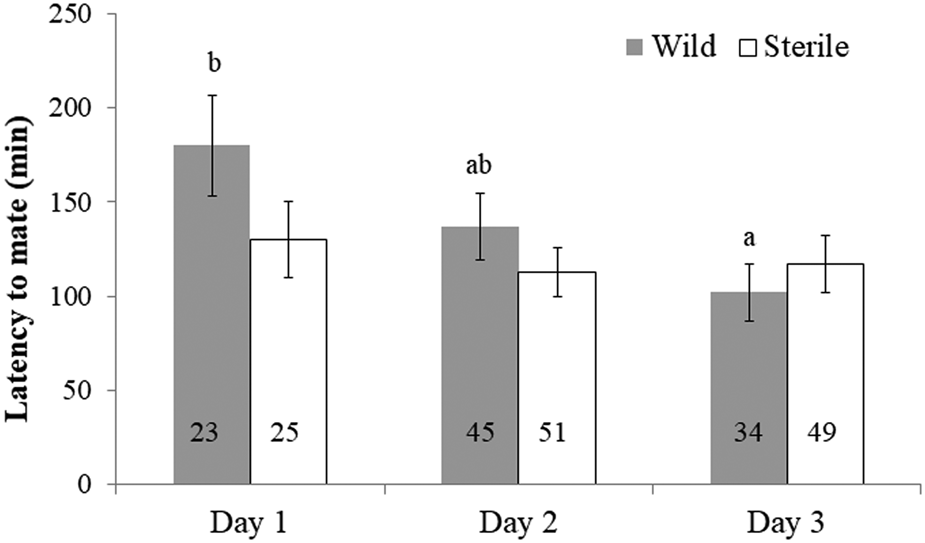
Male identity did not affect mating latency (t-test, control wild vs. sterile 3 day-old: t = 1.52; df = 46; P = 0.136; control wild vs. sterile 4 day-old: t = 1.08; df = 82; P = 0.282; control wild vs. 5 day-old: t = 0.47; df = 81; P = 0.461). However, when compared among days, wild males had a higher mating latency the first day of the experiment than the third one (ANOVA, F = 3.42; df = 99, 2; P = 0.036) while there were no differences in mating latency for sterile males among days (F = 0.27; df = 122, 2; P = 0.764) (fig. 2).
Latency to mate (mean ± S.E.) in pairs involving wild C. capitata females mated with sterile males irradiated at 140 Gy, of 3 day-old (day 1), 4 day-old (day 2), or 5 day-old (day 3). The controls were wild sexually mature (13–15 day-old) males. Numbers inside bars represent sample sizes. Different letters indicate significant differences (ANOVA, P < 0.05).

Copulation duration
As in the experiment above, male identity affected copulation duration; copulation was shorter for pairs involving sterile males than for those involving wild males (t-test, control wild vs. sterile 3 day-old: t = 2.66; df = 26; P = 0.013; control wild vs. sterile 4 day-old: t = 2.78; df = 62; P = 0.007; control wild vs. 5 day-old: t = 3.08; df = 81; P = 0.002). On the other hand, among sterile males, 3 day-old males (day 1) had the shortest copulation duration (ANOVA, F = 2.91; df = 97, 2; P = 0.050) while there were no differences in copulation duration for wild males among days (F = 2.10; df = 80, 2; P = 0.129) (fig. 3).
Copulation duration (mean ± S.E.) in pairs involving wild C. capitata females mated with sterile males irradiated at 140 Gy, of 3 day-old (day 1), 4 day-old (day 2), or 5 day-old (day 3). The controls were wild sexually mature (13–15 day-old) males. Numbers inside bars represent sample sizes. Different letters indicate significant differences (ANOVA, P < 0.05). Asterisks indicate significant differences within each testing day (t-test, P < 0.05).

Mating success and female remating
Mating success was affected by male identity only when comparing wild vs. sterile 5 day-old males. Sterile males had higher mating success than wild males (χ2 = 4.63; df = 1; P = 0.031). However, female remating propensity was not affected by male identity for none of the three ages (P > 0.1 in all the cases) (fig. 4).
Percentage of male mating success (mean ± S.E.) and female remating (mean ± S.E.) at 24 h of first copulation for wild C. capitata females mated with wild (control) or sterile male, irradiated at 140 Gy, of 3, 4, or 5 days of age. Numbers inside bars represent sample sizes. Different letters indicate significant differences within each testing day (χ2 test, P < 0.05).

Number of sperm stored by females and reproductive male organ size
Number of sperm stored by females and their correlation with male and female size
The percentage of females without sperm was affected by male identity (χ2 = 6.50; df = 2; P = 0.039). The 33.3% of females mated with 100 Gy-sterile males had no sperm in their spermathecae, compared with 4.5% of females mated with 140 Gy-sterile males (χ2 = 6.30; df = 1; P = 0.024), while females mated with lab males had intermediate values (19.35% of spermless females). However, the number of sperm stored by females was not affected by male identity (F = 0.99; df = 2, 59; P = 0.377, fig. 5), male size (F = 0.14; df = 1, 59; P = 0.712) or female size (F = 0.11; df = 1, 59; P = 0.739) but was affected by testes size (F = 4.34; df = 1, 59; P = 0.041). There was a negative correlation between number of sperm and testes size (r = −0.26; P = 0.02). Testes size was not affected by male identity (F = 0.48; df = 2, 77; P = 0.623).
Number of sperm stored in the two spermatheca (mean ± S.E.) of lab C. capitata females mated with lab (control) or sterile males irradiated at 100 or 140 Gy. Numbers between brackets represent sample size.

Reproductive organ size of virgin males
Male identity affected mesodermal AG size (F = 4.05; df = 2, 29; P = 0.028). Lab males had the smallest mesodermal AG, 100 Gy-sterile males had the largest, while 140 Gy-sterile males had intermediate values (fig. 6). Ectodermal AG and testes size were not affected by male identity (F = 0.27; df = 2, 45; P = 0.764 and F = 0.73; df = 2, 50; P = 0.487, respectively). Male size did not affect the size of accessory glands or testes (mesodermal AG: F = 0.58; df = 1, 29; P = 0453; ectodermal AG: F = 3.88; df = 1, 45; P = 0.055; testes: F = 0. 10; df = 1, 50; P = 0.752).
Ectodermal accessory glands (AG) size, mesodermal AG size, and testes size (mean ± S.E.) of virgin C. capitata lab (control) or sterile males irradiated at 100 or 140 Gy. Different letters indicate significant differences (ANOVA, P < 0.05).

Discussion
We found that C. capitata males of the V-8 strain, mass-reared and irradiated at 100 or 140 Gy had a higher capacity to inhibit female remating in the short-term (on the same day of copulation) than wild males. Nevertheless, this effect disappeared 24 h after the first copulation. On the other hand, age of sterile males did not affect their ability to inhibit remating. Sterile males had shorter copulation duration than wild males, and young males (3 day-old) had shorter copulation duration than 4 and 5 day-old males; however, this did not impact their post-copulatory performance. Although females mated to low dose irradiated males (100 Gy) exhibited the highest percentage of spermless spermathecae, numbers of sperm stored by females were not affected by radiation doses. On the other hand, males irradiated at a low dose had greater mesodermal accessory gland size than control fertile males.
Female remating inhibition
Remating behavior in medfly females has been extensively studied in the past few decades (Miyatake et al., Reference Miyatake, Chapman and Partridge1999; Bonizzoni et al., Reference Bonizzoni, Katsoyannos, Marguerie, Guglielmino, Gasperi, Malacrida and Chapman2002; Shelly and Kennelly, Reference Shelly and Kennelly2002; Vera et al., 2002, Reference Vera, Wood, Caldera and Gilburn2003; Mossinson and Yuval, Reference Mossinson and Yuval2003; Kraaijeveld and Chapman, Reference Kraaijeveld and Chapman2004; Gavriel et al., Reference Gavriel, Gazit and Yuval2009; Costa et al., Reference Costa, Anjos-Duarte, Roriz, Dias and Joachim-Bravo2012; Morelli et al., Reference Morelli, Paranhos, Coelho, Castro, Garziera, Lopes and Bento2013) although this behavioral trait has not been examined for Argentinean populations of the V8 sterile strain. Medfly is controlled worldwide with the SIT, for which mass-rearing and subsequent irradiation are fundamental prerequisites.
Both factors condition male sexual competitiveness and the ability to inhibit female remating (Mossinson and Yuval, Reference Mossinson and Yuval2003; Gavriel et al., Reference Gavriel, Gazit and Yuval2009). However, Shelly and Kennelly (Reference Shelly and Kennelly2002) found that females mated with mass-reared males had the same tendency to remate than females mated with wild males. On the other hand, Kraaijeveld and Chapman (Reference Kraaijeveld and Chapman2004) attribute to irradiation an important weight in the loss of competitiveness of the male with respect to their ability to induce refractoriness. Mossinson and Yuval (Reference Mossinson and Yuval2003) found that sterile males of the Vienna 4 strain irradiated at 150 Gy were less able to inhibit female remating 24 h after the first copulation, while at 48 and 72 h after the first mating, the percentage of female remating was not affected by the identity of the first male. Similarly, Gavriel et al. (Reference Gavriel, Gazit and Yuval2009), working with sterile flies of the Vienna 8 strain irradiated at 100 Gy, found that the ability of the irradiated males to inhibit females remating on the same day of copulation was dramatically lower than that of wild males, although these differences diminished from the third day since first copulation.
The difference among the results found here and those previously reported by Mossinson and Yuval (Reference Mossinson and Yuval2003) and Gavriel et al. (Reference Gavriel, Gazit and Yuval2009) could be attributed at least to the following three factors: (i) the strain used, (ii) the conditions during the mass-rearing process (which were not controlled), and (iii) the experimental design. With respect to the last point, Mossinson and Yuval (Reference Mossinson and Yuval2003) emphasize the great importance of experimental design, relaxed conditions or a high density of insects per cage, and even with respect to the volume of cages or containers where pairs are obtained. Both Mossinson and Yuval (Reference Mossinson and Yuval2003) and Gavriel et al. (Reference Gavriel, Gazit and Yuval2009) used as an experimental unit high volume cages but with a large number of insects (0.003 and 0.004 flies per cm3, respectively). In our case, we used small containers of 350 ml with 0.008 flies per cm3. The different densities of males in the experimental arena can be perceived by the male as very different situations with respect to the risk of intra-specific competition. In Anastrepha fraterculus (Wied), for example, males are able to vary the number of sperm they transfer to their partners according to how they perceive sperm competition (Abraham et al., Reference Abraham, Vera and Pérez-Staples2015). In the case of C. capitata, Gage (Reference Gage1991) determined that sperm transfer is greater when the male perceives a rival male than when the male is isolated with a female without the presence of another male. These examples demonstrate the great plasticity that males can exhibit under different competition scenarios, varying sperm allocation (and probably also the allocation of AGPs, see Wigby et al., Reference Wigby, Sirot, Linklater, Buehner, Calboli, Bretman, Wolfner and Chapman2009, for Drosophila melanogaster Meigen). A greater allocation of ejaculate resources in a given copulation will reduce the possibility that females remate (Gillott, Reference Gillott2003; Ávila et al., Reference Ávila, Sirot, LaFlamme, Rubinstein and Wolfner2011; Perry et al., Reference Perry, Sirot and Wigby2013).
Copulation duration
The duration of copula involving sterile males was shorter compared to that involving wild males, an observation also made by Mossinson and Yuval (Reference Mossinson and Yuval2003) and Morelli et al. (Reference Morelli, Paranhos, Coelho, Castro, Garziera, Lopes and Bento2013) for this same species (but see Katiyar and Ramirez, Reference Katiyar and Ramirez1973; Shelly and Kennelly, Reference Shelly and Kennelly2002). In some insects, the duration of copulation is considered to be related to the amount of the ejaculate transferred (Dickinson, Reference Dickinson1986; García-González and Gomendio, Reference García-González and Gomendio2004). However, for Tephritids in general, a longer duration of copulation is not related to higher sperm transfer or a lower propensity of female remating (Taylor and Yuval, Reference Taylor and Yuval1999; Taylor et al., Reference Taylor, Kaspi and Yuval2000; Mossinson and Yuval, Reference Mossinson and Yuval2003; Vera et al., Reference Vera, Cladera, Calcagno, Vilardi and McInnis2003; Harmer et al., Reference Harmer, Radhakrishnan and Taylor2006; Pérez-Staples and Aluja, Reference Pérez-Staples and Aluja2006; Abraham et al., Reference Abraham, Goane, Rull, Cladera, Willink and Vera2011a, Reference Abraham, Goane, Cladera and Verab). In fact, here sterile males had a greater ability than wild males to inhibit the sexual behavior of their partners, independently of the fact that the copulations were shorter, both in the first and second trials. In conclusion, the adaptive meaning of a long copulation has not yet been clarified, at least for Tephritids.
Sperm storage
Not all copulations culminate in female sperm storage within the Tephritidae family (see Pérez-Staples et al., Reference Pérez-Staples, Shelly and Yuval2013 for a review). Surprisingly, a reduction in male radiation dose increased the percentage of spermless females in our work, although this did not impact the male ability to inhibit female remating. On the other hand, the number of sperm counted in female's spermathecae was dramatically lower than in other studies on the same species (Taylor and Yuval, Reference Taylor and Yuval1999; Taylor et al., Reference Taylor, Kaspi and Yuval2000). However, females were kept in the freezer until dissection, and for A. fraterculus it has been demonstrated that sperm count in females dissected in fresh is statistically higher than in females kept in the freezer (SA, unpublished data). This fact could have resulted in the low numbers of sperm counted in our study, irrespective of male identity. On the other hand, number of sperm stored can vary with male diet, testing days, female size, the context of the experiment (number of flies housed/container), and the source of flies used (Taylor et al., Reference Taylor, Kaspi and Yuval2000; Yuval et al., Reference Yuval, Kaspi, Field, Blay and Taylor2002; Abraham et al., Reference Abraham, Goane, Cladera and Vera2011b). Other effects that can influence sperm storage are the irradiation procedures and doses. The dose used to induce sterility is of central importance in SIT programs (Rull et al., Reference Rull, Diaz-Fleischer and Arredondo2007). However, radiation induces sterility but can also provoke sterile males to transfer fewer sperm than control males (Seo et al., Reference Seo, Roger, Gilmore, Kurashima and Fugimoto1990; Bloem et al., Reference Bloem, Bloem, Rizzo, Chambers, Aluja and Liedo1993; Taylor et al., Reference Taylor, Kaspi, Mossinson and Yuval2001; Mossinson and Yuval, Reference Mossinson and Yuval2003). Nevertheless, Guerfali et al. (Reference Guerfali, Parker, Fadhl, Hemdane, Raies and Chevrier2011), working with the C. capitata Vienna 8 strain irradiated from 50 to 145 Gy, found that there was no significant difference in sperm production (in male seminal vesicles) and sperm storage (in two female's spermathecae) from males treated at different doses or the control. Similarly, we found no significant effect of radiation dose on sperm storage. Evidently, as other factors in addition to irradiation influence number of sperm transferred by males and stored by females, they could mask or compensate the effect of irradiation, giving dissimilar results between studies.
Reproductive organ size
Testes size was not affected by male irradiation, neither in virgin or mated males. However, there was a negative correlation between testes size in mated males and number of sperm stored by their partners, which could imply that small testes reflect high sperm depletion. Similarly, Leftwich et al. (Reference Leftwich, Edward, Alphey, Gage and Chapman2012) found that males with smaller residual testes size had increased paternity in this same species. Sterile males irradiated at 100 Gy had larger mesodermal AG than fertile males; however, females mated with these males were less likely to store sperm, which could be interpreted as a trade-off between the resources allocated in the different components of the ejaculate; i.e., males that invest more in fluid produced in mesodermal AG (lipids, polysaccharides, and proteins, Marchini et al., Reference Marchini, Del Bene, Cappelli and Dallai2003), may invest less in sperm production. Stress has been found to affect the tradeoff between reproduction and survival in Drosophila (Wayne et al., Reference Wayne, Soundararajan and Harshman2006), where for example, maternal starvation can result in progeny with greater ovariole number. Irradiation during development of sexual organs in Medfly males in our study can be considered as a stressful event and appears to have induced greater investment in mesodermal AGs in irradiated males. It would be interesting to further explore the effects of stress on the survival-reproduction tradeoff using Medflies as a model.
Radiation dose
Despite the fact that a dose of 100 Gy is sufficient to produce 99.9% sterility in males, program managers tend to apply doses as high as 140 Gy to achieve 100% sterility (Robinson et al., Reference Robinson, Cayol and Hendrichs2002). In general, a decrease in radiation dose impacts positively the male performance. For example, for Bactrocera tryoni (Froggatt), an improved flight quality has been achieved by reducing the target sterilizing dose (Collins et al., Reference Collins, Weldon, Banos and Taylor2009). Similarly, Toledo et al. (Reference Toledo, Rull, Oropeza, Hernández and Liedo2004) and Rull et al. (Reference Rull, Diaz-Fleischer and Arredondo2007) found that Anastrepha obliqua (Macquart) and Anastrepha ludens (Loew) males irradiated at lower doses had greater flight ability and induced greater sterility in fertile females than those irradiated at higher doses. In C. capitata, irradiated males are more passive and less vigorous than non-irradiated males, and reduced irradiation dose increased significantly male mating success but only when as low as 70 or 35 Gy, compared to 140 Gy (Lux et al., Reference Lux, Vilardi, Liedo, Gaggl, Calcagno, Munyiri, Vera and Manso2002). Contrary to the expected, a decrease in radiation dose did not impact the copulatory or post-copulatory success of sterile males in our work, since the performance of the males irradiated at 100 or 140 Gy was similar for all the variables evaluated (except for percentage of spermless females), and this may be due to the fact that 100 Gy is still a high dose. However, we do not rule out the fact that males irradiated at lower doses can be more successful in a competitive context, that is, when they must compete with wild males for monopolizing copulations with wild females.
Male age
Early release of sterile males results in cost reductions and greater sterile male release rates in the field (Shelly et al., Reference Shelly, Nishimoto and Edu2009). Nevertheless, release of immature males can result in high mortality before mating (Yuval et al., Reference Yuval, Maor, Levy, Kaspi, Taylor and Shelly2007). Our results showed that 3, 4, and 5 day-old sterile males are efficient in inhibiting female receptivity 1 day after copulation. However, Shelly et al. (Reference Shelly, Edu and Pahio2007) found previously that 3 and 4 day-old sterile males were less able to inhibit female remating than 5 and 10 day-old males, 2 days after first copulation. This inconsistency may be explained because female remating was very high in Shelly et al. (Reference Shelly, Edu and Pahio2007) (50–60% of remating in females previously mated with 3–4 day-old sterile males, vs. more than 30% in females mated with 5 day-old males). Female remating percentages in our study were lower than 20%, and could have masked differences that could have arisen under longer intervals between mating.
Conclusions
The results presented here are very favorable for the SIT, since the sterile males reared in the Bioplanta San Juan were highly efficient, under our laboratory experimental design, both with regard to their success for mating and their ability to inhibit remating of their partners, on the same day of copulation and 24 h later. These results are particularly important in the context of the SIT for C. capitata, since this is a species with a very high female remating rate and short refractory periods, compared with other species of Tephritidae (Chinajariyawong et al., Reference Chinajariyawong, Drew, Meats, Balagawi and Vijaysegaran2010; Abraham et al., Reference Abraham, Goane, Rull, Cladera, Willink and Vera2011a). Moreover, young sterile 3 day-old males were as efficient as mature wild males in inducing female refractoriness. As mentioned above, a very high percentage of remating could jeopardize the efficiency of the SIT, since the females could re-mate with a wild male, thus recovering their fertility. Although we know that laboratory conditions differ from natural conditions, we expect to corroborate these results under semi-natural conditions in field cages in the future.
Acknowledgements
We thank ARCOR® S.A. for providing corn protein for the diets, Diana Pérez-Staples for her revision and comments on an earlier draft of the manuscript; and two anonymous referees for comments that improved the manuscript.