Introduction
The timely detection of early cognitive deficits that precede the advent of frank dementia in older adults will become increasingly important as new treatments for early disease become available. Early diagnosis is likely to lead to direct health benefits for the patient, enabling early treatment and consequent greater treatment efficacy, as well as improvements in the quality of life for patients and their caregivers.
There are currently few well-validated biomarkers for the diagnosis of AD. Established biomarkers usually require expensive biochemical assays on cerebrospinal fluid samples or complex neuroimaging techniques. The availability of such technology in general healthcare settings is limited, and is non-existent in LAMICs. From an economic perspective, then, assessing and identifying AD patients at an early stage can lead to cost savings; from medical and psychosocial perspectives, it can lead to enhancement of patient and caregiver quality of life (Getsios et al., Reference Getsios, Blume, Ishak, Maclaine and Hernández2012). Cognitive testing is therefore likely to remain a pivotal part of the process of early disease detection, particularly in LAMICs.
Educational background is a significant confounding factor in the process of identifying cognitive impairment in older adults. Level of education attained has been positively correlated with cognitive ability across the human lifespan, (Kliegel et al., Reference Kliegel, Zimprich and Rott2004; Burger, Reference Burger2010). Richards and Hatch (Reference Richards and Hatch2011) argued that the enduring effect of early life on cognitive aging is mediated by various experiences, including formal educational exposure. The latter relates not only to the level of education but also to its quality. A low quality of education (including poor access to learning resources) has been linked with poorer cognitive performance. Clinicians, therefore, have to consider both quality and level of education when assessing cognitive functioning in older adults, particularly when evaluating whether the individual's level of functioning is commensurate with his/her age and other demographic factors (Wilson et al., Reference Wilson, Hebert, Scherr, Barnes, Mendes de Leon and Evans2009).
Disparities in education are especially pronounced in LAMICs. Poor access to resources in LAMIC populations increases the likelihood of low levels and a low quality of education. The latter, in turn, creates the platform for a different trajectory of cognitive aging than in high income countries (HICs). Under apartheid in South Africa, the type and quality of education was determined by a system of “racial” classification. Shuttleworth-Edwards and colleagues (2004) showed that black South Africans, especially those with a low quality of education, performed more poorly on neuropsychological tests than white South Africans. Nell (Reference Nell2000) emphasized the role of “test wiseness”: the concept that individuals with higher quality and level of education perform better in test-taking environments, partly because of a greater familiarity with the actual test-taking process.
A well-known assessment tool used in older adults is the Cambridge Mental Disorders of the Elderly-Revised, which is a standardized instrument for the diagnosis of mental disorders (Roth et al., Reference Roth, Huppert, Mountjoy and Tym1998). It includes the CAMCOG-R (Huppert et al., Reference Huppert, Brayne, Gill, Paykel and Beardsall1995) which is a widely used measure of cognitive impairment and dementia in older adults. The CAMCOG-R consists of 69 items divided into subscales, each corresponding to a different cognitive domain (orientation, language, memory, attention/calculation, praxis, abstract thinking, and perception). The memory subscale is further subdivided into remote memory, recent memory, and learning memory.
The recent memory and learning memory subscales are the most useful components of the CAMCOG-R for assessing amnestic MCI and early AD. They are quick to administer, and accurately identify impairments in new learning and memory processes; these cognitive functions are usually the earliest and worst affected in AD (Salmon and Bondi, Reference Salmon and Bondi2009). Conde-Sala et al. (Reference Conde-Sala2012) showed that the recent memory and learning memory subscales of the CAMCOG are also useful for identifying cognitive decline and for predicting conversion from MCI to AD. The learning memory subscale score has been used in conjunction with the NINCDS-ADRDA criteria for the diagnosis of AD as a proxy for cognitive status (control vs. AD) and disease progression (Combrinck et al., Reference Combrinck2006).
Overall performance on the CAMCOG-R appears to be influenced by educational attainment (e.g. Moreira Ide et al., Reference Moreira Ide, Lourenco, Soares, Engelhardt and Laks2009; Aprahamian et al., Reference Aprahamian, Martinelli, Cecato, Izbicki and Yassuda2010). Higher levels of education have been associated with higher total scores, better cognitive performance, and fewer floor effects (Lindeboom et al., Reference Lindeboom, Ter Horst, Hooyer, Dinkgreve and Jonker1993; Huppert et al., Reference Huppert, Brayne, Gill, Paykel and Beardsall1995; Yassuda et al., 2009). However, a large body of the literature suggests that the effects of education on cognitive functioning are not uniform across different cognitive domains. For instance, in adults, level of education tends to be most strongly associated with performance on verbal tasks, spatial memory tasks, cancellation tasks, and on tests that require copying simple line drawings (Lezak et al., Reference Lezak, Howieson and Loring2004). Analysis of the association between CAMCOG-R subscale scores and level of education attained may therefore help reveal the differential effects of education on performance across cognitive domains.
In a sample of without dementia participants, Cullum et al. (Reference Cullum2000) found that level of education was associated with a decline over four years on some subscales of the CAMCOG (viz. orientation, memory, attention/calculation, abstract thinking, and perception), but not others (viz., Language and Praxis). This pattern of data suggests that performance on some subscales, but not others, is related more closely to the acquired formal education. Clearly, such effects would have been concealed had only global measures of cognition such as the CAMCOG total score been used. Importantly for the current purposes, Lindeboom and colleagues (Reference Lindeboom, Ter Horst, Hooyer, Dinkgreve and Jonker1993) found that performance on the learning memory subscale was not associated with level of education in patients with clinical diagnoses ranging from no dementia to severe dementia.
The effects of education on CAMCOG subscale performance may differ in without dementia individuals to those with dementia (Conde-Sala et al., Reference Conde-Sala2012). However, few studies have explored the associations between educational attainment and performance on the individual CAMCOG subscales in AD samples. Even fewer studies have focused on how these relationships may differ across socioeconomic groups and in populations from LAMICs (Aprahamian et al., Reference Aprahamian, Martinelli, Cecato, Izbicki and Yassuda2010). These population differences are of interest because LAMIC samples such as those in South Africa, in contrast to samples drawn from HICs, are characterized by a relative deficiency of resources (such as health clinics, public libraries, etc.) that may otherwise aid cognitive stimulation.
The aim of this study, therefore, was to examine the association between educational attainment and performance on the individual CAMCOG-R subscales in a sample of older adults with and without memory problems from a resource-limited LAMIC. We hypothesized on the basis of previous literature (Lindeboom et al., Reference Lindeboom, Ter Horst, Hooyer, Dinkgreve and Jonker1993; Huppert et al., Reference Huppert, Brayne, Gill, Paykel and Beardsall1995; Cullum et al., Reference Cullum2000; Yassuda et al., 2009; Conde-Sala et al., Reference Conde-Sala2012) that CAMCOG-R total score, Mini-Mental State Examination (MMSE)(Folstein et al., Reference Folstein, Folstein and McHugh1975) score, and scores on the language, memory, abstract thinking, attention/calculation, and praxis subscales of the CAMCOG-R would be related directly to the quality and level of education attained in both the control and AD patient groups.
Methods
Participants
All participants (N = 98) were over the age of 60 years (M = 75.10, SD = 8.94). Each was assigned to either the cognitively healthy control group (n = 51) or the mild-moderate stage AD patient group (n = 47), following NINCDS-ADRDA criteria for AD (McKhann et al., Reference McKhann, Drachman, Folstein, Katzman, Price and Stadlan1984). Group assignment was performed by a neurologist in consultation with a neuropsychologist. An a priori sample size calculation for regression was determined using GPower 3.1.0 software (Faul et al., Reference Faul, Erdfelder, Buchner and Lang2009). Based on values of 0.80 as a minimum acceptable level of power and 0.30 (medium) as an estimated effect size (Cohen, Reference Cohen1988), the software suggested that a total sample size of 62 participants would be sufficient to detect a statistically significant effect of educational attainment on CAMCOG-R performance. This basis for the calculation is supported by previous findings of a significant relationship between education level and CAMCOG-R performance (p < 0.001), associated with an effect size of 0.33 (Huppert et al., Reference Huppert1996).
Controls were community-dwelling volunteers recruited via word-of-mouth advertising. AD patients were recruited from a local memory clinic, from old age homes, or following referrals from their general practitioners. For the most part, this sample represents the median socioeconomic status (SES) of South Africa, and falls within the boundaries of a LAMIC group.
Inclusion criteria were literacy (the self-reported basic ability to speak, read, and write in English) and a MMSE score above 12. Exclusion criteria included a significant psychiatric history, as well as the presence of (a) other neurological disorders, (b) other uncontrolled medical conditions such as hypertension and diabetes mellitus, (c) depression, as indicated by a score of 6/15 or above on the Geriatric Depression scale (Short Form) (GDS-SF; Sheik and Yesavage, Reference Sheikh and Yesavage1986), or (d) any other medical condition which, in the opinion of the researchers, precluded individuals from participation.
Materials and procedures
All participants were assessed in English. We administered a sociodemographic questionnaire that acquired information on participants’ age, sex, quality and level of education, income, and health.
A neuropsychologist administered and scored the CAMCOG-R in a standardized manner. We altered a few items, however, because some of the original items were not suitable for use with South African participants. The altered items included those related to geographical places and historical figures and events; the changes ensured that those items were more appropriate for use with a South African sample (for details on specific changes, see Table S1 published as supplementary material accessible online attached to the electronic version of this paper at http://journals.cambridge.org/ipg). The booklet that accompanies the CAMCOG-R (which contains pictures relating to some of the test items) was reprinted for this study with more culturally appropriate images. The maximum obtainable CAMCOG-R score remained 105, with higher scores indicating better cognitive performance.
Within the CAMCOG-R are the 19 questions that constitute the MMSE, the most commonly used and studied screening test for dementia. The MMSE has been used, unaltered from its original form, in a South African study investigating early-onset AD (Heckmann et al., Reference Heckmann2004), and is used regularly as a screening tool for dementia in South African clinical practice.
Study procedures were conducted in Cape Town in the Division of Neurology at Groote Schuur Hospital, at a non-governmental agency nursing home, or at a participant's residence. Participants, and their relative or caregiver in the case of the AD patients, signed an informed consent document prior to commencing any research procedure. Ethical approval for all study procedures was obtained from the Human Research Ethics Committee of the University of Cape Town's Faculty of Health Sciences. All procedures conformed to the Helsinki Declaration.
Data management and statistical analyses
We determined a participant's quality of education by examining in which of the following settings he/she was schooled: private-urban (i.e. a private school in an urban area), public-urban, private-rural, or public-rural. Private-urban was classified as a “high” quality of education; public-urban and private-rural were classified as “medium”; and public-rural was classified as “low.” We used these categorizations because, in South Africa, many public schools in the poorer rural and farming communities lack adequate facilities (e.g. not enough school books, lack of desks and chairs, few teachers, poor teacher qualifications), which impacts the quality of education received by students at those schools (Shuttleworth-Edwards et al., 2004). We calculated level of education based on the number of years of education the participant had successfully completed in a formal academic institution (e.g. Grade 8 or Standard 6 was regarded as the equivalent of eight years of school).
We performed all statistical analyses using Statistica 10 and SPSS 20, and we set α level at 0.05 for all decisions regarding statistical significance. As a first analytic step, we conducted between-group comparisons on the sociodemographic data and on each of the cognitive outcome variables using either independent samples t-tests (for normally distributed continuous data), Pearson's r correlation analyses, χ2 tests (for categorical data), or Mann–Whitney U-tests (for non-normally distributed continuous data). We used Cohen's d, r, and f 2 as effect size estimates for t-tests and χ2, Mann–Whitney U-tests, and multiple regression analyses respectively. We followed the guidelines suggested by Cohen (Reference Cohen1988) in our interpretation of effect sizes: small, d = 0.2, medium, d = 0.5, and large, d = 0.8; small, r = 0.10, medium, r = 0.30, large, r = 0.50; small, f = 0.1, medium, f = 0.25, and large, f = 0.40.
We then performed a series of hierarchical multiple regression analyses to determine whether sociodemographic variables (specifically age, sex, quality of education, and level of education; entered into the model in that order) influenced overall CAMCOG-R performance, MMSE performance, and performance on the various CAMCOG-R subscales (memory, remote memory, recent memory, learning memory, orientation, language, attention/calculation, praxis, abstract thinking, and perception). We performed separate regression analyses for the control and AD patient groups to determine whether the effect of education remained of the same magnitude and influence in cognitively impaired individuals as in cognitively healthy individuals. We entered age and sex into the models first because of their well-established associations with cognitive performance. The subsequent entries of quality and level of education allowed us to determine whether either contributed significantly to performance on the CAMCOG-R, the MMSE, and the individual CAMCOG-R subscales, after controlling for age and sex.
Results
Sample characteristics
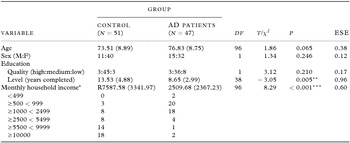
Table 1 shows the sample demographic data. As can be seen, there were no significant between-group differences with regard to age and male/female ratio, although there were more females than males in each group. Regarding education, most participants (n = 81) had attended a public school in an urban setting, and there were no significant between-group differences in terms of quality of education. There was, however, a significant between-group difference in terms of level of education, with AD patients attaining fewer years on average.
Sample demographic data (N = 98)

Notes: For the variables Age, Education Level, and Monthly household income, means are presented with standard deviations in parentheses. ESE = effect size estimate; for t-tests and Chi square, ESE is Cohen's d. aMeasured in South African Rands (R).
*p < 0.05. **p < 0.01. ***p < 0.001.
There was also a significant between-group difference, in favor of the control group, with regard to monthly household income. Level of education was positively correlated with income across groups, r(96) = 0.64, p < 0.001, within the control group, r(49) = 0.56, p < 0.001, and within the AD patient group, r(45) = 0.33, p = 0.023.
Between-group comparisons: cognitive and behavioral outcome measures
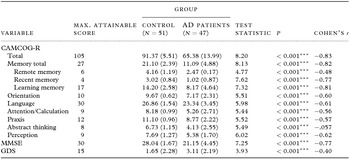
Table 2 summarizes scores for the control and AD patient groups on the CAMCOG-R outcome variables, the MMSE, and the GDS. The mean raw scores for both the cognitive and behavioral measures show clear between-group differences, with better performance by the control group in all cases. This impression was confirmed by statistical analyses. Of note is that the average score for AD patients was ≤24 on the MMSE and ≤80 on the CAMCOG-R, whereas the average scores for controls were higher than those clinically relevant cut-offs (Huppert et al., Reference Huppert1996; Lezak et al., Reference Lezak, Howieson and Loring2004).
Descriptive statistics for cognitive and affective measures (N = 98)

Notes: The third and fourth columns present raw score means, with standard deviations in parentheses. The test statistic is the Z statistic for the Mann–Whitney U-test. Cohen's r = effect size measure for Mann–Whitney. CAMCOG-R = Cambridge Cognitive Examination for Mental Disorders of the Elderly Examination-Revised; MMSE = Mini-Mental Status Examination; GDS = Geriatric Depression Scale.
*One-tailed p < .05. **p < .01. ***p < .001.
Regression analyses
Results from the initial stages of the hierarchical regression models, which showed significant associations between age and sex and some of the cognitive scores, justified the decision to control for those demographic variables when examining the influence of quality and level of education on CAMCOG-R performance. For instance, in the control group, age was negatively associated with CAMCOG-R total score, r(49) = −0.43, p = 0.001; with MMSE score, r(49) = −0.45, p = .001; and with performance on the following CAMCOG-R subscales: learning memory, r(49) = −0.37 p = 0.008; orientation, r(49) = −0.30, p = 0.034; and perception, r(49) = −0.41, p = 0.001. Also in the control group, sex was negatively associated with performance on the language subscale, r(49) = −0.24, p = 0.016. Furthermore, in the AD patient group, age was positively associated with performance on the abstract thinking subscale, r(45) = −0.45, p = 0.001, but sex was not associated with performance on any of the cognitive outcome variables.
Subsequent steps in the series of hierarchical regression analyses indicated that quality of education was not associated with performance on any of the cognitive measures in either group (see Tables S2–S13, published as supplementary material accessible online).
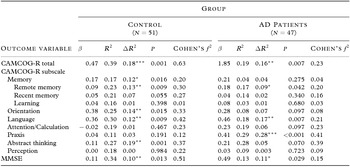
We entered level of education at the fourth step of the model. The final hierarchical regression analyses (see Table 3) showed that level of education contributed significantly to performance on numerous outcome variables, in both the control and AD patient groups. Specifically, in the control group there were significant associations between level of education and CAMCOG-R total score, MMSE score, and scores on the following CAMCOG-R subscales: language, memory, remote memory, abstract thinking, and orientation. In the AD patient group, there were significant associations between level of education and CAMCOG-R total score, MMSE score, and scores on the following CAMCOG-R subscales: remote memory, language, and praxis.
Multiple regression results for the final models: Effects of level of education on CAMCOG-R, CAMCOG-R subscale scores, and MMSE scores after controlling for age, sex, and quality of education (N = 98)

Notes: β = unstandardized coefficients for beta. R 2 = multiple regression correlation coefficient. ΔR 2 = change in multiple regression correlation coefficient. p = probability value. Cohen's f 2 = effect size measure for multiple regression. CAMCOG-R = Cambridge Cognitive Examination for Mental Disorders of the Elderly Examination-Revised; MMSE = Mini-Mental Status Examination. Values are derived from the fourth level of the regression model after controlling for age, sex, and quality of education.
*p < .05. ** p < .01. *** p < .001.
The regression models suggested an unexpected but clinically useful finding: in both the control and AD patient groups, performance on the CAMCOG-R recent memory and learning memory subscales was not influenced by either quality or level of education. In addition to this, and in summary, the following other subscales were not affected by either quality or level of education: in the control group, attention/calculation, praxis, and perception; and in the AD patient group, memory, orientation, attention/calculation, abstract thinking and perception.
Discussion
The aim of the present study was to examine the association between quality and level of education and performance on the individual CAMCOG-R subscales in a sample of older adults with and without memory problems from a resource-limited LAMIC. This association, particularly including the role of quality of education, has not been well studied in LAMICs.
Our key finding was that performance on the CAMCOG-R recent memory and learning memory subscales was not associated with either quality or level of education in either healthy controls or patients with AD. Previous studies have reported that performance on the recent memory and learning memory subscales is useful in identifying cognitive impairment and cognitive decline related to AD (Schmand et al., Reference Schmand, Walstra, Lindeboom, Teunisse and Jonker2000), as well as in predicting conversion from amnestic MCI to AD (Conde-Sala et al., Reference Conde-Sala2012). In both our study and that of Conde-Sala and colleagues, recent memory and learning memory subscale scores were not associated with level of education in cognitively healthy controls and patients with AD. These subscales may, therefore, be suited for detecting the presence of memory impairment and AD, even in older adults from LAMICs with relatively low levels of education.
Participants in the control group had, on average, a higher quality and level of education than those in the AD patient group. The control group also consisted of relatively more participants from higher income groups, and there was a stronger correlation between income and level of education in the control group than in the AD patient group. These findings are consistent with (a) the known and intrinsically linked association between SES and education, and (b) low SES as an established risk factor for the development of AD (Evans et al., Reference Evans1997; Karp et al., Reference Karp, Kâreholt, Qiu, Bellander, Winblad and Fratiglioni2004). A potential mechanism underlying this association is that increased educational and occupational attainment may increase cognitive reserve that delays the onset of the clinical manifestations of the disease (Stern et al., Reference Stern, Gurland, Tatemichi, Tang, Wilder and Mayeux1994).
The first and second steps in the hierarchical regression analyses showed that age and sex were associated with performance on various CAMCOG-R subscales. The finding that age was associated with performance on several CAMCOG-R subscales is consistent with results reported by Huppert and colleagues (Reference Huppert, Brayne, Gill, Paykel and Beardsall1995). Those authors also found associations between sex and performance on some CAMCOG subscales (viz., attention, praxis, calculation, and perception) in a sample of older adults. In contrast to those findings, we, however, did not find that sex was associated with performance on those CAMCOG-R subscales, but that it was associated with performance on the language subscale in the control group. Sex was not associated with any of the CAMCOG-R subscale scores in the AD patient group.
The third step in the hierarchical regression analyses indicated that, after taking into account the contribution of age and sex, quality of education made no significant contribution to variance in performance on the cognitive outcome measures, for both the control and AD patient groups. These data do not confirm our a priori predictions. There are two possible interpretations for these findings. First, it is possible that quality of education does not play any role in cognitive performance of older adults. This possibility is unlikely, however, because good quality schooling is likely to provide intellectual stimulation during a key period of brain development, and could thus enhance brain function throughout the lifespan (Crowe et al., Reference Crowe2012). The second possibility is that the way in which we measured quality of education was not sensitive enough to demonstrate correlations with cognitive performance. Taking into account additional factors such as location (rural vs. urban), pupil–teacher ratios, access to textbooks and materials, qualifications of teachers, and parental involvement may provide a more sensitive measure of quality of education.
Confirming our a priori prediction, the final step in the hierarchical regression analyses suggested that general cognitive functioning, measured by the CAMCOG-R total and MMSE, in both the control and AD patient groups, was positively associated with levels of completed education. Previous studies have reported similar associations (Lindeboom et al., Reference Lindeboom, Ter Horst, Hooyer, Dinkgreve and Jonker1993; Brucki et al., Reference Brucki, Mansur, Carthery-Goulart and Nitrini2011). Control group performance on the following CAMCOG-R subscales was significantly associated with level of education, after controlling for age, sex, and quality of education: language, memory, remote memory, abstract thinking, and orientation. AD patient group performance on the following CAMCOG-R subscales was significantly associated with level of education, after controlling for age, sex, and quality of education: language, remote memory, and praxis. In the control group, scores on these subscales were not affected by education: recent memory, learning memory, attention/calculation, praxis, and perception. In the AD patient group, scores on these subscales were not affected by education: memory, recent memory, learning memory, attention/calculation, orientation, abstract thinking, and perception. Of note is that several of these subscales (viz., recent memory, learning memory, and orientation) assess domains in which cognitive deficits are known to occur in early AD.
These results partly confirm our a priori hypotheses that, in both groups, performance on the language, memory, abstract thinking, attention/calculation, and praxis subscales of the CAMCOG-R would be associated with level of education. However, we did not expect that control performance on the orientation subscale would show such an association, and we did not find any associations between level of education and performance on the attention/calculation subscale in either group. There are several interesting results related to the association between level of education and the abovementioned subscales which could be discussed further; however, we have chosen to focus here on only those related to memory performance, as memory is the key cognitive domain affected in AD.
Regarding performance on the memory subscales, our findings confirm those reported by Conde-Sala et al. (Reference Conde-Sala2012). Results from their baseline analysis indicated that performance on the recent memory and learning memory subscales was not affected by level of education. In terms of total memory, the results confirmed our a priori prediction that performance on that subscale is associated with level of education, after controlling for age, sex, and quality of education. This relationship only held in the control group, however. A possible reason for why this relationship was not found in the AD patient group may relate to the content of this subscale. This subscale measures a range of memory functions (remote and recent memory) and is not a pure measure of episodic verbal memory. An isolated measure of episodic verbal memory, known to be affected in AD, may have yielded different results.
There are some limitations to this study. One is that our sample size was relatively small. However, an a priori power calculation indicated that our regression analyses had sufficient power to detect statistically significant effects. The relatively small sample size did mean, though, that we were only able to sample from narrow bands of SES, level and quality of education, and language; therefore, our sample did not include participants with no, or with very low levels of, education. It is, therefore, possible that there still may be some difficulties with the use of the CAMCOG-R in older adults with no formal education. Future research should aim to replicate this study with a larger sample, drawn from a broader SES range and with a wider range of education levels. Such replication would allow for more in-depth analyses to be performed (e.g. one might be able to determine cut-off scores on the different CAMCOG subscales linked with varying levels of education and SES).
In summary, we investigated the influence of age, sex, quality and level of education on the various cognitive domains tested by the CAMCOG-R within a sample of both cognitively healthy and cognitively impaired older adults from a LAMIC. Our findings demonstrated isolated effects of education on the CAMCOG-R subscales, independent of other sociodemographic factors such as age and sex. We did not find any significant associations between quality of education and performance on the CAMCOG-R, its subscales, or the MMSE. Our data are, however, consistent with those from high-income countries suggesting that, in healthy older adults, level of educational attainment has a positive association with overall CAMCOG-R performance, as well as with performance on the MMSE. We also found an association between level of education and performance on the CAMCOG-R language, memory, abstract thinking, and orientation subscales. Hence, our findings are consistent with those from previous studies in indicating that, in older adults, some areas of cognition may be more vulnerable to the effects of level of education than others. Furthermore, the specific domains affected by education may vary depending on whether an individual has healthy or impaired cognition.
The CAMCOG-R and the MMSE are both frequently used as general cognitive screens in the assessment of possible dementia. The fact that they are both associated with level of education means that clinicians should, ideally, only use education-adjusted normative data in interpreting performance on those instruments, and in making diagnostic decisions. Education affected performance on more of the CAMCOG-R subscales in the control group (CAMCOG-R, MMSE, memory total, remote memory, orientation, language, and abstract thinking) than in the AD patient group (CAMCOG-R, MMSE, remote memory, language, and praxis); such differential effects should be considered when assessing cognitive function in older adults with healthy and impaired cognition. Furthermore, when assessing cognitive function in older adults with and without memory problems, we recommend that the CAMCOG-R recent memory and learning memory subscales be used to provide an accurate picture of recent memory and new learning functioning because they are not affected by level of education. These subscales are easy and quick to administer, and therefore appropriate for use in resource-poor healthcare settings.
Conflict of interest
None.
Description of authors’ roles
K. James was the primary investigator on this study and contributed to its design. She was involved in participant recruitment and data collection, performed the statistical analyses, and wrote the paper. L. Grace was involved in the study design, participant recruitment and data collection, and assisted with writing the paper. K. Thomas supervised the statistical analyses and assisted with writing the paper. M. Combrinck designed the study, provided overall supervision of study conduct, supervised the statistical analyses, and assisted with writing the paper.
Acknowledgments
The authors acknowledge and thank all the participants for their involvement in this study. They also thank the research team from the Clinical Neurosciences Research Unit at Groote Schuur Hospital for assistance with data collection. This study was funded by the National Research Foundation (NRF) of South Africa. Professor M. Combrinck was the recipient of a South African Research Chairs Initiative Grant from the NRF. This grant was the primary source of funding for this study.
Supplementary material
To view supplementary material for this paper, please visit http://dx.doi.org/10.1017/S1041610214002233.