Introduction
Dementia is characterized by a progressive increase in difficulties with memory, communication, personality, and/or behavior that impair a person's everyday function. Approximately 60% of people with dementia in Australia are living at home, and are cared for by family members (Brodaty and Cumming, Reference Brodaty and Cumming2010). Similarly, in the United States approximately 50% of people with dementia are living at home with a carer (Alzheimer's Association, 2014). Dementia will therefore impact both the person themselves and those in the close relationships with them, particularly, spouses and offspring. Furthermore, the presence of dementia has been found to result in a change in the quality of the relationship bond itself (Ablitt et al., Reference Ablitt, Jones and Muers2009).
The experience of relationship change appears to differ between dyads (i.e. the person with dementia and their spouse), with some dyads reported to experience increased closeness, and others experiencing a decline in relationship quality (Ablitt et al., Reference Ablitt, Jones and Muers2009). The quality of the relationship has been directly linked to the well-being of both members of the dyad (Ablitt et al., Reference Ablitt, Jones and Muers2009; Litwin et al., Reference Litwin, Stoeckel and Roll2014). Specifically, poor relationship quality negatively impacts emotional well-being, and is associated with higher levels of carer depression and strain, and feelings of incompetence among carers (Ablitt et al., Reference Ablitt, Jones and Muers2009; Litwin et al., Reference Litwin, Stoeckel and Roll2014). In contrast, higher relationship quality appears to play a protective role against negative experiences of care (Harris et al., Reference Harris, Adams, Zubatsky and White2011), and has been suggested to maintain emotional well-being for both the carer and the person with dementia (herein referred to as PWD)(Ablitt et al., Reference Ablitt, Jones and Muers2009).
Previous systematic reviews have explored the interaction between the dyad's relationship and dementia (Ablitt et al., Reference Ablitt, Jones and Muers2009), as well as the lived experience of couple-hood in the context of dementia (Ablitt et al., Reference Ablitt, Jones and Muers2009; Wadham et al., Reference Wadham, Simpson, Rust and Murray2016). A review conducted by Ablitt et al. (Reference Ablitt, Jones and Muers2009) identified four different types of caring relationships in the dementia context, which were defined according to how the carer perceives the PWD, their motivation for caring, and the quality of the connection (e.g. Reciprocation type: mutuality is maintained despite the PWD being perceived as a changed person, and the carer is motivated to provide care because of prior personal connection). Ablitt et al. (Reference Ablitt, Jones and Muers2009) then proposed a theoretical framework focused on how relationship quality prior to dementia determines the type of caring relationship that the relationship takes in the dementia context, and how that will impact relationship quality (i.e. whether relationship quality is maintained).
Wadham and colleagues (Reference Wadham, Simpson, Rust and Murray2016) expanded on Reference Ablitt, Jones and MuersAblitt et al.’s (Reference Ablitt, Jones and Muers2009) findings by focusing on the dyad's shared experience of dementia. The findings suggested that maintaining a sense of couple-hood (i.e. “togetherness,” attunement, and reciprocity within the relationship) was fundamental and had implications for the quality of life for both members of the dyad (Ablitt et al., Reference Ablitt, Jones and Muers2009; Wadham et al., Reference Wadham, Simpson, Rust and Murray2016). For example, dyads with a strong sense of couple-hood demonstrated resilience and enhanced coping in response to challenges associated with dementia (e.g. distress, identity, and power struggles). However, Reference Wadham, Simpson, Rust and MurrayWadham et al.’s (Reference Wadham, Simpson, Rust and Murray2016) findings suggested that not all dyads were able to maintain a sense of couple-hood in response to dementia, despite efforts to do so. For example, some dyads began to exist as separate individuals, which resulted in relationship strain and a diminished sense of couple-hood.
The above reviews highlight the lived experiences of dyads within a dementia context. However, neither review specifically considered the relationship or individual factors that enhanced or challenged relationship quality, following the diagnosis. In addition, Reference Wadham, Simpson, Rust and MurrayWadham et al.’s (Reference Wadham, Simpson, Rust and Murray2016) restricted focus on studies with both PWD and spouse carers as active participants (although an important perspective) may have missed key insights from studies that sampled the PWD or the spouse carers as individuals. Therefore, a greater understanding of factors associated with relationship quality in the context of dementia is needed. This will inform the development of strategies to strengthen relationship quality.
The current systematic review aims to expand upon previous reviews by examining the factors associated with relationship quality between the carer and the PWD following the diagnosis of dementia. Specifically, this review aims to answer the following research question: What factors or strategies enhance, or challenge the quality of family relationships (spouse or offspring) when one member of the relationship has dementia?
Methods
Search strategy
A search of five electronic databases (CINHAL, Medline, PsychInfo, Scopus, and Web of Science) was conducted in September 2016. The key population related search terms included: dementia or Alzheimer's; spouse, partner, couple, husband, wife, or significant other; offspring, child, adult child, son, daughter, or family; carer, or caregiver. The search also included the following key terms related to the phenomena of interest: relationship, marriage, marital, intimacy, or intimate. The complete search strategy is detailed in Appendix 1, available as supplementary material attached to the electronic version of this paper at http://journals.cambridge.org/ipg. The search was limited to studies published since 2000, as these reflect up-to-date research that is appropriate to inform the current practice. The search was also limited to English language publications. Reference lists of included papers were searched for additional articles.
Study selection
Results from the electronic database search were imported into EndNote and duplicates were excluded. The remaining articles were imported into Covidence© for the screening process. Each article was independently screened by title and abstract by two reviewers (authors 1 and 2) according to the below selection criteria. Full-texts of the remaining articles were screened according to the same selection criteria. Any conflicts that occurred were resolved by a third reviewer (author 3).
Inclusion criteria used in the current review were articles that: (a) were published full-text peer reviewed articles with either quantitative or qualitative methodologies; (b) provided data on factors that contribute to relationship quality between carer and PWD; (c) included spouse/partner or offspring carers of community dwelling PWD. Only immediate family carers (not children-in-law) were included as they are most likely to have a long standing previous relationship with the PWD. Exclusion criteria used in the current review were articles that: (a) were opinion-pieces, editorials, reviews, books, dissertations, abstracts only or study protocols; (b) included a mixture of carer types (including non-immediate family, son- or daughter-in-law or friend carers; or professional/staff carers) where outcomes for spouse/immediate offspring carers could not be differentiated; (c) included carers who were not currently providing primary care for the PWD (e.g. when the PWD had transitioned into residential care or passed away); or (d) included carers for and/or people who did not have dementia.
Data-collection process
Data extraction was completed by two reviewers (authors 1 and 2) independently. The following information was extracted from each study:
1. Study: Publication year, study location, study design, study aim, and theoretical frameworks.
2. Participants and sample: Number of participants, type of carer (spouse or offspring), dementia diagnosis, demographic characteristics, and study perspective (carer, PWD, or the dyad).
3. Methods and outcomes measured: Data collection, analysis approach, and quantitative outcome variables.
4. Key findings: Factors positively and/or negatively associated with relationship quality.
Quality appraisal
Articles included in the review were assessed by two reviewers (authors 1 and 2) for methodological validity. For quantitative articles the Joanna Briggs Institute (JBI) Critical Appraisal Tool (The Joanna Briggs Institute, 2016) was used, and for qualitative articles the Critical Appraisal Skills Program tool for qualitative research was used (Critical Appraisal Skills Programme (CASP), 2014). The JBI scientific committee designed and peer reviewed the JBI tools specifically for use in systematic reviews (The Joanna Briggs Institute, 2016). Conflicts with quality appraisal were resolved via discussion between reviewers and consultation with a third reviewer (author 3).
Analysis
The current review incorporates both qualitative and quantitative data. Data from the qualitative studies were synthesized using thematic analysis. Two reviewers (authors 1 and 2) conducted the analysis of qualitative data. The two reviewers read and re-read each qualitative study to gain an understanding of the findings of each investigation. The findings of interest were extracted, keeping the wording from the original article wherever possible. Final key findings were determined through discussion between the two reviewers. The two reviewers worked collaboratively to group key findings from each study into areas of similarity (e.g. identity change). Refinement of understanding was conducted by going back to the original articles. Once consensus was reached, overarching themes were identified that reflected the content of studies. Themes were then discussed as to how they positively and negatively impacted relationship quality. The content of each theme was re-examined by the same two reviewers and a description of the theme was developed.
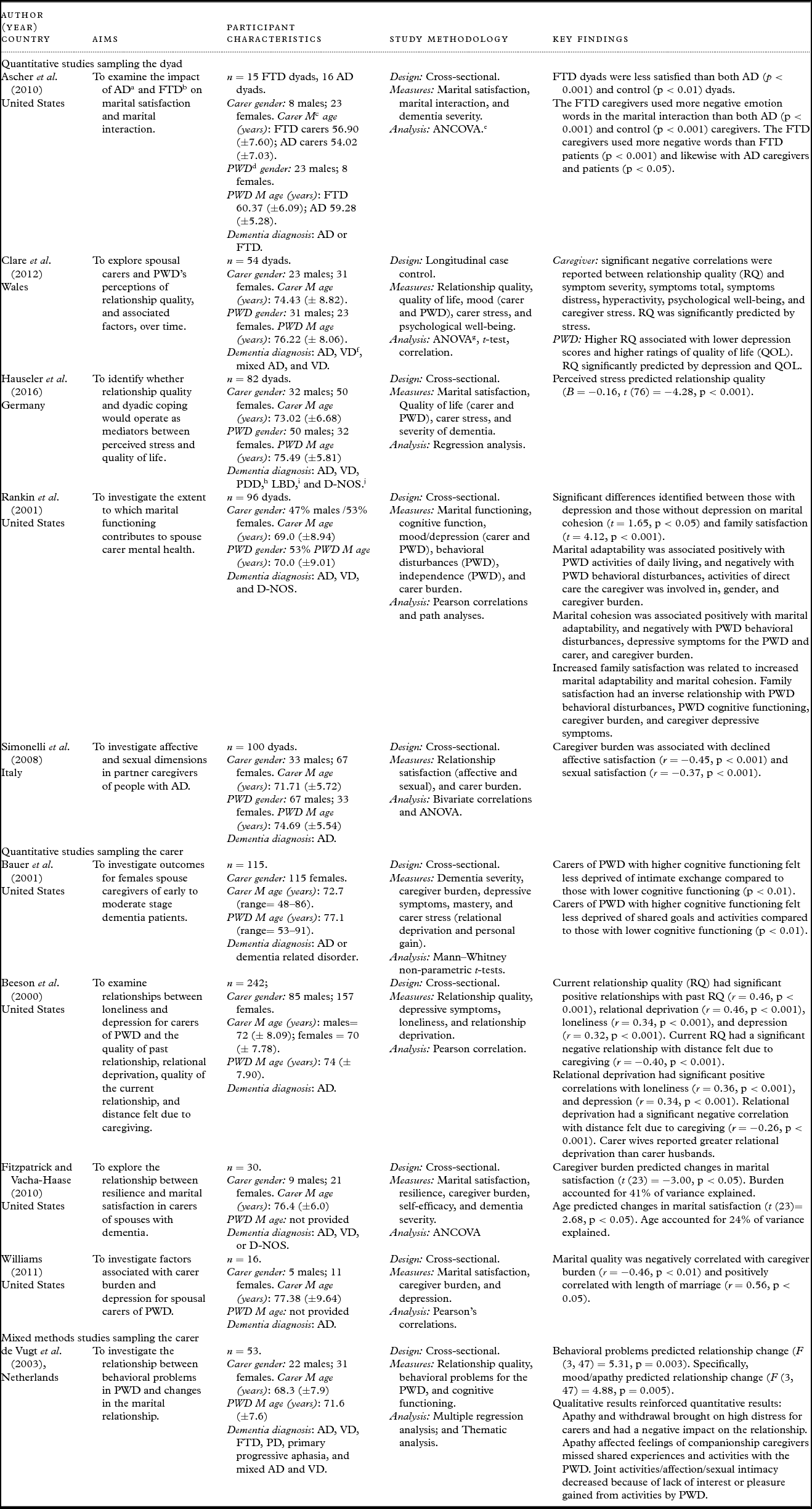
Data from the quantitative studies were not able to be synthesized using a meta-analysis as they differed in their analyses, methodology, and outcome measures used. Further description of the studies and their methods are included in Table 2. Instead, the key findings for the included studies were appraised and summarized in a narrative synthesis.
Results
Study selection
Results of the electronic database search were imported into EndNote (n = 11,068) where 5,365 duplicates were excluded. Title/abstract screening excluded 5,586 articles that did not meet the inclusion criteria for the review. Many of the articles excluded at this point explored a “relationship” between variables, rather than the interpersonal relationship between a carer and a family member with dementia. Following title/abstract screening, the full-text articles were sourced for 117 articles. Following full-text review, 17 articles remained for inclusion in the current review. Figure 1 illustrates the screening process. Study characteristics and key findings are presented in Table 1 (qualitative) and Table 2 (quantitative and mixed methods studies).
Study screening process.

Characteristics and key findings of qualitative studies included in this systematic review

aPWD = person with dementia; bAD = Alzheimer's disease; cM = mean.
Characteristics and key findings of studies with quantitative and mixed methods results included in the systematic review

aAD = Alzheimer's disease; bFTD = frontotemporal dementia; cM= mean; dPWD = person with dementia; eANCOVA = analysis of covariance; fVD = vascular dementia; gANOVA = analysis of variance; hPDD = Parkinson's disease dementia; iLBD = lewy body dementia; jD-NOS = dementia not otherwise specified.
Study characteristics
Of the 17 studies included in the review, 9 were quantitative in design, 2 were mixed methods (note: one of the mixed methods studies (Davies, Reference Davies2011) provided only qualitative results, with quantitative aspect relating to pre-screening of participants and is therefore included in qualitative analyses only), and the remaining 6 were qualitative. All but one of the studies was cross-sectional in design. All qualitative studies used semi-structured interviews. A total of eight studies were based in the USA; three in the United Kingdom; and one, respectively, in Canada, Sweden, Italy, Germany, Wales, and the Netherlands. Sample sizes ranged from 6 to 242. Eight of the studies sought the perspective of the dyad, while the remaining nine studies focused exclusively on the carers. All studies focused on partner carers, with 16 studies including both female and male carers and the remaining study focusing exclusively on female carers. One study also included daughter carers.
Study quality
All included studies were assessed for methodological quality. All of the qualitative studies expressed clear aims appropriate for qualitative methodology; the majority also justified the specific study design selected (Hellström et al., Reference Hellström, Nolan and Lundh2007; Quinn et al., Reference Quinn, Clare, Pearce and van Dijkhuizen2008; Hayes et al., Reference Hayes, Boylstein and Zimmerman2009; O'Shaughnessy et al., Reference O'Shaughnessy, Lee and Lintern2010; Davies, Reference Davies2011; Boylstein and Hayes, Reference Boylstein and Hayes2012; Molyneaux et al., Reference Molyneaux, Butchard, Simpson and Murray2012). However, none of the qualitative studies specifically addressed the relationship between researcher and participants, contradictory data and researcher bias; and most did not discuss data saturation (Hellström et al., Reference Hellström, Nolan and Lundh2007; Quinn et al., Reference Quinn, Clare, Pearce and van Dijkhuizen2008; Hayes et al., Reference Hayes, Boylstein and Zimmerman2009; O'Shaughnessy et al., Reference O'Shaughnessy, Lee and Lintern2010; Davies, Reference Davies2011; Molyneaux et al., Reference Molyneaux, Butchard, Simpson and Murray2012), or interviewer details (Hellström et al., Reference Hellström, Nolan and Lundh2007; Hayes et al., Reference Hayes, Boylstein and Zimmerman2009; O'Shaughnessy et al., Reference O'Shaughnessy, Lee and Lintern2010; Davies, Reference Davies2011; Boylstein and Hayes, Reference Boylstein and Hayes2012; Molyneaux et al., Reference Molyneaux, Butchard, Simpson and Murray2012).
Appraisal of the quantitative studies demonstrated greater variability. All quantitative studies described the participants and setting in sufficient detail, however, only seven of the ten studies (inclusive of mixed methods study with quantitative results) described inclusion and exclusion criteria developed prior to recruitment, or identified criteria by which a dementia diagnosis was made (Bauer et al., Reference Bauer, Maddox, Kirk, Burns and Kuskowski2001; Simonelli et al., Reference Simonelli2008; Ascher et al., Reference Ascher, Sturm, Seider, Holley, Miller and Levenson2010; Fitzpatrick and Vacha-Haase, Reference Fitzpatrick and Vacha-Haase2010; Williams, Reference Williams2011; Clare et al., Reference Clare2012; Häusler et al., Reference Häusler, Sánchez, Gellert, Deeken, Rapp and Nordheim2016). Five studies identified and controlled for confounding factors such as demographics (e.g. age, gender, and education) and dementia severity (Bauer et al., Reference Bauer, Maddox, Kirk, Burns and Kuskowski2001; Simonelli et al., Reference Simonelli2008; Ascher et al., Reference Ascher, Sturm, Seider, Holley, Miller and Levenson2010; Fitzpatrick and Vacha-Haase, Reference Fitzpatrick and Vacha-Haase2010; Clare et al., Reference Clare2012). While outcome measures appeared appropriate for aims across the studies, the psychometric properties of the included outcome measures were inconsistently reported. All studies used appropriate statistical analyses.
Key findings
Qualitative findings
Four themes related to relationship quality were extracted from the qualitative studies: (1) Connection to the carer role; (2) Identity of the PWD; (3) Current efforts to maintain the relationship connection; and (4) The dyads response to dementia. Each of the four themes encompassed both positive and negative factors impacting relationship quality. Therefore, within each theme, the positive and negative aspects are discussed, respectively. Figure 2 summarizes the positive and negative aspects of all of the themes revealed in the analysis.
Summary of main themes related to relationship quality.

Connection to the carer role
Two studies revealed that an important factor in maintaining relationship quality was that caregiving duties were only one aspect of the carer's perceived identity within the relationship (Boylstein and Hayes, Reference Boylstein and Hayes2012; Molyneaux et al., Reference Molyneaux, Butchard, Simpson and Murray2012). Boylstein and Hayes (Reference Boylstein and Hayes2012) explored how carers were able to continue to view their relationship as multidimensional (rather than revolving exclusively around the provision of care for the PWD) by participating in activities to maintain the connection with the PWD. Similarly, Molyneaux et al. (Reference Molyneaux, Butchard, Simpson and Murray2012) reported how the dyads perceived there to be no change in their relationship because the care provided was integrated both into the relationship and their existing roles and identities. Furthermore, the carers described an active resistance to the technical label of “carer,” as this was perceived as a separate role (to their role as a partner) that was devoid of love and affection (Molyneaux et al., Reference Molyneaux, Butchard, Simpson and Murray2012).
Four studies discussed the negative perspective of the loss of pre-dementia identity for the carer (in relation to self and the relationship) following the diagnosis of dementia, with identity becoming consumed by the care role (O'Shaughnessy et al., Reference O'Shaughnessy, Lee and Lintern2010; Davies, Reference Davies2011; Boylstein and Hayes, Reference Boylstein and Hayes2012; Molyneaux et al., Reference Molyneaux, Butchard, Simpson and Murray2012). Some participants described the shift from having a relationship prior to dementia that was characterized by equality and balance to a one-dimensional care-based relationship where the PWD was dependent on the carer (Davies, Reference Davies2011; Boylstein and Hayes, Reference Boylstein and Hayes2012). In addition, the increased responsibility associated with the full-time carer role resulted in carers feeling like they had no time to focus on their own identity (O'Shaughnessy et al., Reference O'Shaughnessy, Lee and Lintern2010; Molyneaux et al., Reference Molyneaux, Butchard, Simpson and Murray2012), and this resulted in feelings of resentment, frustration, and helplessness (Boylstein and Hayes, Reference Boylstein and Hayes2012).
Identity of the PWD
Three studies highlighted the positive impact of maintaining the PWD's connection to their sense of self on relationship quality (Hellström et al., Reference Hellström, Nolan and Lundh2007; O'Shaughnessy et al., Reference O'Shaughnessy, Lee and Lintern2010; Molyneaux et al., Reference Molyneaux, Butchard, Simpson and Murray2012). Both the PWD and the carer actively made efforts to support the continued contribution of the PWD (Hellström et al., Reference Hellström, Nolan and Lundh2007; O'Shaughnessy et al., Reference O'Shaughnessy, Lee and Lintern2010; Molyneaux et al., Reference Molyneaux, Butchard, Simpson and Murray2012). Interestingly, this was consistent across the two studies that sampled the dyad (Hellström et al., Reference Hellström, Nolan and Lundh2007; Molyneaux et al., Reference Molyneaux, Butchard, Simpson and Murray2012) and in one study that focused on the carer perspective (O'Shaughnessy et al., Reference O'Shaughnessy, Lee and Lintern2010).
In all the three studies, a critical aspect of maintaining the PWD's sense of self involved giving the PWD opportunities to connect to their individual interests, responsibilities within the relationship, and their independence (Hellström et al., Reference Hellström, Nolan and Lundh2007; O'Shaughnessy et al., Reference O'Shaughnessy, Lee and Lintern2010; Molyneaux et al., Reference Molyneaux, Butchard, Simpson and Murray2012). This had positive effects both for the PWD (i.e. maintained sense of self and bolstered self-esteem) (O'Shaughnessy et al., Reference O'Shaughnessy, Lee and Lintern2010; Molyneaux et al., Reference Molyneaux, Butchard, Simpson and Murray2012), and for the relationship (i.e. an enhanced sense of couple-hood) (Molyneaux et al., Reference Molyneaux, Butchard, Simpson and Murray2012). Where possible, the PWD continued their active involvement in pre-dementia responsibilities and interests. However, in some cases where the dyad acknowledged that the PWD could not continue in their previous role, new responsibilities were negotiated to ensure their ongoing contribution (Hellström et al., Reference Hellström, Nolan and Lundh2007; O'Shaughnessy et al., Reference O'Shaughnessy, Lee and Lintern2010; Molyneaux et al., Reference Molyneaux, Butchard, Simpson and Murray2012). In constructing new responsibilities, there was an element of risk taking (given the PWD's impaired functioning); for instance, allowing the PWD to go out alone (Hellström et al., Reference Hellström, Nolan and Lundh2007). Over the course of the dementia, the responsibility of assisting the PWD to maintain their sense of self shifted from both members of the dyad to the carer alone (when the PWD no longer had the capacity). In some cases, the PWD would specifically hand over the responsibility to their spouse, while for others the hand over was a less conscious letting go of responsibility (Hellström et al., Reference Hellström, Nolan and Lundh2007).
In three studies, carers reflected on how they perceived the PWD as a changed person whose identity had diminished following the dementia diagnosis (Hayes et al., Reference Hayes, Boylstein and Zimmerman2009; Boylstein and Hayes, Reference Boylstein and Hayes2012; Molyneaux et al., Reference Molyneaux, Butchard, Simpson and Murray2012). Loss of identity in the PWD was associated with feelings of isolation and resentment for carers, as the PWD could no longer fulfill their role within the relationship or provide support (i.e. emotional, financial, physical, or intellectual) (Hayes et al., Reference Hayes, Boylstein and Zimmerman2009; Boylstein and Hayes, Reference Boylstein and Hayes2012). Shifts in identity were explicitly linked with deviations from traditional male and female gender identities (Hayes et al., Reference Hayes, Boylstein and Zimmerman2009; Boylstein and Hayes, Reference Boylstein and Hayes2012). Specifically, carer wives perceived a loss of masculinity and power in their husbands with dementia, seeing them as “children” who were no longer as capable as they had been prior to the dementia (Hayes et al., Reference Hayes, Boylstein and Zimmerman2009; Boylstein and Hayes, Reference Boylstein and Hayes2012). For the female PWD, carer husbands no longer perceived their wives as women due to the ongoing exposure to the naked female body for physical care (Hayes et al., Reference Hayes, Boylstein and Zimmerman2009). The perceived changed gender identity of the PWD negatively impacted the sexual and physical intimacy shared, the gendered roles in the relationship, and the relationship balance (Hayes et al., Reference Hayes, Boylstein and Zimmerman2009; Boylstein and Hayes, Reference Boylstein and Hayes2012). The perceived changed gender identities also contributed feelings of frustration and anxiety for carers (Molyneaux et al., Reference Molyneaux, Butchard, Simpson and Murray2012).
Current efforts to maintain the relationship connection
Four studies demonstrated the importance for dyads to find ways to connect with each other in the relationship, within the dementia context (Hellström et al., Reference Hellström, Nolan and Lundh2007; Davies, Reference Davies2011; Boylstein and Hayes, Reference Boylstein and Hayes2012; Molyneaux et al., Reference Molyneaux, Butchard, Simpson and Murray2012). This theme reflected how dyads worked to maintain couple-hood by sharing affection, activities, and social connections. The majority of studies involving the dyad demonstrated the importance of actively making efforts to maintain the connection in the relationship from the perspective of both the carer and the PWD (Hellström et al., Reference Hellström, Nolan and Lundh2007; Davies, Reference Davies2011; Molyneaux et al., Reference Molyneaux, Butchard, Simpson and Murray2012).
Socially, engaging in enjoyable pre-dementia activities (e.g. gardening, reading, and walking), household activities, and friendships created opportunities to help the PWD be “present” and connected in the relationship (Davies, Reference Davies2011; Boylstein and Hayes, Reference Boylstein and Hayes2012; Molyneaux et al., Reference Molyneaux, Butchard, Simpson and Murray2012). Importantly, the need for joint and separate activities to enable the carer and PWD to feel like individuals, as well as being part of the dyad was highlighted by Molyneaux et al. (Reference Molyneaux, Butchard, Simpson and Murray2012). An emotional bond within the relationship was maintained by sharing affection and tenderness (Hellström et al., Reference Hellström, Nolan and Lundh2007; Davies, Reference Davies2011; Molyneaux et al., Reference Molyneaux, Butchard, Simpson and Murray2012), continuing physical and sexual intimacy (Davies, Reference Davies2011; Boylstein and Hayes, Reference Boylstein and Hayes2012), and creating opportunities for feelings of companionship (Davies, Reference Davies2011). When both parties were committed to the same relationship styles and attitudes, they were better able to maintain the relationship connection (Hellström et al., Reference Hellström, Nolan and Lundh2007; Boylstein and Hayes, Reference Boylstein and Hayes2012; Molyneaux et al., Reference Molyneaux, Butchard, Simpson and Murray2012). This involved both parties being committed to a focus on engaging in open communication (Hellström et al., Reference Hellström, Nolan and Lundh2007), making an effort with the relationship (Hellström et al., Reference Hellström, Nolan and Lundh2007; Molyneaux et al., Reference Molyneaux, Butchard, Simpson and Murray2012), and sharing humor (Boylstein and Hayes, Reference Boylstein and Hayes2012); as well as seeking the positive (Hellström et al., Reference Hellström, Nolan and Lundh2007), and demonstrating forgiveness in response to mistakes(Davies, Reference Davies2011).
The majority of the qualitative studies demonstrated the ways in which relationship quality declined when there was a detachment or disconnection between the carer and PWD (de Vugt et al., Reference de Vugt2003; Hellström et al., Reference Hellström, Nolan and Lundh2007; Quinn et al., Reference Quinn, Clare, Pearce and van Dijkhuizen2008; Hayes et al., Reference Hayes, Boylstein and Zimmerman2009; O'Shaughnessy et al., Reference O'Shaughnessy, Lee and Lintern2010; Davies, Reference Davies2011; Boylstein and Hayes, Reference Boylstein and Hayes2012; Molyneaux et al., Reference Molyneaux, Butchard, Simpson and Murray2012). Four of the studies explored only the carer's perspective (Quinn et al., Reference Quinn, Clare, Pearce and van Dijkhuizen2008; Hayes et al., Reference Hayes, Boylstein and Zimmerman2009; O'Shaughnessy et al., Reference O'Shaughnessy, Lee and Lintern2010; Boylstein and Hayes, Reference Boylstein and Hayes2012); while the others explored the perspective of the dyad (de Vugt et al., Reference de Vugt2003; Hellström et al., Reference Hellström, Nolan and Lundh2007; Davies, Reference Davies2011; Molyneaux et al., Reference Molyneaux, Butchard, Simpson and Murray2012). Three studies described feelings of separateness due to role changes within the relationship, and subsequent power imbalance within the relationship (Quinn et al., Reference Quinn, Clare, Pearce and van Dijkhuizen2008; O'Shaughnessy et al., Reference O'Shaughnessy, Lee and Lintern2010; Davies, Reference Davies2011). Other studies described that feelings of isolation and loss of marital closeness were consequences of a loss of reciprocity, reduced physical, emotional and social intimacy, increased apathy for the PWD, and a loss of shared activities (de Vugt et al., Reference de Vugt2003; Quinn et al., Reference Quinn, Clare, Pearce and van Dijkhuizen2008; Hayes et al., Reference Hayes, Boylstein and Zimmerman2009; O'Shaughnessy et al., Reference O'Shaughnessy, Lee and Lintern2010; Boylstein and Hayes, Reference Boylstein and Hayes2012). Hellström et al. (Reference Hellström, Nolan and Lundh2007) acknowledged the impact of the progression of the disease on the relationship connection, describing a process of separation where the dyad moved from the shared relationship to the carer feeling like an “I.”
The dyad's response to dementia
Where carers were able to view dementia as being just one part of their relationship “story,” they were able to adapt to the dementia without being consumed by it (Hellström et al., Reference Hellström, Nolan and Lundh2007; O'Shaughnessy et al., Reference O'Shaughnessy, Lee and Lintern2010; Davies, Reference Davies2011; Molyneaux et al., Reference Molyneaux, Butchard, Simpson and Murray2012). This was consistent across studies that only sampled carers (Hellström et al., Reference Hellström, Nolan and Lundh2007; O'Shaughnessy et al., Reference O'Shaughnessy, Lee and Lintern2010) and those that sampled the dyad (Davies, Reference Davies2011; Molyneaux et al., Reference Molyneaux, Butchard, Simpson and Murray2012). In two of the studies (Davies, Reference Davies2011; Molyneaux et al., Reference Molyneaux, Butchard, Simpson and Murray2012), participants viewed the dementia to be external from the PWD, a separate entity that the dyad would unite against. Consequently, the dyad worked together as a team to adapt to the changing circumstances (Davies, Reference Davies2011). Alternatively, an attitude of normalizing dementia was demonstrated in three studies, where the changes associated with dementia were seen as either an expected transition in aging (O'Shaughnessy et al., Reference O'Shaughnessy, Lee and Lintern2010; Molyneaux et al., Reference Molyneaux, Butchard, Simpson and Murray2012), or something to adjust to within the context of their relationship (Davies, Reference Davies2011). While feelings of anxiety or powerlessness were associated with the dementia diagnosis (i.e. for the PWD and the relationship), carers sought strategies to cope with this. Strategies included, attending support groups and seeking knowledge (O'Shaughnessy et al., Reference O'Shaughnessy, Lee and Lintern2010), or avoiding conflict (e.g. by avoiding known triggers of challenging behaviors associated with the dementia symptoms) (Hellström et al., Reference Hellström, Nolan and Lundh2007).
In three studies, relationship history prior to the dementia diagnosis provided a strong basis for maintaining the relationship in response to dementia (O'Shaughnessy et al., Reference O'Shaughnessy, Lee and Lintern2010; Davies, Reference Davies2011; Molyneaux et al., Reference Molyneaux, Butchard, Simpson and Murray2012). Results from two of the studies reflected the views of the carer (O'Shaughnessy et al., Reference O'Shaughnessy, Lee and Lintern2010; Davies, Reference Davies2011), and one the view of the dyad (Molyneaux et al., Reference Molyneaux, Butchard, Simpson and Murray2012). The findings demonstrated that due to the quality of the prior relationship, the dyads continued their commitment to and belief in their marriage and vows (i.e. to continue to support each other in response to challenges), as well as the continuation of their past connection (O'Shaughnessy et al., Reference O'Shaughnessy, Lee and Lintern2010; Davies, Reference Davies2011). In addition, the shared understanding constructed through the relationship history allowed the dyad to maintain their emotional bond (Davies, Reference Davies2011), and make sense of the current dementia experience within their relationship (Molyneaux et al., Reference Molyneaux, Butchard, Simpson and Murray2012).
Two studies described the ways that the carer's negative responses to the dementia diagnosis impacted the relationship (Quinn et al., Reference Quinn, Clare, Pearce and van Dijkhuizen2008; Molyneaux et al., Reference Molyneaux, Butchard, Simpson and Murray2012). In response to the dementia diagnosis (and the subsequent experience of fulfilling the carer role) carers perceived there to be an increase in responsibilities and demands from the PWD, and this contributed to feelings of burden and dependence (Quinn et al., Reference Quinn, Clare, Pearce and van Dijkhuizen2008; Molyneaux et al., Reference Molyneaux, Butchard, Simpson and Murray2012). For some participants, the dementia diagnosis raised fears that resulted in greater carer burden and breakdown in relationship quality. For example, carers were fearful the PWD would not be able to contribute to the relationship or become over-reliant on the carer, the PWD was fearful about being separated from the carer, and carers were fearful of leaving the PWD alone (Quinn et al., Reference Quinn, Clare, Pearce and van Dijkhuizen2008; Molyneaux et al., Reference Molyneaux, Butchard, Simpson and Murray2012). These fears resulted in the dyad spending all their time together, thus restricting the carer's opportunities to maintain independence and causing the carer to feel trapped (Quinn et al., Reference Quinn, Clare, Pearce and van Dijkhuizen2008; Molyneaux et al., Reference Molyneaux, Butchard, Simpson and Murray2012). In addition, the PWD became fearful of being a burden (Quinn et al., Reference Quinn, Clare, Pearce and van Dijkhuizen2008; Molyneaux et al., Reference Molyneaux, Butchard, Simpson and Murray2012).
One study examined carer responses to the changing relationship as the dementia progressed (O'Shaughnessy et al., Reference O'Shaughnessy, Lee and Lintern2010). Specifically, O'Shaughnessy et al. (Reference O'Shaughnessy, Lee and Lintern2010) described carer feelings of guilt and self-criticism related to both their difficulty in negotiating their own needs and the PWD's needs, and their treatment of the PWD when they became frustrated within the carer role. Feelings of anticipatory loss were related to the expected decline of the PWD and the eventual separation from the PWD because of institutionalization or death. Finally, O'Shaughnessy et al. (Reference O'Shaughnessy, Lee and Lintern2010) described carers’ feelings of fear about not being able to cope without the PWD.
Quantitative findings
The results from the nine quantitative and quantitative results from one mixed-methods studies are discussed below. Results are grouped as follows: (1) Dementia characteristics; (2) Connection between the dyad; (3) Relationship response to stress and carer burden; and (4) Carer demographic factors. Figure 2 summarizes the positive and negative aspects of all of the themes revealed in the analysis.
Dementia characteristics
Five studies identified significant relationships between specific dementia characteristics (i.e. symptoms exhibited, stage/type of dementia) and relationship quality (Bauer et al., Reference Bauer, Maddox, Kirk, Burns and Kuskowski2001; Rankin et al., Reference Rankin, Haut and Keefover2001; de Vugt et al., Reference de Vugt2003; Ascher et al., Reference Ascher, Sturm, Seider, Holley, Miller and Levenson2010; Clare et al., Reference Clare2012). Three of the five studies demonstrated the negative impact of behavioral disturbances on relationship quality (Rankin et al., Reference Rankin, Haut and Keefover2001; de Vugt et al., Reference de Vugt2003; Clare et al., Reference Clare2012). Clare et al. (Reference Clare2012) suggested that poorer relationship quality was associated with; total number of symptoms, symptom severity, and the carer's distress experienced because of the symptoms. Rankin et al. (Reference Rankin, Haut and Keefover2001) suggested that marital cohesion and marital adaptability were negatively associated with behavioral symptoms. de Vugt et al. (Reference de Vugt2003) found that apathy in the PWD was associated with negative relationship change.
The impact of the type and stage of dementia was investigated in three studies (Bauer et al., Reference Bauer, Maddox, Kirk, Burns and Kuskowski2001; Rankin et al., Reference Rankin, Haut and Keefover2001; Ascher et al., Reference Ascher, Sturm, Seider, Holley, Miller and Levenson2010). Ascher et al. (Reference Ascher, Sturm, Seider, Holley, Miller and Levenson2010) demonstrated that for dyads including a person with frontotemporal dementia, marital satisfaction was lower, and more negative language was used by carers in marital communicative interactions, compared to those dyads including people with Alzheimer's disease or control dyads without dementia. In two studies, the progression of the dementia was investigated by measuring the PWD's cognitive functioning (Bauer et al., Reference Bauer, Maddox, Kirk, Burns and Kuskowski2001; Rankin et al., Reference Rankin, Haut and Keefover2001). Both studies found that higher cognitive function was associated with positive outcomes for relationship quality, including feeling less deprived of intimate exchanges, greater shared goals and activities (Bauer et al., Reference Bauer, Maddox, Kirk, Burns and Kuskowski2001), and greater relationship satisfaction (Rankin et al., Reference Rankin, Haut and Keefover2001).
Connection between the dyad
Two studies examined the impact of emotional connection on relationship quality (Beeson et al., Reference Beeson, Horton-Deutsch, Farran and Neundorfer2000; Rankin et al., Reference Rankin, Haut and Keefover2001). Specifically, lower relationship quality was correlated with higher ratings of relational deprivation (a measure of the loss of intimate exchange and shared goals within a relationship) (Beeson et al., Reference Beeson, Horton-Deutsch, Farran and Neundorfer2000). In addition, greater emotional support (Rankin et al., Reference Rankin, Haut and Keefover2001) and less emotional distance (Beeson et al., Reference Beeson, Horton-Deutsch, Farran and Neundorfer2000) were associated with increased relationship quality.
Relationship response to stress and carer burden
Negative associations between relationship quality and carer stress, burden, and depressive symptomatology were consistently reported (Beeson et al., Reference Beeson, Horton-Deutsch, Farran and Neundorfer2000; Rankin et al., Reference Rankin, Haut and Keefover2001; Simonelli et al., Reference Simonelli2008; Fitzpatrick and Vacha-Haase, Reference Fitzpatrick and Vacha-Haase2010; Williams, Reference Williams2011; Clare et al., Reference Clare2012; Häusler et al., Reference Häusler, Sánchez, Gellert, Deeken, Rapp and Nordheim2016). Two investigations found that greater levels of carer stress contributed to reduced relationship quality (Clare et al., Reference Clare2012; Häusler et al., Reference Häusler, Sánchez, Gellert, Deeken, Rapp and Nordheim2016). Carer burden was consistently associated with lower relationship satisfaction (Rankin et al., Reference Rankin, Haut and Keefover2001; Simonelli et al., Reference Simonelli2008; Fitzpatrick and Vacha-Haase, Reference Fitzpatrick and Vacha-Haase2010; Williams, Reference Williams2011), specifically regarding the affective and sexual aspects of the relationship (Simonelli et al., Reference Simonelli2008), marital cohesion and marital adaptability (Rankin et al., Reference Rankin, Haut and Keefover2001), and marital quality (Williams, Reference Williams2011). Depressive symptomatology was related to poorer relationship quality for both carers and PWD (Beeson et al., Reference Beeson, Horton-Deutsch, Farran and Neundorfer2000; Rankin et al., Reference Rankin, Haut and Keefover2001; Clare et al., Reference Clare2012). Finally, Beeson et al. (Reference Beeson, Horton-Deutsch, Farran and Neundorfer2000) found that carer loneliness was associated with poorer relationship quality and relational deprivation.
Carer demographic factors
The influence of demographic factors on relationship quality was investigated in two studies (Fitzpatrick and Vacha-Haase, Reference Fitzpatrick and Vacha-Haase2010; Williams, Reference Williams2011). Williams (Reference Williams2011) reported a significant positive correlation between length of marriage and relationship quality. However, Fitzpatrick and Vacha-Haase (Reference Fitzpatrick and Vacha-Haase2010) found that it was age, rather than marriage length, that predicted changes in marital satisfaction, with higher levels of satisfaction experienced by older carers.
Discussion
The aim of this systematic review was to identify factors that enhance or challenge the relationship quality between a carer and PWD, following a diagnosis of dementia.
The findings are consistent with the previous reviews that have demonstrated that the relationship prior to the dementia diagnosis impacts current relationship quality (e.g. Ablitt et al., Reference Ablitt, Jones and Muers2009). A strong prior relationship gave the dyad a platform to maintain their relationship quality in response to the dementia diagnosis, as they continued their commitment to, and belief in their marriage (O'Shaughnessy et al., Reference O'Shaughnessy, Lee and Lintern2010; Davies, Reference Davies2011; Molyneaux et al., Reference Molyneaux, Butchard, Simpson and Murray2012). The findings are also consistent with research demonstrating that couple-hood becomes an important focus for dyads during the experience of dementia (Wadham et al., Reference Wadham, Simpson, Rust and Murray2016). The importance of sustaining couple-hood was evident when both members of the dyad actively made efforts to connect by sharing affection and intimacy, pre-dementia activities, and social connections (Hellström et al., Reference Hellström, Nolan and Lundh2007; Davies, Reference Davies2011; Boylstein and Hayes, Reference Boylstein and Hayes2012; Molyneaux et al., Reference Molyneaux, Butchard, Simpson and Murray2012).
Findings in the current review also expand on the framework proposed by Ablitt et al. (Reference Ablitt, Jones and Muers2009) by demonstrating the impact of the relationship prior to the dementia diagnosis and the importance of relationship experiences (i.e. after the diagnosis of dementia) on relationship quality. For example, the dyad's response to dementia, including how they adjust their relationship roles and responsibilities and incorporate the experience into the “story” of their relationship, influenced whether the dyad maintained their relationship quality (Hellström et al., Reference Hellström, Nolan and Lundh2007; O'Shaughnessy et al., Reference O'Shaughnessy, Lee and Lintern2010; Davies, Reference Davies2011; Molyneaux et al., Reference Molyneaux, Butchard, Simpson and Murray2012). Findings from the current review also expand upon previous reviews by emphasizing the key differences in the perspective of the PWD, the carer, or the dyad. This complexity is not reflected in the Reference Ablitt, Jones and MuersAblitt et al. framework, which does not specifically consider the perspective or role of the PWD in the relationship. The findings of the current review have important implications for the development of psychosocial interventions for caregiving dyads, as discussed below. (Rausch et al., Reference Rausch, Caljouw and van der Ploeg2016)
Intervening to support relationship quality
The PWD within the relationship
Within dyads that experienced enhanced relationship quality, the PWD was able to maintain their independence and sense of self (Hellström et al., Reference Hellström, Nolan and Lundh2007; O'Shaughnessy et al., Reference O'Shaughnessy, Lee and Lintern2010; Molyneaux et al., Reference Molyneaux, Butchard, Simpson and Murray2012). Actively seeking opportunities for the PWD to connect to their pre-dementia responsibilities, roles, and independence allowed the PWD to negotiate the changes resulting from the dementia while maintaining their identity (Hellström et al., Reference Hellström, Nolan and Lundh2007; O'Shaughnessy et al., Reference O'Shaughnessy, Lee and Lintern2010; Molyneaux et al., Reference Molyneaux, Butchard, Simpson and Murray2012). Interventions may support the PWD to connect to their identity by including strategies to reinforce their sense of self. This would require incorporating activities based on the PWD's identity prior to the dementia, including what is important and meaningful for the PWD as an individual and as a spouse. The current findings also demonstrate that diminished relationship quality was associated with the PWD's decline in functioning and increase in severity of symptoms (Bauer et al., Reference Bauer, Maddox, Kirk, Burns and Kuskowski2001; Rankin et al., Reference Rankin, Haut and Keefover2001; de Vugt et al., Reference de Vugt2003; Clare et al., Reference Clare2012). This was largely due to the increase in responsibilities placed on the carer (Hellström et al., Reference Hellström, Nolan and Lundh2007; O'Shaughnessy et al., Reference O'Shaughnessy, Lee and Lintern2010; Molyneaux et al., Reference Molyneaux, Butchard, Simpson and Murray2012). As such, interventions need to be personalized for the PWD's stage of dementia, their interests, and their capabilities. (La Fontaine and Oyebode, Reference La Fontaine and Oyebode2014) For example, individualized interventions that focus on the implementation of coping and problem-solving strategies to improve functioning for the PWD (Graff et al., Reference Graff, Vernooij-Dassen, Thijssen, Dekker, Hoefnagels and Rikkert2006) may be improved by including a focus on personalized strategies for active participation in the relationship and for reinforcing the PWD's sense of self.
It should be noted that the investigations included in the current review did not directly examine the PWD's individual experiences, rather relying on carer report or discussions with the dyad. Therefore, the findings may not capture the full range of the PWD's perspectives. For example, the PWDs sampled as part of dyads may not feel they can be honest about their experiences in front of their spouses. Future investigations that explore the PWD's perspectives may provide insight into relationship experiences that are salient for the PWD, and will inform the development of appropriate interventions to support the PWD.
The carer within the relationship
Findings from the current review highlight how relationship quality is challenged by carers’ negative experiences in managing the PWD's symptoms and the associated stress. The findings demonstrate that carer stress, burden, and depressive symptomatology contribute to poor relationship quality (Beeson et al., Reference Beeson, Horton-Deutsch, Farran and Neundorfer2000; Rankin et al., Reference Rankin, Haut and Keefover2001; Simonelli et al., Reference Simonelli2008; Fitzpatrick and Vacha-Haase, Reference Fitzpatrick and Vacha-Haase2010; Williams, Reference Williams2011; Clare et al., Reference Clare2012; Häusler et al., Reference Häusler, Sánchez, Gellert, Deeken, Rapp and Nordheim2016). The findings also highlight how the severity of the dementia is associated with poor relationship quality (Bauer et al., Reference Bauer, Maddox, Kirk, Burns and Kuskowski2001; Rankin et al., Reference Rankin, Haut and Keefover2001; de Vugt et al., Reference de Vugt2003; Clare et al., Reference Clare2012). This is not surprising, given that carers often experience significant stress, burden, and depressive symptoms when the demands of the carer role become overwhelming (Etters et al., Reference Etters, Goodall and Harrison2008; D'Aoust et al., Reference D'Aoust, Brewster and Rowe2015). These symptoms reduce the carer's capacity to provide care (Etters et al., Reference Etters, Goodall and Harrison2008; Leach et al., Reference Leach, Andrew and Taherah2014) and lead to the carer developing negative feelings toward the PWD, and feeling consumed by the carer role (Michon et al., Reference Michon, Weber, Rudhard-Thomazic and Giannakopoulos2005). As such, carers may become unable to focus on their relationship with the PWD, which has a negative impact on relationship quality. While there have been numerous psychosocial interventions aimed at reducing carer burden (for review, see Dickinson et al., Reference Dickinson, Dow, Gibson, Hayes, Robalino and Robinson2016), a few have addressed the carer experience of their relationship with the PWD and its relationship with burden. Improving the carer's capacity to cope with their carer role may allow them to focus their attention on enhancing their relationship with the PWD, and on their identity. Future interventions in the area of carer burden may, therefore, benefit from a combined approach to target both coping with the carer role and improving the carers’ relationship with the PWD.
The current findings relating to the carer also demonstrate that carers that adapted well to the dementia experience and becoming a carer experienced enhanced relationship quality. Specifically, they did this by integrating the carer role as part of a multidimensional identity (Boylstein and Hayes, Reference Boylstein and Hayes2012; Molyneaux et al., Reference Molyneaux, Butchard, Simpson and Murray2012), assisting the PWD to connect to their sense of self as the dementia progressed (Hellström et al., Reference Hellström, Nolan and Lundh2007; Hayes et al., Reference Hayes, Boylstein and Zimmerman2009; O'Shaughnessy et al., Reference O'Shaughnessy, Lee and Lintern2010; Boylstein and Hayes, Reference Boylstein and Hayes2012; Molyneaux et al., Reference Molyneaux, Butchard, Simpson and Murray2012), and actively seeking support and knowledge to facilitate coping (O'Shaughnessy et al., Reference O'Shaughnessy, Lee and Lintern2010). The findings suggested that it is crucial for carers to maintain their identity, and that of the PWD, by continuing activities and roles that were important to them (as an individual and within the relationship), and adjust this based on what was currently possible. Several psychosocial interventions for carers have focused on providing strategies to maintain activities outside of the caregiving role (e.g. planning pleasant past-time social activities and hobbies for themselves and the PWD) (Prick et al., Reference Prick, de Lange, Twisk and Pot2015). However, despite the potential for maintaining pleasant activities to positively impact relationship quality, these studies are yet to examine the influence of such programs on relationship quality outcomes. As such, future research will be required to evaluate the efficacy of this approach (Livingston et al., Reference Livingston2013).
The dyad together in their relationship
Dyads who maintained their relationship quality had a strong relationship prior to the dementia. They were able to continue their connection by focusing on their commitment to and belief in their marriage to find meaning in their relationship, and incorporate the dementia experience into their relationship “story” (Hellström et al., Reference Hellström, Nolan and Lundh2007; O'Shaughnessy et al., Reference O'Shaughnessy, Lee and Lintern2010; Davies, Reference Davies2011; Molyneaux et al., Reference Molyneaux, Butchard, Simpson and Murray2012). In addition, dyads who maintained their relationship quality, with both the carer and the PWD actively making efforts to connect by sharing affection and intimacy, engaging in pre-dementia activities, and social connections (Beeson et al., Reference Beeson, Horton-Deutsch, Farran and Neundorfer2000; Rankin et al., Reference Rankin, Haut and Keefover2001; Hellström et al., Reference Hellström, Nolan and Lundh2007; Davies, Reference Davies2011; Boylstein and Hayes, Reference Boylstein and Hayes2012; Molyneaux et al., Reference Molyneaux, Butchard, Simpson and Murray2012). Dyadic interventions that focus on sustaining couple-hood and maintaining the involvement of both the carer and the PWD could benefit relationship quality for the dyad and enhance the well-being of the carer and the PWD (Moon and Adams, Reference Moon and Adams2013). For example, interventions focused on allowing the dyad to explore the their relationship together (i.e. the meaning of their relationship, the roles they held and hold, and salient shared experiences within their relationship, and the changes experienced due to dementia) may enable the dyad to focus on their relationship strengths and apply these within the dementia experience.(Balfour, Reference Balfour2014)
One example of an existing dyadic intervention that aims to sustain couple-hood and support relationship quality is the “couple life story approach” (Ingersoll-Dayton et al., Reference Ingersoll-Dayton, Spencer, Kwak, Scherrer, Allen and Campbell2013), which involved dyads reflecting on earlier memories of their relationship. The experience of reminiscing created opportunities for the dyad to reconnect to moments of reciprocity, connection, and resilience within their relationship (Ingersoll-Dayton et al., Reference Ingersoll-Dayton, Spencer, Kwak, Scherrer, Allen and Campbell2013). (Ingersoll-Dayton et al., Reference Ingersoll-Dayton, Spencer, Kwak, Scherrer, Allen and Campbell2013). The intervention was focused on the strengths of the couple (i.e. their relatedness, adaptability, and resilience) and improving the dyad's communication and positive engagement (Ingersoll-Dayton et al., Reference Ingersoll-Dayton, Spencer, Kwak, Scherrer, Allen and Campbell2013). Preliminary findings indicated that the participating dyads enjoyed the process of collaboratively telling their narrative and benefited from their engagement, and reported increased feelings of intimacy and couple-hood (Ingersoll-Dayton et al., Reference Ingersoll-Dayton, Spencer, Kwak, Scherrer, Allen and Campbell2013). Another approach to dyadic intervention that has been described in the literature includes the use of cognitive behavior therapy as a means of engaging the dyad in identifying the thoughts and feelings around the changes experienced because of the dementia (i.e. changes in the roles of the carer and the PWD and feelings such as loss and frustration), before challenging their negative cognitions in order to adapt, maintain, and strengthen the relationship (Epstein et al., Reference Epstein, Auclair and Mittelman2007). Future research is required for both these dyadic intervention approaches to provide robust evidence of their efficacy in improving relationship quality.
Missing from the dyadic intervention literature to date is an emphasis on supporting dyads to continue their physical and sexual intimacy, a key component of their relationship quality. Findings from the current review suggest that the continuation of intimacy within the dyad allows couple-hood to be sustained and relationship quality to be strengthened (Davies, Reference Davies2011; Boylstein and Hayes, Reference Boylstein and Hayes2012). However, the current findings also discuss how shifts in the perceptions of the traditional gender identities of the PWD (i.e. male PWDs as less masculine and female PWDs as less feminine) challenge the dyad's shared intimacy, and consequently the relationship quality (Hayes et al., Reference Hayes, Boylstein and Zimmerman2009; Boylstein and Hayes, Reference Boylstein and Hayes2012). In order to create positive experiences of intimacy and strengthen the dyads relationship quality, interventions need to explore changes in the ways the dyads conceptualize and experience intimacy. This is necessary to ensure that the methods used to target this are appropriate and meaningful for both the PWD and the carer. For example, this approach may involve strengthening PWD's gender identities, and creating opportunities for shared physical affection, feelings of companionship, or sexual intimacy. While there is some work published in the area of educating aged care staff regarding sexuality and dementia (Jones and Moyle, Reference Jones and Moyle2016), there is limited evidence available related to intervention approaches for the dyad. Future research would benefit from a focus on the development of intervention strategies to target the shared intimacy of the dyad, in order to improve relationship quality in the dementia context.
Limitations
The findings of this review revealed gaps in the literature. First, studies included in the review examined the perspectives of carers and the joint dyad; however, none of the studies examined the individual perspectives of the PWD. This may influence the findings generated within the review, with the salience of specific relationship experiences, and impacting factors dependent on the perspective reflected. Future research would benefit from sampling dyads together and individually (for the individual perspectives of the PWD and carer) to more thoroughly explore what similarities and differences exist in their experiences of relationship quality. An additional limitation was the lack of studies generated by the current search that met the inclusion criteria of review and sampled offspring carers. As a result, this review was not able to explore the relationship experiences of offspring carers and how they were similar or different to that of spousal carers.
Conclusion
Despite research highlighting the complex changes to relationship experiences in response to dementia, there has been no synthesis of research exploring those factors that impact the relationship quality. The current review examined factors that enhance or challenge relationship quality when one member of the dyad has dementia. Findings highlight that for relationship quality to be enhanced, the PWD and carer need to be able to maintain their individual identities (despite changes associated with the dementia and the demands of the carer role), and together the dyad need continued opportunities to connect to each other to sustain couple-hood. These findings have important implications for interventions designed to maximize relationship quality.
Conflict of interest
None.
Description of authors’ roles
E. Conway contributed to the study concept and design, conducted the database search and study selection, contributed to the analysis of the data and the interpretation, drafted the manuscript, and contributed to the manuscripts critical review and revision. B. Watson contributed to the study concept and design, conducted study selection, contributed to the analysis of the data and the interpretation, contributed to the drafting of the manuscript, and contributed to the manuscripts critical review and revision. G. Tatangelo contributed to the study concept and design, contributed to study selection, contributed to the analysis and interpretation of the data, and contributed to the critical review and revision of the manuscript. M. McCabe led the study concept and design, supervised the data analysis and interpretation, and contributed to the critical review and revision of the manuscript. All authors read and approved the final version of the manuscript