Human communication involves much more than simple encoding and decoding procedures: it crucially involves contextually appropriate inferences. Grice (Reference Grice, Cole and Morgan1975, Reference Grice1989) has provided the most influential account to date of how inferences are derived in communication. He maintained that speakers implicitly follow a ‘Cooperative Principle’ that exhorts them to: ‘Make your conversational contribution such as is required at the stage at which it occurs, by the accepted purpose or direction of the talk exchange in which you are engaged’ (Grice, Reference Grice1989: 26–27). To communicate effectively, speakers conform to four types of conversational maxims that enjoin speakers to be no less informative (First Maxim of Quantity) or no more informative (Second Maxim of Quantity) than is required to communicate effectively, to avoid falsehoods (First Maxim of Quality) or to utter statements for which there is inadequate evidence (Second Maxim of Quality), to avoid obscurity, ambiguity and prolixity (Maxim of Manner), and to be relevant (Maxim of Relation). Another maxim discussed by Grice concerned the requirement to observe norms of politeness in conversational exchanges.
The Gricean view of communication has generated a number of investigations on processes of utterance interpretation, though few of these have been specifically with children (Noveck & Reboul, Reference Noveck and Reboul2008; Siegal & Surian, Reference Siegal and Surian2004, Reference Siegal, Surian, Hoff and Shatz2007; Surian & Job, Reference Surian and Job1987). Deaf children of hearing parents are of particular interest because they lack early conversational experience in that they typically do not have access to a signed or spoken language until they come into contact with a community of deaf users of a sign language. As these children often perform poorly on Theory of Mind (ToM) tasks that involve understanding others' mental states (Siegal & Peterson, Reference Siegal, Peterson, Sharp, Fonagy and Goodyer2008), they may differ from typically developing children in their sensitivity to pragmatic constraints that involve the understanding of intended meaning in communication.
Considerable research has shown that hearing children and native signing children who from birth have had access to a sign language used by deaf family members outperform deaf children who have hearing parents and have gained access to a signed language later in school on tests of ToM reasoning (Courtin & Melot, Reference Courtin and Melot2005; Peterson & Siegal, Reference Peterson and Siegal1998, Reference Peterson and Siegal1999; Peterson, Wellman & Liu, Reference Peterson, Wellman and Liu2005; Siegal & Peterson, Reference Siegal, Peterson, Sharp, Fonagy and Goodyer2008; Russell et al., Reference Russell, Hosie, Gray, Scott, Hunter, Banks and Macaulay1998; Woolfe, Want & Siegal, Reference Woolfe, Want and Siegal2002). This pattern of findings can be seen to point to the powerful impact of early access to conversation on ToM test performance (Harris, de Rosnay & Pons, Reference Harris, de Rosnay and Pons2005; Siegal & Peterson, Reference Siegal, Peterson, Sharp, Fonagy and Goodyer2008; Siegal & Varley, Reference Siegal and Varley2002) – access that is not typically available to deaf children of hearing parents. According to Relevance Theory (Sperber & Wilson, Reference Sperber and Wilson2002), speakers use a subcomponent of a mechanism designed for ToM reasoning to compute and extract relevance in conversational messages. If so, late access to a signed language may affect the development of pragmatic competence in deaf children.
In previous studies that focused on ToM, native signing deaf children normally attended bilingual schools where there was access to a sign language as the medium of instruction. In such schools, there is access both to a sign and a spoken language with the aim of preparing deaf children to live and work as bilingual individuals in society. However, in many parts of the world, deaf children who have gained early proficiency in a sign language nevertheless have no choice but to attend classes in an oralist environment. The aim of oralism is mainly to facilitate the integration of deaf children with the hearing community. Because access to communication in a sign language is not available, children are instead required to follow instruction through lip-reading.
In a recent investigation, Meristo, Falkman, Hjelmquist, Tedoldi, Surian & Siegal (Reference Meristo, Falkman, Hjelmquist, Tedoldi, Surian and Siegal2007) sought to determine whether access to sign language as the medium of instruction influences ToM reasoning. Deaf native signing Italian children who received bimodal/bilingual (B/B) instruction in Italian Sign Language (LIS – Lingua Italiana dei Segni) together with Sign Supported Italian (SSI) significantly outperformed children from oralist schools in which Italian was the language of instruction and communication often was dependent on lip-reading. In the B/B environment, teachers use SSI that relies on spoken Italian words simultaneously accompanied by the corresponding LIS signs, or there is an LIS interpreter who simultaneously translates the teacher's instructions into LIS. In such schools, conversations between deaf children and teachers in the schools are based on LIS, SSI or a combination of the two. LIS vocabulary and grammar are taught as subjects from one to six hours a week. Therefore, the children do not actually receive fluent instruction in LIS as hearing children do in a spoken language and their instruction often involves brief one-way messages. However, unlike in the oralist environment, the children can often communicate spontaneously in their native language. A detailed characterization of the language environment for deaf children in Italian schools can be found in Caselli, Maragna & Volterra (Reference Caselli, Maragna and Volterra2006) and Pizzuto, Ardito, Caselli & Volterra (Reference Pizzuto, Ardito, Caselli, Volterra, Marschark, Clark and Karchmer2002).
Pragmatic difficulties in deaf children have been reported in several studies. In comparison to hearing controls, deaf children show more difficulties in asking and replying to questions (Nicholas & Geers, Reference Nicholas and Geers2003), such as questions designed to clarify referential communication tasks (Jeanes, Nienhuys & Richards, Reference Jeanes, Nienhuys and Richards2000) and to express proto-declarative intentions (Lichtert & Loncke, Reference Lichtert and Loncke2006). Deaf children attending primary and secondary schools often produce underinformative utterances that are not effective in communication (Silvestre, Ramspott & Pareto, Reference Silvestre, Ramspott and Pareto2007; see also Brownell, Trehub & Gartner, Reference Brownell, Trehub and Gartner1988) and they use non-literal constructions in their written compositions less often than do hearing controls (Everhart & Marschark, Reference Everhart and Marschark1988).
One explanation for pragmatic difficulties in deaf children is that these are due to a delay in detecting violations of conversational constraints. Although hearing children are sensitive to violations of conversational maxims at an early age (Eskritt, Whalen & Lee, Reference Eskritt, Whalen and Lee2008; Siegal, Iozzi & Surian, Reference Siegal, Iozzi and Surian2009; Surian, Reference Surian1995; Surian, Baron-Cohen & van der Lely, Reference Surian, Baron-Cohen and van der Lely1996), little is known about the conditions under which deaf children recognize violations of maxims. In the research reported here, we sought to determine whether access to a sign language as a medium for instruction influences sensitivity to conversational maxims in deaf children. We examined the performance of native and late-signing deaf children instructed in schools that followed the oralist schooling tradition or in bilingual schools (see Method section for details) on a Conversational Violations Test (CVT) previously used in research on children with autism or specific language impairment (Surian et al., Reference Surian, Baron-Cohen and van der Lely1996), as well as typically developing bilingual children (Siegal et al., Reference Siegal, Iozzi and Surian2009), and brain-damaged adults (Surian & Siegal, Reference Surian and Siegal2001). The version of the CVT used in the present study involves the detection of utterances that violate Gricean conversational maxims in twenty short conversational exchanges (see Appendix). The utterances violated the First or the Second Maxim of Quantity, the First Maxim of Quality and the Maxim of Relation. Given previous findings that deaf native signers outperform deaf late signers on ToM tasks and that native signers display superior ToM performance if instructed in a B/B environment, we predicted that native signers would outperform late signers on the CVT and also that B/B instructed native signers would be advantaged compared to their oralist instructed counterparts.
METHOD
Participants
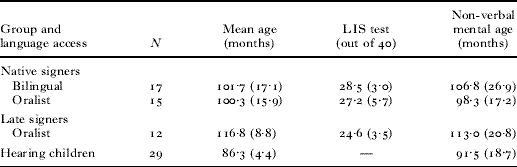
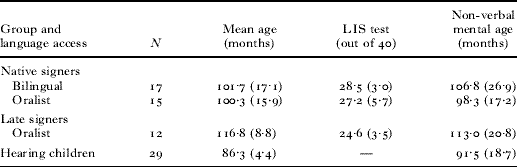
Participants consisted of groups of deaf children and a group of hearing controls. The deaf children were aged 6 to 11 years and were recruited from Italian schools in eight cities located throughout Italy (Bari, Biella, Foggia, Modena, Naples, Salerno, Taranto and Turin): (1) 15 native signers (8 females, 7 males) with at least one signing deaf parent who was proficient in LIS and who were instructed in a B/B environment; (2) 17 native signers (7 females, 10 males) with at least one signing deaf parent who was proficient in LIS and who were instructed in an oralist environment; and (3) 12 late-signing children with hearing parents (6 females, 6 males) whose parents were not proficient in LIS and who were instructed in an oralist environment. The children in the three groups were healthy and without disabilities such as cerebral palsy, autism, mental retardation or visual impairment. All had been included in the sample of those who participated in Study 1 reported in Meristo et al. (Reference Meristo, Falkman, Hjelmquist, Tedoldi, Surian and Siegal2007; see Table 1 for descriptive information on each group).
Mean age, LIS scores, and non-verbal mental age for the groups of deaf and hearing children (with SDs in parentheses)
In both groups of native signers, LIS was used at home whereas the late signers were all instructed in an oralist environment and, in contrast to the native signers, little or no LIS was used at home (see Meristo et al. (Reference Meristo, Falkman, Hjelmquist, Tedoldi, Surian and Siegal2007) for details of the children's home and school language environments). All late-signing deaf children included in the study were enrolled in oralist schools. We were only able to locate a small handful of late signers instructed in a B/B environment and these children were on average more than 18 months older than those in the other three deaf groups. For that reason, we were unable to include children with this background in the study.
In addition to the deaf children, 29 hearing children (16 females, 13 males), aged 6 to 7 years were recruited as controls from schools located in northeastern Italy. The hearing children were younger than the deaf children because older hearing children previously have scored near ceiling on the Quantity 2, Quality and Relation maxims of the CVT (Surian et al., Reference Surian, Baron-Cohen and van der Lely1996).
Materials and procedure
All deaf children were tested by professional LIS interpreters who were also hearing and fluent users of Italian. The interpreters were instructed to carry out the testing procedure in a uniform manner and administered the tests under the supervision of one of us (MT). First, the children were given an LIS Test and Raven's Progressive Matrices as a test of verbal and non-verbal intelligence respectively. The LIS Test is based on the British Sign Language (BSL) Receptive Skills Test (Herman, Holmes & Woll, Reference Herman, Holmes and Woll1999). Each of the forty sentences in the original BSL Test was translated into LIS and recorded on a DVD. The translations used LIS constructions common to Italian signers despite regional variations. Before the test was administered, the children were given a vocabulary check involving twenty-two signs for the nouns used in the test (e.g. book, pencil, table, car). As in the BSL test, the LIS test evaluated the understanding of grammatical features such as spatial verb morphology, number/distribution, size/shape specifiers, noun/verb distinctions and handling classifiers. Performance was recorded out of a maximum score of 40. Based on a sample of ninety-seven deaf Italian children, Meristo et al. (Reference Meristo, Falkman, Hjelmquist, Tedoldi, Surian and Siegal2007) reported a 0·68 correlation between LIS scores and teachers' ratings of the children's LIS proficiency.
The children were then given the CVT that the interpreters had translated into LIS from the Italian version used by Surian & Siegal (Reference Surian and Siegal2001). The test was administered by manipulating the three dolls, moving the doll that was ‘speaking’ on a certain turn. The form of the test given to the children in the present study consisted of twenty-two conversational exchanges (two practice trials and five exchanges for each of four maxims) that were staged by three doll speakers, one male and two female. For each episode, one of the female speakers asked a question of the other two speakers. Each gave a short answer: one that violated a conversational maxim and the other that did not. The children were asked to ‘point to the doll that said something silly’. The utterances violated the First Maxim of Quantity, the Second Maxim of Quantity, the First Maxim of Quality and the Maxim of Relation. To reduce fatigue effects, sensitivity to violations concerning the Maxim of Politeness were not included in the version of the CVT items given to the children in the present study.
On trials assessing the First Maxim of Quantity, the target ‘silly’ utterances failed to provide an informative answer, as in the following episode: (question) ‘What did you get for your birthday?’ (answer) ‘A present.’ For items that represented the Second Maxim of Quantity, the utterances provided redundant, useless information. For example: (question) ‘What would you like for breakfast?’ (answer) ‘A hard boiled egg cooked in hot water in a saucepan.’ Violations of the First Maxim of Quality consisted of utterances that were obviously false, as in the following: ‘Is there any chocolate?’ ‘Yes, I am made of chocolate.’ Violations of the Maxim of Relation were presented by using utterances that did not bear any obvious topical relation with the context question: ‘What game do you know?’ ‘I know your name.’ For half of the target items, the female doll provided the silly response and for the remainder it was the male doll. The CVT items were given in a different randomized order to each subject. The English translation of the complete test is shown in the Appendix.
As a language measure suitable for hearing children, those in the hearing group were tested on an Italian version of the Test for the Reception of Grammar (TROG; Bishop, Reference Bishop2003Footnote 1) to evaluate their language skills. Their mean score was 87·0 (SD=26·9). The hearing children received the CVT in spoken Italian as well as the Raven's Progressive Coloured Matrices.
RESULTS
Mean ages and non-verbal MA (Raven's Progressive Coloured Matrices) of the four groups of children are shown in Table 1, together with LIS scores of the three groups of deaf children. The performance of the Italian deaf children on the LIS Test was at a similar level to that of the British deaf children on the BSL Test used in Woolfe et al.'s (Reference Woolfe, Want and Siegal2002) studies from which the LIS Test was derived.
There was a significant difference among the four groups in age (F(3, 69)=20·32, p<0·001, ηp2=0·47). Post-hoc t-tests indicated that the two deaf native signing groups were significantly older than the hearing group (p's<0·001) but younger than the late signers (p<0·01). The three groups of deaf children did not differ significantly in non-verbal MA and LIS scores (F(2, 41)=1·50, p=0·24, ηp2=0·068) and (F(2, 41)=3·03, p>0·05, ηp2=0·13), respectively.
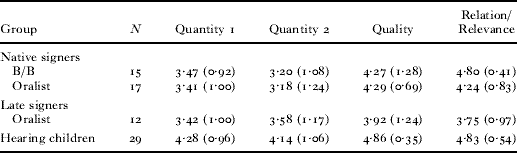
The distribution of responses of the deaf and hearing children on the four maxims is shown in Table 2. The groups of deaf children were above chance on all maxims, including the two quantity maxims (t's>2·26, p's<0·04, two-tailed).
Scores (0 to 5) on the four maxims measures for the groups of deaf and hearing children (with SDs in parentheses)
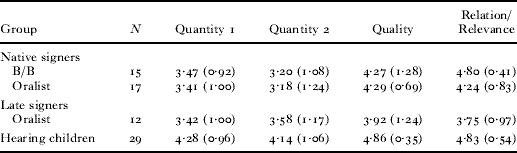
Note: B/B=bilingual/bimodal instructional environment using Sign Supported Italian.
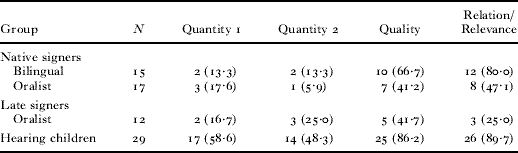
Table 3 shows the numbers of children giving correct responses on all five items for each maxim. For Quantity 1 and Quantity 2, about half of the hearing children were consistently correct in contrast to very few in any of the deaf groups. As many children in all groups scored at the ceiling of 5 correct on Quality and Relation, we compared the frequencies of native signing and late-signing deaf children and hearing children giving either consistently correct responses or one or more incorrect responses on the Quality and Relation maxims. These differences were significant among the three groups (χ2 (2, N=44)=8·39, p<0·04, two-tailed, Cramer's V=0·437). The B/B native signers were significantly more likely than the oralist instructed children to do well on the Relevance component of the CVT, (χ2 (1, N=44)=5·43, p<0·02, two-tailed, Cramer's V=0·399). A similar analysis was carried out for the Quality maxim. However, the difference among the three groups was not significant (χ2 (2, N=44)=2·53, p=0·28).
Frequencies of native and late-signing deaf children and hearing children passing (5/5) the four maxims items (percentages are in parentheses)
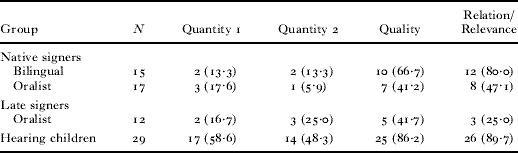
The difference between the hearing children and the B/B native signers was not significant on either the Quality (χ2 (1, N=44)=2·32) or the Relation trials (χ2 (1, N=44)=0·78). In contrast, the hearing children clearly outperformed both oralist native signers (χ2 (1, N=46)⩾10·26, p's⩽0·002) and oralist late signers (Fisher Exact Probability Test, p⩽0·007).
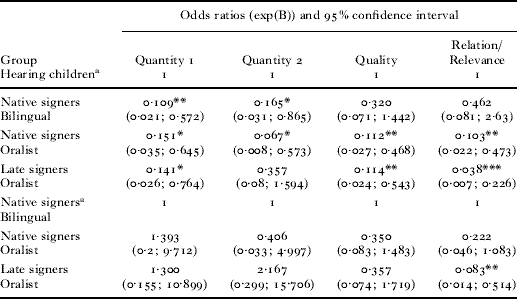
These results were generally confirmed by a logistic regression analysis performed with R software based on the odds ratios of passing (5/5) each of the four CVT components examined in our investigation (see Table 4). Comparisons of the scores of the three groups of deaf children were carried out with the hearing group assumed to have an odds score equal to 1. As shown in Table 4, the hearing children significantly outperformed all groups of deaf children on Quantity 1, both native-signing groups on Quantity 2, and the two oralist-instructed groups on Quality and Relation (p's<0·05). By contrast, the B/B native signing children did not differ significantly from the hearing children on the Quality and Relation items and the late signers did not differ significantly from the hearing children on Quantity 2. The deaf groups did not differ significantly from each other except for the case of the B/B children who outperformed the late signers on Relation (p<0·01).
Logistic regression analysis comparing native and late-signing deaf children and hearing children
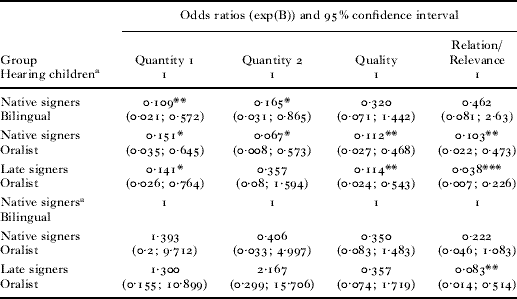
Note: The present logistic regression analysis was based on the odds ratio of performance on all five items for each maxim with the performance of the reference group assumed to be 5/5 or 1.
Wald test (z):
* p⩽0·05; ** p⩽0·01; *** p⩽0·001.
a Reference categories.
DISCUSSION
Regardless of group, the deaf children performed at an above chance level on all four components of the CVT, demonstrating their sensitivity to violations of conversational maxims. However, there were significant differences in their performance level. Native signing deaf children instructed in a B/B environment were significantly more adept in their pragmatic evaluations, as shown on the Relation component of the CVT, than were the native signing or late-signing children instructed in an oralist environment. On both the Relation and Quality components, there were no significant differences between the hearing children and the B/B instructed native signers. The late-signing children were significantly older than the hearing children. They outscored the hearing children in non-verbal intelligence and they were no less proficient in LIS than the B/B instructed native signers, as shown on the LIS Test. Nevertheless, unlike the B/B group, they scored significantly lower than the hearing group on Quality and Relation. Although there was no significant difference between the late signers and the hearing children on Quantity 2, the general level of performance on the items for this maxim was not as high as on Quality or Relation.
According to the computational account of relevance proposed by Sperber & Wilson (Reference Sperber and Wilson2002), the Maxim of Relation should be regarded as a supermaxim under which other conversational maxims may be subsumed. Our results support the claim that relevance constraints are of special importance in considering how children with different degrees of language access process information conveyed in conversation. In this respect, our results are consistent with those of a study by Eskritt et al. (Reference Eskritt, Whalen and Lee2008) in which hearing three- to five-year-olds were told to request the help of one of two puppets in finding a sticker hidden under one of four cups. In responding, one puppet always adhered to the maxim being tested (Quality, Relation or Manner), while the other did not. Consistently abiding by the puppet that adhered to a maxim was regarded as indicative of a child's maxim understanding. As in our study, an awareness of the Maxim of Relation was generally superior to that of the other maxims.
Why did children do well on the Relation and Quality violations compared to Quantity violations, with a particularly marked decrease in performance in the deaf groups? One possibility is that their performance was somehow impaired through presentation of the items using LIS interpreters. However, this is implausible given the lack of variability in the testing procedure followed by the interpreters. Another, more likely, possibility is that their impairment may reflect an immersion in a language environment in which even native signing deaf children are exposed to far more ungrammatical or unintelligible language than are hearing children, given the large numbers of non-native signing peers and teachers.
The difference on components of the CVT that favoured children's performance on Relation and Quality may be seen in terms of items that may have presented the clearest examples of violations of conversational maxims or, in Sperber and Wilson's sense, posed sharp alternatives that permitted computations. By contrast, the Quantity 2 items may convey weaker violations as these involve superfluity or paucity in information and therefore demand only slightly more extra effort in detecting silly responses from appropriate ones. In the case of Quantity 1 items, the children's level of performance is consistent with evidence from referential communication tasks showing that hearing, school-aged children have difficulty in identifying misunderstandings that can arise from message ambiguity (Surian, Reference Surian1995). Further studies are needed to compare perceptions of the severity of pragmatic violations across different CVT items in order to detect the extent to which violations of the Maxims of Quantity are harder to detect than other maxim violations and whether, in terms of Relevance Theory, qualitative differences can be seen in terms of varying degrees of relevance.
The responses of the oralist instructed native signers in our study fell short of that of hearing children on all maxims. This pattern is consistent with that shown in earlier research on belief–desire reasoning in deaf children. In Meristo et al.'s (Reference Meristo, Falkman, Hjelmquist, Tedoldi, Surian and Siegal2007, Study 2) investigation of deaf children in Estonia and Sweden aged 6 to 16 years, bilingually instructed native signers in Estonian Sign Language succeeded at a level that was similar to age-matched hearing children. They outperformed bilingually instructed late signers and native signers attending oralist schools. Similarly, we note that a critical result in the present study concerns differences among groups of deaf children that, given their proficiency on the LIS Test, cannot be explained in terms of differences in vocabulary, morphology and syntax.
In an oralist school, or even in a bimodal/bilingual school in which a sign language is not always used as a direct medium for instruction, both mentalizing and performance on measures of pragmatic understanding of deaf children could be specifically impaired even if the tasks and test questions are presented in their native language. This sort of instructional environment can require children to work using a ‘foreign’ mode of communication that impairs their ability to appraise messages and practise mindreading during verbal communication. By contrast, the ability of deaf children to attend to pragmatic cues in development may be faciliated in a bilingual environment in which both spoken and sign languages are used directly as the medium for instruction. With bilingual instruction, deaf children – and particularly native signers – may gain fuller access to conversation in their native language that supports the expression of certain key aspects of pragmatic understanding.
Several studies point to the importance of very early communicative experience (Meins, Fernyhough, Wainwright, Gupta, Fradley & Tuckey, Reference Meins, Fernyhough, Wainwright, Gupta, Fradley and Tuckey2002; Nelson, Adamson & Bakeman, Reference Nelson, Adamson and Bakeman2008) and language acquisition (Moeller & Schick, Reference Moeller and Schick2006; Ruffman, Slade & Crowe, Reference Ruffman, Slade and Crowe2002; Schick, de Villiers, de Villiers & Hoffmeister, Reference Schick, de Villiers, de Villiers and Hoffmeister2007; Siegal & Peterson, Reference Siegal, Peterson, Sharp, Fonagy and Goodyer2008) in children's expression of their ability to attribute beliefs, at least insofar as such ability is tested by means of explicit verbal tasks (Surian, Caldi & Sperber, Reference Surian, Caldi and Sperber2007). The time at which deaf children gain access to participation in conversation, whether through contact with users of a sign language or through cochlear implants, may ultimately be shown to be a primary determinant of their sensitivity to violations of conversational maxims. Increasing numbers of deaf children receive cochlear implants at an early age. Therefore the effects of early implantation on children's pragmatic awareness is worthy of considerable attention in further research. To date, there have been few studies on social cognition in children with implants (Peterson, Reference Peterson2004), and none to our knowledge of their overall pragmatic ability. The age at which children are implanted, the success of implantation as shown on measures of language development and the degree to which children with implants have access to a spoken and signed language environment may all contribute to their success on measures of their sensitivity to violations of conversational maxims.
APPENDIX
English translations of the items in the Conversational Violations Test, target items are marked by (*)
1. First Maxim of Quantity (‘Be informative’)
1.1.
LUCY: What would you like to buy in this shoe-shop?
*TOM: A pair of shoes.
JANE: A pair of trainers.
1.2.
LUCY: How would you like your tea?
TOM: With milk.
*JANE: In a cup.
1.3.
LUCY: What did you eat for lunch?
*TOM: Some food.
JANE: Pizza.
1.4.
LUCY: What did you see at the cinema last night?
TOM: Snow White.
*JANE: A film.
1.5.
LUCY: What did you get for your birthday?
*TOM: A present.
JANE: A bike.
2. Second Maxim of Quantity (‘Avoid redundant information’)
2.1.
LUCY: What did you have for breakfast?
TOM: I had cornflakes, and then a boiled egg and toast.
*JANE: A hard boiled egg cooked in hot water in a sauce pan.
2.2.
LUCY: Who is your best friend?
*TOM: My best friend is Peter. He wears clothes.
JANE: My best friend is John. He goes to my school.
2.3.
LUCY: What pet do you like?
TOM: I like puppies and kittens.
*JANE: I like rabbits which are animals.
2.4.
LUCY: Where did you go this morning?
TOM: I went to dance class and I had a great time.
*JANE: I went to school and I didn't stay at home.
2.5.
LUCY: Which is your favourite colour?
*TOM: Brown which is a colour.
JANE: Blue like the sea.
3. First Maxim of Quality (‘Be truthful’)
3.1.
LUCY: Where do you live?
*TOM: I live on the moon.
JANE: I live in London.
3.2.
LUCY: Do you have any brothers?
*TOM: Yes, I have 500 brothers.
JANE: Yes, I have two brothers.
3.3.
LUCY: Have you seen my dog?
*TOM: Yes, he is in the clouds.
JANE: Yes, he is in the garden.
3.4.
LUCY: Why don't you play with me?
TOM: Because I have to go home for tea.
*JANE: Because I am playing in the sky.
3.5.
LUCY: Is there any more chocolate?
*TOM: Yes, I am made of chocolate.
JANE: Yes, I saved you a piece.
4. Maxim of Relation (‘Be relevant’)
4.1.
LUCY: What did you do on holiday?
TOM: I cycled every day.
*JANE: My trousers were blue.
4.2.
LUCY: What did you do at school?
*TOM: We had a bath.
JANE: We did some writing.
4.3.
LUCY: What do you like to eat?
*TOM: I like London.
JANE: I like ice-cream.
4.4.
LUCY: What is your favourite programme on television?
TOM: My favourite is cartoons.
*JANE: My favourite is sandwiches.
4.5.
LUCY: What games do you know?
TOM: I know how to play football.
*JANE: I know your name.