Influenza is easily spread in childcare settings, and attending or working in a daycare setting is a risk factor for infection.Reference de Perio, Wiegand and Evans 1 Immunization is the best protection against disease; however, infants younger than 6 months cannot receive vaccine, despite being the highest risk group for influenza-related hospitalization or death.Reference Hadler, Yousey-Hindes and Kudish 2 Children aged at least 6 months may be vaccinated but their vaccine uptake has been low. 3 Vaccinating childcare agency staff would protect the worker and minimize disease spread within childcare settings. However, only 22%Reference de Perio, Wiegand and Evans 1 to 28%Reference Lee, Thompson and Lautenbach 4 of childcare staff have been vaccinated, rates that are lower than the US adult national average. 5 This study’s purpose was to assess predictors of seasonal influenza vaccination among a group that has not been well studied: childcare staff.
METHODS
Paper surveys and a link to an online survey were distributed to parents and staff at 23 St. Louis childcare agencies from September through December, 2014. The questionnaire measured influenza vaccine uptake and beliefs regarding influenza disease and vaccine. The Saint Louis University Institutional Review Board approved this study.
We used the χ2 test for all categorical variable comparisons, such as parents’ versus staff’s vaccine uptake. Multivariate logistic regressions controlling for gender, race, and income, and stratified by parents and staff, determined predictive models for vaccination.
RESULTS
In total, 351 staff and parents from 23 agencies participated (overall response rate, 32%; 33% for parents; 30% for staff/administrators). Three-quarters were parents/guardians (255 [73%]). Many (245 [70%]) were white, most (304 [87%]) were female, and three-quarters worked full-time (257 [73%]). Approximately half (170 [48%]) were 31–40 years old; another quarter (87 [25%]) were younger than 30. Most staff worked at agencies that were licensed (286 [81%]) and provided care to 51 or more children (265 [75%]).
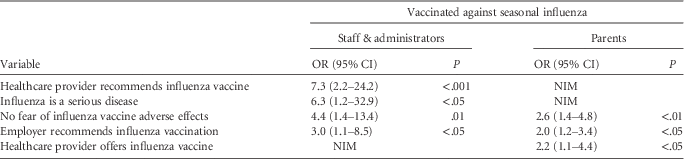
Half (168 [48%]) were vaccinated during the 2014/2015 season; another 60 (17%) were still considering it. More were vaccinated during 2013/2014 compared with 2014/2015 (65% vs 48%, χ2=136.6, P<.001). Childcare employees and parents were equally likely to have been vaccinated during both seasons, though their vaccination predictors differed. For both, not fearing vaccine side effects and employer recommendation predicted vaccination (Table 1). Among staff, healthcare provider recommendation and perceived disease seriousness were important predictors (Table 1). For parents, being offered vaccine by a healthcare provider was important (Table 1). Among the 48 unvaccinated staff, 25 (52%) and 20 (42%) would be vaccinated annually if vaccine were offered onsite and free, respectively.
Staff’s vs Parents’ Factors Related to Uptake of Seasonal Influenza Vaccine From Logistic Regression

NOTE. Factors were controlled for gender, race, and income. NIM, not in model; OR, odds ratio.
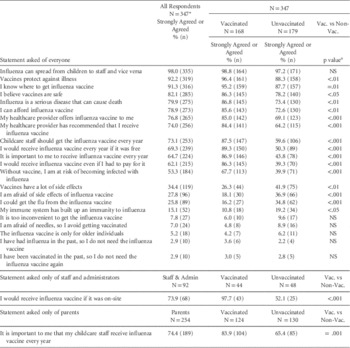
Almost all (335 [98%]) knew that influenza can spread in childcare settings. Many (275 [80%]) believed that influenza is a serious disease. Very few believed that having had influenza or having been vaccinated in the past meant that they do not need vaccine again (10 [3%] for both; Table 2). Few believed that influenza vaccine is only for the elderly (18 [5%]) or that someone can build up immunity to influenza (52 [15%]).
Vaccinated Versus Non-Vaccinated Individuals’ Attitudes and Beliefs About Seasonal Influenza Infection and Vaccine

NS=Non-significant
* The denominator varies from 344 – 347 due to missing data
a Determined by the Χ 2 test
Almost all believed that vaccines are protective (319 [92%]) and safe (285 [82%]). One-third (119 [34%]) believed vaccines have a lot of side effects; 96 (28%) fear these side effects. One-quarter (89 [26%]) believed one can get the flu from the vaccine. Vaccinated individuals were more likely to have positive attitudes towards vaccines (Table 2). Three-quarters (253 [73%]) believed that childcare staff should be vaccinated every year; parents and staff were equally likely to believe this. Of the 254 parents, 189 (74%) believed childcare caregivers should be vaccinated annually. Of all respondents, 273 (79%) could afford vaccine, and parents and staff equally agreed that they could afford it.
DISCUSSION
Almost half of the parents and childcare staff in this study had been vaccinated, which is just slightly higher than the US adult national average: 43.6%. 5 However, this is still far below the 80% Healthy People 2020 target. 3 Tuckerman et alReference Tuckerman, Thomas and Marshall 6 found that 89.9% of the general public believes that childcare staff should be vaccinated against influenza, and 73% of those in this study reported the same belief. There appears to be strong support for vaccinating childcare personnel, yet uptake among these individuals remains low. Increasing vaccine uptake among childcare staff could provide indirect protection for the most vulnerable children in childcare by reducing their exposure risk from caregivers. In addition, it might be possible to reduce or minimize the sick leave of childcare staff that is related to respiratory illness if they were vaccinated annually.
This study identified possible interventions to increase vaccination among childcare staff and parents, many of which have been used to increase healthcare personnel immunization. One of this study’s most significant vaccination predictors was having a healthcare provider either recommend or offer vaccine, similar to research among healthcare personnel.Reference Hubble, Zontek and Richards 7 This finding illustrates the vital role primary care providers play in patient vaccination decisions. Primary care providers should educate their patients about influenza’s severity and the importance of annual vaccination. Whenever feasible, primary care providers should also offer vaccine. However, this intervention may have limited effectiveness among childcare staff owing to age (most are younger than 40). This population may not seek preventative healthcare where vaccines would be encouraged. Similar to research examining healthcare personnel,Reference Maurer, Uscher-Pines and Harris 8 , Reference Rebmann, Wright, Anthony, Knaup and Peters 9 this study found that employer recommendation was associated with vaccination and should be encouraged.
In this study, vaccinated individuals were more likely to have positive attitudes regarding influenza vaccine and to perceive fewer barriers to immunization. Specifically, a lack of fear regarding vaccine side effects was found to be a significant vaccination predictor. Though the number of individuals in this study reporting vaccine misperceptions was low, an education campaign for parents and staff regarding the truth about vaccine safety and efficacy could help dispel these false beliefs. It would be vital to address fear of vaccine adverse effects through education, because this fear was much higher among this study’s participants compared with that among healthcare personnel.Reference Rebmann, Wright, Anthony, Knaup and Peters 9 , Reference Rebmann, Wright, Anthony, Knaup and Peters 10 Education campaigns have been found to be effective at increasing vaccine uptake among healthcare personnelReference Hubble, Zontek and Richards 7 ; however, to our knowledge they have not been studied in childcare settings.
Most parents and staff in this study reported that vaccine was affordable and access was not an issue, indicating that, overall, these are not major vaccination barriers. However, half of unvaccinated staff would be willing to be vaccinated if vaccine was offered free and on-site, indicating that vaccine uptake can be greatly enhanced if cost and access barriers are addressed. This reinforces previous research that found that on-site vaccination significantly increased childcare agency staff vaccination.Reference Lee, Thompson and Lautenbach 4 However, this intervention will be challenging for daycares; unlike in healthcare, on-site childcare vaccination programs are rare.
This study is likely to have social desirability and selection biases. Staff and parents who are most interested in and/or supportive of vaccination were likely to complete a survey; those who oppose vaccination may not have participated. The nonrandom sampling process, moderate response rate, and inclusion of only St. Louis childcare centers may limit generalizability.
In conclusion, the uptake of seasonal influenza vaccine among childcare agency staff was found to be similar to uptake of vaccine among US adults as a whole, though significantly lower than the Healthy People 2020 target. Implementing an education campaign and minimizing barriers to vaccination, such as providing it on-site and free of charge, are likely to result in increased vaccine uptake among these individuals. These interventions would be useful in any public health vaccination program.
ACKNOWLEDGMENTS
We thank Philip Gilbertson for his assistance in the study during subject recruitment, data collection, and data cleaning.
Financial support. Saint Louis University College for Public Health and Social Justice’s Research Office; and the St. Louis County Department of Public Health (contribution of stamps to aid in data collection).
Potential conflicts of interest. All authors report no conflicts of interest relevant to this article.