Introduction
In the past decades, a growing number of studies have highlighted the fact that in Italy there are regional disparities in the distribution of the elderly component. These differences clearly depend on population structure and migration dynamics (GCD-SIS, 2007), but they are also related to regional mortality differences, particularly between the ages of 60 and 85 (Robine et al., Reference Robine, Caselli, Rasulo and Cournil2006), and prove to be determined by the incidence of specific causes of death (Lipsi & Caselli, Reference Lipsi and Caselli2002). Relevant regional differences in Italy were also detected when the analysis was limited to extreme ages, in particular with regard to centenarians and their femininity ratio (Magnolfi et al., Reference Magnolfi, Petruzzi, Pinzani, Malentacchi, Pazzagli and Antonimi2006; Robine et al., Reference Robine, Caselli, Rasulo and Cournil2006). In general, among Italian centenarians the femininity ratio seems to decrease from north to south (Passarino et al., Reference Passarino, Calignano, Vallone, Franceschi, Jeune and Robine2002). Sardinia is one of the regions that most differs from the Italian national framework with regard to mortality features, since it has been shown to be particularly advantaged at oldest ages survival.
Following in the footsteps of the work of Deiana et al. (Reference Deiana, Ferrucci, Pes, Carru, Delitala and Ganau1999), who first drew the attention of the scientific community to the peculiarity of Sardinian longevity, other researchers have tried to explain and describe this phenomenon on the island. Important differences have been observed in Sardinia in the proportion of recorded centenarians and the possible role of specific causes of death (Caselli & Lipsi, Reference Caselli and Lipsi2006), in their geographical distribution (Poulain et al., Reference Poulain, Pes, Grasland, Carru, Ferrucci and Baggio2004; Gatti & Salaris, Reference Gatti and Salaris2004; Orrù, Reference Orrù2011) and in the sex ratio (Passarino et al., Reference Passarino, Underhill, Cavalli-Sforza, Semino, Pes and Carru2001; Caselli & Rasulo, Reference Caselli and Rasulo2005). In particular, the work of Poulain and colleagues (2004), based on the analysis of survival of individuals born in Sardinia between 1880 and 1900, has identified an area called the ‘Blue Zone’. This area is characterized by exceptional longevity, particularly of the male component, pointing to the fact that, despite cases of centenarians being widespread in the regional territory, higher longevity is concentrated in the inner part of the island.
The research of Salaris (Reference Salaris2010), examining mortality trajectories of birth cohorts between 1866 and 1915 in Villagrande Strisaili in the Blue Zone, showed that this community in general has a high level of survival. The comparison with Italian peers shows that females follow similar trajectories in the two contexts, while that of Sardinian and Italian males differs, confirming exceptional male survival in this area. A recent contribution by Poulain et al. (Reference Poulain, Pes and Salaris2011), focusing on birth cohorts from 1872 to 1912 in Villagrande Strisaili, did not identify one single factor responsible for the lack of gender survival differences in this village in the Blue Zone. However, the authors emphasized the possible role exerted by biological/genetic factors, while behavioural and socio-cultural factors were assumed to have influenced gender differences in social roles, in lifestyle and nutrition, physical activities and energy balance.
The examination of the genealogical trees of Sardinian centenarians has highlighted the existence of a familial component in Sardinian longevity, in most cases descending from the maternal side (Caselli et al., Reference Caselli, Pozzi, Vaupel, Deiana, Pes, Carru, Franceschi and Baggio2006). This trend was supported by a study conducted in Villagrande Strisaili in the Blue Zone, which confirmed the importance of a maternal line of transmission of survival (Salaris et al., Reference Salaris, Tedesco and Poulain2013). However, this latter work also showed that the strongest relationship between family members is observed between siblings.
Most of these studies on Sardinian longevity have been conducted using individual data, considering selected groups of individuals, such as centenarians, or focusing on cohorts of newborns in a large period of time that were previously usually treated as a single birth cohort. Based on the analysis of survival trajectories of individuals born in the municipality of Villagrande Strisaili in the Blue Zone, the present study investigates mortality trajectories of birth cohorts defined by shorter time intervals. The general belief is that this approach allows for an investigation of possible differences between cohorts' experiences and a consideration of the possible role of significant events in determining differential mortality among them. The analysis is developed through a longitudinal approach that focuses on the comparison of survival of decennial extinct birth cohorts covering the period 1872–1911. The study aims to examine possible differences across the life course in this population (from birth to advanced ages), between birth cohorts and by sex.
Main demographic and mortality trends in Villagrande Strisaili
The village of Villagrande Strisaili today has 3373 inhabitants (source: Istat, resident population at 1st January 2012); however, its population has varied over time. At the first general population census for a unified Italy in 1861, the village had 1251 inhabitants, and 1111 at the next census 10 years later (Angioni et al., Reference Angioni, Loi and Puggioni1997). Its population grew continuously from 1861 up to the 1971 census, at which time it first registered a decrease in the population stock due to growing out-migration flows. This phenomenon of depopulation, which characterized the demographic evolution of Villagrande Strisaili during the 1970s and in subsequent decades, is prevalent in most of the municipalities in inland and rural areas of Sardinia (Gatti & Puggioni, Reference Gatti, Puggioni, Berlinguer and Mattone1998). In more recent years a continuous reduction of its population has taken place, as the result of a progressive ageing population structure and of migration dynamics.
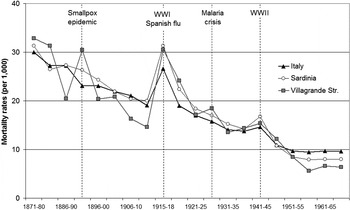
During the examined period in the village of Villagrande Strisaili, few episodes of mortality crisis have been recorded (Fig. 1). Those that did occur were caused by violent smallpox epidemics (such as the one occurring in 1895) or were a consequence of world conflicts, particularly WWI. In Italy WWI caused approximately 700,000 deaths, which corresponds to slightly less than 2% of the total population. Sardinia contributed to the conflict with about 13–14 thousand deaths and in Villagrande Strisaili 40 males died during WWI. These figures correspond to those of mainland Italy. It is to be noted that, in general, the mortality related to WWI affected mostly the young male population.
Mortality rates in Italy, Sardinia and the village of Villagrande Strisaili (per 1000 inhabitants), 1871–1970. Data sources: Italy and Sardinia (Tognotti, Reference Tognotti and Tognotti1996); Villagrande Strisaili (Cannas, Reference Cannas2007).

However, the mortality peak recorded between 1915 and 1918 is not exclusively due to WWI, since an important role was played by the Spanish Flu (Caselli, Reference Caselli and Si.De.1987), which had a more severe impact in Sardinia (Pirarba, Reference Pirarba1980), and in Villagrande Strisaili, than in Italy, due to the particularly poor living conditions of the Sardinian population.
The mortality curve of Villagrande Strisaili shows another peak in the years 1926–1928, which was due to a malaria epidemic that mostly affected children and the male population who were involved in the construction of the hydroelectric station at that time. Finally, the last significant event that affects the history of Villagrande Strisaili is the Second World War which – as can easily be imagined – created a general worsening of living conditions for the community during the years 1940–1945.
Data and Methods
Birth cohorts under study
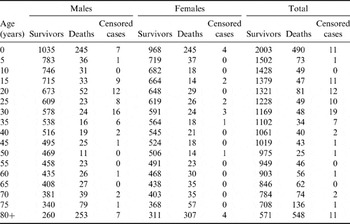
Birth cohorts from 1872 to 1911 for Villagrande Strisaili were analysed as decennial groups (1872–1881, 1882–1891, 1892–1901, 1902–1911) and followed longitudinally from birth to oldest-old ages. The selection of birth cohorts during the period 1872–1911 guaranteed that the analysis was conducted on extinct cohorts or almost extinct cohorts. In Villagrande Strisaili, an average of 50 births per year were recorded; the total number of cases considered in the present study in the birth cohorts 1872–1911 was 2003, of which 1035 were males and 968 females. Table 1 presents the distribution of deaths and censored cases by age and sex.
Distribution of deaths and censored cases of Villagrande Strisaili birth cohorts 1872–1911 by age and by sex

Data sources
Individual data for Villagrande Strisaili were collected from civil status registers, population registers and parish registers with the objective of including all persons born in the village in the birth cohorts here considered. Through the analysis of birth, marriage and death entries each individual was followed from birth to death. Individual data were aggregated at the population level. Data collection covered the period from 1866 to 2013 and provided a level of coverage of 95% of known survival for individuals included in the database.
Data quality
Villagrande Strisaili data necessitated a careful validation process of raw data since, when dealing with historical data, certain crucial points must be considered in order not to compromise data completeness and coverage (Del Panta & Rettaroli, Reference Del Panta and Rettaroli1994). Specifically, raw data validation considered the following points: i) under-registration of births and related deaths; ii) migration flows; iii) age misreporting; iv) censoring.
i) Under-registration of births and related deaths
To avoid under-registration of births in Villagrande Strisaili data, information on births was collected using both civil status and parish registers. Given the significance of the Catholic Church in the life of the community, this procedure enabled the capturing of births not recorded at the municipal office, but present in the parish registers of baptisms or burials. This procedure certainly does not fully guarantee a complete coverage, and moreover does not exclude the possible existence of a systematic under-registration of stillbirths, which have been documented in some communities in Sardinia (Breschi et al., Reference Breschi, Esposito, Mazzoni and Pozzi2012) and which have been shown in different European countries to correspond to around 3% of total births (Gatti, Reference Gatti1999).
ii) Migration flows
Another crucial issue for the completeness of data is migration flows. The population of Villagrande Strisaili proves to have little mobility (Salaris, Reference Salaris2010). To verify mobility of families, data on family formation and subsequent offspring were carefully checked. Villagrande Strisaili had a high level of geographical endogamy of marriages, which was certainly favoured by the municipal regulations concerning the use of common lands, meaning that their access was restricted to residents or individuals married to residents of the village (Del Piano, Reference Del Piano1979). At the end of the 20th century, 84% of marriages on average were celebrated with spouses from the same village (Cannas, Reference Cannas2007). Newly formed families generally remained in the village after marriage and their mobility was verified by examining if the offspring were born in the village itself. Mortality trajectories of migrants were followed, when possible, to the new place of residence; for individuals born in the village, vital events (marriage/s and death) were collected from the so-called ‘marginal annotations’ reported alongside the birth certificate.
The studied cohorts were not involved in migration processes at older ages, and this confirms what is generally reported in the literature, which is that elderly people are insignificantly mobile (Meslé & Vallin, Reference Meslé and Vallin2002). This makes it possible to assume that estimates at advanced ages do not suffer from under-reported migration. In support of the idea of a limited mobility of the Villagrande Strisaili population, it was observed that on average 80% of deaths occurred in the village itself.
iii) Age misreporting
Mortality and age distribution data analysis show that age misrepresentation is common today in countries with no or poor population registration systems and incomplete or non-existent historical records (Preston et al., Reference Preston, Elo and Preston1999). In particular, age exaggeration at older ages was reported to be one of the most common forms of age misreporting (Ewbank, Reference Ewbank1981). The use of poor data quality produces distortions in the observed mortality estimates. Therefore, age validation was rigorously performed in Villagrande Strisaili data. Validation was carried out verifying the coherence between age at death reported in the death entry and the calculated age according to information from an individual's birth certificate. For married individuals, this process of validation was performed by cross-checking information from birth, marriage and death entries. This validation procedure ensured the reliable quality of the data used for analysis.
iv) Censoring
The presence of partial information of individual survival may necessitate the adoption of a censoring strategy in order not to exclude individuals with no complete information on their survival. In this manner, survival was attested at least up to the last information available (i.e. still-living individuals at the end of the observation period, migration date, birth of last child, date of marriage, military medical, confirmation ceremony) and survival was demonstrated to be at least underestimated. Right-truncated cases represented 4.5% of the population under study and this percentage varied from 7.1% for males to 1.8% for females (Table 1).
Methods of analysis
Life tables for the Villagrande Strisaili population were built according to Preston et al. (Reference Preston, Heuveline and Guillot2001) formulas for single decrement life tables. For infants below age 5, the formulas used for a 0 came from adapted values from Coale and Demeny (1983, cited by Preston et al., Reference Preston, Heuveline and Guillot2001) for West model life tables as proposed by Preston et al. (Reference Preston, Heuveline and Guillot2001). Open-age category at 80 years was estimated adopting formulas suggested by Preston et al. (Reference Preston, Heuveline and Guillot2001, p. 48) and by the Human Mortality Database Protocol for Cohort Life Tables (Wilmoth et al., Reference Wilmoth, Andreev, Jdanov and Glei2007). At individual level, data were analysed by means of Kaplan–Meier survival estimation (Kleinbaum, Reference Kleinbaum1995). Differences within categories were tested for significance by means of Breslow and log-rank tests (Blossfeld & Rohwer, Reference Blossfeld and Rohwer2002).
Results
Differential mortality by birth cohort
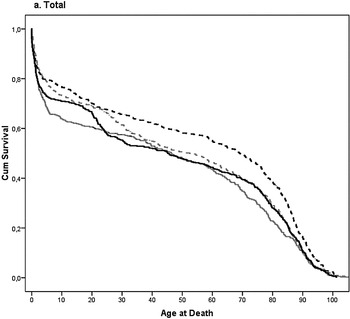
The comparison of mortality trajectories of birth cohorts 1872–1881, 1882–1891, 1892–1901 and 1902–1911 obtained by means of Kaplan–Meier (KM) estimation and its sensitivity tests show that, according to the tests scores, differences between cohorts are statistically significant (Breslow χ2=3.075, p<0.001; log-rank χ2=22.455, p<0.001). However, graphical analysis of the curves shows that the birth cohort 1902–1911 is the one that differs the most from the others (Fig. 2a), having in general higher survival. If this cohort is excluded from the analysis, differences between cohorts turn out to no longer be statistically significant (Breslow χ2=5.543, p=0.063; log-rank χ2=3.122, p=0.210).

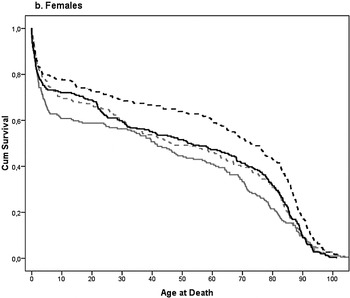
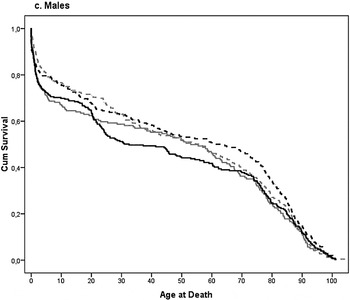
Kaplan–Meier survival curves for Villagrande Strisaili by birth cohort (1872–1911): a, total sample population; b, females; c, males.

Continued

Figure 2a shows several phases of convergence and points of crossover. The occurrence of these intersections between the curves indicates that mortality selection occurs at different ages and intensities in the cohorts under study. The more advantaged cohorts, as opposed to the disadvantaged ones, change with age and these variations question the reliability of the estimates of KM sensitivity test scores.
When the analysis is performed separately for the two sexes (Fig. 2b and 2c), differences between survival curves are statistically significant only among females, as crossover points are present in both subpopulations and particularly among males (females: Breslow χ2=22.397, p<0.001; log-rank χ2=20.750, p<0.001; males: Breslow χ2=7.064, p=0.070; log-rank χ2=4.861, p=0.182). Again, if the survival experience of birth cohort 1902–1911 is not taken into account, difference are also not relevant among females.
Differential mortality by sex
From the results of sensitivity tests of KM curves it emerges that, with the exception of cohort 1902–1911 for which the Breslow test score is slightly significant, there are no statistically significant differences between the sexes in the birth cohorts here examined (1872–1881 cohort: Breslow χ2=0.704, p=0.401; log-rank χ2=0.492, p=0.483; 1882–1891 cohort: Breslow χ2=0.337, p=0.562; log-rank χ2=0.011, p=0.917; 1892–1901 cohort: Breslow χ2=1.521, p=0.218; log-rank χ2=0.054, p=0.816; 1902–1911 cohort: Breslow χ2=4.275, p=0.039; log-rank χ2=2.432, p=0.119), leading to the conclusion that in the population under study, specific conditions do not allow us to observe a gender gap in survival at advanced ages. It is evident that, despite the fact that the most recent birth cohorts had gradually increasing levels of survival, differences between the sexes is not a characterizing aspect of this population. However, moving from KM estimates and its tests (which provide an overall estimate of the level of significance of the detected differences) to the analysis of segments of percentiles of the cumulative distribution of survivors (lx ) by 5-year intervals of age, it is possible to emphasize that in the four birth cohorts considered, mortality trajectories present some interesting differences.
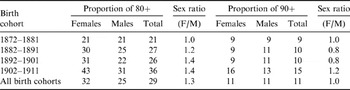
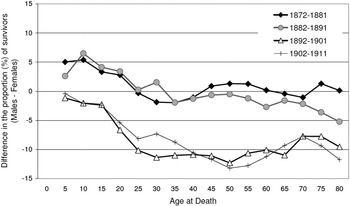
Figure 3 shows to what extent males and females differ in their cumulative percentage of survivors (lx ) by 5-year age groups according to the estimates of life tables. Mortality trajectories in the birth cohorts 1872–1881 and 1882–1891 follow a similar trend, i.e. the female component is eliminated to a greater extent (though differences prove not to be particularly important as they are estimated at around 5%) compared with men up to age 25 years, and from that moment on the gap narrows and differences between the two sexes vary around zero. The experience of 1892–1901 and 1902–1911 birth cohorts differs from that observed among the other cohorts. In these cohorts, in fact, the male component is heavily penalized and highly selected during adulthood (at 20–30 years of age). At subsequent ages, the trend is similar to that of other cohorts, despite a shift downwards. As Table 2 shows, the outcome of these different mortality selection processes is that the sudden elimination of males at adulthood is compensated at subsequent ages, and at advanced ages differences in the proportion of survivors 80+ and 90+ in the birth cohorts under study are not relevant.
Proportion (%) of survivors aged 80+ and 90+ and sex ratio for Villagrande Strisaili birth cohorts, 1872–1911

Difference in the proportion (%) of survivors (males−females) by birth cohort, 1872–1911.

The effect of significant events on mortality differential
From the analysis of general mortality rates (Fig. 1), four relevant events acting on mortality variations in Villagrande Strisaili were detected, namely: a smallpox epidemic (1895), WWI and the Spanish Flu (1915–1918), a violent episode of malaria (1926–1928) and WWII (1940–1945).
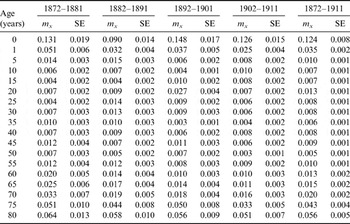
The importance that significant events may have for mortality trajectories also emerges at aggregate level in the analysis of age-specific mortality rates. Table 3 reports mortality rates by birth cohort. The comparison shows that the mortality experience of individuals born in the decennial birth cohorts in Villagrande Strisaili presents some differences compared with the general trend for all birth cohorts from 1872 to 1911 considered together. With respect to infant mortality, it was expected that, as a consequence of secular improvement of early life conditions, a lowering of mortality rates from one cohort to the next would be observed. However, the smallpox epidemic that struck the village in 1895 had a heavy negative impact on the survival of birth cohort 1892–1901. The higher mortality rates recorded in the first years of life in this cohort led to lower mortality levels at age 5, highlighting that this epidemic had an important negative impact. The most advantaged birth cohort in the early phases of life is that of 1882–1891. At adulthood, an important role in increasing the level of mortality was played by the combined effect of WWI and the Spanish Flu, which affected all birth cohorts, although at different ages. According to mortality estimates, the greatest impact is recorded among individuals born in 1892–1901, for which the negative effect is shown to be almost double compared with prior cohorts. However, the effect of the malaria epidemic occurring in the village in 1926–1928 appears to be limited. The consequences for mortality of World War II cannot be clearly detected, as they partially overlap those of the ageing process in all birth cohorts. Nonetheless, if the experience of each decennial cohort is compare with that of the large cohort group 1872–1911, it is observed that birth cohort 1872–1881 suffered more than the others from the general deterioration of living conditions that occurred during the conflict, and it may be assumed that the individuals belonging to this cohort benefited later from improvements made soon after the end of the war. At the onset of the ageing process, the comparison between the mortality experience of different cohorts seems to show a secular trend, which is characterized by a progressive decrease in mortality rates at advanced ages, and birth cohort 1902–1911 has the highest survival compared with the others.
Age-specific mortality rates (mx ) and standard error (SE) for Villagrande Strisaili birth cohorts, 1872–1911

Discussion
The analysis of decennial birth cohorts from 1872 to 1911 born in the village of Villagrande Strisaili in the Blue Zone of longevity in Sardinia shows that the study of groups of individuals, identified by a limited interval of time, provides interesting insights into the evolution of mortality trajectories of the population under study. Firstly, cohorts' experiences are not homogenous, but rather several points of mortality convergence and crossover occur. This points out that estimates of conventional sensitivity tests on survival curves might not be a reliable measure of differences in contexts where there are sudden changes in the mortality level, which can determine the crossover between population subgroups (Kleinbaum, Reference Kleinbaum1995; Blossfeld & Rohwer, Reference Blossfeld and Rohwer2002). The identification of a crossover point raises the question of poor data quality with respect to age at death (Coale & Kisker, Reference Coale and Kisker1986; Elo & Preston, Reference Elo and Preston1994; Preston et al., Reference Preston, Elo and Preston1999). As discussed in the data quality session, in the case of Villagrande Strisaili, individual data were strictly validated, and the existence of approximately 4.5% of right-censored cases has a limited distorting effect on data quality and consequently on mortality estimates here examined.
Secondly, the results show that improvements in survival level from one cohort to the next do not follow a secular trend, as significant events prove to play a relevant role in mortality variations, influencing mortality trajectories. Temporary depressing conditions, like the smallpox epidemic in 1895 or WWI and the Spanish Flu, affect mortality pace and generally an acceleration of the elimination process is observed. The short-term effect of negative events is a sudden rise of mortality rates, but the long-term consequence of this selection is that surviving individuals experience lower mortality risk at subsequent ages. Conversely, particularly favourable situations can slow down the elimination process of frail individuals of a population, leading to a postponement of deaths at later ages. Both selection mechanisms are clearly related to the degree of heterogeneity within each population, where unusual contextual situations and/or the intervention of exceptional events can trigger processes of elimination with different degrees of intensity.
When a population is highly homogenous, frail individuals generally have high levels of early mortality and lower mortality rates at older ages since the remaining survivors are robust individuals who are later exposed to senescence processes and co-morbidity (Vaupel & Yashin, Reference Vaupel, Yashin, Caselli, Vallin and Wunsch2001). While it is clear that at older ages death is subject to competing risk factors and the possibility of taking these into account significantly depends on the available data, the roles of senescence and heterogeneity are often neglected in studies (Duchene & Wunsch, Reference Duchene and Wunsch1988) and are difficult to measure.
In the case of Villagrande Strisaili, and of Sardinia in general, it has been documented that mortality trajectories developed according to the pattern low early mortality and low late mortality (Salaris, Reference Salaris2010), which may be considered unusual. However, a possible explanation for this pattern may be related to the genetic specificity of the Sardinian population (Cavalli-Sforza et al., Reference Cavalli-Sforza, Menozzi and Piazza1997) and to a high homogeneity of its biological structure, as a number of studies (Contu et al., Reference Contu, Carcassi, Orrù, Mulargia, Arras and Boero1998; Lampis et al., Reference Lampis, Morelli, De Virgilis, Congia and Cucca2000) have maintained.
Thirdly, the results suggest that with regard to life course, the younger people are at the occurrence of a negative event, the higher appears its negative impact on the population involved. In the first half of life, mortality due to external factors appears to be more relevant in the selection process, while at the onset of the ageing process and at subsequent ages the predominant mechanisms are biological ones. However, the impact of exceptional mortality shocks proves not to interfere in the process of ageing of the population, as has been documented in other populations (Zarulli, Reference Zarulli2012). Nevertheless, as progressive increases in survival at advanced ages are observed, a possible interaction between natural selection mechanisms and contextual conditions cannot be excluded also during the ageing process.
With regard to sex differential, in the population under study the cohort analysis has not allowed for the detection of statistically significant differences between the two sexes, pointing to the fact that this population presents a gender-balanced ageing process. However, the occurrence of significant events appears to have a greater weight among males than females, as the former are in general exposed to a higher risk of death and prove to be more vulnerable to external changes.
Finally, the generation that seems to demonstrate the highest survival at older ages is represented by the more recent cohort of 1902–1911. However, when focusing on gender differences, male survival is higher among individuals of birth cohort 1882–1891 and 1892–1901 and this turns out to be the outcome of completely different mortality trajectories. The cohort 1882–1891 proves to be mostly favoured in survival in the early stages of life and generally experienced particularly favourable conditions across the entire life course, while the birth cohort 1892–1901 was highly selected by the events in which it was involved. This suggests that extreme contextual conditions, both favourable and unfavourable, may significantly affect the mortality trajectories of a population.