1. Introduction
The world is currently witnessing the rapid growth of cities. People move to the cities for many reasons: better opportunities, better jobs, and better lives. As most development projects and economic opportunities are concentrated in urban areas,Footnote 1 so life in a village becomes increasingly unattractive for many.
Yet, being urbanized does not always in itself bring better lives for such migrants. In fact, those with a lack of education and job skills may find themselves trapped: jobless and forced to live as “squatters.”Footnote 2 They build houses upon unused or abandoned land, either state land that has not been allocated or land which is already the subject of legal titles held by others. Thus, the urban poor are forced to live on the margins, housed in illegally constructed settlements, and engaged in informal employment. Sometimes, as Hardoy and Satterthwaite write, the result is that the state comes to consider almost all aspects of the lives of urban poor as “illegal,” or as falling outside the remit of formal law or urban government.Footnote 3 By seeing such people purely as rule-breakers, the state seeks to justify discrimination towards them and the denial of their basic rights as citizens.
This article analyzes how the denial of legality of the urban poor’s property (land and houses) can lead to other forms of discrimination. It is based on research focusing on an evaluation of a programme of agrarian reform undertaken in Surakarta, Indonesia.Footnote 4 Surakarta was the site of an attempt to implement the agrarian reformFootnote 5 in urban areas, whereby the Surakarta government implemented a Certification of Land (Land Titling) and “slum”Footnote 6 area revitalization programmeFootnote 7 in 2012. The approach used in this research combines a normative legal approach to evaluate the implementation of the programmeFootnote 8 and a qualitative social research approach, using life history interviews to facilitate an understanding of the lives of the urban poor. The first part of the paper describes the process of urbanization and its impact in Indonesian cities. It is followed by a case-study of Kampong Kragilan in Surakarta city, a once illegal settlement where a schematic land-titling programme had a dramatic impact upon lives of the people living there. Next, it analyzes how the relation between the land and the people determines their legality and illegality and suggests that removing this barrier to securing rights in land can result in the removal of other barriers faced by the urban poor. The findings show more than just the effect of a government programme to legalize urban lands or to give legal land titles; it shows how the urban poor, particularly in Surakarta, coped with the difficulties arising from the illegality of their settlements, and how state recognition of their land rights has enabled them to access and realize other rights of personhood.
2. The Urbanized State
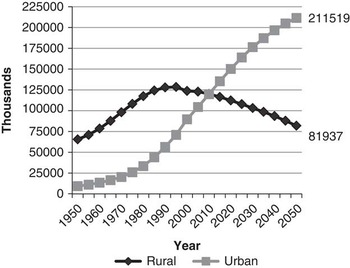
Indonesia is experiencing some of the fastest urban growth in the world. In 2010, according to the United Nations World Urbanization Prospects, among Asian countries, Indonesia had the highest rate of urbanization. Indonesia’s urbanization rate is 4.2% annually, while China’s rate is only 3.8% and India’s is 3.1%.Footnote 9 The high urbanization rate in Indonesia is reflected in the growth of the urban population as compared to the rural population in Indonesia. In the 1950s, the rural population was as high as 60 million people, while the urban population was less than 25 million people. The increase in urban population began in the 1970s when cities were built, as new industrial sectors developed. Although at that time, the agricultural sector, located in rural areas, still dominated the national economy, development was mainly concentrated in urban areas. Figure 1 explains the trends of continuously increased urban population in Indonesia. As shown in Figure 1, after more than three decades, in 2010, the urban population surpassed the rural population and the number keeps rising—today there are 120,229,000 people living in cities, as compared to the declining rural population of 119,752,000 people. This trend is predicted to continue and it is predicted that, by 2050, there will be as few as 100 million people in rural areas in Indonesia, while more than 211 million will live in urban areas.Footnote 10
2.1 Poverty and Urbanization
Li, in her latest book, Land’s End, has rightly pointed out that, the relationship between people and their land has radically changed.Footnote 11 Interests in land have “ended” in many ways: customary land-sharing systems no longer exist, the possibility for expansion into primary forest has disappeared, and there is the sense that those left behind in modernization have run out of options. The vast development of cities and the underdevelopment of rural areas have pulled and pushed people to the urban areas.
This increase in urban population is not always matched by a similar increase in the availability of work (particularly formal employment) or spaces to live. The limited nature of city space has been the cause of constant competition.Footnote 12 Also, the development created by the government does not always favour the poor, in either rural or urban areas. Indonesia’s development has been largely physical and technical, with high-profile economic activities or “high modernism.”Footnote 13 The idea of development has become associated with physical development and a concern with building infrastructure: factories, buildings, roads, and dams. This physical approach of development has not brought any significant changes to society. The reasons for this are many. The needs of local communities have been sidelined in the pursuit of a “progress” that has proved to be unsustainable.Footnote 14 Development has often targeted generalizations of the problems faced by the people in both urban and rural areas, rather than specific issues. This reflects Sen’sFootnote 15 critique that development fails when it does not provide a strategy for increasing people’s capability. The state has a “simplifie[d]”Footnote 16 view of what constitutes development, and focuses upon those indicators which are easily ordered and managed; and economic growth is the only measure for its success.
The World Bank Report on Poverty Reduction in Indonesia has shown that, if “poverty” is defined to include all of the human development dimensions, poverty still haunts more than half of the Indonesian people, in both rural and urban areas.Footnote 17 These dimensions include: the fulfilment of basic human needs; access to education, health, or government services; and the opportunity to participate in the social, economic, and political sector without any discrimination.Footnote 18 Sadly, human development in Indonesia has lagged far behind physical development and inequality has opened up between rural and urban areas, and between the affluent and the poor.
In urban areas in particular, the affluent have a significant advantage: they are able to pay for city space, since they have more resources, deriving from both the physical capital they own and their greater social and educational capital.Footnote 19 Meanwhile, the rest of the urbanized population, suffering from a lack of capabilities and resources, are trapped in illegality and informality. They are mostly living in illegal settlements or “squats.”Footnote 20 Such settlements are found on the edges of rail tracks and riverbanks, on unused or abandoned lands, whether that be state lands or lands where there is a conflict between private parties. The urban poor’s lack of education and skills prevents them from entering the formal job markets in the cities and consequently they find informal employment, working as street vendors, scavengers, etc.
2.2 Illegality, Extra-Legality, or Urban Informality?
Economists have used the term “illegal” or “informal” sector since the late 1970s. Different terms have been used to describe the “other system” which exists outside the formal one specified by the state. The terms range from neutral ones such as informal, unrecorded, extra-legal,Footnote 21 unofficial,Footnote 22 hidden economy,Footnote 23 or shadow economyFootnote 24 to more negative terms such as irregular, illegal, underground,Footnote 25 or black economy.Footnote 26 Most economists use such terms merely to describe economic activities that are not included within the formal system.Footnote 27 Illegality in this particular context is simply a label, or a term used by the state to describe those economic activities which breach normative legal rules. “Illegal” economic activity might well be considered acceptable according to widely recognized cultural norms.
This illegal or informal sector accounts for more than half of the economic activity of Indonesia.Footnote 28 This situation is certainly not a desirable one. Hernando de SotoFootnote 29 writes that poor people in the developing countries have the potential to carry out economic activities, but their ability to do so is restricted. This is, first, because the poor exist in a situation of informality, or what he called “extralegality,” and, second, because the poor cannot generate surplus capital from their informal, unregistered, and (therefore) “dead and unproductive” property.Footnote 30
In his book, The Mystery of Capital, de Soto argues that the Western countries’ “capitalist approach” to property can be used to reduce poverty in Third World countries.Footnote 31 De Soto believes that the potential assets in the Third World countries have not been “identified or realized”Footnote 32 and, as a result, they are “dead capital.”Footnote 33 In other words, the poor in these countries are not accurately described as “poor.” They have property (although mostly with unrecorded rights) and they have business (although mostly extra-legal businesses).
For this reason, a formal legal property system can become a means to shift the potential assets held by people in poor countries into productive assets or capital.Footnote 34 Once the abundance of these assets is recognized and “secured” in the formal system, it will enable the mechanism of property markets. Formally recognizing the legal title to assets of people in developing countries will prove beneficial not only in bringing legal ownership more closely in line with actual ownership, but also in allowing the management of such assets within the market economy. One element of the market economy is the mortgage system. By formally recognizing legal title to land, this title can then be used to borrow money for business and investment. With this idea, de Soto tries to present the concept of property, which is embedded within the Western concept of capitalism,Footnote 35 as a liberating force from poverty which can enable development, instead of a negative oppressive force.
RoyFootnote 36 approaches the problem somewhat differently, arguing that, instead of thinking about informality as deriving from the division or separation between the formal and informal, both informality and formality should be seen as “a series of transactions.”Footnote 37 Both Roy and SafitriFootnote 38 suggest that de Soto’s concern that the poor are somehow excluded from the market by their absence of legal title to capital is misplaced. The poor are already involved in market transactions, though these are characterized by informality and limited to individual localities and closed communities.
SmetsFootnote 39 and Safitri both argue that land titling will put the land owned by the poor within the free market—something which raises the spectre of confiscation of that land should a mortgage be defaulted upon. Allowing the land held by the poor to be traded on the free market is also problematic in that it risks creating what SmetsFootnote 40 describes as new “winners and losers.” In Indonesia, the poor may, understandably, be tempted to sell their land once they gain legal title to it, which would transfer such land into the hands of larger capital owners or land speculators.Footnote 41 There is also concern that what is currently used as agricultural land might be sold to those who wish to use the land for industry, mining, plantations, or real estate, with consequent environmental degradation.Footnote 42 In other words, the concern lies in the prediction that this formal legal property system will allow the poor to make the hasty decision to sell their land to a commercial party, thus raising the possibility that they will lose their major asset and receive a price which is lower than the market value.Footnote 43
Most importantly, possession of legal title will not change the way in which the urban poor are employed (mostly in informal sectors with irregular incomes). Research into informal enterprises in the knitted-garment sector in the city of Bandung showed that most of the small enterprises were informal, with unrecorded workers, and most aspects of their working practices did not conform to the government’s requirements for small and medium enterprises.Footnote 44 Formal financial institutions require stability of the borrower’s income and businesses so as they would be able to pay debts regularly, and that their businesses will have clearly recorded financial data. Even if they possessed legal title, the urban poor might well still be unable to access formal finance, because they do not have a steady income with which to service their debts or sufficient formal means of attesting to their financial position.
In this article, I examine the position of the urban poor living in urban informality, drawing upon research in Kampong Kragilan in Surakarta, Indonesia, where the residents of the Kampong had the status of informal and illegal occupants until the inception of a land-titling programme. Unlike de Soto, however, I would prefer the use of “rights to the city” by Lefebvre in order to frame the findings and so focus upon the transformative potential that formal title, even to a small plot of land, can have where it enables residents to gain recognition from the urban government.
3. “Gambling with the State”: The Case of Kampong Kragilan Surakarta
Kampong Kragilan lies in the eastern part of the city of Surakarta, a city located in the centre of the island of Java.Footnote 45 Surrounded by the urban, predominantly poor area of Surakarta, there are 56 families now living in the area. Most of the people who live in Kragilan are working in the informal sector, as petty traders in traditional markets, becak drivers,Footnote 46 scavengers, factory workers, and household assistants.
Kampong Kragilan developed as a result of two factors: rural-to-urban migration, and the economic and social marginalization of migrants within cities. As discussed above, development in Indonesia has been concentrated in urban areas, resulting in very limited basic services in rural areas, and changes in the agricultural sector which make it no longer sustainable as the main source of income for many villagers.Footnote 47 Rural migrants came to Surakarta not because they sought the benefits of the city so much as they sought to escape circumstances within their village which had made life there untenable. One interviewee in Kragilan, Sakiyem, had come to the city as a child with her parents. She worked removing chillies from their stalks at Pasar Gede (Gede Market) in Surakarta, for which she was paid only Rp. 6,000–10,000 per day, or less than US$1. Though her income was very low, Sakiyem, like many other urban poor, remained in the city because she found that there were more possibilities to earn money for her daily needs in the city as compared to in a rural village. While the rural poor risk starvation in the worst-case scenario, in urban areas, there will always be some employment to be found, even if it is for minimal payment.Footnote 48 Migration to urban areas continues to rise despite urban poverty—something which Todaro and Stilkind suggest is an indication of the perception that life will be better in the cities.Footnote 49
The second factor which explains the rise of informal settlements such as Kragilan is the considerable poverty and economic marginalization experienced by migrants. Urbanized villagers struggle constantly to survive in the cities. While those with a high level of education are able to take advantage of the benefits of the city, including better access to the basic services provided by the state, many urbanized villagers do not have this advantage. As a result, even those rural migrants who have lived in urban areas for much of their lives may live in considerable poverty, unable to access the benefits of the city. Suyatno, a 43-year-old man with five children, worked daily as a “pemulung” or scavenger—an activity that is sometimes banned by municipal governments, with a daily income of Rp. 20,000–25,000 (equivalent to around US$2). To meet his families’ daily needs, at nights, he worked as a helper at a local food stall, receiving a monthly payment of Rp. 400,000 (equivalent to US$33). Such poverty leaves rural migrants vulnerable to an economic downturn, of which Indonesia had several in the late 1990s. As another example, the experience of another informant, Sakiyem, is typical of many migrants. Having been evicted from Gremet Manahan, another area of Surakarta, she moved to a rented house in the area of Kragilan. When the economic crisis hit in 1999, her husband could no longer find enough money to afford the rent of the house—a situation worsened by an illness that made him unable to work. Sakiyem and her husband then began to occupy unused land nearby. They were not alone; 53 other people, most of whom were unemployed due to the economic crisis and thus unable to afford to rent a house, came to live on the plot of abandoned land in Kragilan. In the 1990s, the same abandoned plot had been occupied by only four other people. In 2000, after the Surakarta riots, increasing numbers of people came from the surrounding areas of Surakarta and began to cultivate land and built houses in Kragilan.
The residents of Kampong Kragilan were not considered by the state as locally domiciled residents and therefore were refused the National Identification Card or Kartu Tanda Penduduk (KTP) as proof of identity. They were also ineligible to receive government health and social security benefits and struggled to find formal employment, due in part to a stigma attached to them as “criminals” occupying other’s land.Footnote 50 Although they were viewed by the wider community as “criminals,” who illegally took other people’s land, this perception was a far lesser concern for the residents of Kampong Kragilan than the simple daily battle to survive. They knew and understood the law, and they were aware that they breached it. The effect of this was that the residents were unable to feel fully settled in the area. As Sakiyem said, “even then, when we did not have land certificates, I was not worried, it felt like we were gambling (with the State and landowners); if we lose then we’ll move to another place.”Footnote 51
The land upon which Kampong Kragilan was built had been unused for a long period of time. Legal title to the entire plot was divided between 16 different people, but the land had not been used for over 30 years and it was previously used as a dry paddy-field area. According to one resident,
… when we occupied these lands, we thought it was state land until after the occupation some police came and said that the land belongs to someone else, but they have never even once showed up to take care of the land, so we [urged by the need for land after the crises] made our living upon these land instead.Footnote 52
After the holders of legal title learned that there were people living on their long-neglected lands, they approached the police for help to evict the squatters. However, the holders of legal title did not pursue the case strongly, aware perhaps that they themselves were acting illegally in having abandoned the land. (Under the land law of Indonesia—the Basic Agrarian Law of 1950—owners of a piece of land who do not make use of the land for more than three years shall give up their land to the state.) Although the local police issued summons to some of the illegal occupants, the case was never brought up to court.
In 2006, during the Surakarta City mayoral election, Joko Widodo, the candidate who went on to win the election, was approached by a local of Kampong Kragilan who asked him to help the 54 families to gain legal title to their lands. Widodo was told of the discrimination and intimidation faced by the residents of Kragilan as a result of their illegal status and the stalemate in negotiations between the occupants and the landowners. Widodo visited Kampong Kragilan, and saw for himself the poor standard of living of the inhabitants. The houses were built from a combination of cardboard together with bamboo or reclaimed wood and had neither bathrooms nor access to clean water. Electricity was limited. Between the houses, there were only muddy lanes and the general air was one of degradation.
After his election as mayor, Widodo initiated a programme to revitalize the Kragilan Kampong. In doing so, the Surakarta Municipal government worked together with the Indonesian National Land Body (the Badan Pertanahan Nasional or BPN), and local municipal offices for city regeneration projects. The project proceeded as part of a pilot project for urban areas under the broader aegis of a government schematic programme on agrarian reform. Fifty-six land certificates were givenFootnote 53 and, in addition, the Surakarta government rebuilt the houses of the 54 families under the Rumah Tidak Layak Huni (RTLH) or the House Improvement programme.Footnote 54
A number of benefits were felt as a result. Suyatno, one of the interviewees who had benefited from the land titling, described how people no longer looked down on him and his family as a result of where they lived. He is now receiving government health and social security and he is also accepted as part of the community. The government also ensured the revitalization of the neighbourhood by building lanes, a community centre, and ensuring access for residents to water and electricity.
The previous legal owners of the land were given compensation, though the amount paid was below the market value of the land. The money paid to the previous landowners derived from soft loans from a local bank (Bank of Solo) to the new owners of the land. Importantly, Widodo specifically ordered that failure by the new owners to repay the loan in a timely fashion should not result in the confiscation of the land to which the owner had newly acquired legal title. As a result of this, Suyatno was able to retain his title and land even when he went into default on his loan in 2009.
4. Legal Characteristics of Kampong Kragilan
Legality and illegality permeate the lives of those who live in informal settlements in a number of ways. This section sets out some of those ways. Most obviously, those who squat on land are likely doing so in contravention of the law and, even if their occupation is lawful, the informal nature of the settlement means that they will be breaking laws connected with payment of taxes and for electricity. However, as the experience of those in Kampong Kragilan shows, laws may also be in place which, at least on paper, penalize those who leave land vacant and serve the interest of the urban poor.
4.1 Involvement of Informal Dwellers in Informal Works, or Even Illegal Activities
The illegality of their initial occupation of the land leads those living in informal settlements into further illegality. The houses in Kampong Kragilan—perhaps better described as huts—did not conform with basic housing standards and electricity was obtained illegally. The residents did not pay taxes, either in respect of their land and houses or the Land and Building Tax (Pajak Bumi dan Bangunan/PBB).
There was a popular perception that Kampong Kragilan was a slum (kumuh) and that those who lived within it worked either as scavengers or beggars or were engaged in criminal activity. Begging and scavenging are discouraged by local municipal governments, and some governments consider such activities illegal. Yet, when one probes deeper into the lives of the Kampong dwellers, one can see that the perception of them as beggars or criminals was unfounded; rather they were people who worked hard in a range of informal jobs, often with very low payment, in order to fulfil the needs of their families.
As the Kampong dwellers had no permit to occupy their land and property, it was assumed by the local municipal offices that they were not eligible to gain recognition as urban citizens, with attendant equal rights and responsibilities. Unable to obtain National Identification Cards, they were denied their rights to basic services, particularly health and social insurance. They were also refused access to electricity and clean water since the public companies which supply these utilities require formal identification before they will arrange supply. Fortunately, as the Kampong residents told us, they could still send their children to school, as basic education is both obligatory and, more importantly, it is free of charge.
4.2 Though the Law May Appear to Penalize Those Who Leave Land Unoccupied, in Practice, Such Laws Can Be Circumvented
According to the Basic Agrarian Law of 1950, which regulates Indonesian landholding, owners of a piece of land who do not make use of the land for more than three years shall give up their land to the state. However, in reality, this law is frequently breached by land owners who nonetheless retain legal ownership of the land. As Indonesian society still considers the number of land parcels and houses owned as the main measurement of “wealth”Footnote 55 of a person or family, so there is a significant incentive for the rich to own multiple plots, even though they will not be able to productively make use of their lands, either through residence or through agricultural use. Such land and houses, even when abandoned, may also be retained as a future investment. The legal owners of the land in Kampong Kragilan had not made use of their property for considerably more than three years and so were in breach of the provisions of the Basic Agrarian Law. As explained by one of the residents interviewed:
… these (abandoned) lands were already tilled since the 1970’s by several locals, [used for] several food crops such as corns, sweet potatoes and other households crops. I heard that the land owners got these lands because of their connections to the previous head of Districts (Lurah-ed), they did not buy the land, although they were the ones who paid for the land certificates.Footnote 56
4.3 The Role of Adat Law in Securing the Rights of Agricultural Users of Land Is Complicated
Many of the informal residents interviewed expressed the view that, as they were making agricultural use of the land, they had become its rightful owners. Their understanding of how the agricultural user is supposedly the rightful owner of a piece of land derives from traditional values and norms about land, also called Adat or customary law. Though the specific details of how occupiers of land become its legal owners varies according to the Adat of different areas of Indonesia, the basic concept is that the agricultural users, or tillers, of communal or unoccupied land can, after a certain amount of time, be recognized first as holder, then as owner, of that land. Adat in fact forms the basis for the concepts used by the Indonesian Basic Agrarian Law of 1960, though it is contorted into a very different shape, which perversely makes it more difficult for tillers to appeal for land they have tilled.
Under the Basic Agrarian Law, the following steps are required for the agricultural users of unoccupied land to become legal owners. First, after the land has been unused by its legal owner for a certain period and occupied and used by another, the rights of the legal owner must be extinguished. Second, rather than the land passing immediately to the agricultural user, it instead becomes state land. Finally, the state can redistribute the land to the tiller or agricultural holder. In practice, this mechanism does not always apply and a specific intervention by the government is needed, otherwise land remains in the control of the legal owner despite legal provisions to the contrary. There is also the further problem that, after the land becomes state land, it may be retained by the state rather than redistributed. Even when it is redistributed, in the absence of state control, it may be distributed by those with local power to those in their patronage networks, rather than to the actual agricultural users.
5. The Impact of Illegal Land Tenure on Personhood
As discussed above, illegality of land tenure has a wide impact on many aspects of the lives of those living in informal settlements. Perhaps the most crucial is its impact upon core recognition by the state of the personhood of informal settlers.
Whether the state recognizes the citizenship rights of the urban poor depends to a large extent upon whether it recognizes the rights of the urban poor to land.Footnote 57 For those migrants who move to urban areas but who live, much like the people of Kampong Kragilan, in informal settlements, the state may deem their very residence in the urban area as “illegal.” Unable to gain an identity card in their new urban home because their residence is deemed illegal, the urban poor rely upon the identity card from their rural place of origin. All identity cards expire after a certain number of years, and a new one must be applied for from the local government of one’s place of residence. Here, migrants living in urban informal settlements face a significant problem. They are unable to apply for a card from the government of their rural place of birth as they no longer live in that area. Yet they also cannot obtain an identity card from the urban government of the place where they are now living.
Identity and identity rights are dependent upon the state for recognition. It is the state that defines and decides who is a “legal person” and, whenever a person does not comply with the state’s rules, they are described as “illegal.” In the case of illegal occupants or squatters in urban areas, the categorization by the state of their relationship with the land on which they live as “illegal” thrusts them into a legal limbo. Their legal identity, from which stems so many associated rights, is not legitimated either by the government of their home villages or by the urban government of the place to which they have moved.
When these “identity-less” people become parents, their children suffer from the same affliction and they have difficulties gaining administrative papers, such as birth certificates. The discrimination then continues. In the 1970s, urbanized people to the Jakarta area were given a temporary residential card, or Kartu Ijin Tinggal Sementara (KITAS). However, with the ever-increasing number of people moving to urban areas, by mid-1980s, the urban government saw the regulation of KITAS as no longer an effective mechanism to prevent urbanization.
Identity is one basic right that should be guaranteed for all citizens. The refusal of identity rights opens the door to many other discriminatory actions, by both state institutions and other citizens. Any assessment of the system of landholding in Indonesia must take account of the wide ramifications of the denial of property rights.
6. Gaining Land Rights, Gaining Legal Personhood
A report to Oxfam IndonesiaFootnote 58 found that most of the urban poor have certain characteristics, such as: (1) they are trapped in urban poverty and economic inequality; (2) their habitats are vulnerable towards physical and social disaster; (3) they are reliant on the informal sector; (4) they are vulnerable to interruptions to food supply or a change in food prices; (5) they suffer from social insecurity; (6) they experience gender inequality and inequity; and (7) they are engaged mostly in informal work. The root of these problems can be traced back to the informality and illegality of their land tenure, from which stems a broader denial by the state of their personhood. Hardoy and Satterthwaite put it well:
… government rules and regulations in regard to building, planning, environmental protection and employment regulations ensure that even the most basic aspects of the lives of these citizens –obtaining shelter, earning an income, obtaining food, water and health services- are illegal.Footnote 59
These were precisely the problems facing the residents of Kampong Kragilan, who struggled to obtain basic utilities and to access social security and the formal employment market.
The impact of illegality of land tenure upon the urban poor varies from one city and country to another. According to Hardoy and Satterthwaite,Footnote 60 the factors which determine the impact include: (1) the power of the government; (2) the attitude of the government towards the poor; (3) the level of prosperity of the city; (4) the distribution of income among inhabitants; and (5) the structure of land ownership or possibility of a scheme whereby those making agricultural use of unoccupied land might be able to gain ownership of the land. De Soto’s idea of removing extra-legality of the poor has been very influential yet, in a country such as Indonesia, there is a growing concern that individualization of property, in particular land, instead of creating wealth among the urban poor will only open up the possibility that the poor may be tempted to sell their greatest asset to a commercial entity at an undervaluation.Footnote 61
Here I find a dilemma. On the one hand, the experience of Kampong Kragilan shows the benefits which may arise as a result of the formalization of previously informal and illegal land tenure. As a result of the 2012 land-titling scheme, residents were able to access public services and utilities and were no longer regarded by the wider community as having stolen the land upon which they lived. For them, the intervention of the Surakarta government meant there was no risk they would lose their land, even if they went into default on their mortgages. Yet, on the other hand, should similar land titling be attempted without such an intervention by the regional government, then the spectre is raised that the poor might lose their land as a result of over-extending themselves in borrowing against the land or by selling the land. With these concerns in mind, I suggest that legalizing land rights as proposed by de Soto does not necessarily provide security of land ownership.
Interestingly, the example of Kampong Kragilan suggests that the previous focus of discussion upon the “land” element of “land rights” may be misplaced: instead of land itself, what the urban poor really seek are the rights which stem from recognition of their legal relationship with the land. Claims for land rights in many land-reform movements in other countries were aimed at securing land for the poor in order that they could use that land for the purposes of farming or otherwise supporting their livelihood. By contrast, in Kampong Kragilan, the focus of the urban poor’s desire was to gain recognition from the urban government of their identity as urban citizens. The residents of Kampong Kragilan were mostly satisfied with the limited amount of land for which they received title. Although they received remarkably small parcels of land— approximately 35–70 square meters per family—were satisfied with the legalization outcomes, because legalization of their rights to parcels of land in the city means that they are now being recognized as “legal citizens” living in the city. My findings suggest that what motivates at least some claims to land rights is simply the desire to claim rights to the city space.Footnote 62
7. Conclusion
The case of Kampong Kragilan vividly shows the discrimination suffered by those living upon land informally. Not only does the informal status of their land tenure prevent them from accessing basic public utilities, resulting in a very low standard of living; it also contributes to pushing the informal residents into informal employment.Footnote 63 Most importantly, those living on land informally struggle to have their citizenship and identity rights recognized by the local government.
Despite the Basic Agrarian Law of 1960, which appears to facilitate a transfer of land title from those who own but are not using their land to those who are living informally upon the land, in practice, the convoluted mechanism which the law prescribes for this allows for many opportunities for cronyism and governmental inefficiency to stymie the process. With some exceptions, such as in Kampong Kragilan, the state has persistently prioritized the rights to land of legal title owners over the rights of the users of the land.
The question of how Indonesian urban governments should respond to the influx of migrants is a complicated one. Certainly, there needs to be a greater support for migration, and a reform of the current system for obtaining a National Identity Card. The current system leaves far too many people in limbo, unable to establish their legal status either in the village of their birth or the city in which they have made their home. Recognition is also needed that people from rural areas may at some times in the year find jobs in the urban areas, yet still remain attached to their home villages.Footnote 64 While de Soto proposes land titling as the key to resolving the land disputes which arises as a result of informal occupation of land by the urban poor, there are also risks to such a programme. In particular, and this is something of great concern in Indonesia, land titling may encourage the poor to sell their land at below the commercial price and without sufficient consideration of the impact of selling their most valuable asset.
The experience of Kampong Kragilan suggests that, at least in some contexts, the focus in land-titling programmes upon the benefits of the land itself is misplaced. What interviewees say is that the most damaging part of illegal land tenure is the impact it has upon basic identity and personhood rights. The legitimation provided by the land-titling programme of 2012 helped those who had previously led marginalized lives, deemed “illegal” at every turn, to gain official recognition of their identity as urban citizens and so access other legal rights. Much remains to be done, and one must always be aware that integration into the formal legal system does not necessarily end poverty or address the broader structural problems faced by the rural-to-urban migrants. This article suggests, however, that it is a positive place to start.
Rural and urban population trends in Indonesia Source for data: World Population Prospects: The 2010 Revision (UN, 2011) and World Urbanization Prospects: The 2011 Revision (UN, 2012).