The post-operative period after complete repair of tetralogy of Fallot may be complicated by right ventricular diastolic dysfunction secondary to changes in right ventricular loading conditions immediately post-operatively. Reference Cardoso and Miyague1,Reference Cullen, Shore and Redington2 Patients exhibiting decreases in right ventricular function and right ventricular stroke volume may require pre-load augmentation or inotropic support until right ventricular function improves. Some utilise beta-blockade in such patients in hopes of decreasing heart rate and increasing diastolic filling time and thus right ventricular stroke volume while yet others utilise beta-blockade to help halt or reverse ventricular remodelling that has occurred due to right ventricular pressure overload prior to complete repair. Norozi et al conducted a randomised controlled trial of the use of beta-blockade in patients who have undergone surgical correction of tetralogy of Fallot. The study concluded that beta-blockade did not have beneficial effects versus placebo on patients with right ventricular dysfunction secondary to repaired tetralogy of Fallot with residual pulmonary regurgitation and/or stenosis.
Our study aimed to characterise admissions with complete repair of tetralogy of Fallot and post-operative beta-blockade and determine whether or not beta-blockade had an effect on hospital characteristics (length of stay, billed charges, cardiac arrest, and inpatient mortality).
Methods
Institutional review board approval was obtained from the institutional review board at Texas Children’s Hospital. Consent was not obtained by the authors of this study as deidentified data was obtained from a national database. This cross-sectional study is in compliance with the Helsinki declaration.
Pediatric HealthInformation System (PHIS) database
Data for this study were obtained from the Pediatric Health Information System (PHIS) and PHIS+ databases. Pediatric Health Information System is an administrative and billing database that contains inpatient, emergency department, ambulatory surgery, and observation data from not-for-profit, tertiary care paediatric hospitals in the United States. The 53 hospitals that contribute data to Pediatric Health Information System are affiliated with the Children’s Hospital Association (Lenexa, KS), a business alliance of children’s hospitals. Data quality and reliability are assured through a joint effort between the Children’s Hospital Association and participating hospitals. For the purposes of external benchmarking, participating hospitals provide discharge/encounter data including demographics, diagnoses, procedures, and charges. Data are de-identified at the time of data submission, and data are subjected to a number of reliability and validity checks before being included in the database.
Patient identification
All admissions with complete repair of tetralogy of Fallot between the years 2004 and 2014 were identified using the International Classification of Diseases-9 (ICD-9) code 35.81 for complete repair of tetralogy of Fallot. Next, admissions were separated into two groups: those with beta-blockade and those without. Admissions in which esmolol, propranolol, or metoprolol that were used were classified as being those with beta-blockade. Admissions were excluded if the pre-operative length of stay of the admission was greater than 0, thus ensuring that beta-blockade was post-operative. Any use of the word “admission” in this manuscript refers to those meeting these inclusion criteria.
Data collection
Demographic information such as age and gender were collected for each admission to get general information of the included population. The frequency of some genetic syndromes, such as Turner syndrome, 22q11 deletion, trisomy 13, 18, and 21; and the frequency of some comorbidities, such as isomerism, heart failure, tachyarrhythmias, acute kidney injury, and pulmonary hypertension, were included. Admission characteristics such as length of stay, billed charges, cardiac arrest, inpatient mortality, and the type of beta-blocker used in the beta-blockade group was also collected.
Statistical analysis
A cross-sectional study was conducted. Continuous variables are reported using median and range, while categorical variables are reported using absolute frequency and percentages. Continuous variables were analysed using a Mann–Whitney U-test, while categorical variables were analysed using Fisher’s exact test due to the non-normal distribution of the data.
The first analysis conducted was a univariate analyses to compare the admission characteristics among those with and without beta-blockade. The next set of analyses consisted of regression analyses. In these regressions, one of the following was set as the dependent variables: length of stay, billed charges, cardiac arrest, and inpatient mortality. As the first two variables were continuous variables, they were examined using linear regressions while the second two variables which were categorical variables, they were examined using logistic regressions. The independent variables in all the regressions analyses were as follows: admission age, year of admissions, heart failure, isomerism, tachyarrhythmia, bradyarrhythmia, acute kidney injury, pulmonary hypertension, syndrome, hypothyroidism, and beta-blockade.
All statistical analyses were done utilising SPSS Version 23.0. A p-value of less than 0.05 was considered statistically significant. Any description of differences being significant in this manuscript refers to statistical significance using this p-value cut-off unless explicitly stated otherwise.
Results
Comparison of admissions with and without beta-blockade
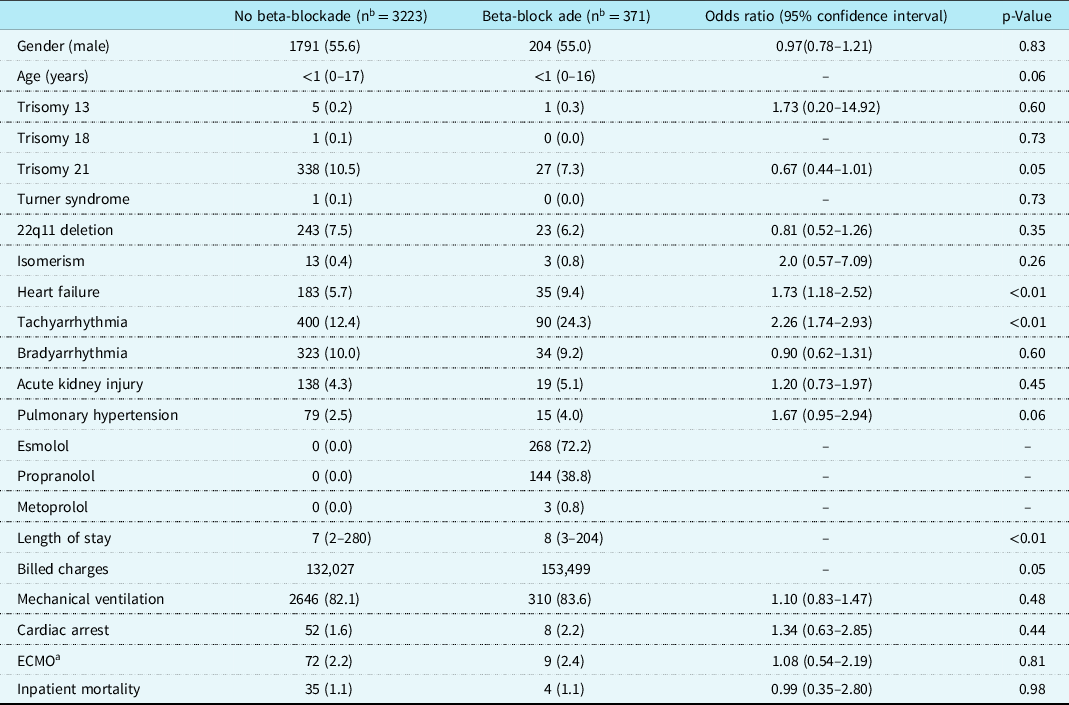
A total of 3594 admissions were included in the analyses. Of these admissions, 371 (10.3%) utilised beta-blockade. There was no significant difference in gender, age, or syndromes between the two groups. The following comorbidities were significantly more frequent in admissions with beta-blockade: heart failure (odds ratio 1.73, 95% confidence interval 1.18–2.52) and tachyarrhythmia (odds ratio 2.26, 95% confidence interval 1.74–2.93). There was no significant difference in other comorbidities such as bradyarrhythmia, acute kidney injury, and pulmonary hypertension (Table 1).
Comparison of admissions with and without beta-blockade.

a ECMO: Extracorporeal Membrane Oxygenation; bn: number of patients
Of the admissions with beta-blockade, esmolol was utilised in 268 (72.2%), propranolol in 144 (38.8%), and metoprolol in 3 (0.8%). Up to 44 (11.8%) beta-blockade admissions utilised more than one beta-blocker (Table 1).
The median length of stay was significantly longer in admissions with beta-blockade when compared to those without (8 days versus 7 days, p < 0.01). Billed charges, mechanical ventilation, cardiac arrest, extracorporeal membrane oxygenation, and inpatient mortality were not significantly different between the two groups (Table 1).
Frequency of admissions with beta-blockade by year
In 2004, 8.5% of admissions utilised beta-blockade, whereas in 2014, 14.4% of admissions did. This difference was not significant (p = 0.08) (Table 2).
Frequency of admissions with beta-blockade by year.

Outcome characteristics by beta-blocker agent
Propranolol is the beta-blocker agent that increases length of stay the most by 8.3 days (p < 0.01) and increases billed charges by $90,574 (p < 0.01) (Table 3).
Outcome characteristics by beta-blocker agent and regression analysis using length of stay, billed charges, cardiac arrest, and inpatient mortality as the dependent variable.

Regression analyses
Linear regression analysis demonstrated that beta-blockade was independently associated with a 2.8-day increase in length of stay (p < 0.01). Linear regression analysis demonstrated that beta-blockade had no significant effect on billed charges (Table 3).
Logistic regression analysis demonstrated that beta-blockade had no significant effect on cardiac arrest. Logistic regression analysis demonstrated that beta-blockade had no significant effect on inpatient mortality (Table 3).
Discussion
This study demonstrates that post-operative beta-blockade is utilised in a small proportion of admissions with complete repair of tetralogy of Fallot. Admissions with beta-blockade are more likely to have heart failure and tachyarrhythmia. Admissions with beta-blockade are significantly longer by 2.8 days as demonstrated by regression analysis controlling for other factors including comorbidities. There was no significant difference in billed charges, cardiac arrest, or inpatient mortality associated with beta-blockade.
While beta-blockade may be utilised after cardiac surgery in the setting of tachyarrhythmias, others also use beta-blockade post-operatively for other reasons. In this current study, only 90 (24%) of 371 patients in the beta-blockade group had tachyarrhythmia, thus a majority of patients receiving beta-blockade presumably had an indication other than tachyarrhythmia for beta-blockade. Anecdotally, some utilise beta-blockade after complete repair of tetralogy of Fallot with the hope that decreasing heart rate will increase diastolic filling time and thus increase stroke volume.
To our knowledge, no previous study has looked at the use of beta-blockade after complete repair of tetralogy of Fallot to see if it leads to change in admission characteristics. Previous studies do provide other insight into this matter, however. The first question becomes whether or not changes in heart rate are truly related to changes in cardiac index in children after cardiac surgery. Truccone and colleagues utilised green dye measurements of cardiac index in 32 infants and 58 children after cardiac surgery. They found that neither central venous pressure nor heart rate correlated with cardiac index. Reference Truccone, Spotnitz, Gersony, Dell, Bowman and Malm3 Lindner and colleagues examined the effect of heart rate and stroke volume on cardiac output in neonates with low cardiac output due to respiratory illness and neonates with high cardiac output due to a patent arterial duct and compared these groups to healthy age-matched controls. This study noted that rise in cardiac output with treatment in the neonates with respiratory illness-related cardiac output reduction mediated increase in cardiac output by stroke volume and not heart rate and that the two were not directly correlated. The same was noted in neonates with a patent arterial duct. Reference Lindner, Schaumberger, Rlegel and Versmold4
Bombardini and colleagues quantified diastolic filling time, systolic filling time, mitral inflow rate, and cardiac index in adults at rest and at exercise with dipyridamole stress echocardiography, pacing stress echocardiography, and with neither. They noted that diastolic filling time did increase with lower heart rate; however, this was not associated with an increase in cardiac index. Cardiac index was actually noted to decrease with increased diastolic filling time, although mitral inflow rate did increase with increased diastolic filling time. Reference Bombardini, Gemignani and Bianchini5
Johnston and colleagues studied the effect of heart rate on right and left ventricular indices such as end-diastolic volume and ejection fraction in adults undergoing myocardial revascularisation utilising cardiopulmonary bypass. This study found that at higher heart rates, the right ventricular ejection fraction did decrease and that this was mediated by decreased end-diastolic volume. This study, thus, found differing results from the previously discussed studies. Reference Johnston, Robertie, Dudas, Kon and Vinten-Johansen6
These previously published data, at first glance, appear conflicting. However, these data are best interpreted by acknowledging that patients may have different Frank–Starling relationships. Not all patients share similar curves, nor do they reside at an analogous point in the curve as one another. When the Frank–Starling curve is steeper, as was demonstrated to be the case for those in the study of Johnston and colleagues, a higher heart rate would be expected to decrease end-diastolic volume and thus stroke volume. However, for patients with a flat or depressed Frank–Starling curve, a decrease in end-diastolic volume may not lead to a decrease in stroke volume. Thus, previously published data demonstrate that the relationship between heart rate and stroke volume is not straightforward. Utilising an intervention based on a simplistic view of a complex physiologic relationship thus may not have the expected effect.
Yet, others utilise beta-blockade in children after complete repair of tetralogy of Fallot to help slow the progression of ventricular remodelling. The concept of ventricular remodelling initially arose from adult ischemic cardiomyopathy and essentially refers to the interplay between ventricular geometry, ventricular function, and neurohormonal activation. The presence of ventricular remodelling in patients after tetralogy of Fallot repair needs to be further studied particularly to understand the potential benefits of beta-blocker therapy.
There is lack of data regarding pharmacologic intervention for slowing or reversing cardiac remodelling in those with tetralogy of Fallot. When right ventricular size plateaus with preservation of right ventricular function, why is intervention even needed? In the small proportion of patients in whom right ventricular remodelling is present at the expense of ventricular function, the ideal agents are known. Data from the Survival and Ventricular Enlargement (SAVE) study in adults with ischemic cardiomyopathy demonstrate that angiotensin-converting enzyme inhibitors reduced cardiovascular events. Reference Pfeffer, Braunwald and Moye7 The Evaluation of Losartan in the Elderly (ELITE) study showed the same benefit in patients with heart failure and also demonstrated that angiotensin receptor blockers exerted a similar benefit. Reference Pitt, Chang and Timmermans8,Reference Pitt, Segal and Martinez9 Subsequent studies in adults with heart failure demonstrated benefit of beta-blockade on halting or reversing ventricular remodelling. Reference Cioffi, Stefenelli, Tarantini and Opasich10,Reference Hoshikawa, Matsumura and Kubo11 It is important to note that these studies were conducted in adult heart failure and utilised longer-term pharmacologic therapy in patients with depressed ventricular function. Thus, these data are not generalisable to most patients with tetralogy of Fallot, a majority of whom have a stabilisation in right ventricular size and preserved ventricular function. Additionally, even if these data were generalisable, beta-blockade for days after cardiac surgery is unlikely to have any real effect.
It is unclear what the true effect of beta-blockade is on simultaneous heart rate, end-diastolic volume, and stroke volume in children after complete repair of tetralogy of Fallot. While this current study demonstrates that, overall, the use of beta-blockade does not improve admission outcomes, this does not mean that there are not subsets of patients within this population that may benefit from it, although there is not data to accept or reject this notion. Future studies are warranted and would need to provide quantification of the right and left ventricular volumes, output, and function at various heart rates in the same post-operative patients. These data, along with admission characteristics such as length of stay, billed charges, and inpatient mortality, can help determine the physiologic and clinical effect of beta-blockade in children after complete repair of tetralogy of Fallot and help identify if there is a subset of patients that does benefit from such an intervention.
While the current study offers novel insight from a large multicentre database, it is not without its limitations. As these data come from an administrative database, it is prone to error in coding such as miscoding or non-coding. Additionally, patient age in the database is only provided in years and thus it is difficult to narrow younger subsets of patients such as neonates. Clinical data such as heart rate, dose of beta-blocker, duration of beta-blocker, cardiac function, ventricular size, and ventricular function are not captured by the database and thus could not be factored into the analyses. Lastly, this dataset did not clearly distinguish systolic versus diastolic heart failure due to ICD-9 code limitation. Futures studies should attempt to distinguish the type of heart failure present in patients receiving beta-blockers.
Conclusion
In conclusion, beta-blockade in children after complete repair of tetralogy of Fallot is independently associated with increase in length of stay but has no significant effect on billed charges, frequency of cardiac arrest, and frequency of inpatient mortality. Studies quantifying the physiologic effects of beta-blockade in this patient population remain needed.
Acknowledgement
None.
Financial support
This research received no specific grant from any funding agency, commercial, or not-for-profit sectors.
Conflicts of interest
None.
Ethical standards
All study procedures complied with the ethical standards of the Helsinki Declaration.