The insufficiency of the supply of the raw material upon which the great cotton industry of this Country depends has inspired Me with deep concern. I trust that the efforts which are being made in various parts of My Empire to increase the area under cultivation may be attended with a large measure of success. Footnote 1
With these words, Edward VII recognized the work of the British Cotton Growing Association (BCGA) in his 1904 speech before Parliament. The BCGA had been founded two years earlier by Lancashire businessmen to transform the British Empire into a major cotton producer, and the association spent seventy years promoting cotton cultivation and operating cotton gins in the empire and its successor states.Footnote 2 For some historians, the BCGA is proof that Britain, like France, Germany, and Portugal, was committed to an agenda of “cotton imperialism,” a set of imperial policies that aimed to extract raw cotton from colonies to meet metropolitan needs, and to create markets for manufactured textiles in colonies.Footnote 3 Lancashire politicians and BCGA officials lobbied for—and won—an important bill for a railroad as well as other concessions to develop cotton agriculture in African colonies, giving the impression that the British government had “tremendous support” for Lancashire's agenda of economic imperialism.Footnote 4
This article revisits the idea of “cotton imperialism” in Britain and uses records from the BCGA's capital fund-raising campaign (1902–14) to highlight a distinct lack of enthusiasm in Lancashire and the rest of Britain for cotton growing. The BCGA and its supporters promoted the idea that “empire cotton” produced in British colonies would compete with imported American cotton. The reactions of workers, capitalists, and average British investors to this imperial propaganda provide economic evidence to weigh against recent claims about the predominance of empire in British identity and everyday life. As the case of the BCGA shows, there was often a clear gap between rhetorical and financial support for imperial projects. While British and colonial governments initially supported the BCGA's work “in a spirit of imperial bonhomie,” the same cannot be said of the cotton capitalists the association was supposed to serve.Footnote 5 Prior studies of the BCGA's activities have assumed an unproblematic relationship between the association and Lancashire's textile industry, taking it for granted that the BCGA represented Lancashire's interests in the empire.Footnote 6 While it is clear that Britain's imperial government “was attuned to the interests of business and willing to divert resources to ends that the business community would have found profitable,” most recent studies have downplayed the importance of manufacturing interests in imperial policy making.Footnote 7 As Peter Cain and A. G. Hopkins have demonstrated, industry “rarely got its way” while the needs of financiers were “very much to the fore.”Footnote 8
Studies of the BCGA's counterparts in other European countries have begun to unravel the simplistic notion that cotton imperialism reflected a “smooth and functional relationship” between metropolitan capital and the colonial state.Footnote 9 As Anne Pitcher found, many scholars of Portuguese imperialism had assumed that the interests of domestic textile manufacturers overlapped with those of the imperial state, despite chronicling “a succession of irrational acts, failed and misguided policies, conflicts between the administration and companies over labour, and effective resistance by Africans against colonial policies.”Footnote 10 Thaddeus Sunseri's study of Germany's cotton program affirmed that “the cotton question was central to the colonial endeavor,” but found that industrialists and colonial officials clashed over where and how cotton should be grown, and to what end.Footnote 11 As this article shows, Lancashire's relationship with cotton imperialism was complex. British cotton manufacturers did unite on several occasions as a “Lancashire lobby” to pursue cotton policies in the empire,Footnote 12 but they divided along political and ideological lines over the broader question of imperial development. Historians of Britain's colonies, especially in Africa, have too often resorted to devices like the “Lancashire lobby” to explain decisions that were products of conflict and negotiation in Britain as well as in the colonies. Most textile manufacturers were interested in empire cotton insofar as it was cheap and easy to get; they argued bitterly over whether empire cotton was worthwhile if it meant abandoning Lancashire's cherished doctrines of free trade and laissez-faire. Some cotton capitalists were wholly disinterested in empire cotton, trusting market forces to manage the world's cotton supply. It took ten years of propaganda and arm-twisting to get Lancashire's capitalists to contribute meaningfully to BCGA fund-raising. The “operatives” who labored in textile mills proved less dogmatic and surprised many in Lancashire and around the world with their financial support for empire cotton. To Lancashire workers, imperial cotton growing seemed like a sensible insurance policy for the nation's largest export industry, which relied on raw fiber from the United States to produce finished textiles.
The BCGA was fundamentally a business, but it was also a public promoter of empire; it tried to convince Britons outside Lancashire that cotton was, as Winston Churchill put it, “the thread which unites the material interests of British industry democracy” with the tropical colonies.Footnote 13 By offering shares to the British public, the BCGA hoped to enlist a broad cross-section of society in the cotton campaign. The BCGA's leaders liked to describe the association as a “semi-philanthropic” entity, using a term usually reserved for hospitals or sanitariums. Capitalist firms pitched their ideas to investors and succeeded or failed on the perceived merits of their business plans, but philanthropic ventures relied on predictable constituencies among certain classes or creeds for funding. As a “semi-philanthropic” business, the BCGA promised to generate returns to investors while also contributing to public welfare in Lancashire, Britain, and the Empire. Colonial cotton would keep Lancashire's mill workers employed; a strong cotton trade would stimulate the rest of the British economy; and colonial subjects would (at least from Lancashire's point of view) earn cash and a taste for “civilization” by growing cotton.
The BCGA's leaders imagined that they could capture a wider constituency of imperial enthusiasts across Britain, but the association failed to rally much support outside Lancashire. The association's prospectus did not interest City investors, and few Britons from outside the textile districts bought shares. Moreover, the BCGA found itself caught in political controversy during the 1906 and 1910 British elections, despite the BCGA's portrayal of empire cotton as a non-partisan issue. The results of the BCGA campaign bolster Brad Beaven's findings on the diversity of imperial experiences in Britain.Footnote 14 Imperial themes resonated in some regions but fell flat in others. It is no surprise that the BCGA's empire cotton message was best received in districts that had (metaphorically and literally) breathed cotton for over a century, but even in those districts, the response to the BCGA was not uniform as workers and capitalists divided over the merits and political implications of pursuing “cotton colonialism” in the empire.
FOUNDING THE BCGA
The BCGA had its origins in the cotton-spinning town of Oldham. Spinning firms were at the leading edge of Lancashire's textile industry, transforming raw cotton imported from abroad into yarn that would be exported or woven in other Lancashire mills.Footnote 15 Oldham's “spinners” owned the largest collection of cotton spindles in the world by the turn of the twentieth century, and they were utterly dependent on the American South for raw materials. No other region could supply enough cotton of the right technical qualities at a low-enough price. When prices for American cotton began to rise sharply in 1901, Oldham spinners became concerned. They knew that demand for textiles was elastic, meaning that attempts to pass on higher cotton prices to customers would reduce demand for textiles. The Oldham Chamber of Commerce organized a series of meetings about the problem, and they resolved in late 1901 “to increase the ‘Growth of Cotton’ particularly within the Empire.”Footnote 16
The Manchester and Liverpool chambers of commerce learned of Oldham's activities, and at a meeting in early 1902 created the British Cotton Growing Association to represent their joint interests. The BCGA's founders summarized their objectives in an April statement: “Dispatch expert expeditions to report on the best methods of procedure, Acquire land on which to make experiments and establish plantations, Distribute seed amongst the natives, and to encourage them by advice and assistance to grow cotton on their own land, and to engage experts for this purpose, if necessary, Establish stations to buy and sell cotton.”Footnote 17 With £50,000 raised from Lancashire investors, the new association hoped to finance this exploratory work as a hedge against rising American cotton prices. The BCGA did experiment with some plantations, but its efforts were focused on peasant farmers in new colonies like northern Nigeria and Uganda that produced few, if any, cash crops for the world market. By combining the “philanthropic” tasks of scientific research, farmer education, and seed distribution with commercial activities like cotton buying and ginning, the association hoped to rapidly grow cotton industries in what colonial secretary Joseph Chamberlain called the “undeveloped estates” of Britain's empire. Once the industry was established, BCGA investors would enjoy the profits from processing the empire's cotton.
While French, German, and Portuguese colonial cotton-growing programs reserved empire-grown cotton for their metropolitan industries, the BCGA was committed to the economic ideals of the Manchester School. Any cotton the BCGA's efforts produced would be offered to the highest bidder, rather than protected for British markets. The BCGA expected colonial governments to provide the railways and seaports needed to export cotton, but otherwise argued that private capital and market forces were the best means for developing Britain's empire.Footnote 18 A BCGA leader explained that the world's cotton supply was “a cistern filled by several taps, and emptied by several; and it does not matter to the English, French or American taps which are emptying the cistern whether it is refilled by a German or Russian supply.”Footnote 19 Lancashire had previously experimented with “empire cotton” before, with the same aim. In 1857, the Cotton Supply Association (CSA) had been founded to break Lancashire's reliance on slave-grown cotton in the Americas; like the BCGA it focused on British colonies and areas under British influence around the world.Footnote 20 Its work in India was rather unsuccessful, and efforts to create cotton plantations in West Africa were disastrous failures.Footnote 21 The CSA dissolved in 1872, when cheap American cotton returned to the world market.
From the CSA's failures the BCGA learned that India, the world's second largest cotton producer, was too big a problem for Lancashire to solve on its own.Footnote 22 The CSA began promoting cotton growing in India in 1857 but by 1862 its president declared that other would-be cotton growers had “nothing whatever to learn from India, except how to mismanage your business, and produce the worst quality of cotton that is grown on the face of the earth.”Footnote 23 Indian cotton was typically short-stapled, making it more difficult to spin into fine yarn than long-staple American cotton. BCGA supporters sometimes quoted the “spinner's prayer,” a joke about low-quality Indian cotton delivered during the “cotton famine” of the 1860s: “O Lord, send us more cotton, but, O Lord, not Surat.”Footnote 24 J. Arthur Hutton, the Manchester merchant who served as BCGA chairman from 1904 to 1918, insisted that India would never be able to supply Lancashire with fiber comparable to American cotton. When questioned about Indian cotton, Hutton and other BCGA members repeatedly said that “[t]he bulk of the cotton produced in India is absolutely useless for Lancashire's needs.”Footnote 25
While the Oldham committee, which had inaugurated the movement, was open to the idea of improving Indian cotton or expanding the Egyptian crop, a clique of merchants and shippers in the Manchester and Liverpool chambers quickly pushed the Lancashire spinning mill owners toward West Africa, where these merchants had expertise in trading agricultural commodities.Footnote 26 Liverpool shipping magnate Sir Alfred Jones was the ringleader: cotton grown in Africa would be a useful return cargo for his fleet, and income from cotton growing would help Africans buy more Manchester cloth from merchant firms. Jones also took a great interest in the colonies his ships serviced in the Caribbean, and he saw the BCGA as a way of diversifying colonial economies there.Footnote 27 The BCGA dutifully answered inquiries from colonies as far-flung as Queensland, but it focused its efforts on regions where BCGA members like Jones and Hutton had experience and private business interests.Footnote 28
The BCGA needed its £50,000 to buy cottonseed and pay the salaries of cotton experts they were recruiting. Oldham's spinning firms, which were most deeply affected by the American cotton situation, invested £8,635. Manchester's manufacturers and merchants together put in £5,241. Other Lancashire towns contributed smaller amounts; trade unions invested £2,300 despite being left out of early BCGA meetings. By October 1903, the BCGA had raised only 60 percent of the required money.Footnote 29
As the BCGA continued to raise funds and began experimental work in the colonies, the situation in the American cotton market worsened. A group of speculators in the New York and New Orleans cotton exchanges began cornering the market for cotton futures in 1902, betting that bad weather would result in a small crop. The situation deteriorated further in the 1903–4 cotton season when Daniel J. Sully and other American cotton brokers organized a well-publicized bull campaign in the cotton futures market.Footnote 30 In an average year, each additional penny Lancashire paid for a pound of cotton meant an extra £6 million transferred from British cotton firms to American cotton sellers.Footnote 31 The futures corner drove cotton prices in the 1902–3 season from 4.5d to more than 7d per pound, reaching a post-1865 high of nearly 9d in March 1904. Many Lancashire firms refused to buy cotton at these inflated prices. By early 1904, the majority of Lancashire mills were working on short time or were shut completely; many firms showed losses or paid no dividends.Footnote 32
At the BCGA's annual meeting in late 1903, J. Arthur Hutton argued that the crisis was an opportunity for the BCGA:
[A]s business men, we ought not to sit idle and cry out for help like children to the Government to come and help us to put a stop to the proceedings of the speculator. It is for us, as business men, to find the remedy for ourselves. … Here are these speculators, who want to have the cotton. I say, let them have the cotton, and let us grow as much we can everywhere, and push it on to them. The only way to deal with speculators is to smother them in cotton. (Hear, hear, and laughter).Footnote 33
In his speech, Hutton laid out a plan of work for the BCGA, moving beyond the tentative ideas circulated in 1902. He urged the association to focus on recruiting cotton experts to train colonial subjects in cotton cultivation, and to establish ginneries and cotton markets to create demand for cotton in the empire. If ginneries offered to buy cotton at good prices, Hutton was sure farmers in the colonies would start growing it. Ginning profits would fund further expansion of the colonial industry, in addition to paying dividends to shareholders.
The BCGA had only just begun its experimental work in 1903, and by the time the king mentioned the cotton crisis in his 1904 speech the association was still short of the £50,000 goal. Nonetheless, the association embarked on a dramatic reorganization, hoping to capitalize on the king's speech and public concern about cotton prices. Hutton's ideas for expanded operations demanded more capital, and the BCGA raised its capital goal to £500,000. It also received a royal charter that Hutton hoped would elevate the association “above all ordinary commercial ventures.”Footnote 34 The BCGA's leaders hoped that Britons would buy shares as investments in the empire, as well as investments in Lancashire's future prosperity. The charter established the BCGA's credentials as a “semi-philanthropic” organization, because it committed the BCGA to reinvest profits in its “pioneer work” for seven years. As with the BCGA's original model, investors would earn profits once colonial subjects began growing cotton and selling it to the association.
At £1 per share the BCGA scrip was not cheap, but shares could be paid for in five annual installments, putting them within the reach of many in Edwardian Britain. Most BCGA advertising material was simple, using plain text to appeal to potential investors.Footnote 35 The association assumed that the benefits of empire cotton were obvious and that its “semi-philanthropic” mission—bolstered by the respectability of a royal charter—would interest a wide range of investors. Newspapers helped out with favorable reports about early BCGA experiments in the colonies, and railway stations posted BCGA advertising. Banks agreed to post notices and take subscriptions for BCGA shares at local branches.
The BCGA emphasized two general arguments in its advertising. The first concerned the importance of Lancashire to the British economy and the threat posed to Lancashire by America's monopoly on cotton. The simple fact was that the world needed more cotton, and without it Lancashire mills would continue to run on short time or even shut down, costing Britain hundreds of thousands of pounds every week. J. Arthur Hutton stressed how Lancashire's suffering would affect Britain more widely:
[Unemployed workers] have, alas, to restrict their purchases of food, and the brewers are also suffering because the people cannot afford to drink so much beer. The farmer suffers too, as there is not so good a market for his milk, his eggs, his butter, his corn; and many a bootmaker in Northampton and clothmaker in Yorkshire must find a lessened demand for their boots and clothes.Footnote 36
A fund-raising letter aimed at retailers emphasized the deep interconnections between Lancashire and the national economy in Britain, as well as the potential of empire-grown cotton to stimulate economic activity throughout Britain. Profitability for British shops “very largely depends upon the condition of the Cotton trade” and its large pool of workers, the letter warned.Footnote 37 The author of a 1904 article agreed that the cotton trade's problems were Britain's problems, declaring that the BCGA's campaign was “in every sense a national undertaking deserving the support of all interested in the welfare of the United Kingdom.”Footnote 38
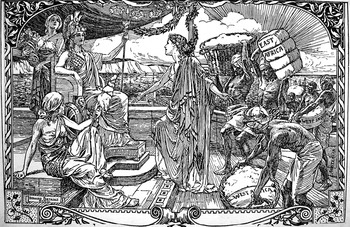
The second argument in the BCGA's publicity campaign involved an explicit defense of economic imperialism, tempered with the language of philanthropy. Joseph Chamberlain had declared in a famous 1895 speech that the empire was a set of “undeveloped estates” that Britain, as “landlord,” had the right and the duty to develop.Footnote 39 As Chamberlain and his supporters argued, there was no shame in acknowledging that colonies had real economic value for Britain and that the inhabitants of these countries could not fully exploit their natural resources without foreign capital. An unpublished allegorical scene drawn by Punch cartoonist Bernard Partridge, printed on a BCGA banquet menu in 1909, clearly illustrated what economic imperialism meant to the association (figure 1). In the image, Asian and African men lay cotton at the feet of an enthroned Brittania; each package was labeled with a cotton-growing region. The message was plain: the empire existed to serve the needs of Britain. A BCGA leaflet noted cotton growing in Africa would give Lancashire “the double benefit of supplemental supplies of cotton similar to American and millions more prosperous customers.”Footnote 40 Colonial cotton farmers would spend their money on Lancashire cloth, creating a virtuous circle of economic growth across the empire.
Punch cartoonist Bernard Partridge depicted imperial subjects laying cotton at the feet of Britannia in this unpublished image from 1904. A stray bale labeled “Australia” illustrates the BCGA's short-lived interest there. The image decorated menus for a 1909 BCGA banquet in honor of the Earl of Crewe. Source: BCGA 10/4/3, University of Birmingham Special Collections.

The philanthropic side of BCGA advertising stressed the benefits that cotton agriculture would bring to colonial subjects, especially those in Africa. Partnership between metropolitan industry and colonial agriculture was a common theme. A 1907 article explained that empire cotton meant “the provision of profitable employment for the natives, freights for the railway, cargo for the steamers, and raw material for the most important industry of this country, bringing prosperity to a vast number of the subjects of the king, whether in England or in Africa, whether white or black.”Footnote 41 The Duke of Marlborough claimed that the BCGA gave Africans “healthy as well as remunerative employment” by providing free cottonseed, contrasting the BCGA model of peasant production with the abuses of European-owned plantations.Footnote 42 G. D. Hazzledine, who served as Sir Frederick Lugard's secretary during the conquest of northern Nigeria, boasted that cotton growing would be “the easiest way of earning money they [Nigerians] have known. Then the Yankee may keep all his cotton, and gamble and fool with his crop to his heart's content, to the injury of his own industries instead of the industry of Lancashire.”Footnote 43
While the BCGA carefully maintained a matter-of-fact tone in its official propaganda, the association's friends in colonial governments and the press enthusiastically used empire-cotton growing to promote their own political agendas. Hazzledine linked the BCGA to his own jingoistic vision of activist imperialism, arguing that cotton growing would allow Britain to achieve its true purpose in Nigeria:
to change the darkest spot in darkest Africa back again into a land flowing with milk and honey. … Is it to be thought that the British public will grudge the money for a work like this? France is doing her share … Germany, in the Cameroons and Adamawa, has more than she wants. Are we, muling and puking, to follow the finger of the Little Englander, invest all our moneys in electric railways, schools, and scientific experiments, and leave the real work of the world to be done by nations who can breed men like those who made Great Britain the leader in civilization?Footnote 44
On other side of the political spectrum, E. D. Morel argued that the BCGA was a model for Liberal imperialism, offering a way to develop the empire without costly and coercive government interventions.Footnote 45 Business, rather than government, would lead the development of Africa according to the laws of supply and demand, delivering benefits for the metropole as well as the colony. According to Morel, the BCGA's investments in Africa would bring wealth to African farmers and stability to Lancashire's cotton industry.
Morel's and Hazzledine's positions do not strike the contemporary reader as philanthropic, but the context in which they made these claims is significant. European empires were rocked by labor scandals in the early twentieth century, and the BCGA's supporters contrasted the association's model with contemporary episodes like the “Chinese slavery” scandal in South Africa.Footnote 46 The most important comparison was with the Congo Free State. In 1904, articles publicizing the BCGA's work and new royal charter appeared alongside news of a campaign against King Leopold's genocidal rule in Congo. The Congo scandal put BCGA president Sir Alfred Jones in an awkward position, as he remained a staunch defender of Leopold's regime. E. D. Morel, who had worked as a clerk for Jones before starting his own newspaper, helped lead the British campaign against Leopold as well as Jones, who refused to suspend his shipping business in Congo. Morel's West African Mail, which declared on its masthead that it was the “official organ of the BCGA,” published stories celebrating the BCGA and fiercely condemning the “Leopoldian system” in Congo.
For Morel, the BCGA—despite Jones's involvement—offered an alternative to exploitative capitalist development in Africa.Footnote 47 Through a combination of “philanthropic” work like distributing free seeds, and commercial activity like buying cotton at ginneries, the BCGA promised to draw millions of African workers into cotton production through market forces alone, free of all hint of coercion. As the editors of the African-owned Lagos Weekly Record put it, “the true object and policy of British rule in West Africa” was to facilitate this kind of private investment in the colonies and to promote unfettered trade, not to unjustly exploit the labor and resources of the colonies.Footnote 48 Morel held that the most vital aspects of imperial development were not government-backed railroads or land concessions to plantation companies, but rather
[t]he maintenance of the right of the native to trade, not with the Englishman only, but with all men: the right of the native to sell his labour and the fruits of his hand, which his labour can alone gather and reap. We hesitate, but too frequently alas! To use the word TRADE, lest we be accused of interested motives; lest humanitarianism be described as utilitarianism.Footnote 49
BCGA supporters like Morel made a powerful case for the association's approach to cotton, especially when contrasted with the coercive measures used in German and French cotton-growing projects. By combining claims about national and imperial economic benefits with the rhetoric of philanthropy, the BCGA hoped to convince individuals across Britain to join the campaign for empire cotton as investors and as philanthropists.
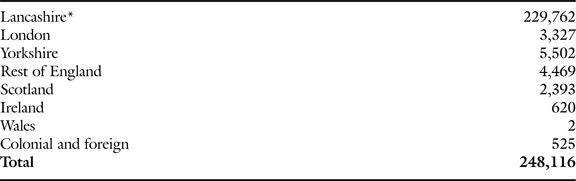
RAISING CAPITAL
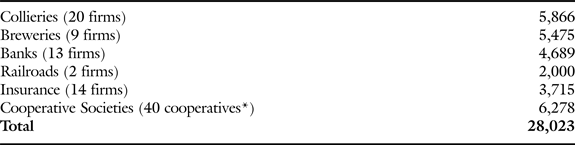
Outside Lancashire, the response to the BCGA's message of “semi-philanthropic” cotton growing was tepid (table 1). Appeals to philanthropy, patriotism, and profit failed to mobilize the nation behind the BCGA's project. By the end of 1905, only about £40,000 of the £188,098 subscribed had come from individuals and companies outside Lancashire and not directly connected to the cotton industry. Regional and national firms like collieries, breweries, railroads, banks, and insurers did respond to the BCGA's appeals with generous contributions (table 2). These were symbolic investments, however, ranging from £50 to £1,000. They were dwarfed by a few contributions from firms and individuals with clear interests at stake. Sir Alfred Jones, whose ships would carry most BCGA cotton, bought ten thousand shares and later raised his stake to £25,000.Footnote 50 Big cotton firms in Manchester contributed comparable amounts: Rylands subscribed for £7,500 and Horrockses, Crewdson & Co. for £10,000. The Fine Cotton Spinners’ and Doublers’ Association, a combine of several dozen fine-spinning firms, contributed £5,000. The most miserly of the big cotton firms was the Scottish firm of J. P. Coats, which gave £500.
BCGA Subscriptions by Region, August 1906 (£)
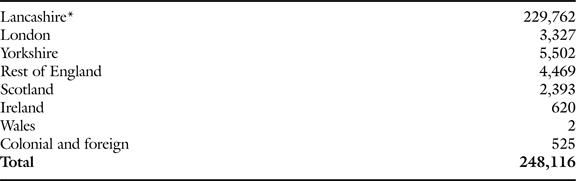
Source: BCGA annual report for 1906, BCGA 2/1, UBSC.
Notes:
* Figure for Lancashire includes subscriptions expected but not paid.
Subscriptions from Non-Cotton Firms by August 1906 (£)
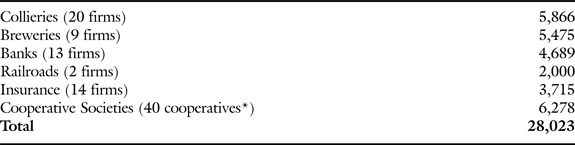
Source: BCGA annual report for 1906, BCGA 2/1, UBSC.
Notes:
*Firms that contributed less than £50 are not identified individually and are not included in counts above. For all categories except cooperatives, contributions under £50 were trivial. An unknown number of cooperatives raised a total of £1,077 (included above).
London residents had subscribed about £3,000 by the summer of 1904, but the list of shareholders does not reveal any City interest in empire-grown cotton. The biggest London investor (£300) was a menswear company, followed by the venerable West African merchant house of F. A. Swanzy (£250). About twenty individuals in London bought £50 or more worth of shares. An unknown number of individuals bought shares in quantities under £50 amounting to a total of £1,461 by the end of 1904. These contributions might have come from a thousand small investors with £1 shares or a few dozen larger investors. The BCGA report for 1903 is the last to list individual subscribers under £50: it lists eighty subscriptions across Britain, mostly from firms. Sixteen firms and individuals subscribed £5 or less; most of the eighty subscribers invested between £10 and £40 each.Footnote 51 Thus it is likely that the BCGA's smaller subscriptions came from a few hundred investors rather than the thousands the association hoped to reach with £1 shares payable in installments. Excluding London and the northern textile districts, only seventeen individuals in the rest of England contributed £50 or more, for a total of just under £2,000. Another £800 came from subscriptions under £50.Footnote 52 All told, this was a poor showing among “gentlemanly capitalists” and armchair imperialists.
By the end of the 1904 it was clear that the royal charter and good publicity had not produced a groundswell of support for empire cotton. To drum up more interest, the association organized a free exhibition at the Imperial Institute. John MacKenzie has argued that imperial exhibitions were, by the end of the nineteenth century, “enormous funfairs” that “combin[ed] pleasure and instruction.”Footnote 53 The imperial cotton exhibition was a dull affair, however. It featured samples of raw cotton, cotton machinery, looms and cloth from Africa, photographs taken by BCGA cotton experts, a telegram from the king, and other ephemera.Footnote 54 A reviewer for the Times had kind things to say about the imperial significance of the BCGA, but he bluntly stated: “A cotton exhibition at the Imperial Institute does not sound exciting. … It is not the sort of thing to appeal to the frivolous London public in the frivolous London season.” The reviewer was sure that the exhibit would “make only a vague impression on the man in the street,” though he held out hope that it might “touch the woman in the street in a way she can understand” by connecting the idea of empire cotton to “those charming or useful articles with which the shops are decked at the present moment in bewildering profusion.”Footnote 55 More than eighteen thousand visitors toured the exhibit, but only four hundred signed the guestbook.Footnote 56 At least a quarter of the signatories indicated that they worked in the cotton trade, and more than an eighth lived or worked in the colonies, leaving addresses ranging from the West Indies to Australia. Cotton men and colonial planters were clearly interested, but the general public was not enthusiastic about joining the BCGA's mailing list. When the exhibit traveled to Manchester later in 1905 it attracted about twenty-five thousand visitors, of whom 602 signed the guestbook.Footnote 57
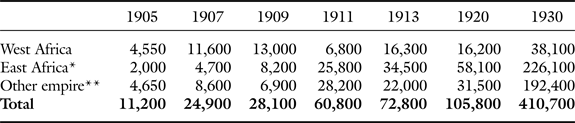
The exhibition failed to bring in new subscriptions, and BCGA chairman J. Arthur Hutton submitted his resignation in 1905, seeing little hope for the BCGA if it could not raise the full amount quickly. His colleagues convinced him that his resignation would signal the association's failure, so he stayed on.Footnote 58 The BCGA hired professional canvassers to sell shares, but they reported that “it was useless to continue further canvassing outside the [cotton] trade, until there had been a much larger response from Spinners and Manufacturers.”Footnote 59 Cotton firms and workers had subscribed, but the association was still far from its goal of £500,000. Unfortunately the BCGA had little to show in Lancashire to encourage new investments: it imported 11,200 bales of cotton from the empire in 1905, an amount equivalent to 0.003 percent of Lancashire's annual consumption of American cotton (table 3).
Cotton Exported by BCGA Programs, 1905–30 (400 lb. Bales)
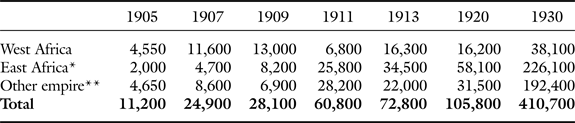
Source: BCGA annual reports BCGA 2/1, UBSC; Wardle, “History of the British Cotton Growing Association,” 538–42.
Notes:
*Mostly Uganda; includes South Africa after 1914.
**Mostly Sudan after 1909, but includes West Indies, India, Australia.
Instead of launching another round of publicity across Britain, the BCGA chairman decided to redouble fund-raising efforts within Lancashire. The BCGA's focus on cotton obviously resonated in Lancashire, but the association's model for imperial development also emerged from a strong tradition of philanthropy and “self-help” in Lancashire.Footnote 60 Lancashire was awash with organizations using private capital to solve problems and provide public goods, as the BCGA proposed to do through colonial cotton growing. Steven King's study of philanthropy in the fine-spinning town of Bolton is illustrative. King found more than four hundred philanthropic projects underway in 1905, with over £50,000 invested.Footnote 61 Most of these projects were focused on domestic concerns like poverty, sanitation, or sobriety, but Lancashire residents did not limit their charity to home. They raised funds for Indian famine relief and supported missionary work in the empire. Lancashire businessman Sir Charles Macara, who served as a BCGA vice president, was responsible for several successful philanthropic campaigns. His most famous, the “Lifeboat Saturday” movement, raised an endowment large enough to generate £187,000 annually for the Royal National Lifeboat Institution.Footnote 62
For many in Lancashire, social and economic problems were entrepreneurial opportunities. The modern consumers’ cooperative movement was born in the spinning town of Rochdale, and hundreds of cooperative societies provided services like medical and life insurance to Lancashire's residents.Footnote 63 Lancashire investors also funded big projects like the Manchester Ship Canal, a public-private venture that raised several million pounds to build a canal bypassing Liverpool's port.Footnote 64 The idea of government intervention was anathema to Lancashire men like Macara, who insisted that the cotton industry did not need “to climb upon the knees of England and be nursed” by subsidies or protectionism.Footnote 65 The BCGA appealed to these entrepreneurial and philanthropic values by promising stable cotton supplies for Lancashire, wealth for African farmers, and profits for BCGA shareholders.
The organization of the cotton industry was also conducive to fund-raising, despite a high level of vertical and horizontal disintegration among the hundreds of large and small spinning, weaving, and finishing firms in Lancashire. Workers were unionized across the industry,Footnote 66 and mill owners were organized in powerful groups like the Federation of Master Cotton Spinners’ Associations (FMCSA) and the North & North-East Lancashire Cotton Spinners’ and Manufacturers’ Association (CSMA).Footnote 67 While workers and capitalists clashed over many issues, their organizations had successfully cooperated to resolve earlier crises and labor disputes. During cotton corners of 1902–4 they coordinated short time work across the industry to minimize losses to firms and workers.
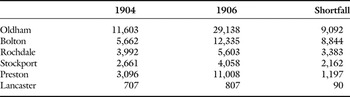
To get the hundreds of smaller firms who made up the bulk of Lancashire's productive capacity to buy BCGA shares, Hutton and Macara, president of the FMCSA, agreed on a scheme to compel spinning and weaving firms to take shares in proportion to their productive capacity (table 4). Manufacturers were to subscribe ten shillings for every thousand spindles and three pence per loom each year, for five years. Labor leaders agreed to collect a day's wage annually from workers over the same period. According to Hutton's calculations, this levy on the cotton industry would raise £210,000.Footnote 68 Macara had high hopes that Lancashire would “set a worthy example to the rest of the world” by exceeding this goal, raising the full capital amount of £500,000 no later than June 1905 when European cotton manufacturers would gather in Manchester for the second International Cotton Congress.Footnote 69 Oldham's Master Cotton Spinner's Association (MCSA) was already in full support of the BCGA,Footnote 70 but leaders in Bolton, the next largest spinning center after Oldham, had been unable to persuade their membership to make BCGA share purchases a collective responsibility.Footnote 71 Whereas Oldham firms relied on American cotton to make coarser yarn for export markets, Bolton firms used expensive Egyptian cotton to make the finest yarns. Profit margins were higher for Bolton spinners and the market was less volatile than the American sector. Bolton firms began supporting the BCGA in 1905, however, when a corner in the Alexandria cotton exchange convinced them that speculation was “firmly established as the ‘profit snatcher’ in every season where the crop is not large enough to kill it.”Footnote 72 The CSMA, which was a looser organization representing spinning and weaving firms in northern Lancashire, was less cooperative. CSMA members embarrassed their leadership by refusing to subscribe collectively, forcing the organization to buy its promised £10,000 of shares out of the general fund to save face. Darwen's CSMA chapter was so annoyed with BCGA solicitations that they voted to buy their allotted shares up front, curtly noting that it would “thus fulfill our obligations to this Fund.”Footnote 73
Cotton Firm Subscriptions (Town and District) before and after 1905 Levy (£)

Source: BCGA annual reports, BCGA 2/1 and BCGA 2/2, UBSC.
When Oldham's MCSA went door-to-door to solicit firms that had not subscribed, they were met with surprisingly hostile reactions. Many firms refused to contribute. When pressed to justify their refusals, some managers pointed out a free-rider problem: firms that did not invest in the BCGA would still enjoy lower cotton prices if the association's plans worked. In the small spinning town of Stalybridge, firms singled out a free rider in their midst, refusing to increase subscriptions until the holdout firm invested.Footnote 74 Other mill owners complained about “continuous and reckless Mill Building,” referring to a surge in new mill construction after American cotton prices declined in 1905.Footnote 75 The final results of the door-to-door campaign greatly embarrassed the Oldham MCSA (table 4). Bolton's MCSA scrapped a similar plan, discovering that local members were ready to slam doors shut on BCGA fund-raisers.Footnote 76
When American speculators cornered the cotton market in 1909–10, the BCGA once more solicited funds from Lancashire. In Oldham, sixty-five firms representing more than 60 percent of the town's productive capacity rebuffed the BCGA, though 121 firms did subscribe for more than £19,300 in new shares. Macara blamed the BCGA for this debacle, noting that the association had not produced much cotton. The FMCSA demanded two seats for spinners on the BCGA Executive Council, which made decisions about colonial strategy without consulting the rest of the BCGA membership.Footnote 77 Macara and his allies in the FMCSA and its international counterpart (the International Federation of Master Cotton Spinners' and Manufacturers' Associations [IFMCSMA]) also forced the BCGA to reconsider India as a site for cotton growing, ultimately leading to the creation of BCGA-Punjab Ltd. as a subsidiary firm.Footnote 78
From Hutton's perspective, the BCGA's situation was clear: it could not produce cotton without capital. He thought the association's value proposition to Lancashire mills was obvious. Investing in colonial cotton would lead to long-term payoffs in the form of cheaper cotton and more customers. A 1905 poster clearly stated Hutton's view: under the heading of “Urgent Appeal to Spinners, Manufacturers, and Operatives,” the poster argued that “if Lancashire chooses to defeat America's monopoly and manipulation, she can do so, but at present her spinners and manufacturers are content to stand by in apathy.”Footnote 79 Without complete shareholding records, which appear to be missing from BCGA and FMCSA records, it is difficult to reach definitive conclusions about why some firms participated while others did not.Footnote 80 The Oldham MCSA kept a list of “firms who have not done as they ought,” but it shows mills of all sizes, including new and old firms, either refusing to participate or participating at a level below the BCGA's expectations.Footnote 81 The politics of imperialism likely had something to do with this, since Hutton's plans for the BCGA gradually involved more government support in the form of grants and subsidies as the association struggled to raise capital. Many of Lancashire's capitalists maintained an “invincible faith” in the power of markets to correct imbalances in supply and demand,Footnote 82 and the BCGA's emphasis on “philanthropic” development in partnership with colonial governments must have struck some as terribly misguided. The job of manufacturers was to manufacture things, after all, rather than fund imperial development schemes. There may also have been some merit in Hutton's allegations of sheer apathy among mill owners. Reflecting on the 1920 crash that devastated Lancashire's cotton industry, journalist Benjamin Bowker asserted that Edwardian mill owners had been “‘arrogant” and “could scarcely see the world for looking at Lancashire, which for them contained all that any world ever need hold.”Footnote 83 Such pronouncements should be taken with a grain of salt, but the narrow-minded attitudes Bowker described are consistent with some of the angry responses the BCGA received from Oldham spinners.
Unlike their employers, Lancashire's mill workers participated in BCGA fund-raising campaigns with enthusiasm. The BCGA's founders initially did not see a place for Lancashire workers in their cotton-growing scheme. Their assumption was that a few workers—especially the relatively well-paid workers who operated mule spindles—would “see their way to take their share of the responsibility and pecuniary risk involved.”Footnote 84 As concrete plans for fund-raising and action in the British Empire began to develop in mid-1902, the BCGA council voted to invite organized labor into the movement.Footnote 85 The results were good. Organized labor raised more than £3,200 by August 1904, with another £4,500 invested by Lancashire cooperative societies.Footnote 86 Oldham unions held a football tournament to raise money for the purchase of BCGA shares, and workers formed local committees to distribute cotton propaganda and to pool money for share purchases.Footnote 87 When Hutton and Macara announced the 1905 levy on spinning and weaving mills, they asked mill workers to join the empire cotton movement through a “Day's Wage” scheme, which collected one day's pay annually for five years. Workers raised more than £24,000 during this first campaign; this was 27 percent short of Hutton's goal, but it was much better than the 39 percent shortfall in levies paid by FMCSA mills. The second “Day's Wage” appeal in 1910 raised another £21,500, falling 35 percent short of the goal.Footnote 88 The Cotton Factory Times, labor's organ in Lancashire, published running tallies of worker subscriptions by town during the summer of 1910, harnessing civic pride to encourage subscriptions. All told, Lancashire's workers raised about 10 percent of the BCGA's total capital.Footnote 89 Hutton boasted that “Lancashire may well feel proud of the public spirit of her working classes, who have subscribed large sums of money in support of this great movement a time when they were suffering severe losses and actual privations.”Footnote 90
If minutes of union meetings and the columns of the Cotton Factory Times are any indication, workers were unsentimental about empire in their responses to the BCGA. They saw the association's brand of economic imperialism as a means to an end. Indeed, the BCGA stressed its business case when selling shares to workers rather than resorting to jingoism. In circulars posted in factories, the BCGA simply stated that “[c]otton can be grown within the Empire on a large scale and on a Commercial basis,” encouraging workers to protect their jobs by “guaranteeing Lancashire a large supply of Empire Grown Cotton.”Footnote 91 This propaganda made no special case for the empire as a site for cotton growing, beyond the fact that Britain already had it, and it was outside the reach of American speculators. The focus on economics resonated with workers, who acutely felt the impact of high cotton prices when mills went on short time. A short-time week of forty hours meant a 30 percent pay cut for the average spinning-mill worker, and this could be the difference between a comfortable life and poverty.Footnote 92 Lancashire mills worked short time for at least forty months between 1902 and 1913. Oldham's Operative Spinners’ Union paid out more than £100,000 in short time benefits to members between 1901 and 1910.Footnote 93 Bolton's union warned the mill owners that “[i]t is too much to expect that the working classes will continue to submit to a policy of starvation, in order to checkmate a body of wealthy gamblers.” The union suggested that “if the position was reversed, and the working classes were the aggressors, some effectual action would soon be taken by the Authorities to put an end to a system which produces such bad results.”Footnote 94
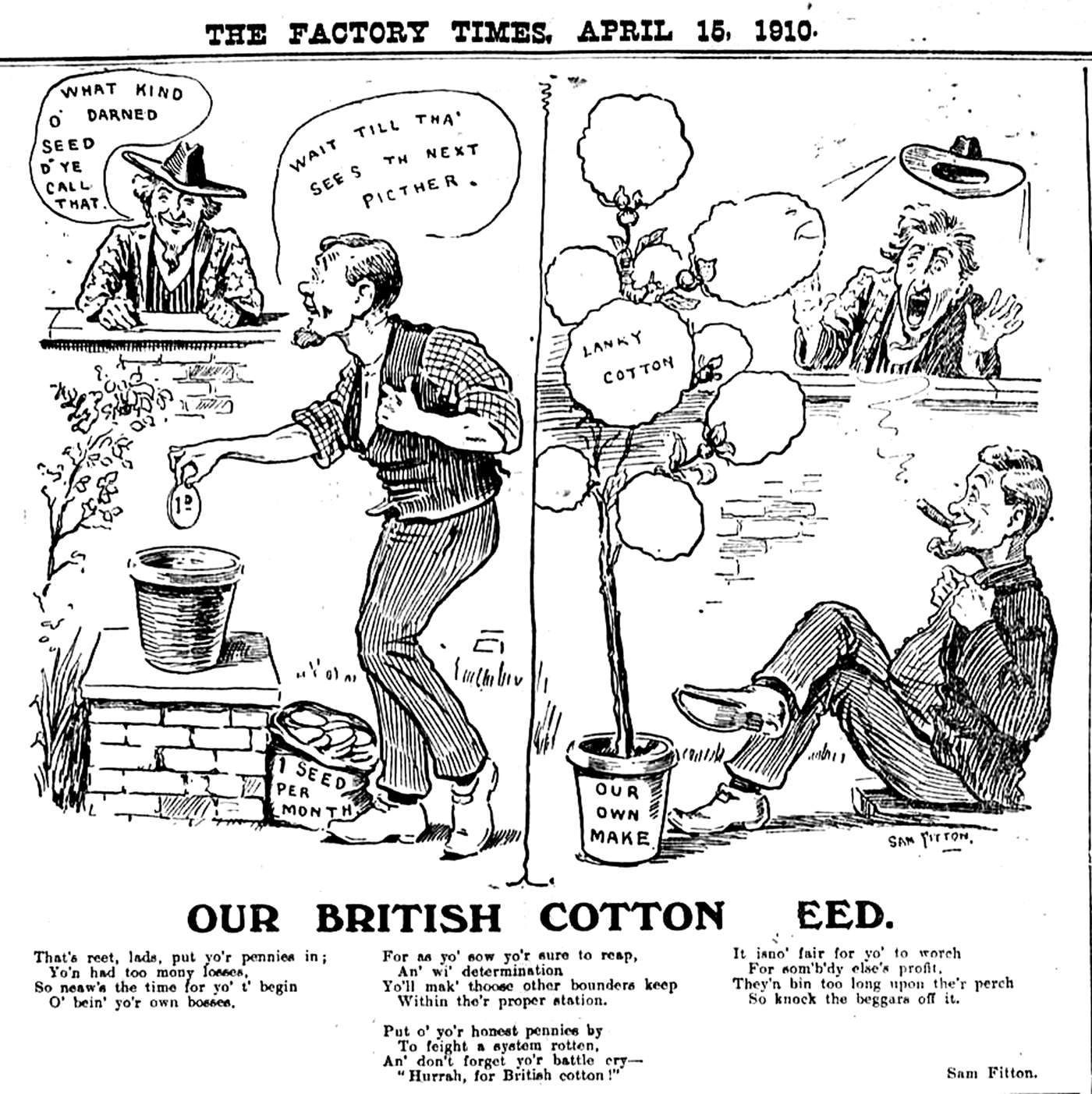
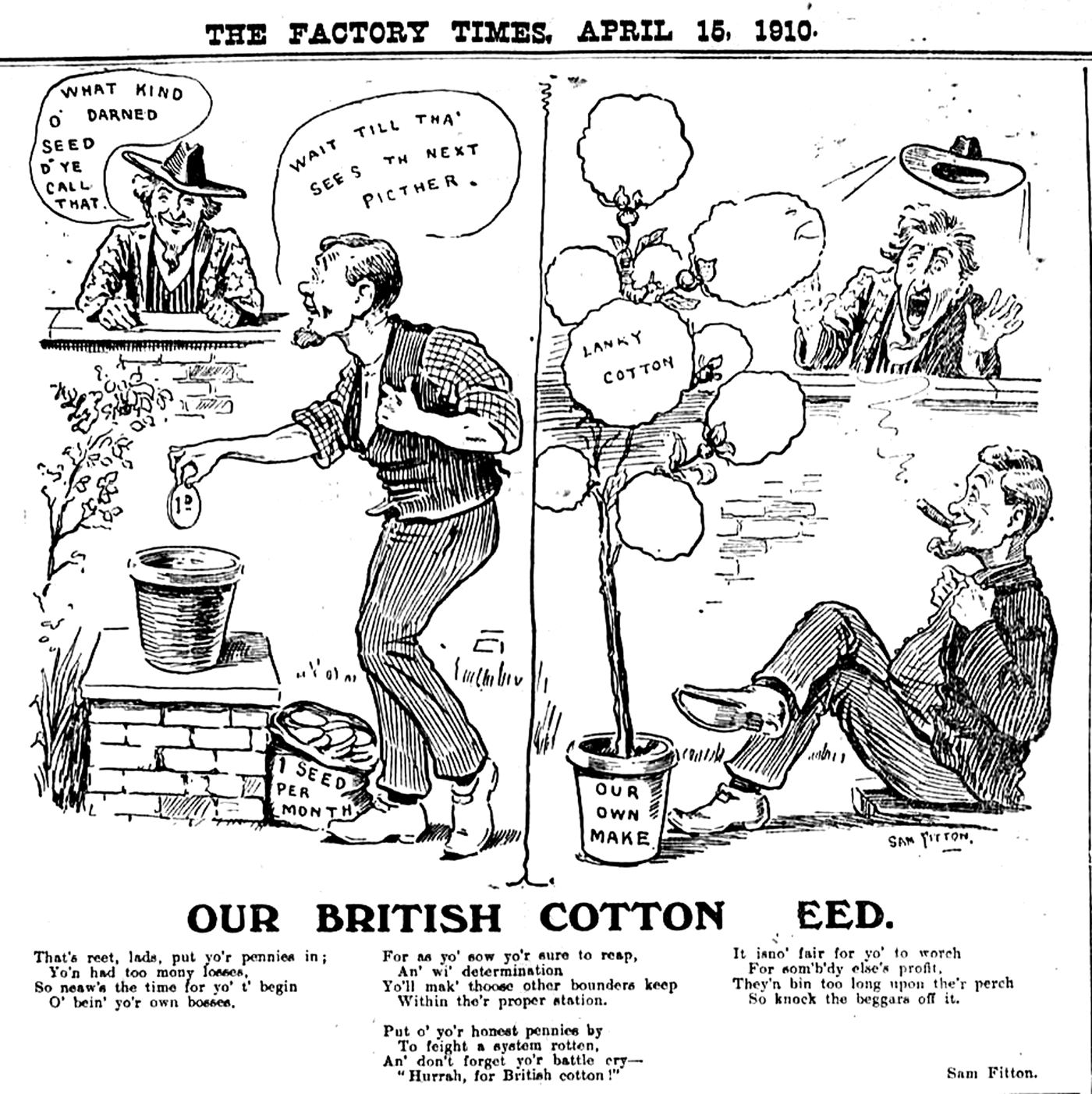
When the Cotton Factory Times tried to drum up support for the second Day's Wage scheme in 1910, it matter-of-factly reported on developments in the empire but emphasized the danger workers faced from uncertain cotton supplies. A cartoon depicting an American cotton planter confronted with a mill worker's “Lanky Cotton” did not make a single reference to the empire; it instead urged workers to “Put o’ y'r honest pennies by to feight a system rotten, an’ don't forget yo'r battle cry—‘Hurrah, for British Cotton!’”Footnote 95 As the doggerel under the cartoon stressed, workers saw the BCGA as a tool to break the power of American speculators and thus secure their own jobs, a way of “bein’ yo'r own bosses” (figure 2). In 1913, the Cotton Factory Times linked continuing BCGA fund-raising appeals with the fiftieth anniversary of the 1862–65 cotton famine. The paper reprinted David Pae's serial novel Hard Times, which dramatized the sufferings of mill workers during the cotton shortage, alongside BCGA advertising. The object was certainly imperial but the imagery local, drawing on memories of personal hardship during the cotton famine to promote preventative action against a future crisis.
Lancashire artist and dialect writer Sam Fitton depicted a Southern planter startled by “Lanky cotton” grown from the wages of Lancashire workers in this cartoon from the Cotton Factory Times, 15 April 1910. Source: http://www.lancashirecottoncartoons.com, image courtesy of Alan Fowler and Terry Wyke.
The long-term interests of labor aligned with the BCGA's mission of empire-grown cotton. Reliable supplies of cotton from the empire, outside the reach of American speculators, promised stability. Increased incomes among colonial subjects meant increased demand for manufactured goods in markets unfettered by tariffs and protectionism, promising a continuation and perhaps expansion of work in Lancashire's cotton industry. Textile workers also valued BCGA shares as real investments that would build trade union and cooperative portfolios.Footnote 96 The Amalgamated Association of Operative Spinners still held BCGA share certificates when the BCGA was wound up in 1970s and presumably collected regular dividends, which were first paid in 1916.Footnote 97
A small group of workers holding what one BCGA agent called “socialistic opinions” took “a decidedly hostile attitude towards the Day's Wage Scheme” in 1905, arguing that Lancashire capitalists could afford to pay for empire cotton themselves. Some even argued that “neither Employer nor Operative ought to be called on to contribute, but that the work of Cotton growing in the Colonies should be done entirely by the Government,” but this seems to have been a minority view. In Colne, a BCGA agent reported that “some of the Socialists are actively helping us towards a Day's Wage collection.” As the BCGA fund-raising campaign dragged on, however, many workers outside the socialist camp began to feel that they had done enough. According to an October 1906 report, “in some towns in East Lancashire a section of the Operatives’ Local Committees, not Socialists, take up the same position, and on the same grounds, with regard to the Employers finding all the capital required.”Footnote 98 As the Day's Wage campaign progressed, the resentment of workers toward their apathetic employers grew. Workers made it clear to the BCGA “that universal support from the Labour bodies in the Textile Districts could be relied upon if the Employers generally responded to the Levy.”Footnote 99
When capitalists failed to hold up their end of the fund-raising scheme, labor retaliated. The Cotton Factory Times expressed surprise in 1903 that the BCGA was not receiving “more encouragement from the capitalist classes,” and by 1906 it was scolding mill owners, telling them that “[i]t is really time they decided to pay up.”Footnote 100 Oldham's cardroom workers refused to pay the second installment of the Day's Wage scheme in 1906, protesting that “employers had not given the movement the support which they ought to have done.” The union eventually succumbed to pressure: the chairman ordered contributions paid “to have done with the thing for good, and in the event of again being asked to subscribe the Association could say that their members had done their share already.”Footnote 101 Bolton's spinning union similarly told its rank-and-file, “You have taken your share in the movement,” calling on members to shame employers into action before contributing any more money to the BCGA.Footnote 102 While employers complained the BCGA had not exported enough cotton, workers retorted that “[f]inancial support from certain quarters has hardly been as liberal as might have been expected.” They concluded that “[w]ith the means at its disposal the Association has no opportunity of patiently prosecuting its work.”Footnote 103
Industrial strife in Lancashire worsened between 1905 and 1913, giving workers little reason to carry along the free-riding capitalists they were opposing in strikes and courtroom battles.Footnote 104 One cause of conflict was “bad spinning,” the trade term for yarn breakage, typically caused by the use of lower-quality cotton to spin a given type of yarn. Spinning-machine operatives were paid by piece rates, and when yarn broke they were responsible for fixing the problem. Any delays in production cut into workers’ earnings. Manufacturers were, of course, substituting cheaper cottons because the price of American cotton remained high and unstable across the period, and cotton substitution pushed some of the costs onto workers.Footnote 105 In this context, it is remarkable that workers contributed anything else to the BCGA after the first levy in 1905.
Across Britain, workers represented only a tiny fraction of investment in domestic, imperial, and foreign stocks, and contemporaries were startled by the high level of worker participation in the BCGA scheme. Outside Britain the idea that workers would voluntarily finance imperial development met with bewilderment and admiration. Boston's Textile World Record concluded that labor's contributions were coerced, drawn from “a working population of whom many are working on short time, facing hunger and deprivation because of a shortage in the cotton supply.” The Cotton Factory Times angrily responded, defending the BCGA as a wise investment for Lancashire workers.Footnote 106 In Germany, leaders of the colonial cotton program complained that German textile workers “ought to follow the example of their broad-minded English colleagues, who, in spite of privations caused them through the short-time movement, contribute to the B.C.G.A.” A campaign “to induce the German operatives to a similar step” had utterly failed, and German textile unions declared that “the cotton question cannot be solved by growing cotton in the African colonies.”Footnote 107
By early 1914, the BCGA was still short £26,000 of its £500,000 goal. The FMCSA, CSMA, and trade unions agreed to divide the remaining sum, with the manufacturers’ associations taking £10,000 each and the workers £5,000. Cooperatives took up the last £1,000. The BCGA was not happy with the results: the FMCSA only raised £3,586, the CSMA £5,128, and workers a mere £229. BCGA records do not shed any light on how manufacturers reacted to this final push, but the minutes of a labor meeting reveal how weary the working class had grown with the response of capitalists to the cotton campaign:
Mr. W. H. Carr stated that he was not in favour of recommending the operatives or their Associations to subscribe to the funds of the Association. He considered that if the Employers thought that the work of the Association was so desirable and necessary, they ought to have no difficulty in finding the requisite money, and he did not see why the operatives should be asked to subscribe at all.
Another worker reminded his colleague “how we had suffered in the past owing to short supply of cotton, and he stated that the Card & Blowing Room Operatives Assn, would no doubt subscribe their preportion [sic] of the £5,000 required if the other Associations would also do their share.”Footnote 108 The workers ultimately voted to raise the remaining money on the condition that employers also raised their share, although the outbreak of war later that summer gave labor and capital a convenient excuse to defer final payments.
COLONIAL INVESTMENT AND IMPERIAL POLITICS
One group was conspicuously absent from BCGA shareholder rolls: the “gentlemanly capitalists” who Cain and Hopkins suggest were the main drivers of imperial economic policy. Only a handful of wealthy imperial enthusiasts like Sir Alfred Jones invested in BCGA shares, and while the BCGA enjoyed the political patronage of men like the Duke of Marlborough, the aristocracy was generally uninterested in financing empire cotton. Social elites were precisely the segment of British society from which “the most strident Empire support could have been expected,”Footnote 109 but as investors, this class preferred specific kinds of imperial investments, such as government bonds and railroad debentures. BCGA shareholder records show only a few gentleman shareholders. Many of these were Lancashire gentry, representing local sentiment rather than a nationwide imperial ethos.Footnote 110
The BCGA also proved to be a poor fit with the investing preferences of business people outside the aristocracy. In their analysis of British investments in the British Empire, Davis and Huttenback found that “businesspeople were less likely to invest in foreign securities than were their elite counterparts,” and that “they were far less inclined to invest in Empire than foreign enterprise.” When this class did invest in imperial ventures, they “tended to put their funds to work in the private sector—competitive and less dependent on government charters or licenses—industries, in short, much less dependent on political control.”Footnote 111 The BCGA held a royal charter and was dependent on colonial governments to help build railroads, distribute seeds, and license buying and ginning stations. It could hardly have been a worse fit for the investing preferences of the average wealthy Briton. Propaganda about the “philanthropic” development of the empire was not enough to sway these investors.
While the BCGA hoped a royal charter would grant prestige and attract investors, the terms of the charter—which required reinvestment of profits for seven years—undoubtedly discouraged commercial investors. Britons readily invested in other colonial agricultural ventures seeking long-term returns, however. Coconut palms, for example, take between four and ten years to produce a commercially viable quantity of nuts, and British investors rushed into Caribbean, African, and Pacific plantations in the same period the BCGA was seeking funds. Books aimed at investors with ridiculous titles like Coco-Nuts: The Consols of the East bear testament to the willingness of British investors to risk money in colonial agriculture.Footnote 112 W. H. Lever committed £1 million for oil palm plantations in Belgian Congo in 1911 after a cursory tour; at the time the entire working capital of Lever's empire amounted to only £6.6 million.Footnote 113 Joseph Chamberlain personally invested £50,000 in an unsuccessful sisal scheme in the Caribbean, and many other Britons made investments—some rather foolish—in colonial agriculture.Footnote 114 The BCGA's major liability in this respect was that, with a few exceptions, it did not establish plantations in the empire. When British investors put money in colonial agriculture, it was typically in the form of land speculation or plantation companies.Footnote 115 Land could be sold to recoup one's investment if the plantation failed, but the only tangible assets in the BCGA's model were a few cotton gins.
The BCGA was not the only colonial cotton growing operation trying to raise capital in Britain. Cotton firms, capitalists, and adventurers all tried to cash in on high cotton prices after 1902, and they were even less successful than the BCGA. The West African Cotton Growing Company was typical of the speculative end of the business. Athanasius Buckle, an official in Sierra Leone who convinced three cotton mill owners and three Manchester merchants to join him as directors of the company, combined firsthand knowledge of West Africa with mercantile and manufacturing expertise. Investors were evidently unimpressed with the firm's prospectus, however. Buckle found a meager £617 from his partners and dissolved the firm in 1906.Footnote 116
East African companies did slightly better than their West African counterparts, perhaps helped by interest in East African tobacco, coffee, and tea plantations. Sir Alfred Jones did double duty as BCGA president and director of the Rhodesia Cotton Syndicate, formed in 1903. After failing to find suitable land, the company reorganized as the privately held East African Cotton Syndicate in 1906. This firm leased five hundred acres on the Tana River and had issued £15,023 in shares by 1910, but it was losing money at the rate of £2,000–3,000 per year. Jones died in 1909, and the rest of the partners folded in 1911.Footnote 117 Other East African firms followed a similar pattern.Footnote 118 The biggest investment in African cotton was in Sudan, where the South African mining capitalists Julius Wernher and Alfred Beit bought out an irrigated cotton concession started by an American adventurer. This project grew into the Sudan Plantations Syndicate (SPS), operator of the Gezira irrigated cotton scheme. Hutton personally invested in the SPS and the BCGA also became a shareholder, gaining some influence over how the operation developed and allowing the BCGA to claim credit for bringing a big cotton producer into the world market. Unlike nearly every other cotton venture of the prewar period, the SPS quickly turned a profit by specializing in high-value Egyptian cottons.Footnote 119 When a Lancashire cotton firm finally made a serious investment in cotton agriculture, it was not in the British Empire, however. In 1911, the Fine Cotton Spinners’ and Doublers’ Association paid nearly £1 million for a cotton plantation—in Mississippi.Footnote 120
National politics did not help the BCGA win over skeptical investors in Lancashire and the rest of Britain. The association had the misfortune of beginning just as Joseph Chamberlain launched his controversial “Tariff Reform” campaign for protectionism and imperial development.Footnote 121 Hutton, a free-trading Liberal Unionist, argued in 1904 that empire cotton stood apart from the Tariff Reform debate: “on the common ground of cotton supply all parties have joined hands—Free-Traders, Freefooders, Tariff-Reformers, Fair Traders, Protectionists, Little Piggers, Whole Hoggers.”Footnote 122 As a pamphleteer put it in 1911, cotton growing was “without doubt of immediate and overwhelming importance to Lancashire, and so long as it is accomplished it matters little or nothing if what is called fiscal orthodoxy is or is not outraged in the effort.”Footnote 123 George Harwood, a Liberal MP and Free Trader representing Bolton, expressed this feeling early in the BCGA's fund-raising campaign when he insisted that Lancashire was not “pursuing a selfish policy.” Borrowing a line straight from Chamberlain, he said, “[a]ll they wanted was that the Government should regard the Empire as an estate to be developed in the interest of the whole Empire.” (The statement provoked “much hilarity on the opposite side of the House [of Commons].”)Footnote 124 Joseph Chamberlain was friendly to the BCGA during his tenure in the Colonial Office, but Chamberlain, Jones, and other Tariff Reformers knew that linking cotton growing to Tariff Reform would poison the BCGA in Lancashire.Footnote 125 In a 1905 speech, Chamberlain pointed out that under the BCGA's free-market model, cotton grown in the empire would be sold to the highest bidder with no special preference for British firms: “If cotton is cheap here, it will also be cheap in Germany; and you would have no special advantage there.”Footnote 126
Free Traders in Lancashire agreed that the BCGA's plans for empire cotton did not constitute protectionism, but they were squeamish about government support for railroads and other colonial infrastructure that the BCGA required to develop cotton growing in the colonies. As a Conservative MP reminded his Free Trade colleagues, they were “asking for a bounty and departing from the pure milk of the Cobdenite theory” when they voted for colonial railroads.Footnote 127 A Tariff Reformer argued in 1907 that a bill for a railroad into cotton-growing areas of Nigeria “was practically a policy of subsidy and bounty, and he cordially supported it … It was a good Tariff Reform Bill.” Winston Churchill, a BCGA supporter and a Liberal at the time, retorted that “he had never heard a line of argument which was more capable of producing the opposite results to that which the hon. member desired.”Footnote 128 For their part, Free Traders tried to use the BCGA as proof that Liberal policy could lead to a humane form of imperial development, with benefits for colonial subjects as well as metropolitan investors and workers.Footnote 129 After the Nigeria railway bill passed, Churchill boasted that the Liberal's “miserable Little Englander Government” built “a great railway 450 miles long through the heart of the cotton districts of Africa.”Footnote 130 Despite the BCGA's efforts to remain aloof from politics, both sides invoked empire cotton as a campaign tool in the 1906 and 1910 elections. Two Conservative candidates in Oldham ran under the slogan, “Vote for Hilton and Stott and Support and help British Cotton growing.”Footnote 131 Churchill pointed to his support for the BCGA during his tenure in the Colonial Office during a 1908 by-election, and Sir Alfred Jones reluctantly endorsed him instead of the Tariff Reform candidate.Footnote 132
CONCLUSION
The BCGA's long-serving chairman J. Arthur Hutton hoped to get the best of both worlds by attracting private capital to fund colonial cotton growing while also seeking government-backed infrastructure projects like railways. The records he left behind suggest that he genuinely believed in the BCGA's “semi-philanthropic” premise and thought it was compatible with his own commitment to free trade and laissez-faire. The stress of running the BCGA as an unpopular and undercapitalized business wore him down and he threatened to resign several times before finally quitting in 1918.Footnote 133 Hutton could not fathom why the “magnificent business proposition” of empire cotton had failed to appeal to British investors and especially to Lancashire capitalists. He complained in 1916 “that the apathy of the Lancashire cotton trade had something to do with the matter, as Lancashire had not given the enthusiastic support to the Association which it deserved.”Footnote 134 Hutton's fellow merchants in Manchester and Liverpool ultimately contributed much of the £268,400 that the association raised outside the textile manufacturing sector.
The experience of the First World War was a major turning point for Lancashire and the BCGA. Wartime cotton shortages and government-backed regulation through the Cotton Control Board broke Lancashire's stubborn commitment to laissez-faire and free trade, and when the war ended the BCGA was dramatically reorganized.Footnote 135 The BCGA gave up scientific and “missionary” work in the colonies and began describing itself as a “semi-commercial” operation, abandoning the “semi-philanthropic” label.Footnote 136 It continued work in the African colonies and, in line with its chartered responsibilities, launched new missions in places like Iraq.Footnote 137 A new body, the Empire Cotton Growing Corporation (ECGC), assumed the BCGA's “philanthropic” duties of research and farmer education. With a million pound grant and an annual levy on Lancashire's cotton firms, the ECGC collaborated with the BCGA to develop new, state-led cotton projects around the empire and the newly independent states of the commonwealth into the early 1970s.Footnote 138
By forcing the question of the “undeveloped estates” on Lancashire, the BCGA unwittingly joined the ferocious struggle over the future of Britain's relationship with its empire. Like the labor unions, the BCGA's leaders initially assumed that cotton was a question of national importance that would unite competing political factions. Instead, the BCGA found itself caught between dogmatists of the “Manchester school,” who thought even state financing for colonial railways were beyond the pale of a Liberal state, and Tariff Reformer imperialists, who wanted even more state intervention to support Britain's largest export industry. Whether they saw the BCGA as a philanthropic group building mutually beneficial trade between colony and metropole or an imperialist strategy to protect Britain's largest industry from foreign threats, British investors were unmoved by the BCGA's rhetoric. The association's “semi-philanthropic” business model proved to be a poor fit with typical investor preferences. The idea of owning a piece of the emerging imperial economy did not catch on, and the BCGA could not excite support for cotton outside Lancashire.
Lancashire's cotton mill operatives were the only group that reliably supported the BCGA, favoring economic pragmatism over politics. To workers, the BCGA seemed to fit the values of cooperative action that Lancashire's trade unions and cooperative societies embodied. Labor historian Joseph White argued that Lancashire labor strategies in the decades before 1914 were marked by “noncollaboration,” avoiding commitments to employers or government that might limit the autonomy of the unions. Buying BCGA shares was an “exceedingly cautious and narrowly bounded” form of collaboration, taken not because workers loved empire or their bosses, but because they concluded that British-controlled supplies of raw cotton would protect their own livelihoods.Footnote 139 Unlike their employers, cotton textile workers were willing to take their fair share in a venture that promised to increase stability and security in their employment, and they paid little attention to economic orthodoxy or party lines. As the Cotton Factory Times noted in 1903, there would be “ample time to discuss [Chamberlain's] mischievous ideas … when we are able to obtain from our colonies the exceedingly large proportion of raw cotton which we have now perforce to draw from foreign competitor.”Footnote 140
Imperial themes may have been popular among advertisers and entertainers in Edwardian Britain, but they were not sufficient to entice investors. As this article has shown, Britain's policies of “cotton imperialism” did not reflect mass support for imperial development at home. The BCGA's imperial rhetoric had little impact on British investors, suggesting that empire was not as salient in everyday life as some scholars have argued. To date, the debate between what Andrew Thompson called “maximalist” and “minimalist” interpretations of the “imperial impact” on Britain has largely focused on texts and other cultural artifacts, leaving us with impressions that Britain was “imbricated with the culture of empire,” as Catherine Hall has argued for the city of Birmingham, or that the whole idea of popular imperialism was conjured up out of “the occasional imperial shard, real or imagined,” as Bernard Porter has claimed.Footnote 141 Historians have made efforts to measure the impact of empire in more tangible ways, however. Records of imperial exhibitions and performances have been an exceptionally rich resource for historians, who have described the variety and quantity of imperial imports as well as the numbers of visitors to these attractions.Footnote 142 Commodity historians have cataloged the spread of imperial things and quantified their consumption,Footnote 143 and other scholars have gauged popular responses to certain kinds of imperial propaganda by measuring overseas migration.Footnote 144 All this helps remedy what Richard Price described as a distinct lack of emphasis among practitioners of the “new imperial history” on “how Empire-British connections worked in practice.”Footnote 145 Yet as Price has also observed, historians of Britain's empire have generally not engaged with the work of economic historians, who have long been interested in measuring the impact of empire on Britain.Footnote 146 Their findings demonstrate the complex interactions of political, economic, social, and cultural forces in the evolution of Britain and its empire, challenging overarching claims about Britain's “imperial culture.” As A. G. Hopkins observed, “good data inhibit easy generalization.”Footnote 147
The BCGA's fund-raising experience shows the importance of following the money in addition to analyzing rhetoric. Romantic ideas of developing the “undeveloped estates” through cotton growing offered many Britons something to like: for Liberals and humanitarians, the idea of “civilizing” Africa through commerce; for hard-core imperialists, the idea of developing colonies to benefit home industries, turning Africans into cotton farmers and wearers of Manchester cloth. Britons of all stripes may have found imperial subjects exciting, but most were not willing to buy shares in imperial ventures. The BCGA did succeed in answering Edward VII's call for more imperial cotton despite its funding difficulties, but it did so for a constituency that was divided over the merits of its work and was in some cases totally indifferent. The BCGA's activities in Africa and other parts of the British Empire must be seen in light of its complex relationship with Lancashire, rather than as a reflection of national support for “cotton imperialism.” The textile workers who cared most about empire cotton lacked the funds to make it a reality, while their uncaring employers, who were unwilling to pay for it, received precious little cotton as a result.