Introduction
Patients with major depressive disorder (MDD) display deficits in executive functioning, memory, attention, and processing speed (Rock et al., Reference Rock, Roiser, Riedel and Blackwell2014). However, MDD patients display significant cognitive heterogeneity, with only a subset showing clinically significant impairment in one or more cognitive domains (Gualtieri and Morgan, Reference Gualtieri and Morgan2008). Importantly, cognitive deficits in MDD are associated with functional impairment (Evans et al., Reference Evans, Iverson, Yatham and Lam2014; Bortolato et al., Reference Bortolato, Miskowiak, Kohler, Maes, Fernandes, Berk and Carvalho2016); as depressive disorders are currently the leading cause of global disability (Friedrich, Reference Friedrich2017), identifying contributors to cognitive dysfunction in MDD may have important therapeutic and public health implications.
Childhood maltreatment – consisting of childhood sexual, physical, emotional abuse and/or neglect – is a major risk factor for the development of adult psychopathology, including MDD (Chapman et al., Reference Chapman, Whitfield, Felitti, Dube, Edwards and Anda2004). Adult psychiatric patients with childhood maltreatment (referred to hereafter as ‘maltreatment’) additionally experience a less favorable clinical course compared to non-maltreated patients (Teicher and Samson, Reference Teicher and Samson2013). Maltreatment is also associated with alterations in the structure, functioning and connectivity of the hippocampus, insula, prefrontal cortex, and amygdala (Teicher et al., Reference Teicher, Samson, Anderson and Ohashi2016; Cross et al., Reference Cross, Fani, Powers and Bradley2017; Clausen et al., Reference Clausen, Aupperle, Yeh, Waller, Payne, Kuplicki, Akeman and Paulus2019). As these are key regions underlying cognition, cognitive dysfunction would be an expected behavioral manifestation of such neurobiological changes (Chakrabarty et al., Reference Chakrabarty, Hadjipavlou and Lam2016). Indeed, adults with maltreatment cross-sectionally display significantly poorer working memory, attention, and processing speed than adults without maltreatment (Masson et al., Reference Masson, Bussieres, East-Richard, RM and Cellard2015); childhood maltreatment is also longitudinally associated with executive functioning deficits in middle-age (Nikulina and Widom, Reference Nikulina and Widom2013). A meta-analysis of psychiatric populations (including schizophrenia, post-traumatic stress disorder (PTSD), and bipolar disorder) found that patients with maltreatment displayed moderate deficits in working memory, verbal memory, and processing speed compared to patients without maltreatment (R-Mercier et al., Reference R-Mercier, Masson, Bussieres and Cellard2018). These findings collectively suggest that adults with a history of maltreatment manifest dysfunction in working memory, attention, processing speed, and executive functioning, independent of the presence or type of diagnosable psychopathology.
These deficits intersect with the cognitive profile of MDD (Rock et al., Reference Rock, Roiser, Riedel and Blackwell2014), suggesting that maltreatment may be an important contributor to cognitive dysfunction and heterogeneity in MDD patients. This is an especially important consideration as maltreatment is reported in approximately half of adults with depressive disorders (Nelson et al., Reference Nelson, Klumparendt, Doebler and Ehring2017). Adult MDD patients with maltreatment may therefore represent a subgroup with more pronounced cognitive deficits v. other MDD patients, and possibly constitute the main contributors to previously reported cognitive deficits in MDD samples v. healthy comparators. However, relatively few studies have characterized the breadth and magnitude of cognitive deficits in MDD patients with and without maltreatment, and results have been variable (Grassi-Oliveira et al., Reference Grassi-Oliveira, Stein, Lopes, Teixeira and Bauer2008; Miller et al., Reference Miller, Mcteague, Gyurak, Patenaude, Williams, Grieve, Korgaonkar and Etkin2015; Dannehl et al., Reference Dannehl, Rief and Euteneuer2017; Saleh et al., Reference Saleh, Potter, Mcquoid, Boyd, Turner, Macfall and Taylor2017). For example, Grassi-Oliveira et al. reported significantly lower verbal memory performance in MDD patients with maltreatment compared to patients without, whereas Dannehl et al. found significant differences in processing speed, but not verbal memory or other cognitive domains, between these subgroups (Grassi-Oliveira et al., Reference Grassi-Oliveira, Stein, Lopes, Teixeira and Bauer2008; Dannehl et al., Reference Dannehl, Rief and Euteneuer2017). Miller et al. found that decrements in attention, working memory, and cognitive flexibility in MDD patients with maltreatment v. patients without maltreatment were no longer significant after adjusting for between group baseline differences in symptom severity and gender (Miller et al., Reference Miller, Mcteague, Gyurak, Patenaude, Williams, Grieve, Korgaonkar and Etkin2015). These variable results indicate the need for larger and more comprehensive studies.
Additionally, the impact of maltreatment on cognitive outcomes with MDD treatment has not been examined. Meta-analyses have found that cognitive improvements with antidepressant treatment in MDD are small in magnitude, and that cognitive deficits continue to be detectable in remission (Bora et al., Reference Bora, Harrison, Yucel and Pantelis2013; Keefe et al., Reference Keefe, Mcclintock, Roth, Doraiswamy, Tiger and Madhoo2014; Prado et al., Reference Prado, Watt and Crowe2018). As persistent cognitive deficits in MDD patients impede full functional recovery, it is important to identify factors affecting treatment related cognitive change and cognitive performance in remission (Bortolato et al., Reference Bortolato, Miskowiak, Kohler, Maes, Fernandes, Berk and Carvalho2016). The long lasting alterations in the structure and functioning of frontal and medial temporal regions associated with maltreatment renders maltreatment a plausible contributor to persisting cognitive deficits in MDD that are independent of treatment and symptom status. If so, MDD patients with maltreatment would display attenuated treatment related cognitive improvements and more severe cognitive deficits in remission, placing these patients at increased risk for ongoing functional impairments despite successful symptomatic treatment.
To clarify these questions, we examined the relationship between maltreatment and cognitive functioning in adults with MDD participating in a multi-site treatment trial. Our first objective was to determine the magnitude of cognitive deficits displayed by acutely depressed MDD participants with and without maltreatment. We hypothesized that while MDD participants without maltreatment might show small to moderate cognitive differences v. healthy comparators, MDD participants with maltreatment would demonstrate significantly decreased cognitive performance compared to MDD participants without, and would show more pronounced cognitive differences compared to healthy controls. Our next objectives were to determine whether MDD patients with maltreatment display lower treatment-associated cognitive improvements and more pronounced cognitive deficits in remission. As physical, sexual, and emotional abuse have been differentially associated with cognitive functioning (Majer et al., Reference Majer, Nater, Lin, Capuron and Reeves2010; Gould et al., Reference Gould, Clarke, Heim, Harvey, Majer and Nemeroff2012; Nikulina and Widom, Reference Nikulina and Widom2013; Dannehl et al., Reference Dannehl, Rief and Euteneuer2017), we also conducted exploratory analyses of the contributions of different maltreatment types to cognitive performance in this patient sample.
Methods
Participants
This was a post-hoc analysis of data from the Canadian Biomarker Integration Network in Depression Study-1 (CAN-BIND-1), a multi-center discovery study designed to identify predictors of MDD treatment response (ClinicalTrials.gov identifier: NCT01655706) (Lam et al., Reference Lam, Milev, Rotzinger, Andreazza, Blier, Brenner, Daskalakis, Dharsee, Downar, Evans, Farzan, Foster, Frey, Geraci, Giacobbe, Feilotter, Hall, Harkness, Hassel, Ismail, Leri, Liotti, Macqueen, Mcandrews, Minuzzi, Muller, Parikh, Placenza, Quilty, Ravindran, Salomons, Soares, Strother, Turecki, Vaccarino, Vila-Rodriguez and Kennedy2016). Methods and clinical outcomes have been previously described (Lam et al., Reference Lam, Milev, Rotzinger, Andreazza, Blier, Brenner, Daskalakis, Dharsee, Downar, Evans, Farzan, Foster, Frey, Geraci, Giacobbe, Feilotter, Hall, Harkness, Hassel, Ismail, Leri, Liotti, Macqueen, Mcandrews, Minuzzi, Muller, Parikh, Placenza, Quilty, Ravindran, Salomons, Soares, Strother, Turecki, Vaccarino, Vila-Rodriguez and Kennedy2016; Kennedy et al., Reference Kennedy, Lam, Rotzinger, Milev, Blier, Downar, Evans, Farzan, Foster, Frey, Giacobbe, Hall, Harkness, Hassel, Ismail, Leri, Mcinerney, Macqueen, Minuzzi, Muller, Parikh, Placenza, Quilty, Ravindran, Sassi, Soares, Strother, Turecki, Vaccarino, Vila-Rodriguez, Yu and Uher2019). Participants with MDD were recruited at six Canadian academic health science centers via outpatient referrals, community advertising, and knowledge translation activities. Inclusion criteria for MDD participants were: (1) 18–60 years old, (2) Mini-International Neuropsychiatric Interview (MINI) confirmed DSM-IV-TR-defined MDD, with current major depressive episode (MDE) (Sheehan et al., Reference Sheehan, Lecrubier, Sheehan, Amorim, Janavs, Weiller, Hergueta, Baker and Dunbar1998), (3) current MDE ⩾3 months, (4) free of psychotropic medications for ⩾5 half-lives, (5) Montgomery-Åsberg Depression Rating Scale (MADRS) score ⩾24 (Montgomery and Asberg, Reference Montgomery and Asberg1979), and (6) fluent in English. Exclusion criteria were: (1) bipolar disorder, (2) another psychiatric disorder as the primary diagnosis (as per the MINI, defined as a diagnosis that troubles the participant the most or dominates other diagnoses), (3) high-suicide risk, (4) substance abuse in the past 6 months, (5) neurological disorder/head trauma/unstable medical condition, (6) pregnant/breast feeding, (7) psychosis in the current episode, (8) high risk for hypomanic switch, (9) non-response to ⩾4 adequate pharmacologic interventions, (10) previous failure/intolerance to escitalopram or aripiprazole, and (11) initiation of psychological treatment in the past 3 months. Age and sex matched healthy participants were recruited from the community, and had no lifetime or current psychiatric disorders (Lam et al., Reference Lam, Milev, Rotzinger, Andreazza, Blier, Brenner, Daskalakis, Dharsee, Downar, Evans, Farzan, Foster, Frey, Geraci, Giacobbe, Feilotter, Hall, Harkness, Hassel, Ismail, Leri, Liotti, Macqueen, Mcandrews, Minuzzi, Muller, Parikh, Placenza, Quilty, Ravindran, Salomons, Soares, Strother, Turecki, Vaccarino, Vila-Rodriguez and Kennedy2016).
All participants provided written informed consent and received compensation for participation. The authors assert that all procedures contributing to this work comply with the ethical standards of the relevant national and institutional committees on human experimentation and with the Helsinki Declaration of 1975, as revised in 2008. All procedures were approved by individual institutional research ethics boards.
Study procedure
Following baseline assessment, MDD participants were initiated on open-label escitalopram 10 mg daily, increasing to 20 mg daily at week 2 or 4 based on clinician judgment of effectiveness/tolerability. MDD participants who responded (⩾50% MADRS reduction) at week 8 continued the effective dose of escitalopram for another 8 weeks, while non-responders received 8 weeks of adjunctive aripiprazole therapy, flexibly dosed between 2 and 10 mg daily as tolerated. Healthy participants received no treatment.
Childhood maltreatment assessment
Maltreatment was assessed using the Childhood Experience of Care and Abuse (CECA) interview (Brown et al., Reference Brown, Craig, Harris, Handley and Harvey2007), a retrospective, semi-structured interview that assesses relationships with caregivers and maltreatment before age 18. The CECA was administered at week 2 for healthy participants and week 4 for MDD participants. All interviews were conducted via a secure videoconferencing service by graduate student interviewers at the Queen's University site (Kingston, ON, Canada). The interview material was audiotaped and subsequently rated by independent judges according to standardized, manualized criteria. All interviewers and raters were trained and supervised by investigator KLH.
The following subscales are rated: (1) antipathy (caregiver behaviors indicating dislike/hostility towards the child), (2) neglect (lack of provision of the child's physical/emotional needs), (3) physical abuse (violence perpetrated by an adult against the child), and (4) sexual abuse (age-inappropriate sexual activity involving abuse of power and trust). Each subscale was rated on a four-point severity scale (‘marked’, ‘moderate’, ‘some’ or ‘little/none’). Severity scores were based on contextual features including frequency, chronicity, degree of injury, age when experience occurred, and relationship with the perpetrator, with reference to an extensive manual of rating rules and anchored exemplars (Brown et al., Reference Brown, Craig, Harris, Handley and Harvey2007). Given the characteristic skew of the severity distributions, each subscale was dichotomized as ‘severe’ (‘marked’ or ‘moderate’) v. ‘non-severe’ (‘some’ or ‘little/none’). As only 15 participants endorsed severe neglect without the presence of severe antipathy (out of 48 total participants endorsing severe neglect), antipathy and neglect were combined to create a measure of emotional abuse. The maltreatment types were thus severe emotional, physical, or sexual abuse. An overall ‘maltreatment’ variable was created that represented the presence v. absence of at least one of these maltreatment types.
Cognitive assessment
Cognitive functioning was evaluated with the Central Nervous System Vital Signs (CNS-VS) computerized battery, validated to detect cognitive deficits in mood disorders (Gualtieri and Johnson, Reference Gualtieri and Johnson2006; Iverson et al., Reference Iverson, Brooks and Young2009). The CNS-VS was administered at baseline, weeks 8 and 16. CNS-VS contains 10 tests, the scores of which are collated to create 15 individual domain scores (Gualtieri and Johnson, Reference Gualtieri and Johnson2006). Raw domain scores were automatically standardized based on an age-matched normative sample, with a mean of 100 and a standard deviation of 15 (Gualtieri and Johnson, Reference Gualtieri and Johnson2006). CNS-VS uses ‘validity indicators’ to flag low scores due to poor effort or misunderstanding instructions; invalid scores were discarded.
A measure of global cognition, the neurocognitive index (NCI), was calculated as an average of composite memory, psychomotor speed, reaction time, cognitive flexibility, and complex attention (Gualtieri and Johnson, Reference Gualtieri and Johnson2006). Five individual domains – composite memory (a composite of verbal and visual memory determined by the word list and figure/shape learning tasks), processing speed (Symbol Digit Coding), complex attention (Stroop, Shifting Attention Test and Continuous Performance Test), cognitive flexibility (Shifting Attention Test and Stroop commission errors), and working memory (4-part Continuous Performance Test) – were selected on the basis of previous literature regarding maltreatment and cognition (Grassi-Oliveira et al., Reference Grassi-Oliveira, Stein, Lopes, Teixeira and Bauer2008; Miller et al., Reference Miller, Mcteague, Gyurak, Patenaude, Williams, Grieve, Korgaonkar and Etkin2015; Dannehl et al., Reference Dannehl, Rief and Euteneuer2017; Saleh et al., Reference Saleh, Potter, Mcquoid, Boyd, Turner, Macfall and Taylor2017).
Statistical analysis
Statistical analyses were carried out using SPSS 24.0; all statistical tests were two-tailed. Prevalence of maltreatment between MDD and healthy participants was compared with the χ2 test. Clinical and demographic variables were compared amongst healthy participants without maltreatment (HM−), healthy participants with maltreatment (HM+), MDD participants with maltreatment (DM+), and MDD participants without maltreatment (DM−), using χ2 or Mann–Whitney U/Kruskal–Wallis tests as appropriate.
Normality of cognitive scores was assessed with histograms; reflect and square root transformations were successfully applied to skewed baseline and week 16 memory, working memory, complex attention, and cognitive flexibility scores. These transformed scores, and non-transformed NCI and processing speed scores, were used for subsequent analyses. Outliers greater than four SDs were capped (Field, Reference Field2009). NCI and individual domain scores were compared amongst groups using ANCOVA, with years of education (which differed between MDD and healthy participants) as a covariate. To prevent type II error in identifying individual cognitive domains potentially impacted by maltreatment, we retained a significance level of p < 0.05 in identifying significant omnibus ANCOVA tests (Rothman, Reference Rothman1990; Feise, Reference Feise2002; Fiedler et al., Reference Fiedler, Kutzner and Krueger2012; Althouse, Reference Althouse2016). Sidak correction was used for post-hoc pairwise comparisons following significant omnibus tests. Assumption of homogeneity of variance was assessed with Levene's test and was met for all analyses except week 16 memory and complex attention scores. As ANOVA is robust to violations of homogeneity of variance when sample sizes are approximately equal, we repeated these tests with the HM+ group excluded with no substantive differences in results (Field, Reference Field2009). Additionally, the ratios of largest to smallest variances in week 16 memory and complex attention scores were <2, below the recommended variance ratio cut-off for ANOVA (Dean and Voss, Reference Dean and Voss1999). Adjusted Cohen's d with 95% confidence intervals was calculated by dividing the differences in transformed means adjusted for education by the pooled variability between HM− and the three remaining groups (Cooper and Hedges, Reference Cooper and Hedges1994; Olejnik and Algina, Reference Olejnik and Algina2003).
To assess whether maltreatment impacted cognitive change from baseline to week 16, time by group interactions in repeated measures ANCOVAs – with group as a between-subjects factor, baseline and week 16 cognitive scores as a within-subjects factor, and education as a covariate – were examined. The HM− group was included in this analysis to control for practice effects. For repeated measures ANCOVA, only participants with both valid baseline and week 16 scores were included. After determining that there were no significant time by covariate interactions, the education covariate was only applied to the main effect of group and not to within subject effects or the time by group interaction term (Winer et al., Reference Winer, Brown and Michels1991). Group differences in cognitive scores at week 16 (using all valid week 16 scores) were assessed with ANCOVA. These analyses were repeated using only patients who remitted (MADRS score ⩽10 at week 16) (Hawley et al., Reference Hawley, Gale and Sivakumaran2002). Differences in the proportion of DM+ v. DM− participants who received adjunctive aripiprazole from weeks 8 to 16 were assessed using the χ2 test.
The association between maltreatment types (physical, sexual or emotional abuse) and baseline cognition in MDD participants was assessed using linear regression, with NCI and individual cognitive domain scores as dependent variables. Potential covariates (age, sex, education, baseline MADRS, comorbid PTSD, comorbid panic disorder, total illness duration, number of previous episodes, and current episode duration) were identified by calculating Spearman's correlations with cognitive scores in all MDD participants who completed baseline cognitive testing. Variables that were correlated at levels of p < 0.10 were included in the first step of regression analyses. The majority of MDD participants with sexual (21/27, 78%) and physical (30/36, 83%) abuse also reported emotional abuse. However, only one-third of MDD participants with physical abuse reported co-occurring sexual abuse (12/36, 33%) and vice versa (12/27, 44%). Thus, two sets of regressions were carried out to avoid multicollinearity. In the first, emotional abuse (coded as a binary yes/no variable) was added in the second step of regression analyses after relevant covariates. In the second, physical and sexual abuse were added in the second and third steps of the regression analyses, respectively. Residuals were normally distributed and all tolerance values were above 0.5.
Results
Baseline clinical/demographic characteristics and maltreatment prevalence
Two hundred and eleven MDD participants and 112 healthy participants completed the baseline assessment (Kennedy et al., Reference Kennedy, Lam, Rotzinger, Milev, Blier, Downar, Evans, Farzan, Foster, Frey, Giacobbe, Hall, Harkness, Hassel, Ismail, Leri, Mcinerney, Macqueen, Minuzzi, Muller, Parikh, Placenza, Quilty, Ravindran, Sassi, Soares, Strother, Turecki, Vaccarino, Vila-Rodriguez, Yu and Uher2019). Twenty-three MDD and 4 healthy participants were lost to follow up before the CECA was administered; 5 MDD and 6 healthy participants did not complete the CECA for undocumented reasons. Thus, CECA and baseline cognitive data were available for 183 MDD and 102 healthy participants.
A higher proportion of MDD (93/183, 50.8%) v. healthy participants (22/102, 21.6%, χ2 = 23.28, p < 0.001) reported overall maltreatment, severe physical abuse (36/183, 19.7% v. 9/102, 8.8%, respectively, χ2 = 5.80, p = 0.016), sexual abuse (27/183, 14.9% v. 5/102, 4.9%, χ2 = 6.53, p = 0.011), and emotional abuse (81/183, 44.3% v. 18/102, 18.2%, χ2 = 20.47, p < 0.001).
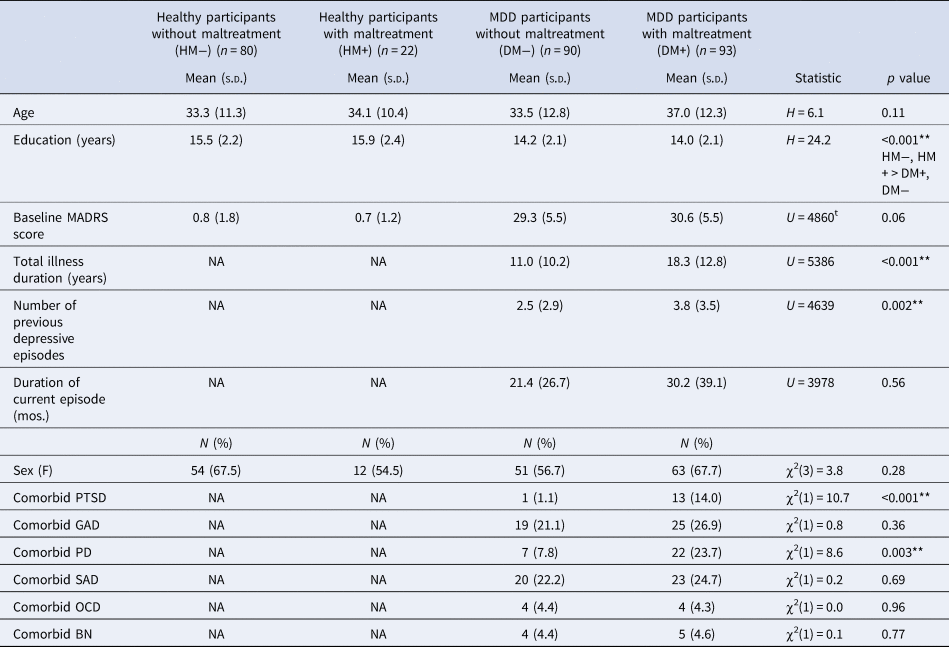
Both HM− and HM+ groups had more years of education v. DM+ and DM− (Table 1). DM+ had longer illness duration, higher number of previous MDEs, proportion with comorbid PTSD and panic disorder v. DM− (Table 1).
Demographic and clinical characteristics of healthy participants and MDD participants, categorized by childhood maltreatment history

MADRS, Montgomery-Åsberg Depression Rating Scale; PTSD, post-traumatic stress disorder; GAD, generalized anxiety disorder; PD, panic disorder; SAD, social anxiety disorder; OCD, obsessive-compulsive disorder; BN, bulimia nervosa.
**p < 0.01, *p < 0.05. tbaseline MADRS scores compared between DM− and DM+ groups
Baseline comparison of cognition
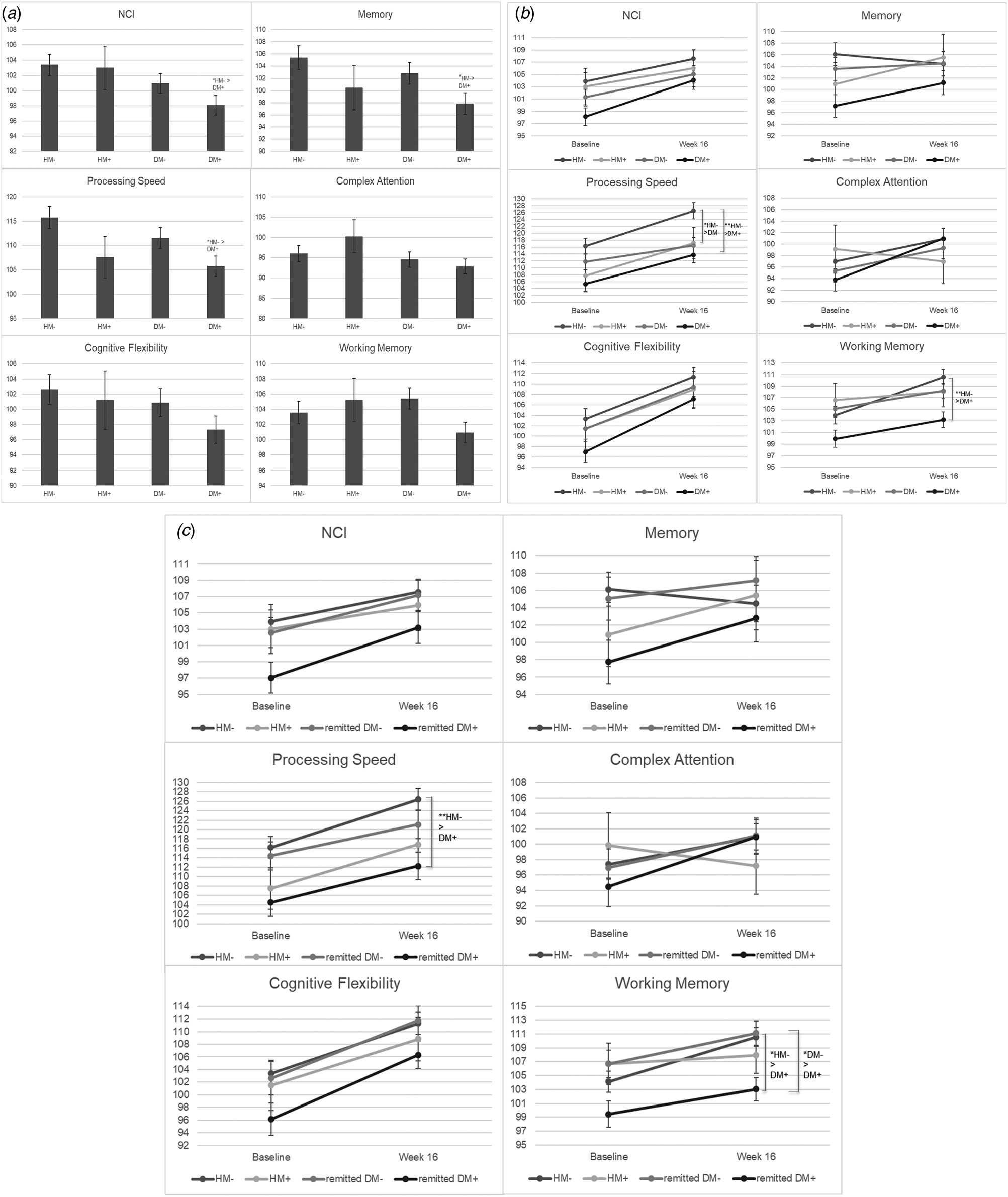
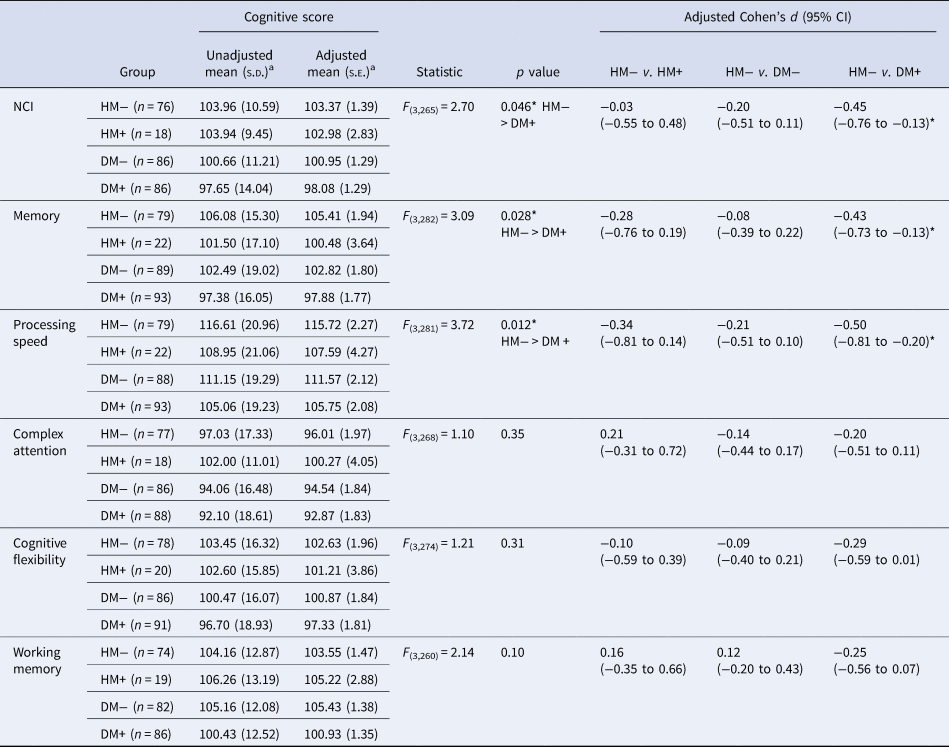
ANCOVA comparing baseline NCI scores showed that DM+ scored significantly lower than HM− (d = −0.45) (Fig. 1a, Table 2). DM+ scored significantly lower in processing speed (d = −0.50) and memory (d = −0.43) than HM− in ANCOVAs comparing individual cognitive domains. There were no significant differences amongst HM−, HM+, and DM− groups.
Baseline and change in cognitive scores from baseline to week 16 in healthy participants without maltreatment (HM−), healthy participants with maltreatment (HM+), MDD participants without maltreatment (DM−), and MDD participants with maltreatment (DM+). (a) Comparison of baseline cognitive scores amongst healthy participants without maltreatment (HM−), healthy participants with maltreatment (HM+), MDD participants with maltreatment (DM+), and MDD participants without maltreatment (DM−). *p < 0.05 difference. (b) Change in cognitive scores from baseline to week 16 in healthy participants without maltreatment (HM−) and healthy participants with maltreatment (HM+) compared to all MDD participants with (DM+) and without maltreatment (DM−). *p < 0.05 and **p < 0.01 difference in week 16 scores. (c) Change in cognitive scores from baseline to week 16 in healthy participants without maltreatment (HM−) and healthy participants with maltreatment (HM+) compared to remitted MDD participants with (DM+) and without (DM−) maltreatment. *p < 0.05 and **p < 0.01 difference in week 16 scores. Estimated marginal means and standard errors (s.e.) after controlling for education are shown for all panels. NCI, neurocognitive index.

Baseline cognitive performance in healthy participants without childhood maltreatment (HM−), healthy participants with childhood maltreatment (HM+), MDD participants with childhood maltreatment (DM+), and MDD participants without childhood maltreatment (DM−)

HM−, healthy participants without maltreatment; HM+, healthy participants with maltreatment; DM−, MDD participants without maltreatment; DM+; MDD participants with maltreatment; NCI, neurocognitive index
Reflect and square root transformed scores used for ANCOVA analysis of memory, complex attention, cognitive flexibility, and working memory.
Numbers with valid scores for each cognitive measure are shown in each cell.
Negative Cohen's d value indicates higher score in the HM− group. Cohen's d calculated using transformed means adjusted for education.
a Raw means and standard deviations (s.d.) as well as estimated marginal means adjusted for years of education with standard errors (s.e.) are presented.
*p < 0.05.
Pre- to post-treatment cognitive change and post-treatment differences in all MDD participants
Seventy-six HM− (5% attrition), 21 HM+ (5% attrition), 82 DM− (10% attrition), and 83 DM+ (11% attrition) completed the 16-week protocol. There were no significant between group differences in attrition rate (χ2 = 2.59, p = 0.46). A similar proportion of DM− (51.2%) and DM+ (54.2%) received adjunctive aripiprazole from weeks 8 to 16 (online Supplementary Table S1).
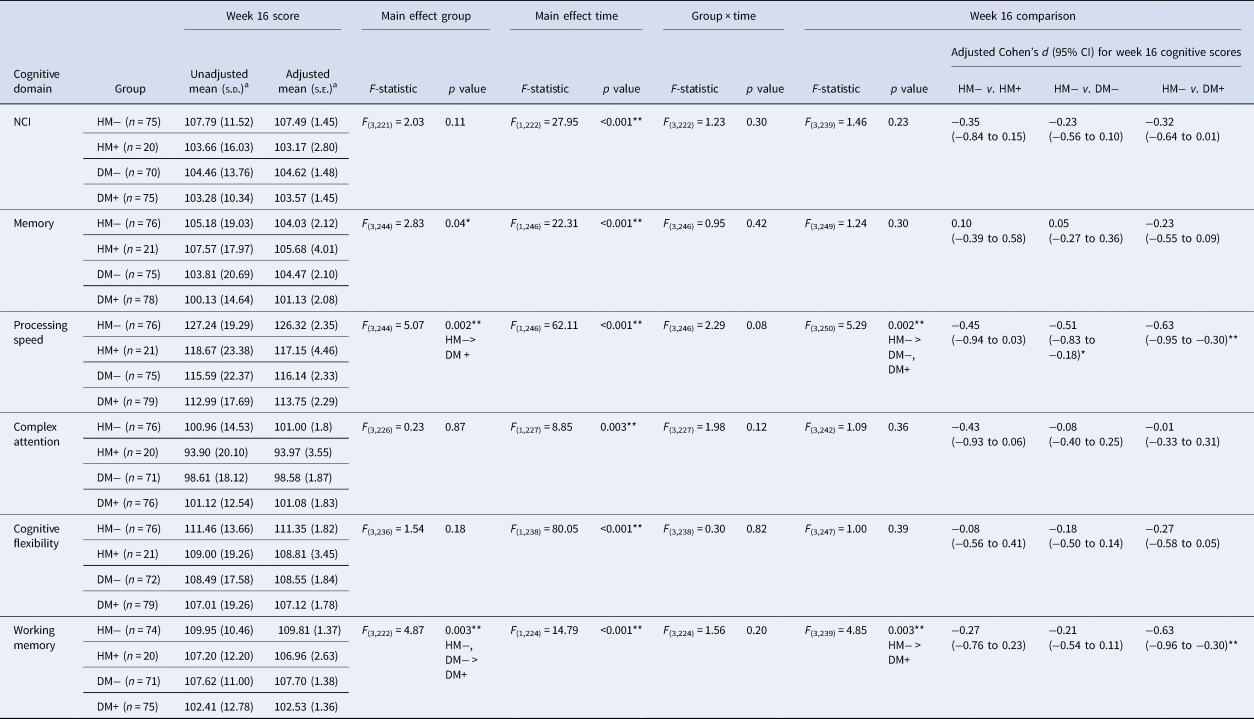
Repeated measures ANCOVA showed significant group main effects in memory, processing speed, and working memory (Table 3, Fig. 1b, online Supplementary Table S2). All domains showed a significant main effect for time. There were no significant group by time interactions. Comparison of week 16 scores showed that DM+ had significantly lower working memory v. HM− (d = −0.63), and both DM+ (d = −0.63) and DM− (d = −0.51) had lower processing speed scores v. HM−.
Repeated measures analysis of cognitive performance from baseline to week 16 between healthy participants without maltreatment (HM−), healthy participants with maltreatment (HM+), all MDD participants without maltreatment (DM−) and all MDD participants with maltreatment (DM+)

HM−, healthy participant without maltreatment; HM+, healthy participant with maltreatment; DM−, MDD participant without maltreatment; DM+, MDD participant with maltreatment.
Numbers with valid scores at week 16 for the cognitive measure of interest are indicated in each cell and were used for ANCOVA comparing week 16 scores. Only participants with valid scores at baseline and week 16 were used for repeated measures ANCOVA (see online Supplementary Table S2 for means)
Negative Cohen's d indicates higher score in the HM− group at week 16. Cohen's d calculated using transformed means adjusted for education.
a Raw mean cognitive scores with standard deviation (s.d.) and estimated marginal means adjusted for education with standard errors (s.e.) are presented.
*p < 0.05 **p < 0.01.
Pre- to post-treatment cognitive change and post-treatment differences in remitted MDD participants
Of the 165 MDD participants who completed the protocol, 99 (50 DM− and 49 DM+) were in remission at 16 weeks. A similar proportion of remitted DM− (34.0%) and remitted DM+ (38.8%) received adjunctive aripiprazole (online Supplementary Table S1).
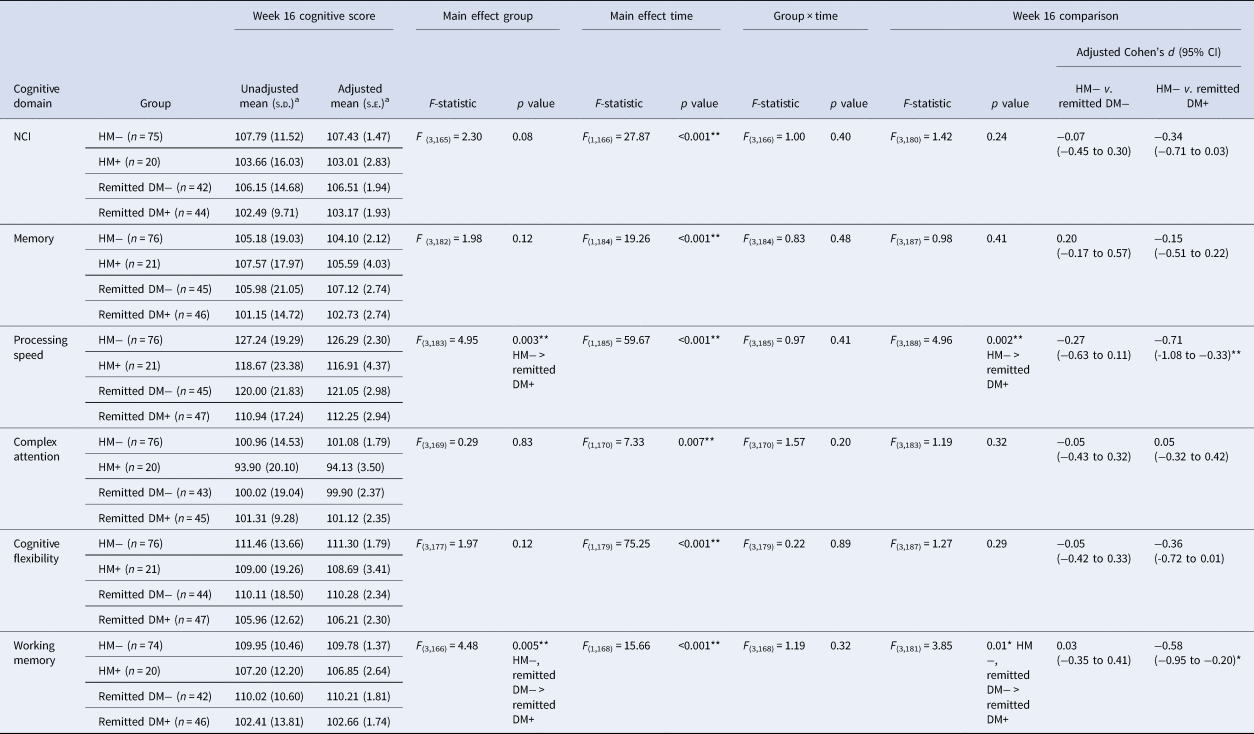
Repeated measures ANCOVA showed significant group main effects in processing speed and working memory, and significant main effects for time in all domains (Table 4, Fig. 1c, online Supplementary Table S3). There were no significant group by time interactions. Remitted DM+ scored significantly lower at week 16 in processing speed (d = −0.71) and working memory (d = −0.58) v. HM−. Remitted DM+ also displayed lower working memory scores v. remitted DM−. Remitted DM−, HM+, and HM− did not significantly differ in any domain.
Repeated measures analysis of cognitive performance from baseline to week 16 between healthy participants without maltreatment (HM−), healthy participants with maltreatment (HM+), remitted MDD participants without maltreatment (DM−), and remitted MDD participants with maltreatment (DM+)

HM−, healthy participants without maltreatment; HM+, healthy participants with maltreatment; DM−, remitted MDD participants without childhood maltreatment; DM+, remitted MDD participants with childhood maltreatment
Numbers with valid scores at week 16 for the cognitive measure of interest are indicated in each cell and were used for ANCOVA comparing week 16 scores. Only participants with valid scores at baseline and week 16 were used for repeated measures ANCOVA (see online Supplementary Table S3 for means)
Negative Cohen's d indicates higher score in the HM− group. Cohen's d calculated using transformed means adjusted for education
Numbers with valid scores for the cognitive measure of interest are indicated in each cell.
a Raw mean cognitive scores (with standard deviations) and means adjusted for education (with standard errors) are presented.
*p < 0.05 **p < 0.01.
Association of maltreatment types with cognition in MDD
After adjusting for clinical/demographic variables correlated with each domain, emotional abuse was negatively associated with baseline memory (β = −0.18, p = 0.016, ΔR 2 = 0.03; covariate age) and working memory (β = −0.17, p = 0.027, ΔR 2 = 0.03; covariates age, education, and current episode duration) scores in MDD participants (online Supplementary Table S4). Neither physical nor sexual abuse was associated with cognitive performance (online Supplementary Table S5). Comorbid PTSD was negatively associated with complex attention and cognitive flexibility (online Supplementary Tables S4 and S5). Total illness duration was significantly correlated with processing speed in univariate analysis, but did not significantly contribute to variance in regression models (online Supplementary Tables S4 and S5).
Discussion
Using data from a multicenter MDD study, we find that cognitive deficits are significantly more pronounced in symptomatic and remitted MDD participants with a history of childhood maltreatment. Consistent with previous reports, ~50% of MDD participants in this sample reported maltreatment (Nelson et al., Reference Nelson, Klumparendt, Doebler and Ehring2017). Depressed participants with maltreatment (DM+) did not significantly differ from depressed participants without maltreatment (DM−) in any domain. However, the DM+ group displayed baseline deficits in global cognition, memory, and processing speed compared to healthy participants without maltreatment (HM−), with effect sizes ranging from −0.43 to −0.50 in these domains. Depressed participants without maltreatment (DM−) did not significantly differ in any measure v. HM− at baseline, with effect sizes across all domains ranging from −0.21 to 0.12. This suggests that while acutely depressed DM− patients may display small magnitude deficits v. healthy comparators in some domains, DM+ patients form a subgroup with significantly more pronounced deficits in acute depression. There were no significant time by group interactions in repeated measures ANCOVA, indicating that history of maltreatment in MDD participants was not associated with attenuated treatment related cognitive improvements as originally hypothesized. Additionally, the deficits seen in acutely depressed DM+ in global cognition and memory appeared to attenuate in DM+ participants who attained symptomatic remission, as these measures no longer differed between remitted DM+ and HM−. However, remitted DM+ participants continued to display lower processing speed and working memory scores compared to HM−, with moderate effect sizes, as well as significantly lower working memory v. DM−. By contrast, remitted DM− performed comparably to HM− in all cognitive domains (effect sizes from −0.27 to 0.20). These results collectively suggest that previously detected cognitive deficits in acute and remitted MDD patients v. healthy comparators may be at least partially attributable to the presence of childhood maltreatment.
These findings align with previous research associating maltreatment with poorer global cognition, memory, working memory, and processing speed in adults with MDD and other psychiatric disorders (Grassi-Oliveira et al., Reference Grassi-Oliveira, Stein, Lopes, Teixeira and Bauer2008; Bucker et al., Reference Bucker, Kozicky, Torres, Kauer-Sant'anna, Silveira, Bond, Lam and Yatham2013; Miller et al., Reference Miller, Mcteague, Gyurak, Patenaude, Williams, Grieve, Korgaonkar and Etkin2015; Masson et al., Reference Masson, East-Richard and Cellard2016; Dannehl et al., Reference Dannehl, Rief and Euteneuer2017; Saleh et al., Reference Saleh, Potter, Mcquoid, Boyd, Turner, Macfall and Taylor2017), as well as previous work associating maltreatment with abnormal brain structure and functioning in frontal, limbic, and medial temporal regions underlying cognition (Dannlowski et al., Reference Dannlowski, Stuhrmann, Beutelmann, Zwanzger, Lenzen, Grotegerd, Domschke, Hohoff, Ohrmann, Bauer, Lindner, Postert, Konrad, Arolt, Heindel, Suslow and Kugel2012; Lim et al., Reference Lim, Radua and Rubia2014; Philip et al., Reference Philip, Valentine, Sweet, Tyrka, Price and Carpenter2014). Such structural and functional changes intersect with those commonly reported in MDD (Sacher et al., Reference Sacher, Neumann, Funfstuck, Soliman, Villringer and Schroeter2012); indeed, neuroimaging studies have found that maltreatment is independently associated with fronto-limbic abnormalities previously thought to be specific to depression (Opel et al., Reference Opel, Redlich, Zwanzger, Grotegerd, Arolt, Heindel, Konrad, Kugel and Dannlowski2014; Yang et al., Reference Yang, Cheng, Mo, Bai, Shen, Liu, Li, Jiang, Chen, Lu, Sun and Xu2017). These studies provide a neurobiological context for our findings that cognitive deficits are more severe in DM+ participants. Additionally, significant cognitive deficits compared to healthy participants were detectable in the remitted state only in DM+ participants, which further suggests that maltreatment may contribute to neurobiological changes associated with persistent cognitive dysfunction in remitted MDD patients.
Previous studies have suggested that specific maltreatment types may differentially impact cognition (Majer et al., Reference Majer, Nater, Lin, Capuron and Reeves2010; Gould et al., Reference Gould, Clarke, Heim, Harvey, Majer and Nemeroff2012; Nikulina and Widom, Reference Nikulina and Widom2013; Dannehl et al., Reference Dannehl, Rief and Euteneuer2017). In non-clinical and mixed samples, physical neglect has been negatively associated with executive functioning and non-verbal reasoning, emotional abuse with visual memory and working memory, and sexual abuse with working memory (Gould et al., Reference Gould, Clarke, Heim, Harvey, Majer and Nemeroff2012; Nikulina and Widom, Reference Nikulina and Widom2013). In the few MDD studies that have examined these relationships, physical neglect has been specifically associated with lower verbal memory (Grassi-Oliveira et al., Reference Grassi-Oliveira, Stein, Lopes, Teixeira and Bauer2008; Dannehl et al., Reference Dannehl, Rief and Euteneuer2017), and physical abuse with lower executive functioning and working memory (Dannehl et al., Reference Dannehl, Rief and Euteneuer2017). In our exploratory analysis, emotional abuse was negatively associated with memory and working memory, whereas physical and sexual abuse were not associated with any cognitive measure. Previous research has found that emotional abuse is a stronger risk factor for the development of MDD compared to other forms of maltreatment, and it has been negatively associated with working and visual memory, independent of physical and sexual abuse (Majer et al., Reference Majer, Nater, Lin, Capuron and Reeves2010; Gould et al., Reference Gould, Clarke, Heim, Harvey, Majer and Nemeroff2012; Mandelli et al., Reference Mandelli, Petrelli and Serretti2015). While the small number of participants reporting physical or sexual abuse may have limited our ability to detect significant associations between these maltreatment types and cognition, our results nevertheless support the conceptualization of emotional abuse as a potent form of trauma that may negatively impact cognition.
Though our results support the hypothesis that maltreatment is associated with cognitive dysfunction in adult MDD, our ability to assess the independent contributions of maltreatment and MDD to cognitive functioning was limited due to the small number of HM+ participants. At baseline, the HM+ group scored numerically lower than HM− in memory, processing speed, and cognitive flexibility, with effect sizes ranging from −0.10 to −0.34. Remitted DM− participants also had numerically higher scores at week 16 compared to HM+ in all domains. This is consistent with previous studies finding that childhood maltreatment has a negative impact on adult cognitive functioning independent of the presence of diagnosable psychopathology (Majer et al., Reference Majer, Nater, Lin, Capuron and Reeves2010). However, no comparisons involving HM+ reached statistical significance, and the small size of this group precludes drawing definitive conclusions. The HM+ group also appeared to show a different trajectory of change in complex attention, with an apparent decline from baseline to week 16 scores (Fig. 1). However, there were no significant time by group interaction terms, and again given the small size of the HM+ group, this may represent chance variation.
Study findings should be considered in the context of certain limitations. As described, the sample size of healthy participants with maltreatment, and MDD participants with severe physical or sexual abuse, was relatively small. Contrary to previous studies that have associated maltreatment with increased symptom severity in MDD, DM+ participants in this sample did not display significantly higher symptom severity compared to DM− (Nelson et al., Reference Nelson, Klumparendt, Doebler and Ehring2017). This may be due to inclusion/exclusion criteria for this clinical trial, and may limit generalizability of the current findings. That a similar proportion of DM+ and DM− participants remitted is another finding at odds with previous studies linking maltreatment with a poorer treatment response (Nanni et al., Reference Nanni, Uher and Danese2012). While comprehensive regression analyses are required to evaluate this finding, this may be another indication that DM+ participants in this sample differ from those seen in naturalistic settings. Consistent with previous research associating maltreatment with earlier age of onset, more frequent episodes, and higher comorbidity in MDD, DM+ participants here were characterized by longer total illness duration, increased number of depressive episodes, and comorbidity load (PTSD and panic disorder) (Nanni et al., Reference Nanni, Uher and Danese2012; Nelson et al., Reference Nelson, Klumparendt, Doebler and Ehring2017). While total illness duration was negatively correlated with processing speed in this sample, it did not significantly contribute to variance in regression analyses. Additionally, PTSD was not associated with any of the cognitive measures that differed significantly between groups, although it was negatively associated with cognitive flexibility and complex attention. Numbers of previous episodes and panic disorder were not correlated with any cognitive measure. Thus, these variables are possible but unlikely confounds. To prevent type II error in identifying potentially relevant cognitive domains, we did not correct omnibus ANCOVA test statistics for multiple comparisons. The current findings thus require replication. However, in all significant omnibus comparisons involving acute and remitted MDD participants, the DM+ group was consistently found to be driving between-group differences in Sidak corrected pairwise comparisons, indicating that these are likely not chance findings. An additional limitation is that the CECA is a retrospective measure and, thus, may be prone to depressive bias. However, the use of independent raters that base judgments of the presence and severity of maltreatment on contextual and behavioral indicators helps to minimize recall bias, and may be superior in this regard to self-report measures of maltreatment (Brown et al., Reference Brown, Craig, Harris, Handley and Harvey2007). This study also cannot establish causal connections between childhood maltreatment and cognitive dysfunction. Environmental factors such as socio-economic disadvantage may mediate the relationship between maltreatment and cognition on a population level (Danese et al., Reference Danese, Moffitt, Arseneault, Bleiberg, Dinardo, Gandelman, Houts, Ambler, Fisher, Poulton and Caspi2017), and childhood maltreatment is a risk factor for re-victimization in adulthood (Widom et al., Reference Widom, Czaja and Dutton2008). As traumatic experiences after the age of 18 were not here assessed, cognitive deficits in the DM+ group may in fact represent the result of cumulative lifetime trauma.
Despite these limitations, our results add to a growing body of evidence linking maltreatment and cognitive dysfunction in psychiatric disorders, and suggest that a history of maltreatment should alert clinicians to a higher risk of severe and persistent cognitive impairments in MDD patients. Analyses using larger groups of healthy participants with maltreatment would clarify the independent effects of maltreatment and MDD on cognition. More complex models that incorporate additional variables, such as lifetime trauma, are required to evaluate the casual chain linking childhood maltreatment to cognition. Future studies may also examine the neurobiological correlates of the memory, processing speed, and working memory deficits in acute and remitted MDD patients with maltreatment, and whether this patient population derives particular benefit from pharmacologic and non-pharmacologic therapies targeting these deficits.
Supplementary material
The supplementary material for this article can be found at https://doi.org/10.1017/S003329171900268X.
Financial support
CAN-BIND is an Integrated Discovery Program carried out in partnership with, and financial support from, the Ontario Brain Institute (grant title ‘Canadian Biomarker Integration Network for Depression (CAN-BIND)’), an independent non-profit corporation, funded partially by the Ontario government. The opinions, results and conclusions are those of the authors and no endorsement by the Ontario Brain Institute is intended or should be inferred. Additional funding was provided by CIHR, Lundbeck, Bristol-Myers Squibb, Pfizer, and Servier. Funding and/or in kind support is also provided by the investigators' universities and academic institutions. All study medications are independently purchased at wholesale market values.
Conflict of interest
Dr Chakrabarty, Dr Harkness, Dr Quilty and Dr Uher report no competing interests. Dr McInerney has received advisory panel income from Janssen and research grant funding through the Healthy Minds Canada/Pfizer Canada Workplace Depression Awards. Dr Milev has received honoraria for ad hoc speaking or advising/consulting, or received research funds, from: Lundbeck, Pfizer, Shire, Sunovion, Janssen, Allergan, BMS, Otsuka, Merck, Canadian Institutes of Health Research, Canadian Biomarker Integration Network for Depression, Ontario Brain Institute, and Ontario Mental Health Foundation. Dr Kennedy has received research funding or honoraria from the following sources: Abbott, Alkermes, Allergan, BMS, Brain Canada, Canadian Institutes for Health Research, Janssen, Lundbeck, Lundbeck Institute, Ontario Brain Institute, Ontario Research Fund, Otsuka, Pfizer, Servier, Sunovion and Xian-Janssen. Dr Frey has served on advisory board for Otsuka and received research grants from Pfizer. Dr MacQueen has received honoraria for ad hoc speaking or advising/consulting, or received research funds, from: Ontario Brain Institute, Canadian Institutes of Health Research, Pfizer, Lundbeck, Janssen, Johnson & Johnson, Allergan. Dr Müller has received research funds from the Centre for Addiction and Mental Health Foundation, Canadian Institutes of Health Research, and the National Institute of Health. Dr Rotzinger holds a patent ‘Teneurin C-Terminal Associated Peptides (TCAP) and methods and uses thereof. Inventors: David Lovejoy, R.B. Chewpoy, Dalia Barsyte, Susan Rotzinger.’ Dr Lam has received honoraria for ad hoc speaking or advising/consulting, or received research funds, from: Akili, Allergan, Asia-Pacific Economic Cooperation, BC Leading Edge Foundation, Brain Canada, Canadian Institutes of Health Research, Canadian Network for Mood and Anxiety Treatments, Canadian Psychiatric Association, CME Institute, Hansoh, Janssen, Lundbeck, Lundbeck Institute, Medscape, Mind Mental Health Technologies, Otsuka, Pfizer, St. Jude Medical, University Health Network Foundation, and Vancouver General Hospital Foundation.