

INTRODUCTION: AIM OF THE INQUIRY AND KEY RESEARCH QUESTIONS
In communication about age and aging, elderly is a key expression. Clues from various genres suggest that it is also contested. Dictionaries, for example, disagree about its evaluative meaning. Thus, the Longman Dictionary of Contemporary English tells its readers that elderly “is used as a polite way of saying that someone is old,” whereas the Macmillan English Dictionary for Advanced Learners advises users that “many people now think that this word is offensive.” Trawling the Internet, one also finds its contested nature emerging in self-reported identity, as in the comment made by a 75-year-old, “I am not elderly. I am old and proud of it” (Hay 1998) – an assertion that clearly would not make sense if, as some dictionaries (e.g., the Concise Oxford) claim, elderly were simply a synonym of old. Finally, elderly has been picked up as “ageist” by institutional arbiters of politically correct language. The Publication Manual of the American Psychological Association, for example, states, “Elderly is not acceptable as a noun and is considered pejorative by some as an adjective” (American Psychological Association 2001:69).
With this initial evidence in mind, and against the backdrop of current research into aging (reviewed in the next section), evidence from a set of large reference corpora was sought to investigate the following questions:
- What is it about elderly that makes some users, individual as well as institutional, reject it as “ageist”?
- What attributes and activities are older people commonly associated with, and what dominant roles and identities emerge as a result?
The aim of this article is twofold. On the substantive level of sociolinguistic inquiry, it aims to contribute to the growing body of research on discourse and aging, which will be reviewed, albeit briefly, in the next section. This article's contribution consists in drawing up a collocational profile of an expression that plays a key role in discursive representations of older people. On the reflective level of methodology, on the other hand, the article aims to demonstrate that large reference corpora are rich repositories of social information and thus offer considerable potential for research in sociolinguistics and discourse analysis. In making this case, I shall be drawing on existing, commercially available data and the software that comes with them. I shall focus on how these can be used by scholars who may have neither the resources to assemble large teams of researchers nor the time and computing know-how to develop and use new tools.
DISCOURSE AND AGING
Aging is a field of research spanning many disciplines, reflecting the fact that the process of aging has biological, psychological, and social implications. While it is true that sociolinguistics has been paying comparatively less attention to age than to other factors – enough so for Coupland (2001:185) to refer to age as “sociolinguistics' under-developed social dimension” – there is now a sizable body of research dealing with communicative aspects of aging. The key themes involved include intergenerational communication (Williams & Nussbaum 2001, Williams & Harwood 2004, Barker, Giles & Harwood 2004), and the communicative construction of relationships (Mares & Fitzpatrick 2004), health communication (Thompson, Robinson & Beisecker 2004), as well as age communication in the media (Nussbaum, Pecchioni, Robinson & Thompson 2000:85–112, Robinson, Skill & Turner 2004) and in marketing (DeRenzo & Malley 1992, Balazs 2004, Stern & Mastro 2004). An angle that is of particular interest here is ageism, defined as “a complex ideological formation – a structured, historically formed set of myths or discourses which endorse the subordinate or marginal positions and qualities of the old” (Coupland 2001:197). Butler 1969 is generally credited with coining the term ageism (Bytheway & Johnson 1990:27), and Nuessel 1984 with the first attempt at cataloguing its lexicon. Nuessel's collection comprises not only overtly denigrating terms such as bat and codger but also seemingly neutral expressions such as generation gap (focusing, as it does, “on the polarization of young and old people in our youth-oriented society”; Nuessel 1984:21). The range of spuriously neutral lexis, according to Nuessel's 1984 paper, also includes elderly, which he calls “stigmatic because this word has been employed by media reporters who have traditionally portrayed this social subdivision in a negative and derisive fashion” (Nuessel 1984:18). However, in a paper published two years earlier (Nuessel 1982), he had still commended elderly for its neutral and non-stereotyping qualities. Williams & Giles 1998, on the other hand, point out that older people “are addressed in a depersonalized (often patronizing) manner as members of a negatively valenced social category,” and they add, “i.e. as ‘elderly’.” Both their use of distancing scare quotes around elderly and Nuessel's uncertainty point in the same direction as do the primary data quoted in the Introduction: that the evaluative meaning of elderly is complex and problematic. This is the issue at the core of this article.
A common thread running through current research on aging is the idea that age and aging are socially and culturally constructed (Hareven 1995:121) – witness, for example, the telling title of Hepworth's 2003 paper, “Aging bodies: Aged by culture.” In the case of linguistic work in this field, the contention is, specifically, that age is discursively constructed. The carving up of the lifespan into distinct stages, the way in which these stages are “boundaried” (Williams & Giles 1998:155), and the attribution of value to each stage: All this happens through language and is sustained, negotiated, or challenged in discourse. People are put (and put themselves) into lifespan categories by labels, being referred to, for example, as young, middle-aged, older, old, elderly, or, to mention coinages from gerontology, as young-old, old-old, or oldest-old (Garfein & Herzog 1995). The labeling expressions, in turn, shape both people's identities and interpersonal relationships. In the process, both individuality and non-age-related group identities are backgrounded or forfeited altogether.
If we accept that labeling plays a crucial role in categorization, boundary drawing, and stereotyping, then the study of age labels emerges as a worthwhile contribution to aging research. If we wish to substantiate intuitions and ad hoc evidence about any specific label, we need to turn to representative textual data. Combining both conditions leads us to the corpus-driven investigation reported on in this article.
CORPUS LINGUISTICS
What does it mean to make a research design “corpus-driven”? The key characteristics of corpus linguistics highlighted in recent programmatic statements include (i) its empirical approach and focus on authentic data, (ii) its contextual and functional approach to meaning, and (iii) its use of information technology (IT) to store and process language data (Tognini-Bonelli 2001:2; Teubert 2005). Although these principles can be applied fruitfully to corpora of all sizes, corpus linguistics methodology comes into its own mainly with very large volumes of data.
Corpus linguistics is probably most widely known for its contributions to lexicography and descriptive grammar, informing such groundbreaking projects as the CollinsCOBUILD Advanced Learners English Dictionary (first published in 1987, now in its 4th edition) and the Longman Grammar of Spoken and Written English, respectively. However, awareness has been increasing, over the past ten years or so, that corpus linguistic techniques can also be harnessed profitably for uncovering relationships between language and the social. Examples include Stubbs & Gerbig's (1993) inquiry into verbs used in geography textbooks, Krishnamurthy's (1996) comparative analysis of three ideologically loaded words (racial, ethnic, and tribal), Alexander's (1999) corpus-based analysis of ecological issues in business texts, Hardt-Mautner's (1995), Teubert's (2000), and Mautner's (2000) investigations of British “Euro” discourse, Fairclough's (2000) work on the language of Tony Blair's “New Labour” party, Piper's (2000a, 2000b) corpus-based investigation of the discourse of lifelong learning, Orpin's (2005) analysis of words related to corruption (such as sleaze and bribery), and Baker & McEnery's (2005) study of texts on refugees. Reflections on the dialogue between discourse studies and corpus linguistics can be found in Mautner 2000, 2001, Hunston (2002:109–23), O'Halloran & Coffin 2004, and Koller & Mautner 2004. Mautner 2005, also pursuing the keyword approach, builds what she calls a “discursive profile” of an expression that has a pivotal function in current higher education discourse. What unites all of these studies is the firm belief that connotations are not merely subjective associations that lexical items trigger in individual speakers, but that, like denotation, “connotations are also widely shared within a speech community” (Stubbs 2001:35). Corpora running to tens or even hundreds of millions of words allow researchers to capture such shared connotations in ways that no other method of data gathering can. Specifically, for those working within a discourse analytic paradigm, the value of accessing large computer-held corpora lies in boosting the empirical credence of analyses. This serves to counteract the charge that individual texts have been cherry-picked to suit the researcher's own political agenda (Koller & Mautner 2004:225; Partington 2004b:13; Orpin 2005:38).
Although fairly recent, the projects mentioned above are related, in spirit if not necessarily through explicit attribution, to the early British school of linguistics associated with J. R. Firth, to whom many corpus linguists acknowledge considerable scholarly debt (Sinclair 2003, Stubbs 1996). In his 1935 paper, Firth mapped out an agenda for what he termed “sociological linguistics” (Firth 1935 [1957]:27), calling specifically for “research into the detailed contextual distribution of sociologically important words, what one might call focal or pivotal words” (Firth 1935 [1957]:10; original italics). The essentially social (rather than cognitive) orientation of corpus linguistics also surfaces in contemporary explorations of the discipline's theory and method. “Corpus linguistics,” Teubert (2005:8) points out, “looks at language not from a psychological, but from a social perspective.” In a similar vein, and also following the Firthian tradition, Stubbs 2001 takes up Raymond Williams's (1976) idea of “cultural keywords” and explores case studies that include heritage, care, and community. Keywords, Stubbs argues, are “nodes around which ideological battles are fought” (2001:188). Within the discourse of aging, elderly certainly fits the bill.
CORPUS AND METHOD
Corpus size and composition
The primary source of data for this study was the 57-million-word online spin-off from the more than 500-million-word Bank of English. Wordbanks Online, as it is called (http://www.cobuild.collins.co.uk/Pages/wordbanks.aspx), consists of twelve subcorpora dating from the early to mid 1990s: the British daily newspapers The Times (5.76 million words), The Sun (5.82 million) and Today (5.2 million), British books (5.35 million), magazines (4.9 million), and ephemera such as flyers and mail-order catalogues (3.21 million); unscripted spoken British English (9.27 million) and BBC radio (2.6 million); U.S. books (5.62 million), U.S. ephemera (1.22 million), and National Public Radio broadcasts (3.13 million); and Australian newspapers (5.34 million).
The Wordbanks corpora are part-of-speech tagged, making it possible to search, for example, for cases where the node word elderly is coordinated with other adjectives, or for occurrences of elderly people followed by a verb form.
Combining quantitative and qualitative approaches
Wordbanks Online comes with its own software, which generates keyword-in-context (KWIC) concordances, calculates absolute and joint frequencies, and computes two measures of relative statistical significance – t-score and Mutual Information (MI) score – for each collocate (based on Church & Hanks 1990). T-score measures certainty of collocation, whereas MI score measures strength of collocation (Hunston 2002:73; McEnery & Wilson 2001:86). T-score directs our attention to high-frequency collocates such as grammatical words (and is thus likely to be more useful to the grammarian or lexicographer than to the sociolinguist or discourse analyst), whereas MI score highlights lexical items that are relatively infrequent by themselves but have a higher-than-random probability of co-occurring with the node word (Clear 1993:281). The two scores are useful, above all, in ranking collocations (Manning & Schütze 1999:166).
The automated statistics generally produce results interesting in their own right, and certainly did in the case of elderly, but their more substantive value lies in identifying key leads worth pursuing qualitatively, according to the tried and tested principle of corpus linguistics, “Decide on the ‘strongest’ pattern and start there” (Sinclair 2003:xvi). Quantitative indicators highlight particularly promising entry points into the data. Moreover, the ensuing qualitative investigation also benefits considerably from the software, with KWIC concordances making it possible to scrutinize volumes of textual data so large that they would otherwise preclude qualitative analysis.
In the present study of elderly, the analysis of concordance lines focused on adjectival and verbal collocates, as well as on the concepts of “semantic preference” and “semantic prosody” (Partington 2004a). Following Stubbs, “semantic preference” is understood as the co-occurrence with “a class of words which share some semantic feature” (Stubbs 2001:88). This concept was invoked, for example, to capture the association of elderly with lexis referring to disability, frailty, and care (which may or may not be realized through the actual items disabled, frail, and care, showing that the statistics related to specific collocates, though valuable, are no substitute for qualitative analysis). “Semantic prosody,” on the other hand, refers to “the consistent aura of meaning with which a form is imbued by its collocates” (Louw 1993:175; see also Sinclair 1987, 1998; Stubbs 2001; Partington 2004a). This is related to what Hunston (2004:157) refers to as “evaluative meaning,” defined as “an indication that something is good or bad,” and what Channell (2000:41) calls “evaluative polarity.” Through semantic preferences and prosodies, respectively, it is possible to identify both the social domains that lexical items are associated with (Orpin 2005:49) and the societal value judgments they carry. With both factored in, the collocational profile of a keyword is semantically enriched and acquires the potential to contribute to sociolinguistic investigations.
FINDINGS
Quantitative evidence
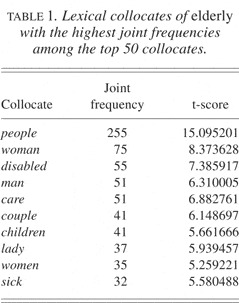
The investigation began by examining the three collocation lists for elderly, ordered by joint frequency, t-score and Mutual Information Score. Among the 50 items with the highest joint frequency (i.e., co-occurring within a span of four words on either side of the node), there were ten lexical words all of which also had high t-scores, of 5 and above (see Table 1).1
In studies using the Bank of English, the cutoff point above which t-scores are assumed to signal statistical significance is reported to be 2 (Hunston 2002:72).
Lexical collocates of elderly with the highest joint frequencies among the top 50 collocates.

That elderly, an adjective with an almost exclusively [+human] orientation, should co-occur frequently with generic [+human] nouns such as people and couple is hardly surprising. Among these nouns, though, there is the oddity of children featuring in the top ten. Given the semantic incompatibility of children and elderly, the high joint frequency obviously cannot be due to pre-modification. To clarify matters, children was earmarked for closer scrutiny in the second, concordance-based part of the analysis. The remaining three items in the top ten lexical collocates are disabled, care, and sick, which are consistent not only in terms of social domain (and hence semantic preference), but also have a distinctly negative evaluative load,2
For the record, I ought to stress that the association of “elderliness” with disability is not only ageist but also “able-ist.” To young people with a disability, who may share some but by no means all needs with the elderly, it must surely be objectionable to have their lifespan discursively condensed by routine coupling with the elderly (not to mention the factual inadequacy of many joint-provision care schemes).
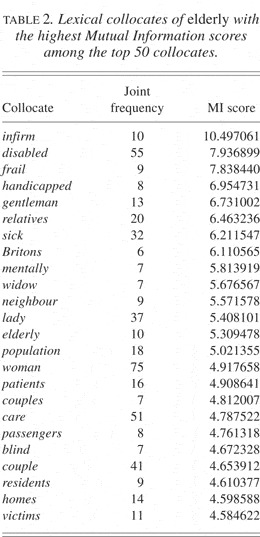
This is further corroborated by the collocation list ordered by MI score, which measures the difference between expected and observed frequencies and hence the strength of the collocational bond. This time, as is usually the case with MI rank orders, the top 50 are all lexical items.3
This is so because grammatical words combine so freely with many different items that even when there is a statistically significant likelihood of their co-occurrence with the node, it does not follow that the association is also strong (i.e., unexpected) in a statistically significant way (cf. Hunston 2002:74).
For example, the collocate with the tenth highest MI score is deng, owing to elderly being used as an epithet for Chinese leader Deng Xiao Ping. Its joint frequency, however, is only 3.
What “very low” means in this context is essentially a matter of judgment, but suggestions in the literature range from 3 to 5 as suitable cutoff points (Stubbs 1995:40).
Lexical collocates of elderly with the highest Mutual Information scores among the top 50 collocates.

In addition to the [+ human] nouns already identified by the joint frequency list, there are several new ones. Crucially, they include not only more of the fairly general expressions such as relatives and population, but also domain-specific nouns that once again reflect semantic preferences clustering around discourses of illness and care, namely patients and homes (and, as the concordances show, all 14 occurrences of homes in the vicinity of elderly refer to the residents of care homes). The list of statistically significant adjectival and adverbial collocates has also become longer, and these new additions, too, come from the same (prosodically negative) domains: infirm, frail, handicapped, mentally, and blind.6
These collocates all have MI scores of 4.5 or more and are thus well above the threshold of 3, which is generally taken to indicate significance (Hunston 2002:71).
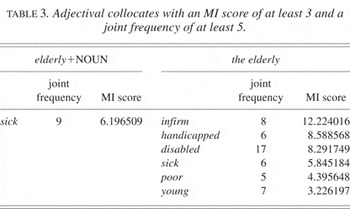
At this point, it is appropriate to refine the search and ask whether this collocational behavior is typical of elderly in all syntactic roles. Intuitively, one would expect elderly to have a comparatively more negative semantic prosody when it functions as a noun phrase head (the elderly) than when it serves in an attributive or predicative syntactic role. As far as adjectival collocates are concerned, this is confirmed by the data (see Table 3). When elderly is followed by a noun, the list of strongest collocates includes only one negatively loaded adjective, whereas the elderly has five such adjectives among its statistically significant collocates7
The statistics for elderly+NOUN were calculated on the basis of a selection of 450 occurrences (out of a total of 950), from which all stray collective uses (“false positives” resulting from errors in the tagging software, such as Did the elderly cause this deficit?) had been manually deleted. Similarly, the concordances for the elderly (again a selection of 450, out of a total of 475) had to be manually scanned and non-collective uses (e.g. the elderly owner had died) eliminated before compiling the collocation list.
Adjectival collocates with an MI score of at least 3 and a joint frequency of at least 5.

The picture that emerges, then, is of elderly being strongly associated with lexical items related to disability, care, victimhood and vulnerable social groups. The association is particularly noticeable with the nominalized adjective the elderly. With this quantitative evidence as a guide, we can now move on to examine concordances, which show the node in its immediate textual environment.8
Wordbanks offers between 80 and 512 characters of context.
Qualitative evidence: Refining the collocational profile
Adjectival and nominal collocates: Constructing group identities
The statistics reported in the preceding subsection tell us that adjectives with a negative semantic load from particular semantic domains have a higher than random probability of occurring in the vicinity of elderly.9
These findings were also confirmed by comparative data from the British National Corpus (BNC), using “Word Sketch,” a tool that provides “one-page automatic, corpus-based summaries of a word's grammatical and collocational behaviour” (Kilgarriff, Rychly, Smrz & Tugwell 2004:1). In the BNC, too, the ten adjectives linked most frequently with elderly through and/or were disabled, frail, infirm, vulnerable, sick, ill, handicapped, housebound, confused, and dependent.
Focusing first of all on adjectival collocates, we can see from the concordance10
The search command used was one that filtered out all occurrences of elderly followed by an adjective and with up to one word in between (to allow for cases of coordination with conjunctions). A 50-line selection (out of the total 150) is reproduced as Figure 1 in the Appendix.
(1)

Alternatively, as the following selection of concordance lines illustrates, the co-occurrence may be due to the elderly being mentioned in the same breath as other disadvantaged groups:
(2)

When we extend our view from adjectives that are statistically significant to the full set, even more such “lumping together” becomes apparent, as does the negative polarity of many of the labeling expressions involved (including arthritic, disadvantaged, geriatric, and unemployed). A few new domains emerge, too: lack of mobility, loneliness, and poverty (cf. collocates housebound, lonely, poor). Even among the few positively loaded examples (e.g., handsome, sprightly, dear, independent) there are some that turn out to be negative when viewed as part of coherent discourse. Consider, for example, the case of Myron Taylor, whom Evelyn Waugh described as elderly, handsome, obtuse, with the positive evaluation conveyed by the second adjective being deflated by the negative one that follows. Similarly, the full concordance citation for independent shows that, while its evaluative meaning is certainly positive, the context is once again that of care provision (It's thanks to Community Services Agency and special people like you that help make our elderly feel independent11
This comes from the spoken section of the Wordbanks corpus, hence the idiosyncratic syntax.
That elderly is predominantly a social rather than a chronological label is also evident from its nominal collocates. In the quantitative part of the analysis (see the preceding section), residents, victims, and children turned out to be among the nouns co-occurring with elderly at statistically significant levels. The concordances for elderly residents, then, point not only to the issue of institutionalized care (cf. the charity-funded home for up to 56 elderly residents), but also explore the theme of vulnerability to crime:
(3)

This is confirmed by the concordances that feature elderly referring to victims: of a total of eleven instances, only two refer to disease (elderly heart attack victims) or disaster (Some of the victims, mainly elderly, were trampled and others fell to their deaths). The remaining nine talk about crime (some of our elderly have become victims of crime).
In the case of children, the corresponding concordances reveal how co-occurrence and, in particular, coordination constructs shared group identities. Some expressions including children have the ring of a stock phrase to them – women, children and the elderly, for example, occurs six times in identical form – and of the 41 joint occurrences of children and elderly, 38 are cases where elderly and children are part of a coordinated noun phrase, linked by and, or, or a comma. The concordances for the collocate children also draw our attention to the fact that this bracketing together of vulnerable groups relies heavily on the nominalized and collectivized expression theelderly. In fact, 34 out of the 41 cases in which children collocates significantly with elderly feature the adjective in nominal use, confirming evidence that was revealed by the automated procedures reported on in the previous section (cf. Table 3).
Finally, the concordance for elderly followed by a noun also includes several instances of customers and investors, suggesting that there at last we may find some evidence of economic empowerment and independence. Any such hopes are quickly shattered, though. As the complete set of citations for these collocates shows, “elderly” customers are, once again, closely linked with disabled customers and are shown to be lacking basic skills (hiding their money under mattresses and in socks). They are poor (buying cigarettes by the piece), victims of accidents and beneficiaries of charitable work. Elderly investors do not fare much better. They suffer financial hardship, have to be protected against repossession, and are duped into making dubious investments:
(4)

Having established what qualities and social groups the elderly are generally associated with, let us now move on to activities.
Verbal collocates: What the elderly do
What, then, are elderly people seen to be doing in the corpus? Are they represented as shaping their own lives? What we are looking for primarily, following a systemic-functional approach (Halliday 2004), are cases where elderly is part of a noun group occupying the role of “Actor” in a “material process.” This is not the only way in which agency can be expressed (van Leeuwen 1996:33), but it is certainly an important one, and one that can be accessed reasonably well through concordance output. Material clauses “express the notion that some entity ‘does’ something” (Halliday 2004:181), and the Actor “is the one that does the deed” (Halliday 2004:179). There is no query in Wordbanks Online that will yield up this information ready-made, but it is possible to extract a suitably focused selection of examples from the corpus by searching for elderly followed by any type of verb, with up to two items in between.12
This allows for simple and compound tenses, as well as for the presence of “mid-position” adverbs. See Figure 2 in the Appendix for a sample of 50 concordance lines with this pattern.
It turns out that, in a random 100-line sample of elderly as an attributive adjective, just over a quarter of instances (26) include a material process with an elderly Actor. Among those, the activities described vary in terms of how much conscious shaping of events they actually involve and in how far they reflect stereotypical role models. Citations such as the following are at the most active end of the spectrum:
(5)

Others are closely related to the semantic preferences identified in previous sections:
(6)

When the elderly is used collectively,13
For a sample of 50 concordance lines exhibiting this pattern see Figure 3 in the Appendix.
(7)

On the other hand, there are citations that clearly tie in with the negative semantic prosody that is projected onto the elderly by its adjectival collocates (see the subsection on quantitative evidence):
(8)

The remaining hope for the analyst looking for positive constructions of aging was that elderly people might be cast in the role of agents in passive constructions, as the complement of by, a pattern not included in the query described above. More disappointment was in store. Out of a total of 609 occurrences of elderly preceded by a preposition, by accounts for a mere 3.9%. For and of make up around 30% each, and a variety of other prepositions the remaining 30%.
Perhaps unexpectedly, even these instances of the most common prepositions, such as of, can contribute to the discursive profile of elderly, and the social reality reflected and constructed by it. Among the noun phrases including of, one notices clusters of care of and carers of, as well as of number of together with rising and growing. This mirrors society's preoccupations in dealing with “the elderly,” reflecting the fact “that the aging population is ‘problematized’ (that is, brought into prominence as a dilemma)” (Bailey & Corner 2003:177, referring to Katz 1996). The evidence is very similar for phrases including for, with the high incidence of care for, centre for, home for, and clubs for indicating what the priorities are. Examples conveying a different image – such as the power of the elderly lobby – do exist, but they remain isolated and are drowned out by representations that are negative and/or focus on institutionalized care schemes for people who have lost (or are being denied) their independence.
CONCLUSION
Elderly and the discourse of aging: Summary and contextualization of results
Let me return to the research questions posed in the third section and summarize how the corpus evidence suggests they should be answered.
First, the ageist quality of elderly (and thus its rejection by individual users and lobbying groups) can be traced back to its collocational profile. Dominant semantic preferences include disability, illness, care, and vulnerability to crime, with the associated semantic prosodies often negative. We look in vain for the lexis of independence, initiative, and empowerment. Other blind spots are education, jobs, experience and the potential arising from these.
Second, at various points in the investigation – in connection with adjectival collocation, for example, and in the study of agency – evidence emerged that the negative polarity of elderly is particularly strong when the adjective is used as a nominalized, collective expression (the elderly).
Third, the elderly are portrayed as a predominantly passive group, on the receiving end of care as well as of crime. Rarely are they seen to be actively shaping their own lives. In combination with the dominant semantic preferences mentioned above, a picture emerges of the elderly being conceptualized as dependent and vulnerable.
The associative meaning that is bestowed on elderly through its semantic preferences and prosody takes us from the mere facts of chronological age to the social sphere, in which age is used as the basis for a whole chain of stereotypical assumptions about individuals' attributes, needs, and life chances. Who is described as elderly depends less on the date given on their birth certificate than on whether they are perceived to fit the stereotype. We can conclude from corpus evidence that someone who is old and fit, old and wealthy, or old and powerful, or a combination of all these, is much less likely to be referred to as elderly than are those who are old and disabled, old and poor, or old and dependent (or, as is quite likely, a combination of all these). Education and money offer no protection against becoming old, but they do against being made to become elderly.
Returning briefly to the quotations mentioned in the introduction, one has to reject the notion, upheld by nearly all current dictionaries, that elderly can be accurately glossed simply as “old or aging” (Concise Oxford English Dictionary2004). Its associative meaning clearly ranges much more widely. The evaluative semantic load it carries is predominantly negative, which explains why even people who are old or aging do not wish to be referred to as elderly, and why organizations advocating non-ageist language have largely abandoned elderly in favor of older. Thus, while elderly may have been a euphemism for old once, there are definitely no grounds now for describing it as “a polite way of saying old” (Longman Dictionary of Contemporary English2003). Instead, dictionaries ought to follow Macmillan's lead in including a warning that the word is now considered offensive by many and should be avoided (Macmillan English Dictionary for Advanced Learners2002). The findings support the policy of those publications and organizations already avoiding and advising against the use of elderly, and should encourage those that do not yet have such a policy to follow suit. Nonetheless, a caveat is in order. Important though the promotion of non-ageist language is, the social issue at the heart of this article is the way in which older people are negatively stereotyped, and for that to change it takes more than a few guidelines on non-offensive lexical choices. Certainly, given the dialectic between language and social life, ageist language not only reflects ageism in society but also contributes to promoting it. Yet we need to remind ourselves that ageism cannot be eradicated by non-ageist language alone. As other “isms” have shown, adding another word to the blacklist of politically incorrect usage, important though that is, does not automatically change mindsets and policies, or improve people's lives.
Finally, two qualifying remarks. First, many older people evidently do require and should receive care, are disabled or poor, or become victims of crime. This cannot be denied, nor should public and voluntary sector programs intended to alleviate the ensuing disadvantage and suffering be belittled. The problem is, rather, that other types of activity – those that focus, for example, on empowerment, older people's own initiative, and their (re)integration into the job market – are comparatively underrepresented.
On the other hand, and this is the second qualification, some skepticism is warranted about alternative discourses of “successful aging,” centering on what Katz & Marshall (2003:4) refer to as “a culture of obsessive self-improvement.” Ideologies built on the pathologization of normal aging – and the concomitant creation of pressures on individuals to “do something about it” – should not be allowed to become hegemonic either. The normative goal should be policies and discourses that recognize diversity among the older generation, assuming neither that all older people are frail and in need of care, nor that they are all fit and independent.
Using corpus methodology: A critique
In keeping with this article's two-pronged aim, thematic as well as methodological, some concluding reflections on methodology are also in order. I have made a case for tracing the discursive construction of a particular group of people by accessing a large, computer-held corpus, and combining such quantitative and qualitative approaches as the software allowed.
Like all other research designs, using large corpora and concordance programs opens up specific potential but also has limitations. To some extent, the latter are the flip side of the former. On the plus side, there is representativeness. Millions of words from diverse genres allow one to be reasonably confident about generalizability, especially when the item under investigation, as is the case with elderly, has a high total frequency in the corpus concerned. What large-scale data are not well suited for, on the other hand, is making direct, text-by-text links between the linguistic evidence and the contextual framework it is embedded in. In Wordbanks Online, the corpus used here, there is some source information for each occurrence, but by sociolinguistic and discourse analytic standards this is rather sparse. For the newspaper data, for example, we are given the name of the paper and the date of publication, but there is no information on which journalistic subgenre (e.g., an editorial or a news feature) each extract comes from. Also, as Wordbanks and similar corpora work with text-format only, the accompanying visuals are lost. In the “Spoken” section of the corpus, speakers' gender is identified, but that is the only demographic or situational information that is given. We are not dealing with complete interactions, but with a data aggregate that features only extracts from situated talk. The maximum stretch of text that can be viewed is 512 characters. In the vast majority of cases this provides enough co-text for the analyst to work out the meaning of the search word in each instance, to identify the semantic “aura” around the word (Louw 1993), and to pinpoint the many instances of contestation that do in fact become manifest within a relatively confined collocational space. Still, the cap on accessible co-text means that we cannot trace how meaning unfolds over longer stretches of discourse, or how meaning is negotiated between interactants. To unravel discursive patterning, one has to go elsewhere for data and tackle them with different tools. However, like other approaches, corpus linguistic methods should not be blamed for not being able to do what they were never meant to do in the first place.
While I believe that findings such as those reported in this paper are in themselves valuable, the type of approach illustrated here will not come into its own unless it is integrated into a research design that combines the collocational analysis of a data aggregate with the in-depth analysis of a small sample of longer stretches of coherent discourse. In a more comprehensive project, the idea would be to oscillate between observations derived from longer, complete texts on the one hand and the search for patterns across large reference corpora on the other (Mautner 2000:104–6), with corpus data playing a crucial role in providing a safeguard against “overinterpretation” and “underinterpretation” (O'Halloran & Coffin 2004). Evidence gleaned from reference corpora becomes the foil against which usage in individual texts can be judged. As Sinclair (2004:29) puts it, “When a reliable description of the regularities has been assembled, then individual texts can be read against it, and at that time the individual instance will make a balanced impact by comparison with the norms.”
Essentially, the analysis can move in two directions, from quantitative to qualitative, or the other way round. In practice, one is likely to want to go back and forth several times during an investigation. One can start from situated text and talk, and then put questions about norms to the reference corpus, or begin the iterative process at the other end, interrogating the corpus first and then using the results of automated discovery procedures as clues to guide the qualitative analysis.
In either case, it is important to note that keyword-in-context concordances provide a strong link between quantification and interpretation, allowing the researcher to see beyond phenomena identified as significant by computational statistics, and yet do so on the basis of a very large number of citations. Effectively, what the method outlined here does is mediate between a macro and a micro approach to language, allowing access to data aggregates as well as close attention to detail. Crucially, the corpora and the accompanying software enable individual researchers to combine these approaches singlehandedly, without recourse to additional manpower, which may be hard to obtain in research environments increasingly squeezed for funding. There is no miracle cure for the perennial tension between macro and micro levels of analysis, and between quantitative and qualitative procedures, but enriching projects in sociolinguistics and discourse analysis with corpus methodology can go some way toward turning this tension into fruitful dialogue.
APPENDIX: SAMPLE CONCORDANCES FOR ELDERLY
1. Random selection of 50 concordance citations of elderly followed by an adjective, with up to one word in between.

2. Random selection of 50 concordances of elderly followed by a noun (singular or plural) and a verb (any form), with up to two words in between

3. Random selection of 50 concordances of the elderly used collectively