Introduction
In the emergency department and prehospital settings, estimating the weight of pediatric patients is the most important step of treatment and stabilization. Medicine and equipment used in resuscitation are calculated and selected according to the weight of the patient. In case of incorrect weight estimation, medical errors are quite common. In emergencies, it is difficult to determine weight due to on-going resuscitative processes and interventions. Many methods have been described in the literature to determine weight in the pediatric age group. Among them, the most frequently used ones in the prehospital setting and emergency department are the estimated weight determination by the family or health care professionals, the age-based formula, the length-based calculation (Broselow method), and the Mercy method (based on the humerus length and forearm diameter measurement). Reference Wells, Goldstein and Bentley1 The Pediatric Advanced Life Support (PALS) guide, which sets the rules for resuscitation and is widely accepted all over the world, defined the weight measurement in children in 2011, and no additional suggestions were added in the 2015 PALS guidelines. Although length-based formulas are prominent in this guide, it is still recommended that weight be estimated according to the child’s current age. Accordingly, age-based weight determination should be done as follows:
Infants 0-12 months: Weight (kg) = (0.5 × age in months) + 4;
Children 1-5 years: Weight (kg) = (2 × age in years) + 8; and
Children 6-12 years: Weight (kg) = (3 × age in years) + 7.
This definition has been accepted world-wide and is still being used frequently during practice in emergency departments today. Reference O’Meara and Watton2
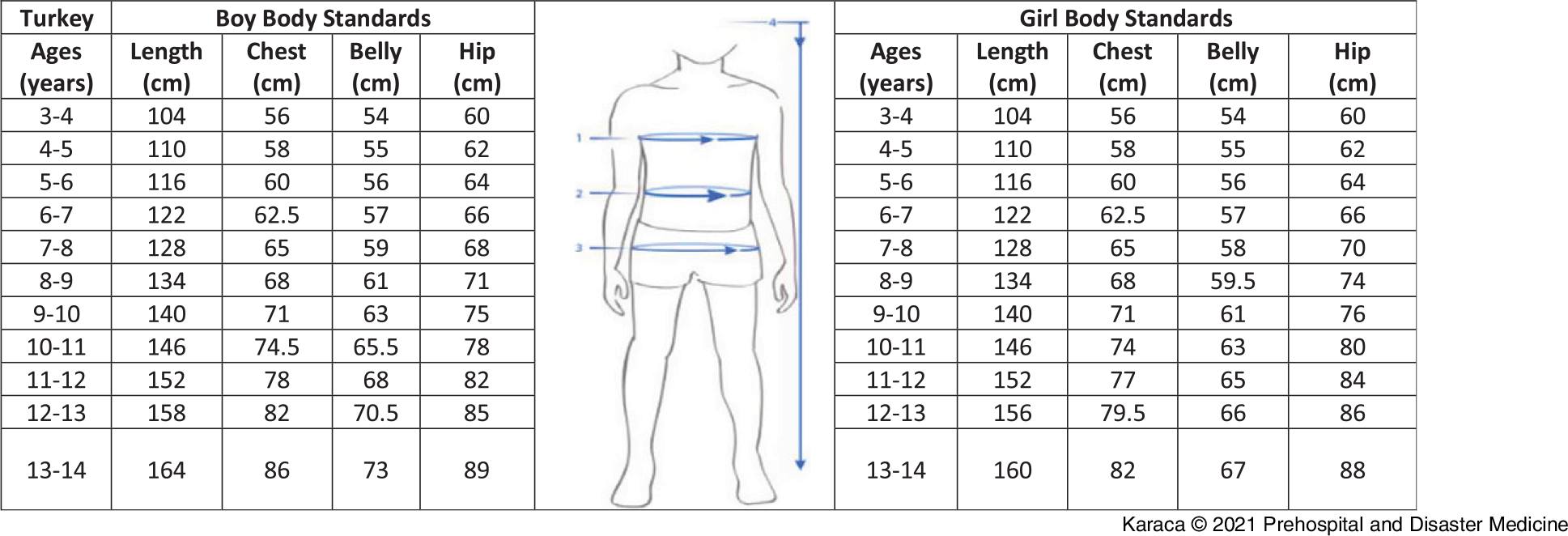
Label information in clothes has been developed for each country and race following anthropometric measurements and is used as a standard in the clothing industry. For example, the size of the boy-girl clothes in Turkey are shown Figure 1.3
Standard Body Sizes of a Confection which is One of the Best-Selling Children Brands in Turkey.

The aim of this study was to investigate the compatibility between the age on clothing label (ACL) and the actual age (AA) of the children, and the usability of the ACL in the age-based weight determination formula recommended in PALS guidelines.
Materials and Methods
Study Design
It is very hard to determine the pediatric patient’s weight with a universal-standard formula in emergency departments due to national, regional, ethnic, socioeconomic factors, and presence of processes that require stabilization and resuscitation. Therefore, this study was designed and planned as prospective, observer, and cross-sectional. Approval was obtained from the Republic of Turkey, Health Sciences University, Antalya Training and Research Hospital Clinical Research Ethics Committee (Antalya, Turkey; approval number: 41-12) and registered on clinicaltrials.com. The study was performed at Antalya Training and Research Hospital Pediatric Emergency Department, with approximately 60,000 pediatric patients annually. Written consent was obtained from the families of all patients who participated in the study.
Selection of Cases
All of the cases included in the study were in the triage categories three, four, or five, requiring no acute resuscitative treatment, ranging from one to twelve years of age. The date of birth, gender, measured weight, and height were recorded by emergency specialists and assistants. A Mewa GmbH/Schwerin III (Schwerin, Germany) M20313 weighing device was used for standing children, while a Weewell (Istanbul, Turkey) WWD700 weighing device was used for those who could not stand. These devices are medical scales that comply with quality standards. Before the study, the calibration of both devices was completed. While taking measurements, the patients’ shoes were removed and they were provided with bare or minimal clothing. Each case was calculated by a blinded emergency physicians or nurses, according to the size and age of the label on the clothing. The cases were divided into two groups: one-to-five-year-old group and six-to-twelve-year-old group.
Primary Data Analysis
One-to-Five-Year-Old Age Group—The weight measurement was determined as weight = (2 x age) +8 according to the formula in the PALS guideline. Also, age-based and label-based measurements in clothing were performed.
Six-to-Twelve-Year-Old Age Group—The weight measurement was determined as weight = (3 x age) +7 according to the formula in the PALS guideline. Also, age-based and label-based measurements in clothing were performed.
All Ages—Age and clothing label-based measurements were performed at all ages. Body Mass Index (BMI) was also calculated and compared to normal percentiles. In the case of multiple ages in the labels, the average age was accepted; for example, if “Age 4-6” was written on a label, the average of the numbers was taken into consideration. Only shirt labels were used in the study. Cases with information such as small, medium, and large instead of age were excluded from the study.
Statistical Analysis
All data were processed by SPSS 22.0 for Windows (IBM; Armonk, New York USA) and MedCalc software version 16.8.4 (MedCalc Software; Ostend, Belgium). Numerical variables were presented as median, 95% confidence interval (CI), and inter quantile range (IQR) 25-75, while categorical variables were presented as numbers and percentages. Kolmogorov-Smirnov test was used to determine whether or not they were normally distributed. Spearman’s rank correlation analysis (R) was used for correlation analysis. Passing-Bablok regression analysis that is one of the Bland-Altman graphics and model-II regression was used to evaluate and visualize the harmony among the methods. Also (+)10% and (-)10% percentage limits of estimation errors were used. The diagram included “the percentage of difference between weight values calculated by the formula and gold standard measurement values” on the y-axis and “age information” on the x-axis. The reference lines for (+)10% and (-)10% error limits were noted. Thus, the efficacy of the used formula, within 10% limits of error for all ages, could clearly be shown (the calculated weight of the patients by this method being within 10% of their true weight in weight estimation methods is a generally accepted limit for medications). The Chi Square test was used to compare outlier numbers outside the (+)10% and (-)10% limits. A P value of less than .05 was considered to show a statistically significant result.
Ethical Approval
All procedures performed in studies involving human participants were in accordance with the ethical standards of the institutional and/or national research committee and with the 1964 Helsinki Declaration and its later amendments or comparable ethical standards. This article does not contain any studies with animals performed by any of the authors.
Results
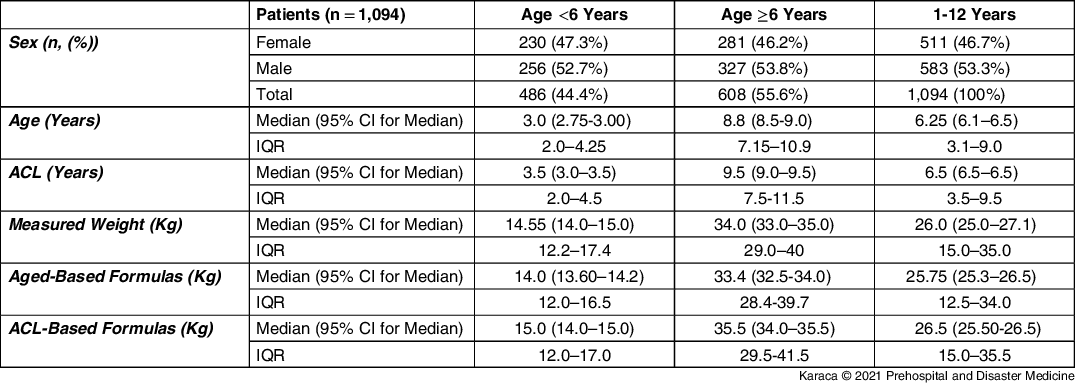
In the specified time interval, 1,998 children with a triage category of three, four, or five applied with non-traumatic complaints. One-thousand three-hundred eighty of them were between the ages of one and twelve. Age information was not available in the labels of 255 (18.4%) articles of clothes. Cases with labels indicating length were excluded. Of these cases, 17 were excluded from the study because their weight was not measured at the time of admission. A total of 1,094 patients whose AA was known were included to the study. The mean age of them was 6.25 (IQR: 3.1-9.0) years. Five-hundred eighty-three (53.3%) of them were male and 511 (46.7%) were female. Those aged one to five were 486 (44.4%) and those aged six to twelve were 608 (53.6%; Table 1).
Demographic Data, Measured and Estimated Medians for Age and Weight

Abbreviation: ACL, age on clothing label.
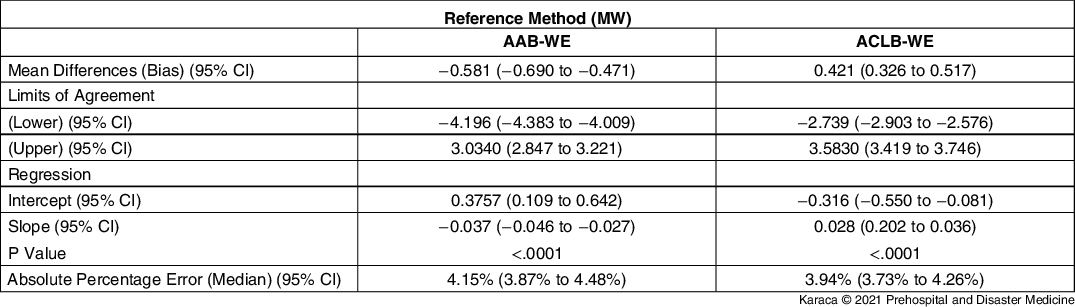
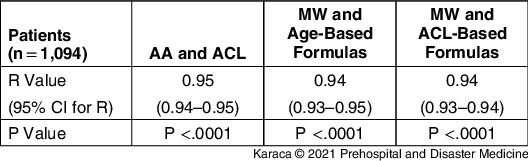
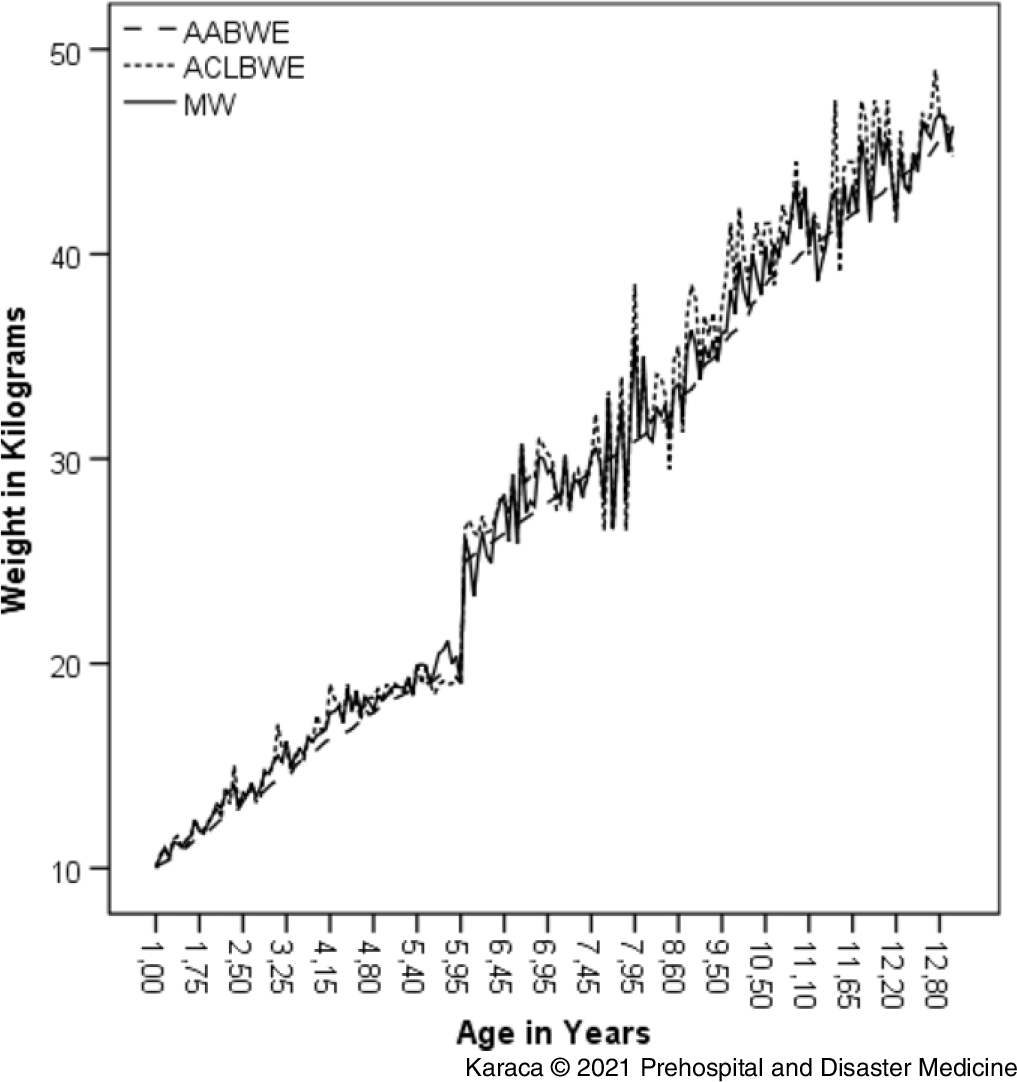
Average weights were measured 25.75kg according to age-based measurements, 26.5kg according to label-based measurements, and 26.0kg on the scales, and showed no significant difference (P <.0001). In the Passing-Bablok regression analysis, a significant correlation was detected between AA and ACL (R = 0.95; 95% CI, 0.94-0.95; P <.0001). Also, there was significant correlation between measured main weight (MW) and actual-age-based weight estimation (AAB-WE), and between MW and mean age-on-clothing-label-based weight estimation (ACLB-WE; Table 2 and 3). These correlations are shown graphically in Figure 2.
Results of Passing-Bablok Regression for the Comparison between the MW/AAB-WE and MW/ACLB-WE Methods

Note: The 95% confidence intervals are shown in parenthesis.
Abbreviations: ACL, age on clothing label; MW, main weight; AAB-WE, actual-age-based weight estimation; ACLB-WE, age-on-clothing-label-based weight estimation.
Correlations of AA/ACL and MW/AABWE/ACLBWE

Abbreviations: AA, actual age; ACL, age on clothing label; MW, main weight; AAB-WE, actual-age-based weight estimation; ACLB-WE, age-on-clothing-label-based weight estimation.
Correlations of Main Weight (MW), Actual-Age-Based Weight Estimation (AAB-WE), and Age-on-Clothing-Label-Based Weight Estimation (ACLB-WE).

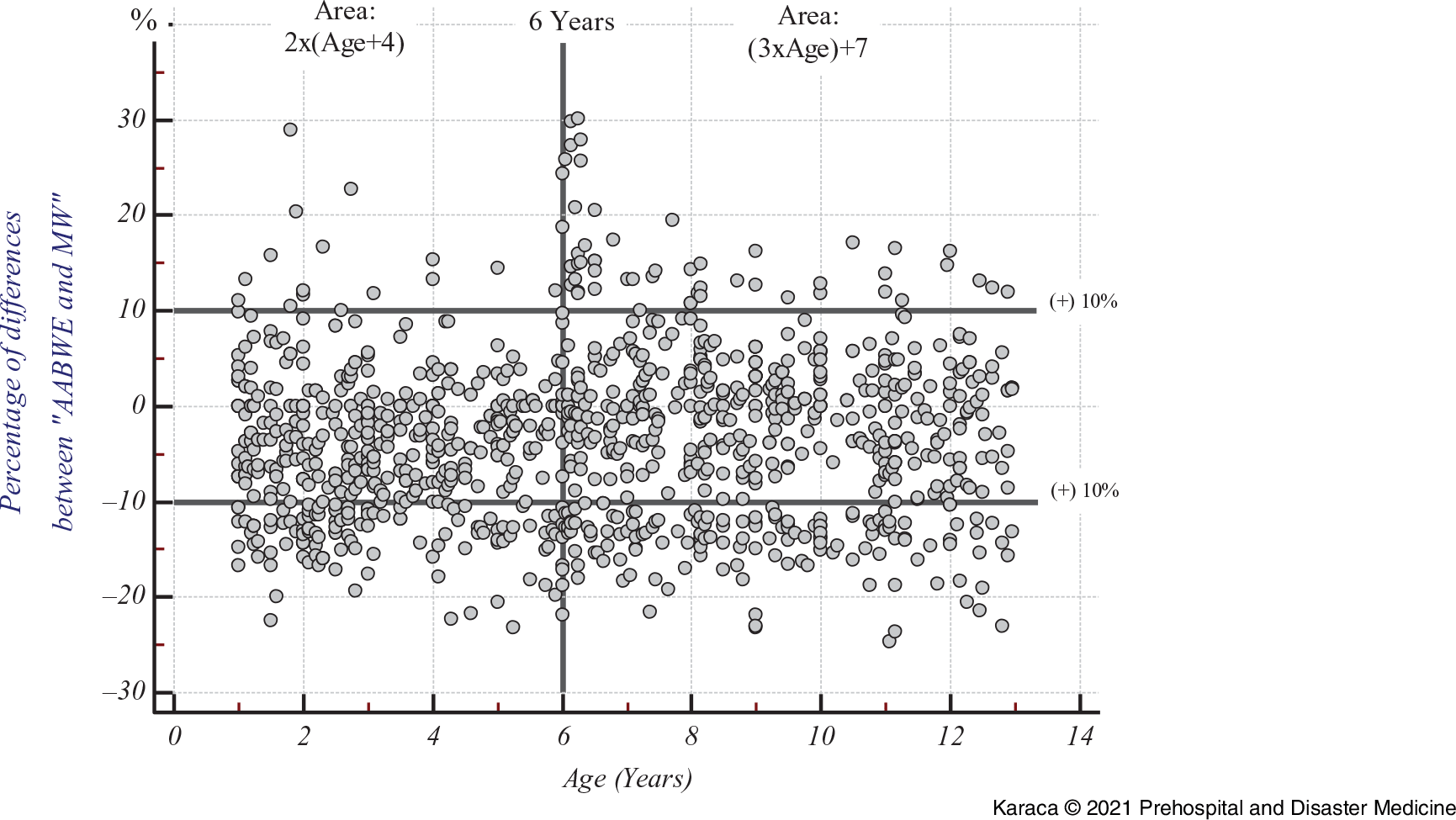
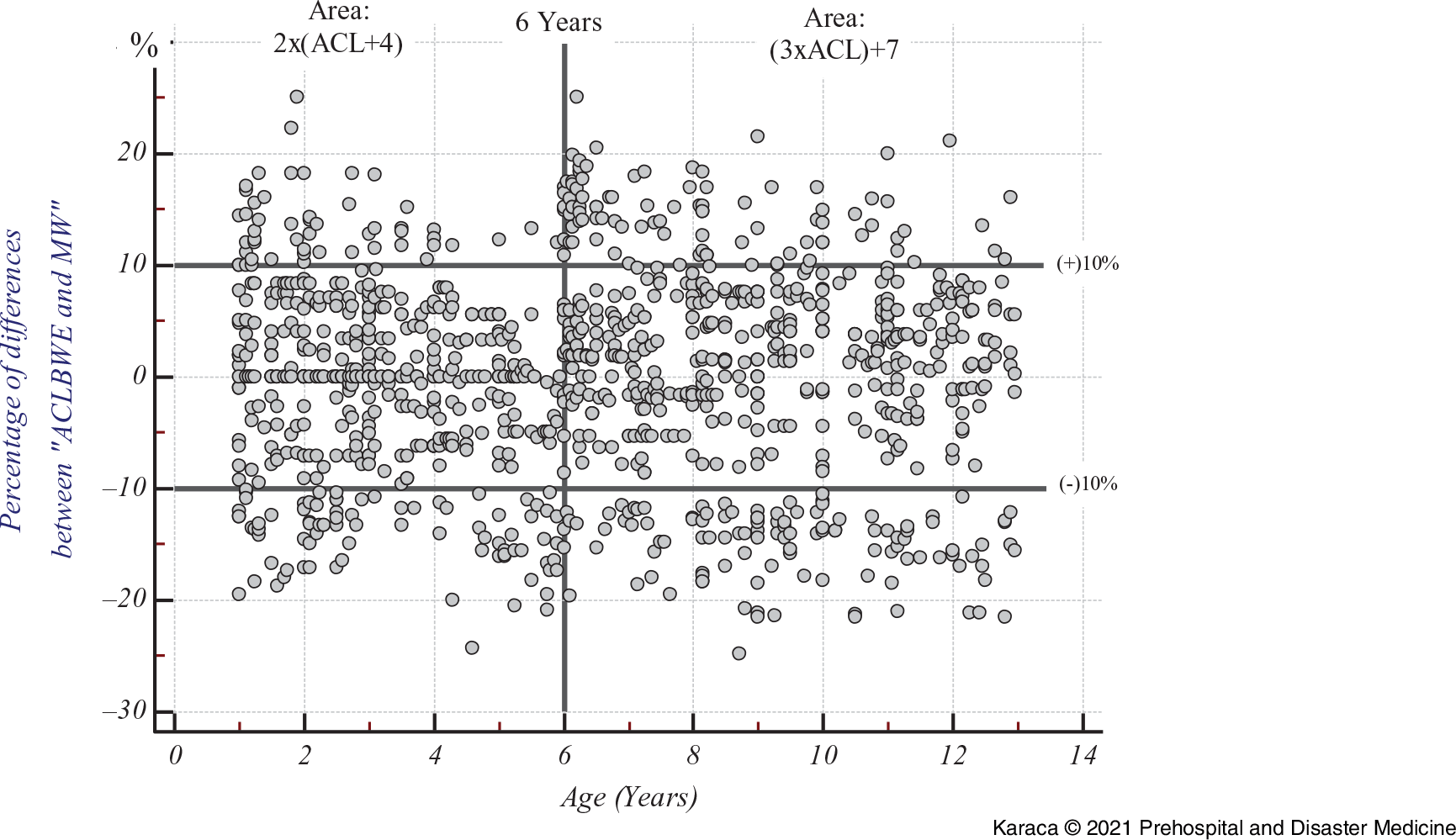
Measurements remaining within the (±)10% margin of error limits according to normal weights were found to be 67.7% and 70.8% for the AAB-WE and ACLB-WE, respectively. Two-hundred sixty (23.7%) patients in the under-estimated region and 93 (8.5%) patients in the over-estimated region were detected in the AAB-WE group. Mean differences (Figure 3) for 188 (17.2%) patients in the under-estimated region and 131 (12.0%) patients in the over-estimated region were detected in the ACBL-WE group (Figure 4). No significant differences were found for these outlier numbers of patients beyond the (±)10% margin of error limits (P = .126).
Bland-Altman Plots for Actual-Age-Based Weight Estimation (AAB-WE) Method.
Note: The plot measures the agreement between the AAB-WE and measured weight (MW) by graphing the difference between the AAB-WE and MW by the mean of the two weights (*y=100 x (AABWE - MW)/MW); dark lines indicate (±) 20% error limits.

Bland-Altman Plots for Mean Age-on-Clothing-Label-Based Weight Estimation (ACLB-WE) Method.
Note: The plot measures the agreement between the ACLB-WE and measured weight (MW) by graphing the difference between the ACLB-WE and MW by the mean of the two weights (*y=100 x (ACLBWE - MW)/MW); dark lines indicate (±) 20% error limits.

The BMI was detected among 25-75 percentiles in the majority of children (72.0%) in accordance with the national percentile diagram.
Discussion
According to the PALS guideline, almost all drugs and equipment used during resuscitation are selected and used in a weight-dependent attitude. Reference Elgie and Williams4 For this reason, it is preferable to estimate the child’s weight as accurately as possible in order to avoid making mistakes and causing harm in emergencies. Reference Stevens, Hernandez and Jones5 The urgency of the stabilization and the stress of the environment affects health care professionals weight estimation. Normally, detailed and equipment-dependent weight estimation methods do not give optimal results due to insufficient time in emergency situations. Reference Young and Korotzer6
In cases of resuscitation and emergency stabilization, easy, fast, and reliable methods are needed to estimate the child’s weight. Weighing methods used in prehospital settings and emergency departments are generally designed for the measurement of stable, standing, or low body weight babies; these devices are not capable of measuring in-patients and are not available for routine use. The ideal way to determine the child’s weight is to measure the weight of the patients who need resuscitation or stabilization in the supine position, without wasting time. The development and dissemination of weighing-stretcher equipment used in obese patients can also be a method that will eliminate the difficulties in determining weight. It will be beneficial to focus on future weight estimation methods on emergency patient care.
The main methods of weight estimation that are frequently used and recommended in children, especially in emergency departments, are as follows.
-
1. Methods for estimating weight by family members or health care professionals responsible for the child are not objective and the results are controversial. Reference Kelly and Preedy7 Lim, et al showed in their study that health care professionals are generally competent in predicting weight, but they often make false predictions in emergencies such as epilepsy or cardiopulmonary resuscitation. Reference Lim, Kaufman and O’Connor8
-
2. One of the most commonly preferable methods in practice and recommended in international resuscitation guidelines is the weight calculation based on age. It was first proposed in the PALS guide published in 2011 and is widely used all over the world today. Reference O’Meara and Watton2 It is simple and easy to calculate and remember, and there is no need for additional equipment. It is necessary to know the real age of the child. The fact that it can be used easily in the prehospital setting provides the preparation of appropriate equipment and a better preparation and intervention by giving information to the emergency department before the transfer of the team that manages the case. Reference Stewart9 Despite that there are many publications stating that age-based calculations are insufficient today, the use of this method is still recommended in textbooks and manuals. Due to different ethnic groups, sociocultural status, and different nutritional levels, inadequate measurements may occur. It can also provide estimates in children up to 12 years old and cannot be used in obese children. Reference Wells, Goldstein and Bentley1
-
3. Length-based weight measurement methods, of which the most known and widely used is the Broselow Band. It is based on the measurement of the child’s height from head to toe. It is expensive. In a meta-analysis conducted in 2017, length-based measurements and predictions have been shown to harm the patient. Reference Francesca Carasco, Fletcher and Maconochie10
-
4. Other common length-based methods are Pediatric Advanced Weight Prediction in the Emergency Room (PAWPER) and the Mercy method. Both methods are systems that make two-dimensional measurements and their margin of error is low. It takes a long time in emergencies and its awareness and use by physicians is very low. It requires additional cost and extra equipment. Reference Wells and Goldstein11
The formula to be used in weight estimation generally varies according to the physician’s preference, experience, and availability of appropriate equipment. The aim of this study was to investigate the usability of the age label on the clothes of the child in the emergency department, instead of the AA in the age-based weight estimation formula recommended by the PALS guide.
In the literature, there is only one study on weight estimation based on the clothing label. In 2012, in Elgie and William’s study on 188 children, the weight measurements obtained by taking the age range on the clothing label were compared with the AA measurements and small bias and narrow limits of agreement were determined. In this study, it was clearly stated that using the ACL rather than the AA is very reliable and gives better results. Elgie, et al even recommended label-based weight estimation when the child’s age is known or unknown. They showed that this method is usable and practical, especially in emergency situations. Reference Elgie and Williams4 In this study, the age and AA match of the child on the clothing label was (±)10% standard deviation and 95% CI and similar to the results of Elgie, et al.
In cases where the child is larger or weaker (obese or extremely weak) compared to their age, estimating the weight using the number on the clothing label can give more accurate results. There are methods recommended in the literature in such incompatible patients, but they are not easy to practice in emergency situations. Elgie, et al suggested that the correlation between clothing size and body provides a more accurate weight estimation. Reference Elgie and Williams4 According to the observations of this study, the clothing label will give more accurate results in age-weight mismatch. As an example, in Luscombe’s study on children aged one through ten, the heaviest overweight child weighed 52kg. According to Luscombe’s formula, the calculated weight would be 37kg at the child’s upper age limit, even though the child was 10 years old ((3 × 10) +7). Reference Luscombe, Owens and Burke12 According to the PALS formula, the same child will be calculated as 28kg ((2 × 10) +8). The heaviest weight measurement recorded in this study was 55kg. Although the age limit was 12, the maximum label age was recorded as 14.5 years. The Luscombe formula used on the basis of the clothing label provided a calculation up to 50.5kg ((3 × 14.5) +7). Especially properly dressed obese and overweight children, calculations based on the clothing label can provide more accurate results than the measurements made on the AA. However, in this study, no additional evaluation was made for this group of patients. In all studies related to weight estimation methods in the pediatric age group, it is accepted as the gold standard that the weight estimation is within the limits of (±)10% as the degree of accuracy. The results of this study were evaluated within these limits and were found consistent with the literature. Reference Wells, Goldstein and Bentley1
Limitations
Socioeconomic status was not taken into account in selecting the outfit, while fashion-dependent factors, which can influence the choice of clothing in school-aged patients, was also not considered. To minimize problems resulting from these issues, separate demographic data and the predictions of health workers that may have led to bias were not noted, while all patients within the time specified were included in the study consecutively. Finally, the study participants were selected from populations in Turkey. As such, further studies are needed to establish the validity of the findings.
Conclusion
In the emergency department and prehospital setting, when the minutes are being counted, the age and weight measurements estimated based on the clothing label during the resuscitation and stabilization management of the critical child patient can be safely used, similar to the formulas recommended in PALS guidelines.
Conflicts of interest/funding support
No funding was received. All authors declare that they have no conflict of interest.
Author Contributions
KA, GF, KM, ÇUC, and JA performed the study design, data collection, and analysis; GR and AKC performed the study design and data collection; KA, GF, and GR performed the statistically analysis and article’s drafting; and all authors approved the study.