“Un investigador, y un intelectual, debe estar muy abierto a cuestionar todo el orden mental vigente en una determinada época”Footnote 1
José Pedro BarránIntroduction
In a 2013 panel on the development of Political Science (PS) in Uruguay, a member of the audience asked an uneasy question: How do politics and political events affect PS’ research agendas?Footnote 2 Most studies about our discipline’s history ignore this issue, the colleague complained. In other words, they do not focus on the political context and on power relations, which is paradoxical given that our discipline has the word ‘political’ in its name. This article accepts the challenge and explores the history of PS in Uruguay, attending to how PS’ ‘inside’ and ‘outside’ interact, as well as showing how broader ideological and political shifts have manifested within the discipline’s narratives and institutions.
After the right-wing dictatorship that ruled Uruguay between 1973 and 1985, socialism, and especially the vision of a social revolution, disappeared not only from the political horizon but, to some extent, from public discourse. With some exceptions, both left and right embraced liberalism and liberal democracy as an – unquestionable – normative framework (Rico Reference Rico2005). This ideological shift was not uniquely Uruguayan of course: Quite the contrary, it was part of a regional change that has been extensively explored by historians and other social scientists (Lesgart Reference Lesgart2003; Markarian Reference Markarian2005; Puryear Reference Puryear1994). Some scholars go further in this description and argue that the 1990s were the neoliberal peak in the region (Brieger Reference Brieger and Gambina2002; Rojas Villagra Reference Rojas Villagra2015) – a period when ‘communism’ became a spectre, but in a radically different way from the one imagined by Karl Marx. No doubt, the international background – i.e. the fall of the Berlin Wall and the consolidation of US influence in the region – pushed in this direction.
This political transformation was embodied by the social sciences as well: whereas in the Uruguayan social sciences of the 1960s and early 1970s, Marxism and radical politics had a remarkable presence (Filgueira Reference Filgueira1974; Prates Reference Prates1987), such influence was certainly debilitated after the democratic transition. PS’ institutional consolidation during the 80s and 90s, and the discourse framing and sustaining the process, in my view reveal how this ideological transformation played out. In sharp contrast with the social sciences pre-coup d’état, some of the leading texts of – post-transition – Uruguayan PS have been quite celebratory of the traditional political partiesFootnote 3 and the political establishment (see for example Buquet, Chasquetti, & Moraes Reference Buquet, Chasquetti and Moraes1998; Lanzaro Reference Lanzaro2000; Caetano, Pérez Antón & Rilla Reference Caetano, Antón and Rilla1987; Pérez Antón Reference Pérez Antón, Gerardo, Mieres, Antón and Rilla1992). Furthermore, leading political scientists have explicitly seen themselves as “militants” of liberal democracy. As Cecilia Lesgart argued for the case of Argentina and Chile, the very notion of transition functioned more as a political project than as a carefully crafted scientific category (Lesgart Reference Lesgart2003, 242). How has the travelling from ‘revolution’ to ‘democracy’ been experienced within Uruguayan academia and particularly by PS practitioners? How have the shifts described above manifested, and how can these shifts be accounted for? I explore these questions in the pages that follow.
This article looks at the discipline from a critical theory perspective, one whose scholarly tradition situates knowledge – even academic knowledge – as an object of political inquiry (Foucault Reference Foucault1992, Reference Foucault1991a, Reference Foucault1991b; Said Reference Said1979; Cox Reference Cox1987; Gramsci Reference Gramsci, Hoare and Geoffrey2008; Marcuse Reference Marcuse1991; Butler Reference Butler1990; Alexander Reference Alexander2005; Escobar Reference Escobar2004).Footnote 4 In recent epistemological debates “reflexivity” is sometimes employed as an umbrella category to name the diverse perspectives – from the Frankfurt School to post-colonial theory – that, in one way or another, problematize the dimension of power within knowledge production (Jackson Reference Jackson2011; Amoureux & Steele Reference Amoureux and Steele2016). My critical and reflexivist analysis focuses on PS’s salient narratives, during and after the transition (late 80s and 90s), about Uruguayan democracy. Three key processes of this period will be examined: The embrace of liberalism, the rejection of Marxism, and the uncritical engagement with the national political establishment. These components of PS’ mainstream narrative will be accounted for through a systematic analysis of the 163 articles published by Revista Uruguaya de Ciencia Política (RUCP) from its foundation (1987) to 2012,Footnote 5 22 in-depth interviews with scholars from the Instituto de Ciencia Política (ICP) of Universidad de la República (UdelaR) – the leading political science department in the country – as well as the examination of historical records.Footnote 6
The article is organized as follows. The first section briefly delineates the theoretical perspective adopted by this study. The second explores the situation of the social sciences during the right-wing dictatorship (1973–1985) as well as the implications of how such experience has been narrated by PS practitioners. The third section focuses specifically on the private research centers (PRCs) during same period, offering an original interpretation about them that departs from the dominant one. Subsequently, the article explores PS’ rejection of Marxism – and radical politics – as well as the affirmation of disciplinary identity vis-à-vis sociology. The fifth section unpacks the discipline’s dominant view on Uruguayan democracy and the national political establishment. Lastly, the so-called Expiry Law (Ley de Caducidad) is examined in order to show a conceptual and political paradox that was produced by the interweaving of PS and its political context: That an academic community embracing liberalism did not question the quality of Uruguayan democracy, even after the latter approved a law that virtually destroyed one of the sacred tenants of political liberalism – the separation of powers. The concluding remarks gather the different analytical moments of this study into an integrated perspective on Uruguayan PS and its political history.
Science, context, and power: the take of critical theory
As pointed out in the introduction to this dossier, sociologists of knowledge have extensively debated the role of internal and external factors in the development of the social sciences. Political scientists have also discussed the trajectory, the history, and the state of their discipline.Footnote 7 However, social scientists – particularly PS practitioners – tend to think about their disciplines as the objective analysis of society. Hence, it seems productive to introduce critical theory into the conversation around the development of PS, especially in studying the Uruguayan case, where the question of power relations has been virtually absent in the literature and in the debate (see Altman Reference Altman2005; Bentancur 2003; Bentancur and Mancebo Reference Bentancur and María2013, Buquet Reference Buquet2012; Chasquetti Reference Chasquetti2013; Garcé Reference Garcé2005; Garcé and Rocha Reference Garcé and Cecilia2015, Pérez Antón Reference Pérez Antón, Gerardo, Mieres, Antón and Rilla1992, Rocha Reference Rocha Carpiuc2012, Reference Rocha Carpiuc and Freindenberg2017).Footnote 8
The Marxist and post-structuralist traditions of critical theory include significant and well documented disagreements about how social reality operates. At the epistemological level, however, they share a fundamental insight: The scientist is not separated from the world she or he studies; in other words, knowledge is part of the social relations under study and, therefore, it is not – and it should not pretend to be – politically neutral. Gramsci’s notion of hegemony, for instance, enriched Marx’s insights about the role of knowledge in capitalism’s reproduction while Michel Foucault’s analyses on power and knowledge dynamics extended Nietzsche’s critique of religion and science. Marcuse’s One Dimensional Man openly critiqued American mainstream PS which, in his view, was a good example of technological rationality and conformist thinking. Later, postcolonial studies, queer theory, and recent versions of post-structuralist approaches also politicized language and knowledge, arguing that the ways in which objects of study – be it sex/gender, mental health, the global south, democracy or any other relevant ‘thing’ in the world – are approached, are actually part of the problem to be addressed. The list goes on. Ravecca (Reference Ravecca2019) offers an exploration of different ways critical perspectives unpack the political role of knowledge and its intertwinement with the social context.
The central point here is that the academic discipline of PS has its own social life while at the same time it is part of broader social life. PS is a socially embedded space of human action and interaction. Therefore, the theories and the ideologies of scholars and intellectuals are both socio-historical and biographical entities. Furthermore, memories and subjectivities also have a role in scholarship and its changes, especially in the case of the social sciences where we study dynamics that we are so heavily involved in. Scholarship is made by subjects of social reality: Scholarship, as a human activity, is inescapably affected by its object (also human activity). In sum, the social sciences do not have exteriority vis-à-vis – micro and macro – power relations. It is under this conceptual framework that this article tackles PS’ narratives about democracy, Marxism, liberalism, and the political establishment, as well as their embeddedness in broader political processes.
Dictatorship and PS’ lateness
Professionalized social sciences were late comers to Uruguay. The Social Sciences Institute was formally created in 1956 at the Law School of UdelaR (Filgueira Reference Filgueira1974; Filgueira Reference Filgueira1986; Solari Reference Solari1959).Footnote 9 The first sociologist trained in the country graduated in 1973 (Filgueira Reference Filgueira1974) but the social sciences did not have their own institutional home until the founding of the School of Social Sciences in 1989.Footnote 10 Furthermore, PS is among the last of the social sciences to be institutionalized and for years it was taught only in specific courses (called cátedras) at the School of Law and the School of Economics.Footnote 11 The process of creation of the ICP took place between 1985 and 1989 when it was finally established at the School of Social Sciences.Footnote 12 The first political scientist defended his BA thesis as late as 1994. Thus, PS as an institutional reality arrived late in Uruguay even compared with other countries of the region (Filgueira Reference Filgueira1974; Garcé Reference Garcé2005; Pérez Antón Reference Pérez Antón1986; Pérez Antón Reference Pérez Antón, Gerardo, Mieres, Antón and Rilla1992).
In the 1960s, Uruguayan democracy was in severe trouble. Among the factors at play were the crisis of the Import Substitution Industrialization model (ISI), the significant deterioration of life conditions for wide segments of the population, and the social and political tensions that led to violence (Caetano and Rilla Reference Caetano and José1987; Bohoslavsky Reference Bohoslavsky2012, Marchesi Reference Marchesi2017). It is analytically relevant to note that, similarly to what happened in Argentina and Chile (Garretón Reference Garretón2005; O’Donnell Reference O’Donnell1984), the public university participated in the environment of ideological polarization. According to both the academic literature on the period and my interviewees, the 1960s and early 1970s saw the radicalization towards the left of many professors and students.Footnote 13 The conservative government of Pacheco Areco (1967-1972) took an authoritarian path by repeatedly decreeing the ‘state of emergency,’ which seriously eroded civil liberties.Footnote 14 The increased militarization of the repression of the urban guerrilla (particularly the MLN-Tuparamos) put the Military and its authorities at the center of the political stage. This ‘descending spiral’ ended with the collapse of Uruguayan democracy in 1973. The country would live under a brutal right-wing dictatorship until 1985. These local political circumstances were of course situated in a broader continental and temporal context shaped by the Cold War dynamics: Failed and successful revolutions as well as the defense of capitalism and bloody attempts of imposing neoliberalism had a profound impact on the region and on Uruguayan society (Caetano & Rilla, Reference Caetano, Antón and Rilla1987; Cosse & Markarian Reference Cosse and Vania[1975] 1996; Markarian Reference Markarian2005; Menéndez-Carrión Reference Menéndez-Carrión2015; Yaffé Reference Yaffé2010). In this regard, academia was not an exception.
During the 1960s, the presence of Marxism was salient in Latin American universities and in student unions (Filgueira Reference Filgueira1974; Markarian Reference Markarian2005; Marchesi & Markarian Reference Marchesi and Vania2012; Lesgart Reference Lesgart2003; Plotkin Reference Plotkin2015). In Uruguay, the public university was perceived as a leftist bastion. After the coup, the right-wing contempt against the institution materialized: Vania Markarian (Reference Markarian2015) notes that during the dictatorship an estimated 45 percent of the faculty was fired for political reasons. The social sciences were strongly affected. The dictatorship removed the recently created introductory sociology courses in the Law School of the public university. Sociology was wiped out from the advanced years of the BAs as well. The Institute of Social Sciences was closed and many of its members were fired. In the same physical venue, a new Institute of Social Studies was created whose academic activity was scarce and did not produce any relevant research during its existence (Filgueira Reference Filgueira1986). From the point of view of the professionalization of sociology, the creation of this institution was, according to Carlos Filgueira – one of the main early sociologists in the country – a reversion of the development path (a sort of de-institutionalization).
The consensus among interviewees and authors is overwhelming: the dictatorship was devastating for the social sciences (interviews U4, U5, U13, U15, U18, U21). Filgueira (Reference Filgueira1974, 31–32) explains that the regime’s intervention within the university (la intervención de la Universidad, as the experience was named) began a period of “destruction” of these disciplines. The public departments that had some social science activity also saw the disintegration of its technical teams (Filgueira Reference Filgueira1974). Given that most of social science research and teaching was concentrated at UdelaR and other public organizations, this resulted in a dreadful situation. The terms employed by authors to describe the period are consistently negative. De Sierra (Reference De Sierra2005) mobilizes the same notion of destruction and adds “dismantling,” while Pérez Antón (Reference Pérez Antón, Gerardo, Mieres, Antón and Rilla1992, 49) argues that anything perceived as critical or disruptive was “amputated.” For Garcé (Reference Garcé2005) and Altman (Reference Altman2005) the social sciences were “interrupted.” Prates (Reference Prates1987) refers to a “freezing” process of the University in general.
Academic activity during the dictatorship was under permanent threat. In contrast with, for instance, the Chilean dictatorship that sponsored its own academic discourse (Ravecca Reference Ravecca2015), the Uruguayan military operated mainly through negation and censorship. Their brutality remained in the memory of Uruguayans to the extent that it is rare to find scholars who would say anything positive about the period, illustrating their relationship with the regime.
At this early stage of the analysis, I want to make a point about the dictatorship, subjectivity, and the political and intellectual transformations in Uruguay. The images with which interviewees – political scientists of different generations who directly experienced the dictatorship in one way or another – describe their relationship with the authoritarian regime are powerful, revealing, and homogenously negative. The dictatorship was a “monster” unto which one dreams of extirpating an eye or an arm (U3). It was also a long road with a dense fog that paralyzes (U5), or it was simply a terrifying, oppressive regime that controlled people’s movements, conversations, and thoughts (U15): “We were all terrified. We only had spaces in the interstices because control over society was brutal … You walked on 18 de Julio Avenue and it was full of cops. They passed by all the time. I was socialized with cops beside me. I still carry my ID everywhere. It is a mark that I carry” (my emphasis). For U4 it is an entire period of life Uruguayans were dispossessed of: “The dictatorship took away so many things from us. It took so many things away from me. I was 15 in 1973. Imagine everything they took from me from when I was 15 to 24 years old!”
The remarkable emotional character of the interviewees’ negative narratives about the dictatorship has its counterpart in their categorical embracing of democracy. This period seems to have produced deep changes in how academia related to politics, socialism, and democracy. The dictatorship unintentionally, and by contrast, ‘taught’ scholars about the importance of the rule of law (interviews U1, U6, U7, U10, U12, U13, U14, U17, U18, U3, U22). “The dictatorship made me categorically embrace democracy” (U18). Scholars were not “loyal” to democracy before: “Democracy was just a form; democracy was of others. Democracy was not yours” (U12). Given that this democratic learning process (González Reference González1993) included persecution and exile, it was deeply traumatic. The emotionally charged narratives of distress, suffering, loss, struggle, and damage embody the historical interweaving between subjectivity and political transformations (Campbell Reference Campbell2003; Fleming Reference Fleming2005; Freud Reference Freud1986; Horowitz Reference Horowitz1977; Marcuse Reference Marcuse1974). In a way, the trauma is the ideological transformation: if scholars cared about socialism and dismissed democracy, and if their quest for utopian equality contributed to the political polarization responsible for the coup, then they were guilty of their own collective pain and, even worse, of the horrific consequences of the dictatorship for the country as a whole.Footnote 15 I will come back to the relationship between ideological changes and biographical experience later.
Private research centers during the dictatorship: an academic ‘modernization’ with political effects
As a reaction to the dictatorship’s radical institutional dismantling of the social sciences (De Sierra Reference De Sierra2005, 499) and the firing of many academics from the public sector, several private research centers (PRC) were created, including four that would extend their activity throughout the region thanks to their participation in CLACSO (Prates Reference Prates1987).Footnote 16 An epic tone dominates the narration of this experience (De Sierra Reference De Sierra2005; Filgueira Reference Filgueira1974; Filgueira Reference Filgueira1986; Prates Reference Prates1987). The PRCs are perceived as sites where steps towards social sciences’ institutionalization were taken in addition to having constituted a peaceful form of resistance against authoritarianism. For Prates (Reference Prates1987), for instance, they kept critical consciousness alive. Without necessarily contesting such a perspective, in this section, I look for a more nuanced account of the PRC experience, showing that the dictatorship created the conditions for a new model of science with ideological implications.
In Prates’ view, the PRCs took the Uruguayan social sciences to a more advanced stage, achieving goals that the pre-coup UdelaR did not because of its heavy bureaucratic structure and its over-politicized dynamics. In terms of academic internationalization, these centers made great progress: in this period, social sciences abandoned their provincialism and isolationism (Filgueira Reference Filgueira1974, 24), confronting an enormous challenge in terms of management, administration, and fundraising.Footnote 17 This literally means that the new material conditions transformed the way of being an academic in the country, a process that included ideology. What Prates called “learning effort” can be read – without challenging in any way the empirical aspect of her or Filgueira’s analyses – as a shift in the terrain of power (Menéndez-Carrión Reference Menéndez-Carrión2015) and in the governmentality of academia (Foucault Reference Foucault2006). Granted, the need to search for funding is a powerful intellectual disciplining force.
Prates (Reference Prates1987, 52) makes another point interesting to unpack: taking the risk of making “dubious transpositions” – her words – she argues that the notion of the informal sector comes to the mind of the observer. What is witnessed, indeed, is the constitution of a highly competitive market structured by several organizations with small-scale operations and scarce resources that achieve high productivity through a labor-intensive strategy. In other words, the researchers became entrepreneurs, funding seekers and/or precarious workers, experiencing firsthand what happens when the state withdraws from an economic activity – neoliberalism (Harvey Reference Harvey2005; Brown Reference Brown2015; Amadae Reference Amadae2016) applied to academia. For Prates, this form of organizing academic activity allowed the social sciences to consolidate.Footnote 18
In Filgueira’s words:
There are differences in the organizational forms that these private centres adopted. However, in my opinion, the most important point is that they achieved efficient decision-making structures thanks to their way of funding, the relatively reduced membership, their efficient way of relating to Latin American institutions and the rest of the world and, fundamentally, because of their flexibility and rapid adaptive capacity to the demands to which they were subjected. This contrasts with the heavy and complex bureaucratic mechanisms of the precedent institutions [i.e. the public university]. To this we should add an intense competition in which the centres had to engage in order to survive in a context where research by contract or defined by grants/projects with their pre-established schedules and terms, proved to be more adequate for the new discipline that was taking shape. (Filgueira Reference Filgueira1986, 183, translation and emphasis mine.)
The mutation is impressive: From a well-documented rejection of external funds to a situation in which 50 percent of the PRCs’ financial support was provided by international institutions (Prates Reference Prates1987, 50). This encompassed a shift within the governmentality (Foucault Reference Foucault2006) of academia. To put it simply, the material and institutional changes that I am describing had deep implications for social research. On the one hand, these centers were always under suspicion and therefore self-censorship was common (interviews U4, U15). This ‘training’ in self-disciplining can be, for interpretative purposes, projected into the future. But also, and to put it metaphorically: if Carlos Filgueira “saved two generations of scholars” (interview U15) and the social sciences in general, it is because he was allowed to do so by the far right-wing dictatorship. And if that is the case, it is because the kind of social science that he practiced was not perceived as a threat. This interpretive point goes beyond the discussion about the ideologies of the international funders, their political intentions, or potential ethnocentrism (Plotkin Reference Plotkin2015; Petra 2008/Reference Petra2009), and relates to what is in my view a fundamental change: the transition from the revolutionary to the professional and objective academic, which is intermingled with what would become an increasingly acritical adoption of liberalism. Let me elaborate about this.
Markarian (Reference Markarian2015) attempts going beyond the widespread analytical emphasis on the repressive aspects of the dictatorship by exploring its public policies on education, in particular those directed toward the public university. Markarian argues that the dictatorship seemed to have aimed for a more “technical” or “practical” form of knowledge within the university. Paradoxically, this was somehow achieved by the PRCs. The forging of ‘non-ideological’ social sciences is thus a shift in the direction of both the professionalization and the disciplining of intellectuals – paradoxically, while ‘resisting.’ An overall empiricist and anti-critical theory version of the social sciences became dominant in Uruguay in this period.Footnote 19 This was part of a process “of detoxification from Marxism” (interview U5) that would be completed during the transition, when specially political scientists would finally escape “the Marxist Church” (interview U7). In sum, in the practice of the PRCs there was not much room for Marxism, which “had regulated the political and academic discussion” before (U12). From a critical theory perspective, the type of social science that survived in Uruguay can be conceptually situated as in itself a victory for the US-led project of dismantling revolutionary politics and thinking.
In his analysis of the social sciences in Uruguay, De Sierra argues that during the dictatorship “the issues analyzed did change, as did the discursive contexts, predominant ideologies and explicit political referents, but the conceptual core of the situation remained basically as it had been before the coup” (De Sierra Reference De Sierra2005, 493). The second half of this observation is quite mysterious: If the issues, discourses, ideologies, and political referents changed, it is hard to accept that the conceptual core of “the situation” remained unchanged. Furthermore, De Sierra acknowledges that a radical epistemology of “asepsis” became dominant. This epistemological change is also a political one, given that it severs academic practice from ideological commitments, a key feature of the public (leftist) intellectual. The institutional project of basing social sciences’ development on the PRCs’ structure and political economy disappeared after the restoration of UdelaR.Footnote 20 However, the ideological and intellectual shifts that they allowed were consolidated.
A caveat is needed at this point in the analysis. The interpretation I propose captures an important (and up today ignored) aspect or dimension of the PRCs, but I do not pretend to totalize my interpretation or take the insight on neoliberalization too far. Menéndez-Carrión (Reference Menéndez-Carrión2015) for instance conceptualizes the experience of (at least some of) the PRCs in an entirely different fashion. She highlights the role played by some NGOs, as well as private homes and individual researchers, within the politics of insilio (a state of being ‘in exile,’ while remaining in the country) in keeping the possibility of talking-and-thinking and of being political (that is, of “being of the polis” through being there, at those sheltered spaces) throughout the dictatorship. Both logics (insilio and neo-liberalization) might have been at play during the period, probably with differentiated and specific intensities in the different PRCs. Furthermore, the important and politically committed ouvre of José Pedro Barrán and Benjamín Nahum was partially written during the dictatorship (Moraes Reference Moraes2013). And this is just one example of several. My argument captures something relevant that happened during the dictatorship – i.e., the emergence and consolidation of an academic model that purges ideology from research, in a context where leftist intellectuals were persecuted by government officials. This intellectual change is relevant not because it is the only thing that happened in Uruguayan academia during those years but because PS – my object of analysis here – will deepen this path.
In the previous section I argued that persecution, torture, and exile ‘taught’ scholars about the importance of the so-called rule of law and political freedoms. Meanwhile, those who could work at PRCs were trained in ‘objective science.’ If we analytically gather these two points together the conclusion is clear: some steps in the direction of the hegemony of liberalism and objectivity within academia – or towards the academic representation of liberalism as the objective idiom – were taken in this period. The kind of social science that at least some of the PRCs performed – data-driven and indifferent towards ideological discussions – went well with the technical language of liberalism and the – naturalized – celebration of the ‘great discovery’ of the transition – liberal democracy.
Epistemological erasures of the 1990s: the abandonment of Marxism (and the separation from sociology)
The ideological mutations explored above and processed in the PRCs were followed and radicalized by PS practitioners after the transition. The quite explicit mantra of the discipline has been: Objectivity for science, liberalism for politics, and a mix of them for PS. In this section, I look at the relationship of a significant sample of political scientists of different generations, who mostly belong to the leading political science department in Uruguay, with Marxism and Marxist politics. I will also look at the aggregated data of RUCP to solidify the insights extracted from the interviews.
I am interested in the analytical power of details and gestures, and their implications for social research (Dauphinee Reference Dauphinee2013; Geertz Reference Geertz1997; Butalia Reference Butalia2000; Ravecca & Dauphinee Reference Ravecca and Elizabeth2018). Aggregated data and nomothetic attempts, as useful as they are, risk erasing not only the meaning of experience but also the experience of meaning. Let me mobilize this theoretical statement through a concrete example. In the previous section, we learned from Filgueira (Reference Filgueira1974) that Uruguayan academia of the 1960s and early 1970s was – in his view – both “parochial” and “ideologically narrow,” to the point of rejecting any collaboration with international institutions. Filgueira experienced this narrowness firsthand: He was accused of being an agent of imperialism because of his ties with the Ford Foundation (interviews U7, U13). His was not the only case according to U10. Some of the future ICP founders participated in a sort of popular trial against him that involved a public statement of condemnation. Upon his return to the country, after the dictatorship, one of the first things U13 did as ICP director was to institutionally apologize to Filgueira:
U13- There were also acts of mea culpa. One of the first things I did when I returned to Uruguay was to apologize to Carlitos Filgueira. He ranked first in a contest at the Institute of Sociology in 1970. We [the student body] publicly shamed him because he had ties with the Ford Foundation. Of course, during and after the dictatorship everybody worked for the Ford, Rockefeller and other foundations that kept the little candle’s flame alive. This episode [of repentance] took place in a context of vindication of democracy, pluralism, and political parties… the traditional political parties and the party system.
PR- So it was a sort of critique of the critique of the system.
U13- Exactly, Exactly!
This act of “mea culpa” – and the path from insult to apology – is a meaningful fragment of historical experience. It shows how two academic biographies, part and parcel of the political reality of the country, intersect in two different points that delineate a collective trajectory. This strong sense of guilt around Filgueira’s harmful treatment is much more than that: Indeed, the narration of this micro-experience embodies what became the prevailing discourse around the wrongs of the left in that period. The issue of the politics of PRC’s funding is of course part of this story (Plotkin Reference Plotkin2015; Petra 2008/Reference Petra2009); but here I propose to focus our attention at what Lesgart (Reference Lesgart2003) also observed for the cases of Argentina and Chile: The ways in which the dominant language of transition (and transitioning) situated the pre-coup desires for social revolution as one of the manifestations of an authoritarian outlook that needed to be overcome by the new democracy. Furthermore, during the transition and after, the leftist ‘illiberal’ and ‘anti-democratic’ views and practices were perceived – by the political establishment, part of the left and significant sectors of academia – as partially responsible for the political polarization that crashed the Uruguayan democracy in 1973. This negative judgment included social sciences and social scientists, massively identified with the – radicalized – left and its dogmatism (interviews U1, U6, U7, U10, U12, U13, U14, U17, U18, U3, U22).
PS deliberately and drastically undoes the path of radicalization from the very beginning. The discipline is institutionalized after the transition and born as a pro-systemic creature that embraces stability, order, and the rule of law. It is only natural that Marxism was perceived as narrow minded, dated, and in certain circumstances (fortunately absent since democracy came back) even dangerous, being expelled outside the realm of acceptability. Taking distance from Marxism and radical politics was also a way of legitimizing PS vis-à-vis the mainstream political parties, which in a party-centric society (interview U13; Caetano, Pérez Antón & Rilla Reference Caetano, Antón and Rilla1987) have a powerful capacity of regulating the public conversation. I come back to the notion of party-centric society later. The international conditions – fall of the Berlin Wall, collapse of the Soviet Union, consolidation of the American hegemony in different areas including academia – pushed in the same direction.
It has been argued that the ICP was a plural space from its inception (Garcé Reference Garcé2005). Garcé offers an exultant description of the intellectual forging of the institution: “A very important achievement [of U13’s administration] was to assemble (haber amalgamado) different political, ideological, and theoretical tendencies which stimulated the formation of a pluralist environment highly beneficial for academic debate and learning” (Garcé Reference Garcé2005, 237; translation mine).Footnote 21 This pluralism has been a tangible reality at different levels. For instance, the protagonists of the ICP foundational process came from different disciplinary backgrounds (History, Law, and Political Sociology in particular) and had diverse geographical and professional trajectories (interviews U12, U13, U18). Furthermore, no particular theory or set of theories were imposed and multiple testimonies and analyses coincide in the notion of the absence of intellectual policing of any sort (Garcé Reference Garcé2005; Rocha Reference Rocha Carpiuc and Freindenberg2017; Bentancur and Mancebo Reference Bentancur and María2013). And yet, Uruguayan PS has actively ignored Marxism, neomarxism, and critical theory of any kind at least until I completed the data collection in 2012 (Ravecca Reference Ravecca2014). During my BA years I was disturbed by the disdain for Marxism that many of my professors transmitted in the classrooms. I was also intrigued by the conceptual ease displayed in conferences and other scholarly settings where it was often declared as a matter of fact, without any sense of complexity, that the development of PS was possible because socio-centric theories, such as Marxism, had been abandoned. What was most striking for me was not the existence of such discourse but the fact that nobody seemed to be bothered by it, with the exception of a few students.
It seems that a rudimentary conception of the autonomy of politics has narrowed the pluralism celebrated by Garcé (Reference Garcé2005). In this logic, the explanation for political processes should be looked for in the “political system” in Sartori (Reference Sartori1984)’s sense. This has operated as a principle of regulation of PS’ pluralism. Everyone was welcome as long as he or she adjusted to this disciplinary norm (Rocha Reference Buquet2012). This permitted also the separation from sociology, which was somehow equated, or at least interconnected, with Marxism and radical politics. In the words of U13: “In the School of Law I had a lot of advantage because PS was built against sociology. We were the nice, neat and good, and they were the fat, dirty and leftist.” This is a curious paradox given that, before the dictatorship, U13 accused Carlos Filgueira, a sociologist, of being an agent of imperialism.
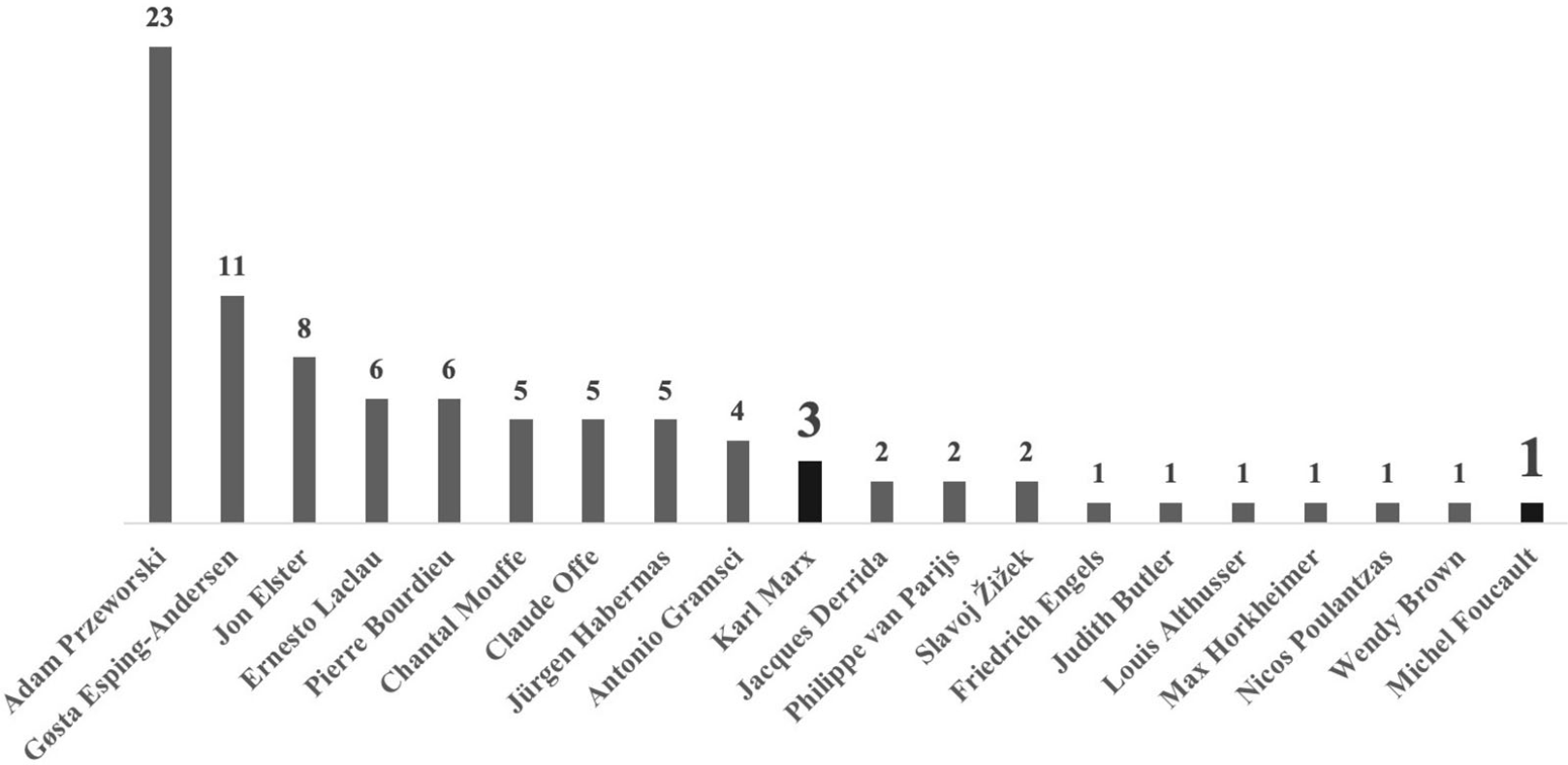
In Uruguayan PS research, Marx has been ignored, even from the point of view of the history of ideas. The consensus around such indifference is overwhelming (interviews U1, U2, U3, U4, U5, U6, U7, U9, U10, U11, U12, U13, U14, U15, U16, U17, U18, U19, U20, U21, U22).Footnote 22 In contrast with the cases of Tocqueville and Locke, for instance, up-to 2012 there was no RUCP article addressing Marxist theory as its main theme and few refer to it (Graph 1). Furthermore, contemporary critical thought has not been included either. As we can see in Graph 2, Marx has been quoted three times in the whole history of the journal; Michel Foucault only once. In terms of theory, RUCP seems to be more welcoming for the tradition of analytical philosophy. Globally, this chart shows the marginality of critical Political Theory in Uruguayan PS.
View of Marxism in RUCP, 1987-2012.

“Critical” Authors Cited in RUCP, 1987-2012.

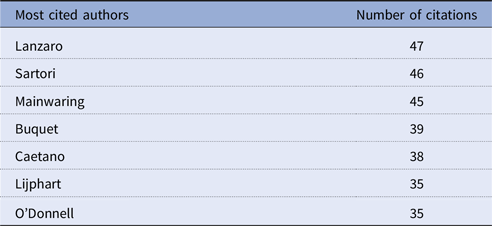
Graph 2 also provides elements to grasp RUCP’s dominant conception of the political: Political parties and more lately public policy (Buquet Reference Buquet2012; Garcé and Rocha Reference Garcé and Cecilia2015) seem to have been considered the unique protagonists of politics. This is consistent with Table 1, which presents the most cited authors: Most of them have research agendas related to government and political parties and held a mainstream conception of politics. Such a narrow perspective has precluded the incorporation of articles on other aspects of the political (grassroots movements in particular). Graph 3 confirms these findings: 75 percent of the articles published by RUCP 1987-2012 hold a narrow conception of politics.Footnote 23
Conception of the Political in “Spatial” Terms in RUCP, 1987-2012.

“Popular” authors in RUCP, 1987-2012

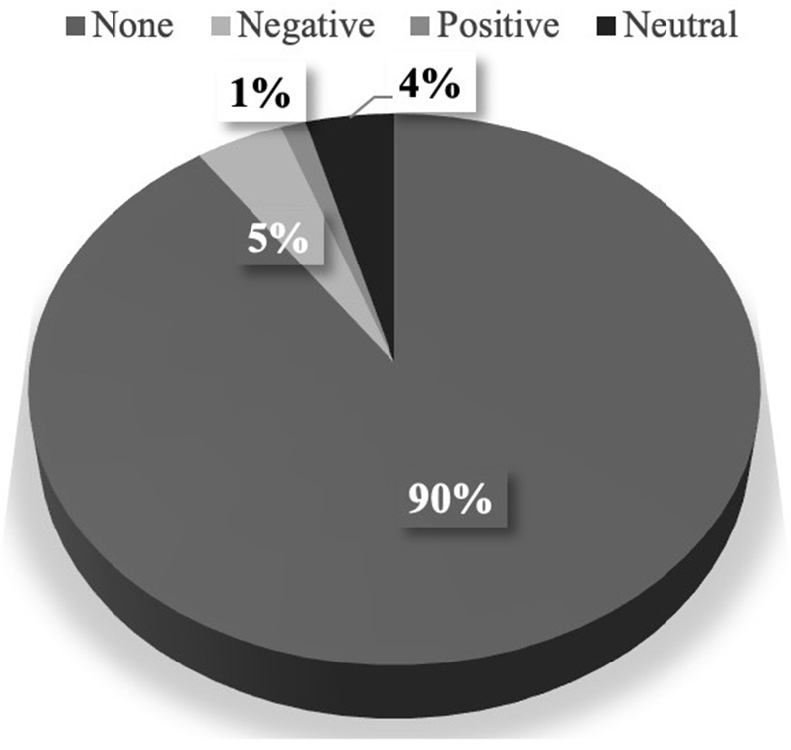
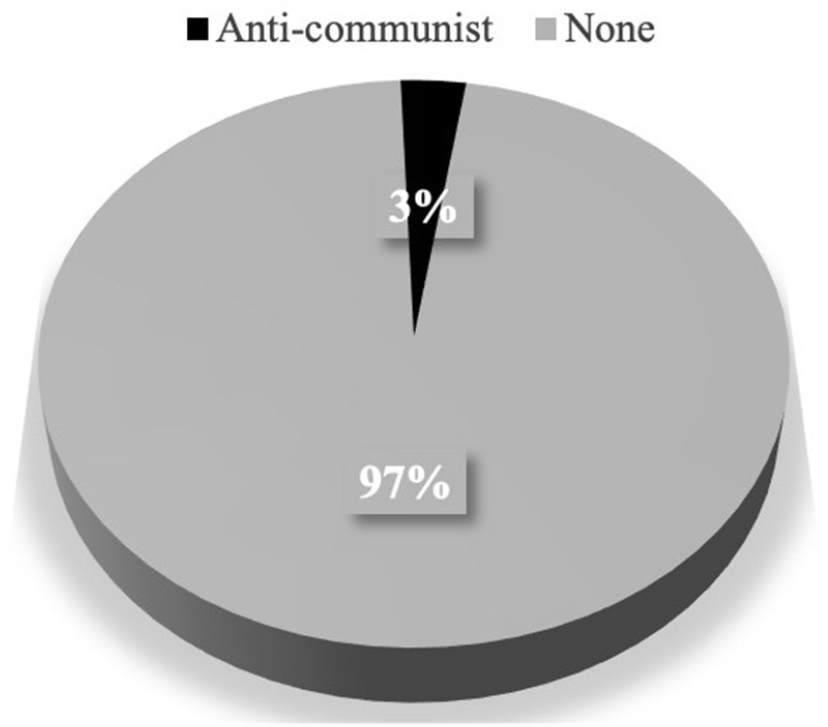
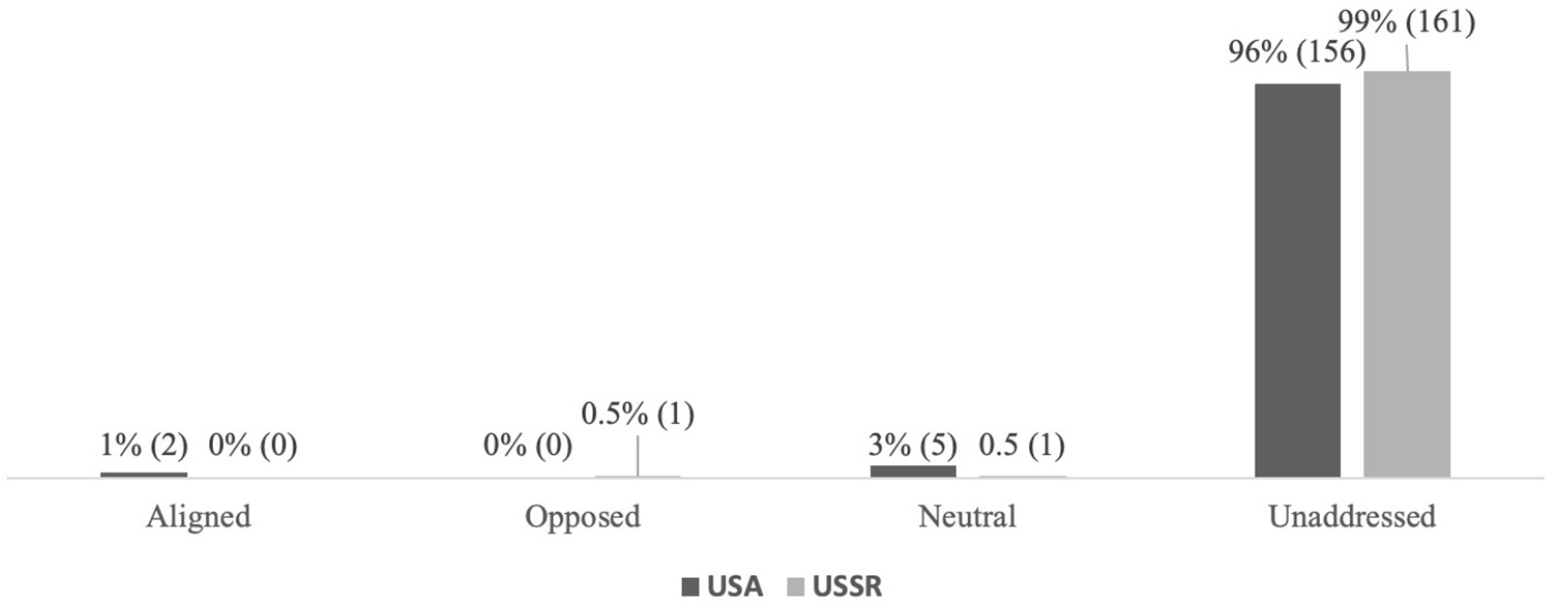
Given the overwhelming consensus around the strong connection between the social sciences and the left in the 1960s and early 1970s (interviews U1, U15), the almost absolute absence of Marxism (including neo and post-Marxism) in RUCP is striking. Communism as a historical reality has not been addressed either, even though RUCP’s first issues were contemporary with the agonizing years of the Soviet Union (Graphs 4 and 5). Such indifference needs to be situated within an academia that at the time looked inwards and a liberal discourse that despises communism without embracing anti-communist narratives.
View of Communism in RUCP, 1987-2012.

Position Toward the USA and the USSR in RUCP, 1987-2012.

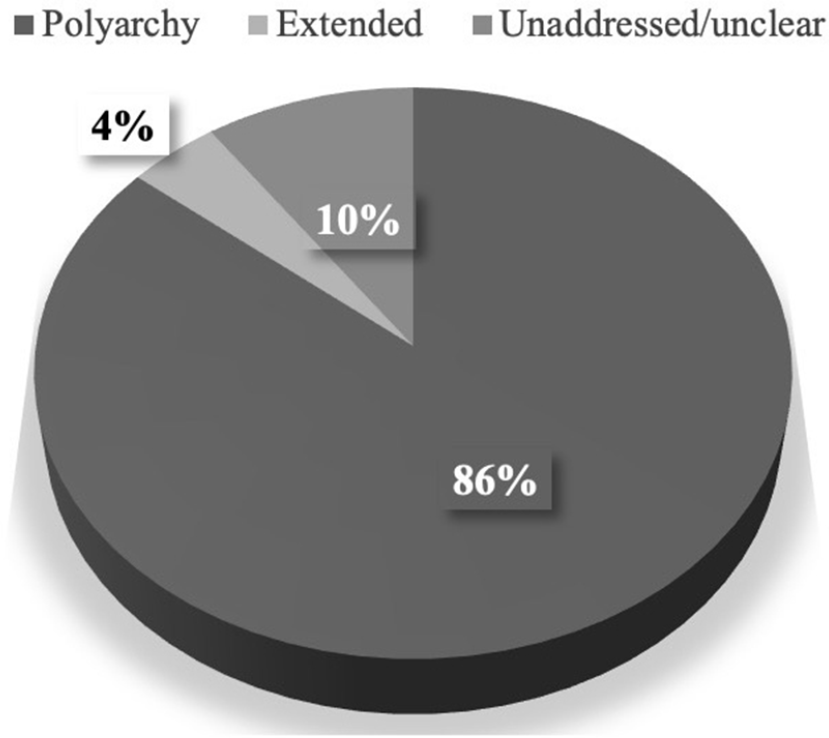
Uruguayan PS is a creature of the transition to democracy forged by scholars who I broadly situate from left to moderate right and who unanimously opposed the dictatorship (interviews U1, U2, U3, U4, U5, U6, U7, U8 U9, U10, U11, U12, U13, U14, U15, U16, U17, U18, U19, U20, U21, U22). In contrast with the Chilean experience which I analyzed somewhere else (Ravecca Reference Ravecca2015) where authoritarian perspectives articulated through the notion of “Protected democracy” (a limited democracy guarded by the military) have been part of the fabric of PS,Footnote 24 in Uruguay the discipline was fully polyarchych from the beginning of its institutionalization. As shown in Graph 6, RUCP does not host articles promoting a limited democracy of any kind. The Cold War framed PS in both Chile and Uruguay, but in different ways. In Chile, PS was cultivated (not denied) by the dictatorship, so the enemies of the regime had to be addressed. Uruguayan PS, in contrast, was born within and for liberal democracy in a context of the collapse of socialism in reality and thought. There was no need to talk about communism, a topic that reminded some leading political scientists about their ‘anti-democratic’ beliefs of not a long time ago. Furthermore, “Marxism, from the perspective of polyarchy is idiotic” (interview U17).
Type of Democracy Promoted in RUCP, 1987-201.

The anecdote that opens this section makes clear that this ‘hard data’ translates personal experiences. The case study shows the entrenchment between subjectivity, epistemology, and politics, even global politics (Ravecca & Dauphinee Reference Ravecca and Elizabeth2018). Indeed, these ideological transformations that we are exploring have an experiential and biographical dimension. In other words, the transition from ‘Marxism to liberalism’Footnote 25 has been interwoven with the fabric of scholars’ lives. I will now again turn to discourse (Foucault 1991; Said Reference Said1979) and language (Laclau and Mouffe Reference Laclau and Chantal2004)Footnote 26 in the register of the subjective, personal, and ‘testimonial’ (Butalia Reference Butalia2000).
The emotional intensity of the adjectives and images about and around Marxism speak of something else other than just an intellectual shift. They seem to reveal the tremendous impact of historical experience on scholars’ views: “Swindler,” “untrustworthy,” “shameful,” “ridiculous,” “dogmatic,” “Church,” “mocked,” “expiated guilt,” “crude,” “repented,” “obsolete,” “precarious,” “anti-science,” “toxic,” “erased,” “despicable,” “stupid,” “idiotic,” “a path that I interrupted forever,” “I threw it in the garbage,” “shit,” “crisis,” “mea culpa,” etc.
In analyzing this rupture with Marxism, it is difficult to measure the weight differential between the impact of the collapse of the Soviet Union and the effect of the dictatorship, particularly the feeling of guilt fed by the perception of having participated in the radicalization that trumped Uruguayan democracy in 1973. In any case, the process of rejection had very concrete effects on the lived experience of scholarship. Indeed, colleagues with a neo-Marxist background had to negotiate with a difficult reality. “Some of us were forced to unlearn much of what we knew,” declared U1 who, as a new scholar in the context of the post-transition, had to change the research topic because his theoretical views were unacceptable within Political Parties and Government, the mainstream research area of the discipline during the 90s (Buquet Reference Buquet2012; Rocha Reference Rocha Carpiuc2012). U17, the only scholar singled out in many interviews as a neo-Marxist experienced a feeling of inadequacy both in research and in teaching, particularly at the MA level (the most advanced PS degree provided by the institution at the time). He described his situation as being “extremely depressed” and as being detrimental to his academic productivity. He also characterized some of the colleagues as “aggressive liberals” and recalled some “violent” exchanges with students (scholars identified as Uruguayan “big names” today) in which they asked him not to teach those “dated” theories anymore. “I threw all of that in the garbage,” he concludes.
In the interviews, this theoretical change is not described or narrated as a gradual and meditated one but as a violent rupture, as a reaction against the beliefs “of the past” which were since then completely dismissed. Such rejection or embarrassed escaping (U7) denotes a traumatic process of transformation that is far from being just the product of research or even personal reflection. The power dynamics of the dictatorship and the transition affected PS practitioners’ views on liberalism, Marxism, politics, and democracy.
Objectivity and romance: PS, liberal democracy, and the political establishment
Uruguayan PS has narrated its identity against (Marxist) economic reductionism and socio-centric views. The discipline’s scope was traced in ways that excluded ‘society’ and the ‘economy,’ which prevented welcoming broader conceptions of the political, interdisciplinary approaches and, of course, political economy.Footnote 27 The interest in political parties was almost the exclusive one in the PS formation period of the 90s.Footnote 28 The interest in public policy would grow in the 2000s (Bentancur & Mancebo Reference Bentancur and María2013; Buquet Reference Buquet2012, Rocha Reference Rocha Carpiuc and Freindenberg2017). In my view, this shift, however, does not expand the (narrow) dominant conception of politics (see Graph 3 above). The country has been thought of as a “party-ocracy” (Caetano, Pérez Antón & Rilla Reference Caetano, Antón and Rilla1987) and, consequently, social movements and other aspects of the political have remained relatively ignored during the whole period encompassed by my dataset.
Jorge Lanzaro is considered one of the fathers of Uruguayan PS.Footnote 29 He talks openly about this crusade to separate from sociology and Law, which he argues was necessary to build the PS community and identity. Lanzaro’s account of the period, however, shows a reflective and ironic distance from this process. He neither believes in a sharp distinction between disciplines nor in a radical notion of the political system’s autonomy.Footnote 30 This awareness seems to have been lost on later generations. On many occasions, I have noticed how the name of Jorge Lanzaro is symbolically mobilized and ‘consumed’ to reify PS identity (Ravecca Reference Ravecca2014).
The attachment to political parties and democracy has not been merely analytical. There is, indeed, a general acknowledgment from all former directors of the ICP that PS has not been critical enough vis-à-vis the Uruguayan democracy and political parties. The celebratory perception of political elites radically challenged the traditionally critical view that intellectuals held of the political system before (Lanzaro Reference Lanzaro2000). Thus,
Uruguayan PS takes distance from historiographic perspectives that were quite drastic in their censorship of the traditional political parties, which were accused of empiricism, paralyzing heterogeneity, and submission to the upper classes. Besides internal disagreements, PS authors acquitted political parties on the basis of a more refined reconstruction of the problems that they have faced as well as the concrete alternatives that they had available. (Pérez Antón Reference Pérez Antón, Gerardo, Mieres, Antón and Rilla1992, 57-58; emphasis and translation mine)
This positive view was radicalized by the following generation educated by the ICP founders.Footnote 31 These are some of the main components of PS’ narrative about Uruguayan democracy:
-
1) Our exemplary democracy was built by the traditional political parties. In more elegant words, “the centrality of the political parties as dominant political actors is a line of long durée of our history and a key feature of our politics” (Caetano, Pérez Antón & Rilla Reference Caetano, Antón and Rilla1987, 41; translation mine). This feature has been labelled partidocracia (party-ocracy).
-
2) The Uruguayan political system functioned and functions satisfactorily: “Uruguay is admired because of the balanced and democratic ways of processing reforms in politics, the State and the market” (Buquet, Chasquetti & Moraes Reference Buquet, Chasquetti and Moraes1998, 83; translation mine).
-
3) Uruguayan democracy has taken a moderate and gradual path in the introduction of pro-market reforms. Balanced and negotiated arrangements have been perceived as a core feature of Uruguayan politics (Real de Azúa Reference Real1984). To see “gradualism” as a self-evident merit is another example of the inter-penetration between PS and its context.
The tone of Uruguayan PS is well represented by the next quote from the first ICP’s Director: “The revisionism – of anti-critical critique – that this book cultivates, and which is the product of careful and to some extent provocative explorations … refers to the quality of the government and to the parties’ dynamics” (Lanzaro Reference Lanzaro2000, 13; translation mine). He analyzes this period thus:
I mean, given that we had to be so laudatory of the Uruguayan political history, of the political system, of democracy, which is linked to the autonomy of politics… we were not critical enough. On the contrary, we were the defenders of our politicians even more than they were defenders of themselves; we were more invested than them, especially in the traditional political parties. We lost a little bit of … we needed to do a lot of work in one direction and we abandoned the other direction, the direction of critique. There were a lot of things to be critical about. (Personal communication)
It is remarkable that this form of optimism, which seems to be more a political than a scientific or analytical disposition, is conceptualized as a necessity for both Uruguayan democracy (harshly criticized by intellectuals before) and PS (whose luck is perceived as attached to that one of the political system). Such ‘attachment’ to its object had implications for both research and education. This was a period of ideological shift “towards the right,” as Lanzaro openly recognizes.
Its alignment with mainstream politics shaped the political role of PS. For instance, there were challenging aspects of Uruguayan democracy that were ignored by its scholarship. Rico (Reference Rico2005) critically explores some of them. Here I will focus on the Law of Expiry of Punitive Claims of the State (Ley de Caducidad de la Pretensión Punitiva del Estado).
Ley de Caducidad: a hole in the narrative, or “a stone that covered a veil”
The Ley de Caducidad de la Pretensión Punitiva del Estado (Expiry Law, n° 15.848) was approved in 1986. The law stated that the State’s intention of legally persecuting the crimes committed by the police and military members during the dictatorship up until March 1st, 1985, had expired. Such limitation to the reach of the justice system was the result – according to the text of the norm – of the “logic of the facts” originated by the agreement between political parties and the military in August 1984. The Expiry Law gave the Executive – in the hands of President Julio María Sanguinetti (Colorado Party), one of its leading proponents – the prerogative to decide if an alleged illegal act was or was not comprehended by this norm.Footnote 32 In practical terms, the Expiry Law effectively shielded the military from the legal repercussions of the human rights violations of the dictatorship. The reason proclaimed for this amnesty – granted to (mostly) men who tortured, killed, and ‘disappeared’ political opponents – was to secure the completion of a peaceful transition towards the constitutional order.
A coalition formed by victims of the repression and their relatives, the leftist Broad Front – then the second main party of the opposition –, some dissenting figures of the traditional parties, students’ and workers’ unions, as well as other civil society organizations, gained the necessary popular support to force the government to hold a referendum against the law, which took place in 1989 under abnormal circumstances of fear and unequal campaign conditions. There were threats of authoritarian backlash if the law was revoked. For instance, Army Commander, Lieutenant General Hugo Medina warned that the judicial citations to military members were locked in his strongbox. The message was clear: The military was not going to allow its members to be incarcerated no matter the crime they could have committed. Furthermore, the unequal access to the media was notorious: Most of the press and all the TV channels were against the referendum. The government of Julio María Sanguinetti and its social and political allies won the ballot: 58% of the electorate supported the Law.
It goes without saying: The result was traumatic for the families of the victims, human rights activists and, in general, for those who promoted the voto verde (green vote) against the law. Once upheld by an absolute majority of the electorate, the Expiry Law interrupted the rule of law. By condoning the notion that powerful criminals could not be punished, Uruguay’s “admired democracy” normalized state repression. By locating the Executive over the judges and the court system, it violated a sacred principle of liberal democracy: The separation of powers. Furthermore, the law violated the international legal order.Footnote 33
There was and there is a lot to reflect upon, analyze, and critique regarding this norm.Footnote 34 If narratives are about ‘accounting for’ they are also about silences and sometimes about silencing (Butalia Reference Butalia2000; Dauphinee Reference Dauphinee2013; Dutrénit & Buriano 2017; Ravecca & Dauphinee Reference Ravecca and Elizabeth2018; Spivak Reference Spivak Chakravorty, Cary and Lawrence1988). Arias (Reference Arias2012) notes the silence surrounding the law – once Uruguayan social scientists’ research interests in the period 1987-89 are taken into account. At the beginning of their review of five decades of scholarship on the crisis, democracy and authoritarianism in Uruguay, historians Aldo Marchesi and Vania Markarian (Reference Marchesi and Vania2012) mention that they started working on these topics in the 1990s, a decade that initiated with lack of public debate and ended with a slow rebirth of the social interest for a past then still painful and controversial. In footnote 45 (page 224) they show the participation of PS in this silence through the emblematic book on the “Second Transition” (Lanzaro Reference Lanzaro2000) mentioned by U7 above (see footnote 31 of this article). This silence, which in PS has been particularly long, reproduced the narrative of Uruguay’s traditional political parties and elites about how the transition should be understood and by default has even justified the Expiry Law’s disquieting implications. Meanwhile, Rico (Reference Rico2005) as well as other leadings historians such as U22 argue that PS ignores the dictatorship altogether. What happens once we tie these two silences together?
In Arias’ view, academia jumped onto the wagon of erasing the past, and thus proceeded to “omit” the topic of the law, “promoting the option of forgetting” in the process (Arias Reference Arias2012, 32). But, in contrast with what happened in other disciplines (historical research in particular), it seems that in the case of PS the situation has not changed that much. At least not until 2012: Between 1987 and 2012 only 4 RUCP articles (out of 163) address human rights issues and none focus on the Law in question – which, needless to say, is a salient issue of Uruguay’s recent past that shapes the country’s political present. As for my interviewees, in an admirable collective gesture of raw honesty, today they bitterly agree with such assessment (interviews U4, U6, U10, U13, U18, U20, U22). In the view of some, to the extent that the discipline has been thought of as “the science of democracy” it simply ignored the dictatorship and, at least to some extent, its dark legacies:
What happened? I think that reality was like a stone that covered a veil Footnote 35 that created a social environment that strongly conditioned (public debate). After the ratification of the Law through the referendum of 1989, at the social and political level the topic was not spoken of anymore, and I believe that in academia we followed that path. This generated an absolute disregard for addressing the problem. I don’t have a more specific explanation than that. “Well, this issue was solved by our society,” so nobody felt that it was necessary to problematize it. (Interview U22; emphasis mine)
In other words, political scientists did not follow José Pedro Barrán’s vision regarding the intellectuals’ important role of questioning the mental order of their time (see the excerpt that opens this article). Given that the Expiry Law violated the liberal principles embraced by most PS practitioners, it is remarkable that the quality of Uruguayan democracy was not critically addressed either by RUCP, in the ICP books or in the public interventions by members of the PS community. This situation is a clear manifestation of the interpenetration between politics and PS and how knowledge production is affected by the political conditions in which it happens.
Concluding remarks
In the late 1960s the expansion of sociology in Uruguay happened in a context of political polarization (Filgueira Reference Filgueira1974). In contrast, during the democratic transition and after (80s and 90s), PS had a sort of ‘window of opportunity’ for identity building in the rejection of both sociology and Marxism. This double rejection is a contingent event that has been essentialized by the mainstream PS narrative. On a plainly political level, the overcoming of radicalism and ‘socio-centric’ approaches was assembled to a (self-)critical reading of the leftist critique of the mainstream political parties and liberal democracy – the critique of the critique (Lanzaro Reference Lanzaro2000; interviews U10; U13). As if ‘socio-centrism’ and Marxism needed to be literally reversed, Uruguayan PS has been blatantly liberal and party-centric. The very fact of the (narrow) definition of the political embraced by the discipline is a foundational political act with huge consequences, as we saw in the case of the Expiry Law.
“The party-ocracy” (Caetano, Pérez Antón, and Rilla Reference Caetano, Antón and Rilla1987) and The Second Transition (Lanzaro Reference Lanzaro2000) are both academic and political interventions. Their praise for mainstream political parties is linked to a mode of thinking about the transition, democracy, the dictatorship as well as the desirable future of the country. The dictatorship traumatized the left-leaning social scientists who, in their attempt to rescue the main protagonists of liberal democracy, the political parties – and rescuing themselves from their past alleged political mistakes in the process – committed hubris: the harsh critique of the political parties was substituted by an acritical view and a lack of analytical distance.
Time and timing were crucial: all of what has been described was situated in, and interlocked with, the context of the fall of the Berlin Wall and the consolidation of US influence in the region, both politically and academically. These international and historical circumstances framed the positive reevaluation of democracy linked to the transition in unilaterally liberal terms. Marxism and the radical left were perceived as something of the past and associated with an ‘underdeveloped’ version of science, while liberalism and objectivity were thought, in a sort of postmodern pastiche, as the language of the future. The assumed separation between academia and ideology meant that the international academic dominance of the US was seen as politically neutral.
At the most abstract level, the consequence of the equation between PS’s very identity and this sort of objectivist liberalism is the naturalization of capitalism as the uncontested (back-) ground for democracy. In other words, capitalism is trafficked under the cover of democracy. This implication (as any good ideological move) remains invisible but is crucial as it reveals how capitalism succeeds in naturalizing itself through (also) academic knowledge.
To sum up, the set of factors that shaped PS involved different intertwined registers: political economy (the definitive defeat of any alternative to capitalism), the international (the collapse of the Soviet Union and the US hegemony in the region), theory, ideology and epistemology (the hegemony of liberalism and neopositivism, the abandonment of Marxism and the separation from sociology), an institutional enterprise (the creation of the ICP) and, last but not least, subjectivity (trauma, guilt). This multilayered dynamic regulated what can be considered PS and what was expelled beyond the walls of the discipline’s identity. The consequences are multiple and go from micro-practices of intellectual policing of BA students (“your research about social movements is not political science”), to the lack of critical distance with its object of study, the mainstream political parties in particular.
If knowledge is historical (Buck-Morss Reference Buck-Morss2009), to understand history we need to (re)examine knowledge and its politics. Indeed, the study of knowledge production may reveal significant aspects of the society that is being known. From this perspective, epistemology is about society – and ethics (Marcuse Reference Marcuse1991).
In closing this article, let me go back to “anecdote”: On Tuesday, October 30th, 2006, President Tabaré Vázquez spoke at the central roundtable of the First Uruguayan Conference of Political Science. There, he shared the stage with two other presidents. The President of the Uruguayan Association of Political Science (AUCiP), Daniel Buquet, and the President of the International Political Science Association (IPSA), Lourdes Solá, who also gave speeches. Buquet solemnly declared that PS is not neutral when it comes to political regimes:
There is only one principle to defend to death and that is democracy… in this case Political Science is not neutral because it supports democracy and makes a contribution to keep it and improve it. (My translation and emphasis)Footnote 36
Uruguayan Democracy, in this narrative, should not be taken for granted. This political regime, more than just an object of inquiry, is thought of as a fragile system that should be defended. Given that this political regime is now at work, the political scientist should become a pro-systemic creature, a guardian of the status quo. A series of questions come to my mind: What kind of democracy is being talked about? Should I be ‘democratic’ to be a political scientist? And if so, what does that mean? What does the statement that political science “supports democracy” mean and do? To whom is it directed? What kind of violence is being deployed here? Can we find in this statement traces of the same logic of Marxism-Leninism and any other dogma? Who is being silenced through this apparently reasonable statement? If political science is ‘democratic,’ what happens to those political scientists or discourses that challenge liberal democracy as the unique acceptable political option… should they be ‘disappeared’? If something should be defended “to death,” where is the room for free thinking and critical reflection? Is the role of the scientist to die in the name of her object of study? Is that science? It seems that, here, we have reached the limits of PS’ episteme.
Acknowledgments
A previous version of this article was thoroughly debated on July 13, 2018, at one of the sessions of the faculty seminar of the Instituto de Ciencia Política (ICP) at Universidad de la República (UdelaR). I gratefully acknowledge the feedback and suggestions I then received from my colleagues. Two anonymous reviewers, Daniel Buquet, Jaime Yaffé, as well as Cecilia Rocha provided detailed comments and corrections that helped me to significantly improve the text. Errors and omissions remain the responsibility of the author.
Paulo Ravecca is Assistant Professor in the Department of Political Science at the Universidad de la República, Uruguay. His research focus includes epistemology and the history of political science; the intersections between critical theories (queer, neo-marxist, postcolonial, and poststructural approaches); political economy and international relations; and gender and sexuality. He is the author of The Politics of Political Science: Re-Writing Latin American Experiences (Routledge 2019).