


1 Introduction
1.1 Results
The Littlewood conjecture (circa 1930) is perhaps the most sought-after result in diophantine approximation. It asserts that if
 $\unicode[STIX]{x1D6FC},\unicode[STIX]{x1D6FD}\in \mathbb{R}$
then
 $$\begin{eqnarray}\liminf _{n\rightarrow \infty }n\Vert n\unicode[STIX]{x1D6FC}\Vert \cdot \Vert n\unicode[STIX]{x1D6FD}\Vert =0.\end{eqnarray}$$
However, Gallagher’s theorem [Reference GallagherGal62] implies that if
 $k\geqslant 2$
then for almost all tuples
 $(\unicode[STIX]{x1D6FC}_{1},\ldots ,\unicode[STIX]{x1D6FC}_{k})\in \mathbb{R}^{k}$
the stronger statement
 $$\begin{eqnarray}\liminf _{n\rightarrow \infty }n(\log n)^{k}\Vert n\unicode[STIX]{x1D6FC}_{1}\Vert \cdots \Vert n\unicode[STIX]{x1D6FC}_{k}\Vert =0\end{eqnarray}$$
is valid. Beresnevich, Haynes and Velani [Reference Beresnevich, Haynes and VelaniBHV, Theorem 2.1 and Remark 2.4] showed that if
 $k=2$
then for any
 $\unicode[STIX]{x1D6FC}_{1}\in \mathbb{R}$
the statement (1.1) holds for almost all
 $\unicode[STIX]{x1D6FC}_{2}\in \mathbb{R}$
. On higher-dimensional fibres, the problem has remained visibly open until now [Reference Beresnevich, Haynes and VelaniBHV, Problem 2.1]. We solve this problem.
Theorem 1.1. If
 $k\geqslant 2$
and
 $\unicode[STIX]{x1D6FC}_{1},\ldots ,\unicode[STIX]{x1D6FC}_{k-1}\in \mathbb{R}$
then for almost all
 $\unicode[STIX]{x1D6FC}_{k}\in \mathbb{R}$
we have
 $$\begin{eqnarray}\liminf _{n\rightarrow \infty }n(\log n)^{k}\Vert n\unicode[STIX]{x1D6FC}_{1}\Vert \cdots \Vert n\unicode[STIX]{x1D6FC}_{k}\Vert =0.\end{eqnarray}$$
What we show is more general. The multiplicative exponent of the vector
 $\boldsymbol{\unicode[STIX]{x1D6FC}}=(\unicode[STIX]{x1D6FC}_{1},\ldots ,\unicode[STIX]{x1D6FC}_{k-1})$
, denoted
 $\unicode[STIX]{x1D714}^{\times }(\boldsymbol{\unicode[STIX]{x1D6FC}})$
, is the supremum of the set of real numbers
 $w$
such that, for infinitely many
 $n\in \mathbb{N}$
, we have
 $$\begin{eqnarray}\Vert n\unicode[STIX]{x1D6FC}_{1}\Vert \cdots \Vert n\unicode[STIX]{x1D6FC}_{k-1}\Vert <n^{-w}.\end{eqnarray}$$
Theorem 1.2. Let
 $k\geqslant 2$
, let
 $\unicode[STIX]{x1D6FC}_{1},\ldots ,\unicode[STIX]{x1D6FC}_{k-1},\unicode[STIX]{x1D6FE}_{1},\ldots ,\unicode[STIX]{x1D6FE}_{k-1}\in \mathbb{R}$
, and assume that the multiplicative exponent of
 $\boldsymbol{\unicode[STIX]{x1D6FC}}=(\unicode[STIX]{x1D6FC}_{1},\ldots ,\unicode[STIX]{x1D6FC}_{k-1})$
satisfies
 $\unicode[STIX]{x1D714}^{\times }(\boldsymbol{\unicode[STIX]{x1D6FC}})<(k-1)/(k-2)$
. Let
 $\unicode[STIX]{x1D713}:\mathbb{N}\rightarrow \mathbb{R}_{{\geqslant}0}$
be a decreasing function such that
 $$\begin{eqnarray}\mathop{\sum }_{n=1}^{\infty }\unicode[STIX]{x1D713}(n)(\log n)^{k-1}=\infty .\end{eqnarray}$$
Then for almost all
 $\unicode[STIX]{x1D6FC}\in \mathbb{R}$
there exist infinitely many
 $n\in \mathbb{N}$
such that
 $$\begin{eqnarray}\Vert n\unicode[STIX]{x1D6FC}_{1}-\unicode[STIX]{x1D6FE}_{1}\Vert \cdots \Vert n\unicode[STIX]{x1D6FC}_{k-1}-\unicode[STIX]{x1D6FE}_{k-1}\Vert \cdot \Vert n\unicode[STIX]{x1D6FC}\Vert <\unicode[STIX]{x1D713}(n).\end{eqnarray}$$
The
 $k=2$
case was established in [Reference ChowCho18]. In that case, the condition becomes
 $\unicode[STIX]{x1D714}^{\times }(\unicode[STIX]{x1D6FC})<\infty$
, which is equivalent to
 $\unicode[STIX]{x1D6FC}$
being irrational and non-Liouville.
Theorem 1.1 will follow from Theorem 1.2, except in the case
 $\unicode[STIX]{x1D714}^{\times }(\boldsymbol{\unicode[STIX]{x1D6FC}})\geqslant (k-1)/(k-2)$
. However, in the latter case there exist arbitrarily large
 $n\in \mathbb{N}$
for which
 $$\begin{eqnarray}\Vert n\unicode[STIX]{x1D6FC}_{1}\Vert \cdots \Vert n\unicode[STIX]{x1D6FC}_{k-1}\Vert <n^{-1-1/(k-1)}.\end{eqnarray}$$
For these
 $n$
, we thus have
 $$\begin{eqnarray}n(\log n)^{k}\Vert n\unicode[STIX]{x1D6FC}_{1}\Vert \cdots \Vert n\unicode[STIX]{x1D6FC}_{k}\Vert =o(1)\end{eqnarray}$$
for all
 $\unicode[STIX]{x1D6FC}_{k}$
. This completes the deduction of Theorem 1.1 assuming Theorem 1.2.
The hypothesis
 $\unicode[STIX]{x1D714}^{\times }(\boldsymbol{\unicode[STIX]{x1D6FC}})<(k-1)/(k-2)$
is generic. Indeed, it follows directly from the work of Hussain and Simmons [Reference Hussain and SimmonsHS18, Corollary 1.4], or alternatively from the prior but weaker conclusions of [Reference Beresnevich and VelaniBV15, Remark 1.2], that the exceptional set
 $$\begin{eqnarray}\bigg\{\boldsymbol{\unicode[STIX]{x1D6FC}}\in \mathbb{R}^{k-1}:\unicode[STIX]{x1D714}^{\times }(\boldsymbol{\unicode[STIX]{x1D6FC}})\geqslant \frac{k-1}{k-2}\bigg\}\end{eqnarray}$$
has Hausdorff codimension
 $1/(2k-3)$
in
 $\mathbb{R}^{k-1}$
. This is much stronger than the assertion that the set of exceptions has Lebesgue measure zero.
Some condition on
 $(\unicode[STIX]{x1D6FC}_{1},\ldots ,\unicode[STIX]{x1D6FC}_{k-1})$
is needed for Theorem 1.2. For example, if
 $(\unicode[STIX]{x1D6FC}_{1},\ldots ,\unicode[STIX]{x1D6FC}_{k-1})\in \mathbb{Q}^{k-1}$
, then the
 $n\unicode[STIX]{x1D6FC}_{i}$
take on finitely many values modulo 1, so if the
 $\unicode[STIX]{x1D6FE}_{i}$
avoid these then
 $$\begin{eqnarray}\Vert n\unicode[STIX]{x1D6FC}_{1}-\unicode[STIX]{x1D6FE}_{1}\Vert \cdots \Vert n\unicode[STIX]{x1D6FC}_{k-1}-\unicode[STIX]{x1D6FE}_{k-1}\Vert \gg 1.\end{eqnarray}$$
Khintchine’s theorem (Theorem 1.4) then refutes the conclusion of Theorem 1.2 in this scenario, for appropriate
 $\unicode[STIX]{x1D713}$
.
Theorem 1.2 is sharp, in the sense that the divergence hypothesis (1.2) is necessary, as we now explain. Gallagher’s work [Reference GallagherGal62] shows, more precisely, the following (see [Reference Beresnevich and VelaniBV15, Remark 1.2]).
Theorem 1.3 (Gallagher).
Let
 $k\geqslant 2$
, and write
 $\unicode[STIX]{x1D707}_{k}$
for
 $k$
-dimensional Lebesgue measure. Let
 $\unicode[STIX]{x1D713}:\mathbb{N}\rightarrow \mathbb{R}_{{\geqslant}0}$
be a decreasing function, and denote by
 $W_{k}^{\times }(\unicode[STIX]{x1D713})$
the set of
 $(\unicode[STIX]{x1D6FC}_{1},\ldots ,\unicode[STIX]{x1D6FC}_{k})\in [0,1]^{k}$
such that
 $$\begin{eqnarray}\Vert n\unicode[STIX]{x1D6FC}_{1}\Vert \cdots \Vert n\unicode[STIX]{x1D6FC}_{k}\Vert <\unicode[STIX]{x1D713}(n)\end{eqnarray}$$
has infinitely many solutions
 $n\in \mathbb{N}$
. Then
 $$\begin{eqnarray}\unicode[STIX]{x1D707}_{k}(W_{k}^{\times }(\unicode[STIX]{x1D713}))=\left\{\begin{array}{@{}ll@{}}0\quad & \text{if }\displaystyle \mathop{\sum }_{n=1}^{\infty }\unicode[STIX]{x1D713}(n)(\log n)^{k-1}<\infty ,\\ 1\quad & \text{if }\displaystyle \mathop{\sum }_{n=1}^{\infty }\unicode[STIX]{x1D713}(n)(\log n)^{k-1}=\infty .\end{array}\right.\end{eqnarray}$$
In particular, the divergence part of this statement is sharp. Theorem 1.2 is stronger still, so it must also be sharp, insofar as it is necessary to assume (1.2).
Some readers may be curious about the multiplicative Hausdorff theory. Owing to the investigations of Beresnevich and Velani [Reference Beresnevich and VelaniBV15, §1] and Hussain and Simmons [Reference Hussain and SimmonsHS18], we now understand that genuine ‘fractal’ Hausdorff measures are insensitive to the multiplicative nature of such problems. With
 $k\in \mathbb{Z}_{{\geqslant}2}$
and
 $\unicode[STIX]{x1D713}:\mathbb{N}\rightarrow \mathbb{R}_{{\geqslant}0}$
, let
 $W_{k}^{\times }(\unicode[STIX]{x1D713})$
be as in Theorem 1.3, and denote by
 $W_{k}(\unicode[STIX]{x1D713})$
the set of
 $(\unicode[STIX]{x1D6FC}_{1},\ldots ,\unicode[STIX]{x1D6FC}_{k})\in [0,1]^{k}$
for which
 $$\begin{eqnarray}\max (\Vert n\unicode[STIX]{x1D6FC}_{1}\Vert ,\ldots ,\Vert n\unicode[STIX]{x1D6FC}_{k}\Vert )<\unicode[STIX]{x1D713}(n)\end{eqnarray}$$
has infinitely many solutions
 $n\in \mathbb{N}$
. In light of [Reference Hussain and SimmonsHS18, Corollary 1.4] and [Reference Beresnevich, Ramírez and VelaniBRV16, Theorem 4.12], we have the Hausdorff measure identity
 $$\begin{eqnarray}{\mathcal{H}}^{s}(W_{k}^{\times }(\unicode[STIX]{x1D713}))={\mathcal{H}}^{s-(k-1)}(W_{1}(\unicode[STIX]{x1D713}))\quad (k-1<s<k).\end{eqnarray}$$
Loosely speaking, this reveals that multiplicatively approximating
 $k$
real numbers at once is the same as approximating one of the
 $k$
numbers, save for a set of zero Hausdorff
 $s$
-measure. This is in stark contrast to the Lebesgue case
 $s=k$
, wherein there are extra logarithms in the multiplicative setting (compare Theorems 1.3 and 1.4). As discussed in [Reference Beresnevich and VelaniBV15, Reference Hussain and SimmonsHS18], if
 $s>k$
then
 ${\mathcal{H}}^{s}(W_{k}^{\times }(\unicode[STIX]{x1D713}))=0$
, irrespective of
 $\unicode[STIX]{x1D713}$
, while if
 $s\leqslant k-1$
then
 ${\mathcal{H}}^{s}(W_{k}^{\times }(\unicode[STIX]{x1D713}))=\infty$
, so long as
 $\unicode[STIX]{x1D713}$
does not vanish identically.
1.2 Techniques
The proof of Theorem 1.2 parallels [Reference ChowCho18], with a more robust approach needed for the structural theory of Bohr sets. Recalling that
 $$\begin{eqnarray}\boldsymbol{\unicode[STIX]{x1D6FC}}=(\unicode[STIX]{x1D6FC}_{1},\ldots ,\unicode[STIX]{x1D6FC}_{k-1}),\quad \boldsymbol{\unicode[STIX]{x1D6FE}}=(\unicode[STIX]{x1D6FE}_{1},\ldots ,\unicode[STIX]{x1D6FE}_{k-1})\end{eqnarray}$$
are fixed, we introduce the auxiliary approximating function
 $\unicode[STIX]{x1D6F7}=\unicode[STIX]{x1D6F7}_{\boldsymbol{\unicode[STIX]{x1D6FC}}}^{\boldsymbol{\unicode[STIX]{x1D6FE}}}$
given by
 $$\begin{eqnarray}\unicode[STIX]{x1D6F7}(n)=\frac{\unicode[STIX]{x1D713}(n)}{\Vert n\unicode[STIX]{x1D6FC}_{1}-\unicode[STIX]{x1D6FE}_{1}\Vert \cdots \Vert n\unicode[STIX]{x1D6FC}_{k-1}-\unicode[STIX]{x1D6FE}_{k-1}\Vert }.\end{eqnarray}$$
The conclusion of Theorem 1.2 is equivalent to the assertion that for almost all
 $\unicode[STIX]{x1D6FC}\in \mathbb{R}$
there exist infinitely many
 $n\in \mathbb{N}$
such that
 $$\begin{eqnarray}\Vert n\unicode[STIX]{x1D6FC}\Vert <\unicode[STIX]{x1D6F7}(n).\end{eqnarray}$$
If
 $\unicode[STIX]{x1D6F7}$
were monotonic, then Khintchine’s theorem [Reference Beresnevich, Ramírez and VelaniBRV16, Theorem 2.3] would be a natural and effective approach.
Theorem 1.4 (Khintchine’s theorem).
Let
 $\unicode[STIX]{x1D6F7}:\mathbb{N}\rightarrow \mathbb{R}_{{\geqslant}0}$
. Then the measure of the set
 $$\begin{eqnarray}\{\unicode[STIX]{x1D6FC}\in [0,1]:\Vert n\unicode[STIX]{x1D6FC}\Vert <\unicode[STIX]{x1D6F7}(n)\text{ for infinitely many }n\in \mathbb{N}\}\end{eqnarray}$$
is
 $$\begin{eqnarray}\left\{\begin{array}{@{}ll@{}}0\quad & \text{if }\displaystyle \mathop{\sum }_{n=1}^{\infty }\unicode[STIX]{x1D6F7}(n)<\infty ,\\ 1\quad & \text{if }\displaystyle \mathop{\sum }_{n=1}^{\infty }\unicode[STIX]{x1D6F7}(n)=\infty \text{and }\unicode[STIX]{x1D6F7}\text{ is monotonic}.\end{array}\right.\end{eqnarray}$$
For any
 $n\in \mathbb{N}$
the function
 $\unicode[STIX]{x1D6FC}\mapsto \Vert n\unicode[STIX]{x1D6FC}\Vert$
is periodic modulo 1, so Khintchine’s theorem implies that if
 $\unicode[STIX]{x1D6F7}$
is monotonic and
 $\sum _{n=1}^{\infty }\unicode[STIX]{x1D6F7}(n)=\infty$
then for almost all
 $\unicode[STIX]{x1D6FD}\in \mathbb{R}$
the inequality
 $\Vert n\unicode[STIX]{x1D6FD}\Vert <\unicode[STIX]{x1D6F7}(n)$
holds for infinitely many
 $n\in \mathbb{N}$
. The specific function
 $\unicode[STIX]{x1D6F7}$
defined in (1.3) is very much not monotonic, so for Theorem 1.2 our task is more demanding. We place the problem in the context of the Duffin–Schaeffer conjecture [Reference Duffin and SchaefferDS41].
Conjecture 1.5 (Duffin–Schaeffer conjecture, 1941).
Let
 $\unicode[STIX]{x1D6F7}:\mathbb{N}\rightarrow \mathbb{R}_{{\geqslant}0}$
satisfy
 $$\begin{eqnarray}\mathop{\sum }_{n=1}^{\infty }\frac{\unicode[STIX]{x1D711}(n)}{n}\unicode[STIX]{x1D6F7}(n)=\infty .\end{eqnarray}$$
Then for almost all
 $\unicode[STIX]{x1D6FD}\in \mathbb{R}$
the inequality
 $$\begin{eqnarray}|n\unicode[STIX]{x1D6FD}-r|<\unicode[STIX]{x1D6F7}(n)\end{eqnarray}$$
holds for infinitely many coprime pairs
 $(n,r)\in \mathbb{N}\times \mathbb{Z}$
.
For comparison to Khintchine’s theorem, note that if
 $\unicode[STIX]{x1D6F7}$
is monotonic then the divergence of
 $\sum _{n=1}^{\infty }(\unicode[STIX]{x1D711}(n)/n)\unicode[STIX]{x1D6F7}(n)$
is equivalent to that of
 $\sum _{n=1}^{\infty }\unicode[STIX]{x1D6F7}(n)$
.
The Duffin–Schaeffer conjecture has stimulated research in diophantine approximation for decades, and remains open. There has been some progress, including the Erdős–Vaaler theorem [Reference HarmanHar98, Theorem 2.6], as well as [Reference AistleitnerAis14, Reference Beresnevich, Harman, Haynes and VelaniBHHV13, Reference Haynes, Pollington and VelaniHPV12] and, most recently, [Reference Aistleitner, Lachmann, Munsch, Technau and ZafeiropoulosALMT18]. For our purpose, the most relevant partial result is the Duffin–Schaeffer theorem [Reference HarmanHar98, Theorem 2.5].
Theorem 1.6 (Duffin–Schaeffer theorem).
Conjecture 1.5 holds under the additional hypothesis
 $$\begin{eqnarray}\limsup _{N\rightarrow \infty }\biggl(\mathop{\sum }_{n\leqslant N}\frac{\unicode[STIX]{x1D711}(n)}{n}\unicode[STIX]{x1D6F7}(n)\biggr)\biggl(\mathop{\sum }_{n\leqslant N}\unicode[STIX]{x1D6F7}(n)\biggr)^{-1}>0.\end{eqnarray}$$
Here
 $\unicode[STIX]{x1D711}$
is the Euler totient function, given by
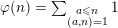 $\unicode[STIX]{x1D711}(n)=\sum _{\substack{ a\leqslant n \\ (a,n)=1}}1$
.
If
 $\unicode[STIX]{x1D6F7}$
were supported on primes, for instance, then the hypothesis (1.5) would present no difficulties [Reference HarmanHar98, p. 27], but in general this hypothesis is quite unwieldy. There have been very few genuinely different examples in which the Duffin–Schaeffer theorem has been applied but, as demonstrated in [Reference ChowCho18], approximating functions of the shape
 $\unicode[STIX]{x1D6F7}_{\boldsymbol{\unicode[STIX]{x1D6FC}}}^{\unicode[STIX]{x1D6FE}}$
are susceptible to this style of attack.
We tame our auxiliary approximating function
 $\unicode[STIX]{x1D6F7}$
by restricting its support to a ‘well-behaved’ set
 $G$
, giving rise to a modified auxiliary approximating function
 $\unicode[STIX]{x1D6F9}=\unicode[STIX]{x1D6F9}_{\boldsymbol{\unicode[STIX]{x1D6FC}}}^{\boldsymbol{\unicode[STIX]{x1D6FE}}}$
(see §§5 and 6). The Duffin–Schaeffer theorem will be applied to
 $\unicode[STIX]{x1D6F9}$
. By partial summation and the monotonicity of
 $\unicode[STIX]{x1D6F9}$
, we are led to estimate the sums
 $$\begin{eqnarray}T_{N}(\boldsymbol{\unicode[STIX]{x1D6FC}},\boldsymbol{\unicode[STIX]{x1D6FE}}):=\mathop{\sum }_{\substack{ n\leqslant N \\ n\in G}}\frac{1}{\Vert n\unicode[STIX]{x1D6FC}_{1}-\unicode[STIX]{x1D6FE}_{1}\Vert \cdots \Vert n\unicode[STIX]{x1D6FC}_{k-1}-\unicode[STIX]{x1D6FE}_{k-1}\Vert }\end{eqnarray}$$
and
 $$\begin{eqnarray}T_{N}^{\ast }(\boldsymbol{\unicode[STIX]{x1D6FC}},\boldsymbol{\unicode[STIX]{x1D6FE}}):=\mathop{\sum }_{\substack{ n\leqslant N \\ n\in G}}\frac{\unicode[STIX]{x1D711}(n)}{n\Vert n\unicode[STIX]{x1D6FC}_{1}-\unicode[STIX]{x1D6FE}_{1}\Vert \cdots \Vert n\unicode[STIX]{x1D6FC}_{k-1}-\unicode[STIX]{x1D6FE}_{k-1}\Vert }.\end{eqnarray}$$
Specifically, we require sharp upper bounds for the first sum and sharp lower bounds for the second. By dyadic pigeonholing, the former boils down to estimating the cardinality of Bohr sets
 $$\begin{eqnarray}B=B_{\boldsymbol{\unicode[STIX]{x1D6FC}}}^{\boldsymbol{\unicode[STIX]{x1D6FE}}}(N;\boldsymbol{\unicode[STIX]{x1D6FF}}):=\{n\in \mathbb{Z}:|n|\leqslant N,\Vert n\unicode[STIX]{x1D6FC}_{i}-\unicode[STIX]{x1D6FE}_{i}\Vert \leqslant \unicode[STIX]{x1D6FF}_{i}~(1\leqslant i\leqslant k-1)\}.\end{eqnarray}$$
The latter, meanwhile, demands that we also understand the structure of
 $B$
; we will be allowed to impose a size restriction on the
 $\unicode[STIX]{x1D6FF}_{i}$
to make this work.
Bohr sets have been studied in other parts of mathematics, notably in additive combinatorics [Reference Tao and VuTV06, §4.4]. The idea is that there should be generalised arithmetic progressions
 $P$
and
 $P^{\prime }$
, of comparable size, for which
 $P\subseteq B\subseteq P^{\prime }$
. This correspondence is well-understood in the context of abelian groups, but for diophantine approximation the foundations are still being laid. In [Reference ChowCho18], the first author constructed
 $P$
in the case
 $k=2$
case using continued fractions, drawing inspiration from Tao’s blog post [Reference TaoTao12]. Lacking such a theory in higher dimensions, we will use reduced successive minima in this article, and the theory of exponents of diophantine approximation will be used to handle the inhomogeneity. We shall also construct the homogeneous counterpart of
 $P^{\prime }$
, in order to estimate the cardinality of
 $B$
.
The basic idea is to lift
 $B$
to a set
 $\tilde{B}\subset \mathbb{Z}^{k}$
. To determine the structure of
 $\tilde{B}$
, we procure a discrete analogue of John’s theorem, akin to that of Tao and Vu [Reference Tao and VuTV08, Theorem 1.6]. The structural data provided in [Reference Tao and VuTV08] are insufficient for our purposes, as they only assert the upper bound
 $\text{dim}(P)\leqslant k$
. By exercising some control over the parameters, which we may for the problem at hand, we show not only that
 $\text{dim}(P)=k$
, but also that each dimension has substantial length. In addition, we extend to the inhomogeneous case.
As in [Reference ChowCho18], the totient function does average well: we show that
 $\unicode[STIX]{x1D711}(n)/n\gg 1$
on average over our generalised arithmetic progressions. This will eventually enable us to conclude that
 $$\begin{eqnarray}T_{N}^{\ast }(\boldsymbol{\unicode[STIX]{x1D6FC}},\boldsymbol{\unicode[STIX]{x1D6FE}})\asymp T_{N}(\boldsymbol{\unicode[STIX]{x1D6FC}},\boldsymbol{\unicode[STIX]{x1D6FE}}),\end{eqnarray}$$
and to then complete the proof of Theorem 1.2 using the Duffin–Schaeffer theorem.
1.3 Open problems
1.3.1 The large multiplicative exponent case
It is plausible that Theorem 1.2 might hold without the assumption
 $\unicode[STIX]{x1D714}^{\times }(\boldsymbol{\unicode[STIX]{x1D6FC}})<(k-1)/(k-2)$
; as discussed in the introduction, some assumption is necessary (irrationality, for example). This aspect has not been solved even in the case
 $k=2$
, see [Reference ChowCho18]. When
 $k=2$
, the hypothesis
 $\unicode[STIX]{x1D714}^{\times }(\boldsymbol{\unicode[STIX]{x1D6FC}})<(k-1)/(k-2)$
is equivalent to
 $\unicode[STIX]{x1D6FC}_{1}$
being irrational and non-Liouville and, whilst the former is necessary, the latter is likely not.
1.3.2 The convergence theory
It would be desirable to have a closer convergence counterpart to Theorem 1.2, in the spirit of [Reference Beresnevich, Haynes and VelaniBHV, Corollary 2.1]. A homogeneous convergence statement would follow from an upper bound of the shape
 $$\begin{eqnarray}\mathop{\sum }_{n\leqslant N}\frac{1}{\Vert n\unicode[STIX]{x1D6FC}_{1}\Vert \cdots \Vert n\unicode[STIX]{x1D6FC}_{k-1}\Vert }\ll N(\log N)^{k-1}\end{eqnarray}$$
for the sums considered in [Reference BugeaudBug09, Reference FregoliFre19, Reference Lê and VaalerLV15], together with an application of the Borel–Cantelli lemma. This bound is generically false [Reference Beresnevich, Haynes and VelaniBHV, §1.2.4] in the case
 $k=2$
, and when
 $k\geqslant 3$
is considered to be difficult to obtain even for a single vector
 $(\unicode[STIX]{x1D6FC}_{1},\ldots ,\unicode[STIX]{x1D6FC}_{k-1})$
; see the question surrounding [Reference Lê and VaalerLV15, Equation (1.4)]. It is likely that the logarithmically-averaged sums
 $$\begin{eqnarray}\mathop{\sum }_{n\leqslant N}\frac{1}{n\Vert n\unicode[STIX]{x1D6FC}_{1}\Vert \cdots \Vert n\unicode[STIX]{x1D6FC}_{k-1}\Vert }\end{eqnarray}$$
are better-behaved. Perhaps the order of magnitude is generically
 $(\log N)^{k}$
, as is known when
 $k=2$
(see [Reference Beresnevich, Haynes and VelaniBHV, §1.2.4]).
1.3.3 A special case of the Duffin–Schaeffer conjecture
In the course of our proof of Theorem 1.2, we establish the Duffin–Schaeffer conjecture for a class of functions, namely those modified auxiliary approximating functions of the shape
 $\unicode[STIX]{x1D6F9}=\unicode[STIX]{x1D6F9}_{\boldsymbol{\unicode[STIX]{x1D6FC}}}^{\boldsymbol{\unicode[STIX]{x1D6FE}}}$
. The task of proving the Duffin–Schaeffer conjecture for the unmodified functions
 $\unicode[STIX]{x1D6F7}=\unicode[STIX]{x1D6F7}_{\boldsymbol{\unicode[STIX]{x1D6FC}}}^{\boldsymbol{\unicode[STIX]{x1D6FE}}}$
, however, remains largely open, even in the simplest case
 $k=2$
.
1.3.4 Inhomogeneous Duffin–Schaeffer problems
Inhomogeneous variants of the Duffin–Schaeffer conjecture have received some attention in recent years [Reference Beresnevich, Haynes and VelaniBHV, Reference ChowCho18, Reference RamírezRam17a, Reference RamírezRam17b, Reference YuYu]. If we knew an inhomogeneous version of the Duffin–Schaeffer theorem, then the following assertion would follow from our method.
Conjecture 1.7. Let
 $k\geqslant 2$
, let
 $\unicode[STIX]{x1D6FC}_{1},\ldots ,\unicode[STIX]{x1D6FC}_{k-1},\unicode[STIX]{x1D6FE}_{1},\ldots ,\unicode[STIX]{x1D6FE}_{k}\in \mathbb{R}$
, and assume that the multiplicative exponent of
 $\boldsymbol{\unicode[STIX]{x1D6FC}}=(\unicode[STIX]{x1D6FC}_{1},\ldots ,\unicode[STIX]{x1D6FC}_{k-1})$
satisfies
 $\unicode[STIX]{x1D714}^{\times }(\boldsymbol{\unicode[STIX]{x1D6FC}})<(k-1)/(k-2)$
. Let
 $\unicode[STIX]{x1D713}:\mathbb{N}\rightarrow \mathbb{R}_{{\geqslant}0}$
be a decreasing function satisfying (1.2). Then for almost all
 $\unicode[STIX]{x1D6FC}\in \mathbb{R}$
there exist infinitely many
 $n\in \mathbb{N}$
such that
 $$\begin{eqnarray}\Vert n\unicode[STIX]{x1D6FC}_{1}-\unicode[STIX]{x1D6FE}_{1}\Vert \cdots \Vert n\unicode[STIX]{x1D6FC}_{k-1}-\unicode[STIX]{x1D6FE}_{k-1}\Vert \cdot \Vert n\unicode[STIX]{x1D6FC}-\unicode[STIX]{x1D6FE}_{k}\Vert <\unicode[STIX]{x1D713}(n).\end{eqnarray}$$
It would follow, for instance, if we knew the following [Reference ChowCho18, Conjecture 1.7].
Conjecture 1.8 (Inhomogeneous Duffin–Schaeffer theorem).
Let
 $\unicode[STIX]{x1D6FF}\in \mathbb{R}$
, and let
 $\unicode[STIX]{x1D6F7}:\mathbb{N}\rightarrow \mathbb{R}_{{\geqslant}0}$
satisfy (1.4) and (1.5). Then for almost all
 $\unicode[STIX]{x1D6FD}\in \mathbb{R}$
there exist infinitely many
 $n\in \mathbb{N}$
such that
 $$\begin{eqnarray}\Vert n\unicode[STIX]{x1D6FD}-\unicode[STIX]{x1D6FF}\Vert <\unicode[STIX]{x1D6F7}(n).\end{eqnarray}$$
There is little consensus over what the ‘right’ statement of the inhomogeneous Duffin–Schaeffer theorem should be. The assumption (1.5) may not ultimately be necessary, just as it is conjecturally not needed when
 $\unicode[STIX]{x1D6FF}=0$
. In the inhomogeneous setting, we do not at present even have an analogue of Gallagher’s zero-full law [Reference GallagherGal61].
1.3.5 The dual problem
We hope to address this in future work.
Conjecture 1.9. Let
 $\unicode[STIX]{x1D6FC}_{1},\ldots ,\unicode[STIX]{x1D6FC}_{k-1}\in \mathbb{R}$
. For
 $n\in \mathbb{Z}$
write
 $n^{+}=\max (|n|,2)$
, and define
 $$\begin{eqnarray}\displaystyle \unicode[STIX]{x1D713}:\mathbb{Z}_{{\geqslant}2} & \rightarrow & \displaystyle \mathbb{R}_{{\geqslant}0}\nonumber\\ \displaystyle n & \mapsto & \displaystyle n^{-1}(\log n)^{-k}.\nonumber\end{eqnarray}$$
Then for almost all
 $\unicode[STIX]{x1D6FC}_{k}\in \mathbb{R}$
there exist infinitely many
 $(n_{1},\ldots ,n_{k})\in \mathbb{Z}^{k}$
such that
 $$\begin{eqnarray}\Vert n_{1}\unicode[STIX]{x1D6FC}_{1}+\cdots +n_{k}\unicode[STIX]{x1D6FC}_{k}\Vert <\unicode[STIX]{x1D713}(n_{1}^{+}\cdots n_{k}^{+}).\end{eqnarray}$$
To motivate this, observe that the conditions
 $\unicode[STIX]{x1D6FC}_{k}\in [0,1]$
and (1.9) define a limit superior set of unions of balls
 $$\begin{eqnarray}E_{\mathbf{n}}=\mathop{\bigcup }_{a=0}^{n_{k}}B\biggl(\frac{a-n_{1}\unicode[STIX]{x1D6FC}_{1}-\cdots -n_{k-1}\unicode[STIX]{x1D6FC}_{k-1}}{n_{k}},\frac{\unicode[STIX]{x1D713}(n_{1}\cdots n_{k})}{n_{k}}\biggr)\cap [0,1].\end{eqnarray}$$
(Let us assume, for illustration, that
 $n_{1},\ldots ,n_{k}>0$
. This is a simplification of reality.) Using partial summation and the fact that
 $$\begin{eqnarray}\mathop{\sum }_{n\leqslant N}\mathop{\sum }_{n_{1}\cdots n_{k}=n}1\asymp _{k}N(\log N)^{k-1},\end{eqnarray}$$
one can show that
 $$\begin{eqnarray}\mathop{\sum }_{\substack{ n_{1},\ldots ,n_{k}\in \mathbb{N}}}\unicode[STIX]{x1D707}(E_{\mathbf{n}})\gg \mathop{\sum }_{n=2}^{\infty }\frac{1}{n\log n}=\infty .\end{eqnarray}$$
In view of the Borel–Cantelli lemmas, we would expect on probabilistic grounds that
 $\limsup _{\mathbf{n}\rightarrow \infty }E_{\mathbf{n}}$
has full measure in
 $[0,1]$
, and one can use periodicity to extend this reasoning to
 $\unicode[STIX]{x1D6FC}_{k}\in \mathbb{R}$
.
1.4 Organisation
In §2, we recall the relevant diophantine transference inequalities, in particular Khintchine transference and that of Bugeaud and Laurent. Then, in §3, we develop the structural theory of Bohr sets, in this higher-dimensional diophantine approximation setting. This enables us to prove that the Euler totient function averages well on our Bohr sets, in §4, paving the way for us to show that the sums
 $T_{N}(\boldsymbol{\unicode[STIX]{x1D6FC}},\boldsymbol{\unicode[STIX]{x1D6FE}})$
and
 $T_{N}^{\ast }(\boldsymbol{\unicode[STIX]{x1D6FC}},\boldsymbol{\unicode[STIX]{x1D6FE}})$
are comparable, in §5. With all of the ingredients in place, we finish the proof of our main result, Theorem 1.2, in §6.
1.5 Notation
We use the Bachmann–Landau and Vinogradov notations: for functions
 $f$
and positive-valued functions
 $g$
, we write
 $f\ll g$
or
 $f=O(g)$
if there exists a constant
 $C$
such that
 $|f(x)|\leqslant Cg(x)$
for all
 $x$
. The constants implied by these notations are permitted to depend on
 $\unicode[STIX]{x1D6FC}_{1},\ldots ,\unicode[STIX]{x1D6FC}_{k-1}$
. Further, we write
 $f\asymp g$
if
 $f\ll g\ll f$
. If
 $S$
is a set, we denote the cardinality of
 $S$
by
 $|S|$
or
 $\#S$
. The symbol
 $p$
is reserved for primes. The pronumeral
 $N$
denotes a positive integer, sufficiently large in terms of
 $\unicode[STIX]{x1D6FC}_{1},\ldots ,\unicode[STIX]{x1D6FC}_{k-1}$
. When
 $x\in \mathbb{R}$
, we write
 $\Vert x\Vert$
for the distance from
 $x$
to the nearest integer.
2 Diophantine exponents and transference inequalities
Beginning with Khintchine transference [Reference Beresnevich, Ramírez and VelaniBRV16, Reference KhintchineKhi26], the relationship between simultaneous and dual approximation remains an active topic of research. Our focus will be on the inhomogeneous theory of Bugeaud and Laurent [Reference Bugeaud and LaurentBL05], which builds upon foundational work of Mahler on dual lattices from the late 1930s (see [Reference Evertse, Baake, Bugeaud and CoonsEve, Corollary 2.3] and the surrounding discussion). For real vectors
 $\boldsymbol{\unicode[STIX]{x1D6FC}}=(\unicode[STIX]{x1D6FC}_{1},\ldots ,\unicode[STIX]{x1D6FC}_{d})$
and
 $\boldsymbol{\unicode[STIX]{x1D6FE}}=(\unicode[STIX]{x1D6FE}_{1},\ldots ,\unicode[STIX]{x1D6FE}_{d})$
, this provides a lower bound for the uniform simultaneous inhomogeneous exponent
 $\hat{\unicode[STIX]{x1D714}}(\boldsymbol{\unicode[STIX]{x1D6FC}},\boldsymbol{\unicode[STIX]{x1D6FE}})$
in terms of the dual exponent
 $\unicode[STIX]{x1D714}^{\ast }(\boldsymbol{\unicode[STIX]{x1D6FC}})$
. There have since been refinements and generalisations by a number of authors, among them Beresnevich and Velani [Reference Beresnevich and VelaniBV10], Ghosh and Marnat [Reference Ghosh and MarnatGM19], and Chow et al. [Reference Chow, Ghosh, Guan, Marnat and SimmonsCGGMS].
We commence by introducing the simultaneous exponent
 $\unicode[STIX]{x1D714}(\boldsymbol{\unicode[STIX]{x1D6FC}})$
of a vector
 $\boldsymbol{\unicode[STIX]{x1D6FC}}=(\unicode[STIX]{x1D6FC}_{1},\ldots ,\unicode[STIX]{x1D6FC}_{d})\in \mathbb{R}^{d}$
. This is the supremum of the set of real numbers
 $w$
such that, for infinitely many
 $n\in \mathbb{N}$
, we have
 $$\begin{eqnarray}\Vert n\unicode[STIX]{x1D6FC}_{i}\Vert <n^{-w}\quad (1\leqslant i\leqslant d).\end{eqnarray}$$
Comparing this to the multiplicative exponent
 $\unicode[STIX]{x1D714}^{\times }(\boldsymbol{\unicode[STIX]{x1D6FC}})$
defined in the introduction, it follows immediately from the definitions that
 $$\begin{eqnarray}d\unicode[STIX]{x1D714}(\boldsymbol{\unicode[STIX]{x1D6FC}})\leqslant \unicode[STIX]{x1D714}^{\times }(\boldsymbol{\unicode[STIX]{x1D6FC}}).\end{eqnarray}$$
For
 $\boldsymbol{\unicode[STIX]{x1D6FC}}\in \mathbb{R}^{d}$
, define
 $\unicode[STIX]{x1D714}^{\ast }(\boldsymbol{\unicode[STIX]{x1D6FC}})$
as the supremum of the set of real numbers
 $w$
such that, for infinitely many
 $\mathbf{n}=(n_{1},\ldots ,n_{d})\in \mathbb{Z}^{d}$
, we have
 $$\begin{eqnarray}\Vert n_{1}\unicode[STIX]{x1D6FC}_{1}+\cdots +n_{d}\unicode[STIX]{x1D6FC}_{d}\Vert \leqslant |\mathbf{n}|^{-w}.\end{eqnarray}$$
For
 $\boldsymbol{\unicode[STIX]{x1D6FC}},\boldsymbol{\unicode[STIX]{x1D6FE}}\in \mathbb{R}^{d}$
, define
 $\hat{\unicode[STIX]{x1D714}}(\boldsymbol{\unicode[STIX]{x1D6FC}},\boldsymbol{\unicode[STIX]{x1D6FE}})$
as the supremum of the set of real numbers
 $w$
such that, for any sufficiently large real number
 $X$
, there exists
 $n\in \mathbb{N}$
satisfying
 $$\begin{eqnarray}n<X,\quad \Vert n\unicode[STIX]{x1D6FC}_{i}-\unicode[STIX]{x1D6FE}_{i}\Vert <X^{-w}\quad (1\leqslant i\leqslant d).\end{eqnarray}$$
Below we quote a special case of the main theorem of [Reference Bugeaud and LaurentBL05].
Theorem 2.1 (Bugeaud–Laurent).
If
 $\boldsymbol{\unicode[STIX]{x1D6FC}},\boldsymbol{\unicode[STIX]{x1D6FE}}\in \mathbb{R}^{d}$
then
 $$\begin{eqnarray}\hat{\unicode[STIX]{x1D714}}(\boldsymbol{\unicode[STIX]{x1D6FC}},\boldsymbol{\unicode[STIX]{x1D6FE}})\geqslant \unicode[STIX]{x1D714}^{\ast }(\boldsymbol{\unicode[STIX]{x1D6FC}})^{-1}.\end{eqnarray}$$
In the context of Theorem 1.2, we have
 $d=k-1$
and
 $$\begin{eqnarray}\unicode[STIX]{x1D714}(\boldsymbol{\unicode[STIX]{x1D6FC}})\leqslant \frac{\unicode[STIX]{x1D714}^{\times }(\boldsymbol{\unicode[STIX]{x1D6FC}})}{d}<\frac{1}{d-1}.\end{eqnarray}$$
Khintchine transference [Reference Bugeaud and LaurentBL10, Theorem K] gives
 $$\begin{eqnarray}\frac{\unicode[STIX]{x1D714}^{\ast }(\boldsymbol{\unicode[STIX]{x1D6FC}})}{d+(d-1)\unicode[STIX]{x1D714}^{\ast }(\boldsymbol{\unicode[STIX]{x1D6FC}})}\leqslant \unicode[STIX]{x1D714}(\boldsymbol{\unicode[STIX]{x1D6FC}})<\frac{1}{d-1},\end{eqnarray}$$
and in particular
 $$\begin{eqnarray}\unicode[STIX]{x1D714}^{\ast }(\boldsymbol{\unicode[STIX]{x1D6FC}})<\infty .\end{eqnarray}$$
Theorem 2.1 then furnishes a positive lower bound for
 $\hat{\unicode[STIX]{x1D714}}(\boldsymbol{\unicode[STIX]{x1D6FC}},\boldsymbol{\unicode[STIX]{x1D6FE}})$
, uniform in
 $\boldsymbol{\unicode[STIX]{x1D6FE}}$
. In what follows, let
 $\unicode[STIX]{x1D700}$
be a positive real number, sufficiently small in terms of
 $\unicode[STIX]{x1D6FC}_{1},\ldots ,\unicode[STIX]{x1D6FC}_{k-1}$
. One may choose
 $\unicode[STIX]{x1D700}$
according to
 $$\begin{eqnarray}10k\sqrt{\unicode[STIX]{x1D700}}=\frac{1}{\unicode[STIX]{x1D714}^{\times }(\boldsymbol{\unicode[STIX]{x1D6FC}})}-\frac{k-2}{k-1}\in (0,1].\end{eqnarray}$$
3 The structural theory of Bohr sets
In this section, we develop the correspondence between Bohr sets and generalised arithmetic progressions. In a different context, this is a fundamental paradigm of additive combinatorics [Reference Tao and VuTV06]. For diophantine approximation, the first author used continued fractions to describe the theory in the case of rank-one Bohr sets in [Reference ChowCho18]. In the absence of a satisfactory higher-dimensional theory of continued fractions, we take a more general approach here, involving reduced successive minima. Our theory is inhomogeneous, which presents an additional difficulty. To handle this aspect, we deploy the theory of diophantine exponents, specifically Theorem 2.1 of Bugeaud and Laurent [Reference Bugeaud and LaurentBL05].
Let
 $N$
be a large positive integer, and recall that we have fixed
 $\boldsymbol{\unicode[STIX]{x1D6FC}}\in \mathbb{R}^{k-1}$
with
 $\unicode[STIX]{x1D714}^{\times }(\boldsymbol{\unicode[STIX]{x1D6FC}})<(k-1)/(k-2)$
. The shift vector
 $\boldsymbol{\unicode[STIX]{x1D6FE}}=(\unicode[STIX]{x1D6FE}_{1},\ldots ,\unicode[STIX]{x1D6FE}_{k-1})$
is also fixed, and for certain values of
 $\boldsymbol{\unicode[STIX]{x1D6FF}}=(\unicode[STIX]{x1D6FF}_{1},\ldots ,\unicode[STIX]{x1D6FF}_{k-1})$
we wish to study the structure of the Bohr set
 $B=B_{\boldsymbol{\unicode[STIX]{x1D6FC}}}^{\boldsymbol{\unicode[STIX]{x1D6FE}}}(N;\boldsymbol{\unicode[STIX]{x1D6FF}})$
defined in (1.8). This rank-
 $(k-1)$
Bohr set
 $B$
has the structure of a
 $k$
-dimensional generalised arithmetic progression: we construct such patterns
 $P$
and
 $P^{\prime }$
with a number of desirable properties, including that
 $P\subseteq B\subseteq P^{\prime }$
. For concreteness, we introduce the notations
 $$\begin{eqnarray}P(b;A_{1},\ldots ,A_{k};N_{1},\ldots ,N_{k})=\{b+A_{1}n_{1}+\cdots +A_{k}n_{k}:|n_{i}|\leqslant N_{i}\}\end{eqnarray}$$
and
 $$\begin{eqnarray}P^{+}(b;A_{1},\ldots ,A_{k};N_{1},\ldots ,N_{k})=\{b+A_{1}n_{1}+\cdots +A_{k}n_{k}:1\leqslant n_{i}\leqslant N_{i}\},\end{eqnarray}$$
when
 $b,A_{1},\ldots ,A_{k},N_{1},\ldots ,N_{k}\in \mathbb{N}$
. The latter generalised arithmetic progression is proper if for each
 $n\in P^{+}(b,A_{1},\ldots ,A_{k},N_{1},\ldots ,N_{k})$
there is a unique vector
 $(n_{1},\ldots ,n_{k})\in \mathbb{N}^{k}$
for which
 $$\begin{eqnarray}n_{i}\leqslant N_{i}\quad (1\leqslant i\leqslant k),\quad n=b+A_{1}n_{1}+\cdots +A_{k}n_{k}.\end{eqnarray}$$
Most of our structural analysis is based on the geometry of numbers in
 $\mathbb{R}^{k}$
. With
 $$\begin{eqnarray}\unicode[STIX]{x1D70B}_{1}:\mathbb{R}^{k}\rightarrow \mathbb{R}\end{eqnarray}$$
being projection onto the first coordinate, observe that
 $B=\unicode[STIX]{x1D70B}_{1}(\tilde{B})$
, where
 $$\begin{eqnarray}\tilde{B}=\{(n,a_{1},\ldots ,a_{k-1})\in \mathbb{Z}^{k}:|n|\leqslant N,|n\unicode[STIX]{x1D6FC}_{i}-\unicode[STIX]{x1D6FE}_{i}-a_{i}|\leqslant \unicode[STIX]{x1D6FF}_{i}~(1\leqslant i\leqslant k-1)\}.\end{eqnarray}$$
Meanwhile, our generalised arithmetic progressions will essentially be projections of suitably truncated lattices. For
 $\mathbf{v}_{1},\ldots ,\mathbf{v}_{k}\in \mathbb{Z}^{k}$
and
 $N_{1},\ldots ,N_{k}\in \mathbb{N}$
, define
 $$\begin{eqnarray}\tilde{P}(\mathbf{v}_{1},\ldots ,\mathbf{v}_{k};N_{1},\ldots ,N_{k})=\{n_{1}\mathbf{v}_{1}+\cdots +n_{k}\mathbf{v}_{k}:|n_{i}|\leqslant N_{i}\}.\end{eqnarray}$$
To orient the reader, we declare in advance that we will choose
 $A_{i}=|\unicode[STIX]{x1D70B}_{1}(\mathbf{v}_{i})|$
for all
 $i$
.
Our primary objective in this section is to prove the following lemma.
Lemma 3.1 (Inner structure).
Assume
 $$\begin{eqnarray}N^{-\unicode[STIX]{x1D700}}\leqslant \unicode[STIX]{x1D6FF}_{i}\leqslant 1\quad (1\leqslant i\leqslant k-1).\end{eqnarray}$$
Then there exists a proper generalised arithmetic progression
 $$\begin{eqnarray}P=P^{+}(b;A_{1},\ldots ,A_{k};N_{1},\ldots ,N_{k})\end{eqnarray}$$
contained in
 $B$
, for which
 $$\begin{eqnarray}|P|\gg \unicode[STIX]{x1D6FF}_{1}\cdots \unicode[STIX]{x1D6FF}_{k-1}N,\quad N_{i}\geqslant N^{\unicode[STIX]{x1D700}}\quad (1\leqslant i\leqslant k),\quad N^{\sqrt{\unicode[STIX]{x1D700}}}\leqslant b\leqslant \frac{N}{10}\end{eqnarray}$$
and
 $$\begin{eqnarray}\gcd (A_{1},\ldots ,A_{k})=1.\end{eqnarray}$$
Our approach to analysing
 $\tilde{B}$
is similar to that of Tao and Vu [Reference Tao and VuTV08]. Under our hypotheses, we are able to obtain the important inequalities
 $N_{i}\geqslant N^{\unicode[STIX]{x1D700}}$
(
 $1\leqslant i\leqslant k$
), and also to deal with the inhomogeneous shift. These two features are not present in [Reference Tao and VuTV08], which is more general.
3.1 Homogeneous structure
We begin with the homogeneous lifted Bohr set
 $$\begin{eqnarray}\tilde{B}_{0}:=\bigg\{(n,a_{1},\ldots ,a_{k-1})\in \mathbb{Z}^{k}:|n|\leqslant \frac{N}{10},|n\unicode[STIX]{x1D6FC}_{i}-a_{i}|\leqslant \frac{1}{10}\unicode[STIX]{x1D6FF}_{i}~(1\leqslant i\leqslant k-1)\bigg\}.\end{eqnarray}$$
This consists of the lattice points in the region
 $$\begin{eqnarray}{\mathcal{R}}:=\bigg\{(n,a_{1},\ldots ,a_{k-1})\in \mathbb{R}^{k}:|n|\leqslant \frac{N}{10},|n\unicode[STIX]{x1D6FC}_{i}-a_{i}|\leqslant \frac{1}{10}\unicode[STIX]{x1D6FF}_{i}~(1\leqslant i\leqslant k-1)\bigg\}.\end{eqnarray}$$
Define
 $$\begin{eqnarray}\unicode[STIX]{x1D706}=(\unicode[STIX]{x1D6FF}_{1}\cdots \unicode[STIX]{x1D6FF}_{k-1}N)^{1/k},\quad {\mathcal{S}}=\unicode[STIX]{x1D706}^{-1}{\mathcal{R}}.\end{eqnarray}$$
Let
 $\unicode[STIX]{x1D706}_{1}\leqslant \unicode[STIX]{x1D706}_{2}\leqslant \cdots \leqslant \unicode[STIX]{x1D706}_{k}$
be the reduced successive minima [Reference SiegelSie89, Lecture X] of the symmetric convex body
 ${\mathcal{S}}$
. Corresponding to these are vectors
 $\mathbf{v}_{1},\ldots ,\mathbf{v}_{k}\in \mathbb{Z}^{k}$
whose
 $\mathbb{Z}$
-span is
 $\mathbb{Z}^{k}$
, and for which
 $\mathbf{v}_{i}\in \unicode[STIX]{x1D706}_{i}{\mathcal{S}}$
(
 $1\leqslant i\leqslant k$
). By the first finiteness theorem [Reference SiegelSie89, Lecture X, §6], we have
 $$\begin{eqnarray}\unicode[STIX]{x1D706}_{1}\cdots \unicode[STIX]{x1D706}_{k}\asymp _{k}\text{vol}({\mathcal{S}})^{-1}\asymp 1.\end{eqnarray}$$
We choose moduli parameters
 $A_{i}=|\unicode[STIX]{x1D70B}_{1}(\mathbf{v}_{i})|$
(
 $1\leqslant i\leqslant k$
). As
 $$\begin{eqnarray}\text{det}(\mathbf{v}_{1},\ldots ,\mathbf{v}_{k})=\pm 1,\end{eqnarray}$$
we must have (3.2).
Next, we bound
 $\unicode[STIX]{x1D706}_{1}$
from below. We know that
 $$\begin{eqnarray}\mathbf{v}_{1}\in \unicode[STIX]{x1D706}_{1}{\mathcal{S}}=\frac{\unicode[STIX]{x1D706}_{1}}{\unicode[STIX]{x1D706}}{\mathcal{R}}\end{eqnarray}$$
has integer coordinates, so with
 $n=|\unicode[STIX]{x1D70B}_{1}(\mathbf{v}_{1})|$
we have
 $$\begin{eqnarray}1\leqslant n\leqslant \frac{\unicode[STIX]{x1D706}_{1}}{10\unicode[STIX]{x1D706}}N,\quad \Vert n\unicode[STIX]{x1D6FC}_{i}\Vert \leqslant \frac{\unicode[STIX]{x1D706}_{1}}{10\unicode[STIX]{x1D706}}\unicode[STIX]{x1D6FF}_{i}\quad (1\leqslant i\leqslant k-1),\end{eqnarray}$$
and so
 $$\begin{eqnarray}\Vert n\unicode[STIX]{x1D6FC}_{1}\Vert \cdots \Vert n\unicode[STIX]{x1D6FC}_{k-1}\Vert \ll (\unicode[STIX]{x1D706}_{1}/\unicode[STIX]{x1D706})^{k-1}\unicode[STIX]{x1D6FF}_{1}\cdots \unicode[STIX]{x1D6FF}_{k-1}\ll (\unicode[STIX]{x1D706}_{1}/\unicode[STIX]{x1D706})^{k-1}.\end{eqnarray}$$
On the other hand
 $$\begin{eqnarray}\Vert n\unicode[STIX]{x1D6FC}_{1}\Vert \cdots \Vert n\unicode[STIX]{x1D6FC}_{k-1}\Vert \gg n^{-\unicode[STIX]{x1D700}-\unicode[STIX]{x1D714}^{\times }(\boldsymbol{\unicode[STIX]{x1D6FC}})}\gg (N\unicode[STIX]{x1D706}_{1}/\unicode[STIX]{x1D706})^{-\unicode[STIX]{x1D700}-\unicode[STIX]{x1D714}^{\times }(\boldsymbol{\unicode[STIX]{x1D6FC}})}.\end{eqnarray}$$
Together, the previous two inequalities yield
 $$\begin{eqnarray}(\unicode[STIX]{x1D706}_{1}/\unicode[STIX]{x1D706})^{k-1+\unicode[STIX]{x1D714}^{\times }(\boldsymbol{\unicode[STIX]{x1D6FC}})+\unicode[STIX]{x1D700}}\gg N^{-\unicode[STIX]{x1D700}-\unicode[STIX]{x1D714}^{\times }(\boldsymbol{\unicode[STIX]{x1D6FC}})},\end{eqnarray}$$
and using (3.1) now gives
 $$\begin{eqnarray}\unicode[STIX]{x1D706}_{1}\gg \unicode[STIX]{x1D706}N^{(-\unicode[STIX]{x1D700}-\unicode[STIX]{x1D714}^{\times }(\boldsymbol{\unicode[STIX]{x1D6FC}}))/(k-1+\unicode[STIX]{x1D714}^{\times }(\boldsymbol{\unicode[STIX]{x1D6FC}})+\unicode[STIX]{x1D700})}\gg N^{(1-\unicode[STIX]{x1D700}(k-1))/k+(-\unicode[STIX]{x1D700}-\unicode[STIX]{x1D714}^{\times }(\boldsymbol{\unicode[STIX]{x1D6FC}}))/(k-1+\unicode[STIX]{x1D714}^{\times }(\boldsymbol{\unicode[STIX]{x1D6FC}})+\unicode[STIX]{x1D700})}.\end{eqnarray}$$
This enables us to bound
 $\unicode[STIX]{x1D706}_{k}$
from above: from (3.3), we have
 $$\begin{eqnarray}\unicode[STIX]{x1D706}_{k}\ll \unicode[STIX]{x1D706}_{1}^{1-k}\ll N^{(k-1)((\unicode[STIX]{x1D714}^{\times }(\boldsymbol{\unicode[STIX]{x1D6FC}})+\unicode[STIX]{x1D700})/(k-1+\unicode[STIX]{x1D714}^{\times }(\boldsymbol{\unicode[STIX]{x1D6FC}})-\unicode[STIX]{x1D700})-(1-\unicode[STIX]{x1D700}(k-1))/k)}.\end{eqnarray}$$
As
 $\unicode[STIX]{x1D700}$
is small and
 $\unicode[STIX]{x1D714}^{\times }(\boldsymbol{\unicode[STIX]{x1D6FC}})<(k-1)/(k-2)$
, the exponent is strictly less than
 $$\begin{eqnarray}(k-1)\left(\frac{(k-1)/(k-2)}{k-1+(k-1)/(k-2)}-\frac{1}{k}\right)-2\unicode[STIX]{x1D700}=\frac{1}{k}-2\unicode[STIX]{x1D700}.\end{eqnarray}$$
(We interpret the left-hand side as a limit if
 $k=2$
.) Indeed, the function
 $$\begin{eqnarray}f(x,y)=\frac{x+y}{k-1+x-y}\end{eqnarray}$$
is uniformly bi-Lipschitz in each component on
 $[\unicode[STIX]{x1D714}^{\times }(\boldsymbol{\unicode[STIX]{x1D6FC}}),(k-1)/(k-2)]\times [0,1]$
, and so
 $$\begin{eqnarray}f\biggl(\frac{k-1}{k-2},0\biggr)-f(\unicode[STIX]{x1D714}^{\times }(\boldsymbol{\unicode[STIX]{x1D6FC}}),\unicode[STIX]{x1D700})>3\unicode[STIX]{x1D700}.\end{eqnarray}$$
Since
 $$\begin{eqnarray}\unicode[STIX]{x1D706}\gg N^{(1-\unicode[STIX]{x1D700}(k-1))/k},\end{eqnarray}$$
with
 $\unicode[STIX]{x1D700}$
small and
 $N$
large, we conclude that
 $\unicode[STIX]{x1D706}\geqslant k\unicode[STIX]{x1D706}_{k}(N^{\unicode[STIX]{x1D700}}+1)$
. We now specify our length parameters
 $$\begin{eqnarray}N_{i}=\biggl\lfloor\frac{\unicode[STIX]{x1D706}}{k\unicode[STIX]{x1D706}_{i}}\biggr\rfloor\geqslant N^{\unicode[STIX]{x1D700}}\quad (1\leqslant i\leqslant k).\end{eqnarray}$$
For
 $i=1,2,\ldots ,k$
, we have
 $\mathbf{v}_{i}\in (\unicode[STIX]{x1D706}_{i}/\unicode[STIX]{x1D706}){\mathcal{R}}\cap \mathbb{Z}^{k}$
. The triangle inequality now ensures that
 $$\begin{eqnarray}\tilde{P}(\mathbf{v}_{1},\ldots ,\mathbf{v}_{k};N_{1},\ldots ,N_{k})\subseteq \tilde{B}_{0}.\end{eqnarray}$$
3.2 Finding and adjusting a base point
By (2.1) and Theorem 2.1, together with the fact that
 $\unicode[STIX]{x1D700}$
is small, we have
 $\hat{\unicode[STIX]{x1D714}}(\boldsymbol{\unicode[STIX]{x1D6FC}},\boldsymbol{\unicode[STIX]{x1D6FE}})>\unicode[STIX]{x1D700}$
. Hence, in light of (3.1), there exists
 $b_{0}\in \mathbb{N}$
such that
 $$\begin{eqnarray}b_{0}\leqslant \frac{N}{20},\quad \Vert b_{0}\unicode[STIX]{x1D6FC}_{i}-\unicode[STIX]{x1D6FE}_{i}\Vert \leqslant \frac{\unicode[STIX]{x1D6FF}_{i}}{20}\quad (1\leqslant i\leqslant k-1).\end{eqnarray}$$
By Dirichlet’s approximation theorem [Reference Beresnevich, Ramírez and VelaniBRV16, Theorem 4.1], choose
 $s\in \mathbb{N}$
such that
 $$\begin{eqnarray}s\leqslant \lfloor N/20\rfloor ,\quad \Vert s\unicode[STIX]{x1D6FC}_{i}\Vert \leqslant \lfloor N/20\rfloor ^{-1/(k-1)}\quad (1\leqslant i\leqslant k-1).\end{eqnarray}$$
As
 $\unicode[STIX]{x1D700}$
is small and
 $\unicode[STIX]{x1D714}(\boldsymbol{\unicode[STIX]{x1D6FC}})\leqslant \unicode[STIX]{x1D714}^{\times }(\boldsymbol{\unicode[STIX]{x1D6FC}})/(k-1)<1/(k-2)$
, there exists
 $\unicode[STIX]{x1D6FF}\in (0,1/(k-2+\sqrt{\unicode[STIX]{x1D700}})-\unicode[STIX]{x1D714}(\boldsymbol{\unicode[STIX]{x1D6FC}}))$
. Now
 $$\begin{eqnarray}N^{-1/(k-1)}\geqslant \max _{i\leqslant k-1}\Vert s\unicode[STIX]{x1D6FC}_{i}\Vert \gg s^{-\unicode[STIX]{x1D6FF}-\unicode[STIX]{x1D714}(\boldsymbol{\unicode[STIX]{x1D6FC}})},\end{eqnarray}$$
and so
 $$\begin{eqnarray}s\gg N^{1/((k-1)(\unicode[STIX]{x1D6FF}+\unicode[STIX]{x1D714}(\boldsymbol{\unicode[STIX]{x1D6FC}})))}.\end{eqnarray}$$
Since
 $N$
is large and
 $\unicode[STIX]{x1D6FF}+\unicode[STIX]{x1D714}(\boldsymbol{\unicode[STIX]{x1D6FC}})<1/(k-2+\sqrt{\unicode[STIX]{x1D700}})$
, we glean that
 $$\begin{eqnarray}s\geqslant N^{(k-2+\sqrt{\unicode[STIX]{x1D700}})/(k-1)}\geqslant N^{\sqrt{\unicode[STIX]{x1D700}}}.\end{eqnarray}$$
We modify our basepoint by putting
 $b:=b_{0}+s$
. By the triangle inequality, this ensures that
 $$\begin{eqnarray}N^{\sqrt{\unicode[STIX]{x1D700}}}\leqslant b\leqslant \frac{N}{10},\quad \Vert b\unicode[STIX]{x1D6FC}_{i}-\unicode[STIX]{x1D6FE}_{i}\Vert \leqslant \frac{\unicode[STIX]{x1D6FF}_{i}}{10}\quad (1\leqslant i\leqslant k-1).\end{eqnarray}$$
With the base point, moduli parameters, and length parameters specified, we have how defined the generalised arithmetic progression
 $$\begin{eqnarray}P=P^{+}(b,A_{1},\ldots ,A_{k},N_{1},\ldots ,N_{k}).\end{eqnarray}$$
3.3 Projection, properness, and size
First and foremost, we verify the inclusion
 $P\subseteq B$
. Any
 $n\in P$
has the shape
 $$\begin{eqnarray}n=b+\mathop{\sum }_{i\leqslant k}n_{i}\unicode[STIX]{x1D70B}_{1}(\mathbf{v}_{i})\end{eqnarray}$$
for some integers
 $n_{1}\in [-N_{1},N_{1}],\ldots ,n_{k}\in [-N_{k},N_{k}]$
. By (3.4) and the triangle inequality, we have
 $$\begin{eqnarray}|n|\leqslant b+\mathop{\sum }_{i\leqslant k}N_{i}A_{i}\leqslant \frac{N}{10}+\frac{N}{10}<N\end{eqnarray}$$
and, for
 $i=1,2,\ldots ,k-1$
,
 $$\begin{eqnarray}\Vert n\unicode[STIX]{x1D6FC}_{i}-\unicode[STIX]{x1D6FE}_{i}\Vert \leqslant \Vert b\unicode[STIX]{x1D6FC}_{i}-\unicode[STIX]{x1D6FE}_{i}\Vert +\biggl\|\unicode[STIX]{x1D70B}_{1}\biggl(\mathop{\sum }_{j\leqslant k}n_{j}\mathbf{v}_{j}\biggr)\unicode[STIX]{x1D6FC}_{i}\biggr\|\leqslant \frac{\unicode[STIX]{x1D6FF}_{i}}{10}+\frac{\unicode[STIX]{x1D6FF}_{i}}{10}<\unicode[STIX]{x1D6FF}_{i}.\end{eqnarray}$$
We conclude that
 $P\subseteq B$
.
Second, we show that
 $P$
is proper. Suppose that integers
 $n_{i},m_{i}\in \{1,2,\ldots ,N_{i}\}$
(
 $1\leqslant i\leqslant k$
) satisfy
 $$\begin{eqnarray}b+n_{1}A_{1}+\cdots +n_{k}A_{k}=b+m_{1}A_{1}+\cdots +m_{k}A_{k}.\end{eqnarray}$$
Then, with
 $(x_{1},\ldots ,x_{k})=(n_{1},\ldots ,n_{k})-(m_{1},\ldots ,m_{k})$
, we have
 $$\begin{eqnarray}\mathop{\sum }_{i\leqslant k}x_{i}|\unicode[STIX]{x1D70B}_{1}(\mathbf{v}_{i})|=0.\end{eqnarray}$$
With
 $y_{i}=x_{i}\cdot \text{sgn}(\unicode[STIX]{x1D70B}_{1}(\mathbf{v}_{i}))$
and
 $\mathbf{y}=(y_{1},\ldots ,y_{k})^{T}$
, we now have
 $$\begin{eqnarray}\unicode[STIX]{x1D70B}_{1}(M\mathbf{y})=0,\end{eqnarray}$$
where
 $M=(\mathbf{v}_{1},\ldots ,\mathbf{v}_{k})\in \text{GL}_{k}(\mathbb{Z})$
. Moreover
 $$\begin{eqnarray}M\mathbf{y}\in \tilde{P}(\mathbf{v}_{1},\ldots ,\mathbf{v}_{k};N_{1},\ldots ,N_{k})\subseteq \tilde{B}_{0},\end{eqnarray}$$
so we draw the a priori stronger conclusion that
 $M\mathbf{y}=\mathbf{0}$
. As
 $M$
is invertible, we obtain
 $\mathbf{y}=\mathbf{0}$
, so
 $\mathbf{x}=\mathbf{0}$
, and we conclude that
 $P$
is proper.
Finally, as
 $P$
is proper, its cardinality is readily computed as
 $$\begin{eqnarray}|P|=N_{1}\cdots N_{k}\gg \mathop{\prod }_{i\leqslant k}(\unicode[STIX]{x1D706}/\unicode[STIX]{x1D706}_{i})^{k}\gg \unicode[STIX]{x1D706}^{k}=\unicode[STIX]{x1D6FF}_{1}\cdots \unicode[STIX]{x1D6FF}_{k-1}N.\end{eqnarray}$$
This completes the proof of Lemma 3.1.
3.4 Structure outside Bohr sets, and an upper bound on the cardinality
In this subsection we provide an ‘outer’ construction, complementing the structural lemma of the previous subsection. For the purpose of Theorem 1.2, we only require this for homogeneous Bohr sets (those with
 $\boldsymbol{\unicode[STIX]{x1D6FE}}=\mathbf{0}$
). A standard counting trick will then enable us to handle the shift
 $\boldsymbol{\unicode[STIX]{x1D6FE}}$
, accurately bounding the size of
 $B_{\boldsymbol{\unicode[STIX]{x1D6FC}}}^{\boldsymbol{\unicode[STIX]{x1D6FE}}}(N;\boldsymbol{\unicode[STIX]{x1D6FF}})$
. Put
 $\unicode[STIX]{x1D70F}=\sqrt{\unicode[STIX]{x1D700}}$
.
Lemma 3.2 (Outer structure).
If
 $$\begin{eqnarray}N^{-\unicode[STIX]{x1D70F}}\leqslant \unicode[STIX]{x1D6FF}_{i}\leqslant 2\quad (1\leqslant i\leqslant k-1)\end{eqnarray}$$
then there exists a generalised arithmetic progression
 $$\begin{eqnarray}P^{\prime }=P(0;A_{1},\ldots ,A_{k};N_{1},\ldots ,N_{k})\end{eqnarray}$$
containing
 $B_{\boldsymbol{\unicode[STIX]{x1D6FC}}}^{\mathbf{0}}(N;\boldsymbol{\unicode[STIX]{x1D6FF}})$
, for which
 $|P^{\prime }|\ll \unicode[STIX]{x1D6FF}_{1}\cdots \unicode[STIX]{x1D6FF}_{k-1}N$
.
Proof. We initially follow the proof of Lemma 3.1, with
 $\unicode[STIX]{x1D70F}$
in place of
 $\unicode[STIX]{x1D700}$
. Now, however, we enlarge the
 $N_{i}$
by a constant factor: let
 $C_{k}$
be a large positive constant, and choose
 $N_{i}=\lfloor C_{k}\unicode[STIX]{x1D706}/\unicode[STIX]{x1D706}_{i}\rfloor \geqslant N^{\unicode[STIX]{x1D70F}}$
for
 $i=1,2,\ldots ,k$
. The cardinality of
 $P^{\prime }$
is bounded above as
 $$\begin{eqnarray}|P^{\prime }|\ll _{k}N_{1}\cdots N_{k}\ll \unicode[STIX]{x1D6FF}_{1}\cdots \unicode[STIX]{x1D6FF}_{k-1}N,\end{eqnarray}$$
so our only remaining task is to show that
 $B_{\boldsymbol{\unicode[STIX]{x1D6FC}}}^{\mathbf{0}}(N;\boldsymbol{\unicode[STIX]{x1D6FF}})\subseteq P^{\prime }$
. We establish, a fortiori, that
 $\tilde{B}_{\boldsymbol{\unicode[STIX]{x1D6FC}}}^{\mathbf{0}}(N;\boldsymbol{\unicode[STIX]{x1D6FF}})\subseteq \tilde{P}^{\prime }$
.
Let
 $(n,a_{1},\ldots ,a_{k-1})\in \tilde{B}_{\boldsymbol{\unicode[STIX]{x1D6FC}}}^{\mathbf{0}}(N;\boldsymbol{\unicode[STIX]{x1D6FF}})$
. Since
 $\mathbf{v}_{1},\ldots ,\mathbf{v}_{k}$
generate
 $\mathbb{Z}^{k}$
, there exist
 $n_{1},\ldots ,n_{k}\in \mathbb{Z}$
such that
 $$\begin{eqnarray}\mathbf{n}:=(n,a_{1},\ldots ,a_{k-1})^{T}=n_{1}\mathbf{v}_{1}+\cdots +n_{k}\mathbf{v}_{k}.\end{eqnarray}$$
Let
 $M=(\mathbf{v}_{1},\ldots ,\mathbf{v}_{k})\in \text{GL}_{k}(\mathbb{Z})$
, and for
 $i=1,2,\ldots ,k$
let
 $M_{i}$
be the matrix obtained by replacing the
 $i$
th column of
 $M$
by
 $\mathbf{n}$
. Now Cramer’s rule gives
 $$\begin{eqnarray}|n_{i}|=|\text{det}(M_{i})|.\end{eqnarray}$$
Observe that
 $\mathbf{n}\in 10\unicode[STIX]{x1D706}{\mathcal{S}}$
and
 $\mathbf{v}_{i}\in \unicode[STIX]{x1D706}_{i}{\mathcal{S}}$
. Determinants measure volume, so by (3.3) we have
 $$\begin{eqnarray}n_{i}\ll |\unicode[STIX]{x1D706}\unicode[STIX]{x1D706}_{1}\cdots \unicode[STIX]{x1D706}_{k}/\unicode[STIX]{x1D706}_{i}|\ll _{k}|\unicode[STIX]{x1D706}/\unicode[STIX]{x1D706}_{i}|.\end{eqnarray}$$
As
 $C_{k}$
is large, we have
 $|n_{i}|\leqslant N_{i}$
, and so
 $\mathbf{n}\in \tilde{P}^{\prime }$
.◻
Corollary 3.3 (Cardinality bound).
If
 $$\begin{eqnarray}N^{-\unicode[STIX]{x1D70F}}\leqslant \unicode[STIX]{x1D6FF}_{i}\leqslant 1\quad (1\leqslant i\leqslant k-1)\end{eqnarray}$$
then
 $$\begin{eqnarray}\#B_{\boldsymbol{\unicode[STIX]{x1D6FC}}}^{\boldsymbol{\unicode[STIX]{x1D6FE}}}(N;\boldsymbol{\unicode[STIX]{x1D6FF}})\ll \unicode[STIX]{x1D6FF}_{1}\cdots \unicode[STIX]{x1D6FF}_{k-1}N.\end{eqnarray}$$
Proof. We may freely assume that
 $B_{\boldsymbol{\unicode[STIX]{x1D6FC}}}^{\boldsymbol{\unicode[STIX]{x1D6FE}}}(N;\boldsymbol{\unicode[STIX]{x1D6FF}})$
is non-empty. Fix
 $n_{0}\in B_{\boldsymbol{\unicode[STIX]{x1D6FC}}}^{\boldsymbol{\unicode[STIX]{x1D6FE}}}(N;\boldsymbol{\unicode[STIX]{x1D6FF}})$
. By the triangle inequality, the function
 $n\mapsto n-n_{0}$
defines an injection of
 $B_{\boldsymbol{\unicode[STIX]{x1D6FC}}}^{\boldsymbol{\unicode[STIX]{x1D6FE}}}(N;\boldsymbol{\unicode[STIX]{x1D6FF}})$
into
 $B_{\boldsymbol{\unicode[STIX]{x1D6FC}}}^{\mathbf{0}}(N;2\boldsymbol{\unicode[STIX]{x1D6FF}})$
, so
 $$\begin{eqnarray}|B_{\boldsymbol{\unicode[STIX]{x1D6FC}}}^{\boldsymbol{\unicode[STIX]{x1D6FE}}}(N;\boldsymbol{\unicode[STIX]{x1D6FF}})|\leqslant \max \{1,|B_{\boldsymbol{\unicode[STIX]{x1D6FC}}}^{\mathbf{0}}(N;2\boldsymbol{\unicode[STIX]{x1D6FF}})|\}.\end{eqnarray}$$
An application of Lemma 3.2 completes the proof.◻
4 The preponderance of reduced fractions
In this section, we use the generalised arithmetic progression structure to control the average behaviour of the Euler totient function
 $\unicode[STIX]{x1D711}$
on
 $$\begin{eqnarray}\hat{B}_{\boldsymbol{\unicode[STIX]{x1D6FC}}}^{\boldsymbol{\unicode[STIX]{x1D6FE}}}(N;\boldsymbol{\unicode[STIX]{x1D6FF}}):=B_{\boldsymbol{\unicode[STIX]{x1D6FC}}}^{\boldsymbol{\unicode[STIX]{x1D6FE}}}(N;\boldsymbol{\unicode[STIX]{x1D6FF}})\cap [N^{\sqrt{\unicode[STIX]{x1D700}}},N].\end{eqnarray}$$
The AM–GM inequality [Reference SteeleSte04, ch. 2] will enable us to treat each prime separately, at which point we can employ the geometry of numbers.
Lemma 4.1 (Good averaging).
Let
 $N^{-\unicode[STIX]{x1D700}}\leqslant \unicode[STIX]{x1D6FF}_{1},\ldots ,\unicode[STIX]{x1D6FF}_{k-1}\leqslant 1$
. Then
 $$\begin{eqnarray}\mathop{\sum }_{n\in \hat{B}_{\boldsymbol{\unicode[STIX]{x1D6FC}}}^{\boldsymbol{\unicode[STIX]{x1D6FE}}}(N;\boldsymbol{\unicode[STIX]{x1D6FF}})}\frac{\unicode[STIX]{x1D711}(n)}{n}\gg \unicode[STIX]{x1D6FF}_{1}\cdots \unicode[STIX]{x1D6FF}_{k-1}N.\end{eqnarray}$$
Proof. Let
 $P\subset \hat{B}_{\boldsymbol{\unicode[STIX]{x1D6FC}}}^{\boldsymbol{\unicode[STIX]{x1D6FE}}}(N;\boldsymbol{\unicode[STIX]{x1D6FF}})$
denote the generalised arithmetic progression from Lemma 3.1. Since
 $$\begin{eqnarray}\mathop{\sum }_{n\in \hat{B}_{\boldsymbol{\unicode[STIX]{x1D6FC}}}^{\boldsymbol{\unicode[STIX]{x1D6FE}}}(N;\boldsymbol{\unicode[STIX]{x1D6FF}})}\frac{\unicode[STIX]{x1D711}(n)}{n}\geqslant \mathop{\sum }_{n\in P}\frac{\unicode[STIX]{x1D711}(n)}{n},\end{eqnarray}$$
and since
 $|P|\gg \unicode[STIX]{x1D6FF}_{1}\cdots \unicode[STIX]{x1D6FF}_{k-1}N$
, the AM–GM inequality implies that it suffices to establish that
 $$\begin{eqnarray}X:=\biggl(\mathop{\prod }_{n\in P}\frac{\unicode[STIX]{x1D711}(n)}{n}\biggr)^{1/|P|}\gg 1.\end{eqnarray}$$
To this end, we observe that the well-known relation
 $$\begin{eqnarray}\frac{\unicode[STIX]{x1D711}(n)}{n}=\mathop{\prod }_{p|n}(1-1/p)\end{eqnarray}$$
permits us to rewrite
 $X$
as
 $$\begin{eqnarray}X=\mathop{\prod }_{p\leqslant N}(1-1/p)^{\unicode[STIX]{x1D6FC}_{p}},\end{eqnarray}$$
where
 $\unicode[STIX]{x1D6FC}_{p}=|P|^{-1}|\{n\in P:n\equiv 0\,\,\text{mod}\,\,p\}|$
. It therefore remains to show that
 $$\begin{eqnarray}\unicode[STIX]{x1D6FC}_{p}\ll p^{-\unicode[STIX]{x1D700}}.\end{eqnarray}$$
Indeed, once we have (4.2) at hand, we can infer that
 $$\begin{eqnarray}\log (1/X)\leqslant \mathop{\sum }_{p}\unicode[STIX]{x1D6FC}_{p}\log (1+2/p)\ll \mathop{\sum }_{p}p^{-\unicode[STIX]{x1D700}}\log (1+2/p),\end{eqnarray}$$
whereupon the trivial inequality
 $\log (1+2/p)\leqslant 2/p$
yields
 $$\begin{eqnarray}\log (1/X)\ll \mathop{\sum }_{p}p^{-1-\unicode[STIX]{x1D700}}\ll 1,\end{eqnarray}$$
implying (4.1).
We proceed to establish (4.2). We may suppose that
 $\unicode[STIX]{x1D6FC}_{p}>0$
, which allows us to fix positive integers
 $n_{1}^{\ast }\leqslant N_{1},\ldots ,n_{k}^{\ast }\leqslant N_{k}$
for which
 $$\begin{eqnarray}b+A_{1}n_{1}^{\ast }+\cdots +A_{k}n_{k}^{\ast }\equiv 0\quad \text{mod}\,\,p.\end{eqnarray}$$
If
 $n\in P$
then there exist unique
 $n_{1},\ldots ,n_{k}\in \mathbb{N}$
such that
 $n_{i}\leqslant N_{i}~(1\leqslant i\leqslant k)$
and
 $n=b+A_{1}n_{1}+\cdots +A_{k}n_{k}$
. If, further,
 $p|n$
, then
 $$\begin{eqnarray}b+A_{1}n_{1}+\cdots +A_{k}n_{k}\equiv 0\quad \text{mod}\,\,p.\end{eqnarray}$$
Now
 $$\begin{eqnarray}A_{1}n_{1}^{\prime }+\cdots +A_{k}n_{k}^{\prime }\equiv 0\quad \text{mod}\,\,p,\end{eqnarray}$$
where
 $n_{i}^{\prime }=n_{i}-n_{i}^{\ast }$
(
 $1\leqslant i\leqslant k$
) are integers such that
 $(n_{1}^{\prime },\ldots ,n_{k}^{\prime })$
lies in the box
 $$\begin{eqnarray}{\mathcal{B}}:=[-N_{1},N_{1}]\times \cdots \times [-N_{k},N_{k}]\subseteq \mathbb{R}^{k}.\end{eqnarray}$$
In particular, the quantity
 $|P|\unicode[STIX]{x1D6FC}_{p}$
is bounded above by the number of integer solutions to (4.3) in the box
 ${\mathcal{B}}$
.
Let
 ${\mathcal{J}}$
denote the set of
 $i\in \{1,\ldots ,k\}$
such that
 $p|A_{i}$
, and let
 ${\mathcal{J}}^{\text{c}}$
be its complement in
 $\{1,\ldots ,k\}$
. We note from (3.2) that
 $$\begin{eqnarray}|{\mathcal{J}}|\leqslant k-1.\end{eqnarray}$$
Thus, the number
 ${\mathcal{N}}$
of solutions to (4.3) is at most
 $\prod _{i\in {\mathcal{J}}}(2N_{i}+1)$
times the number of integer vectors
 $(n_{1}^{\prime \prime },\ldots ,n_{|{\mathcal{J}}^{\text{c}}|}^{\prime \prime })$
in the box
 ${\mathcal{B}}_{{\mathcal{J}}}:=\prod _{i\in {\mathcal{J}}^{c}}\left[-N_{i},N_{i}\right]$
which, additionally, satisfy the congruence
 $$\begin{eqnarray}\mathop{\sum }_{i\in {\mathcal{J}}^{\text{c}}}A_{i}n_{i}^{\prime \prime }\equiv 0\quad \text{mod}\,\,p.\end{eqnarray}$$
As (4.4) defines a full-rank lattice in
 $\mathbb{R}^{|{\mathcal{J}}^{\text{c}}|}$
of determinant
 $p$
, we can exploit a counting result due to Davenport [Reference DavenportDav51]; see also [Reference Barroero and WidmerBW13] and [Reference ThunderThu93, p. 244]. Our precise statement follows from [Reference Barroero and WidmerBW13, Lemmas 2.1 and 2.2].
Theorem 4.2 (Davenport).
Let
 $d$
be a positive integer, and
 ${\mathcal{S}}\subset \mathbb{R}^{d}$
compact. Suppose both the two following conditions are met.
(i) Any line intersects
 ${\mathcal{S}}$
in a set of points which, if non-empty, consists of at most
$h$
intervals.
(ii) The condition (i) holds true, with
$j$
in place of
$d$
, for any projection of
${\mathcal{S}}$
onto a
$j$
-dimensional subspace.


Moreover, let
 $\unicode[STIX]{x1D707}_{1}\leqslant \cdots \leqslant \unicode[STIX]{x1D707}_{d}$
denote the successive minima, with respect to the Euclidean unit ball, of a (full-rank) lattice
 $\unicode[STIX]{x1D6EC}\subset \mathbb{R}^{d}$
. Then
 $$\begin{eqnarray}\biggl||{\mathcal{S}}\cap \unicode[STIX]{x1D6EC}|-\frac{\text{vol}({\mathcal{S}})}{\text{det}\,\unicode[STIX]{x1D6EC}}\biggr|\ll _{d,h}\mathop{\sum }_{j=0}^{d-1}\frac{V_{j}({\mathcal{S}})}{\unicode[STIX]{x1D707}_{1}\cdots \unicode[STIX]{x1D707}_{j}},\end{eqnarray}$$
where
 $V_{j}({\mathcal{S}})$
is the supremum of the
 $j$
-dimensional volumes of the projections of
 ${\mathcal{S}}$
onto any
 $j$
-dimensional subspace, and for
 $j=0$
the convention
 $V_{0}({\mathcal{S}})=1$
is to be used.
As
 ${\mathcal{B}}_{{\mathcal{J}}}$
satisfies the hypotheses of Theorem 4.2, with
 $h=1$
and
 $d=|{\mathcal{J}}^{c}|$
, and with each
 $V_{j}({\mathcal{B}}_{{\mathcal{J}}})$
less than the surface area of
 ${\mathcal{B}}_{{\mathcal{J}}}$
, we obtain
 $$\begin{eqnarray}{\mathcal{N}}\ll \biggl(\mathop{\prod }_{i\in {\mathcal{J}}}N_{i}\biggr)\bigg(\frac{\mathop{\prod }_{i\in {\mathcal{J}}^{\text{c}}}N_{i}}{p}+\mathop{\sum }_{i\in {\mathcal{J}}^{\text{c}}}\frac{\mathop{\prod }_{j\in {\mathcal{J}}^{\text{c}}}N_{j}}{N_{i}}\bigg).\end{eqnarray}$$
Here we have used the fact that
 $\unicode[STIX]{x1D707}_{d}\geqslant \cdots \geqslant \unicode[STIX]{x1D707}_{1}\geqslant 1$
, which follows from our lattice being a sublattice of
 $\mathbb{Z}^{d}$
. Therefore
 $$\begin{eqnarray}\unicode[STIX]{x1D6FC}_{p}\ll \biggl(\mathop{\prod }_{i\in {\mathcal{J}}^{\text{c}}}N_{i}\biggr)^{-1}\bigg(\frac{\mathop{\prod }_{i\in {\mathcal{J}}^{\text{c}}}N_{i}}{p}+\mathop{\sum }_{i\in {\mathcal{J}}^{\text{c}}}\frac{\mathop{\prod }_{j\in {\mathcal{J}}^{\text{c}}}N_{j}}{N_{i}}\bigg)\ll \frac{1}{p}+\frac{1}{\min \{N_{i}:\,i\in {\mathcal{J}}^{\text{c}}\}},\end{eqnarray}$$
and Lemma 3.1 guarantees that
 $N_{i}\geqslant N^{\unicode[STIX]{x1D700}}\geqslant p^{\unicode[STIX]{x1D700}}$
for
 $i=1,\ldots ,k$
. Now (4.2) follows, and the proof is complete.◻
5 Generalised sums of reciprocals of fractional parts
As in [Reference Beresnevich, Haynes and VelaniBHV, Reference ChowCho18], an essential part of the analysis is to estimate generalisations of sums of reciprocals of fractional parts. Recall that we fixed real numbers
 $\unicode[STIX]{x1D6FC}_{1},\ldots ,\unicode[STIX]{x1D6FC}_{k-1}$
and
 $\unicode[STIX]{x1D6FE}_{1},\ldots ,\unicode[STIX]{x1D6FE}_{k-1}$
, with
 $\unicode[STIX]{x1D714}^{\times }(\unicode[STIX]{x1D6FC}_{1},\ldots ,\unicode[STIX]{x1D6FC}_{k-1})<(k-1)/(k-2)$
, from the beginning. As in [Reference ChowCho18], we restrict the range of summation. Let
 $$\begin{eqnarray}G=\{n\in \mathbb{N}:\Vert n\unicode[STIX]{x1D6FC}_{i}-\unicode[STIX]{x1D6FE}_{i}\Vert \geqslant n^{-\sqrt{\unicode[STIX]{x1D700}}}~(1\leqslant i\leqslant k-1)\}.\end{eqnarray}$$
We consider the sums
 $T_{N}(\boldsymbol{\unicode[STIX]{x1D6FC}},\boldsymbol{\unicode[STIX]{x1D6FE}})$
and
 $T_{N}^{\ast }(\boldsymbol{\unicode[STIX]{x1D6FC}},\boldsymbol{\unicode[STIX]{x1D6FE}})$
defined in (1.6), (1.7), and show that
 $$\begin{eqnarray}T_{N}(\boldsymbol{\unicode[STIX]{x1D6FC}},\boldsymbol{\unicode[STIX]{x1D6FE}})\asymp T_{N}^{\ast }(\boldsymbol{\unicode[STIX]{x1D6FC}},\boldsymbol{\unicode[STIX]{x1D6FE}})\asymp N(\log N)^{k-1}.\end{eqnarray}$$
We begin with an upper bound.
Lemma 5.1. We have
 $$\begin{eqnarray}T_{N}(\boldsymbol{\unicode[STIX]{x1D6FC}},\boldsymbol{\unicode[STIX]{x1D6FE}})\ll N(\log N)^{k-1}.\end{eqnarray}$$
Proof. First, we decompose
 $T_{N}(\boldsymbol{\unicode[STIX]{x1D6FC}},\boldsymbol{\unicode[STIX]{x1D6FE}})$
so that the size parameters
 $\unicode[STIX]{x1D6FF}_{i}$
determine dyadic ranges:
 $$\begin{eqnarray}T_{N}(\boldsymbol{\unicode[STIX]{x1D6FC}},\boldsymbol{\unicode[STIX]{x1D6FE}})=\mathop{\sum }_{i_{1},\ldots ,i_{k-1}\in \mathbb{Z}}\mathop{\sum }_{\substack{ n\leqslant N,n\in G \\ \,2^{-(i_{j}+1)}<\Vert n\unicode[STIX]{x1D6FC}_{j}-\unicode[STIX]{x1D6FE}_{j}\Vert \leqslant 2^{-i_{j}}}}\frac{1}{\Vert n\unicode[STIX]{x1D6FC}_{1}-\unicode[STIX]{x1D6FE}_{1}\Vert \cdots \Vert n\unicode[STIX]{x1D6FC}_{k-1}-\unicode[STIX]{x1D6FE}_{k-1}\Vert }.\end{eqnarray}$$
For each
 $j\leqslant k-1$
there are
 $O(\log N)$
choices of
 $i_{j}$
for which the inner sum is non-zero, owing to our choice of
 $G$
. Therefore the inner sum is non-zero
 $O((\log N)^{k-1})$
times. Furthermore, the inner sum is bounded above by
 $$\begin{eqnarray}\biggl(\mathop{\prod }_{j\leqslant k-1}2^{i_{j}+1}\biggr)\#B_{\boldsymbol{\unicode[STIX]{x1D6FC}}}^{\boldsymbol{\unicode[STIX]{x1D6FE}}}(N;2^{-i_{1}},\ldots ,2^{-i_{k-1}})\end{eqnarray}$$
which, by Corollary 3.3, is
 $O(N)$
. This completes the proof.◻
We also require a lower bound for
 $T_{N}^{\ast }(\boldsymbol{\unicode[STIX]{x1D6FC}},\boldsymbol{\unicode[STIX]{x1D6FE}})$
.
Lemma 5.2. We have
 $$\begin{eqnarray}T_{N}^{\ast }(\boldsymbol{\unicode[STIX]{x1D6FC}},\boldsymbol{\unicode[STIX]{x1D6FE}})\gg N(\log N)^{k-1}.\end{eqnarray}$$
Proof. First observe that if
 $N^{\sqrt{\unicode[STIX]{x1D700}}}\leqslant n\leqslant N$
and
 $$\begin{eqnarray}\Vert n\unicode[STIX]{x1D6FC}_{i}-\unicode[STIX]{x1D6FE}_{i}\Vert \geqslant N^{-\unicode[STIX]{x1D700}}\quad (1\leqslant i\leqslant k-1)\end{eqnarray}$$
then
 $n\in G$
. It therefore suffices to prove that
 $$\begin{eqnarray}\mathop{\sum }_{\substack{ N^{\sqrt{\unicode[STIX]{x1D700}}}\leqslant n\leqslant N \\ \Vert n\unicode[STIX]{x1D6FC}_{i}-\unicode[STIX]{x1D6FE}_{i}\Vert \geqslant N^{-\unicode[STIX]{x1D700}}}}\frac{\unicode[STIX]{x1D711}(n)}{n\Vert n\unicode[STIX]{x1D6FC}_{1}-\unicode[STIX]{x1D6FE}_{1}\Vert \cdots \Vert n\unicode[STIX]{x1D6FC}_{k-1}-\unicode[STIX]{x1D6FE}_{k-1}\Vert }\gg N(\log N)^{k-1}.\end{eqnarray}$$
Before proceeding in earnest, we note from Lemma 4.1 and Corollary 3.3 that if
 $N^{-\unicode[STIX]{x1D700}}\leqslant \unicode[STIX]{x1D6FF}_{1},\ldots ,\unicode[STIX]{x1D6FF}_{k-1}\leqslant 1$
then
 $$\begin{eqnarray}\mathop{\sum }_{n\in \hat{B}_{\boldsymbol{\unicode[STIX]{x1D6FC}}}^{\boldsymbol{\unicode[STIX]{x1D6FE}}}(N;\boldsymbol{\unicode[STIX]{x1D6FF}})}\frac{\unicode[STIX]{x1D711}(n)}{n}\asymp \unicode[STIX]{x1D6FF}_{1}\cdots \unicode[STIX]{x1D6FF}_{k-1}N,\end{eqnarray}$$
wherein the implied constants depend at most on
 $\unicode[STIX]{x1D6FC}_{1},\ldots ,\unicode[STIX]{x1D6FC}_{k-1}$
.
Let
 $\unicode[STIX]{x1D702}$
be a constant which is small in terms of the constants implicit in (5.3), and put
 $\boldsymbol{\unicode[STIX]{x1D6FF}}=(\unicode[STIX]{x1D6FF}_{1},\ldots ,\unicode[STIX]{x1D6FF}_{k-1})$
. We split the left-hand side of (5.2) into
 $\gg _{\unicode[STIX]{x1D702}}(\log N)^{k-1}$
sums, for which
 $N^{-\unicode[STIX]{x1D700}}\leqslant \unicode[STIX]{x1D6FF}_{1},\ldots ,\unicode[STIX]{x1D6FF}_{k-1}\leqslant 1$
, of the shape
 $$\begin{eqnarray}\mathop{\sum }_{n\in \hat{B}_{\boldsymbol{\unicode[STIX]{x1D6FC}}}^{\boldsymbol{\unicode[STIX]{x1D6FE}}}(N;\boldsymbol{\unicode[STIX]{x1D6FF}})\setminus \hat{B}_{\boldsymbol{\unicode[STIX]{x1D6FC}}}^{\boldsymbol{\unicode[STIX]{x1D6FE}}}(N;\unicode[STIX]{x1D702}\boldsymbol{\unicode[STIX]{x1D6FF}})}\frac{\unicode[STIX]{x1D711}(n)}{n\Vert n\unicode[STIX]{x1D6FC}_{1}-\unicode[STIX]{x1D6FE}_{1}\Vert \cdots \Vert n\unicode[STIX]{x1D6FC}_{k-1}-\unicode[STIX]{x1D6FE}_{k-1}\Vert }.\end{eqnarray}$$
Each of these sums exceeds
 $\unicode[STIX]{x1D702}^{k-1}(\unicode[STIX]{x1D6FF}_{1}\cdots \unicode[STIX]{x1D6FF}_{k-1})^{-1}$
times
 $$\begin{eqnarray}\mathop{\sum }_{n\in \hat{B}_{\boldsymbol{\unicode[STIX]{x1D6FC}}}^{\boldsymbol{\unicode[STIX]{x1D6FE}}}(N;\boldsymbol{\unicode[STIX]{x1D6FF}})\setminus \hat{B}_{\boldsymbol{\unicode[STIX]{x1D6FC}}}^{\boldsymbol{\unicode[STIX]{x1D6FE}}}(N;\unicode[STIX]{x1D702}\boldsymbol{\unicode[STIX]{x1D6FF}})}\frac{\unicode[STIX]{x1D711}(n)}{n}=\mathop{\sum }_{n\in \hat{B}_{\boldsymbol{\unicode[STIX]{x1D6FC}}}^{\boldsymbol{\unicode[STIX]{x1D6FE}}}(N;\boldsymbol{\unicode[STIX]{x1D6FF}})}\frac{\unicode[STIX]{x1D711}(n)}{n}-\mathop{\sum }_{n\in \hat{B}_{\boldsymbol{\unicode[STIX]{x1D6FC}}}^{\boldsymbol{\unicode[STIX]{x1D6FE}}}(N;\unicode[STIX]{x1D702}\boldsymbol{\unicode[STIX]{x1D6FF}})}\frac{\unicode[STIX]{x1D711}(n)}{n}.\end{eqnarray}$$
Since the right-hand side is
 $\gg \unicode[STIX]{x1D6FF}_{1}\cdots \unicode[STIX]{x1D6FF}_{k-1}N$
, by (5.3) and
 $\unicode[STIX]{x1D702}$
being small, we conclude that the quantity (5.4) is
 $\gg _{\unicode[STIX]{x1D702}}N$
. As
 $\unicode[STIX]{x1D702}$
only depends on
 $\boldsymbol{\unicode[STIX]{x1D6FC}}$
, this entails (5.2), and thus completes the proof.◻
As
 $T_{N}(\boldsymbol{\unicode[STIX]{x1D6FC}},\boldsymbol{\unicode[STIX]{x1D6FE}})\geqslant T_{N}^{\ast }(\boldsymbol{\unicode[STIX]{x1D6FC}},\boldsymbol{\unicode[STIX]{x1D6FE}})$
, the previous two lemmas imply (5.1).
6 An application of the Duffin–Schaeffer theorem
In this section, we finish the proof of Theorem 1.2. The overall strategy is to apply the Duffin–Schaeffer theorem (Theorem 1.6) to the approximating function
 $$\begin{eqnarray}\unicode[STIX]{x1D6F9}(n)=\unicode[STIX]{x1D6F9}_{\boldsymbol{\unicode[STIX]{x1D6FC}}}^{\boldsymbol{\unicode[STIX]{x1D6FE}}}(n)=\left\{\begin{array}{@{}ll@{}}\displaystyle \frac{\unicode[STIX]{x1D713}(n)}{\Vert n\unicode[STIX]{x1D6FC}_{1}-\unicode[STIX]{x1D6FE}_{1}\Vert \cdots \Vert n\unicode[STIX]{x1D6FC}_{k-1}-\unicode[STIX]{x1D6FE}_{k-1}\Vert }\quad & \text{if }n\in G,\\ 0\quad & \text{if }n\notin G.\end{array}\right.\end{eqnarray}$$
A valid application of the Duffin–Schaeffer theorem will complete the proof, so we need only verify its hypotheses, namely
 $$\begin{eqnarray}\mathop{\sum }_{n=1}^{\infty }\frac{\unicode[STIX]{x1D711}(n)}{n}\unicode[STIX]{x1D6F9}(n)=\infty\end{eqnarray}$$
and
 $$\begin{eqnarray}\mathop{\sum }_{n\leqslant N}\frac{\unicode[STIX]{x1D711}(n)}{n}\unicode[STIX]{x1D6F9}(n)\gg \mathop{\sum }_{n\leqslant N}\unicode[STIX]{x1D6F9}(n).\end{eqnarray}$$
The inequality (6.2) is only needed for an infinite strictly increasing sequence of positive integers
 $N$
, but we shall prove a fortiori that for all large
 $N$
we have
 $$\begin{eqnarray}\mathop{\sum }_{n\leqslant N}\frac{\unicode[STIX]{x1D711}(n)}{n}\unicode[STIX]{x1D6F9}(n)\gg \mathop{\sum }_{n\leqslant N}\unicode[STIX]{x1D713}(n)(\log n)^{k-1}\end{eqnarray}$$
and
 $$\begin{eqnarray}\mathop{\sum }_{n\leqslant N}\unicode[STIX]{x1D6F9}(n)\ll \mathop{\sum }_{n\leqslant N}\unicode[STIX]{x1D713}(n)(\log n)^{k-1}.\end{eqnarray}$$
Observe, moreover, that (1.2) and (6.3) would imply (6.1). The upshot is that it remains to prove (6.3) and (6.4).
Recall the sums
 $T_{N}(\boldsymbol{\unicode[STIX]{x1D6FC}},\boldsymbol{\unicode[STIX]{x1D6FE}})$
and
 $T_{N}^{\ast }(\boldsymbol{\unicode[STIX]{x1D6FC}},\boldsymbol{\unicode[STIX]{x1D6FE}})$
considered in the previous section, and let
 $N_{0}\in \mathbb{N}$
be a large constant. By partial summation and the fact that
 $$\begin{eqnarray}\unicode[STIX]{x1D713}(n)\geqslant \unicode[STIX]{x1D713}(n+1),\end{eqnarray}$$
we have the lower bound
 $$\begin{eqnarray}\mathop{\sum }_{n\leqslant N}\frac{\unicode[STIX]{x1D711}(n)}{n}\unicode[STIX]{x1D6F9}(n)\geqslant \unicode[STIX]{x1D713}(N+1)T_{N}^{\ast }(\boldsymbol{\unicode[STIX]{x1D6FC}},\boldsymbol{\unicode[STIX]{x1D6FE}})+\mathop{\sum }_{n=N_{0}}^{N}(\unicode[STIX]{x1D713}(n)-\unicode[STIX]{x1D713}(n+1))T_{n}^{\ast }(\boldsymbol{\unicode[STIX]{x1D6FC}},\boldsymbol{\unicode[STIX]{x1D6FE}}).\end{eqnarray}$$
Applying Lemma 5.2 to continue our calculation yields
 $$\begin{eqnarray}\mathop{\sum }_{n\leqslant N}\frac{\unicode[STIX]{x1D711}(n)}{n}\unicode[STIX]{x1D6F9}(n)\gg \unicode[STIX]{x1D713}(N+1)N(\log N)^{k-1}+\mathop{\sum }_{n=N_{0}}^{N}(\unicode[STIX]{x1D713}(n)-\unicode[STIX]{x1D713}(n+1))n(\log n)^{k-1}.\end{eqnarray}$$
As
 $\unicode[STIX]{x1D713}(n)\geqslant \unicode[STIX]{x1D713}(n+1)$
and
 $\sum _{m\leqslant n}(\log m)^{k-1}\leqslant n(\log n)^{k-1}$
, we now have
 $$\begin{eqnarray}\mathop{\sum }_{n\leqslant N}\frac{\unicode[STIX]{x1D711}(n)}{n}\unicode[STIX]{x1D6F9}(n)\gg \unicode[STIX]{x1D713}(N+1)\mathop{\sum }_{m\leqslant N}(\log m)^{k-1}+\mathop{\sum }_{n=N_{0}}^{N}(\unicode[STIX]{x1D713}(n)-\unicode[STIX]{x1D713}(n+1))\mathop{\sum }_{m\leqslant n}(\log m)^{k-1}.\end{eqnarray}$$
Another application of partial summation now gives
 $$\begin{eqnarray}\mathop{\sum }_{n\leqslant N}\frac{\unicode[STIX]{x1D711}(n)}{n}\unicode[STIX]{x1D6F9}(n)\gg \mathop{\sum }_{n=N_{0}}^{N}\unicode[STIX]{x1D713}(n)(\log n)^{k-1},\end{eqnarray}$$
establishing (6.3).
We arrive at the final piece of the puzzle, which is (6.4). By partial summation, we have
 $$\begin{eqnarray}\mathop{\sum }_{n\leqslant N}\unicode[STIX]{x1D6F9}(n)=\unicode[STIX]{x1D713}(N+1)T_{N}(\boldsymbol{\unicode[STIX]{x1D6FC}},\boldsymbol{\unicode[STIX]{x1D6FE}})+\mathop{\sum }_{n\leqslant N}(\unicode[STIX]{x1D713}(n)-\unicode[STIX]{x1D713}(n+1))T_{n}(\boldsymbol{\unicode[STIX]{x1D6FC}},\boldsymbol{\unicode[STIX]{x1D6FE}}).\end{eqnarray}$$
Observe that if
 $n\leqslant N_{0}$
then
 $T_{n}(\boldsymbol{\unicode[STIX]{x1D6FC}},\boldsymbol{\unicode[STIX]{x1D6FE}})\leqslant T_{N_{0}}(\boldsymbol{\unicode[STIX]{x1D6FC}},\boldsymbol{\unicode[STIX]{x1D6FE}})\ll 1$
. Thus, applying Lemma 5.1 to continue our calculation yields
 $$\begin{eqnarray}\mathop{\sum }_{n\leqslant N}\unicode[STIX]{x1D6F9}(n)\ll 1+\unicode[STIX]{x1D713}(N+1)N(\log N)^{k-1}+\mathop{\sum }_{n=N_{0}}^{N}(\unicode[STIX]{x1D713}(n)-\unicode[STIX]{x1D713}(n+1))n(\log n)^{k-1}.\end{eqnarray}$$
Partial summation tells us that
 $\sum _{m\leqslant n}(\log m)^{k-1}\gg n(\log n)^{k-1}$
, and so
 $$\begin{eqnarray}\mathop{\sum }_{n\leqslant N}\unicode[STIX]{x1D6F9}(n)\ll 1+\unicode[STIX]{x1D713}(N+1)\biggl(\mathop{\sum }_{m\leqslant N}(\log m)^{k-1}\biggr)+\mathop{\sum }_{n=N_{0}}^{N}(\unicode[STIX]{x1D713}(n)-\unicode[STIX]{x1D713}(n+1))\mathop{\sum }_{m\leqslant n}(\log m)^{k-1}.\end{eqnarray}$$
A further application of partial summation now gives
 $$\begin{eqnarray}\mathop{\sum }_{n\leqslant N}\unicode[STIX]{x1D6F9}(n)\ll 1+\mathop{\sum }_{n=N_{0}}^{N}\unicode[STIX]{x1D713}(n)(\log n)^{k-1}.\end{eqnarray}$$
This confirms (6.4), thereby completing the proof of Theorem 1.2.
Acknowledgements
The authors were supported by EPSRC Programme Grant EP/J018260/1. S.C. was also supported by EPSRC Fellowship Grant EP/S00226X/1. We thank Victor Beresnevich, Lifan Guan, Mumtaz Hussain, Antoine Marnat and Terence Tao for beneficial conversations, and Antoine Marnat for introducing us to a broad spectrum of exponents of diophantine approximation. We are grateful to the anonymous referees for carefully reading through this manuscript. Most of all, S.C. thanks Victor Beresnevich and Sanju Velani for introducing him to the wonderful world of metric diophantine approximation.


