Ningbo is located near the coast of eastern China, in the southeast corner of the Yangtze River. The city is in a northern subtropical monsoon climate zone, with an annual average temperature of 16.4°C. The annual low temperature is around 4.7°C, which occurs mostly in January. Ningbo comprises 11 districts or counties covering Ningshao plain and mountainous areas. These areas are mostly resource-rich, and have access to health care. In the past 50 years, no heavy snowstorms were recorded in Ningbo until January 2008. An unprecedented disaster of low temperature, persistent rain, followed by heavy snow and ice storms, affected Southeastern and Central China including Zhejiang, Anhui, Jiangxi, Hunan, and Guizhou provinces and Shanghai. This disaster caused a huge loss of bamboo and other forests and a series of damage to public infrastructure in the affected regions.Reference Stone1
In Ningbo, rainfall reached 45 to 75 mm within the first 10 days. The snow began at midnight on January 28, 2008. A heavy snowfall, accompanied by northerly winds of grades 4 to 6, struck Ningbo in the subsequent 2 days. The snowfall accumulated to an average of 6 cm within the first 12 hours. It was as high as 12 cm in mountainous areas, accompanied by freezing temperatures, ranging from a low of −4°C to −6°C to a high of 1°C. Because this snow-ice storm was unexpected, the local government was not well prepared for the disaster. At the very beginning of the storm, meteorological departments of the government issued a red-alert blizzard, which is the highest level of alert. Even so, the snowstorm affected the communities in this region and caused severe public health problems.
As with other extreme climate-related natural disasters, a snow-ice storm of this magnitude raises public health concerns. A few studies have examined the patterns of injuries identified in emergency departments of hospitals after snow-ice storms. A significant increase in the frequencies of fall-related injuries, shovel-related injuries, and sledding accidents during the storm has been reported, predominately due to injuries from storm-related damage and carbon monoxide exposure.Reference Lewis and Lasater2Reference Hartling, Pickett and Brison3Reference Smith and Nelson4Reference Broder, Mehrotra and Tintinalli5Reference Watson, Shields and Smith6 There are fewer published reports of data concerning the effect of a snow disaster on the incidence of injuries and its influencing factors in the affected communities. In this study, we performed a large-scale epidemiological survey to analyze the characteristic of the injuries and the storm's influencing factors in the affected communities immediately after the disaster.
METHODS
Participants and Epidemiological Methods
A field epidemiological study was carried out in urban, rural, and mountainous areas of Ningbo, Zhejiang province, China, from February 11 to February 15, 2008. A multistage cluster probability sampling method was applied to select the study population. The representative 11 districts or counties were initially stratified into 3 groups according to urban, rural, and mountainous areas. One district or county was randomly sampled from each group; one township was randomly sampled from the selected district or county; and 6 villages were randomly sampled from each selected township. The permanent residents of each selected village were surveyed.
Face-to-face interviews were conducted by professionals working for the Centers for Disease Control and Prevention at prefectural and municipal levels using a structured questionnaire. The variables in the questionnaire were chosen according to the priority of rapid injury assessment. After 3 rounds of discussion by the authors and 3 rounds of discussion by external specialists, the final version of the questionnaire was reached; it was composed of 2 sections. The first section requested general demographic information including age, gender, educational level, socioeconomic status, consumption of alcohol, physical exercise, and occupational information for jobs held during the past 24 months. The second section requested disaster-related information including cause and type of injuries (eg, frostbite, bruise, and fracture), treatment, locations where injury occurred, means of transportation, and housing damage during the disaster period from January 20 to February 10, 2008. We also provided ordinary medical services including the treatment of frostbite to affected residents during the survey. Data of some injuries also were verified by checking medical records.
Each resident who agreed to participate in this survey completed the questionnaire. Written informed consent was obtained from each participant or guardian. The study protocol conformed to the ethical guidelines of the 1975 Declaration of Helsinki and was approved by the institutional review boards of Municipal Center for Disease Control and Prevention of Ningbo and Second Military Medical University.
Definition of Injury and Terms Used in This Study
In this study, injury was defined as damage inflicted on the body as the direct or indirect result of an external force, with or without disruption of structural continuity. Snowstorm-related injuries included frostbite, falling injury, and those associated with traffic accidents that were caused by low temperature, slippery roads, and collapsed buildings during the snowstorm. Frostbite referred to damage to tissues as the result of low environmental temperatures, with the visible focus of chilblain. If someone had more than one area of frostbite, that person was counted only once; however, all injuries were counted to calculate the frequency of injury.
Falling injury referred to abrasion, sprain, and fracture due to falls, resulting in temporary limitation of physical activity. Falling down without apparent wound was not categorized as a falling injury. If an individual experienced falling injuries more than one time, injury frequency and number of injured individuals were counted separately. If a subject had more than one kind of injury, for example, frostbite and a falling injury, then the injury type was counted separately. Alcohol consumption (yes vs no; the threshold of alcohol consumption was 25 g of net alcohol per day for more than 1 year) has been defined previously.Reference Zhang, Zhang, Lu, Tong and Cao7
Regular physical exercise referred to doing physical exercise more than 3 times a week, lasting for 30 minutes or more per time. Urban area and rural area referred to the urban and rural areas within the Ningshao plain. Mountainous area referred to the rural mountainous area under the administration of the Ningbo local government.
Statistical Analysis
Data were entered (double entry) and analyzed using the statistical program for social sciences (SPSS 15.0 for Windows). The differences in categorical variables, such as the percentages of injuries were tested by χ2 test. Odds ratio (OR) and 95% CI for the factors under consideration were calculated by univariate logistic regression analysis. To determine the factors contributing independently to specific type of injuries, forward stepwise multivariate regression analyses (P entry =. 05, P removal =. 10) were performed. The adjusted OR for each risk factor was estimated by the adjustments for factors that were significantly associated with the type of injuries in univariate regression analysis. All statistical tests were two sided. A P value of <.05 was considered statistically significant.
RESULTS
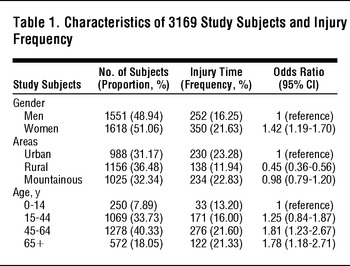
A total of 3169 residents (1551 men and 1618 women) from 1416 families provided intact information needed for this epidemiological assay. Of the 1416 families, 532 (1156 residents) were from rural areas, 429 (988 residents) from urban areas, and 455 (1025 residents) from mountainous areas. As shown in Table 1, disaster-associated injury occurred more frequently in women than in men, less frequently in residents living in rural areas than in those living in urban areas and mountainous areas, and more frequently in elderly residents than in the young.
Characteristics of 3169 Study Subjects and Injury Frequency

The heavy snowfall caused major structural housing and roof damage; 8.52% of the houses collapsed or were partially damaged. The frequencies of housing damage in mountainous, rural, and urban areas were 10.07%, 9.66%, and 5.73%, respectively. The difference in the frequencies of housing damage among the 3 areas was statistically significant (χ2 = 6.742, P =. 034).
During the 22-day storm, walking (60.74%) was the major means of transportation, followed by driving a motorcycle (16.12%), bus or car (12.56%), and riding a bicycle (11.20%). The incidence of falling injury in walking, driving a motorcycle, and riding a bicycle groups were 5.97%, 5.37%, and 5.28%, respectively. The rates were significantly higher than those in the group taking a bus or car (2.01%, P <. 05 for each comparison). The frequencies of being outside (eg, for shopping, working, seeing doctors) for 0 to 4 days, 5 to 9 days, 10 to 14 days, 15 to 21 days, and 22 days during the storm were 25.82%, 6.88%, 10.84%, 20.88%, and 35.58%, respectively.
The average number of days of being outside was 13.46 days. The average duration of being outside was 2.26 hours per day. The duration of being outside was related to the occupation of the residents. Farmers, forest rangers, and cleaning workers had more days of working outside than those with other occupations (16.58 ± 6.85 days vs 11.30 ± 9.27 days, P <. 001). The incidence of frostbite in residents who worked outside for more than 15 days was significantly higher than that in those who worked outside for 15 days or less during the snowstorm (6.09% vs 4.47%, P =. 042).
A total of 602 injuries were identified in 581 residents. The incidence of frostbite, falling injury, traffic accident-related injury, burns, unintentional carbon monoxide poisoning, and explosion in this study population was 12.78% (405 cases), 5.30% (168 cases), 0.50% (16 cases), 0.16% (5 cases), 0.03% (1 case), and 0.03% (1 case), respectively. The 168 residents who had falling injuries had 175 falling injuries; 15 subjects had 2 or more kinds of injuries. The highest incidence of injuries was found in residents living in urban and mountainous areas, while the lowest frequency occurred in those in rural areas. The difference in the incidence of injuries among areas was statistically significant (χ2 = 55.668, P <. 001).
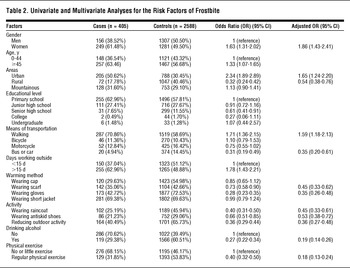
Frostbite was the most common injury, accounting for 67.28% of all injuries. Of the subjects with frostbite, the frequency of frostbite with tissue necrosis of hands, multiple areas, and head-face area (mostly on ears) accounted for 42.08%, 26.24%, and 25.50%, respectively. Table 2 lists factors that contributed significantly to the occurrence of frostbite, as compared with 2588 residents without injury. It was found that women who lived in urban areas and walked as means of transportation were independently associated with increased risk of frostbite, whereas living in rural areas, traveling by bus or car, wearing a scarf, wearing gloves, wearing a raincoat, wearing antiskid shoes, reducing outdoor activity, drinking alcohol, and performing regular physical exercise were independently associated with decreased risks of frostbite.
Univariate and Multivariate Analyses for the Risk Factors of Frostbite

Falling injury was the second most common type of injury during the 22-day storm. Falling injury peaked after 2 days and again 10 to 15 days after the storm began. Eighty men and 88 women were injured owing to falls. The most common types of falling injuries were contusion plus abrasion, sprain strain, and fracture, accounting for 58.05%, 29.31%, and 10.92%, respectively. Lower leg and trunk injuries were the most frequent, accounting for 33.71% and 14.86% of falling injuries, respectively. No significant differences in the incidence of falling injury were found between men and women (χ2 = 0.01, P =. 919).
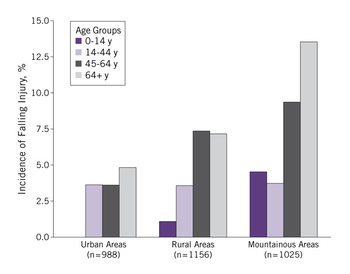
The incidence of falling injury in participants aged 0 to 14 years, 15 to 44 years, 45 to 64 years, and 65 years and older were 2.00%, 3.65%, 6.73%, and 7.87%, respectively. The incidence of falling injury increased with increasing age (P trend<.001). The proportion of falling injuries that occurred in yard, country road, and urban street were 27.43%, 26.29%, and 21.14% of the total falling injuries, respectively. Of the falling injuries, 7.43% happened in the work place including factories, construction sites, and farms.
Figure 1 presents the incidence of falling injury in the 3 areas. The incidence was higher in mountainous areas than in urban and rural areas (P <. 001 for each comparison). Falling injury that happened from February 1 to February 5 accounted for 67.13% of all falling injuries, for the roads were frozen and extremely slippery in this period. Falling injury that happened from 7:00 AM to 9:00 AM accounted for 62.12% of all falling injuries.
Incidence of Falling Injury in Affected Populations of Different Age Groups Living in Urban, Rural, and Mountainous Areas.

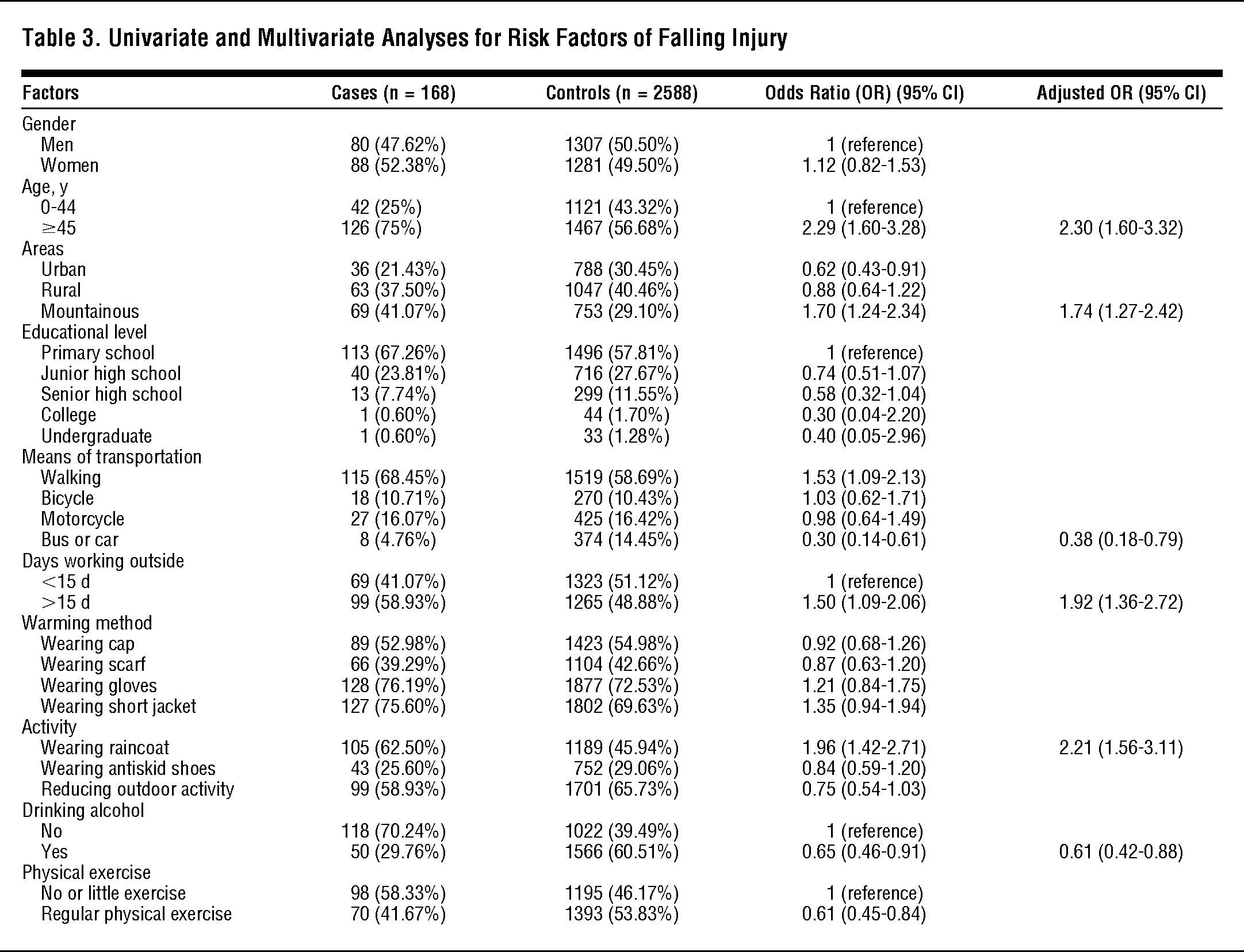
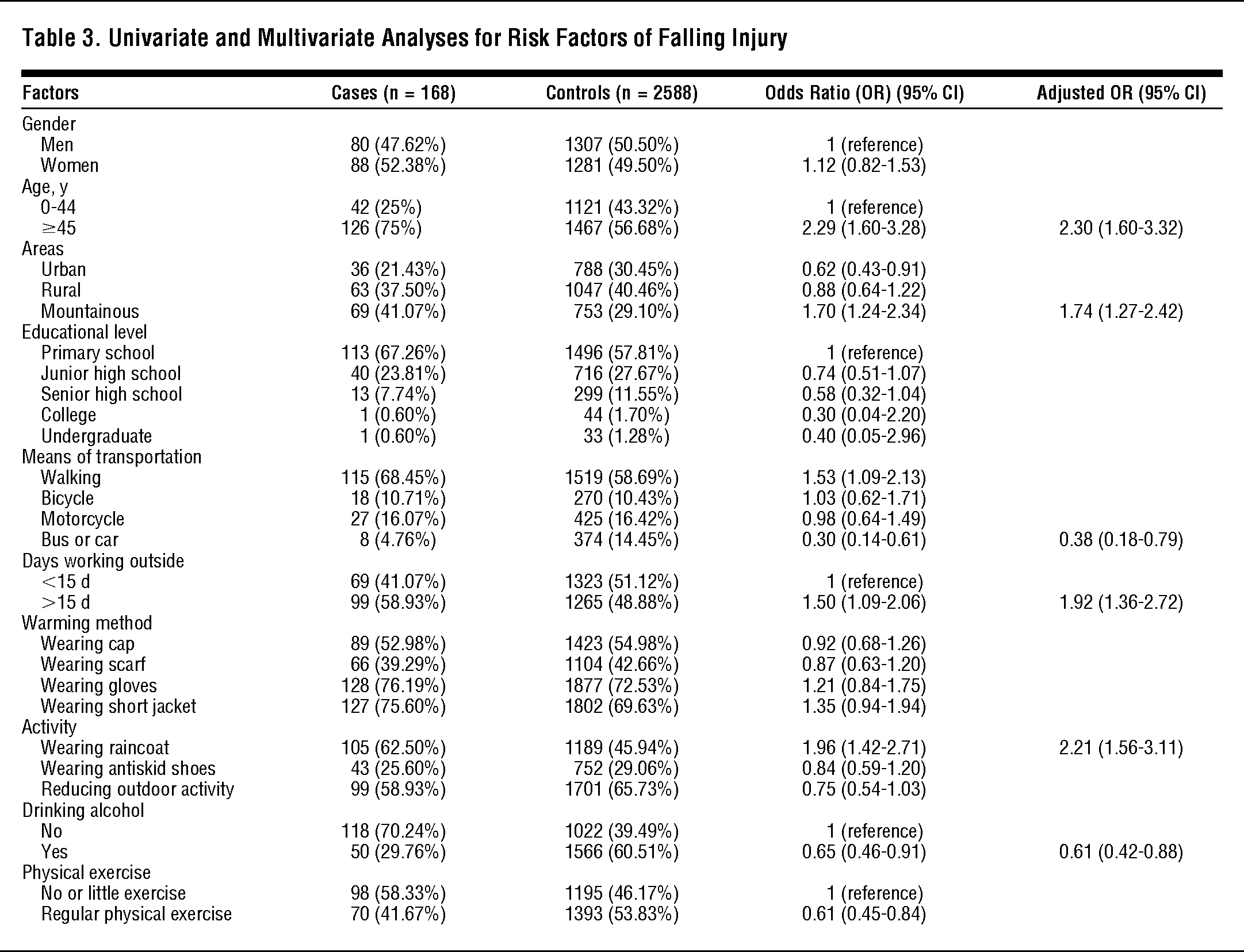
Table 2 shows factors that contributed significantly to the occurrence of falling injury. Old age, living in mountainous areas, being outside for more than 15 days, and wearing waterproof clothes were independently associated with increased risks of falling injury, whereas traveling by bus or car and drinking alcohol were inversely associated with the risk of falling injury (Table 3).
Univariate and Multivariate Analyses for Risk Factors of Falling Injury
Traffic accident-associated injury was the third common injury. Of 16 cases, 2 victims had fractures. Other injuries resulting from traffic accidents were soft tissue injuries such as bruising and wrenches. Most (75%) traffic accidents happened in the morning (7:00 AM to 10:00 AM), from February 2 to February 4, 2008.
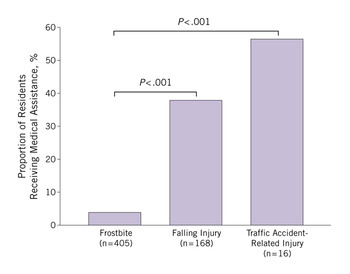
As shown in Figure 2, small percentages of residents with frostbite and with falling injury ever saw a physician or went to a medical facility for medical assistance. As compared to residents with falling injury or traffic accident–related injury, a smaller proportion of residents with frostbite went to a medical facility for medical assistance. No significant difference was found in the frequencies of seeking medical assistance between the falling injury group and traffic accident-related injury group.
Proportion of People With Frostbite, Falling Injury, and Traffic Accident-Related Injury Who Saw a Physician or Visited a Medical Facility for Medical Assistance.

DISCUSSION
The number of victims during an unprecedented snowstorm can be quite high, so having epidemiological knowledge that allows the profiling of injury types caused by the storm is important for public health preparedness. In this large-scale field epidemiological study with 3169 participants, we found that major types of injuries were frostbite and falling injury, with an incidence of 12.78% and 5.30%, respectively. There were low frequencies of traffic accident-related injury, burns, unintentional carbon monoxide poisoning, and explosion in this population. The injury types in this population are different from those in the snow-ice storm-affected populations reported in Ontario, Canada, St Louis, Missouri, and North Carolina, where fractures, other fall-related injuries, and carbon monoxide poisoning predominated.Reference Lewis and Lasater2Reference Hartling, Pickett and Brison3Reference Smith and Nelson4Reference Broder, Mehrotra and Tintinalli5 The injury types reported in published data have been mostly documented in emergency departments of hospitals. Furthermore, wounded persons in the published literature have been mainly from metropolitan areas. In this study, we found that residents with frostbite rarely saw a doctor and only 37.79% of those with a falling injury went to a medical facility for medical assistance. Data documented in hospitals, therefore, have been unable to profile injury types caused by a given disaster. The type and the frequency of the disaster-related injuries in the affected communities in urban, rural, and mountainous areas were also documented in this study. This approach greatly diminished the missing data of the type and frequency of snow-ice disaster-related injury. Thus, this study provided more intact profiling of injury type caused by an unprecedented snow-ice disaster than in previously reported ones.
During the storm, frostbite was the most frequent injury type, with an incidence of 12.78%. The high incidence of frostbite in this population indicated the necessity for public health education to prevent residents from experiencing frostbite in an unprecedented cold condition. Delivery of health care information could be potentially more valuable than particular clinical interventions in humanitarian action.Reference Turner, Green and Harris8 The breakdown of skin microcirculation and leukocyte-endothelium interaction are assumed to play a key role in the pathophysiology of frostbite injuries.Reference Goertz, Baerreiter and Ring9 Direct injury produced during the initial freezing process contributes less to tissue damage than the progressive microvascular thrombosis following reperfusion due to rapid rewarming.Reference Mohr, Jenabzadeh and Ahrenholz10 Slow and progressive rewarming of frozen limbs should avoid the formation of microvascular thrombosis and reduce the possibility of frostbite. Frostbite was frequently found in women, possibly because of poor skin microcirculation. Interestingly, living in rural areas was a protective factor, whereas living in urban areas was a risk factor for frostbite (Table 2). This finding could be explained by the fact that residents living in rural areas are accustomed to manual labor outside and in a cold environment. For the first time, we found that regular physical exercise was independently associated with a decreased risk of frostbite (adjusted OR, 0.18; 95% CI, 0.13-0.24), indicating that regular physical excise can decrease the risk of frostbite. Compared with other means of transportation, travel by bus or car was independently associated with a decreased risk of frostbite, possibly because of reduced exposure to a cold environment. The same was true for wearing gloves and/or wearing a scarf, for hands and ears are easily frostbitten. Wearing a raincoat protected the body from getting wet during the snowstorm, while getting wet facilitated the formation of frostbite in the cold environment.Reference Rintamäki11Reference Harirchi, Arvin, Vash and Zafarmand12 In Europe and North America, heavy alcohol consumption has been frequently associated with frostbite in homeless persons.Reference Mäkinen, Jokelainen, Näyhä, Laatikainen, Jousilahti and Hassi13Reference Koutsavlis and Kosatsky14 In this study, we found that alcohol consumption was an independent protective factor for either frostbite or falling injury. Consuming alcohol at home in cold weather, a known cultural practice in this region, might explain this difference.
Falling injury was the second most common type of injury during the snowstorm. Environmental temperature was lower in mountainous areas than in rural and urban areas. The same was true for the severity of snowfall, as evidenced by a higher proportion of housing damage in mountainous areas than in other areas (P =. 034). Falling injury occurred more often in residents living in mountainous areas than in those living in rural and urban areas (P <. 001 for each comparison) and it increased in frequency with increasing age (P trend<.001). The high incidence of falling injury in mountainous areas was due to slippery country pavements on slopes and poor infrastructure for transportation. Falling injury peaked in 2 days and then decreased in frequency, possibly because public health intervention such as cleaning snow off pavements was issued by local governments by then. However, injury increased in frequency at 10 to15 days after the disaster began. In this period, snow that thawed during the day was frozen at night, resulting in icing on pavements. The elderly are vulnerable to falling injury that usually results in severe clinical consequences, such as fractures in hip joints. Public health intervention such as providing transportation for senior citizens during a snowstorm is an effective preventive method to reduce the risk of falling injury.
Traffic accidents and the related injury mostly happened in the morning between 7:00 and 10:00 AM because snow was frozen during those hours before thawing later in the day. Accidents were mostly caused by slippery roads. Public health intervention such as cleaning snow from roads and providing transportation warnings that began February 4, 2008, greatly diminished the frequency of subsequent accident-related injury.
Limitations
Our study had several limitations. Although the epidemiological survey was carried out immediately after the snowstorm, the design was retrospective in nature and unable to determine causal relationship between the variables and the risk of injuries. Public health intervention greatly diminished the occurrence of the disaster-related injuries during the storm; however, a long-term large-scale prospective study would be needed to clarify the influence of the disaster on all aspects of this society and to determine suitable disaster preparedness for the snowstorm. In this study, physical injuries were investigated, whereas psychological injury during the storm was not evaluated. Psychological and mental injuries due to exposure to a given disaster are also important injuries in the affected population.Reference Hashmi, Petraro and Rizzo15 Managing the psychological aspects of large-scale disasters should be included in a framework of disaster preparedness and response.Reference Meredith, Eisenman and Tanielian16 In addition, economic loss due to the snowstorm was not fully evaluated, resulting in loss of data.
In conclusion, this study demonstrated that frostbite and falling injury were the main injuries caused by an unprecedented snowstorm in Ningbo, China. Frostbite occurred more frequently in residents living in urban areas than in those living in rural and mountainous areas. Travel by bus or car, wearing a scarf, wearing gloves, wearing a raincoat, reducing outdoor activity, and maintaining regular physical exercise significantly reduced the risks of frostbite during the storm. Falling injury occurred more often in residents living in mountainous areas than those living in plain areas and increased in frequency with increasing age. Persons 45 years or older, working outside more than 15 days, and wearing a raincoat were independent risk factors of falling injury. Public health interventions such as cleaning snow from roads can reduce the risk of falling and traffic accident-related injuries. Residents with frostbite rarely saw a doctor, and only a small percentage of residents with falling injury went to a medical facility for medical assistance, indicating the importance of epidemiological survey of the affected communities in understanding intact profiling of injury types caused by a given disaster. These data of injuries in the affected population living in different topographic or geographic areas are important for suitable public health preparedness to climate-related disaster.
Acknowledgments: Member of the epidemiological staff from the Centers of Diseases Prevention and Control and Community Health Centers in Jiangbei district, Qinzhou district, and Cixi city of Ningbo administrative region provided assistance with the field epidemiological survey.
Support and Funding: The study was supported by a key project on disaster medicine from Shanghai Education Committee (No. A1016) to Dr Cao. The fund had no role in the design and conduct of the study; collection, management, analysis, and interpretation of the data; and preparation, review, or approval of the manuscript.