Introduction
Several Nepali GurkhaFootnote 1 cemeteries and memorials from the Second World War and decolonization periods are located in former British colonies in Asia. At present, they are managed by the Commonwealth War Graves Commission. The Gurkhas, as Cynthia Enloe highlights, constituted Britain’s ‘principal military presence in Asia’.Footnote 2 Intriguingly, during British imperial expansion, Nepal was not colonized nor is it a member country of the Commonwealth of Nations.Footnote 3 Therefore, the Nepali Gurkhas engender a paradox as they comprise a ‘relic of the forces of Britain’s imperial days’,Footnote 4 and their recruitment since the early nineteenth century still weighs heavily on their colonial legacies, despite Nepal’s status within the British empire.Footnote 5 In her book, Military Migrants: Fighting for Your Country, Vron Ware examines Britain’s multinational army within the domestic context of the United Kingdom and explores a range of contemporary socio-political issues that emerge for the Nepali Gurkha community on account of their status as ‘migrant soldiers’.Footnote 6 Following Vron Ware’s suggestive insights, this article will deliberate upon Gurkhas and their families as ‘military migrants’. However, this article attempts to go beyond the United Kingdom and looks at an earlier era in the Asian region(s), using Gurkha families as a case study, to explore transregional military labour migration and lived experiences from 1948 to 1971.
The transnational lives of Gurkha families between 1948 until the withdrawal of British troops from the Far East in 1971 brings into sharp focus the interconnections between military service and migrant pathways in predominantly Asian contexts. The aftermath of India’s independence—and partition—in 1947 signalled a new beginning for the erstwhile Gurkha troops of the British Raj as they were divided between the newly formed Indian Army and the British Army.Footnote 7 Subsequently, in 1948, the headquarters of the British Army’s ‘Brigade of Gurkhas’ was located at Seremban, Negeri Sembilan in Malaya, and Gurkha battalions were widely dispersed across Malaya, Singapore, and, to a far lesser extent, Hong Kong.Footnote 8 In other words, in 1947, following the reconstitution of Gurkha units that had long served in the British Indian Army, British colonies such as Malaya, Singapore, and Hong Kong formed an integral part of a transregional military labour network in Asia. Furthermore, the development of a British Gurkha garrison in Brunei following the revolt in 1962 renders visible the significance of Brunei as a transnational historical link.Footnote 9 More significantly, Malaya, Singapore, Brunei, and Hong Kong were nodal points in the military migrant routes of Gurkha families. These countries, therefore, encompassed ‘sites of Asian interaction’Footnote 10 that draw our attention to the protean ways in which colonial legacies and geopolitical imperatives mutually constituted and shaped the transnational lives of this lesser-known military migrant community.
The impetus for writing this article stems from the Social Science Research Council’s call in 2008 for investigation into ‘inter-Asian connections’.Footnote 11 I employ inter-Asian connections as a methodological analysis to frame transregional military labour networks and gendered circuits of migration during decolonization. To this end, this article sets out to make three key contributions. Firstly, it attempts to facilitate a dialogue between two distinct historiographical fields—military history and migration history—and in doing so, broadens the history of Asian labour migration within Asia by examining a less explored form of colonial labour network. By drawing out transnational processes that intersected between and within South Asia, Southeast Asia, and (to a lesser extent) East Asia, this article seeks to argue that from 1948 to 1971, the Asian region(s) were a dominant feature in the global migration process of Gurkha families who circulated within the arc of a declining British empire. Secondly, through a study of Gurkha families, this article offers a gendered perspective on inter-Asian military labour migration by directing a gaze at realms of family histories and transnational lives, which remain largely unexplored. In bringing to fore military regulations that came to bear upon when and under what circumstances Gurkha wives and children could migrate or were left behind in Nepal, this article contends that their transnational history provides a vantage point from which to disentangle the ‘migration–left behind’ nexus as binary opposites and to instead evaluate military migrant patterns that inflected the transnational lives of Gurkha families in complex ways.Footnote 12 While there is expansive literature on migration and transnational families in Asia, within the context of studies on the ‘left behind’, research tends to focus on the unidirectional nature of mobility rather than taking into account case studies that account for dynamic patterns wherein the ‘left behind’, for instance, women and children, also engage in mobility, therefore complicating the ‘migration–left behind’ nexus. Thirdly, by studying the transnational experiences of Gurkhas and their families as military migrants in Asia, this article seeks to humanize their narratives and offer a critique of colonial constructs that reduce the Gurkhas to embodiments of masculine loyalty and bravery.Footnote 13 In using inter-Asia as a point of entry, the purpose of this article is not to claim Asian exceptionalism. Instead, an inter-Asia approach offers analytical purchase to provide a longer-term perspective on Nepalese migration and to seriously consider how Nepal’s transregional historical links to other parts of Asia developed vis-à-vis the military migration of Gurkha families.
The first part of the article situates Gurkha families within post-Second World War Asian contexts. Through an analysis of the Tripartite Agreement (TPA) signed in 1947 by the United Kingdom, Nepal, and India, this section will examine the historical and political context that gave rise to and shaped their transnational dynamics. By reconstructing their transregional routes in the past, the second segment deliberates on inter-Asian connections and demonstrates how Gurkha families negotiated their transnational lives within and between South and Southeast Asia as well as Hong Kong. The last section expands upon the notion of dukha—meaning ‘sadness’ or ‘suffering’ in Nepali—as an analytical theme to yield further insights into the impact of military migration on their lived experiences, and in so doing, revisits colonial constructs about Gurkha history. One caveat pertains to the usage of ‘Gurkha’ as a term of reference in the broadest sense. While there are distinctions among the ‘Singapore Gurkhas’, ‘Indian Gurkhas’, and ‘British Gurkhas’, kinship ties and social networks transcend these categories. This article focuses on the transnational lives of Gurkha families who were part of the British Army during a particular historical period. Hence, ‘British Gurkha’ as an appellation will be used only in so far as to tease out nuances that emerge about their migration and/or professional trajectories.
This article forms part of an ongoing study to document the transnational history of Gurkha families in the past. The empirical research is drawn from multi-sited archival and ethnographic fieldwork conducted in Nepal, Singapore, Malaysia, and the United Kingdom between 2019 and 2020. By closely reading along and against the archival grain, this article pays attention to the strengths and limitations of engaging with only official archival sources as a research methodology.Footnote 14 Archival data from the Foreign Office, War Office, Commonwealth Office, and Defence Department during the post-Second World War period offer scant glimpses into the transnational history of Gurkha wives and children who, in general, are categorized as ‘dependants’ in these records. Broadly speaking, insights about them, if any, are embedded within the framework of service provisions for Gurkha troops serving in the British Army. Although Gurkha families have slipped through the cracks of history, it is between those interstices, in the fragments of written traces that crisscrossed between the United Kingdom, India, Nepal, and the Far East, that I begin to reconstruct their transnational past. While archival documents offer a rich avenue to critically assess geopolitical realities and to piece together how transregional military labour networks within Asia were shaped in the past, there is a resounding silence about the lived experiences of Gurkha families as military migrants. As Alistair Thomson alerts us, ‘if history is the story we make of the stories we find, then one needs to consider those missing stories and the significance of their absence’.Footnote 15 Herein, in-depth life history interviews conducted with approximately 50 Gurkha families across Nepal (Kathmandu, Dharan, and Pokhara) and in Hampshire, the United Kingdom, were ‘an essential source for examining the lived experiences of individuals and communities whose history was undocumented or ill-recorded’.Footnote 16 By recentring marginalized voices through a life history methodology, this article seeks to ‘enlarge and enrich the scope of historical writing itself’, in Paul Thomson’s words.Footnote 17 In short, the transnational lives of Gurkha families allow us to study a largely unexplored form of transregional labour networks in Asia, and within this parameter, it opens up an area of enquiry to discover a lesser-known dimension of their social history.
Imperial inheritance: Situating Gurkha families in post-war Asian contexts
Two fundamental limitations surface in extant scholarship on the Gurkhas in the context of the post-Second World War period. Firstly, most of the literature is relegated to military history within the purview of defence and decolonization in Asia. On the one hand, as Lionel Caplan rightly observes, countless British military writings tend to unproblematically represent ‘The Gurkha’ as the ‘Bravest of the Brave’.Footnote 18 While there are exceptions,Footnote 19 numerous British military publications, as Michael Hutt postulates, are ‘quasi-historical accounts’.Footnote 20 This corpus of work details military exploits and chronicles various historical events—the Second World War (1939–1945); partition of India in 1947; Malayan Emergency (1948–1960); Brunei Revolt (1962); Indonesia-Malaysia Confrontation (1963–1966); and riots in Hong Kong in the late 1960s during the Cultural Revolution—to chart the crucial role played by the Gurkhas in various military campaigns.Footnote 21 While these works inform our understanding of the historical development of Gurkha troops in Asia and, at times, offer clues about their families, they ultimately seek to position the Gurkhas as ‘brave warriors’ within a larger colonial enterprise. On the other hand, several scholarly works situate Gurkha troops as a colonial army and in doing so, further our understanding of issues relating to imperial security, nationalism, and the Cold War in Asia.Footnote 22 This body of scholarship is valuable to our understanding of defence and decolonization processes. However, more notably, the focus is on the positionality of Gurkhas as ‘soldiers’ rather than as ‘migrants’.
Secondly, in sharp contrast to military historiography, there has been burgeoning research since the 2010s examining Gurkha/Gorkhali migration and, more broadly, the Nepali diaspora, as a global phenomenon. For example, in comparison to previous scholarship, it might be fair to suggest that the edited volume, the Routledge Handbook of the South Asian Diaspora, with its inclusion of a critical chapter on the Nepali/Gorkhali diaspora by social anthropologist David Gellner, signals a promising endeavour to appraise the Nepali diaspora within the broader field of South Asian diaspora studies.Footnote 23 Thereafter, two other significant volumes which have been published since—Nepali Diaspora in a Globalised Era and Global Nepalis: Religion, Culture, and Community in a New and Old Diaspora—speak to migration and diaspora studies as an emergent field of research in the context of Nepal.Footnote 24 However, while this historiographical shift has given fresh scholarly impetus to studying Nepali Gurkha families’ social and transnational history, most works are focused on a single country, and few have examined them across regional boundaries. Moreover, writings on the social experiences of Gurkha families, such as identity, belonging, caste, culture, ethnicity, and religiosity, are primarily focused on either India or the United Kingdom.Footnote 25 While there are stirrings in the direction of research towards other parts of Asia,Footnote 26 there is a lacuna in scholarly works that study transregional military labour networks and gendered circuits of migration during the era of decolonization, with scant research studying the transnational entanglements that developed within and between the Asian region(s). This article, therefore, addresses this gap and builds upon previous scholarship in this field while broadening the contours of military migration by engaging with inter-Asia as a reference point.
The Tripartite Agreement, 1947: Constructing transnational Gurkha families
India, historically, was the ‘regimental home’ for Gurkha regiments.Footnote 27 In 1947, uncertainty about the future of Gurkha troops emerged at the time of India’s independence and partition. In tandem with the development of India and Pakistan as independent nations, the ten Gurkha regiments from Nepal that had long served under the British Indian Army were reconstituted. In the aftermath of India’s independence, the main document governing the future of Gurkhas recruits and their families was the Tripartite Agreement (TPA) signed by the representatives of the governments of the United Kingdom, India, and Nepal on 9 November 1947.Footnote 28 The TPA permitted Nepali Gurkhas to be recruited by both India and Britain, and correspondingly, the ten Gurkha regiments were reorganized, with six remaining in India and four being transferred to the British Army.Footnote 29 The four rifle regiments—the Second, Sixth, Seventh, and Tenth Gurkha Rifles—comprised eight battalions, alongside various other Gurkha units, which were collectively known as the ‘Brigade of Gurkhas’. They set sail to British Malaya and Hong Kong in 1948.Footnote 30 Notably, the TPA demonstrates how the extensive workings of the empire shaped transregional military labour networks within Asia during the period of decolonization.
Further analysis of official correspondences in the archives reveals the terms and conditions that undergirded the military service of Nepali nationals and how this, in turn, impacted on gendered mobility patterns. In contemplating this, two key questions are significant. Firstly, how were ‘Gurkha families’ as a category defined by the British Army, and in what ways did military regulations bear upon when and under what circumstances families could travel abroad or be left behind in Nepal? In perusing these official documents, the ‘family’ of a Gurkha officer or soldier was defined to include ‘his legal wife and legitimate unmarried children below 15 years’.Footnote 31 Typically, in the past, Gurkha recruits enlisted to the British Army at the age of about 17 and after 15 years of service they were entitled to a pension.Footnote 32 After three years of continuous service overseas with the British Army, personnel were granted six months’ leave to Nepal.Footnote 33 Based on the life history interviews, most Gurkhas generally married during their first leave period. However, they were not entitled to a ‘family permission tour’ since it was ‘only after having served for four years that Gurkhas were qualified and permitted to take their entitled families overseas at the expense of British Army funds’.Footnote 34 More significantly, only about 25 per cent of the Gurkha unit were entitled to have their familes accompany them overseas.Footnote 35 In other words, as many informants corroborated, notwithstanding the families of Gurkha officers, the vast majority of the rank and file had an opportunity to bring their families from Nepal only once or at most twice in their 15 years of service. Consequently, respondents further shared that Gurkha children were born in Nepal and subsequently travelled to Malaya, Singapore, Brunei, or Hong Kong when the opportunity arose. Otherwise, they were born in Asian colonies during the ‘family permission tour’ and were subsequently repatriated to Nepal. Therefore, historically, the ‘migration–left behind’ nexus in the context of Gurkha families was complexly negotiated as Gurkha wives and children engaged in mobility at different junctures, therefore making it imperative to situate military migration within a broader institutional context.
Secondly, what sorts of welfare arrangements were made to accommodate Gurkha families during their sojourns in military camps in Southeast Asia and Hong Kong? To a certain extent, social, cultural, and religious concerns figured in the discussions about Gurkha families in 1947. Welfare concerns such as medical amenities, broadcasting facilities, and Nepali religious observances were raised in the meetings and discussions between Nepal, India, and the United Kingdom. It was agreed that Nepali nurses would be employed to attend to Gurkha families in pre-natal clinics and maternity hospitals overseas. In the months leading up to the signing of the TPA, it was highlighted that Nepal would assist in advertising for employment prospects in nursing. However, since few nurses were available from Nepal, the United Kingdom proposed to turn towards India to secure nurses from ‘Gurkha colonies’ in Assam, Darjeeling, and Shillong.Footnote 36 The setting up of a broadcasting station in Nepal was also mooted to help ‘minimise to some extent the feeling of exile’ among the Gurkha community abroad.Footnote 37 Lastly, concerning religious aspects, Hindu priests were attached to units of British Gurkha regiments. In addition, it was proposed that the ceremony of panipatiya (or pani patya)—a religious-military ritual deemed to give complete religious absolution to Gurkha soldiers who crossed the kalo/kala pani (terms derived from Sanskrit to mean ‘black waters’ in Nepali and Hindi respectively)—would be arranged for Gurkhas returning to Nepal. It was further suggested that Calcutta would be the most suitable site for the panipatiya ceremony.Footnote 38
Although the lived experiences of Gurkha families are obscured in official archival records, they nevertheless allow us to evaluate the interconnections between military service and migrant pathways during the post-Second World War period, and situate the origins of Gurkha families in Asian colonies within a broader imperial context. The transnational lives of Gurkha families were shaped by colonial legacies and geopolitical realities when the curtain fell on the British empire. Furthermore, we learn that the military recruitment of Nepali nationals had implications for gendered circuits of migration and transnational processes for family members, which, in effect, provide an avenue to reconceptualize the ‘migration–left behind’ nexus within a more integrated framework.
Military labour, migrant pathways: From sea movement to air-trooping
The arrival of Gurkha troops in British Malaya in 1948 coincided with the initial rumblings of the Malayan Emergency. Raffi Gregorian posits that although the intended purpose of stationing the Gurkha division in Malaya was to train them to fight the Russians in the Middle East, it was clear that the Gurkhas had become a de facto Cold War force in the Far East instead.Footnote 39 From the outset, the transregional flow of Gurkha troops within and between the Asian regions during the Cold War gave rise to contending political rhetoric that emanated from the United Kingdom, India, and Nepal.Footnote 40 Arguably, the role of Gurkha troops in containing the spread of communism during the Malayan Emergency constituted a trope against which geopolitical realities were imagined and contested during the Cold War period. As a result, although assurance was given to the United Kingdom by India to permit Gurkha families, who hailed from landlocked Nepal, to ‘travel freely on duty or leave through Indian Territory between the frontier of Nepal and the Port of Calcutta, without interference’,Footnote 41 there were parallel discussions to make ‘the movement of Gurkha recruits from Nepal to Malaya as inconspicuous as possible’.Footnote 42 In addition, it was further proposed that the ‘use of air trooping would certainly aid in making the transit of Gurkha recruits inconspicuous’.Footnote 43 The debates and discussions that emerge from official archival sources tend to polarize the identity of Gurkhas as either ‘mercenaries’ who were used to contain communism in Asia or as ‘brave warriors’ fighting for the cause of democracy in Asia.Footnote 44 Ultimately, these sources emphasize the mobility of Gurkhas as ‘military soldiers’ and obscure their movement as ‘military migrants’ who journeyed to Southeast Asia and Hong Kong with their families during the Cold War.
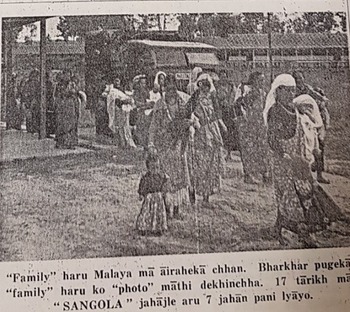
In contrast, the picture published in the Parbate newsletter in 1949 (see Figure 1) draws our attention to Gurkha wives and children from Nepal arriving in Malaya after their sea journey from Calcutta, India, on the S. S. Sangola. The Parbate, which is still in circulation today, began in 1949 as a weekly Roman Gorkhali military newsletter published by the General Headquarters—Far East Land Forces (GHQ FARLEF) based in Singapore.Footnote 45 The late 1940s–1960s was a politically tumultuous period, and pioneer editions of the Parbate bring into sharp focus the early origins and development of Gurkha families in various parts of Southeast Asia and Hong Kong against the backdrop of decolonization and Cold War realities.
Gurkha wives and children arriving in Malaya after a ship journey on board the S. S. Sangola.

Apart from vernacular sources such as the Parbate, we gain insights into the development of Gurkha families in 1948 through the British Women’s Voluntary Service (WVS) Bulletin. The WVS played a significant role within the British Army, as they were intimately involved in the welfare of Gurkha families. The British WVS Bulletin highlights that in early 1948, they sent members to Malaya to act in a welfare capacity for Gurkha families who had started arriving in the spring of that year.Footnote 46 The Bulletin sheds light on the migrant journey of Gurkha families and their need to adapt to new ways of life:
These [Gurkha] families have never been out of Nepal in their lives; had probably never seen the sea; had anything from a five to fourteen day’ walk to reach the port of embarkation; and could speak no English. To go overseas to live in a strange country with strange people in unknown and unimaginable conditions would be a tremendous step.Footnote 47
In addition, a newspaper article highlights that in 1953, a group of 60 wives and children of the 2nd/2nd Gurkha Rifles set sail from Calcutta to Hong Kong in the S.S. Santhia and, after that, made their way to the New Territories.Footnote 48 By this time, there were an estimated 43 WVS workers in Singapore and Malaya serving the Gurkha community.Footnote 49 There is a paucity of research on the migrant experiences of women and children. Apart from a few sources, little is known about how they engaged with military migration and mediated patterns of im/mobilities.
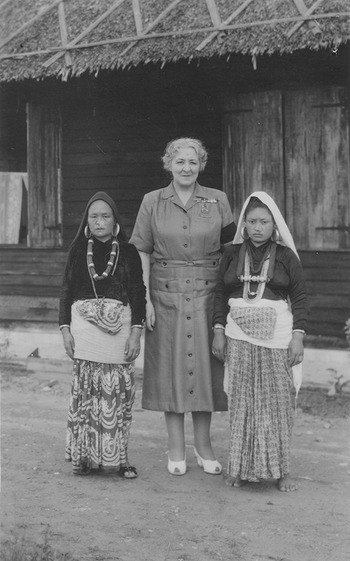
For Gurkha wives, their migrant journey from Nepal to Singapore, Malaya, or Hong Kong marked their maiden voyage to uncharted territories. Their personal accounts during the early years tell a story of their migrant journeys and how they adapted to new ways of life. When Gurkha wives first arrived, they commonly wore traditional attire, often a long-sleeve blouse in velvet material and thick, full-length petticoats (Figure 2). Despite severe prickly heat and outbreaks of impetigo and other skin diseases in Malaya, it was not easy to convince the women that light clothing was suitable.Footnote 50 For example, during my interview in the United Kingdom with Tika Gurung,Footnote 51 a great-grandmother and Gurkha widow in her eighties, she candidly shared how challenging it was to adjust to the tropical weather at first, given that she was not accustomed to wearing other types of attire. ‘I continued to wear lungi (sarong) or sari with bulaki (traditional nose ornament), and till today, I still do not like to wear trousers’,Footnote 52 she said in Nepali with a soft chuckle. Tika’s father served as a Gurkha in the British Indian Army. She was born in India as a ‘Gurkha daughter’ who subsequently became a ‘Gurkha wife’ when she married her late husband in 1950, who was then serving in Malaya. Initially, she stayed behind in Nepal, and after the ‘family permission’ was granted sometime in 1953, she accompanied her husband to Malaya. Tika described walking for about seven days from her village to the Indo-Nepal border before settling sail to Singapore from Calcutta.
Chairman of the Women’s Voluntary Service, Lady Reading, with Mrs Man Maya Rai and Mrs Gangamaya Limbu at Sungai Udang, Terendak Camp in Malacca, Malaya, circa 1960s.

In another, similar account Gita Rai, who is now in her sixties, recounted that her late mother was left behind in Nepal during the initial years of her father’s service. Her parents were married in the mid-1940s and her father was among the first batch of Gurkha recruits to travel to Malaya in 1948. Gita, who was born in Nepal in 1954, travelled to Malaya with her mother and elder brother around 1956. She explained that she spent more than a decade of her schooling in the Gurkha Children’s School at Sungai Petani, Kedah, and during this period, three of her other siblings were born in Malaya. Gita’s family experienced repatriation to Nepal in 1968, when the British gradually withdrew their forces from Malaysia and Singapore.
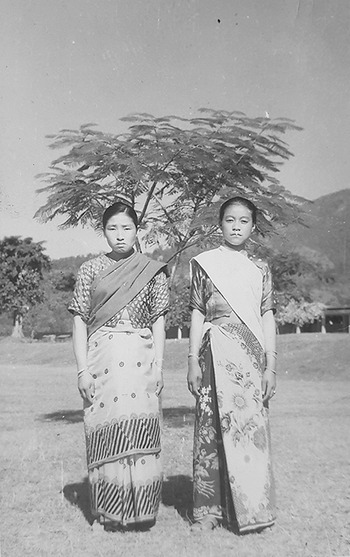
From the late 1940s to the mid-1950s, sea travel provided the primary mode of transportation. Gurkha families typically began their migrant journey walking for several days from their villages in the eastern or western regions of Nepal towards the Indo-Nepal border, where upon crossing, they would take a train to Calcutta before heading towards the transit camp which was located at Barrackpore. After that, they would set sail to the ports of British Malaya before heading to the respective ‘family lines’ (Figure 3). The Training Depot of the Brigade of Gurkhas was established in Sungai Petani, Kedah, in 1951.Footnote 53 New recruits would head towards the northern part of Malaya to undergo training before being posted to their respective units in Southeast Asia or Hong Kong. For example, in Nepal, during a conversation with a couple in their late eighties and their daughter, who was born in Hong Kong, Balhang Limbu recollected that:
Balhang Limbu: … India’s independence was in 1947. I joined the naya [new] British Army when I was just 17 and a half years old. Six went to India and four to the British. It was a Friday, I remember, 27 February 1948, I enlisted.
Author: Could you please describe your journey?
Balhang Limbu: I walked from my village in Nepal to the Indian border for many days, then took a train to Calcutta to [the] first transit camp, then went to Barrackpore, second transit camp. From there took a big pani jahaj [ship] S.S. Sangola to Rangoon and then to Singapore. From there [Singapore], I went to Kluang [Johor Bahru, Malaya] for infantry training …Footnote 54
Gurkha wives at Sungai Udang, Terendak Camp in Malacca, Malaya, circa 1960s.

By 1962, the two British India Steam Navigation Company cargo-passenger ships on the Far East/Calcutta run—the S.S. Sangola and S.S. Santhia—which had been relied upon in the past to effect the sea movement of Gurkha troops and their families between Calcutta and Singapore/Hong Kong were in the process of being withdrawn.Footnote 55 By this time, air trooping was considered the most economical method of facilitating the movement of Gurkha families.Footnote 56
Archival records shed light on how, annually, there was a pattern to the movement of air trooping Gurkha families within Asia, and various considerations had to be taken into account. For example, the monsoon in Nepal, raging torrents and landslides in the hills during June/July, as well as traditional festivals (such as Dashera) in October were critical determining factors that reflect both environmental and cultural considerations. Notably, a two-way parallel movement eastwards and westwards required administrative and logistical planning. On the one hand, there were serving Gurkhas and/or Gurkha families returning to Nepal for their six months’ leave in May and returning to Southeast Asia or Hong Kong in November. The pattern was automatically set annually to ‘move all the passengers in about six weeks from 20th April to 31st May and consequently the return airlift was from 20th October to 31st November’.Footnote 57 There were usually about 2,300 passengers from Singapore and 900 passengers from Hong Kong every six months that required logistical planning.Footnote 58 On the other hand, about 1,000 Gurkha recruits enlisted each year, and about the same number of soldiers went on pension, usually about the same time.Footnote 59 In addition, as mentioned earlier, every three years, Gurkhas and/or Gurkha families were entitled to six months’ leave, which constituted a significant movement alongside that of new recruits and pensioners. The transnational routes and mobility patterns of Gurkha families underscore intense exchanges and constant circulation within and between the Asian region(s).
Transnational routes: Regional directions, inter-Asian features
As mentioned in the Introduction, from 1948 up until 1962, Malaya, Singapore, and Hong Kong comprised primary sites in the transnational routes of Gurkha families. After that, following the Brunei Revolt in 1962, which led to the development of a British Gurkha garrison, Brunei was integrated into a transregional military labour network in Asia. In addition, in 1962, Gurkha families from Sixth Gurkha Rifles were stationed in the United Kingdom for the first time, and a small minority of them moved from Malaya to Tidworth before experiencing repatriation to Nepal.Footnote 60 Notwithstanding this development, the Asian region(s) constituted a more significant part of their ‘transnational social field’Footnote 61 from 1948 to 1971. During this era, the transnational direction for Gurkha families largely pivoted between South Asia and Southeast Asia and Hong Kong. After that, similar to 1947, the withdrawal of British troops from the Far East in 1971 marked yet another turning point as Gurkha units were once again redeployed, this time from two former Asian colonies, namely Malaysia and Singapore, to a protectorate (Brunei) and a colony (Hong Kong). In other words, except for Brunei, where a British Gurkha garrison remains to this day, by 1971 Southeast Asia as a region had gradually lost its significance in the military migrant routes for British Gurkha families.Footnote 62 From here on, the ‘transnational social field’ for Gurkha families realigned around the United Kingdom (at Church Crookham), Brunei, and Hong Kong, and in the case of the latter, the Gurkha battalion was disbanded after the handover to China in 1997, pointing to yet another watershed in the renegotiation of transnational routes among British Gurkha families.Footnote 63 Considering these historical changes and continuities, it is apparent that in the decades spanning 1948 to 1971, the migrant pathways and transregional directions of Gurkha families predominantly centred within and between the Asian region(s). It also brings to fore the broader imperial context against which the transnational lives of Gurkha families were enacted.
In these years, Gurkha families were accommodated in military camps, commonly referred to as ‘family lines’, which were widely dispersed across Southeast Asia and Hong Kong. In assessing life history interviews and regimental records in Pokhara, Nepal, and Winchester, the United Kingdom, it is evident that these Gurkha ‘family lines’ were not concentrated in one particular locality within each Asian country. The ‘Brigade of Gurkhas’ which comprised four rifle regiments (Second, Sixth, Seventh, and Tenth Gurkha Rifles) or, put another way, eight battalions, as well as several other Gurkha units such as the Engineers, Gunners, Sappers, Signals, Transport, Military Police, and so on, were, all in all, extensively based across Southeast Asia as well as Hong Kong. Thus, Gurkha families once lived as widely dispersed gated communities, sequestered in various military camps. For example, in Singapore, Gurkha ‘family lines’ were established at Nee Soon Camp in the northern area and at Slim Barracks, Ulu Pandan, and Pulau Blakang Mati located in the western and southwestern areas of the island. In Hong Kong, the sites for Gurkhas and their families were primarily located in Kowloon (Whitfield barracks and Gun Club Hill) as well as in the New Territories (Cassino Lines, Tam Mei Camp, Sek Kong Camp, Queens Hill Camp, and San Wai Camp, later renamed as the Gallipoli Lines). In Malaya, Gurkha families once lived in the southern regions: Johor (Majidee Barracks and Kluang), Negeri Sembilan (Rasah Camp and Sikamat Camp), and Malacca (Sungai Udang Camp and Terendak Camp); in the central region: Selangor (Sungei Besi Camp); and also in the northern regions: Perak (Suvla Lines), Penang (Minden Barracks), and Kedah (Sungai Petani Camp).Footnote 64
In Nepal, 84-year-old widower Harka Limbu and his daughter, Manisha Limbu, shared their experience of living in several parts of Asia. Harka, who was born in a village at Tankhuwa in the eastern area of Nepal, joined the British Army in 1953 at the age of 18 and was enlisted to the 2nd/7th Gurkha Rifles. He described how he walked from his village to Jogbani on the Indo-Nepal border, then took a train to Calcutta before setting sail for Malaya, where, upon disembarking, he went to Sungai Petani for training. His battalion had to rotate between Kluang, Malaya, and Hong Kong in his early years. It was only after his second leave that he received his ‘family permission’. Both father and daughter shared that:
Harka Limbu: I took my wife to Singapur [Pulau] Blakang Mati ‘family lines’ in 1960, and our two sons were born there, in 1961, my first son, and the second in 1963. They were born in British Military Hospital (BMH). We have medical facilities like Nepali sisters also in the camp, serious cases only would go to the BMH. Then…uhm…our daughters were born in Hong Kong, around late 1960s—
Manisha Limbu: —Yes, so I was born in Hong Kong, we stayed in Sek Kong camp, and by 70s we were in Brunei—
Harka Limbu: There’s a lot of rotation and moving with family also you know … first I was in Malaya, then Singapur with family, then went to Hong Kong, and back again to Malaya in Malacca, Sungai Udang Camp near Terendak. Then, after the [British] handover you know, to Malaya and Singapore government in 1967 or something, around that time, then all the Gurkha battalions moved to Hong Kong and Brunei. One battalion in Brunei, under Brunei sultan protection and the rest in Hong Kong—
Manisha Limbu: —In Brunei, we stayed at Tuker Lines, Seria. I remember going to watch Hindi films with friends at a cinema nearby (laughs).Footnote 65
Firstly, the interview sheds light on lived experiences during a transition period within the context of decolonization. It reinforces how from the late 1960s onwards, Southeast Asia, except for Brunei, gradually abated in its significance as a transnational route for British Gurkha families. Secondly, in a similar vein to the vast majority of life-history interviews, the transcript above points to how their transnational lives within and between the Asian region(s) was punctuated by a larger process of continuous movement, detours, and multiple nodal points. Similar to contemporary Asian migrations, the transnational features of Gurkha families in the past was ‘transient and complex, ridden with disruptions, detours, and multiple destinations’.Footnote 66 Both the movement of Gurkha troops and their families were dynamic transnational processes that co-occurred. This, in turn, had implications for how they negotiated their everyday lives.
Broadly speaking, Gurkha families who were part of the British Army during this study are now either settled in Nepal, Hong Kong, or the United Kingdom. This points towards the uneven outcomes of foreign military service and the differentiated migration strategies adopted. For example, Gurkha children born in Hong Kong before 1983 were entitled to permanent residency.Footnote 67 In the context of the United Kingdom, before 1 July 1997, the Gurkhas had no right to settlement. This arbitrary cut-off date is significant as it marked not only the handover of Hong Kong to China, but also, for the first time in history, the United Kingdom as the home base for the Brigade of Gurkhas. By 2004, the British government had granted post-1997 retirees indefinite leave to enter or remain (ILR/E) in the United Kingdom upon completing four years of service, and they had the right of settlement.Footnote 68 Thereafter, in May 2009, following a Gurkha Justice Campaign, a further change in the immigration policy was implemented. It permitted Gurkhas who had retired before 1 July 1997 and completed four years’ service to apply to settle in the United Kingdom.Footnote 69 Consequently, around 36,000 members of the regiment who had retired before 1997 were allowed to live in the United Kingdom with their spouses and children if they chose to do so,Footnote 70 leading to a mass migration of Gurkha families. While it has been slightly more than a decade since this landmark decision and ‘historic victory’, ongoing issues relating to inequality and discriminationFootnote 71 render visible the unstable nature of citizenship and belonging as articulated within the broader context of military migration.
Rethinking colonial legacies: Embodying ‘bravery’, enduring dukha
While colonial writings represent the Gurkhas as aggressive fighters and ‘jungle warriors’ in Asia and elsewhere, comparatively little attention has been paid to alternative representations of their history. For Gurkha families, as political tensions increased during the Cold War era, their migrant lives were marked by both opportunities as well as challenges. In the process of studying transregional military labour networks and gendered circuits of migration in Asian contexts, dukha was a term that Gurkha families commonly used to describe their lived experiences. Gurkha dukha, defined by Pratyoush Onta as bodily pain, mental suffering, extreme hardship, and death, is a subject that he contends has ‘remained virtually unexplored since reportage has been dominated by the representation of Gurkhas as icons of superhuman bravery’.Footnote 72 I would like to go a step further and propose that the notion of dukha is neither limited to Gurkha men nor battlefield encounters, as life history interviews reveal how it is an embodied experience common to Gurkha families that highlights a lesser-known dimension of their lived realities. Based on empirical analysis, dukha manifests in various ways and takes on different meanings.
Dukha can refer to loss, grief, and having to cope with the death of either family members or fellow comrades. For example, in Nepal, a couple recollected that:
Padam Rai: … Those times, we are not stay with our family for long time. Only one or two weeks, because we need to go to the jungle. Go by helicopter to jungle, drop there and then with bandits. Chin Peng finish, then later Azahari bandit in 1962 [references to Malayan Emergency and Brunei Revolt]. After that, with the Indonesia… you know, that time tension…I fight in the Borneo in the place called Long Pasia, Long Semado, many places.
Author: How about your family during this time?
Padam Rai: In ‘family lines’ in Sungai Udang in Terendak Camp, which is in Malacca—
Lilawati Rai (In Nepali): —in Malaya, two of our sons were born in 1967 and 1968—
Padam Rai: So I meet three times with the enemy, luckily I survived. But very sad, two of my friends in Long Semado died—
Lilawati Rai: —Tyo samayama dherai dukha thiyo, ke garne? (At that time, there was a lot of dukha, what to do?)Footnote 73
Throughout the Cold War and in the era of decolonization, Gurkhas were heavily involved in various military campaigns in Asia. As Raffi Gregorian argues, the Gurkhas ‘provided the nucleus of Britain’s fighting forces in the Far East’.Footnote 74 While the interview above highlights the involvement of Padam Rai in several military campaigns, it also draws our attention to how Gurkha families negotiated their transnational lives during a politically tumultuous period. As such, the historical events act as a backdrop to their discussions about dukha, thus emphasizing their lived experiences as military migrants. Padam Rai’s near-death encounter and having to cope with the loss of a comrade compels us to reimagine colonial constructs about the Gurkhas as invincible warriors. Furthermore, the interview reinforces the extent to which the military mobility of Gurkha troops within Asia shaped the formative years of young Gurkha families and dynamically impacted upon their transnational lives.
Relatedly, dukha suggests ‘suffering’ and ‘worrying’, and conveys a heightened sense of military migrant precariousness and vulnerability to death. In Aldershot, I met a Gurkha couple in their late seventies who hailed from Palpa in the western region of Nepal. Tul Bahadur Thapa enlisted into the British Army in 1958, during which time he was part of the Second Gurkha Rifles, and he was made redundant in 1970. Although the couple was married in 1961 during his first leave, Maya Thapa lamented that it was only after his third leave that she was able to accompany her husband and went to Brunei. As he shared his dukha over a near-death encounter during the Brunei Revolt in 1962, Maya Thapa chimed in to express the immeasurable extent of her dukha as she constantly worried about whether ‘he would return alive or would I be a widow?’.Footnote 75 In a similar vein, another Gurkha wife, Pancha Gurung, with tears in her eyes, shared that the letters she received from her husband in Malaya, in which he said, ‘I am not sure if I will be alive or die’, caused her to be perpetually anxious. Several women, particularly those who married Gurkhas of the rank and file, often used the term dukha to illustrate an affective dimension of their lives and emphasize what Aryal refers to as the ‘waiting and worrying’ and consequences of marrying a lahure.Footnote 76 Gurkha families endured long periods of separation before the opportunity for a ‘family permission tour’ arose, and dukha captures the uncertainty they faced as military migrants during a politically turbulent period.
The notion of dukha also expresses the challenges that Gurkha families encountered when having to mediate patterns of im/mobilities while coping with the realities of raising infants and young children. As explained earlier, their narratives underscore that Gurkha children were either born in Nepal and engaged in mobility when the opportunity arose or they were born in Asian colonies during the ‘family permission tour’ and were subsequently repatriated to Nepal. For example, in Nepal, a Gurkha couple in their eighties shared that they were married before Shankar Limbu’s enlistment into the British Army in 1955, during which time he was part of the Tenth Gurkha Rifles. It was only in 1962 that he received his ‘family permission tour’, and his wife, Sita Limbu, shared that they endured a long period of separation before she had an opportunity to accompany her husband abroad. They added that their daughter was born in Seremban, Malaya, in 1963 while their son was born in Ulu Pandan, Singapore, in 1969; over time, both of them were schooled within the barracks as ‘all the family lines had their own Gurkha school’.Footnote 77 During the conversation, it was evident that Malaya, Singapore, and Hong Kong comprised key destinations in their transnational routes in Asia. More significantly, since Shankar Limbu was rapidly promoted, he explained that he had the opportunity to ‘bring his wife and children up till pensionable service’.Footnote 78 This, he qualified, was not the case for riflemen who were only permitted to bring their family maybe once, so ‘basically, for 12–15 years, only one time they get, and rest of the life, the husband is in Malaya, Singapore or Hong Kong, and wife is here in Nepal’.Footnote 79
An interview with another family further emphasizes the complex transnational lives of Gurkha families. Dil Burathoki and Maya Burathoki, a Gurkha couple in their late seventies, shared how they were married in Nepal during his first leave period.Footnote 80 Maya lamented that, after that, they were separated for nearly seven years. During this period, although he would return to Nepal for his six months’ leave and the couple had children, Dil expressed the dukha he felt, which stemmed from his absence during the births of his children. Maya explained that she relied on the support of her in-laws to cope with her transition into motherhood. At the beginning of the interview, she repeatedly said ‘lagena, lagena’ which translates to ‘didn’t take (me), didn’t take (me)’, thus placing emphasis on her transnational experience as a Gurkha wife who was ‘left behind’ to care for herself and her children within the socio-cultural milieu of a joint family before she and her children finally had the opportunity to travel to Southeast Asia and/or Hong Kong.
In the context of inter-Asian military migration, gendered mobility patterns had an impact on Gurkha wives and children who constantly mediated a continuum between ‘those who moved’ and ‘those left behind’. They were ‘left behind’ for a particular period of time before they engaged with mobility, and their lived experiences showcase how they were embedded within a ‘transnational social field with social processes that linked those who moved and those who stayed behind’.Footnote 81 Life history interviews further demonstrate that military migration affected not only Gurkha families but had implications for ‘broader communities, notably those who do not directly migrate themselves’Footnote 82 such as extended families.
While the notion of dukha in the context of Gurkhas society is intriguing as it contradicts colonial discourse about them and unsettles stereotypical representations, and even though their lived experiences were marred by pain and suffering, financial solvency was an equally salient feature. Gurkha families, historically, were considered to be the most fortunate Nepalis in that they had exposure to a world beyond Nepal; had access to employment opportunities aboard; and, up until the recent development of other sources of migration, remittances from Gurkha soldiers and their pensions were the country’s largest source of foreign currency earnings.Footnote 83 As a consequence, they have had the purchasing power to invest in land in Nepal and could afford better food, clothes, jewellery, and other consumer durables.Footnote 84 However, the extent to which any, or all, of these materializes depends upon various factors such as one’s length of service, rank, and income status, among others.
Furthermore, despite expressing concerns about the challenges of providing for their families after retiring from 15 years of service with the British Army, there were Gurkhas from this generation who embarked on a second career. For example, military employment in the Gurkha Reserve Unit in Brunei from the mid-1970s onwards provided an additional livelihood.Footnote 85 In this context, while dukha was used by some families to express the challenges of adjusting to civilian life and having to seek further transnational military deployment,Footnote 86 it also gave shape to a conversation about employment opportunities. For example, in Nepal, a couple in their late seventies said that, in retrospect:
Govind Gurung: If we didn’t go to the British Army at first, then how could we have gone to Brunei later?
Kumari Gurung: Although there was hardship, it is because we went to the British Army that we got all these chances and could build this house in Nepal.Footnote 87
As the interview above suggests, dukha provides an analytical theme to yield insights into the multifaceted implications of military labour migration. By exploring dukha reflexively, the notion takes on different meanings. Gurkha families have been able to navigate institutional structures that both enable and constrain their movement to forge prospects through transnational processes. In other words, it is crucial to understand their limitations and circumstances (for example, economic situation or formal institutions) in order to appreciate how Gurkha families actively participated in, were affected by, and responded to, institutional and formal processes that shaped their transnational lives.
Conclusion
There is a paucity of research, either geographically or historically, that locates Gurkha families within inter-Asian contexts during the post-Second World War period. In an effort to address this gap, this article has explored the transnational lives of Gurkha families historically from 1948 to 1971. In so doing, it has explored inter-Asian military labour migration and gendered circuits of im/mobilities during decolonization. In particular, it has examined why and how Gurkha wives and children were transnational actors who engaged in migration.
Firstly, this article has demonstrated that during this historical period, the Asian region(s) were a defining feature in the global migration process of Gurkha families who circulated within the arc of a declining British empire. India’s independence in 1947 was a critical historical antecedent that reoriented the transnational spatial grid for Gurkha families whose migrant lives pivoted within and between the Asian region(s). By reconstructing their transregional military labour routes in the past through a variety of archival sources as well as life history interviews, this article has emphasized migrant pathways that reveal intense circulations, disruptions, and multiple detours within the context of former British colonies in Asia: South Asia (India and Nepal), Southeast Asia (Malaya, Singapore, Brunei), and East Asia (Hong Kong). Secondly, through a critical analysis of military labour regulations, it has further advanced that the gendered mobility patterns of this soldiering community problematizes the dichotomy between ‘those who moved’ and ‘those left behind’ as binary opposites since Gurkha wives and children constantly negotiated and mediated their transnational lives along this continuum. Last but not least, within this context, life history interviews place emphasis on the notion of dukha. The first-hand accounts and narratives of Gurkha families’ reorients colonial-centric representations of ‘The Gurkha’ as a bloodthirsty warrior with a khukri raised, charging his adversary with the battle cry ‘Ayo Gorkhali!’ (The Gurkhas are upon you!). Instead, it makes us consider the lived realities that Gurkhas and their families encountered as military migrants and how regimental structures impacted on and shaped their transnational lives in inter-Asian contexts during the turbulent era of decolonization. At the same time, this article has nuanced the notion of dukha by demonstrating how it does not merely suggest suffering or sadness. Instead, it can also be best understood as a term that is reflexively used to produce a narrative about negotiating transnational lives despite being challenged by formal or institutional processes.
Acknowledgements
This research would not have been possible without the assistance of many Gurkha families. I would like to thank all my informants for their generosity and invaluable contributions. I am grateful to Dr John Solomon and A/P Maitrii Aung-Thwin for their feedback and insightful comments on earlier iterations of this article. I wish extend my thanks to the editors and two anonymous reviewers of MAS. I would also like to thank the National University of Singapore for funding a substantial part of my multi-sited research through the Graduate Research Support Scheme (GRSS).
Competing interests
None.