More than half of hospitalized patients receive an antimicrobial, and many receive multiple and overly broad-spectrum agents, especially in the critical care setting.1 Reducing antimicrobial overuse is a prime focus of antimicrobial stewardship programs (ASPs), and measurement of antimicrobial utilization is critical to the success of ASPs. Systematic measurement of antimicrobial spectrum may provide a more nuanced view of the impact of antimicrobials beyond simple utilization metrics.1-Reference Madaras-Kelly, Jones, Remington, Caplinger, Huttner and Samore6 We reviewed 2 scoring systems proposed to objectively define spectrum of antimicrobial usage.Reference Gerber, Hersh, Kronman, Newland, Ross and Metjian2,Reference Madaras-Kelly, Jones, Remington, Hill, Huttner and Samore3 These tools score antimicrobials upon their spectrum of activity and have been used in studies of prescriber feedback,Reference McIntyre, Naik, Bell and Morris4 multicenter point prevalence of antimicrobial use,Reference Leung, Li and Wu5 and antimicrobial de-escalation.Reference Madaras-Kelly, Jones, Remington, Caplinger, Huttner and Samore6 However, these scores do not consider other factors that may be important to local ASPs such as formulary status, route of administration, cost, local bacterial susceptibilities, or other local preferences. Therefore, we modified the score from Gerber et al,Reference Gerber, Hersh, Kronman, Newland, Ross and Metjian2 to develop a locally applicable antimicrobial spectrum score. To our knowledge, no other such locally adapted spectrum scoring system has been developed. Here, we compare our local score with those published by Gerber et alReference Gerber, Hersh, Kronman, Newland, Ross and Metjian2 and Madaras-Kelly et alReference Madaras-Kelly, Jones, Remington, Hill, Huttner and Samore3 in a data set of antimicrobial prescribing following a 2-stage ASP intervention targeting agent selection for prophylaxis in patients on extracoporeal membrane oxygenation (ECMO).
Methods
Significant variation exists in practices for prophylaxis of infections for patients on ECMO, from restrictive to aggressive antimicrobial use. Our institutional ECMO antimicrobial prophylaxis protocol first came into existence in July 2014 based on literature review and expert consensus among infectious diseases, critical care and cardiovascular surgery specialists in an effort to standardize antimicrobial use for prophylaxis of infections while on ECMO. Selection of antimicrobials was based on emergency of cannulation, location of invasive lines, access to the chest cavity, and presence of prosthetic valves or cardiovascular devices (protocol 1, Supplementary Table 1 online).
The principle aim of this protocol was to standardize antimicrobial prophylaxis and encourage the use of narrow-spectrum agents. Based on a review of data and outcomes following implementation of the initial protocol and multiple stakeholder meetings, iterative changes were made to the protocol to make it more restrictive and to increase the involvement of the infectious diseases team (protocol 2, Supplementary Table 2 online). At the time protocol 2 was implemented, daily prospective audit and feedback between the infectious diseases team and the critical care team was initiated. Only patients receiving antimicrobials for prophylaxis were included in our analysis.
Total antimicrobial utilization was determined as the median number of DOT of all administered prophylactic agents in each time period. We then assigned antimicrobial-spectrum scores (Table 1) to the data over 3 periods using the approaches of Gerber et al,Reference Gerber, Hersh, Kronman, Newland, Ross and Metjian2 Madaras-Kelly et al,Reference Madaras-Kelly, Jones, Remington, Hill, Huttner and Samore3 and locally adapted scores. For patients receiving multiple antimicrobial agents on the same day, the individual spectrum of each agent was summed using the approach of Gerber et al. We recorded and compared the total spectrum score over the full period, as well as the median spectrum score by each score per ECMO day.
Applicable Antimicrobial Spectrum Scoresa

a The higher the score in an individual scoring system, broader the spectrum.
To adapt an existing score for local application, we began with the score published by Gerber et al,Reference Gerber, Hersh, Kronman, Newland, Ross and Metjian2 and we added adjustments for route of administration, hospital formulary inclusion, and local preferences. Specifically, we subtracted 2 points if the agent was administered orally, and we also assigned agents that were either formulary restricted or nonformulary 5 additional points. Thereafter, an adjustment in score was performed to shift an agent’s score and the overall hierarchy to align with local prescribing and ASP preferences. Additionally, we updated the list of included antibacterial agents to include newer antimicrobials not included in the initial score. Antifungal agent recommendations were included in the ECMO antimicrobial prophylaxis protocols; however, antifungals were not included in this evaluation.
Total days on ECMO, total antimicrobial days, antimicrobial days per ECMO day, and antimicrobial spectrum scores, both total and adjusted per day of ECMO, are summarized as medians and interquartile ranges. Kruskal-Wallis tests were used to compare outcomes between periods, and subsequent Wilcoxon rank-sum tests were used to compare changes between pairs of periods.
Results
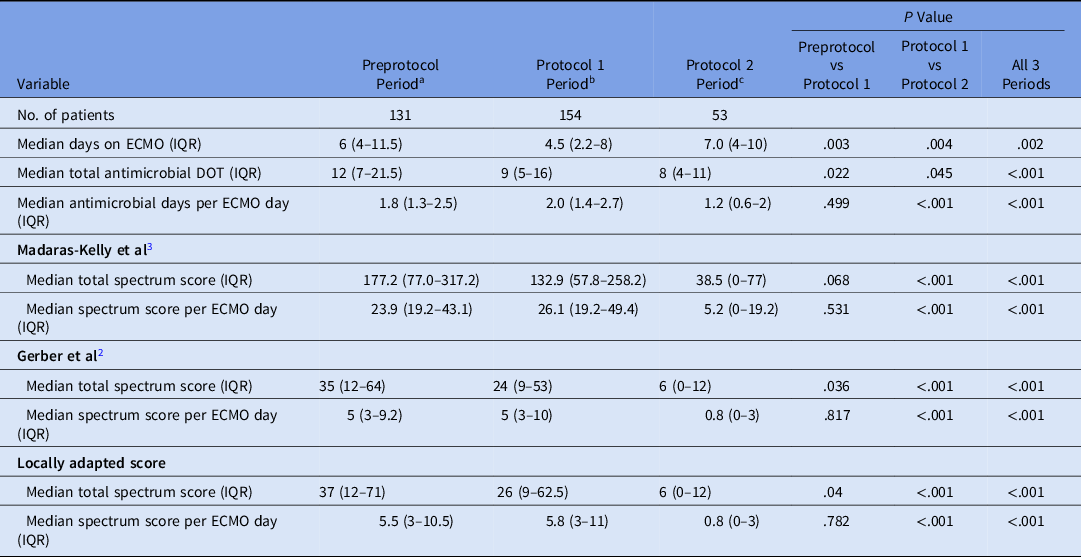
When evaluated across all 3 periods, we observed a consistent decrease of median total spectrum score and median spectrum score per ECMO day in each of the 3 scoring systems (P < .001). The median days on ECMO varied between time periods. When total spectrum scores were adjusted for days on ECMO, the median spectrum scores per ECMO day, after showing initial improvement, did not demonstrate statistically significant reduction in any of the 3 scoring systems between the preprotocol period and the protocol 1 periods (ie, no audit and feedback). However, between the protocol 1 and protocol 2 periods, a significant reduction in median spectrum score per ECMO day was observed in all 3 scores (P < .001) (Table 2).
Antimicrobial Use Metrics and Spectrum Scores

Note. ECMO, extracorporeal membrane oxygenation; IQR, interquartile range; N/A, not applicable.
a July 2011–June 2014.
b July 2014–June 2017.
c November 2018–November 2019.
Discussion
We applied 2 published antimicrobial-spectrum scoring methods to data to evaluate the impact of a 2-stage ASP intervention on antimicrobial prophylaxis regimens in our adult ECMO patient population. We then introduced a locally adapted version of the Gerber spectrum score. In addition to the previously cited spectrum scores, other studies have also evaluated antimicrobial use through the lens of spectrum of activity.Reference Stenehjem, Hersh and Sheng7,Reference Moehring, Ashley and Davis8 Such scores, as demonstrated in these data, allow the comparison of not only the quantity of each antimicrobial prescribed but also objective measurement of other aspects of antimicrobial use that have historically been difficult to quantify.
Our study has several limitations. By limiting evaluation to patients receiving antimicrobial prophylaxis on ECMO, the potential impact of the locally adapted score was not fully realized. Local scores were similar to those produced by the Gerber score, especially in the protocol 2 period, because the implemented ECMO protocols did not contain agents with significant modifications to the Gerber score based on the criteria by which modifications were made during local adaptation. Thereby, as adherence to the protocol increased, the locally adapted scores reverted to the original Gerber scores. Future research regarding the application of locally adapted spectrum scores should be directed toward evaluating therapeutic antimicrobial use in disease states with a wide array of antimicrobial prescribing practices, routes of administration, and patient acuity.
Our study also has several strengths. First, we have demonstrated internal health-system modification of an existing spectrum score, showing the feasibility of customization of a score to institutional ASP priorities. Although a locally adapted score may have limited external validity, it provides a locally tailored method to more aptly quantify antimicrobial use when both designing and measuring the impact of interventions. Second, we studied the application of these spectrum scores in a unique patient population. This critically ill patient population offers a different application of this method of measuring antimicrobial use and spectrum compared to the previously studied populations of community-acquired pneumonia and healthcare-associated pneumonia.Reference Gerber, Hersh, Kronman, Newland, Ross and Metjian2,Reference Madaras-Kelly, Jones, Remington, Caplinger, Huttner and Samore6 Lastly, the observed reduction in spectrum of activity for antimicrobial use when the refined protocol was coupled with prospective audit with intervention and feedback adds to the existing evidence demonstrating greater success with application of antimicrobial stewardship principles applied through active, rather than passive, strategies.
In conclusion, antimicrobial spectrum scores, both published and locally adapted, provide ASPs with another form of measuring antimicrobial use. Our application of these scores allowed for quantification of the impacts of a multifaceted intervention on prophylactic antimicrobial prescribing in patients receiving antimicrobial prophylaxis while on ECMO. Modification of an existing score to create an internally customized spectrum score allowed for a locally adapted interpretation of antimicrobial use, though further study of this practice is warranted in other therapeutic indications.
Supplementary material
To view supplementary material for this article, please visit https://doi.org/10.1017/ice.2021.13
Financial support
No financial support was provided relevant to this article.
Conflicts of interest
All authors report no conflicts of interest relevant to this article.