“We are not against the western media, but against the lies and fabricated stories in the media” reads the opening paragraph of the website anti-cnn.com. International media coverage of the Tibetan protests only a few months before the Beijing Olympics in 2008 triggered a strong reaction inside China. Many Chinese rejected American and European media coverage because of its perceived lack of objectivity and fairness, as illustrated by heated debate on the internet and slogans shouted during protests against Tibetan independence.Footnote 1 Chinese media practitioners took the opportunity to argue with propaganda authorities for more media freedom: “If not even Chinese journalists are allowed to report about the problems in Tibet, how can foreign journalists know about the Chinese perspective about the events?”Footnote 2 Indeed, by the end of the meeting of the National People's Congress the Chinese media were able to report about the protests, a highly sensitive issue rarely covered in the news.Footnote 3 Accordingly, netizens did not take up bias in the Chinese media as a topic of discussion. Instead, criticism directed at foreign information sources implied that Chinese citizens found the domestic media more trustworthy than foreign media sources.Footnote 4
Since the Chinese state continues to exert a considerable amount of control over the media, public support for domestic media reporting came as a surprise to many observers. Which media sources does the Chinese public perceive as credible and why? To what extent do Chinese citizens believe the mouthpiece of the Chinese Communist Party? Not much is known about the answers to these questions. So far, research on the media in China has focused on the changing relationship between media outlets and the state during the reform era.Footnote 5 Little is known about how China's changing media environment has affected the persuasion of media audiences. Research on political trust reveals that exposure to the media correlates positively as well as negatively with support for the government, which has been interpreted as evidence that the Chinese public either believes or disbelieves propaganda transmitted to them through the news media.Footnote 6 These contradictory results can be explained once we take into account that ordinary citizens do not consider all media sources to be equally credible, depending on the extent to which media outlets have undergone reform.
This article examines how commercial liberalization of newspapers, driven by deregulation, commercialization and partial privatization, figured into media effects on Beijingers' views about Japan in the spring of 2005. The anti-Japanese protests constitute an example of what Chinese media scholars call a “public opinion crisis.” This term refers to situations in which there is a mismatch between the position of the state and public opinion on a particular issue, thus endangering social stability and slowing down economic growth.Footnote 7 During the spring of 2005 there was a discrepancy between public opinion and the position of the government on Sino-Japanese relations: ordinary citizens demanded a strong reaction from the state, while the Foreign Ministry followed a more lenient stance. To calm down public anger towards Japan the Propaganda Department changed its management of the news media from relatively loose to strict control over news content. By chance, a randomly sampled public opinion survey was conducted in Beijing before and after these press restrictions, thus providing a unique opportunity to examine how citizens reacted to changes in media management. Beijingers made sense of a complicated media environment by attaching labels to different media outlets based on their perceived level of commercial liberalization. More commercialized media outlets were perceived as more credible than less commercialized ones. When the Propaganda Department imposed restrictions on media content, commercial liberalization promoted the ability of the state to influence public opinion through the means of the mass media.
Media Reform and the Structure of the Chinese Newspaper Environment
Economic reforms brought about changes in the structure of the Chinese state media. Before the reforms all media were state-owned and financed by the state, but budgetary constraints forced the government to sever media subsidies as early as 1978.Footnote 8 The media were encouraged to obtain outside funding through advertising and increased sales. Today most media institutions finance themselves with advertising revenues, though some continue to receive indirect or small state subsidies.Footnote 9 To facilitate commercialization the government provided lower levels in the broadcast and print administrative hierarchy with greater authority over programming, personnel and business decisions, and further promoted profit-orientation of media outlets through investment. First broadcasting and then print media became subject to the stock market in the late 1990s, and since 2002 non-media companies were allowed to invest in media groups. Although there remain restrictions – the share of non-state investment in media outlets must not exceed 49 per cent – the state has partially transferred property from public to private ownership.Footnote 10 Media reform thus included deregulation, commercialization and partial privatization of media outlets.
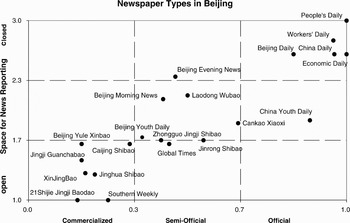
Individual media outlets have been affected by commercial liberalization to varying degrees, which has resulted in a complex media system. To learn about the nature of variation among newspapers I conducted 46 open-ended, semi-structured interviews with editors and journalists in Beijing and Chongqing. Figure 1 illustrates the structure of the Beijing newspaper market as seen by local media practitioners. The x-axis displays the degree of commercial liberalization of major newspapers in Beijing. Media practitioners distinguished between three newspaper types. Official papers are sponsored by a government organ and therefore include both Party (dangbao 党报) and political machine papers (jiguanbao 机关报); these papers are financed by a mix of indirect state subsidies and advertising, and are managed like a state organ.Footnote 11 At the other end of the spectrum are the commercialized papers (also referred to as dushibao 都市报 or xiaobao 小报) which finance themselves solely through advertising and investment, and are run like an enterprise with the goal of profit-making. Semi-official papers (also called wanbao 晚报) do not receive investment and therefore fit between those extremes. The three newspaper types vary with respect to their degree of commercial liberalization, with official and semi-official papers lagging behind the most progressive commercialized ones.
Newspapers in Beijing as Perceived by Local Media Practitioners, 2005

Since semi-official and commercialized papers shared many similarities in the eyes of media practitioners, they often referred to these two as non-official papers. Individual newspapers may not always fit neatly into these categories. The China Youth Daily (Zhongguo qingnian bao 中国青年报), for example, was often regarded as an official paper that “behaved” more like a non-official one. However, media practitioners made sense of a complicated media environment by distinguishing between different newspaper types, thus pointing towards general tendencies within a more complex media system.
In addition to raising the degree of commercial liberalization, about half of my interviewees spontaneously brought up variation in content when asked about differences between newspaper types. Their assessment of space for news reporting is indicated on the y-axis of Figure 1. Official papers were described as focusing on the most sensitive political issues. Commercialized papers were perceived as a tabloid press stressing less sensitive issues related to society, sports and entertainment. In the minds of media practitioners, commercially liberalized papers were more distant from the official line of the state: their reports were perceived to be closer to the boundaries of what was allowed than those of official papers. Figure 1 shows that commercial liberalization and perceived space for news reporting are linked to each other. When asked to rank newspapers in Beijing in terms of their openness or closeness of reporting,Footnote 12 interviewees said that greater commercial liberalization was related to more space for reporting.
These results illustrate that media practitioners associated commercial liberalization of the media with less government influence over the selection, framing and wording of news stories. It would be wrong to conclude, however, that the state has lost its ability to exercise influence over news content. Media practitioners were well aware of this fact: 35 per cent of interviewees pointed out that “China actually does not have a fully commercialized and truly private media.” Traditional media outlets remain integrated into the political structure. All major newspapers, radio and television stations are required to be registered under state and Party organizations; they are owned by the Party,Footnote 13 and they remain subject to the General Administration of Press and Publications, the State Administration of Radio, Film and Television, and the Propaganda Department. These institutions can influence the organization of the media industry, make personnel decisions and, most importantly, issue directives for news content. Despite media reform the state can exert considerable control over the news media, especially when an issue is seen as being core to social stability and economic growth. During protests, for example, the state is able to respond quickly by convening meetings between editors and officials of the Propaganda Department. Thus news content on a salient issue can be homogenized within a day.
Synchronization of all media is only necessary, however, if most media outlets communicate information to citizens that conflicts with the position of the state. Under normal circumstances media practitioners feel free to report about issues in any way they like as long as they do not overstep certain boundaries set by the Propaganda Department.Footnote 14 Within these general limitations individual media outlets differ with respect to their space for news reporting: some sources enjoy greater autonomy than others, depending on how deeply they have undergone reform.
Media Credibility in China
Non-official papers often advertise themselves as “The Paper that Talks Responsibly About Everything!” or “We make a Paper that is Close to YOU!”Footnote 15 These examples illustrate that newspaper types carry different labels or shuxing (属性). These labels are related to two concepts, which together make information sources credible: expertise and objectivity of the source.Footnote 16
In my interviews I asked about perceptions of different kinds of newspapers. Editors and journalists generally believed that official papers were experts on the position of the state organization the paper was registered with, while non-official papers were especially knowledgeable about the common people. Official papers were described as “representing the government's opinion”;Footnote 17 non-official papers, however, stressed issues that were “close to ordinary people's lives.”Footnote 18 In other words, less reformed, more tightly controlled media sources were considered to be experts on the position of the state, while more reformed, less tightly controlled media sources were seen as voicing public opinion.
In addition, media experts had opinions about the objectivity of different newspaper types. Official papers were perceived to publish propaganda. When using this term I refer to the Chinese term xuanchuan 宣传, which is used in a neutral way similar to the English term “persuasion.”Footnote 19 All my interviewees accepted the need for propaganda for the collective benefit.Footnote 20 Propaganda was based on subjective opinion aimed at guiding the reader in a certain direction. This direction was generally positive, emphasizing issues such as economic development, social development and people's happiness to keep the public in a positive mood.Footnote 21 Propaganda was also characterized by selective reporting. Most of the time this implied not being able to report an issue, especially when it was sensitive.
In contrast to propaganda, media practitioners believed that non-official papers published what they called “real news.” Real news reported the facts in a balanced fashion, providing the complete story including negative aspects.Footnote 22 Non-official papers played “table tennis by the edge,” constantly pushing the boundaries set by the state either by reporting quickly in order to pre-empt instructions from the propaganda authorities or by not respecting previously issued instructions.Footnote 23 Overall, official papers were regarded as propaganda organs, while semi-official and commercialized papers were perceived to be more balanced in reporting.
Together, these differing views of expertise and objectivity create the perception of a reliable source. A source that seems to know the truth but nevertheless appears to mislead is not perceived to be credible. Similarly, a source that appears sincere but is not able to provide accurate information will be perceived as unreliable.Footnote 24 Taking into account the fact that media credibility requires high levels of both expertise and objectivity, official papers generally ranked lower in terms of media credibility than non-official ones.
Media practitioners were not the only ones with these differing perceptions. When Beijingers were asked “which paper gives you a feeling of trust?” 83 per cent selected non-official papers while only 17 per cent chose official papers.Footnote 25 This is not to say that official media sources do not serve an important function in Chinese society. They are, in fact, very useful for telling citizens about the goals and policies of the government. Nevertheless, their usefulness does not necessarily mean that they are perceived as credible. Evidence for the different levels of credibility is provided by a quasi-experimental study of media influence on public opinion during the anti-Japanese protest in 2005.
A Quasi-Experimental Study of Attitude Change
In the spring of 2005 the Research Center of Contemporary China at Peking University conducted the Beijing Area Studies of Beijing Residents (BAS). The survey was originally planned for late 2004 (and thus named BAS 2004), but it was delayed.Footnote 26 Sampling was done according to probability proportional to size, a form of stratified random sampling. Polling in the survey involved face-to-face interviews by trained university students. The response rate was 56.1 per cent (n = 617). More detailed information about question wording and variable coding can be found in the online appendix at www.daniestockmann.net.
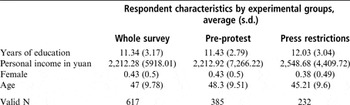
The timing of the BAS provides a unique opportunity for a quasi-experiment. A quasi-experiment draws an analogy between a situation observed in real life and an experiment. Its main advantage is that people can be observed behaving naturally without artificially created treatments and settings being imposed upon them. I employ a time-series experimental design, whereby the behaviour of similar people are observed over time throughout the course of the survey. At some point a treatment is introduced, in this case a change in state control over news media content about Japan after the first protest in Beijing. Since this method relies on treatment groups without random assignment, however, the assumption that members of treatment and control groups are indeed similar to each other needs to be tested.Footnote 27 The treatment group was slightly more educated, more affluent, younger and had slightly more males than the control group, features that were controlled for in the statistical analysis.Footnote 28 Therefore, it is plausible to interpret changes between those interviewed before and after the protests as media effects.
Course of Events and Newspaper Content
Nationalist outbursts of public anger towards Japan have been growing during the reform era. The series of anti-Japanese demonstrations started in 1985 when Japanese Prime Minister Nakasone paid an official visit to the Yasukuni Shrine on the 40th anniversary of Japan's surrender. Protests continued sporadically throughout the 1990s, then occurred almost annually from 2001 until the most recent wave in April 2005.Footnote 29
By the spring of 2005 international relations between China and Japan were becoming increasingly tense. In February Japan agreed with the United States at security talks that the Taiwan Strait issue was a mutual security concern. As the first such reference in the US–Japanese security alliance, this statement led the Chinese government to express concern about Japanese intervention in China's domestic affairs.Footnote 30 In March, political ties between China and Japan had become strained over rival claims to the Diaoyu islands in the East China Sea, where both nations had taken steps to exploit reserves of natural gas. In early April the Japanese government initiated procedures to grant Japanese firms the right to conduct test drilling. At about the same time, the United Nations were considering the promotion of Japan and other countries to permanent membership on the Security Council. On 5 April the Japanese Ministry of Education approved junior high school history textbooks that were interpreted as whitewashing Japanese war crimes during its occupation of China and South Korea in the 1930s and 1940s, and violent attacks on Japanese businesses and protests erupted in China as well as in South Korea, Vietnam, Canada and Europe.Footnote 31
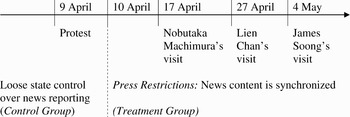
The first protest in Beijing took place on 9 April.Footnote 32 After a peaceful demonstration in Zhongguancun district several hundred protesters tried to storm the residence of the Japanese ambassador, hurling stones and bottles into the walled compound before riot police broke down the confrontation. Meanwhile protests were also taking place in Shanghai and other cities, until the government made it clear that it would not tolerate any more. In Beijing a continuation of action was effectively prevented on 17 April when police presence at a meeting point intimidated protesters.Footnote 33 The timing coincided with a meeting between Chinese Foreign Minister Li Zhaoxing 李肇星 and his Japanese counterpart Nobutaka Machimura as part of the seventh Asia–Europe Meeting.
Crisis management through the means of the mass media had started even earlier. Before the demonstrations, editors and journalists in Beijing had not been restricted when reporting about Japan.Footnote 34 Immediately after the first demonstration, however, space for news reports closed. The Propaganda Department issued instructions not to cover protest marches and to keep news reporting close to the government line (see Figure 2).Footnote 35 Self-censorship of news content related to Japan continued throughout April and May for two main reasons. First, spring has traditionally been a time in which students are likely to participate in protest marches: the May 4th movement and the 1989 demonstrations started at about this time. Furthermore, the government expected two important visitors in late April and early May, Lien Chan 連戰 and James Soong 宋楚瑜, leaders of two influential parties in Taiwan. Lien Chan, the leader of the Nationalist Party, visited the mainland for about a week in late April. This was the first time a Nationalist leader had been welcomed since the Nationalists had retreated to Taiwan in 1949. Immediately after his visit, James Soong, the leader of the People's First Party, was expected for another nine-day trip to the mainland. Space for news reporting on Japan continued to be tightly restricted during and after the two politicians' visits.Footnote 36
Timeline of Events in Beijing

These changes in media management constitute the treatment of our quasi-experiment. The BAS was conducted between mid-March and mid-May, thus allowing us to investigate the effects that the change of news content had on people's views about Japan during two periods. Before the first anti-Japanese demonstration in Beijing the state had loosened control over the news media. I therefore assign respondents who were interviewed during this first period to the control group that allows us to observe people's attitudes and behaviour during periods of relatively unconstrained news reporting. When space for news reporting closed after 9 April, Beijingers received a “press restrictions treatment”: news content became more uniform and less negative. This provides an opportunity to investigate who was persuaded by the sudden change in media messages.
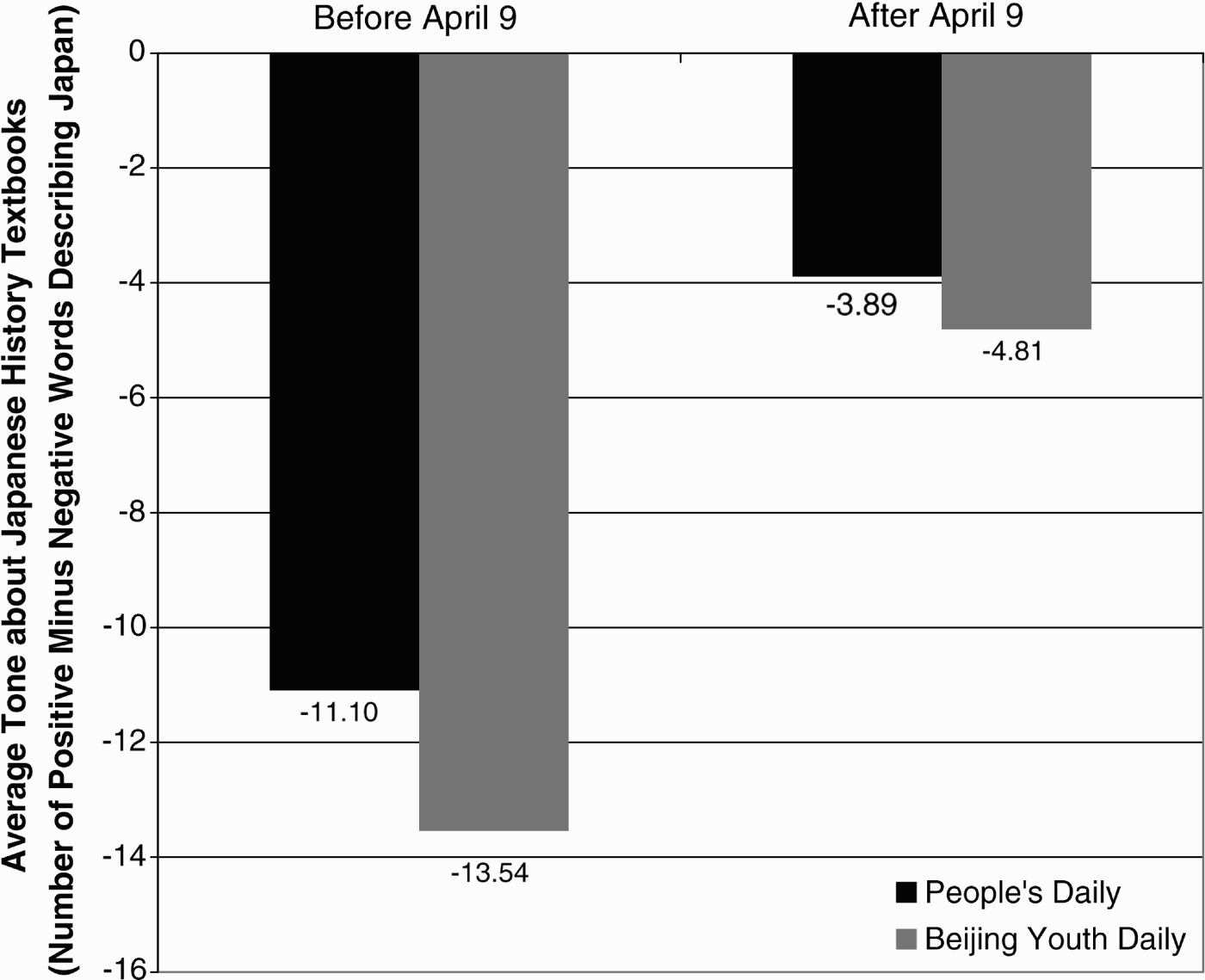
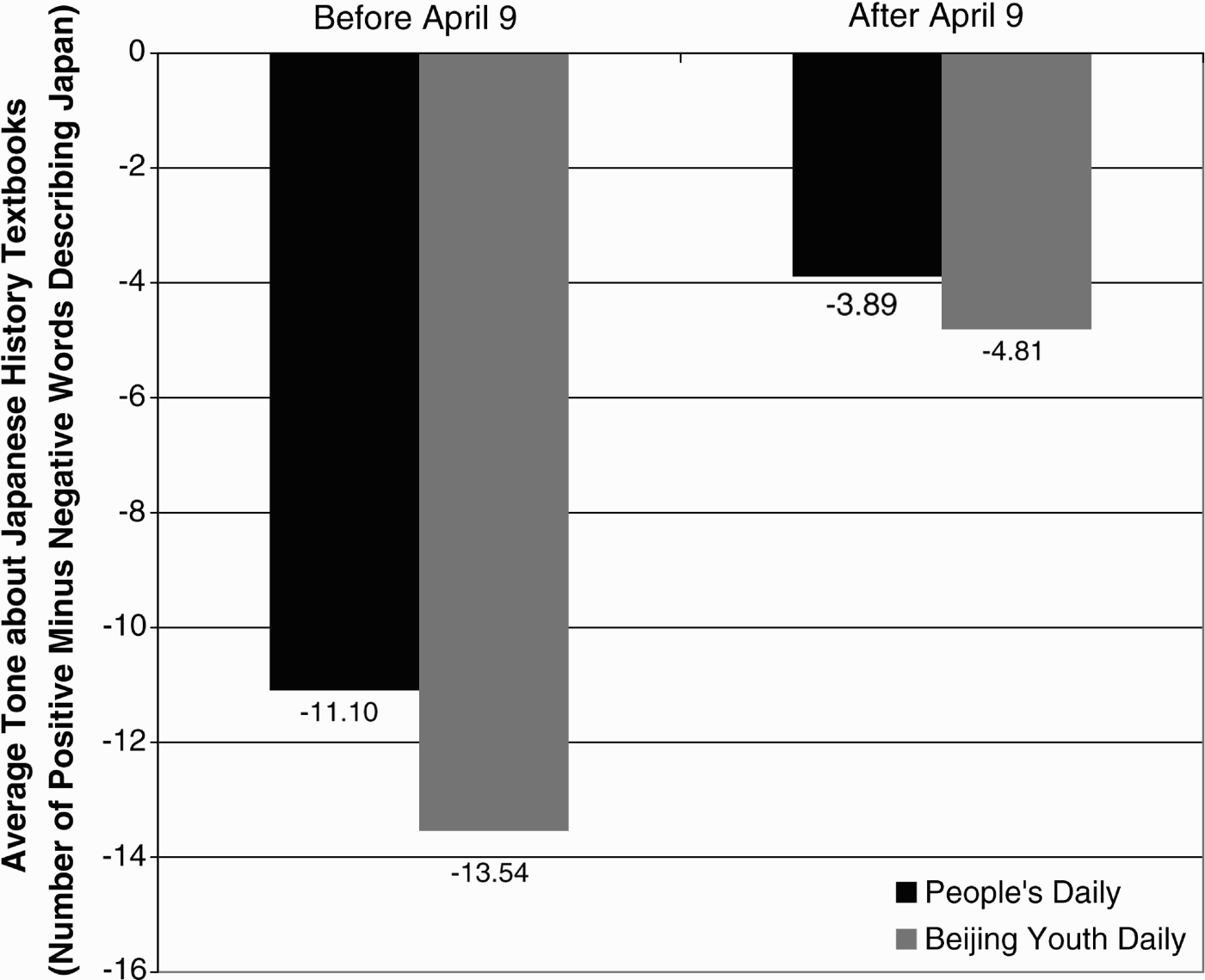
A content analysis of articles on the Japanese history textbooks in the Beijing Youth Daily (Beijing qingnian bao 北京青年报) and the People's Daily (Renmin ribao 人民日报) illustrate this point. To examine the tone in news reporting I used a content analysis program that can handle Chinese characters.Footnote 37 To derive at the tone of each article I subtracted the number of negative from the number of positive valence words within a semantic space of eight words before and after terms that referred to Japan. Figure 3 demonstrates that both newspapers became, on average, about eight words less negative after press restrictions had been imposed by the Propaganda Department.Footnote 38 While the Beijing Youth Daily had been about two words more negative beforehand, the difference between the newspapers decreased after 9 April. Press restrictions also became evident in an increased use of reports by the Xinhua News Agency since editors felt that it was safe to re-print these articles.Footnote 39 For example, the Beijing Youth Daily increased the percentage of Xinhua reports on the history textbooks from 58 to 69 per cent; the Xinjingbao 新京报 even went from zero to 50 per cent.Footnote 40
Average Tone of News Reports about the Japanese History Textbooks before and after 9 April 2005, n = 89
Why was the Beijing Youth Daily consistently more negative than the People's Daily when reporting about Japan? In an interview during the first week of April an editor-in-chief explained:
Stockmann: Can you give an example of how these newspapers differ when they cover international news? (referring to a list of newspapers available in Beijing)
Editor: Let's look at a recent example: when it comes to Japan there are differences in reporting. Recently, the People's Daily always reports about foreign policies. There is also some criticism, but it represents less the sentiment and attitudes of ordinary people, it needs to focus on the official side.… Papers like the China Youth Daily or the Global Times (Huanqiu shibao 环球时报) are more commercialized. Commercialization means that they respond more to the demands of the reader.
In an effort to attract readers non-official papers presented themselves as an outlet for the anger of outraged citizens. For example, the Xinjingbao detailed how the newly approved textbooks by the Japanese Ministry of Education downplayed Japan's imperialist past.Footnote 41 The Beijing Youth Daily featured the story of Saburo Ienaga, a Japanese historian who refused to let the authorities censor his textbooks, went to court about it and eventually won after 32 years.Footnote 42 Numerous articles emphasized the resistance of the Japanese state to changing how the Second World War is taught in Japanese high schools.Footnote 43 Reports in non-official papers expressed anger and distrust in the Japanese government that allegedly had not deviated from its expansionist plans since 1945.
Official papers, however, focused on official statements by both the Chinese and the Japanese sides. For example, the People's Daily contrasted reactions by the two spokespersons of the Ministries of Foreign Affairs. The Chinese official demanded that Japan should live up to its promise to reflect upon its history; the Japanese politican emphasized that the position of the Japanese government had not changed by the approval of the textbooks.Footnote 44 In doing so, the People's Daily selectively restated the official reaction of the Japanese side. Explanations as to why the controversial textbooks did not reflect government opinion were not taken up by newspapers, although reporters had asked relevant questions in press conferences.Footnote 45
After 9 April different newspaper types continued to present themselves as representatives of public opinion and the government. Apart from re-printed Xinhua reports that publicized calls by the Foreign Ministry to express feelings in a “calm, rational, and orderly manner in accordance with the law”Footnote 46 and to let the government handle the crisis through diplomatic ties,Footnote 47 newspapers published their own reports. The Beijing Youth Daily publicized a collection of quotations from internet websites, for example, restating the opinion of netizen “Fish”: “the behaviour of Japan hurt the feelings of the Chinese people and we need to protest and express our sentiment, but we need to use legal and effective means to voice our opinions and don't cause any trouble to the Party and the government.”Footnote 48 Meanwhile, the People's Daily printed an article by “Zhong Xuanli” 钟轩理, a pen name of an official at the Central Propaganda Department,Footnote 49 which warned not to use e-mail and short messages to mobilize protest and not to cause public disorder. Instead, a true patriot had the goal of furthering the stability of society and the development of the country, and revitalizing the nation.Footnote 50 With less difference in tone and choice of topics, the framing of the articles remained the key difference between non-official and official papers.
Overall, newspaper reporting about Japan became considerably more positive after press restrictions were imposed. Official and non-official newspapers varied in terms of tone, topics and framing of articles, but the basic political messages were much the same for the different newspaper types. Nevertheless, slight differences in the way in which the news was delivered in the non-official papers contributed to creating the label of a news product that is credible. Yet if official papers ranked low in terms of their credibility, why did some Beijingers decide to read them?
Patterns of Newspaper Consumption
Newspapers are one of the most popular news media sources in urban areas.Footnote 51 In recent years they have continuously been ranked the second favourite news media source after television.Footnote 52 In Beijing about 80 per cent of urban residents read newspapers. Most of the time people read them in the late afternoon or evening, skimming the headlines first and reading the article in more detail if interested. In 1996 readers in Beijing spent, on average, 42 minutes a day reading newspapers. In contrast to Europe and the United States, people in China usually read the newspaper at their work unit or purchase it at a newspaper stand rather than subscribe.Footnote 53 As a consequence, Chinese readers switch frequently between newspapers and read a great variety of them. In Beijing, for example, people read, on average, two different newspapers; some read up to ten.Footnote 54
Urban residents generally favour non-official papers: in 2005 only about 36 per cent of readers chose to read official papers in Beijing. Among non-official papers semi-official ones were the most popular with about 83 per cent of readers. The situation of commercialized papers was similar to that of official papers, with about 39 per cent of readers.Footnote 55
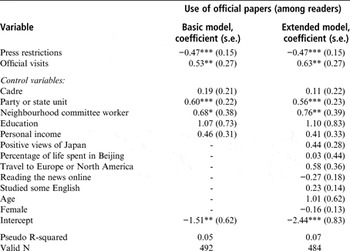
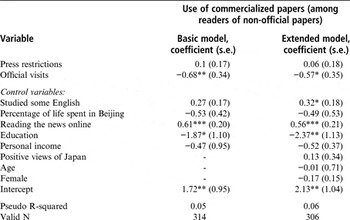
The readers of the three newspaper types differed in terms of their income, education, profession and sedentariness. To illustrate the differences I developed profiles for four types of readers in Beijing, henceforth called Old Wang, Comrade Shu, Mrs Li and Little Zhao. These profiles are empirically drawn based on predicted probabilities to read different kinds of newspapers among BAS respondents. Detailed results of the multiple probit analysis can be found in Tables A2 and A3 in the Appendix.
Old Wang represents the average reader in Beijing in 2005. He earned about 2,338 yuan per month and had received about 11 years of education, which was equivalent to a Chinese high school degree. He preferred to read semi-official papers, particularly the Beijing Evening News (Beijing wanbao 北京晚报). Old Wang was only 37 per cent likely to read official papers.Footnote 56
Comrade Shu, Mrs Li and Little Zhao differed from Old Wang in ways that made them more likely to use other paper types. Official papers are read by the two kinds of readers named Comrade Shu and Mrs Li. Comrade Shu identified himself as a regular official working for a Party or government unit, who received about three more years of education and had a monthly salary about four times higher than Old Wang (about 9,464 yuan). Party and government units usually subscribe to official papers to make sure that officials are informed about political decisions made by state units at higher and lower levels of government. Since Comrade Shu was conveniently supplied with newspapers at work, he was 71 per cent likely to read official newspapers,Footnote 57 about 34 per cent more likely than Old Wang.
Mrs Li also favoured official papers, but in contrast to Comrade Shu, who also bought commercialized papers, she exclusively read them. Mrs Li was a neighbourhood committee worker. These workers often organize collective newspaper readings for senior citizens and are therefore supplied with newspapers at work. Her low salary (about 936 yuan) may explain her reluctance to purchase non-official papers at newspaper stands. Overall, she was 63 per cent likely to read official papers.Footnote 58
Finally, Little Zhao was part of a group of residents that tends to be more mobile and internationally oriented than the average Beijinger. In contrast to Old Wang, Little Zhao had spent most of his life at places other than Beijing, travelled to North America or Europe, had studied some English and surfed the internet. These characteristics made him 75 per cent likely to read commercialized papers, which was about 42 per cent more likely than Old Wang.Footnote 59
Why did cadres and neighbourhood committee workers in Beijing choose to read official papers? Subscriptions by their work units made these papers easily accessible to them, and their professions required knowledge about government policies. Therefore, they primarily read official papers because this knowledge was useful to them. Yet reading official papers did not necessarily entail that readers were convinced by their content. A closer examination of how readers' selection of newspapers changed over time further illustrates this point.
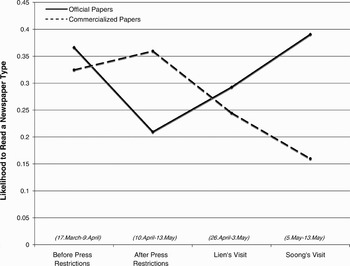
Figure 4 shows how readers in China reacted to press restrictions and the first official visits by Taiwanese leaders to China since 1949 (see also Tables A2 and A3 in the appendix). Once press restrictions were imposed on the news media and media content became more positive than public opinion, readers searched for the news product that they expected to divert from the official line and to report from the perspective of ordinary citizens.Footnote 60 Accordingly, all readers moved away from official papers towards non-official papers.Footnote 61 Readers of non-official papers, such as Old Wang and Little Zhao, became slightly more likely to select commercialized papers. Yet official events provided an incentive for them to move back to their regular patterns of newspaper use.Footnote 62 Visits by Lien Chan and James Soong were big media events that were continuously reported about even after they had returned to Taiwan.Footnote 63 Once incentives were given to citizens to look for information about how the government dealt with the two politicians, they became again more likely to read official papers – while remaining sceptical about news content on Japan. This scepticism also showed when examining media effects.
The Average Beijinger's Use of Newspapers Types Over Time (among readers)

Appeasement of Angry Citizens through the Media
To understand how the Chinese media influenced citizen opinion during the anti-Japanese protests we need to take a closer look at how people learn about issues through the news media. Exposure to the news media alone does not change attitudes. Research in political communication has shown that a person's level of attentiveness to an issue affects whether that person is influenced by the mass media.Footnote 64 For example, if readers do not pay attention to international news and therefore skip that section of the newspaper, they will not be affected by reading the paper. Because of the increasing tension in Sino-Japanese relations leading up to the protests, I assume that most readers in Beijing were at least moderately attentive to news related to Japan at the time. Therefore, we should be able to detect media effects when investigating whether the relationship between newspaper consumption and sentiment towards Japan differs between Beijingers interviewed before and after 9 April.
Since Beijingers reportedly read a number of newspapers, I created a variable that measured the extent to which a reader was, on average, exposed to commercialized messages. The BAS contained information about which and how many newspapers respondents were reported to read. Based on how commercially liberalized media practitioners had assessed each paper (see Figure 1), I assigned weights to each newspaper and calculated the average score among all newspapers a person read. The resulting variable ran from zero to one, with low numbers reflecting being, on average, exposed to official messages and high numbers being, on average, exposed to commercialized messages. To interpret the statistical results it is helpful to consider where the readership profiles introduced in the previous section end up on this scale of exposure to commercialized messages. Mrs Li ended up at the lower and Little Zhao at the higher end of the scale; Comrade Shu and Old Wang fell in between these two extremes.
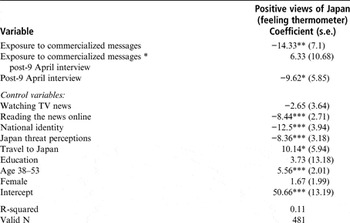
To analyse media effects I investigated the two-way interaction between exposure to commercialized messages and the dummy variable for being interviewed after 9 April (see Table 1). Before 9 April readers of commercialized papers, such as Little Zhao, felt about 14 degrees more negative towards Japan than readers of official papers, such as Mrs Li. As a standard for comparison, being exposed to commercialized messages made about as much of a difference as having a strong nationalist identity, which decreased Beijingers' feelings towards Japan by about 12 degrees, on average. Yet after press restrictions had been imposed, readers with different readership habits became more similar to one another, as indicated by the positive (though statistically insignificant) sign of the interaction term.Footnote 65 Now Little Zhao only felt about 8 degrees colder towards Japan than Mrs Li. Consistent with the synchronization of news content, Beijingers with different readership habits differed less in terms of their attitudes towards Japan. Press restrictions resulted in more homogenous views among readers.
OLS Regression Results on Positivity towards Japan among Readers

Notes:
p-value * p < 0.1; ** p< 0.05; *** p < 0.01.
Source:
BAS 2004.
In addition to inducing greater uniformity, the media were also able to appease angry citizens, which can be observed when examining the effects of the press restrictions as exposure to commercialized messages varies. The anti-Japanese protests induced a sense of crisis among Beijingers: even though news reporting about Japan became more positive after 9 April, those exposed to official messages, such as Mrs Li, felt about 9 degrees colder towards Japan than before the protests, as indicated by the dummy variable. Scepticism about news reporting made readers of official papers resistant to changes in the tone of the reports. Yet exposure to commercialized messages pulled readers' views of Japan into a positive direction of up to 6.33 degrees. For example, Little Zhao only felt about 3 degrees colder towards Japan after 9 April than beforehand. Although reporting in official as well as more commercialized papers was roughly uniform, the commercial wrapping of newspapers made readers more susceptible to the nature of the news reports. Everyone felt more negatively towards Japan after the demonstrations, but being exposed to commercialized messages mitigated the effect.
Taking into account that Beijingers read more than one newspaper further confirms these results.Footnote 66 Readers of official papers, such as Mrs Li, became more resistant to news reporting as they read more newspapers. Despite highly negative press reporting before 9 April, reading more papers made them feel more warmly towards Japan; and regardless of the more positive tone in the press after 9 April, exposure to more papers made them feel colder. Yet as readers consumed more commercially liberalized papers, the situation was reversed. When reading additional papers, readers of commercialized papers, such as Little Zhao, expressed more negative views towards Japan before 9 April and more positive ones afterwards. Less commercialization was associated with greater scepticism while more commercialization boosted the crediblity of media sources. Once press restrictions were imposed, the commercial liberalization of the media assisted the state in appeasing angry citizens.
The Role of Commercialized Media during the Public Opinion Crisis
Despite the manifold literature on the Chinese media, there has been little research so far on media effects in the China field. The results presented in this article demonstrate that Chinese leaders are able to manipulate public opinion during a crisis. The Propaganda Department effectively cooled off hostility towards Japan by imposing press restrictions during the anti-Japanese protests in 2005. Commercial liberalization of the media played a key role in guiding public opinion into a more positive direction. Slight differences in news reporting among different newspaper types boosted the credibility of non-official papers in the eyes of readers. As a result, Beijingers preferred to read and believe papers that were more strongly commercialized.
Yet the case of the anti-Japanese protests also shows that commercial liberalization of the media benefits the state only as long as the Propaganda Department is able to impose press restrictions effectively on media outlets when needed. When space for news reporting was loosely controlled, editors and journalists attempted to satisfy the perceived demands of their readers and thus published highly critical stories about Japan. Because of the credibility bonus that comes with commercial liberalization, non-official papers were particularly effective in accelerating negativity towards Japan. When being loosely controlled, commercialized media outlets can act as a catalyst for disagreement between citizens and government and thus facilitate protest.
At times, these dynamics may be helpful for propaganda authorities. To a certain extent Chinese political leaders profited from tolerating public expressions of negativity. Domestically, nationalists could have easily turned against the regime when not allowed an outlet to express their anger. Internationally, protesters added to the legitimacy of foreign policy positions as the public display of the Chinese people's resentment increased the audience costs of the Chinese central leadership.Footnote 67 Accordingly, the Propaganda Department only stepped in after Beijingers had been permitted to voice their feelings in a demonstration. In the absence of press restrictions the government “outsourced” media control to the market and thus gave tacit consent to the mobilization of resentment against Japan through the means of the mass media.
Similarly, Chinese leaders had nothing to fear from lifting restrictions on the protests in Tibet in 2008. The case of the anti-Japanese protests shows that, at least in Beijing, readers prefer to read and trust media that report about the “real news” of the day from the perspective of ordinary citizens. Not surprisingly, once media outlets were free to respond to the demands of primarily Han audiences on Tibet, they were supporting the position of the central authorities in the conflict. As long as the Chinese Communist Party retains its ability to enforce press restrictions when necessary, commercial liberalization of the media can be used as a tool to achieve policy goals in times of crisis.
Appendix
Demographic Characteristics of Readers

Source:
BAS 2004.
Multiple Probit Regression on Use of Official Papers Among Readers in Beijing

Notes:
z-value * z < 0.1; ** z< 0.05; *** z < 0.01.
Source:
BAS 2004.
Multiple Probit Regression on Use of Commercialized Papers Among Readers of Non-Official Papers in Beijing

Notes:
z-value * z < 0.1; ** z< 0.05; *** z < 0.01.
Source:
BAS 2004.