Introduction
Skeletal muscle is composed of different types of fibers, which are classified according to morphological as well as to functional characteristics (Ogata, Reference Ogata1958). The specificity of the metabolic route and type of contraction inherent to the myosin chains lead to extensive studies, which resulted in several methods of classification of the myofibers, based on metabolism, contraction properties and color.
Apart from the slow-twitch type I, Hämäläinen and Pette (Reference Hämäläinen and Pette1993) identified three myofiber fast-twitch types (IIA, IIB and IIX or IID) in adult rabbit skeletal muscle based on the histochemical classification proposed by Brooke and Kaiser (Reference Brooke and Kaiser1970). According to Bredman et al. (Reference Bredman, Weijs, Moorman and Brugman1990), SDH activity indicated that both types I and IIA could be classified as oxidative. Therefore, type I fibers show slow twitch and oxidative metabolism, type IIA fibers show fast twitch and oxidative metabolism, whereas type IIB/X fibers show fast twitch and glycolytic metabolism. These fiber types have been designated as SO (slow oxidative), FOG (fast oxidative-glycolytic) and FG (fast glycolytic) by Peter et al. (Reference Peter, Barnard, Edgerton, Gillespie and Stempel1972).
The proportion of muscle fiber types in meat animals is a key factor in the determination of meat quality and of the degree of susceptibility to stress. The effect of stress on muscle tissue is in direct proportion to the percentage of IIB/X fibers, which in its turn, occurs in higher proportion in farm animals selected for growth rate (Ashmore and Robinson, Reference Ashmore and Robinson1969; Dildey et al., Reference Dildey, Aberle, Forrest and Judge1970). In addition to the evaluation of the metabolic and contraction properties of the myofibers and their distribution in skeletal muscle, it is important to investigate their cross-sectional areas, once they are responsible, to a great extent, for the final muscle weight (Ashmore et al., Reference Ashmore, Tompkins and Doer1972). Therefore, the measurement of the area or diameter of the muscle fibers may help explain growth differences among animals.
In species where the newborn presents a low degree of maturity, such as in rabbits, all muscles are oxidative at birth. After birth, each muscle gradually acquires its specific pattern of energy metabolism (Briand et al., Reference Briand, Boissonnet, Laplace-Marieze and Briand1993; Gondret et al., Reference Gondret, Lefaucheur, D’ Albis and Bonneau1996). Selection for growth rate in rabbits has resulted in myofiber hypertrophy (Gondret et al., Reference Gondret, Combes, Larzul and De Rochambeau2002), together with increased (Pascual and Pla, Reference Pascual and Pla2007) or unchanged (Hernandez et al., Reference Hernandez, Aliaga, Pla and Blasco2004) oxidative traits evaluated through enzymatic activity. Although a lower proportion of slow-type myosin heavy chain has been demonstrated in rabbits selected for a rapid growth rate (Ramírez et al., Reference Ramírez, Oliver, Pla, Guerrero, Ariño, Blasco, Pascual and Gil2004), no changes in the relative proportion of fiber types as evaluated by m-ATPase histochemistry have been elicited (Gondret et al., Reference Gondret, Larzul, Combes and De Rochambeau2005).
This study was designed to investigate the effects of the interaction among the genetic group, sex and age on the frequencies and cross-sectional areas of myofiber types in rabbits. The longissimus dorsi (along with the hind leg muscles) is the muscle of the greatest economic value in rabbits; however, for being a long muscle, its fiber composition may not be homogeneous across all its extension (Vigneron et al., Reference Vigneron, Bacou and Ashmore1976). Sampling a smaller muscle would overcome this problem. Since one of the objectives of this study was to investigate the age modulation of myofiber types, a small mixed metabolism muscle would be ideal, so the flexor carpi radialis was selected.
Material and methods
General management and experimental design
Initially, 144 weaned rabbits, males and females, were assigned to 16 wire cages, nine per cage, according to genetic group and gender, at weaning (35 days of age). From day 42 to 91, a total of 128 rabbits were slaughtered at weekly intervals, 16 per week. The weight of their flexor carpi radialis muscle was recorded as well as other traits used in performance, carcass and allometry of growth studies (Bianospino et al., Reference Bianospino, Moura, Fernandes and Wechsler2005 and Reference Bianospino, Wechsler, Fernandes, Roça and Moura2006). Due to resource limitations, only 48 animals slaughtered at 42, 63 and 84 days of age were used in the study of muscle fiber types. Half of them were from the Botucatu strain and half were products of the crossbreeding between Botucatu females and White German Giant males.
The Botucatu genetic group is a synthetic multi-purpose strain, originated from Norfolk 2000 rabbits (Moura et al., Reference Moura, Polastre and Wechsler2000), selected according to a selection index, which included growth and litter traits (Moura et al., Reference Moura, Costa and Polastre2001) over a period of 2.6 years. In the last 10 years, the selection criteria have been litter size at weaning and post-weaning growth rate in an independent level selection (Garreau et al., 2004). Adult body weight of Botucatu rabbits varies from 4.0 to 5.0 kg. Ten German Giant breeding males were acquired from a commercial producer. They were heavier (body weight between 5.5 and 6.5 kg) and assumed to be later maturing than the Botucatu strain.
Animals had free access to feed and water. A pelleted feed formulated according to De Blas and Mateos (Reference De Blas and Mateos1998) to contain 10.5 MJ DE/kg, 16% CP and 16.7% ADF was produced on campus. Details of the diet were previously presented (Bianospino et al., Reference Bianospino, Wechsler, Fernandes, Roça and Moura2006).
A 2 × 2 factorial arrangement (genetic group × gender) was employed in a completely randomized design with repeated measures; the factorial was applied to the main plots (cages) and the repeated measures consisted of the ages.
Histochemical analyses
At 42, 63 and 84 days of age, one rabbit was randomly taken from each cage (four per genetic group × sex combination) for slaughter. The flexor carpi radialis muscle from the left fore leg was dissected and weighed. Small fragments from its median region were frozen in liquid nitrogen for histochemical analyses.
In a cryostat microtome at −20°C, 10-μm-thick cross-sections were obtained and processed for myofibrilar ATPase (m-ATPase) activity, after acid (pH 4.6 or 4.5) pre-incubation (Guth and Samaha, Reference Guth and Samaha1969). When the pre-incubation was performed at a pH 4.6, type IIB/X fibers reacted so intensely that it was difficult to differentiate between them and type I myofibers. After the pre-incubation at pH = 4.5 it was possible to distinguish among the three types of myofibers that were classified as type I, IIA and IIB + IIX (Brooke and Kaiser, Reference Brooke and Kaiser1970).
The morphometric analysis involved recording of fiber type frequencies and myofiber cross-sectional areas. For each animal, five microscopical fields were sampled in which all myofibers were counted and classified. Additionally, the cross-sectional area of each fiber was determined using a Digital Image Analysis System (Leica QWin). For each animal, the proportion and cross-sectional areas of myofiber types were computed from the average of these five values.
Statistical analyses
The frequency of fiber types data was transformed in logits and analyzed employing the maximum likelihood method, with the CATMOD procedure of Statistical Analysis Systems Institute (SAS, 2001), according to a model that included the fixed effects of genetic group, sex, age at slaughter and interactions. χ 2 tests were used to compare fiber type proportions. The statistical model used for the analyses of flexor carpi radialis muscle weight and cross-sectional areas of fiber types included the fixed effects of genetic group, sex, age at slaughter and interactions, and the random effects of cage (genetic group × sex) and of the residual. The MIXED procedure of SAS (2001) was employed.
Results
Two of the male rabbits slaughtered at 63 days of age, one straightbred and one crossbred, showed body weights that were more than three standard deviations below average and were found to be athymic at slaughter. Their data were thus ignored.
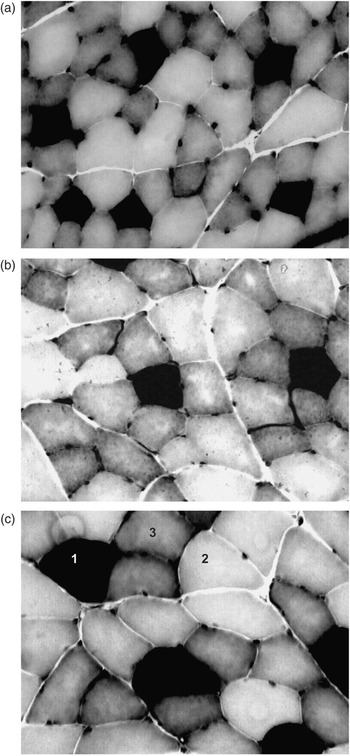
Three different populations of myofibers were identified in the flexor carpi radialis muscle of straightbred and crossbred rabbits at 42, 63 and 84 days of age. The classification of muscle fiber types (type I, type IIA and type IIB/X), shown in Figure 1, was based on the intensity of staining of m-ATPase reaction after acid (pH 4.5) pre-incubation.
Flexor carpi radialis muscle (40×) of crossbred female rabbits slaughtered at 42 (a), 63 (b) and 84 days of age (c). Notice the three types of fibers: I (1), IIA (2) and IIB/X (3) and also the hypertrophy in the more advanced age. ATPase, after acid pre-incubation (pH = 4.5).

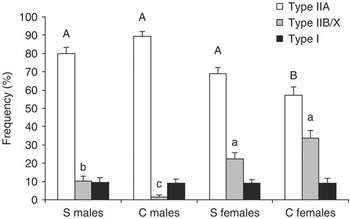
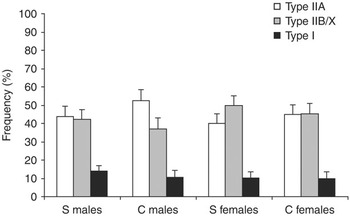
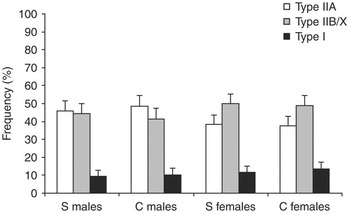
Genetic group × sex × slaughter age interaction effects (P < 0.01) were detected on the frequency distribution of the three myofibers types. For each slaughter age (42, 63 and 84 days) the frequencies of fiber types are shown in Figures 2–4.
Frequency of myofiber types in the flexor carpi radialis muscle of straightbred (S) and crossbred (C) males and females at 42 days of age. Bars with different letters (A, B for proportions of type IIA fibers and a, b, c for proportions of type IIB/X) differ (P < 0.01).

Frequency of myofiber types in the flexor carpi radialis muscle of straightbred (S) and crossbred (C) males and females at 63 days of age.

Frequency of myofiber types in the flexor carpi radialis muscle of straightbred (S) and crossbred (C) males and females at 84 days of age.

At 42 days of age, type IIA fibers were the most frequent in all four genetic group × sex combinations (Figure 2); however, comparing genetic groups within sexes, the proportion of type IIA fibers did not differ between straightbred and crossbred males (89.4% v. 80.1%, respectively), but was higher in straightbred than in crossbred females (68.8% v. 57.3%, respectively, P < 0.01). The proportion of type IIB/X fibers behaved exactly the opposite way: it was higher in straightbred than in crossbred males (10.3% v. 1.6%, respectively, P < 0.01), but did not differ between straightbred and crossbred females (22.3% v. 33.7%, respectively). Additionally, the proportion of type IIB/X fibers was higher in females from both genetic groups than in males (P < 0.01). No differences in the frequency of type I fibers were observed among the four genetic group × sex combinations at 42 days of age, whose proportions were 9.6%, 9.0%, 8.9% and 9.1% for straightbred and crossbred males and females, respectively.
With the advancement of age from 42 to 63 days, a sharp decrease in the proportion of type IIA fibers (P < 0.01) and a simultaneous pronounced increase in the proportion of type IIB/X fibers (P < 0.01) were observed in all genetic group × sex combinations, except in crossbred females (P = 0.09 for type IIA and P = 0.14 for type IIB/X). But the frequency of type IIA fibers was already lower and of type IIB/X fibers numerically higher for this group at 42 days of age. The proportions of type IIA fibers in straightbred males, crossbred males and straightbred females decreased from 80.1%, 89.4% and 68.8% at 42 days to 43.9%, 52.3% and 40.1% at 63 days, respectively, whereas the proportions of type IIB/X fibers, in the same groups, increased from 10.3%, 1.6% and 22.3% at 42 days to 42.2%, 37.0% and 49.8.1% at 63 days, respectively. Comparing genetic groups within sexes at 63 days (Figure 3), no differences in the proportions of type IIA fibers were detected between crossbred and straightbred males (52.3% v. 43.9%, respectively), or females (45.0% v. 40.1%, respectively). Similarly, no differences in the proportions of type IIB/X fibers were detected between crossbred and straightbred males (37.0% v. 42.2%, respectively), or females (45.2% v. 49.8%, respectively). Again, no differences in the frequency of type I fibers were observed among the four genetic group × sex combinations at 63 days of age, whose proportions were 13.9%, 10.7%, 10.1% and 9.9% for straightbred and crossbred males and females, respectively.
In the last period, from 63 days to 84 days no changes in the proportions of type IIA, type IIB/X and type I fibers were observed for any of the four genetic group × sex combinations relative to the previous period. Therefore, at 84 days of age, the frequencies of the three fiber types were similar in the four groups: 46.0%, 48.4%, 38.4% and 37.4% type IIA; 44.5%, 41.4%, 50.1% and 49.0% type IIB/X and 9.5%, 10.3%, 11.5% and 13.6% type I, in straightbred and crossbred males and females, respectively (Figure 4).
In all three age points, type IIA fibers showed the largest cross-sectional area, followed by type I and then by type IIB/X fibers (Table 1). Neither three-way (genetic group × sex × age) nor two-way (genetic group × sex, genetic group × slaughter age or sex × slaughter age) interaction effects were detected on the cross-sectional areas of any of the fiber types. But type IIB/X fibers had larger area in crossbreds than in straightbreds (Table 1). No differences between genetic groups were found concerning the cross-sectional areas of type IIA and type I fibers, although they were numerically higher in the crossbreds. The cross-sectional areas of all three types of fibers showed linear association with age (P < 0.001). Relative to the initial area at 42 days, the area of type IIB/X fibers increased proportionally more, 144% on average, than that from type IIA and type I fibers (86% and 85%, respectively), up to 84 days.
Least-square means (s.e.) of the cross-section areas (μm2) of muscle fibers types according to genetic group, sex and age

1Prob. = probability of type I error in the F test.
No genetic group × sex × age of slaughter interaction effects were detected on the weight of the flexor carpi radialis muscle, but the genetic group × sex interaction (P = 0.01) and the genetic group (P < 0.01) affected this trait. Comparing genetic groups within sexes, the flexor carpi radialis muscle was heavier in crossbred than in straightbred females (1.077 ± 0.018 v. 0.932 ± 0.018 g, P < 0.01), whereas no difference in the weight of this muscle was observed between crossbred and straightbred males (1.024 ± 0.018 v. 0.982 ± 0.018 g, P = 0.12). Additionally, weight of the flexor carpi radialis muscle increased linearly with age (P < 0.001) from 0.625 ± 0.025 g at 42 days to 1.267 ± 0.025 g at 84 days.
Discussion
This study provides evidence of a transition from type IIA to type IIB/X fibers in the flexor carpi radialis muscle of rabbits with the advancement of age from 42 to 63 days, which happened earlier and was more pronounced in females than males. The frequency of type I fibers did not show age-related changes. A higher degree of hypertrophy of type IIB/X fibers, relative to type I and IIA fibers, from 42 to 84 days, was also observed.
Type IIA fibers were predominant in all four genetic groups x sex combinations at 42 days, followed by type IIB/X fibers, which showed a heterogeneous distribution among genetic groups and sex combinations. From 42 to 63 days, there was a sharp decrease in the proportions of type IIA fibers and a simultaneous increase in the proportion of type IIB/X fibers, leading to a relative equilibrium between them at 63 days. In the next period, from 63 to 84 days, slight changes occurred following the same previous trend, but they were not significant. Dalle Zotte et al. (Reference Dalle Zotte, Rémignon and Ouhayoun2005) have shown similar growth-related changes in fiber type frequencies in biceps femoris muscle.
However, in the present study, these age-related changes in fiber types frequencies were not uniform across genetic groups and sexes. They occurred earlier and faster in females than in males, and in straightbreds than in crossbreds. Therefore, a transition from type IIA to type IIB/X fibers was observed in the flexor carpi radialis muscle with advancing age, but it happened earlier and was more pronounced in females than males. As a result of these changes, at 84 days, the proportion of type IIB/X fibers was numerically higher than of type IIA fibers in females, but not in males.
Changes in muscle fiber proportions described in this study seemed to have paralleled the evolution of dressing percentage as described by Bianospino et al. (Reference Bianospino, Wechsler, Fernandes, Roça and Moura2006) and could provide a partial explanation for it. They give support to the hypothesis of a lower degree of maturity of crossbreds up to 84 days of age. Lambertini et al. (Reference Lambertini, Lalatta Costerbosa, Petrosino, Zaghini, Vignola, Benassi and Gatta1996) reported differences in the proportions of muscle fiber types of three different muscles between Hyla and Provisal hybrid rabbits, but they did not find changes associated with age. Their study, however, involved exclusively males and began at 75 days of age. Attention should be drawn to the fact that no further changes in the proportions of myofiber types were detected in the present study after 63 days of age.
As pointed out by Gondret et al. (Reference Gondret, Lefaucheur, D’ Albis and Bonneau1996), rabbit skeletal muscle shows a high degree of plasticity at early ages due to its immaturity, allowing the modulation of muscular characteristics by hormonal factors, among others. In the present study, sexual hormones could have influenced the transition from type IIA to type IIB/X fibers at a different pace in females and males. Dalle Zotte et al. (Reference Dalle Zotte, Rémignon and Ouhayoun2005) related feed rationing (from 5 to 8 weeks) followed by compensatory growth (from 8 to 11 weeks), to a fast increase in glycolytic energy metabolism and a correlated decrease of oxidative energy metabolism in the biceps femoris muscle of hybrid rabbits.
As expected, the cross-sectional areas of all three types of fibers increased with advancing age, reflecting hypertrophy, but type IIB/X fibers enlarged proportionally more. Dall Pai et al. (Reference Dall Pai, Costa and Curi1982) pointed out that because type IIB/X fibers are anaerobic, they show reduced rates of metabolite and oxygen exchange, being compatible with the process of hypertrophy. Type I fibers, on the other hand, are aerobic and, therefore, associated with the continuous process of energy production and consumption. This type of myofiber relies on high rates of metabolite and oxygen exchanges and, as a consequence, are not suited for hypertrophy.
Across all three age points, type IIA fibers showed larger area, followed by type I and then by type IIB/X. These results contrasted with those reported by Dall Pai and Curi (Reference Dall Pai and Curi1992) who observed, in an earlier generation of straightbred Botucatu females, before the selection program started, that the cross-sectional areas of fibers of the same muscle were higher for FG, followed by FOG and then by SO. These differences could be attributed to several factors, including changes due to selection and adaptation to the environment across the later generations. Dalle Zotte et al. (Reference Dalle Zotte, Rémignon and Ouhayoun2005) reported that the cross-sectional areas of all three types of fibers from the biceps femoris muscle doubled from weaning to 11 weeks of age. In that muscle, type αW fibers showed the largest areas for all treatments and ages followed by αR and βR fibers that showed similar areas.
Differences in weight of flexor carpi radialis muscle between crossbred and straightbred females and between crossbreds and straightbreds were attributed to the hypertrophy of type IIB/X fibers in the first group, associated with a higher proportion of type IIA fibers in crossbred males across ages. These features are compatible with the superior performance registered for crossbred rabbits, with respect to average body weight from 42 to 84 days of age, when compared to straightbreds (Bianospino et al., Reference Bianospino, Wechsler, Fernandes, Roça and Moura2006).
Summarizing, a transition from type IIA to type IIB/X fibers was described in the mixed muscle flexor carpi radialis in rabbits between six and nine weeks of age. This transition happened faster and more intensely in females and in straightbreds, which seemed to reflect their maturity status. Cross-sectional areas of all three populations of myofibers showed important increases with advancing age, but a higher degree of hypertrophy occurred in type IIB/X fibers, especially in crossbreds. Age-related changes in muscle fiber composition and fiber hypertrophy explained differences in muscle weight among sexes and genetic groups.
Acknowledgments
The authors thank Mrs I. F. Arruda for technical assistance. This work was supported by the ‘Fundação de Amparo à Pesquisa do Estado de São Paulo’, FAPESP, SP, Brazil. E. Bianospino received a scholarship from CAPES, Brazil.