Billed as the first great crisis of the twenty-first century, terrorist attacks on the United States led to unprecedented media attention. What was initially seen as unqualified worldwide support for the U.S. quickly gave way to claims in the U.S. of growing anti-Americanism around the world (Mack 2005, v). This paper uses editorial cartoons in leading newspapers in Spain and the U.S. to investigate purported anti-Americanism.
The aftermath of the terrorist attacks of 9/11 presents an opportunity for scholars to take anti-Americanism more seriously (McPherson 2003, 1). I illustrate here a framework within which to locate anti-American sentiment, and pose questions that will guide our reading of post-9/11 editorial cartoons. I then review literature on editorial cartooning and highlight examples of the use of editorial cartoons to visualize the stuff of politics. Finally, I present a series of themes common to cartoons published in the in the United States and Spain in the year following the 9/11 terrorist attacks that allows us to compare and contrast the perspectives of cartoonists from each country. Significantly, these themes and their treatment present an opportunity to explore the idea of anti-Americanism as it manifests itself through post-9/11 cartoons.
Anti-Americanism
Definitions of anti-Americanism are imprecise (Shin 1996). This ambiguity has continued in the commentary and literature growing from the events of 9/11 (see, for example, Holmes 2001; Sunstein 2002). By way of formulating a definitive definition, a point of departure might be Hollander's (1992, vii) equation of anti-Americanism with equally irrational hatreds such as misogyny, racism, or anti-Semitism. However, while he decries the equation of criticism of the U.S. with anti-Americanism, his scathing dismissal of U.S. cultural relativism as a belief that “no society can be inferior to this one” (1992, 78), has Hollander questioning the motives behind careers in the diplomatic service that might indicate “some discomfort with the home setting” (1992, 395) by his treatise's end. Nonetheless, the idea of deep-seated irrational animosity is one accepted dimension of anti-Americanism.
Elsewhere there are monographs on anti-Americanism in specific geographic settings. In this sense, Shiraev and Zubok (2000) make a strong case that anti-Americanism emerged in Russia only recently, as economic collapse fueled identity politics and democratic pluralism allowed anti-American sentiment to be voiced loud and clear; indeed, turning it into the stuff of electoral politics [and Steinberg signals this has also been the case since 1987 in newly democratic South Korea (Steinberg 2005, xii et seq.)]. Similarly, in an edited volume, Rubinstein and Smith (1985) explore anti-Americanism in the developing world during the Cold War. They present a useful typology of anti-Americanism where the foreign policy decisions of successive U.S. administrations form a backdrop for the emergence of anti-American sentiment. In a more recent, and brief, treatment, Hoffman (2001) echoes this idea of U.S. foreign policy engendering anti-Americanism. And, McPherson (2003) also documents the foreign policy dimension of anti-Americanism in Latin America. Shin (1996) offers a typology of anti-Americanism in a thoughtful analysis of the phenomenon in South Korea wherein, once again, U.S. foreign policy decisions loom large. More recently, Steinberg's (2005) edited volume returns to Korean anti-Americanism, and reiterates the idea of foreign policy decisions fueling anti-Americanism, particularly under the administration of George W. Bush (Hertsgaard 2002; Ikenberry 2005, 11). A second dimension, then, of anti-Americanism is as a response to U.S. foreign policy decisions.
It is perhaps in an accounting of anti-Americanism in Germany, published there in the aftermath of the Gulf War, that the greatest insight into anti-Americanism is found (Diner 1996). Diner charts the emergence of anti-Americanism as a European discourse underpinned by trepidation at the newly emerging strength of a modern transatlantic colossus. Both the power of the upstart state and the future it foretold threatened Europeans (see Epstein 2005 for this argument in the British context, and Rubin and Rubin 2004, particularly chapter 3). To be fair, other analyses of anti-Americanism discussed here do make reference to the idea of anti-Americanism as the rejection of modernity (and others locate anti-Americanism as a discourse originating in France rather than Germany [Melleuish 2006; Roger 2005]), but it is Diner who comprehensively and systematically tracks this deep-seated, irrational, and oh so revealing worldview at the heart of anti-Americanism. Moreover, he connects this anti-modern thesis to the more recent historical experiences of defeat for Germany in World Wars I and II, and to leftwing intellectual critique of the U.S. during the Cold War (and, incidentally, draws strong parallels between anti-Americanism and anti-Semitism). Walker (2000) is also useful here, but he sees entrenched European anti-Americanism as a fact of life for only the last 50 years; as does Spiro (1988), who chides European elites for their snobbery (Spiro 1988). This idea of trepidation at the dislocations of modernity is a third and compelling dimension of anti-Americanism, one, further, that allows connections to be drawn between the phenomenon in eighteenth-century Germany and twenty-first-century Saudi Arabia.
In a useful introduction to anti-Americanism, Thornton (1988) synthesizes many of the themes highlighted here and raises important questions with regard to who can be anti-American and how to distinguish anti-Americanism from criticism of the U.S., a distinction that proves elusive for some commentators (Flynn 2002; Hollander 2002; 1992). While there are no clear guidelines as to how to separate criticism from anti-Americanism, McPherson (2003, 3) has claimed that we know anti-Americanism when we see it. Taking McPherson at his word, we should recognize anti-Americanism in visual representations of the U.S. in editorial cartoons. Moreover, in taking a comparative perspective we will gain insight into where to draw the line between criticism and anti-Americanism. If, as Thornton (1988, 15) argues, most Americans who criticize their country do so precisely with a view to strengthening it, should, as Thornton likewise suggests, we not also afford commentators abroad the same benefit, or at least that of assuming that their criticism is not necessarily anti-American? The comparative reading of post-9/11 editorial cartoons, then, offers a unique opportunity. Comparing and contrasting U.S. and Spanish cartoonists' depiction of 9/11 and its aftermath allows investigation of the purported emergence of anti-Americanism in the year following the terrorist attacks.
Editorial Cartoons and the Visualization of Politics
Benjamin Franklin drew the United States' first political cartoon in 1754, and it was very much a call to action. Franklin drew a snake divided into eight pieces representing the colonies and challenged his fellow Americans to “join, or die” (Hess and Northrop 1996, 24). Sixty years later a political cartoon, once again with a reptilian motif, introduced a new term into U.S. political lexicon, Tilsdale's salamander-cum-Gerry-mander. The gerrymander, along with Herblock's coining of McCarthyism (Lamb 2004, 107), underscore the impact that the very best editorial cartoons can have. Such cartoons share what Leonard (1986, 97) signals as the lasting contribution of editorial cartoons, “visual thinking about political power.” Histories of editorial cartooning in the U.S. emphasize this facility (Fischer 1996; Hess and Northrop 1996; Lamb 2004), and it is in this visualization and representation of political power that the worth of editorial cartoons is most apparent.
Editorial cartoonists continue to play roles as vital social critics, daily in newspapers, but also in volumes such as Rall's (2006; 2002a) graphic accounts of trips to wartime post-Taliban Afghanistan and Central Asia and Bok's (2002) volume on 9/11. Likewise, Forges (n.d.) has cartooned Spain's transition to democracy. Further, editorial cartoons have garnered interest from multiple disciplinary perspectives beyond history (Fischer 1996) and media studies (Abel and Filak 2005; Filak and Abel 2004). A sociological study of Canadian editorial cartoons was anchored by concerns central to national and regional politics there (Morris 1995). Geographers too have studied editorial cartoons (Gilmartin and Brunn 1998), and certainly political geographers have used post-9/11 cartoon strips to encourage us to think visually about political power (Ditmer 2005).
Visualizing Politics in the Aftermath of 9/11
I gathered the body of cartoons used for this study over the course of the year following the 9/11 attacks in New York and Washington. They are from two publications, both premier dailies in their respective polities, the New York Times in the U.S., and El País in Spain, where I was living after 9/11. The choice of newspapers was informed first and foremost by their standing, but also by their availability as digital copy on the Internet at www.elpais.es and www.nytimes.com (with free and universal access over the timeframe of this study). Both newspapers carry a number of cartoonists on their digital op-ed pages. El País had five, and the digital edition of the New York Times is especially noteworthy in this regard, as it carried eight traditional editorial cartoonists (in addition to two cartoon strips) over the time under review.1
However, Ted Rall would certainly bristle at his description as “traditional” (Rall 2002b, 7), and he was subsequently dropped by the New York Times, likely for a cartoon growing from 9/11 (Lamb 2004, 16).
Content analysis was used to sort the cartoons according to theme, for example, whether the cartoons contained ideographs (Abel and Filak 2005) such as Uncle Sam and Lady Liberty, or on the basis of place: Afghanistan, Guantanamo, and Ground Zero, for example. Extensive reading and analysis of the cartoons provided multiple categorizations, far beyond the constraints of this paper. Student-generated categorization of the cartoons will be explored in another paper; here five central themes are used, following a largely chronological ordering. While the choice of images speaks both to their content and the message conveyed by the artist, it must also be recognized as revealing of the researcher's own perspectives and, further, interfaces with the reader's understanding to create meaning (Rose 2003, 216). This selection of images makes no claims to objectivity, beyond conscious efforts on my part to faithfully report the political visualization of 9/11 and its aftermath. In this sense, no single cartoon is itself representative of the cartooning on 9/11 and its aftermath, but as a group they are broadly representative of the response on the part of commentators in the U.S. and Spain. The images are used as vehicles to chart trends in reporting on 9/11 and its aftermath, and to interrogate the idea of anti-Americanism as it took center stage in the debate over the motivations and consequences of 9/11.
The cartoons can be divided into two broad groups, the first, and smaller, of which represents what Lamb (2004, chapter 1) has argued was a rallying around the flag in the U.S. These cartoons are somewhat at odds with the traditional vocation of editorial cartoonists, but their zealous memorializing and patriotism is not unprecedented given the work of U.S. cartoonists in WWI, for example (Lamb 2004, 82). Shortly thereafter, however, U.S. and Spanish cartoonists returned to the tried and tested righteous anger that characterizes the profession, laying aside condolences to critically engage the world and new U.S. roles in it.
Initial Reactions, Liberty and Sam
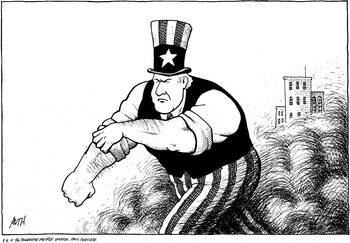
The initial outpouring of grief at the magnitude of the attacks on the U.S. was clearly reflected in editorial cartoons in Spain, as exhibited in El País by Máximo's tribute to the victims with a wreath laid at the base of the damaged, but still-standing twin towers. In the days after the attacks, classic metaphors for the U.S. in the guise of Lady Liberty and Uncle Sam made their way onto editorial pages in both the U.S. and Spain. Moreover, these icons were depicted in strikingly similar terms on both sides of the Atlantic: Spaniard Forges' Lady Liberty turning away from the destruction in downtown Manhattan is one and the same as American Glenn McCoy's Liberty aghast on the pages of the New York Times. At the same time, Tony Auth's cartoon in the New York Times portrays a defiant torch shining through the clouds of smoke billowing from Ground Zero. The initial response, then, is one dominated by U.S. icons, and here Forges' angry Uncle Sam amidst the smoke from 9/11 is mirrored by Auth, who shows Sam rolling up his sleeves to make war, in a cartoon representative of the response both in the U.S. and Spain to the 9/11 attacks (Figure 1).

© Auth, Universal Press Syndicate. Reprinted with permission. All rights reserved.
Making War
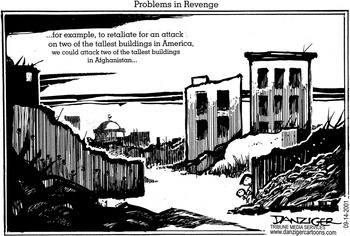
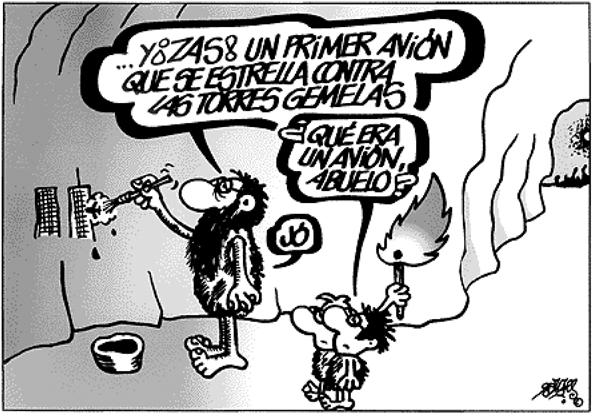
The war in Afghanistan began on October 7, 2001. While cartoonists on both sides of the Atlantic highlight problematic aspects of the war, some differences in the way U.S. and Spanish cartoonists portray the war do begin to show. Jeff Danziger, in the New York Times, goes to the heart of the U.S. agenda in making war in Afghanistan by signaling the need for retribution, dilemma included (Figure 2). Forges meanwhile draws the essence of European fears that this war might get out of control when he depicts a weary grandfather, deep in a cave, painting the attacks on Manhattan. Granddad explains his artwork to his grandsons as he paints, and despairs at their response to his “Kaboom! The first plane crashes into the twin towers”: “What was a plane, granddad?” (Figure 3). Spanish cartoonists are more troubled by the ramifications of the war in Afghanistan, and so El Roto pictures buildings ablaze under the headline “this is how to democratize.” Likewise, Forges call for “peace yes, war no” with a minute Afghan figure wandering through an empty landscape musing to himself: “It's just as well I'm not a Taliban; if not who knows what'd happen.” Most of the panel, however, is filled with a massive incoming bomb inches above this tragic figure's head. Clearly, Spanish cartoonists are unhappy with the conduct of the war, given the loss of innocent lives and the distance between professed U.S. aims to foster democracy worldwide and developments on the ground in Afghanistan. Significantly, then, there is sustained criticism of the war in Afghanistan on the part of cartoonists in El País on a level not apparent in the New York Times. However, as can be seen in the shared perspectives of El Roto, who pictures Afghans calling for the U.S. to bomb them with bread to see how quickly the war could be won, and Tom Toles for whom smart bombs are food, medicine, and blankets parachuted into Afghanistan, there is also common ground here. The foreign policy dimension of purported anti-Americanism, then, may be on display here, but, if so, important questions are raised by similar depictions of U.S. action in the war in Afghanistan on both sides of the Atlantic. The dividing line in terms of the war in Afghanistan has much more to do with the volume of criticism of U.S. policies than it does with the thrust of the criticism in Spain and the U.S.

© Jeff Danziger, New York Times Syndicate. Reprinted with permission. All rights reserved.

Forges © 2001. Reprinted with permission. All rights reserved.
Big Business
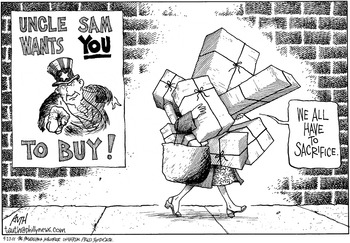
There is common ground too in understandings of the relationship between war and business on both sides of the Atlantic. McCoy's “War on Terror” machine-gun, fed with wads of dollars for ammo, is particularly insightful, and Forges' protestor being admonished that his “No war” banner is wrong, that war has been spelled with the letter $ for years now, echoes that sentiment. Danziger suggests how surreal this all is, with his Taliban equipped with arms made throughout the Judeo-Christian world awaiting the alliance attack, and here is Johnson's (2000) blowback from foreign policy decisions gone awry writ large. The home front also falls under the pen of U.S. and Spanish cartoonists, and again their perspectives are very similar, particularly with respect to the relationship between patriotism and consumption. Auth's “Uncle Sam wants you … to buy!” (Figure 4), is a telling commentary on the challenge the Bush administration laid down for Americans after 9/11, but so too is El Roto's stockbroker advising clients to “buy flags! They're going up.” Ted Rall pictures a mother who explains to her boss that she cannot work late as she has to pick up her kids, only to have him respond: “So—you're with the terrorists.” And again El Roto pictures Ground Zero where a sign is read by a businessman, briefcase in hand: “Business as usual—Forgive the rubble.” Regarding the interface between U.S. war and commerce, then, cartoonists are equally critical on both sides of the Atlantic.
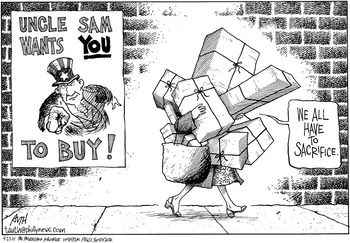
© Auth, Universal Press Syndicate. Reprinted with permission. All rights reserved.
Peace
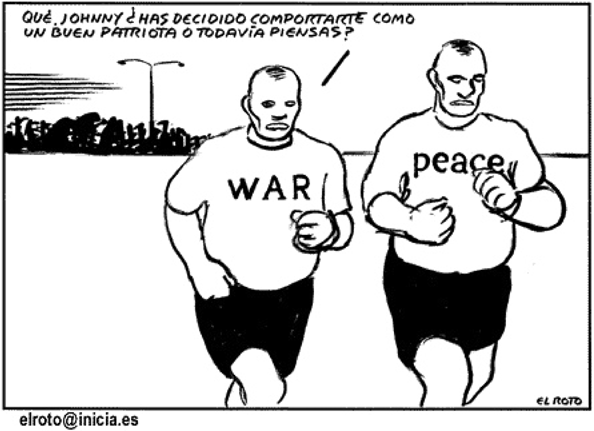
The most striking difference between portrayals of the aftermath of 9/11 in the U.S. and Spain shows in cartoonists' treatment of the peace movement. In the New York Times, cartoons disparaging of peace and pacifists are published that find no echo in El País. McCoy is particularly scathing when he portrays a car with a registration which reads ACLU and a bumper sticker which asks: “Have you hugged a terrorist today?” In another of McCoy's cartoons, so-called pacifists for appeasement, armed with a placard that reads “stop provoking terrorists,” drag U.S. President George W. Bush away from his war room, bellowing “Don't just do something. Stand there!” Spanish cartoonists, on the other hand, equate pacifism with clarity of mind and are anxious to promote the peace agenda, with Forges highlighting how “pacifist” has become a dirty word, used as an insult in cafeterias and bars, and El Roto drawing a wide-eyed peace dove hovering above the planet with the word “Help!” (in English in the original) on its breast, and a squadron of fighters or bombers just coming into view below. In another cartoon (Figure 5), El Roto has two stocky Americans out for a run, and one, dressed in a t-shirt emblazoned with the word “War” (in English) asks the other, whose t-shirt reads “Peace” (in English), “So, Johnny, have you decided to be a good patriot, or are you still a thinking man?” (Figure 5). Clearly, there is no common ground to be found here, and this, of course, is related to the overwhelming thirst for revenge in the U.S. This Spanish championing of peace, surely one of the American values that the Bush administration believed motivated the 9/11 attacks, is also driven by fears about the suppression of dissent in wartime (Hedges 2002), and represents, thus, a cry for free speech, another quintessential American value.

El Roto © 2001. Reprinted with permission. All rights reserved.
Coming to Terms?
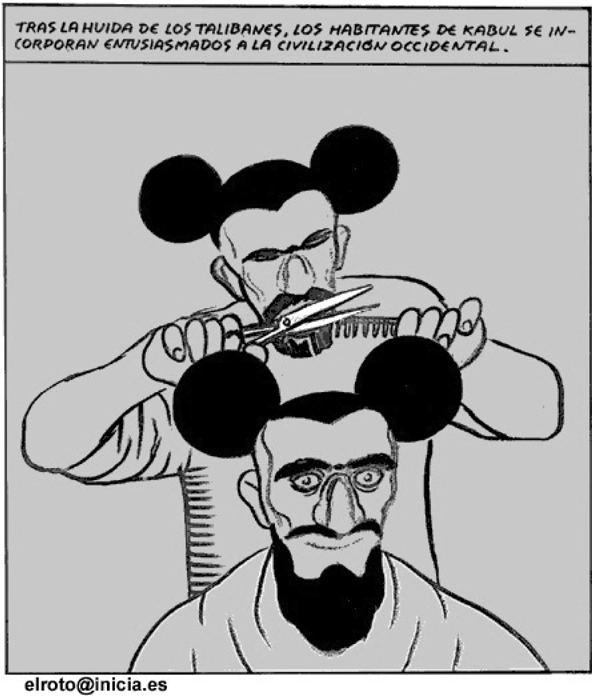
U.S. and Spanish cartoonists' use of humor in the editorial cartoons of 9/11 helps underline their different perspectives. In the weeks and months following 9/11, U.S. cartoonists began to see the inherent humor in even the most dramatic human predicaments, and so the airline bailout, marital relations in post-Taliban Afghanistan, and cultural changes associated with regime change in Afghanistan all became fair game for the pens of, for example, Pat Oliphant and Danziger in the New York Times. The use of humor in the post-9/11 editorial cartoon is epitomized by Oliphant's “Return of the Taliban warrior,” where an intimidating female figure, rolling pin in hand, tells her returning husband “Get in the house big boy, while I catch you up on some of the changes around here,” or Danziger's depiction of a recently reopened Mamoud's barbershop where a bearded Afghan sighs in anticipation of a clean shave after five long years of “scratchy, scraggly Taliban-ordered beard,” only to have it dawn on him that “ol' rusty Mamoud's been out of practice for five years too.” Spanish editorial cartoonists did not poke fun at mundane aspects of change in Afghanistan or the U.S. in this way, with the possible exception of El Roto's depiction of life in a changed Afghanistan. A barbershop is again the focus. This time, however, it's a new hairstyle that's all the rage with men cutting their hair into the shape of Mickey Mouse's ears as “the citizens of Kabul enthusiastically embrace Western culture” (Figure 6). This may be evidence of the third dimension of anti-Americanism, discomfort at the Americanization of the world, but, interestingly, this image invariably causes mirth when I've shown it to American audiences of students and academics.

El Roto © 2001. Reprinted with permission. All rights reserved.
Conclusion: Anti-Americanism in Post-9/11 Editorial Cartoons?
Comparing and contrasting themes across these editorial cartoons serves to underline common perspectives on the part of Spanish and U.S. cartoonists. Certainly, there are differences in emphasis and even disagreement as to what the post-9/11 world means and how the U.S. in particular conducts itself there. Uniting these cartoonists, however, is a critical engagement of the U.S. and its policies, and a challenging of received truths and accepted, convenient discourses. The question remains, then, can we use these visualizations of politics to chart anti-Americanism, perhaps in the U.S. itself, and certainly in Spain?
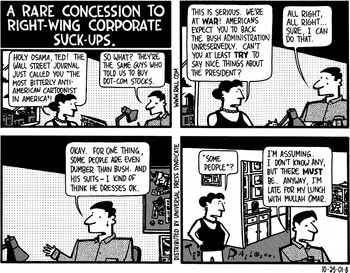
Cartoonists themselves are acutely aware of their categorization as anti-American, as a telling cartoon by Rall who has given no quarter to President Bush over recent years on the pages of American newspapers, or elsewhere (Rall 2004), shows. Rall parodies his classification as “the most bitterly anti-American cartoonist in America” (Figure 7). Moreover, cartoonists are sensitive to broader discussions of anti-Americanism, as can be seen in Danziger's ridiculing of plans by summer 2002 to revamp America's image worldwide. Danziger pictures a tired Uncle Sam, surrounded by marketing types who explain that all the trinkets of advertising campaigns from bumper stickers, to slogan underwear, to baseball hats, to mint flavored toothpicks will be marshaled in a 24/7 blitz to “convince people that we're not just a crass money culture bent on world domination through cheap commercialism”; that the U.S. is “more than bombs and fat people.”

Rall © 2001 Ted Rall. Reprinted by permission of Universal Press Syndicate. All rights reserved.
Are the editorial cartoonists in the New York Times and El País anti-American, however? Clearly, if we use a broad definition of anti-Americanism that brooks no criticism, such as that ultimately constructed by Hollander (1992), then most, if not all, of the editorial cartoonists discussed here, and tracked over the entirety of this study, should be labeled anti-American. However, if we take this definition as a valid understanding of what constitutes anti-Americanism, then Spain's editorial cartoonists are no more anti-American than their colleagues drawing for the New York Times. Clearly, a more precise definition of anti-Americanism is needed.
To this end, consider the hard-hitting work of Oliphant, admittedly originally an Australian (Westin, Robbins, and Rothenberg 1979, 140), who portrays a gullible, patriotic Joe Public duped by a naïve or conniving Bush, himself no more than a lackey for the corporate interests that are busy robbing America blind. Oliphant pictures a flag-flying everyday-American egging on the president, also flag in hand, to fire more artillery at the enemy, “Give it to 'em, George.” Bush, however, is listening not to Joe Public but rather to capitalist fat cats—IBM, GM, Enron, GE, et al.—towering behind who are bidding him to keep Joe distracted, “while we pick his pockets.” Consider too the head-on criticism of Rall, who in a cartoon from summer 2002 has Bush “The Bully” explain to a Muslim victim of a U.S. missile attack that the only reason he thinks he hates America is because he's been suckered by anti-American propaganda (not because he's just been blown to bits by the U.S.). Does such hard-hitting criticism of U.S. society and politics or of U.S. foreign policy constitute anti-Americanism? In heady days of nationalism (normally dressed up as patriotism, of course [Billig 1995]), it may be considered so in some quarters, but restless, confrontational criticism such as this may be celebrated as the essence of patriotism itself at some point in the future.
Nonetheless, it is not the purpose of this paper to call into doubt the very existence of anti-Americanism. In fact, a small number of cartoons that might be considered anti-American were indeed published in the 12 months following the 9/11 attacks. It is noteworthy that such cartoons appeared in El País, while no such cartoons were published in the New York Times over the course of this study. Representative of such cartoons is one by Romeu, where two individuals discuss the monstrous terrorist attacks, concluding, “In American everything is huge.” The tone is certainly one that trivializes, and the parallels drawn between a country defined by its size, where bigger is better, and the terrorist attacks may highlight anti-Americanism. Significantly, the shape of the figures in this cartoon may also be a nod in the direction of U.S. society's chronic problem with obesity, which would only serve to underline anti-American sentiment here. Another cartoon, this time by Máximo, shows an adult explaining to a child that in newscasts from Afghanistan “cameras pass quickly over the corpses as if they were part of the terrain” because Afghans, like Native Americans, “Don't get counted.” These images may represent the irrational animosity to the U.S. highlighted above as the first dimension of anti-Americanism. The suggestion in Máximo's newscast cartoon, moreover, that the U.S. agenda in Afghanistan is one of genocide, also constitutes anti-Americanism as it bastardizes foreign policy in ways that speak to that self-same animosity, while at the same time harking back to the cleansing of the American plains of native populations over the nineteenth century. Paradoxically, however, it is in another cartoon by Máximo that anti-Americanism shows most clearly. He pictures a map of Europe with the toponyms changed to read Eurousa in the case of the continent, Blairshington for London, and Berlusbush for Rome—apparently innocuous, right? However, the fear that Diner underlines as central to anti-Americanism—Europeans' phobia that their identity be subsumed in the expansion of their upstart transatlantic rival—is apparent in these toponyms that signal new U.S. power in Europe.
In summary, then, anti-Americanism is a contested concept and a label that should be used with great care, lest all criticism of the U.S. be silenced through the power to deride it as intrinsically anti-American. This paper charted commonalities and differences in editorial cartoons in the U.S. and Spain to investigate purported anti-Americanism. It concludes that some limited anti-Americanism does in fact manifest itself in Spanish editorial cartoons. In the main, however, Spanish cartoonists show themselves to be no more anti-American than their U.S. colleagues, if every bit as critical. Anti-Americanism is a powerful label that should be used with great care.