

INTRODUCTION
A number of publications in a variety of fields (anthropological linguistics, sociology, conversation and discourse analysis) have called for research that provides a link between micro and macro issues of language use – that is, between the local organization or microcosm of talk and larger societal issues or societal organization (e.g., Alexander, Giesen, Münch & Smelser Reference Alexander, Giesen, Münch and Smelser1987; Ellis Reference Ellis1999; Mayes Reference Mayes2005; Tracy Reference Tracy1999:3). Within conversation analysis (CA) this issue is also discussed. For example, Schegloff (Reference Schegloff and Alexandro1987a:209) raises the question whether connections between micro and macro should be made: “It is not clear how the kind of microanalysis CA does (if it is microanalysis) is to be related to macro-level theorizing or whether it should be.” Specifically, Schegloff cautions researchers wanting to relate conversation analytic practices to societal attributes (such as gender or ethnicity) by saying that these attributes or categories need to be shown to be oriented to by the participants. Moreover, Schegloff cautions that making connections between conversational moves and macro-level attributes too early in the analytic process might lead to “analytic losses at both the micro and macro levels” (Schegloff Reference Schegloff and Alexandro1987a:15). There are studies, however, which heed Schegloff's (Reference Schegloff and Alexandro1987a) cautionary remarks while at the same time connecting localized language use with larger societal issues. These studies show how the sequential organization of talk-in-interaction, turn design, and the participation framework serve to socially construct the context of the interaction, interactional and institutional roles, and group and gender identities. The idea is that these macro phenomena are not preexisting outside discourse, but are “talked into being,” that is, produced by the members to the interaction (cf. Goodwin & Goodwin Reference Goodwin, Goodwin and Grimshaw1990, Kitzinger Reference Kitzinger2000) and can therefore be analyzed. Moreover, it is by analyzing the orientations participants in the interaction have to their own talk that researchers can describe how “power,” “gender,” or “group membership” is constructed and locally invoked in the unfolding conversation, or, as Goodwin & Goodwin (Reference Goodwin, Goodwin and Grimshaw1990:85) put it, “how what is said in a given turn can make relevant particular social identities.” One of the earlier examples of this type of argument is included in Sacks's lectures (Sacks Reference Sacks and Jefferson1992:185–86), when he discusses how one participant's talk can demonstrably be shown to be heard as racist by considering that participant's own orientation to the talk at hand. In his study of repair, overlap, and sequence organization in Thai conversation, Moerman Reference Moerman1988 shows how they are connected with macro issues in society, demonstrating that overlap management in various data segments is inextricably linked to the macro concept of power. In her study of children at play, M. Goodwin Reference Goodwin1990 contributes to our understanding of “gender” as enacted in and through the talk of children, specifically in directive and dispute sequences and in the organization of their narratives. Similarly, Sidnell Reference Sidnell2005 shows how gender in a Guyanese society is constituted in and through various interactional practices (e.g., pronominal usage and reminiscing). Rather than assuming gender as an exogenic category, he demonstrates that it is “talked into being” by the participants to the interaction. In studying repair in the interactions of band members, Keating Reference Keating1993 demonstrates how these practices are oriented to by the interactants to invoke group membership and group competence. And Kitzinger Reference Kitzinger2000 shows effectively how conversation analysis can be used to study feminism exploring in detail the sequential organization of (sexual) refusals and “coming out.”
The present article contributes to this line of research on the micro-macro link by investigating specific conversational sequences in which French speakers from different speech communities interact. We analyze membership categorization devices (Sacks Reference Sacks and Jefferson1992, Schegloff Reference Schegloff2007b, Silverman Reference Silverman1998; see also the discussion below) – that is, the descriptions participants use and the inferences these (demonstrably) invoke for the participants within the sequential context of the utterance. Specifically, we discuss how some such descriptions become trouble sources targeted by self- and other-initiated repair. We show that the trouble source is demonstrably connected to a co-participant's group membership (e.g., belonging to a group of Canadian-French or Metropolitan-FrenchFootnote 1 speakers). Based on these examples, we argue that repair can be used as a means for participants to establish, confirm, or insist on their belonging to one particular speech community rather than another. Moreover, we argue that participants can use repair to express affiliation and disaffiliation with each other. In this regard, then, our study shows how micro-level phenomena (e.g., repair) can be linked to macro-level issues (e.g., linguistic and social identity, language attitudes).
We begin with briefly describing our data, transcript notations, and conversation analytic work in French. We then discuss the concept of membership categorization and its relation to repair in general before we turn to the main analytic section of the article. Finally, we discuss some of the implications of our research, linking the organization of conversation with issues of language and identity, specifically with the social meaning of dialect variety in the Francophone world.
DATA
The data for this study consist of approximately four hours of videotaped, non-elicited mundane conversation between two and four interlocutors at each taping. All nine participants were friends and French teaching assistants at a Midwestern U.S. university. They were (native) speakers of French, yet came from different Francophone countries. While this ethnographic background of the speakers did not yield any difference in regard to the overall organization of repair,Footnote 2 the ethnographic background of the speakers is important for the analysis. Thus a brief description of the participants precedes each of the transcripts.
The data were transcribed using the transcription notation developed by Jefferson as described in Atkinson & Heritage Reference Atkinson and Heritage1984. In each of our transcripts, the top line is the French original, the second line is an interlinear gloss (included when necessary), and the third line is an idiomatic English translation. All subjects' names were changed to protect their identity. Arrows on the left side of the transcript indicate the line in which the described phenomenon occurs.
CONVERSATION ANALYSIS IN FRENCH
The CA literature focusing on French emerged mostly in the 1990s, with a few crucial pieces describing conversation in sequential terms following the CA tradition developed in the United States. Gülich & Mondada Reference Gülich and Mondada1995 discuss the basic concepts of CA using data excerpts in French; they cover topics ranging from institutional talk, turn-taking, collaborative completions, preference organization, repair, to sequence organization. In de Fornel & Léon Reference de Fornel and Léon2000, a similar review of CA is offered in addition to a discussion about the role of prosody, gesture, and specific linguistic resources as carriers of pragmatic meanings. Mondada and her colleagues have written extensively on the organizational structures of French conversation, dealing with issues such as topic selection (Mondada Reference Mondada2001), public discourse (Relieu & Brock Reference Relieu and Brock1995), collaborative descriptions (Mondada Reference Mondada1999), and speakers' categorization (Mondada & Dubois Reference Mondada and Dubois1995).
Providing a full-fledged account of all aspects of repair in French is beyond the scope of this article. Instead, we refer the reader to a brief overview of repair in French in Maheux-Pelletier & Golato Reference Maheux-Pelletier and Golato2003, which shows that repair in French can be initiated from the same positions as in German and English, with a preference for self-repair.
REPAIR SEQUENCES ORIENTING TO MEMBERSHIP CATEGORIZATION
In addition to dealing with problems in hearing, speaking, and understanding, repair can simultaneously be used for additional interactional achievements, such as attention of non-gazing participants (C. Goodwin Reference Goodwin and Psathas1979), signaling pre-disagreements (Schegloff Reference Schegloff2007a:103–4), securing speakership in overlap (Schegloff Reference Schegloff, Button and Lee1987b), entering ongoing conversations (Egbert Reference Egbert1997), creating alignments with other speakers (Egbert Reference Egbert1997), and engaging in membership categorization (Egbert Reference Egbert2004). This last function is of particular interest with respect to our data. As mentioned in the introduction, it allows us to link the micro-level findings derived from CA research to larger societal issues.
The term membership categorization refers to Sacks's work on how people do descriptions (Sacks Reference Sacks and Jefferson1992:40; Schegloff Reference Schegloff2007b; Silverman Reference Silverman1998). Sacks observed that when people use descriptions, they employ categories to label themselves and others. He noted that such categorizations are “inference-rich” (Sacks Reference Sacks and Jefferson1992:40), meaning that when a particular category label is used, members of a society rely on their societal knowledge of what it means to be labeled with such a category. That is, when categories are used and interpreted, members always tie them to specific characteristics and behaviors that are presumed to be known about the category (Sacks Reference Sacks and Psathas1979:13). Sacks also observed that, in principle, any feature of a person can be used for membership categorization, and thus several categories can be applied (simultaneously or on different occasions) for the same person or object (e.g., a person might be described as female, white, and/or as professor, etc.). Sacks was then interested in describing the apparatus or “procedures that members have for selecting categories” (Sacks Reference Sacks and Jefferson1992:42).
In her German data, Egbert Reference Egbert2004 showed that other-initiated repair can be one of those procedures. In one excerpt, a co-participant is telling a story about her exchange year at an American university. In the course of the telling, she uses the descriptor frat guys, which turns out to be problematic for one of the co-participants. In resolving the repair, the speaker of the trouble source opts for a translation of the turn, thus displaying that she takes the repair as stemming from a lack of linguistic knowledge. When producing the English item, she orients to the linguistic membership of her co-participants as Germans who understand English and are familiar with American university life, and in her repair she shows that at least one of the interlocutors does not seem to belong to this category.
In the next section, we present and analyze instances of membership categorization we found in our data.
Data analysis
We discuss five excerpts in which repair is used to deal with membership categorizations. We start with a self-repair on the word French itself. In this first excerpt, our speakers are displaying and directly topicalizing their orientation to this particular category label. O is a female from French-speaking Canada and N is a male speaker of Metropolitan French.
(1)

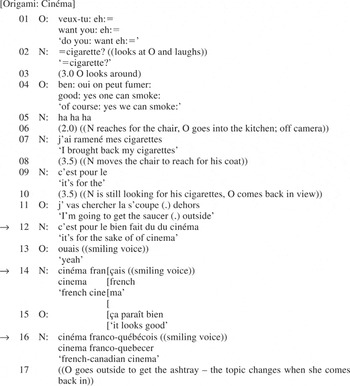
In line 1, O produces the beginning of an offer, veux-tu: ‘do you want’, followed by a speech perturbation. N collaboratively completes the offer with the lexical item, cigarettes. N's laughter and O's delayed response are indications that this was not the offer O was about to make. Yet O agrees to N's suggestion to smoke in her apartment (line 4). After O and N locate the cigarettes and an ashtray, N produces c'est pour le bien fait du cinema ‘it's for the sake of of cinema.’ (line 12). N seems to be referring to the fact that their interaction is being recorded. In line 13, O agrees with ouais ‘yeah’ uttered with a smiling voice. In third turn, N self-repairs cinéma to cinéma français with a smiling voice. In partial overlap with N's turn yet at a point when his utterance is projectable, O produces an agreement in the form of an assessment. In line 16, N produces a second self-repair changing his categorization from cinéma français to cinéma franco-québécois, again produced with a smiling voice. The categorical descriptor cinéma français may be (and indeed usually is) interpreted as referring to the movie scene in France and not in the Francophone world in general. This repair shows that the speaker is aware of the meaning generally ascribed to the term French in this expression.Footnote 3 Given that N knows that O is from Quebec, he embraces a slightly different, broader social identity, one that articulates two categories (franco + québécois), thus producing a common identity, both French and Canadian. He thus displays a “transformed identity” (Wong Reference Wong2000) to include O in his cultural reference.
The following segment is slightly more involved and contains several repairs and dividing lines among the participants based on cultural membership. Of interest is the repair in line 13, which is embedded in the larger repair sequence starting in line 1. The speakers in this segment are again N, a male speaker from France and O, a female from French-speaking Canada. The excerpt starts with N grabbing O's recipe and reading it:
(2)

When N reads O's recipe title, une tarte aux bleuets? ‘a blueberry pie?’ in line 1, he does so by stressing the first syllable of the word bleuet. This is unusual since French has an extremely regular stress pattern by which in unmarked utterances, the last syllable of a segment receives the stress (Léon Reference Léon2000). The fact that here the penultimate syllable is stressed and the fact that the entire utterance has questioning intonation are indications that this lexical item is troublesome for N. In line 2, O confirms with ben oui ‘well yes’, insisting on the appropriateness of the term and making a geographical reference to lac st-jean ‘st-jean lake’, thus linking the word to a specific region (within Québec). This reference is quite relevant to O, as Lac St-Jean is known to most Québécois as a region where blueberries grow in large quantities. She thus refers to the fruit as a cultural specificity of Lac St-Jean, located within Québec, Canada. On the contrary, N is dealing with linguistic variation, so it may be that the participants are making relevant two kinds of relevancies (cf. Sacks).Footnote 4
This geographical reference does not solve the problem for N, because in line 4, he initiates repair on the same trouble source again. In the same turn, he provides a candidate understanding which is produced hesitantly and with the characteristics of a word search: du bleu: des bleu: des fleurs? ‘blue: blue: flowers?’ Subsequently, O rejects this candidate understanding by an other-initiated, other-completed repair, in effect correcting the term flower to berry (note also her gestures). In line 6, N acknowledges the receipt of this information, but after a micro-pause, he offers an alternate word for the same fruit (line 8), but does so with rising intonation, thus initiating a repair sequence (for the third time on the same trouble source!) by using a comprehension check. In effect, he is offering a lexical item used predominantly in France (his native country), myrtille. By using this lexical item, he is thus presenting himself as a member of a particular variety of French (spoken in France) and not as a speaker of O's variety of French (Canadian French).
In line 9, O acknowledges the lexical item myrtille as a possible substitute for bleuet. After a micro-pause, she recycles the beginning of her utterance, providing additional information. She makes another geographical reference that is more specific than the first one at line 2. She specifies that lac st-jean is a region of Quebec, the French-speaking part of Canada where she is from. Note that within her turn, she continues using the word bleuet (after having just ratified the word myrtille as an alternate). She holds onto her own language variety, thereby displaying it as appropriate. O's turn design parallels that of N: After a candidate is offered, they both accept it with ‘yes’, followed by a micro-pause, and then they use the lexical item common in their respective varieties of French. By using their own varieties, the speakers show an orientation to their own membership in specific speech communities – and a possible disaffiliation with each other.
In the next lines, the situation becomes even more delicate. In lines 13–15, N states that in his variety of French the term bleuet refers to a flower. If this statement was meant as an account of why he had not understood the term bleuet, it almost backfires. N starts out by saying en français ‘in french,’ then hesitates and self-repairs it to français français ‘French French’, followed by another pause, followed by an explanation that a bleuet is a flower. This use of ‘French French’, as opposed to an alternate expression such as ‘French as spoken in France’, could be interpreted as claiming authority as to what counts as real French,Footnote 5 but the self-repair is an indication that N is aware of his hegemonic attitude and tries to avoid it. By initiating repair on the category descriptor of ‘French’, he indicates which Francophone community he is referring to. He also demonstrates that he is aware of the fact that the category French may draw up different inferences, depending on one's speech community. However, given that N and O have already drawn dividing lines among each other based on linguistic membership in lines 1–11, N's repair may be taken as having prevented a possibly delicate situation: If N had not initiated repair on the item French, his utterance would have been: ‘in french a blueberry: it's eh a blue flower actually’. This would have been an ambiguous utterance with two meanings: Meaning A, “In my variety of French a bleuet is a blue flower (but it may not be in yours)”; Meaning B, “In French a bleuet is a blue flower (and your take is unacceptable).” The second meaning would cast O as an incompetent speaker, or at least as a speaker of a nonstandard variety. By initiating self-repair, N attempts to eliminate reading B, although a trace of it remains, since the two alternative readings are actually made explicit by the repair initiation. For similar observations of how speakers can employ repair to remove possibly available unwanted hearings, while at the same time making the unwanted hearing fully available through the repair process, see Mandelbaum Reference Mandelbaum2005.
In line 16, O accepts this definition as a possible one by saying c'est aussi une fleur ‘it's also a flower’. After a gap, O replaces (corrects) the word ‘flower’ with ‘plant’, a botanically more accurate term.Footnote 6 As the speakers then go on to talk about other matters, O's correction closes the repair sequence that was begun in line 1.
Let's now turn to a different interactional context, between three females, R, H, and P. R is a speaker from the Northwest region in France, and H, a Moroccan woman who is considered a (nearly) native speaker of French by her friends. She was educated in French Catholic schools in Morocco and spent several years in Montpellier, France, as an undergraduate student. P is a native speaker of Parisian French. As the analysis shows, not all of these categorizations are relevant (i.e., oriented to by) for the co-participants. More than national affiliation, regional characteristics are treated as significant to the speakers here.
In what follows, both P and H (the city girls) claim membership in the urban lifestyle by using “cool” language, while R is left out as a country girl with little awareness of such usage. They are negotiating the meaning of the expression langues zo. Prior to discussing this, the three co-participants had been talking about food and are now discussing an Indian spice R uses when roasting chickens.
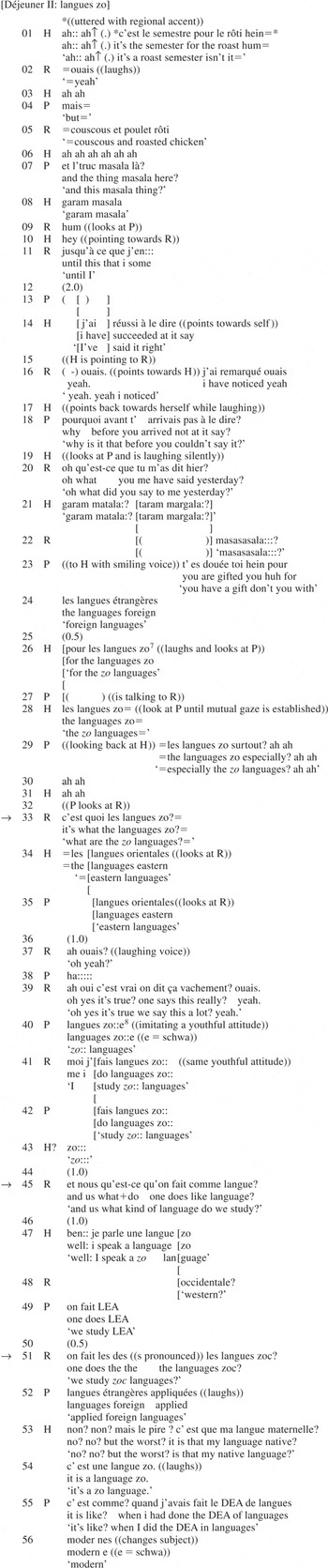
In line 1, H makes a humorous comment about R's roasted chicken, using a Southern French accent in doing so. R acknowledges this and in line 5, she continues describing her current eating preferences. While H laughs, P begins to inquire about an Indian spice (line 7). Upon hearing the approximation of the name of the spice, H produces its correct name in line 8. In line 9, R provides a continuer aimed at P's last turn (as indicated by R's gaze towards P). In line 10, H tries to draw R's attention by uttering a summons. In line 11, R continues with her previous description started in line 5, but she aborts her utterance and a gap of two seconds ensues – potentially an indication of interactional trouble as two different actions are currently at play. In line 14, H explains that she successfully pronounced the name of the spice, an observation R confirms in line 16. The whole time, H is laughing and pointing to R and back to herself. In line 18, P inquires whether this joke is due to H having had difficulty with the expression. After H looks at P while laughing silently, R asks for H's help in trying to recollect how H pronounced it the day before. H produces several variations on the pronunciation and in overlap, R produces a variation of her own. In lines 23–24, P makes fun of H by making a sarcastic comment regarding H's talent for foreign languages. At this point, after a short pause, it looks like the alliance has moved from R / H to H / P. In line 26, H replies jokingly to P's sarcasm with the expression les langues zo ‘zo languages’ in overlap with P who seems to be making a comment to R. As an expression used in university circles in France, the expression langues zo becomes a way of expressing academic co-membership.
In line 28, H repeats her previous utterance and gets an immediate upgraded alignment from P. In lines 30–31, the two women continue laughing and P turns toward R, waiting for a reaction from her. The joint laughter of P and H marks their alignment; the fact that R does not join in indicates either nonalignment or incomprehension. And indeed, in line 33 R initiates repair on that term. Note that H starts answering R's question and P immediately jumps in, so both women overlap in providing an explanation langues orientales ‘eastern languages.’ In doing so, P shows that she was in the know from the get-go and is thus excluding R from the affiliation H and P have initiated. After another pause, R indicates receipt of the information, but it is not clear, given the rising intonation of her turn, whether this is a real change-of-state token (Heritage Reference Heritage, Atkinson and Heritage1984) or further inquiry as to what this is all about. Indeed, given the pause in line 36 and given that R repeats ah ouais ‘oh yeah’ in line 37, it looks like she is buying herself time to make sense of this expression. Then, she claims that she actually knew the expression with c'est vrai? on dit ça vachement ouais. ‘oh yes it's true we say this a lot? yeah.’ The last TCU is said with falling intonation so as to confirm that she knows. P repeats the expressions with a youthful tone, insisting on zo by adding a schwa at the end of it. R aligns herself with P by creating a context for using the expression, using the same youthful tone (line 41). Note that P anticipates R's utterance as they collaboratively complete it. In line 43, H repeats zo. After a one-second pause, R asks what kind of language they are studying (all of them being in a French department). H begins a response then produces a cut-off and R proposes occidentale ‘western’ as a possible completion. P answers that they are doing LEA and repairs it with the full phrase langues étrangères appliquées ‘applied foreign languages’ (an existing discipline in France), perhaps assuming that R does not know the meaning of the abbreviated academic reference once again. But her answer does not seem to satisfy either R or H. In line 51, R proposes her own made-up word that she constructs by analogy to langues zo: langues zoc. R gets no reaction from either P or H as P continues with her previous utterances by spelling out what LEA stands for (line 52). Perhaps as a response to R's candidate response to her own question in line 51, H indicates in lines 53–54 that her native language (Moroccan Arabic) is actually a langue zo, and then P changes the subject.
This excerpt shows how membership categorization can be negotiated in conversation. Although regional categories are never explicitly mentioned, H's mimicking of the Southern accent, and her later alliance with P in using an expression associated with academia in France, but at the same time ironically mimicking the Parisian youth, cast R as an out-group member (as evidenced by R's repair initiation). When both of her co-participants provide an explanation, R does “having been knowledgeable all along” by casting her utterance as a remembering ‘oh yes it's true we say this a lot? yeah.’ That is, in providing this utterance, she also casts herself as an in-group member. However, her attempt to join the alliance fails, and the conversation ends without her being included by H and P as a legitimate member of their academic language mockery.
Prior to this next segment, R commented on the different kinds of breads available in local sandwich shops. This time, the meaning of the expression pain aux raisins ‘raisin bread’ is co-constructed by the participants, H and R (the same as in excerpt 3).
(4)
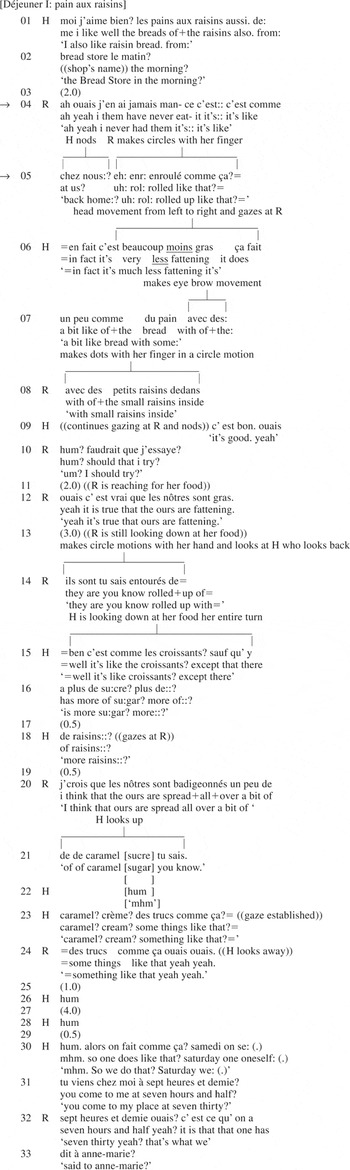
In line 1, H moves the topic from sandwich bread (not shown in transcript) to that of raisin bread available at the same shop. H does so by way of an assessment. After a 2-second pause, R, instead of providing a second assessment, explains that she has not tasted it before. She self-interrupts and asks a question on which she performs various self-repairs, and H nods when asked whether the bread is like chez nous ‘back home’. R continues her inquiry by asking if this raisin bread is the rolled-up kind, like the one chez nous, making circles with her finger as she speaks. It is not clear whether the use of nous ‘us’ is inclusive or exclusive, but the fact that R asks H to confirm implies that R expects H to know the shape of raisin bread in France. In line 6, H first shakes her head and explains that it is not as fattening as the chez nous variety, and in line 7 she invites R, through eye-gaze and facial expressions, to collaboratively complete the description, which R does in line 8. In line 9, H confirms the completion with a nod and adds c'est bon. ouais ‘it's good. yeah’. R gives an agreement token and suggests that she would like to try it. After a 2-second pause during which R reaches for her food, she rephrases H's statement made in line 6 about the amount of fat in the chez nous kind. While H had said that the Bread Store's version of raisin bread is beaucoup moins gras ‘much less fattening’, R agrees that les nôtres sont gras ‘ours are fattening’. This assessment is not taken up by H. In line 14, R starts explaining the characteristics of les nôtres ‘ours’, now suggesting that H may not know what they look like. R's orientation, supported by the absence of uptake from H, is cut short when H, in line 15, interrupts R's description, by providing a try-marked candidate standing. Here again, as in line 07, the word raisin is missing from H's self-interrupted description, which she ultimately self-completes with des raisins ‘some raisins’. After a gap, R reuses the first person plural possessive pronoun les nôtres ‘ours’ in her turn and adds another ingredient to the description H started in lines 15–16. R produces an agreement token in overlap. In line 23, H repeats the word caramel with questioning intonation, adds a fourth try-marked ingredient, and ends the description with des trucs comme ça? ‘things like that?’ All of these try-markings invite confirmation from the co-participant, which is forthcoming in line 24, where R partially repeats the prior utterance followed by a double agreement token des trucs comme ça ouais ouais ‘things like that yeah yeah’, with ouais ouais produced under one intonation contour. Double sayings of this kind have been shown to indicate that the prior action has gone on too long and can be stopped (Golato & Fagyal Reference Golato and Fagyal2008, Stivers Reference Stivers2004). While this prior research did not address French, the extract above indicates that multiple sayings may have a similar function in French, as the sequence here also comes to a close. In lines 23 to 24, coinciding with their agreement, the copartipants have reestablished eye gaze. After several agreement tokens interspersed with silences, H changes the subject.
This excerpt is interesting for several reasons. First, the co-participants frame the meaning of “raisin bread” as a kind that is different from American bread. While it never becomes clear whether R uses the inclusive or exclusive ‘we/our’, H manages to demonstrate that she is in the know. She interrupts R in line 14 to offer her own definition of raisin bread. At the same time, it seems that H and R are cooperating in defining the term so as to make sure that both demonstrate membership in the cultural reference they are constructing. In doing so they make use of repair (in form of word searches and candidate understandings). It is striking, for example, that H hesitates twice when the word raisin itself is contextually required (lines 7 and 16), allowing R to jump in and collaboratively complete the description. In addition, there is quite a bit of “echoing” going during co-constructing the meaning of the term, which indicates the speakers' alignment with each other.Footnote 9
At the end of the sequence, then, it has become clear that although H may or may not have been included in the use of nous ‘us’ and les nôtres ‘ours’ at the beginning of the sequence, she has earned, through collaborative descriptive efforts with R, inclusion into what R describes as a cultural specialty of her home country. It is H, more than R, who has negotiated that inclusion, since she is the one showing the most collaborative gestures (by letting R complete some of her statements), but also the one who interrupts before it's too late (i.e., before the description is completed by R alone in line 14). Toward the end of the sequence, R treats her as a legitimate knower of what that cultural reference is. Hence, H has successfully negotiated her membership in “those who know what French raisin bread is,” an inclusion that was not guaranteed at the beginning of the conversation.
This excerpt is different from the previous one in one important way. While the expression pain aux raisins is used to construct mutual membership to a certain category, the expression langue zo excluded one of the participants. R and H, in this last excerpt, are collaborators, whereas H creates an alliance with P against R in the previous one. The contrast between the two sequences thus indicates that membership categorizations are negotiated in talk-in-interaction, and that any speaker alliances are bound to context, participant constellation, and the interactional strategies used by the participants.
Membership categorization can materialize not only in terms of lexical choices and repair of lexical choices as demonstrated in the data samples above, but also in terms of language choice in a multilingual setting. The data excerpt below is taken from Maheux-Pelletier Reference Maheux-Pelletier2006, who investigated language use in a Quebec immigrant training center. The official language of the center is French, with English being a second lingua franca, while the employees also speak their native languages with each other. In the segment below, two Arabic L1 speakers, C and N, are talking about an imminent visit from the minister of health. It should be noted that the pattern of language use between these two participants was overwhelmingly Arabic, especially when the topic was not job-related.
(5)
Footnote 10
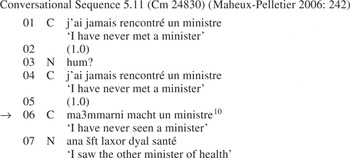
Prior to line 1, the two women had been quiet for about a minute, and before that they were speaking Arabic. In line 1, C makes an announcement in French that does not receive an uptake. In line 3, N initiates repair with a nonlexical open-class repair initiator (Drew Reference Drew1997), thus not indicating precisely what it is about C's turn that is problematic for her. C self-repairs by providing a verbatim repeat of the trouble source turn, thereby treating the repair as a problem related to hearing. N provides neither an uptake of the repair nor a second pair part to the announcement. In line 6, C pursues a response by restating her announcement in Arabic (thereby self-repairing her language choice) whereupon N produces a response in form of an announcement of her own, leading to a longer telling in Arabic.
What seems to be at stake here is the expression of solidarity toward one's cultural group and compliance to localized language use. While French is the so-called legitimate language in the Montreal workplace, competing norms are urging Arabic speakers to use their native language, especially in interactions that are not work-related. Because C did not comply with that norm, her initial utterance in French was treated as a trouble source. C's word-for-word repeat, while indicating that she treated the other-repair initiation as a problem in hearing, did not solve the problem. Only when complying with the nonstandard, micro-community pattern of language use did she get a response from N.
These segments have shown how repair can be used strategically for membership categorization, in the instances above with participants positioning themselves according to linguistic/cultural membership in a particular speech community. Our data corroborate Egbert's (Reference Egbert2004:1495) finding: “In terms of who engages in membership categorizing, it turns out that a co-participant can assign membership to him/herself or to other co-participants. At the same time, this is a collaborative process in which membership categorizing can be assigned, rejected and following a rejection, be insisted upon.” In our data, the speakers were shown to initiate repair in order (a) to achieve linguistic/cultural inclusiveness (in data samples 1, 4, and 5), (b) to legitimize language varieties inside and outside so-called standard French (in data sample 2), and (c) in a three-way conversation, to achieve linguistic exclusiveness of one of the co-participants by mocking academic jargon using Parisian youth language (in data sample 3).
SOCIAL MEANING OF LINGUISTIC VARIETY IN FRENCH
In this article, we argue that macro-level issues of linguistic and social identity and language attitudes are routinely negotiated on a micro level. In order to adequately frame the discussion in the remainder of the article, a brief overview with regard to language policy and planning, and language attitudes in the Francophone world is necessary.
In general, in France there is an “ideology of the standard” (Fox Reference Fox, Gass, Bardovi-Harlig, Magnan and Walz2002:203), meaning that everyone should adhere to the same ways of speaking and writing. Lodge (Reference Lodge1991:93) observes that the “prescriptive attitudes to language seem to be more deeply ingrained [in France] than in many other speech-communities,” perhaps because nonstandard varieties “are viewed as a threat to both linguistic unity of France and to the purity and universality of the French language” (Bourhis Reference Bourhis and Jaworski1997:312).
Yet French is not only spoken in France but also is used as an official language in other countries, each variety of French having its own distinctive characteristics with respect to pronunciation, syntax, and vocabulary. Aware of such differences, speakers of French outside of France often devalue their variety as compared to Metropolitan French (Fox Reference Fox1995, Francard Reference Francard1993, Gueunier, Genouvrier, & Khomsi Reference Gueunier, Genouvrier, Khomsi, Bédard and Marais1983, Tremblay Reference Tremblay1990).
In the case of Canada, however, an indigenous norm seems to be slowly emerging. The 1960s witnessed a reconstruction of Quebecers' identity “reversing almost entirely the lack of prestige that had been associated previously with speaking French” (Conrick Reference Conrick and Sahli2002:253). Now, French-speaking Canadians tend not to adopt Metropolitan French as their standard because they want to speak a French language of quality with the specificities that enable them to express their North American cultural and institutional identity (Martel & Cajolet-Laganière Reference Martel and Cajolet-Laganière1995). There is a constant tension between adherence to a norm outside one's linguistic community and the need to define and use a language that is true to one's cultural background.
This relative linguistic insecurity displayed toward Metropolitan French testifies to the differential value assigned by the French/Francophone community to different linguistic varieties. According to Bourdieu Reference Bourdieu1977, Reference Bourdieu1982, legitimization of a standard variety is maintained by formal institutions: the family, the school, and other cultural institutions such the Académie Française, but also the Office Québécois de la Langue Française in the Canadian context. Through them, a particular language variety is sustained and transmitted as being the most valued one, its status depending on two factors: (i) its unequal distribution among the speech community, and (ii) the extent to which those who do not control it recognize its legitimacy. A devaluation of one's variety is often a symptom of this asymmetry as well (Gal Reference Gal1987:638). Thus, those whose language use is closest to the norm imposed through official channels control the linguistic “marketplace” and can benefit from the symbolic resources associated with it (Bourdieu Reference Bourdieu1977, Reference Bourdieu1982).
This analytical framework can explain compliance with normative practice, negative attitudes toward so-called nonstandard varieties, and a certain amount of linguistic insecurity among the members of speech communities that primarily use a vernacular. However, it is a top-down perspective that draws a rather simplistic sketch of language use. As Woolard Reference Woolard1985 points out, this framework takes for granted that any given linguistic market is fully integrated, when it seems possible that alternative or even opposing linguistic forms may be generated, maintained, and valued. A number of researchers have argued that the dominating linguistic marketplace is often being competed against by parallel “economies” in which vernaculars are favored. In fact, Woolard Reference Woolard1985 maintains that alternative linguistic markets may gain authority, not through formal institutions as Bourdieu would claim, but rather in primary relations, face-to-face interactions, and in various informal, daily life encounters. She argues “that there are significant social pressures toward the vernacular” (Woolard Reference Woolard1985:744) and further explains that this is the result of competing pressure rather than a mere reaction to restricted access to standard forms. In addition, linguistic forms are interactional entities that must be conceived “as practice and process, not just as product” (Woolard Reference Woolard1985:744). Hence, the collaborative or oppositional work that takes place in face-to-face interaction when defining one's membership in one linguistic community or another is a process by which the legitimacy of one's community is negotiated, transformed, and reaffirmed through talk.
In analyzing our data, we have demonstrated that membership categorization – one's sense of belonging (or not) to the Metropolitan or French-Canadian community – can be negotiated through repair. The conversations that unfold between the Canadian and French speakers make it clear that they are aware of the distinction made in the Francophone world regarding the greater legitimacy of Metropolitan French. In these cases, however, one variety is not imposed on the other. Instead, the inclusive statement regarding French cinema as well as the semantic category of the term ‘blueberry’ show an effort to recognize the legitimate character of each participant's own variety despite traditional views regarding the standard. In that regard, the videotape has recorded a live example of the Québécois' newly acquired confidence in their own variety of French as well as their wish to assert its legitimacy. Here, there is recognition of competing sets of values, and the interactional work succeeds in establishing two viable parallel economies.
In the two excerpts involving a French speaker of Moroccan origin, the unfolding conversations have different outcomes. In the first one, the Parisian speaker P forges an alliance with H against R based on academic jargon unknown to R while displaying the use of an urban tone. R attempts to join her friends in the alliance but fails momentarily to become a member of her friends' speech community. R orients towards an academic and urban argot (French slang) with the underlying assumption that this type of language has a more privileged status than her provincial usage. It is also noteworthy that P and H mimic Parisian intonation as opposed to using it in a serious tone, in some way also a display of resistance against the Parisian norm.
In excerpt (4), in which only R and H are present, a different kind of alliance is created. In co-constructing the meaning of pain aux raisins, H negotiates her inclusion into the nous ‘we’ R uses. This interactional move is particularly significant because the linguistic resources of French did not allow R to explicitly include or exclude H in her reference. In this instance, then, H manages to gain the symbolic power associated with being acquainted with French culture, and hence shows orientation to the most recognized variety within the Francophone world. While in excerpt (3) H formed an alliance with P against R, the absence of P in the other segment changes speaker alliances. It is thus an indication that membership categorizations are negotiated in talk-in-interaction, but also that they are not immutable values.
In the last excerpt (5), in-group solidarity was reestablished by codeswitching from the out-group language (French) to Arabic. This language compliance toward localized language use, as opposed to using the official language of the workplace, shows that the legitimacy of one's community/language can be negotiated through talk. It is good indication that the linguistic market is not fully integrated but allows for competing language use patterns and forms.
Our data demonstrate how linguistic perceptions and beliefs materialize and are negotiated in discourse. Repair initiations can show that the category of identity is not simply an exogenous factor brought to bear on the conversation by the analysts but instead is demonstrably relevant to the participants themselves. In particular, the “blueberry” example showed (a) how repair can be used in constructing one's identity in ongoing talk, and (b) how speakers can insist on asserting an identity that lies outside the Metropolitan French norm. Langues zo and pain aux raisins demonstrate how one may want to converge to the perceived norm. This norm, however, is not a static concept but a dynamic one in that the macro factors treated as relevant by the co-participants can change depending on the situational features of the interaction, participant constellation being the case here. These excerpts show nicely an awareness of what kind of language use can yield the most symbolic power, but also how someone whose language variety is not traditionally associated with that norm can either gain symbolic power by valuing alternative linguistic markets or negotiate her or his way into the speech community that draws the most symbolic resources. In our data, repair is therefore one mechanism by which speakers reveal and negotiate linguistic attitudes and identity. Thus, our data show the connection between macro and micro levels of language.



