Introduction
Some species are consistently common, others less so. The hypothesis that abundance is a species trait has been tested by comparing the relative contribution of populations-within-species and species to variability in abundance. For example, the variance in abundance of nematode parasites of mammals depends more on the species of nematode than on the population from which the nematodes come (Arneberg et al. Reference Arneberg, Skorping and Read1997). The same is true for 77 species of metazoan parasites of freshwater fish (Poulin Reference Poulin2006), and for 145 species of fleas from small mammals (Krasnov et al. Reference Krasnov, Shenbrot, Khokolova and Poulin2006). This hypothesis might also be tested by comparing the abundance of different species over time. If abundance is a species trait, temporal variation in abundance would not obscure differences among species that live in similar habitats. Parasites provide numerous examples of species assemblages that live together in the same habitat, the bodies of their host (Price Reference Price1980).
Average abundance is only one aspect of population dynamics, another being the stability of the population. Stability, often measured as temporal variability in abundance, is also hypothesised to be a species trait. Taylor and Woiwod (Reference Taylor and Woiwod1980) argued that temporal stability depends on the density-dependent characteristics of each species. Three species of aphids (Hemiptera: Aphididae) living on the same host plant did show species-specific levels of population stability (Lamb et al. Reference Lamb, MacKay and Alyokhin2011).
We test the hypotheses that both abundance and population stability are species-specific traits for ectoparasites of feral pigeons, Columba livia Gmelin (Aves: Columbiformes: Columbidae). The ectoparasites are chewing lice (Phthiraptera): Philopteridae – Campanulotes compar (Burmeister), Columbicola columbae (Linnaeus), and Coloceras tovornikae Tendeiro; Menoponidae – Hohorstiella lata (Piaget). Lice on pigeons have been studied in Manitoba, Canada since 1994, and some of the data (1994–2006) on species composition and infestation parameters have been reported previously (Galloway and Palma Reference Galloway and Palma2008). Campanulotes compar and C. columbae are well-known, host-specific ectoparasites that feed on abdominal feathers, although the latter species is mostly found on wing or tail feathers (Clayton and Drown Reference Clayton and Drown2001). Coloceras tovornikae is also a feather feeder, but not well known. Prior to its discovery in Manitoba in 2003, only the type specimen had been collected, a female from a pigeon in Croatia (Galloway and Palma Reference Galloway and Palma2008). In contrast to the three feather-feeders, H. lata is a blood-feeder (Galloway and Palma Reference Galloway and Palma2008).
Although ectoparasite-host systems might be ideal for testing hypotheses related to the species-specificity of population processes, relatively few long term studies have been conducted (but see Szczykutowicz et al. Reference Szczykutowicz, Adamski, Hromada and Tryjanowski2006; Bush et al. Reference Bush, Harbison, Slager, Peterson, Price and Clayton2009). Using 14 years of population data, we compare the abundance and stability of the lice, to test our main hypotheses that these two population parameters are species-specific traits. Then we examine whether processes important in the population dynamics of ectoparasites account for differences in the population traits of the four louse species living on feral pigeons in southern Manitoba.
Materials and methods
Pigeons were salvaged from rehabilitation hospitals at the Wildlife Haven (Manitoba Wildlife Rehabilitation Organization) and Prairie Wildlife Rehabilitation Centre. Living pigeons that could not be rehabilitated were euthanised, and the body immediately placed individually in a plastic bag, frozen (−20 °C) for at least 48 hours and then examined for lice. This protocol assured that lice present on the living pigeons were retained, and minimised contamination among pigeons. Nearly all came from Winnipeg, Manitoba, Canada, with the remainder from elsewhere in southern Manitoba. In 1995 and 1996 pigeons were ruffled over a white surface to remove and collect the lice, but in subsequent years lice were collected by washing pigeons two times in soapy and once in clean water (Mironov and Galloway Reference Mironov and Galloway2002). The washing method removes nearly the entire population of lice infesting the host, whereas ruffling is less efficient (Clayton and Drown Reference Clayton and Drown2001; T.D.G., personal observation). Voucher specimens of all species of lice were deposited in the J.B. Wallis/R.E. Roughley Museum of Entomology, Department of Entomology, University of Manitoba, Winnipeg, Manitoba, Canada.
Data
For each species of louse from 659 pigeons, the following data were recorded: number of lice, number of adult females and males, and number of nymphs. Nymphs were not sexed. From 2003, each pigeon was weighed. Most were adult, but 10 chicks and 49 juveniles were also assessed. Given the small number of sub-adults and similarity in louse abundance on pigeons of different age, the sub-adults were included. The number of pigeons assessed each year depended on the number submitted for rehabilitation, averaging 44 per year, but ranging from 7–126.
An individual pigeon was considered to be the local habitat for each infrapopulation of lice. Frequency distributions of the number of each louse species were calculated for all individual pigeons collected from 1995–2012. Because C. tovornikae was not collected prior to 2003, because pigeons were ruffled rather than washed in 1995 and 1996, because no pigeons were assessed in 1999–2002, and because the numbers of pigeons were low in two years at the beginning of the study, comparisons of population parameters among species of lice were made for the 10 years from 2003–2012. We assumed pigeons collected each year provide an unbiased estimate of the abundance of lice that year in the Winnipeg area, because we know of no practical method to collect such a large sample of pigeons in a way that would assure a random sample in relation to louse abundance.
The abundance of lice each year was considered in terms of prevalence (proportion of pigeons with lice) and mean intensity (the mean number of lice on infested pigeons) (Rózsa et al. Reference Rózsa, Reiczigel and Majoros2000). The mean abundance of lice on a pigeon each year equals prevalence multiplied by mean intensity. Partitioning abundance into these two components is reasonable for these species because the processes that affect establishment of lice on a pigeon (prevalence) may differ from those that subsequently affect population size on a pigeon (intensity). For each year, the following five parameters were estimated for each louse species: abundance, intensity, prevalence, sex ratio (number of males divided by number of females), and the ratio of nymphs to females.
Overall means and variances were estimated for each of these parameters, based on 10 annual estimates. The distributions of the annual estimates did not deviate appreciably from normal for any of the parameters or louse species (Shapiro-Wilk Statistic, P > 0.07 for the 20 tests, usually P > 0.3) (SYSTAT 2009). The near normality of the distributions might be expected because each annual estimate is a mean based on at least 27 pigeons. Parameter estimates were compared among louse species using the Games-Howell Test, because variances were not homogeneous (SYSTAT 2009).
The mass of individual pigeons was expected to be related to infestation by lice (Poulin Reference Poulin1999), either because lice establish on or multiply more rapidly on pigeons with a particular mass, or because high louse populations reduce the health and mass of pigeons (Ash Reference Ash1960). To test this hypothesis, the frequency distributions of louse numbers on pigeons were divided into 4–6 classes, depending on the number of pigeons available, as follows: no lice, 1–10 lice, 1–3 classes of intermediate louse intensity, and a class consisting of the 10% of infested pigeons with the highest louse intensity. Each of the intermediate classes included data from at least 15 pigeons. The mean mass of pigeons in each class for each louse species was compared among classes by one-way analyses of variance (SYSTAT 2009).
The four species of lice may interact with each other or interact with the pigeons in similar ways, either when colonising a pigeon or after the population is established, so that their abundances are not independent. These possible interactions were assessed in three ways. 1) The probability that each pair of species occurred together on individual pigeons more frequently than expected by chance was assessed in χ 2-tests of independence on the frequencies of pigeons with neither, one, the other, or both species, for all pairs of species (SYSTAT 2009). 2) For infested pigeons, the intensity of one louse species was compared with that of each of the other species by Pearson product moment correlation (SYSTAT 2009) in two steps. Mean intensities were estimated for 12 classes of pigeons with increasing louse intensity (e.g., 1, 2 …. 100–200 lice per pigeon), and then the mean intensities of lice for each class were correlated for pairs of louse species. If a significant correlation was detected, the louse intensity for one species on individual pigeons was correlated with the louse intensity of the other species, for the same pigeons. 3) The relationships among louse species from year to year were assessed by correlating a population parameter for one species with that of another species, across years from 2003–2012.
The stability of louse abundance was assessed using two metrics for population variability, PV (Heath Reference Heath2006) and CV (MacArdle et al. Reference MacArdle, Gaston and Lawton1990). The metric PV is calculated as the sum of differences for the absolute values of all pairs of annual estimates of a parameter, with each difference divided by the larger estimate for each pair (Heath Reference Heath2006). The result is a proportion between 0 and 1; a low value indicates low population variability and high stability. This metric is particularly suitable for comparisons among species, because it measures population variability on the same scale, regardless of mean abundance, and does not assume that estimates of population parameters are distributed normally. However, no estimate of variance for PV is available unless PV can be replicated over time or space. The metric CV is the traditional coefficient of variation, which adjusts standard deviation of the sample for the mean, allowing comparison among population parameters with different mean values (MacArdle et al. Reference MacArdle, Gaston and Lawton1990). Variance and confidence intervals can be estimated for CV, although the estimates are sensitive to the normality of the distribution of population values (Sokal and Rohlf Reference Sokal and Rohlf1981), as is CV (Heath Reference Heath2006). We estimated both PV and CV for the five population parameters for the four louse species. PV was adopted as the primary metric for population stability and CV was used to assess whether differences in stability were statistically significant. Unbiased confidence intervals for CV were estimated (Sokal and Rohlf Reference Sokal and Rohlf1981) to compare CV among species, after having shown that the distributions of annual values for the population parameters do not deviate from normal (see above). We then assessed the relationship between PV and CV, using Pearson product moment correlation (SYSTAT 2009). A high correlation between PV and CV justified accepting differences in PV as significant if the comparable differences in CV were significant.
Two types of year to year variation might contribute to the apparent stability of populations: the background variation that is observed in population parameters even when a population is in equilibrium; variation that results from trends in population parameters, for example an increase in abundance over time. The latter source of variation was assessed by estimating population trends by linear regression (SYSTAT 2009) of abundance against time.
Results
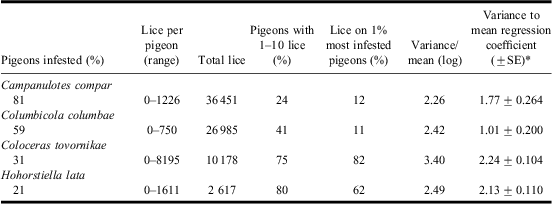
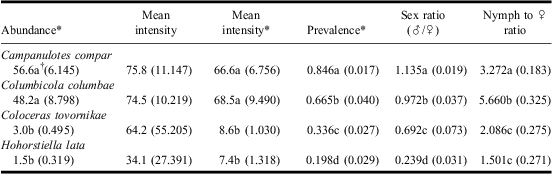
All four species were present from 2003–2012, but C. tovornikae was not collected prior to 2003. Abundance was usually 10 times higher for C. compar and C. columbae than for C. tovornikae and H. lata (Fig. 1A–1B). The percentage of pigeons infested differed among all species (based on 99% confidence limits for percentages (Rohlf and Sokal Reference Rohlf and Sokal1981)), being highest for C. compar and lowest for H. lata (Table 1). The total numbers of lice followed the same pattern as the percentages of pigeons infested. Individual pigeons sometimes had more than 1000 lice of a particular species. Distributions of lice among pigeons were not normal with variance to mean ratios greater than 2.0 for log-transformed data, and the distributions differed among species (Table 1). As the percentage of pigeons infested by a particular species declined, the percentage of pigeons with 1–10 lice increased (Table 1). For C. compar and C. columbae, the most infested 1% of pigeons had a relatively small proportion of all lice. However, for C. tovornikae and H. lata the most heavily infested 1% of the infested pigeons had over 60% of all lice (Table 1). One pigeon in 2008 for C. tovornikae and two in 2003 for H. lata caused mean abundances to be anomalously high in those years, more than 10 times higher than other years. To eliminate the effects of these extreme outliers on population parameters, 1% of the pigeons with the highest infestation for each species were excluded from annual estimates (Table 2). Excluding these few pigeons had a large effect on mean intensity and its standard error for C. tovornikae and H. lata, and a small effect on the estimates for C. compar and C. columbae (Table 2).
Stability of mean annual abundance over 14 years for four species of lice collected from feral pigeons in southern Manitoba, Canada, with the number of pigeons collected shown in B. The most heavily infested pigeons (1%) are outliers and excluded (see text).

Distribution of ectoparasites among 659 feral pigeons sampled over 14 years from 1995–2012, in southern Manitoba, Canada.

*Linear regression coefficient relating variance and mean (log10-transformed) of abundance on individual pigeons over the 10 years when all louse species were present. A Poisson distribution has a coefficient of 1.
Means (with standard errors) for population parameters of ectoparasites from 559 feral pigeons sampled over 10 years, 2003–2012, in southern Manitoba, Canada.
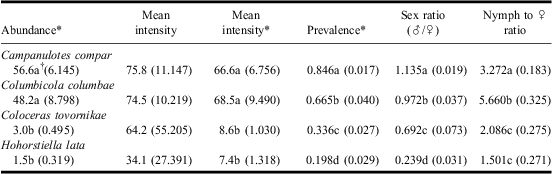
*Estimated after eliminating one to five pigeons (1%) with the highest ectoparasite intensity.
†For each parameter (column), means followed by different letters differ, P < 0.05, based on Games–Howell test (SYSTAT 2009).
Differences in all population parameters were evident among the four species (Table 2). Campanulotes compar and C. columbae had high abundance and similar mean intensity, but the former had a higher prevalence and male to female sex ratio, but a lower nymph to female ratio than the latter (Table 2). The abundance of lice for these two species was more than 10 times higher than for C. tovornikae and H. lata, as a result of a low mean intensity and prevalence for the latter two species. Hohorstiella lata had the lowest prevalence (Table 2). Coloceras tovornikae, and particularly H. lata, had low sex ratios and low nymph to female ratios (Table 2).
Pigeons without lice had a mass between 280–290 g, on average. No difference was detected in the mass of pigeons among infestation classes for C. compar and C. columbae, although the mass of the most infested class was low for both species: 263 and 262 g, respectively. The mass of the most infested class was also low for C. tovornikae, 250 g, and infestation classes for this species differed (P = 0.045). However, no differences were detected among classes for H. lata (P = 0.63), although the most infested class for this species had a higher mass (301 g) than any of the infestation classes of all four species. No consistent relation between pigeon mass and louse population was evident, and mass was not considered further.
The different species of lice tended to occur together on individual pigeons, with the exception of C. tovornikae and C. columbae (Table 3). Once lice infested pigeons, their abundance was not correlated among species (Pearson product moment correlations, P > 0.05), except for C. compar and C. columbae (Fig. 2). When divided into 12 infestation classes, pigeons with high numbers of C. compar also tended to have high numbers of C. columbae. This relationship also was evident when the numbers of lice on individual pigeons were considered, although the data were more scattered (r = 0.568, P < 0.0001, n = 344). As expected from this relationship, the 1% of birds most infested by C. compar (872 lice per bird, n = 5) also had high numbers of C. columbae (720 lice per bird, n = 4), higher intensities of infestation than the averages for the species (Table 2). One of the heavily infested birds was the same individual for the two species of lice. Coloceras tovornikae and H. lata, however, provided no consistent evidence of being more abundant on birds heavily infested with C. compar or C. columbae. The two birds most heavily infested by C. tovornikae had lower than average intensities of C. compar and C. columbae (38 and 12 lice, respectively, compared with a mean intensity of about 68) and no H. lata. The one bird heavily infested by H. lata had high intensities of C. compar and C. columbae (475 and 330 lice, respectively, compared with a mean intensity of about 68) and no C. tovornikae.
Percentage by which co-infestation of two species of lice on 559 feral pigeonsFootnote * in southern Manitoba, Canada exceeds that expected by chance (χ 2-test of independence).

* Estimated after eliminating one to five pigeons (1%) with the highest ectoparasite intensity.
Relationship between the mean intensities of infestation for Campanulotes compar and Columbicola columbae for 344 individual feral pigeons from southern Manitoba, Canada, divided into 12 classes based on the intensity of C. columbae and the mean intensity for each class.
The prevalence of the four species did not fluctuate together over 10 years (Pearson product moment correlations for pairs of species, P > 0.167). Similarly, neither mean annual abundance nor mean annual intensity for pairs of species were related (P > 0.168), except for C. columbae and C. tovornikae (abundance: r = −0.764, P = 0.01; intensity: r = −0.671, P < 0.04). However, these correlations were due to two extreme values of intensity out of 10, suggesting the relationship may not be consistent.
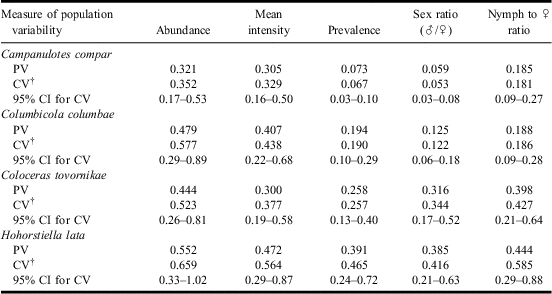
The five population parameters were remarkably stable for all four species (Table 4). Only one estimate of PV, for the abundance of H. lata, exceeded 0.5 on the 0–1 scale. Prevalence and sex ratio were usually the most stable parameters for all species. The ratio of nymphs to females was the next most stable parameter, particularly for C. compar and C. columbae. The two metrics for stability, PV and CV, had similar numerical values (Table 4), and were highly correlated (r = 0.990, P < 0.0001, n = 20). Campanulotes compar and C. columbae had similar levels of population stability for all parameters, except that prevalence was more stable for the former than for the latter (based on the separation between CV values and their 95% confidence intervals) (Table 4). Campanulotes compar and C. columbae had more stable sex ratios and ratios of nymphs to females than C. tovornikae and H. lata, and C. compar also had more stable prevalence than the latter two species. Coloceras tovornikae and H. lata had similar levels of stability for all population parameters. Abundance and intensity had relatively high and similar levels of PV and CV, except that the values for abundance of C. compar were lower than for H. lata (Table 4).
Population variability measured as PV (see text) and coefficient of variation (CV) with 95% confidence intervals (CI) for ectoparasites from 559 feral pigeonsFootnote * sampled over 10 years, 2003–2012, in southern Manitoba, Canada.
* Estimated after eliminating one to five pigeons (1%) with the highest ectoparasite intensity.
† Estimated CV of the population (Sokal and Rohlf Reference Sokal and Rohlf1981: 59).
The mean annual abundance of lice was lower in the first four (1995–1998) than in the last 10 years (2003–2012) of the study (Fig. 1). However, in 1995 and 1996, abundance of lice removed by ruffling was underestimated for C. compar by a factor of about two and C. columbae by a factor of 1.2, in comparison with extraction by the washing technique used in other years (Clayton and Drown Reference Clayton and Drown2001). No trends in abundance were evident for any species when data from 2003–2012 were considered (linear regression of abundance against years, df = 1, 8, P > 0.30), providing no evidence that differences in stability among species was due to differences in their population trends.
Particular pigeons might be more or less resistant to lice, less likely to be infested initially and perhaps also less likely to support a rapidly growing or a larger louse population. If so, mean intensity (reflecting rate of population growth) might be expected to be positively correlated with prevalence (reflecting in part the ability of lice to infest a particular bird). For C. columbae, mean intensity and prevalence were positively correlated (Fig. 3), but not for any of the other species (r < 0.51, P > 0.13, n = 10). For all four species, the level of stability for mean intensity was lower (PV was higher) than for prevalence (Table 4). For C. columbae, and particularly for C. compar, PV for mean intensity was close to that for abundance, indicating that instability of intensity and not prevalence contributed most to the PV for abundance. Following this argument for C. tovornikae and H. lata, however, suggests that instability of both intensity and prevalence contributed to PV for abundance (Table 4).
Relationship between intensity and prevalence of infestation for Columbicola columbae on feral pigeons in southern Manitoba, Canada.
Mean values (Table 2) of population parameters and the stability (PV) of those means (Table 4) were sometimes related (Pearson product moment correlation, SYSTAT 2009). Species of lice with high prevalence had more stable prevalence (low PV) than lice with low prevalence (r = −0.961, P = 0.039, n = 4). However, no such relationship was evident for mean intensity and the stability of intensity (r = 0.208, P = 0.792, n = 4). More abundant species tended to have more stable prevalence than less abundant ones (r = −0.879, P = 0.121, n = 4), although this non-significant relationship might reflect the relationship between mean abundance and mean prevalence (Table 2), along with the relationship between mean prevalence and the PV of prevalence (see above). More abundant species also had more stable ratios of nymphs to females than less abundant ones (r = −0.987, P = 0.013, n = 4).
Discussion
Four species of lice infesting feral pigeons in southern Manitoba exhibit species-specific population parameters, both for abundance and stability. Campanulotes compar and C. columbae are more abundant, have higher male to female sex ratios and higher ratios of nymphs to females than C. tovornikae and H. lata. Differences in abundance result, in part, from differences in mean intensity between the two common species and the two less common ones, but primarily from differences in prevalence among all four species. Stability of prevalence, sex ratio, and ratio of nymphs to females also differs among species. Stability is higher for the two common species than for the two less common ones.
Although the stability of these ectoparasites varies, all four species of lice have more stable populations than the vertebrates for which PV has been measured, including salmonid fish (Dochtermann and Peacock Reference Dochtermann and Peacock2012), tuna and swordfish (Corbineau et al. Reference Corbineau, Rouyer, Cazelles, Fromentin, Fonteneau and Ménard2008) and seabird colonies (Jovani et al. Reference Jovani, Schielzeth, Mavor and Oro2012). One exception is a lizard with PV values ranging from 0.20–0.38 (Dochtermann and Gienger Reference Dochtermann and Gienger2012), enclosing the PV of C. compar at 0.32. Among insects, PV has not previously been estimated for any ectoparasites of vertebrates, and only in aphids (Hemiptera), for time series of 10 years or more. Louse populations are more stable than three species of aphids living on the surfaces of potato plants, with PV ranging from 0.32–0.55 for abundance compared with 0.59–0.83 for the aphids (Lamb et al. Reference Lamb, MacKay and Alyokhin2011). Of the two components of abundance, intensity and prevalence, the PV of prevalence varies most among louse species, ranging from 0.07–0.39, but all are lower than the PV of 0.65 and 0.58 for two aphid species (Lamb and MacKay Reference Lamb and MacKay2010; Lamb et al. Reference Lamb, MacKay and Wool2012). Differences in PV of as little as 0.03 units can be distinguished for aphids (Lamb et al. Reference Lamb, MacKay and Alyokhin2013), supporting the conclusion that estimates of PV are higher (populations are less stable) for ectoparasites of plants than of pigeons. The stability of these louse populations seems remarkable given that all four species and its host were introduced to North America. Pigeons have been present in Manitoba for about 200 years. Coloceras tovornikae may have been introduced as recently as the late 1990s as it was not detected in Manitoba or anywhere else in North America until 2003 (Galloway and Palma Reference Galloway and Palma2008). Nevertheless, its population rapidly became widespread on pigeons in the Winnipeg area and has been stable over the 10 years since it was detected.
Anderson and May (Reference Anderson and May1978) theorise that regulation and stability of host-parasite populations result in part from “over-dispersion of parasite numbers per host”. Parasites in general and ectoparasites in particular usually show over-dispersion on their hosts (Poulin Reference Poulin2007a). The four louse species that infest pigeons are all over-dispersed (Galloway and Palma Reference Galloway and Palma2008), although not to the same extent. Coloceras tovornikae and H. lata are more highly aggregated than C. compar and C. columbae, and the former two species have relatively unstable populations in comparison with the latter two. Therefore, the pigeon lice provide no evidence that stability increases with the degree of aggregation.
Transmission of lice among hosts, immune responses of the host at least for H. lata, preening, and interspecific competition are all potentially important density dependent processes for the lice on pigeons and other birds. Lice move from bird to bird primarily when they are in close physical contact (Clayton and Tompkins Reference Clayton and Tompkins1995). Although long-distance dispersal of lice by phoresy on parasitic flies (Diptera: Hippoboscidae) occurs for C. columbae in some pigeon populations (Harbison et al. Reference Harbison, Bush, Malenke and Clayton2008), hippoboscids have never been detected on pigeons in Manitoba. Prevalence reflects, in part, the success of lice in dispersing from host to host, with intensity being the result of population growth after lice have reached a particular host individual. Amblycera (blood-feeders) are more vagile and therefore possibly more dispersive than Ischnocera (feather-feeders), at least in Galapagos hawks (Whiteman and Parker Reference Whiteman and Parker2004), but H. lata, the blood-feeder on pigeons, is less prevalent than the three feather-feeders.
Populations of blood-feeding lice (Amblycera), but not the feather-feeding lice (Ischnocera), are constrained by immune responses of their host (Møller and Rózsa Reference Møller and Rózsa2005). Consistent with this conclusion, the abundance of blood-feeding lice is lower than that of feather-feeders on many bird species (Møller and Rózsa Reference Møller and Rózsa2005), as is also the case for the blood-feeder, H. lata, in comparison with feather-feeders on pigeons in Manitoba. The main mortality factor for chewing lice on birds in general and pigeons in particular is probably preening by the host (Clayton and Walther Reference Clayton and Walther2001; Clayton et al. Reference Clayton, Moyer, Bush, Jones, Gardiner, Rhodes and Goller2005; Clayton et al. Reference Clayton, Koop, Harbison, Moyer and Bush2010), which may be density dependent (Krištofík et al. Reference Krištofík, Darolová, Hoi and Hoi2007). Differential abundances of louse species may be due in part to differences in the efficiency of preening, but such differences have yet to be investigated. The heavily infested pigeons observed in Manitoba might be individuals with compromised preening ability (Clayton et al. Reference Clayton, Moyer, Bush, Jones, Gardiner, Rhodes and Goller2005), but the small number of birds involved and the inconsistent patterns of co-infestation of these birds offer no clues to differences in the effects of preening on the four louse species.
Interspecific competition among louse species may be an important density determining process, with louse species often segregated on their host's body. In some populations of pigeons, C. compar, which feeds and lives on the body feathers of pigeons, has a competitive advantage over C. columbae, which feeds on body feathers but spends much of its time on wing and tail feathers (Bush and Malenke Reference Bush and Malenke2008; Harbison et al. Reference Harbison, Bush, Malenke and Clayton2008). No evidence of competition between these species was observed in feral populations of Manitoba pigeons, however. The abundance of both species is high, similar, and positively correlated; competition would be expected to result in a negative correlation in abundance between C. compar and C. columbae. Similarly, no consistent evidence was detected for competition between the less abundant C. tovornikae and H. lata and the two more abundant species. Nevertheless, competition in conjunction with differential preening by the host (Clayton et al. Reference Clayton, Lee, Tompkins and Brodie1999) could be a factor in the relatively low abundance of C. tovornikae, because of the large size of the females of this species in relation to the other feather-feeders (Galloway and Palma Reference Galloway and Palma2008). Low relative humidity reduces the competitive ability of some louse species, and thereby affects the species composition of lice present in particular geographic areas (Moyer et al. Reference Moyer, Drown and Clayton2002; Bush et al. Reference Bush, Harbison, Slager, Peterson, Price and Clayton2009; Malenke et al. Reference Malenke, Newbold and Clayton2011). It is possible that the humidity in southern Manitoba affects the relative abundance of the four lice species present on pigeons at certain times of the year, but the humidity requirements of these lice, especially in relation to ambient temperature, are too poorly known to draw any conclusions on the importance of this factor.
Although the population parameters related to average abundance of the lice on pigeons in Manitoba are species-specific traits, none of the factors thought to be important in determining louse abundance can be singled out as a cause of the observed differences among the species. One possible exception is the role of host immunity in suppressing populations of blood-feeding lice such as H. lata. The experimental studies of these factors were all conducted in other geographic areas and usually under controlled aviary conditions, with different species compositions, making comparisons with the Manitoba populations problematic. None of the previous North American studies of louse populations on pigeons report the occurrence of C. tovornikae or H. lata. Furthermore, although this study of Manitoba populations of lice is of longer duration and includes larger samples of host individuals than any previous study of bird lice, much of the background information on the life histories of these lice in Manitoba is unknown.
The stabilities of the populations of lice on pigeons in Manitoba are also species-specific traits. Species with the highest average abundance have the highest stability for prevalence, sex ratio, and ratio of nymphs to females, although average abundance does not seem to play a role in the stability of intensity. A larger sample of louse species from a diversity of bird species is required to assess whether high louse abundance does lead to population stability.
The four lice that occur on pigeons in southern Manitoba occupy essentially the same habitat, the surfaces of the bodies of their host (Galloway and Palma Reference Galloway and Palma2008). Three of the four species feed on feathers and the fourth feeds on blood (Clayton and Drown Reference Clayton and Drown2001; Galloway and Palma Reference Galloway and Palma2008). Nevertheless, over 10 years, each of the louse species showed a characteristic population dynamic. This diversity of population dynamics poses a puzzle and an opportunity. The puzzle is that species of lice with superficially similar life histories can live on the body of the same host under the same environmental conditions and yet show different population dynamics. The opportunity is to use the taxonomically diverse chewing lice on pigeons to understand how differences in life history result in such diverse population dynamics among the species. Permanent ectoparasitic insects, such as lice, are excellent models to explore species-specific evolutionary traits, and could help us understand the co-evolution between parasites and their hosts (Poulin Reference Poulin2007b).
Acknowledgements
We thank the staff at the rehabilitation hospitals of the Wildlife Haven and the Prairie Wildlife Rehabilitation Centre for the care in which they handled pigeons before reaching our laboratory. Thanks also go to Dave Holder, Lisa Babey, and the many students during this study who helped by washing pigeons. This research was partially funded by Discovery Grants to T.D.G. from the National Science and Engineering Council of Canada.