Introduction
Health professional education programs consider the clinical experience gained by students an important enhancement to the theoretical component of a program and the basis for the development of competent practitioners.Reference Gignac-Caille and Oermann1,Reference Ell2 Theclinical experience provides the student with opportunities to have ‘hands-on’ learning in a situational, contextual and clinical environment while being supervised, directed and mentored by knowledgeable, competent professionals.Reference Ell2 In a teaching hospital, it is the responsibility of all staff to participate in clinical teaching and every interaction with a student constitutes a learning experience.Reference Laurent and Weidner3 To integrate the theoretical and clinical learning, and support the holistic development of a healthcare professional, clinical teaching staff and students must work towards a common goal. Frustration can arise when students learn that they and their clinical teachers have differing expectations, usually reflected, but not always, in a poor evaluation. Indeed, the extent to which a health professional student is successful can, in some way, be reflective of the effectiveness or ineffectiveness of the clinical teacher(s).Reference Knox and Mogan4 Identification of important and helpful clinical teaching behaviours or characteristics is necessary so that those characteristics can be recognized, encouraged and developed.Reference Laurent and Weidner3
There is a plethora of literature that identifies teaching behaviours relevant to the practice of nursing. Much of the literature that directly investigates these questions spans 20 years,Reference Knox and Mogan4 primarily deals with students and faculty in nursing programs, and relates back to the 1985 work of Knox and MoganReference Knox and Mogan4,Reference Lee, Cholowski and Williams5,Reference Li6 as a seminal piece of research. In a follow-up to their original study, the same researchers conducted a studyReference Mogan and Knox7 in 1987 to evaluate the characteristics of the ‘best’ and ‘worst’ clinical teachers, as perceived by hospital-based nursing faculty and students in the United States and Canada. The Nursing Clinical Teacher Effectiveness Inventory (NCTEI) developed by the authors of the 1985 studyReference Knox and Mogan4 was used to collect data in five subscales of behaviours: Teaching ability, nursing competence, personality traits, interpersonal relationships and evaluation. Both groups rated clinical teachers who enjoyed nursing, demonstrated clinical skill and judgement, were approachable and fostered mutual respect as the ‘best’. In addition to that, both faculty and students agreed that being or not being a good role model was the most critical characteristic differentiating the good from the less desirable clinical teacher. However, there was less agreement between the staff and students in their ratings of ‘worst’ teachers; students were concerned about the lack of empathy and belittling, whereas faculty identified poor organisational and communication skills as being weak characteristics for clinical teaching behaviours. Several authors worldwide have attempted to replicate this study, using the NCTEI, and results have been inconsistent.Reference Lee, Cholowski and Williams5,Reference Li6,Reference Kotzabassaki, Panou, Dimou, Karabagli, Koutsopoulou and Ikonomou8
Evaluation or assessment is a valuable, necessary and integral component of the clinical learning experience, and is one of the methods to assure professional standards are maintained.Reference Ell2,Reference Li6 The category of evaluation behaviours was ranked high by students as important teaching behaviours in several studies.Reference Gignac-Caille and Oermann1,Reference Lee, Cholowski and Williams5,Reference Li6,Reference Viverais-Dresler and Kutschke9 The ability of a clinical teacher to provide effective feedback to students about their clinical practice is essential in assisting students to develop self-confidence and self-esteem.Reference Gignac-Caille and Oermann1,Reference Lee, Cholowski and Williams5,Reference Viverais-Dresler and Kutschke9 Students often express that anxiety levels are raised during an evaluative situation.Reference Li6 Moreover, it has been argued that ‘...RN students are highly motivated and achievement-oriented’ which may account for the category of evaluation being ranked as high as students are ‘focussing on course success’.Reference Viverais-Dresler and Kutschke9
Modelling professional behaviour and clinical competence ranked high (within the top ten behaviours regardless of actual rank) as an important or helpful clinical teaching behaviour in the literature.Reference Gignac-Caille and Oermann1,Reference Laurent and Weidner3,Reference Li6,Reference Mogan and Knox7,Reference Viverais-Dresler and Kutschke9 One author suggests, ‘Novices learn a great deal by observing and emulating the attitudes and behaviours of preceptors who act as role models for both personal and professional standards’.Reference Ell2 Qualities, a good role model possess, such as strong communication skills, being clear and organized, providing good feedback and having a positive attitudeReference Davies10 have been explored in the nursing profession and are well recognized as a powerful tool in assisting students to learn and socialize into the profession.Reference Ell2,Reference Davies10 In a recent qualitative study, undergraduate medical students recognized the importance of positive role modelling, where a ‘. . . Consultants’ relationships with patients and their clinical skills can make an impression on students’.Reference Stark11 Interestingly, in this study, the students also discussed that some teaching methods, such as ‘being put on the spot’ was considered intimidation and humiliation by some and a motivation to learn by others. Regardless, as role models, teachers in the clinical setting must refrain from the stereotypical function of transmitter of knowledge, and function instead as a role model for best professional practice.Reference Wright and Carrese12
The relationship that develops between the students and the clinical teacher is extremely important to the learning process. Students have viewed developing good interpersonal relationships with the clinical teachers as more valuable and important than professional competence.Reference Lee, Cholowski and Williams5,Reference Li6 A Toronto-based research groupReference Atack, Comacu, Kenny, LaBelle and Miller13 sought a qualitative approach to understand the impact the relationship between staff and students had on learning. Focus groups were conducted to examine the ‘lived experience’ of hospital staff and nursing students. The authors rationalize that the clinical learning experience and interactions that occur between nurses and students had a significant impact on how students were socialized into the nursing profession. Not surprisingly, students discussed the importance of feeling like a colleague, being part of decision-making, and receiving mutual courtesy and respect. Staff thought it was important to differentiate between the student and the staff roles for legal purposes, and to provide constructive criticism. The study also provided insight into challenges clinical teaching staff face, such as anxiousness to demonstrate appropriate role modelling behaviours, and the negative impact an evaluator has on interpersonal relationships with students. These issues were not explored in detail in previous quantitative studies. Both groups did agree that empathy towards the student role was important.
The clinical practicum of a radiation therapy program is a student’s opportunity to integrate classroom theory into the clinical environment with a real patient population, and the transition from formal education to a career in healthcare. With the transition into the clinical environment, the teaching paradigm evolves from one of an academic (theoretical) nature to one of a clinical (skill-based) nature. This evolution of teaching can prove to be an unexpected or difficult transition for some students, and students’ expectations of their clinical teachers can be very different from their academic teachers. Clinical teaching in a team-based radiation therapy department is the responsibility of all radiation therapists, and can enhance or hinder a student’s practical experience and ultimate socialization into the profession. There is a professional expectation that radiation therapists will actively participate in clinical teaching, and many do so without formal education in teaching principles or strategies.Reference Laurent and Weidner3 Therefore, the purpose of this study was to identify the ten most and the ten least important clinical teaching characteristics as perceived by radiation therapy students and clinical teaching staff, with the intent of encouraging and developing helpful individual clinical teaching behaviours in staff. As a further consequence of this study, it is also anticipated that professional development activities will be developed and provided to all staff to promote positive clinical teaching behaviours to provide a more student-centred learning environment.
Materials and Methods
Setting
Radiation therapy students enrolled in the second-entry Medical Radiation Sciences degree program, complete 2 years of theoretical courses in a health science academic institution followed by 48 weeks of clinical experience in an affiliated cancer centre. At the site, the clinical coordinators, who also act as a liaison between the site and the academic institution, supervise the students. Radiation therapists, known as clinical teachers, work alongside, and evaluate the competence and professional behaviours of the students in both treatment delivery and treatment planning areas. Clinical teachers have no connection with the academic institution. A comparative study was undertaken to assess the differences between the most and the least important clinical teaching characteristics as identified by students and clinical teaching staff at a large urban cancer centre in Toronto, Canada. Ethics approval was granted by the Toronto Academic Health Sciences Network and the Michener Institute for Applied Health Sciences Research Ethics Boards prior to data collection.
Sample
The participants of this study were drawn from the researchers’ place of employment, one of the affiliated cancer centres with over 160 radiation therapy staff. Twenty radiation therapy students who were in the final clinical practicum, as well as 130 radiation therapists were invited to participate. Management and others in specialty roles (not directly involved in student education) were excluded from this study, as were those who completed the pilot survey. The researchers also excluded clinical educators/coordinators, as they have undertaken formal education in teaching principles/learning strategies that could have impacted the results.
Instrument
A self-administered, online questionnaire was deemed the most appropriate methodology with the online platform of SurveymonkeyTM being utilized. Survey research provides information at a particular point in time, and once it is analysed, it describes patterns of a situation to draw comparisons.Reference Bell14,Reference Cohen, Manion and Morrison15 The questionnaire was adapted from Knox and Mogan’s Nursing Clinical Teaching Effectiveness Inventory (1985), modified to include other characteristics identified in the literatureReference Ell2,Reference Viverais-Dresler and Kutschke9,Reference Zimmerman and Westfall16 and to reflect the radiation therapy environment. The survey tool was divided into two parts: Part A requested demographic information from the participants and Part B listed discrete clinical teaching characteristics under five main categories (clinical competence, teaching approach, personality traits, evaluation methods and interpersonal relationships). Participants were asked to rate each clinical teaching characteristic according to its perceived importance on a 4-point Likert-type scale, with 1 being ‘not at all important’ and 4 being ‘very important’. There were 55 clinical teaching characteristics in total.
Study procedure
The survey tool was first piloted with four students and four staff members; this was to assess for comprehensiveness, content, and length of time to complete the survey. On the basis of the feedback, the wording (phrasing) of several characteristics was modified accordingly. A link to the questionnaire was sent through electronic mail to all staff and students enclosed with an introductory cover page. The cover page explained the nature and intent of the study to the staff and the students, and indicated that accessing the link implied consent to the study. The participants were given 2 weeks to complete the survey, with a reminder being sent after 1 week. Participants were assured of anonymity and confidentiality of the responses; hence, there could be no follow-up with non-responders.
Data analysis
All responses were first reviewed for completeness of the answers and the incomplete ones were eliminated from the study. The data were analysed using mean scores, standard deviations (SDs) and frequencies to determine the rank order of characteristics within each major category. For the mean scores, a high score signified a very important clinical teaching characteristic, whereas a low mean score signified a less important one. Independent t-tests were performed to determine statistical significance between the two groups with alpha level statistically adjusted for multiple comparisons using the Bonferroni correction. Results were determined to be statistically significant if p < 0.001.
Study limitations
The major limitation to this study is related to the size of sample and the small numbers of respondents. In addition, the sample population was chosen from one cancer centre, making this a sample of convenience and therefore, the results from this study cannot be generalised across cancer centres. However, at the time of the survey, the demographics of the department indicated that 80% of the clinical teachers were female and approximately 65% of clinical teachers had less than 5 years of experience. As a result, the authors were able to draw some conclusions about this particular target population.
There is also evidence in the literature that a student’s perception of what important teaching characteristics are will change depending upon whether the student is just beginning or completing the clinical practicum.Reference Li6,Reference Davies10 This study was completed at the end of the clinical practicum, close to graduation. Anecdotally, the researchers also heard that participants felt that the survey was too long to complete.
Results
Part A
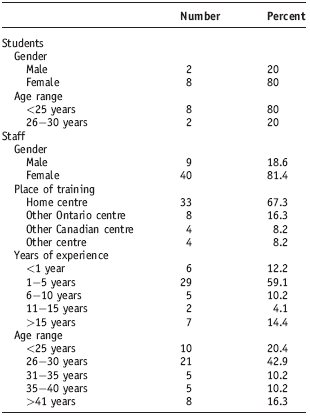
One hundred and fifty questionnaires were distributed to radiation therapists and students: 130 to clinical teachers and 20 to students. Sixty eight responses were returned; however, nine were rejected from the study, as they were incomplete. The remaining 59 (39%) completed responses were included in the study: 10 (50%) students and 49 (38%) radiation therapists. Table 1 shows the demographics of the respondents. The study included 11 (18.6%) male and 48 (81.4%) female respondents. Over half the staff respondents actually trained at the cancer centre at which this survey was undertaken and 35 (71.3%) of the staff had 5 years or less experience as a qualified radiation therapist. Although the response rate was relatively low, anonymity had been assured so it was not possible to reach non-respondents.
Demographic information of the students and staff participating in the survey
Part B
The items within each major category were examined using mean scores, SDs and frequencies to establish the distribution of the responses, and generally speaking, the results demonstrated overall high ratings for most characteristics.
Table 2 shows the top ten most important clinical teaching characteristics based on the highest mean scores for both the staff and the students, respectively. The number of respondents choosing a characteristic as ‘very important’, that is, the frequency, is confirmed in the tables. The results demonstrate that the clinical teaching staff rank 6 out of 10 (60%) most important characteristics in the category of clinical competence, including ‘demonstrates accurate clinical procedures and techniques’, ‘accepts responsibility for clinical decisions’, ‘demonstrates flexibility in the clinical approach depending on individual patients’, ‘is a good role model as a healthcare professional’, ‘identifies and respects cultural differences’ and ‘summarises and delivers patient information concisely’. The students showed less agreement with only three items in the clinical competence category: ‘accepts responsibility for clinical decisions’, ‘demonstrates accurate clinical procedures and techniques’ and ‘demonstrates breadth of clinical knowledge and skills’. As a result, there was agreement for the most important clinical teaching characteristics between the clinical teachers and the students on two characteristics in the clinical competence category. There was also agreement between the characteristic ‘has patience’ in the category of personality traits, with clinical teachers ranking it in fifth place and the students ranking it second. Overall, only three characteristics were in agreement.
Means, standard deviations and t-test results for the ten most important clinical teaching characteristics perceived by staff and students
Key: C = clinical competence; P = personality traits; E = evaluation; T = teaching approach; I = interpersonal relationships.
* Frequency of this item scoring the highest rating (4 = very important).
There was high agreement between the groups for the least important clinical teaching characteristic as shown in Table 3. The characteristics demonstrated in the tables represent the items that received the lowest mean score and hence the items that are considered the ‘least important’. Of the ten characteristics identified as the ‘least important’, both staff and students agreed on six characteristics: ‘takes a personal interest in students’ lives’, ‘ensures students are participating in activities only related to treatment delivery’, ‘adopts one clinical approach that is suitable for all patients’, ‘encourages students to take part in non-instructional staff activities’, ‘always informed of students whereabouts (i.e., labs, tutorials, competencies, breaks)’ and ‘is creative’. The results also demonstrate that the students ranked 7 items out of 10 (70%) in the categories of interpersonal relationships and personality traits, with 0% in the evaluation category.
Means, standard deviations and t-test results for the ten least important clinical teaching characteristics perceived by staff and students
Key: C = clinical competence; P = personality traits; E= evaluation; T = teaching approach; I = interpersonal relationships.
There was no statistically significant difference between the rankings of the clinical teaching characteristics made by the staff and students when t-tests were performed on each item, for either the most or the least important clinical teaching characteristics.
Discussion
By identifying important clinical teaching characteristics, promotion of these helpful qualities can be directed to the clinical teaching staff. Studies, primarily in nursing, have demonstrated that there is no statistically significant difference between the clinical teachers and the students’ perceptions of important clinical teaching characteristics.Reference Gignac-Caille and Oermann1,Reference Li6 Reviewed studies showed a greater agreement in the highest-rated characteristics between the staff and students, than in the lowest rated characteristics. Interestingly, in this study clinical teachers and students showed greater agreement in the lowest rated characteristics, and less in the highest rated. However there was no statistically significant difference between clinical teachers and student radiation therapists’ perceptions of important clinical teaching characteristics.
Most Important Clinical Teaching Characteristics
Clinical competence
The clinical teachers who participated in this study identified six out of ten most important characteristics in the category of clinical competence whereas the students identified three, with two of those three also rated high by the clinical teachers. Irrespective of the ranking, this would suggest that both the clinical teachers and the students regard demonstration of clinical competence as an integral component of the teaching-learning process. The literature suggests that there is a level of anxiety present in the clinical learning environment related to the grave consequences that result from a clinical error,Reference Knox and Mogan4 which can explain why the characteristics of clinical competence are rated high. This is borne out in this study where both clinical teachers and students recognize that accepting responsibility for clinical decisions and demonstrating accurate clinical procedures and techniques speaks of patient safety. In the nursing studies reviewed, this was not identified explicitly and therefore, unique to this study in radiation therapy.
The assessment of a student during the clinical practica focuses heavily on demonstration of clinical competence, resulting in certification through a competency-based national examination. Competence is strongly emphasised during the program and upon graduation as a factor for continued licensure. The majority of the clinical teachers participated in this study were relatively new practitioners; many having completed the clinical training at the centre where the study was conducted and more having been through the same program of study. The researchers could therefore argue that the focus on clinical competence is inherent in radiation therapy practice and that a higher value is placed on clinical competence on top of everything else. Moreover, it could be a reflection that the clinical teachers were educated first and foremost as radiation therapists and not as teachers.Reference Knox and Mogan4
Furthermore, this finding could be a consequence of the timing of the survey administration being close to graduation, where clinical teachers are acting less as transmitters of knowledge, and rather confirming clinical competence of potential colleagues. A longitudinal study to assess students’ perceptions of clinical teaching characteristics over the span of the clinical practica could provide insight to whether clinical competence is an important characteristic at the outset.
Role modelling
Role modelling is a characteristic within the category of clinical competence. In previous studies ‘is a good role model’ was identified as an important characteristic and was highly rated in most of those studies.Reference Laurent and Weidner3,Reference Viverais-Dresler and Kutschke9 Interestingly, the two characteristics of ‘being a good role model as a healthcare professional’ and ‘being a good role model as a clinical teacher’ were rated as important (fourth and seventh ranking, respectively) by clinical teachers but not at all by students in this study. Almost 60% of the clinical teachers who responded had between 1 and 5 years of experience. According to Benner’s model of clinical knowledge development, this is the time when professionals, moving through the stages of competent to proficient performance, are honing their clinical skills and determining what aspects of a situation are salient.Reference Benner17 Therefore, one explanation of why clinical teachers view acting as a good role model as important for the students, either as health professional or teacher, could be an angst on the part of the clinical teacher to demonstrate competence and behaviours that reinforce their own abilities in a positive way.Reference Atack, Comacu, Kenny, LaBelle and Miller13 Role modelling in the nursing literature was ranked very high by both faculty and students. Several studies referred to preceptorship models and, although not overtly explained, would imply a one-on-one working relationship between a nurse and a student. This type of relationship does not exist in the radiation therapy environment where there is a more team-based approach, and could provide further insight into why students do not associate role modelling with important teaching characteristics. Furthermore in the qualitative undergraduate medical student study, it was reported that as the students approached graduation they were expected to be more self-directed with an independent practice. Ultimately, an imbalance then exists between the ability of the consultant to address the student’s needs and the student’s expectations.Reference Stark11 It could be argued though that the students in this study were approaching graduation and that there was probably less need for a good role model as teacher. However, the researchers had presumed that students would have appreciated the need for a good healthcare professional role model, valuing the importance, at this juncture in their education, of a professional who demonstrates best practice.
Evaluation
The clinical teachers did not rate any characteristics in the evaluation category as important. In contrast to that, the students rated two characteristics as most important: ‘being fair in grading’ and ‘corrects students’ mistakes without belittling them’ (ranked third and seventh, respectively). Evaluation rated high in other studies where student concern to succeed was inferred and where the sample participants were relatively novice nursing students.Reference Gignac-Caille and Oermann1,Reference Li6,Reference Viverais-Dresler and Kutschke9 In this study, the data collection period was conducted at a time when students would have been aware that success was inevitable, potentially placing less emphasis on the evaluation processes. The authors surmise that the emphasis on evaluation processes and related anxieties becomes less important to a student as they navigate along the clinical continuum, and that students are looking for different characteristics and behaviours from their clinical teachers as they approach graduation. Once again, a longitudinal study would provide evidence as to whether or not novice radiation therapy students, like their nursing counterparts, place more value on evaluation characteristics at the commencement of the clinical practicum.
There were no characteristics in the evaluation category rated as the least important by the students. However, it is interesting to note that the clinical teachers ranked the evaluation characteristic ‘submits evaluation forms on time’ as the least important with a mean score of 2.82. This characteristic was the only one item in this study where there was a major difference between the clinical teachers and the students, with the students ranking this characteristic, although not in the top ten, with a mean score of 3.60. This would imply that students recognize the value of timely and constructive feedback, and that this does not diminish significantly even though the students are close to completion of the clinical practicum.
Least Important Clinical Teaching Characteristics
Interpersonal relationships/ personality traits
Of the ten characteristics ranked as the least important, the two groups agreed on six items, with students rating 70% in the categories of interpersonal relationships and personality traits. The socialization or acculturation, of a student into the professional environment resulted in participants rating interpersonal relationships and personality traits as very important in some nursing studies.Reference Ell2,Reference Viverais-Dresler and Kutschke9 These studies recognized that students appreciated clinical teachers who made them feel part of the group or who were approachable, respectful and kind. One study went on to qualify that junior students rated interpersonal relationships high because ‘. . .during their first clinical experience junior students are confronted with concepts of pain, fear, anguish and emotional trauma and death…. A supportive student–teacher relationship is expected to lessen such anxiety’.Reference Li6 This study, however, did not replicate those findings. The authors can only postulate that due to the timing of the survey, the socialization, and therefore the need for the ‘supportive student–teacher relationship’ had already occurred for the most part and that students’ anxiety and necessity to ‘fit-in’ had diminished. Alternatively, considering the size of the cancer centre and the number of clinical teachers involved in the students’ clinical education developing a personal relationship with each clinical teacher or student is not a reasonable assumption.
This study does, however, concur with previous studies that have identified ‘takes a personal interest in students’ lives’, in the category of interpersonal relationships, as the least important clinical teaching characteristic, for both staff and students.Reference Gignac-Caille and Oermann1,Reference Lee, Cholowski and Williams5,Reference Viverais-Dresler and Kutschke9 One study reviewed noted ‘faculty, less affected by the ‘pleasantness’ of the clinical teacher, rated these categories lower’.Reference Mogan and Knox7 Certainly, taking a personal interest in a student can make it more difficult for a clinical teacher to evaluate the student objectively, provide feedback fairly and without bias.
Conclusion
In conclusion, this research has taken a preliminary look at clinical teachers and students’ perceptions of important clinical teaching characteristics within radiation therapy. The body of knowledge in regards to effective clinical teaching characteristics has primarily been within the scope of nursing practice. The practice, and therefore the learning environment, of radiation therapy is vastly different from that of nursing. As a consequence, more exploration of effective clinical teaching characteristics within radiation therapy is required.
From this research, it has also been identified that role modelling in radiation therapy is an avenue that requires some further investigation i.e. the criteria or qualities that constitute a good role model and the importance of good role modelling in radiation therapy clinical education/practice are not fully understood. As the definition for ‘role model’ was not provided in this study, further investigation is required to determine what a radiation therapist must do to be perceived as a good role model by the student, as it is recognized that role models are a vital assistor of socializing students into the profession and the clinical environment.Reference Davies10
There can be no denying that a student’s success in the clinical environment and socialization into the profession is, in part, due to the effectiveness and quality of the clinical teaching. Although an inherent aspect of the job description, many radiation therapists undertake the role of clinical teacher reluctantly, if at all, and those who take on the role willingly and with aplomb more often than not have had no formal instructional education. As students traverse the clinical practica from novice to beginner,Reference Benner17 it is imperative that the clinical teachers are able to modify their clinical teaching to suit the students’ learning needs. Development of educational sessions that reinforce the effective clinical teaching characteristics, utilising the results from this study, will encourage and support the clinical teachers in modifying their teaching behaviours appropriate to the needs of the student, ultimately assisting in the student’s success.